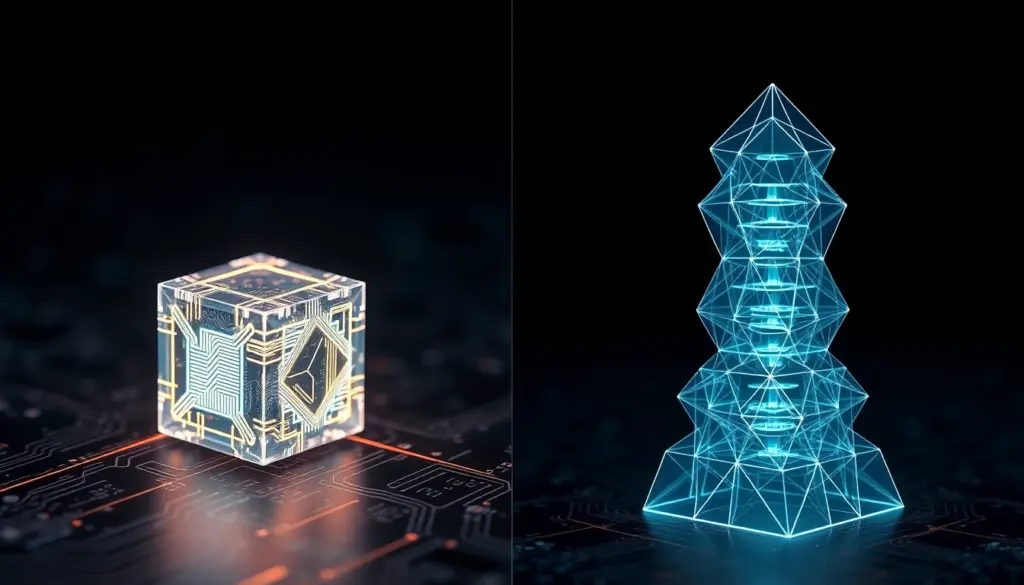
Every rollup team building on Ethereum in 2026 eventually hits the same fork in the road: prove transactions with zk-SNARKs or prove them with zk-STARKs. The two families of zero-knowledge proofs solve the same problem, letting a verifier confirm a computation happened correctly without re-running it, but they get there through very different math, and that math shows up directly in proof size, gas bills, and how exposed a protocol is to a future quantum computer. A 2026 empirical study running identical circuits on Apple M1, Raspberry Pi, and PPC64 hardware found SNARK proofs landing at 384 bytes against roughly 68.6 KB for STARKs, a gap of about 178x. That single number explains why zkSync picked one path and StarkNet picked the other, and why the choice still splits engineering teams today.
This comparison breaks down proof size, proving and verification speed, trusted setup requirements, quantum resistance, gas costs on Ethereum mainnet, and where each system actually runs in production right now. It draws on benchmark data from independent 2025-2026 studies, not marketing copy, so the numbers can disagree between sources depending on hardware and circuit choice. Where they disagree, both figures are shown, since presenting a single cherry-picked number would misrepresent how much these results depend on hardware and implementation choices.
What Are Zero-Knowledge Proofs, and Why the SNARK/STARK Split Matters
A zero-knowledge proof lets a prover convince a verifier that a statement is true (a transaction is valid, a batch of transfers balances, a private input satisfies a public rule) without revealing the underlying data or forcing the verifier to redo the computation. In blockchain contexts, that means a rollup can process thousands of transactions off-chain, then submit a single proof to Ethereum that a smart contract can check in milliseconds, instead of every node re-executing every transaction.
Both zk-SNARKs (Succinct Non-interactive ARguments of Knowledge) and zk-STARKs (Scalable Transparent ARguments of Knowledge) do this, but they rest on different cryptographic foundations. SNARKs generally rely on elliptic curve pairings and polynomial commitment schemes. STARKs build entirely on collision-resistant hash functions and the FRI (Fast Reed-Solomon IOP of Knowledge) protocol. That foundational difference cascades into every practical tradeoff covered below: proof size, setup requirements, and resistance to quantum attacks. Ethereum’s own developer documentation frames this as a core design decision for any team building a zero-knowledge rollup, not a minor implementation detail.
The term “zero-knowledge” itself covers a broader family than just SNARKs and STARKs. Bulletproofs, another proof system used mainly for confidential transaction amounts, sit alongside both in benchmark studies as a third reference point, though neither Bulletproofs nor older interactive proof schemes have gained the rollup-scale production adoption that SNARKs and STARKs have. What makes the SNARK/STARK comparison specifically worth tracking in 2026 is that it now decides the base layer economics for a large share of Ethereum’s transaction volume. Every rollup that batches transactions off-chain and settles a proof on-chain inherits whichever tradeoff its proof system makes, whether that team’s engineers thought hard about it or just copied whatever framework had the best documentation at the time.
How zk-SNARKs Work
A zk-SNARK circuit compiles a computation into a set of polynomial constraints, then uses a Common Reference String (CRS) generated during a setup ceremony to produce a proof that those constraints hold. The most widely deployed SNARK variants (Groth16, PLONK, and PLONK’s faster derivative FFLONK) trade a one-time setup cost for extremely small, fast-to-verify proofs. A 2025 zkEVM deep dive puts PLONK proofs at roughly 200 bytes and FFLONK proofs at roughly 100 bytes for comparable workloads, both using a “universal” CRS that can be reused across different circuits rather than regenerated for each one.
The tradeoff sits on the proving side. Generating a SNARK proof is computationally heavy relative to STARKs in some benchmarks (though not all, as the numbers below show), and every SNARK scheme built on pairings inherits a dependency on elliptic curve discrete-log hardness. That dependency is what eventually breaks under Shor’s algorithm on a sufficiently powerful quantum computer, a point covered in more depth further down. Matter Labs’ zkSync Era and Polygon’s zkEVM both lean on recursive SNARK circuits, aggregating thousands of transactions into proofs a few hundred bytes long.
Recursion is the mechanism that makes this aggregation possible, and it’s worth understanding on its own. A recursive SNARK doesn’t just prove a batch of transactions once, it proves that a previous proof was itself valid, chaining proofs together so a single final proof on Ethereum vouches for an entire history of prior computation. Boojum, Matter Labs’ in-house prover, was built specifically to make this recursive step fast enough to run economically at zkSync’s transaction volume. Without efficient recursion, the gas savings that make SNARK-based rollups viable at scale simply wouldn’t materialize, since submitting one proof per transaction would erase any cost advantage over plain Ethereum execution.
How zk-STARKs Work
STARKs skip the trusted setup entirely. Instead of a structured CRS, they use public randomness plus Merkle trees and the FRI protocol to commit to and verify polynomial evaluations, drawing security purely from the collision resistance of the underlying hash function (commonly SHA-256 or the STARK-friendly Poseidon hash). Because nothing about a STARK’s setup involves secret trapdoor data, there’s no ceremony to run and no risk that a leaked “toxic waste” parameter could let someone forge proofs.
That transparency comes at a size cost. The same 2025 zkEVM deep dive that measured PLONK at 200 bytes measured comparable STARK proofs at roughly 100 KB, a three-order-of-magnitude gap. StarkWare’s StarkNet handles this by batching many Layer 2 transactions into each STARK proof through its SHARP prover before submitting to Ethereum, spreading the size and gas cost across thousands of transactions rather than paying it per transaction. Cairo, StarkWare’s own VM language, is purpose-built around this STARK-first design.
Where STARKs claw back ground is verification scaling. Because the FRI protocol checks polynomial evaluations at a logarithmic number of points relative to the size of the computation, STARK verification time grows far more slowly than the computation itself as circuits get larger. On very large workloads, that scaling advantage can offset some of the gas cost from the bigger proof, which is part of why StarkWare has consistently pitched Cairo and STARKs as the better long-term bet for computation-heavy applications rather than simple value transfers. Mina Protocol and Zcash both draw on SNARK-family constructions for their own privacy and succinctness goals, a reminder that the STARK/SNARK split runs well beyond just Ethereum rollups and into how blockchains handle private state generally.
zk-SNARKs vs zk-STARKs: Full Specs Comparison
The table below lines up the two systems across the properties that actually affect a production deployment, from proof size to tooling maturity.
| Property | zk-SNARKs | zk-STARKs |
|---|---|---|
| Typical proof size | ~200-500 bytes (PLONK, Groth16) | ~12 KB-125 KB depending on workload |
| Trusted setup | Required (structured CRS, ceremony) | Not required (public randomness) |
| Underlying math | Elliptic curve pairings, polynomial commitments | Collision-resistant hashes, FRI |
| Quantum resistance | Vulnerable (Shor’s algorithm breaks pairings) | Considered quantum-resistant (hash-based) |
| Verification speed | Fast, near-constant regardless of computation size | Fast, and scales well with larger computations |
| Proving speed (small circuits) | Often faster in cross-hardware benchmarks | Often slower per the same benchmarks |
| Transparency | No (trapdoor data exists during setup) | Yes (fully public randomness) |
| Primary tooling | Circom, snarkjs, PLONK/FFLONK libraries | Cairo, Winterfell, SHARP |
| Cross-system language | Noir (compiles to multiple backends) | Noir (compiles to multiple backends) |
| Recursion support | Mature (Boojum, recursive PLONK) | Mature (STARK-of-STARK recursion) |
| Notable production users | zkSync Era, Polygon zkEVM, Scroll, Linea | StarkNet |
| Gas cost per proof (Ethereum L1, 2026) | ~200,000-300,000 gas | Higher raw gas, amortized over larger batches |
Benchmarks From Three Independent 2025-2026 Studies
Benchmark numbers for zero-knowledge proof systems vary a lot depending on hardware, circuit complexity, and which specific SNARK or STARK variant is tested. Rather than pick one source, here are results from three separate studies published in 2025 and 2026.
| Source | SNARK proof / proving / verify | STARK proof / proving / verify |
|---|---|---|
| 2026 cross-hardware SoK (M1, Raspberry Pi, Ubuntu, PPC64) | 384 bytes / 55.47 ms (M1) / fast | 68.6 KB / 3,809.64 ms (M1) / fast, scales better |
| 2025 multi-protocol benchmark study | 288 bytes / 2,300 ms / 10 ms | 45,000 bytes / 1,600 ms / 16 ms |
| 2025 StarkNet-oriented benchmark (batch of 100 tx) | 305 bytes / not disclosed / not disclosed | 128,546 bytes / not disclosed / not disclosed |
The takeaway that holds across all three: SNARK proofs stay in the hundreds-of-bytes range almost regardless of workload, while STARK proofs grow with the complexity of what’s being proven, from about 12 KB for a simple transfer up to 125 KB-plus for a batch of 100 transactions in the StarkNet-style benchmark. The 2026 SoK study found SNARKs generating proofs roughly 68x faster and 123x smaller than STARKs on identical hardware, but the 2025 multi-protocol study actually showed STARK proving slightly faster (1,600 ms vs 2,300 ms) in its own test setup. Implementation details, not just algorithm family, decide which system wins on raw speed.
The Trusted Setup Problem
This is the single biggest philosophical divide between the two systems. A SNARK’s Common Reference String is generated from secret randomness that must be destroyed after the ceremony. If even one participant in a multi-party ceremony retains that “toxic waste,” they could theoretically forge valid-looking proofs for false statements. Projects mitigate this by running large, distributed ceremonies with dozens or hundreds of independent participants, on the assumption that at least one destroyed their share honestly. PLONK and FFLONK improve on this by using a universal setup, meaning one ceremony can serve many different circuits instead of requiring a fresh ceremony per circuit, but the trust assumption itself doesn’t go away.
STARKs sidestep the problem by design. Because every parameter comes from public, verifiable randomness rather than a secret ceremony, there’s no toxic waste to worry about and no ceremony to audit. Cyfrin’s technical comparison of the two systems frames this as the core reason some teams pick STARKs even at the cost of dramatically larger proofs: for a protocol expected to run for a decade or more, removing a long-term trust assumption can matter more than shaving verification gas today.
In practice, most production SNARK deployments manage ceremony risk through scale rather than through eliminating it. A ceremony with a few dozen participants is meaningfully safer than one with two or three, since an attacker needs every single participant to have retained and colluded with their share of the secret, not just one. Polygon zkEVM and zkSync Era have both run public, well-documented multi-party ceremonies for exactly this reason, publishing participant lists and cryptographic attestations so outside researchers can verify the process after the fact. It reduces the risk to something most security teams consider acceptable, but it doesn’t reduce it to zero the way STARKs’ transparent design does structurally.
Quantum Resistance Compared
SNARKs built on elliptic curve pairings, which covers the large majority of production SNARK deployments today, depend on the hardness of the discrete logarithm problem. Shor’s algorithm, running on a sufficiently large fault-tolerant quantum computer, breaks that hardness assumption directly. That’s not a theoretical footnote either. 2025-2026 surveys of proof systems explicitly classify pairing-based SNARKs as quantum-vulnerable for this reason, and the classification isn’t controversial among cryptographers who study the space.
STARKs avoid the problem because they rest on collision-resistant hash functions rather than number-theoretic assumptions. Hash functions like SHA-256 lose some security margin against a quantum adversary running Grover’s algorithm, but only a quadratic speedup, not the exponential break that Shor’s algorithm delivers against elliptic curves. NIST’s own FIPS 202 standard for SHA-3-family hash functions, which NIST updated in March 2025, underlines just how much of modern post-quantum cryptographic design leans on hash-based primitives for exactly this reason. For teams building infrastructure meant to survive into the 2030s, that difference between “quadratic weakening” and “total break” is the whole argument for STARKs.
It’s worth being precise about what “quantum-resistant” means here, since the term gets used loosely. A STARK’s security still depends on the specific hash function underneath it holding up, and hash function security is an ongoing research question, not a permanent guarantee. What STARKs avoid is a single point of catastrophic failure tied to one well-understood, well-studied mathematical problem (discrete log on elliptic curves) that a large enough quantum computer solves efficiently. That’s a narrower, more defensible claim than “immune to quantum computers,” and it’s the one most 2025-2026 technical writeups on the topic are careful to make.
Gas Costs and On-Chain Verification Pricing
Verification cost is where proof size stops being an abstract number and starts hitting a protocol’s bottom line. Every byte of proof data submitted to Ethereum costs gas, and every verification computation the smart contract runs costs more gas on top of that. A 2026 Layer 2 economics analysis tracked how Ethereum’s “Fusaka” upgrade cluster changed this picture: L1 gas per proof ran 500,000 to 2 million gas before August 2025, fell to 200,000-400,000 gas by December 2025, and settled around 180,000-350,000 gas by February 2026 across both proof families.
| Rollup | Proof system | Est. cost per transaction (2026) | Throughput |
|---|---|---|---|
| zkSync Era | Recursive SNARK (Boojum) | $0.01-$0.05 | ~3,000 TPS |
| Polygon zkEVM | PLONK / recursive SNARK | $0.02-$0.06 | ~4,000 TPS |
| Scroll | PLONK / recursive SNARK | $0.01-$0.04 | ~3,500 TPS |
| StarkNet | STARK (SHARP batching) | Amortized across ~1,500-3,000 tx per L1 proof | Batch-dependent |
A separate 2025 gas-fee tracking article recorded rollup-level proof submission costs climbing between February and April 2025: zkSync Era went from 0.0032 ETH to 0.0043 ETH per proof, Polygon zkEVM from 0.0028 ETH to 0.0039 ETH, and StarkNet from 0.0035 ETH to 0.0046 ETH. At scale and under peak gas prices, a single large ZK proof submission has been estimated to cost tens of thousands of dollars before batching and amortization bring the per-user cost down to the cents range shown above. This is why every serious rollup, regardless of proof family, invests heavily in recursion and batching rather than submitting proofs per transaction.
The Fusaka-driven gas reduction matters more for STARK-family systems in relative terms, since their larger proofs were hit harder by high per-byte data costs before the upgrade. A SNARK proof at a few hundred bytes barely notices a change in per-byte pricing, but a 100 KB STARK proof feels every basis point. That asymmetry is part of why StarkNet’s economics have improved noticeably through 2025 and into 2026 even without a change to the underlying proof system itself.
Real-World Production Deployments in 2026
The theory matters less than what’s actually running in production. Here’s where each proof system sits as of mid-2026.
- zkSync Era (Matter Labs): Runs on recursive SNARK circuits optimized by Matter Labs’ Boojum prover, aggregating an estimated 2,000-5,000 transactions per L1 proof and hitting roughly 3,000 TPS.
- StarkNet (StarkWare): The flagship production STARK deployment, batching roughly 1,500-3,000 Layer 2 transactions per L1 proof through its SHARP (SHARed Prover) service, built on the Cairo VM.
- Polygon zkEVM: Uses PLONK-based recursive SNARK proofs with a universal trusted setup, aggregating 500-1,500 transactions per proof at around 4,000 TPS.
- Scroll: Also PLONK/recursive-SNARK based, aggregating 300-800 transactions per proof at roughly 3,500 TPS, with a strong focus on EVM-equivalence.
- Linea: Grouped among the SNARK-based zkEVM rollups in 2026 L1 verification cost tracking, part of the broader push to cut post-Fusaka proof gas costs.
Each of these five deployments made its proof-system choice years before mainnet launch, and none has since switched families, which is itself a data point. Rewriting a production rollup’s circuits and verifier contracts around a different proof system is expensive enough that teams tend to invest in optimizing the system they picked (Boojum for zkSync’s SNARKs, ongoing SHARP improvements for StarkNet’s STARKs) rather than reconsider the underlying family from scratch.
Notice the lopsided list: SNARKs currently dominate the production zkEVM rollup landscape, while STARKs hold a strong, defensible position through StarkNet specifically. ConsenSys’ own technical breakdown of the two systems attributes this partly to tooling maturity (Circom-based SNARK circuits had a multi-year head start) and partly to the raw gas savings SNARKs deliver on a per-transaction basis today.
That doesn’t mean STARK-family research is standing still outside StarkNet. Chainlink’s education hub notes that STARK-based designs keep showing up in newer proposals specifically because of the quantum-resistance argument, even in teams that ultimately ship a SNARK-based product for near-term cost reasons. The practical pattern in 2026 looks less like a permanent winner-take-all split and more like SNARKs owning the current cost-sensitive rollup market while STARK research quietly keeps building the case for a slower, more transparency-focused corner of the ecosystem.
Circuit Tooling: Circom, Cairo, and Noir
Choosing a proof system also means choosing a development stack, and the three ecosystems have diverged. Circom remains the dominant language for writing SNARK circuits, backed by the snarkjs library and used across zkSync, Polygon zkEVM, and Scroll. It gives developers fine-grained control over constraint systems but has a steep learning curve, since circuit bugs can silently produce proofs for incorrect statements.
Cairo is StarkWare’s purpose-built language for STARK circuits and powers everything running on StarkNet. It reads closer to a general-purpose programming language than Circom does, trading some of Circom’s low-level control for developer ergonomics suited to STARK’s transparent, hash-based design. Sitting above both is Noir, a proof-system-agnostic language that compiles down to multiple backends, letting teams write circuit logic once and target either a SNARK or STARK prover depending on the deployment. Its rise through 2025-2026 reflects a broader industry move toward decoupling circuit logic from the specific cryptographic backend underneath it.
For teams evaluating tooling maturity rather than raw cryptographic tradeoffs, the practical differences show up in day-to-day developer experience. Circom’s ecosystem includes snarkjs for proof generation and a large library of pre-audited circuit templates, which shortens development time for common patterns like Merkle proof verification or signature checks. Cairo’s tooling has matured quickly since StarkNet’s mainnet launch but still has a smaller library of battle-tested community circuits to draw from. QuillAudits’ security-focused comparison of the two ecosystems flags circuit auditability as a growing concern either way, since both Circom and Cairo circuits are hard to review manually and increasingly rely on automated constraint-checking tools to catch the kind of subtle bugs that let invalid proofs pass as valid.
What’s New in 2025-2026: Boojum, FRI Improvements, and Recursive Proving
Both ecosystems spent 2025 and 2026 chasing the same two goals: smaller proofs and cheaper gas. On the SNARK side, Matter Labs’ Boojum prover and continued work on PLONK/FFLONK variants pushed practical proof sizes into the 100-300 byte range while dragging L1 gas per proof down into the 200,000-300,000 range described earlier. On the STARK side, ongoing refinements to the FRI protocol and its polynomial-commitment encodings targeted keeping proof sizes in the 10 KB-100 KB band while improving proving time and preserving STARK’s core transparency and hash-based quantum resistance.
Several newer proving systems, including Plonky2, Plonky3, Binius, and STIR, are part of this same research direction, aimed at closing the size and speed gap between SNARKs and STARKs from both sides. Public benchmark data on these specific systems remains thin as of this writing, so treat any precise numbers you see elsewhere with some skepticism until they’re independently reproduced. The direction is clear even where the exact figures aren’t yet: lower proving cost and deeper recursive composition for SNARKs, better hash-based encodings and batching for STARKs.
What’s notable about this period is how much the two camps are borrowing from each other conceptually, even while staying on separate cryptographic foundations. SNARK researchers are leaning harder on FRI-adjacent techniques to shrink setup dependencies, and STARK researchers are exploring smaller field sizes and better encodings to chip away at proof size, the exact area where SNARKs have historically dominated. Neither camp has closed the gap enough to flip the production rollup landscape as of mid-2026, but the direction of travel suggests the size and cost gap between the two families will keep narrowing rather than staying fixed at today’s ratios.
Migration Guide: Moving Between Proof Systems
Switching a live protocol from one proof system to the other is a major undertaking, not a config change. Teams that have done it (or built dual-proving systems to hedge) generally follow a similar sequence.
- Audit the existing circuit logic independently of its proof system. Separate the business logic (what’s being proven) from the cryptographic backend (how it’s proven) before touching anything.
- Evaluate a proof-system-agnostic language like Noir if the circuit is being rewritten anyway, so future migrations don’t require a full rebuild.
- Re-benchmark proving hardware requirements. STARK proving can demand different memory and CPU profiles than SNARK proving, and provers built for one don’t necessarily transfer.
- Redesign the on-chain verifier contract. A SNARK verifier and a STARK verifier have almost nothing in common at the smart contract level, and this is usually the most expensive part of a migration.
- Run both systems in parallel before cutting over. Dual-proving, submitting both a SNARK and a STARK proof for the same batch during a transition window, catches discrepancies before they become production incidents.
- Re-run trusted setup or confirm transparency. Moving toward STARKs eliminates the ceremony requirement. Moving toward SNARKs means planning and executing a new one.
- Recalculate gas economics at expected production volume, not testnet volume. Per-proof gas costs behave very differently at 100 transactions per batch versus 5,000.
A simplified illustration of how the same balance-check logic tends to look conceptually different across a SNARK-oriented Circom-style circuit and a STARK-oriented Cairo-style one:
// Conceptual SNARK-style constraint (Circom-like)
template BalanceCheck() {
    signal input balance;
    signal input amount;
    signal output valid;
    valid <== (balance - amount) >= 0 ? 1 : 0;
}

// Conceptual STARK-style function (Cairo-like)
func balance_check(balance: felt, amount: felt) -> (valid: felt) {
    assert_le(amount, balance);
    return (valid=1);
}
These snippets are illustrative simplifications meant to show the conceptual gap in how the two ecosystems express constraints, not production-ready code for either language.
Budget for a migration to take longer than the engineering plan first suggests. Teams that have gone through a proof-system switch consistently report that circuit rewriting is the fast part; re-auditing the new circuits, re-running or eliminating a trusted setup, and re-benchmarking gas costs against real production traffic (not testnet traffic, which behaves nothing like mainnet under load) tend to eat most of the calendar time. A phased rollout that runs the old and new systems side by side for weeks, not days, gives enough data to catch edge cases before user funds depend on the new prover being correct.
Use Cases: Which One Should You Choose
Neither system is universally better. The right pick depends on what the protocol optimizes for.
- High-throughput payment or DeFi rollups: zk-SNARKs (PLONK/FFLONK) make sense when minimizing per-transaction gas cost is the priority and the team can manage a trusted setup ceremony, which is why zkSync, Polygon zkEVM, and Scroll all lean SNARK.
- Long-lived infrastructure with no trust assumptions: zk-STARKs fit when a protocol needs to guarantee, for a decade or more, that no hidden ceremony parameter could ever compromise proof integrity. StarkNet’s entire design philosophy centers on this.
- Post-quantum-sensitive applications: Anything storing value or identity data meant to remain secure past the point quantum computers become practical should lean toward STARKs’ hash-based construction over pairing-based SNARKs.
- Mobile or resource-constrained verifiers: SNARKs’ near-constant, sub-kilobyte proof size makes them dramatically cheaper to verify on low-power or bandwidth-constrained clients than STARK’s larger proofs.
- Privacy-preserving identity or credential systems: Either system works, but SNARKs’ smaller proof footprint has historically made them the default for use cases where proofs get stored or transmitted frequently, such as private credential verification.
- Protocols that can’t predict future circuit needs: A proof-system-agnostic approach through Noir reduces lock-in risk for teams unsure whether SNARK or STARK will be the better fit two years out.
- Computation-heavy applications with large circuits: STARKs’ logarithmic verification scaling makes them a stronger fit than SNARKs once circuit complexity grows well past simple transfers, since verification cost grows much more slowly than the underlying computation.
Most teams don’t actually pick in a vacuum. They inherit constraints from whatever ecosystem they’re building on top of, whether that’s an existing zkEVM’s tooling, a partner protocol’s verifier contract, or a grant program that only funds one proof family. The recommendations above assume a genuinely open choice, which is rarer in practice than the framing suggests, but useful as a baseline before ecosystem-specific constraints get layered on.
Pros and Cons of Each System
zk-SNARKs
Pros: Tiny proofs (hundreds of bytes), cheap and fast on-chain verification, mature tooling (Circom, snarkjs), dominant production track record across zkSync, Polygon zkEVM, and Scroll.
Cons: Requires a trusted setup ceremony with real (if small) trust risk, pairing-based variants are quantum-vulnerable, circuit development in Circom has a steep learning curve with real security stakes for mistakes.
zk-STARKs
Pros: No trusted setup, hash-based construction considered quantum-resistant, verification scales well as computation size grows, full transparency simplifies long-term auditability.
Cons: Proofs run tens to over a hundred kilobytes, meaningfully higher raw gas costs per proof before batching, smaller production ecosystem outside StarkNet, Cairo tooling is younger and less battle-tested than Circom.
The Verdict
On raw numbers, zk-SNARKs win the efficiency argument today. A 178x proof-size advantage and dramatically lower per-transaction gas costs explain why zkSync Era, Polygon zkEVM, Scroll, and Linea all built on SNARK foundations, and why that group currently processes the bulk of production zk-rollup volume on Ethereum. If the priority is minimizing cost at scale right now, SNARKs are the practical default.
But “wins today” isn’t the same as “wins for the next decade.” STARKs’ transparency removes a trust assumption that never fully disappears with SNARKs, no matter how large the ceremony, and their hash-based security model holds up against quantum attacks in a way pairing-based SNARKs do not. StarkNet’s continued investment in SHARP batching and Cairo tooling shows that tradeoff is still worth making for a meaningful slice of the market. The honest verdict: choose SNARKs for cost-sensitive, high-throughput systems built for the next few years, and choose STARKs for infrastructure meant to outlast both a ceremony’s trust assumptions and the arrival of practical quantum computing.
The most durable engineering position, and one that more teams seem to be converging on through tools like Noir, is to stop treating the choice as permanent. Proof systems keep improving on both sides of the ledger, and locking circuit logic to one backend early makes it expensive to move later if the tradeoffs shift, or if a quantum computing timeline moves up faster than most 2026 forecasts assume. Building circuit logic that can target either backend costs some upfront flexibility today in exchange for real optionality down the line, and for protocols expected to run for years, that optionality is worth paying for.
Frequently Asked Questions
Are zk-SNARKs or zk-STARKs faster?
It depends on the benchmark. A 2026 cross-hardware study found SNARKs proving roughly 68x faster than STARKs on identical circuits, while a separate 2025 multi-protocol benchmark found STARK proving slightly faster (1,600 ms vs 2,300 ms) in its own test setup. Verification time favors STARKs at scale since it grows more slowly with computation size.
Why do zk-SNARKs need a trusted setup and zk-STARKs don’t?
SNARKs rely on a Common Reference String generated from secret randomness during a ceremony, which must be destroyed afterward. STARKs derive all their parameters from public randomness and hash functions, so there’s no secret data to generate or destroy in the first place.
Are zk-STARKs really quantum-resistant?
They’re considered quantum-resistant because they rely on collision-resistant hash functions, which only lose a quadratic security margin against Grover’s algorithm rather than being broken outright the way elliptic curve pairings are by Shor’s algorithm. That’s a meaningfully stronger position than pairing-based SNARKs, though “resistant” isn’t the same as “immune.”
Which rollups use zk-SNARKs vs zk-STARKs?
zkSync Era, Polygon zkEVM, Scroll, and Linea all run on SNARK-family proof systems. StarkNet is the primary production STARK deployment, using StarkWare’s SHARP prover and Cairo VM.
Can I use both zk-SNARKs and zk-STARKs in the same protocol?
Yes, and some teams do it deliberately during migrations, running dual-proving where both a SNARK and a STARK proof are generated for the same batch to catch discrepancies before fully cutting over to one system.
How much does it cost to verify a proof on Ethereum in 2026?
Post-Fusaka gas optimizations brought typical proof verification down to roughly 180,000-350,000 gas as of February 2026, translating to a per-transaction cost of $0.01 to $0.06 once amortized across a batch, depending on the rollup and how many transactions it aggregates per proof.
What is Noir and why does it matter for this comparison?
Noir is a proof-system-agnostic circuit language that can compile to either SNARK or STARK backends. It matters because it lets teams write circuit logic once without permanently committing to one proof system, reducing the cost of a future migration.
Is Circom or Cairo easier to learn?
Most developers coming from general-purpose programming find Cairo more approachable since it reads closer to a conventional language. Circom gives more low-level control over constraint systems but carries higher stakes for subtle bugs, since a flawed circuit can silently accept invalid proofs.
Do zk-SNARKs and zk-STARKs both work with the full Ethereum Virtual Machine?
Yes, both proof families back zkEVMs today. Polygon zkEVM and Scroll use SNARK-based proving with a strong focus on EVM equivalence, while StarkNet’s Cairo VM takes a different architectural approach that isn’t natively EVM-equivalent but achieves similar smart contract functionality through its own execution environment.
Why did older SNARK proofs need a new ceremony for every circuit, and has that changed?
Early SNARK schemes like Groth16 required a fresh trusted setup ceremony for each individual circuit, which made updates slow and risky. PLONK and its faster derivative FFLONK solved this with a universal setup that can be reused across many circuits, cutting down how often teams need to run a new ceremony, though the underlying trust assumption from the original ceremony still applies.