Cryptography
Deep-dives into the maths that secures the internet: hash functions, digital signatures, the SHA family and the SHAttered collision that gave this site its name. Explainers and reporting for people who want to understand how the primitives actually work.

AES-256-GCM vs Ascon: NIST Standard Cuts Code 2 Ways [2026]
On August 13, 2025, the National Institute of Standards and Technology quietly closed out a 50-year run. NIST Special Publication 800-232 made Ascon, not a descendant of AES,…

AES-CTR vs AES-GCM: 2.23 vs 0.17 Cycles/Byte [2026]
Pick the wrong AES mode and you don’t get a slow app. You get a cipher that happily decrypts ciphertext an attacker has tampered with, no error, no…

BLAKE3 vs BLAKE2: 4x Faster, 140 GiB/s [2026]
Cryptographic hashing has two live generations fighting for the same job today. BLAKE2, standardized in IETF RFC 7693 back in 2012, still runs inside Argon2, WireGuard, and libsodium.…
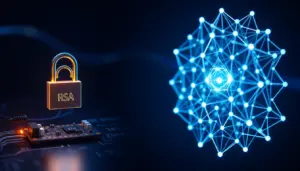
RSA vs ML-DSA: 256 vs 2,420-Byte Signatures [2026]
RSA has signed the internet’s certificates for three decades. ML-DSA, finalized by NIST in August 2024, is the algorithm built to take over once quantum computers make RSA’s…

LMS vs XMSS: 1,432 vs 2,500-Byte Signatures [2026]
Every major post-quantum migration story in 2026 centers on ML-KEM and ML-DSA, the lattice-based algorithms NIST finalized in August 2024. But there’s a second, quieter category of quantum-resistant…
SSL vs TLS: TLS 1.3 Hits 72% Share, SSL at 0% [2026]
Type “SSL certificate” into a browser’s address bar settings and you will still find the phrase everywhere, from hosting dashboards to email marketing banners promising a “free SSL”…
HMAC vs KMAC: One Pass Beats Two, 3.3x Faster [2026]
Every API request signed with a secret key, every webhook payload from Stripe or GitHub, and every AWS Signature V4 header relies on the same 1997 construction: HMAC.…

Post-Quantum WireGuard vs Classic: 37x Bigger Keys [2026]
WireGuard earned its reputation by stripping VPN cryptography down to a handful of fixed, modern primitives: Curve25519 for key exchange, ChaCha20-Poly1305 for encryption, BLAKE2s for hashing. That simplicity…

BLAKE3 vs SHA-512: 8x Faster, Still No FIPS Nod [2026]
Pick a hash function for a new project in 2026 and you will run into a strange split. One camp wants raw speed and points at BLAKE3, the…

Argon2 vs scrypt: 19MB vs 128MB, OWASP Picks One [2026]
Pick the wrong password-hashing algorithm in 2026 and you find out the hard way, usually after a breach, when someone runs your hash database through a GPU cluster.…