
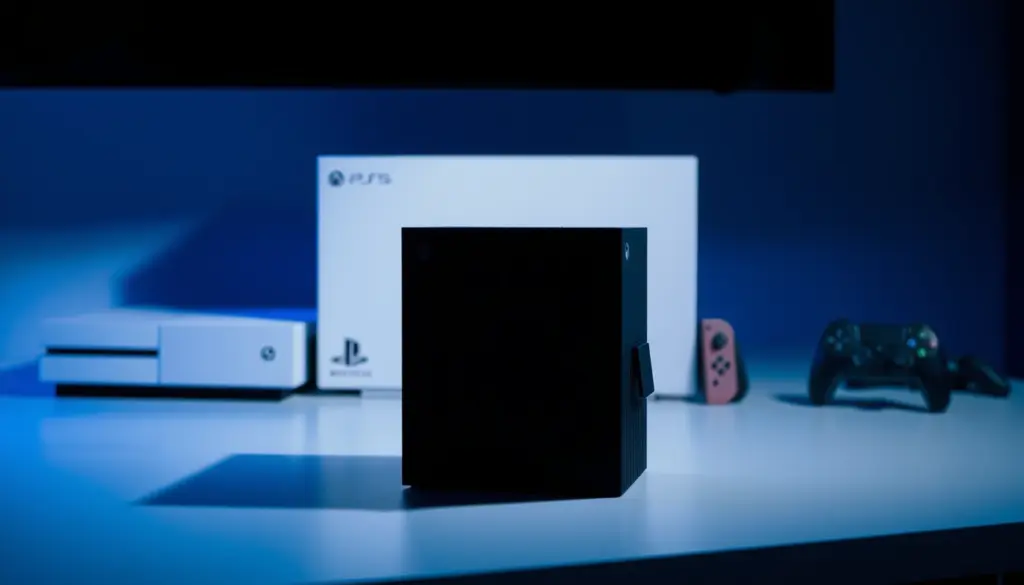
Global console shipments are on track for their steepest single-year drop of this hardware generation, and Xbox is absorbing the worst of it. A new forecast from S&P Global Market Intelligence’s Kagan media research group projects industry-wide console shipments falling 19.5% in 2026, to 33.9 million units – and singles out Xbox Series X|S for a trajectory analyst Neil Barbour bluntly calls “a rapid wind-down toward zero” by 2027. The report, compiled in July 2026, lands just weeks after Microsoft’s own July 6 restructuring memo admitted “our business today is not healthy,” and it puts hard numbers behind that admission: Xbox shipped just 3.2 million consoles in 2025, its lowest annual total on record, and first-quarter 2026 shipments fell below 500,000 units for the first time. PlayStation 5 and Nintendo Switch 2 aren’t escaping the downturn either – but Xbox is falling fastest, furthest, and with the least room left to fall.
What the New Forecast Says: Shipments to Fall 19.5% in 2026
S&P Global Market Intelligence’s Kagan group projects global console shipments will fall to 33.9 million units in 2026, down 19.5% from 42.1 million in 2025. That 2025 baseline was itself inflated by Nintendo Switch 2’s launch-year surge, which makes the year-over-year comparison look steeper than a simple market slowdown – but Kagan’s own analyst, Neil Barbour, doesn’t expect the pain to stop there. The firm projects a further slide to 27.1 million units in 2027, roughly another 20% decline, before a gradual recovery to 37.4 million units by 2030, contingent on next-generation hardware from Sony and Microsoft actually reaching the market at prices consumers can absorb.
Broken down by platform, the 2026 forecast has Nintendo Switch 2 shipping 17.1 million units, PlayStation 5 shipping 13.2 million, and Xbox Series X|S shipping just 2.5 million. Barbour leads Kagan’s video game coverage within S&P Global Market Intelligence’s consumer technology team, and this is one of the more granular platform-by-platform breakdowns the firm has published for the current console generation.
# Checking the analyst math against the headline figures
shipments_2025 = 42.1  # million units, S&P Global Market Intelligence Kagan
shipments_2026 = 33.9  # million units, forecast

industry_decline = (shipments_2025 - shipments_2026) / shipments_2025 * 100
print(f"Industry-wide decline: {industry_decline:.1f}%")  # 19.5%

xbox_2025 = 3.2
xbox_2026 = 2.5
xbox_decline = (xbox_2025 - xbox_2026) / xbox_2025 * 100
print(f"Xbox Series X|S decline: {xbox_decline:.1f}%")  # 21.9%, rounds to 22%
Xbox’s Numbers Are the Worst in the Report
Every platform is slowing down, but Xbox Series X|S is the outlier. Microsoft shipped 3.2 million Series X|S consoles in 2025 – the lowest annual total in the platform’s five-year history, and a figure Microsoft has never confirmed itself; the company has been notoriously reluctant to publish hardware unit sales since early in the generation. Kagan’s forecast has that figure falling further still, to 2.5 million units in 2026, a 21.9% year-over-year decline that rounds to the 22% figure driving this story’s headlines. Even more striking: first-quarter 2026 quarterly shipments fell below 500,000 units for the first time since S&P began tracking the platform.
Set against the installed base, the shrinkage is even more visible. Xbox Series X and Series S have sold roughly 34.79 million units lifetime as of May 2026, according to VGChartz tracking – meaning Microsoft is now shipping new hardware at a rate equal to barely 7% of its entire generational installed base every year. PlayStation 5, by comparison, is shipping more than five times Xbox’s forecast volume in 2026 alone.
Why Analysts See Xbox Shipments Heading Toward Zero
Barbour’s report doesn’t treat the decline as a temporary dip. “For now, the market faces a compounding problem: hardware that is either too old or too expensive for the median consumer, a software slate that is thin outside a handful of tentpole releases, and a macro environment that keeps any meaningful price relief off the table,” he wrote, in commentary reported by VGChartz. He added a blunter line: “That framing does not inspire confidence for 2027 or beyond.”
Three factors recur across the coverage of Barbour’s analysis: an uneven first-party software library, a subscription-first strategy – built around Game Pass – that hasn’t meaningfully moved hardware, and pricing that now sits above a comparable PlayStation 5. None of these are new criticisms of Xbox’s current-generation strategy, but Kagan’s forecast is one of the first to attach a hard shipment number and a “toward zero” trajectory to them.
The Price Gap Behind the Forecast
Barbour specifically cites pricing “that now puts an Xbox Series X [US] $100 above a standard PS5” as one of the drags on Xbox hardware demand. That gap comes from Microsoft’s second console price hike in under a year, announced June 25, 2026 and effective August 1, 2026 – confirmed on Xbox Wire. Sony’s PlayStation 5 price hikes, by contrast, took effect back in April 2026 and haven’t moved since.
Barbour’s $100 Math, Explained
Once the August 1 hike lands, an Xbox Series X digital edition will cost $749.99 against a standard disc PlayStation 5 at $649.99 – exactly the $100 gap Barbour’s report describes. Microsoft has said the increase reflects storage and memory component costs that are “up more than 2.5 times” versus a year earlier, with another near-doubling possible by fall 2027.
| Console / Edition | Price Before Aug 1, 2026 | Price From Aug 1, 2026 | Change |
|---|---|---|---|
| Xbox Series S 512GB | $399.99 | $499.99 | +$100 |
| Xbox Series S 1TB | $449.99 | $599.99 | +$150 |
| Xbox Series X (digital) | $599.99 | $749.99 | +$150 |
| Xbox Series X (disc) | $649.99 | $799.99 | +$150 |
| PlayStation 5 Digital | $599.99 (since Apr 2026) | No change announced | – |
| PlayStation 5 (disc) | $649.99 (since Apr 2026) | No change announced | – |
| PlayStation 5 Pro | $899.99 (since Apr 2026) | No change announced | – |
PlayStation 5 Isn’t Immune Either
Sony’s console isn’t in freefall the way Xbox is, but it isn’t growing either. PlayStation 5 shipments declined 15.2% year-over-year in 2025, and Kagan forecasts just 13.2 million units in 2026 – still comfortably the second-best-selling platform, but a clear step down from Sony’s earlier pace in the generation. That slowdown followed Sony’s own April 2026 price increases, which pushed the Digital Edition from $499.99 to $599.99, the disc model from $549.99 to $649.99, and the PS5 Pro from $749.99 to $899.99, all attributed to what Sony called sustained pressure on the global economic situation. US retail data tracked separately this year showed PS5 sell-through cratering even harder than shipment figures suggest, with average selling prices climbing at the same time volumes fell – a classic signal of a hardware line being managed for margin rather than growth this late in its life cycle.
Still, 13.2 million units is more than five times Xbox’s 2.5 million forecast, and Sony enters this downturn from a much larger installed base – PlayStation 5 has sold in the neighborhood of 92 million units lifetime, versus Xbox Series X|S’s roughly 35 million.
Nintendo Switch 2 Still Leads, But Growth Is Slowing
Nintendo Switch 2 remains the industry’s clear best-seller, and Kagan’s 17.1 million-unit forecast for 2026 is more than six times Xbox’s projected volume. But the trajectory is still a cooldown, not a plateau at peak velocity. Kagan explicitly frames the pace as comparable to “the original Switch’s second-year performance and similar to the Wii” – in other words, a normal post-launch deceleration rather than anything unique to Switch 2’s reception. Nintendo shipped 19.86 million Switch 2 units in its first fiscal year, through March 31, 2026, and the company’s own guidance for its second fiscal year projects a 16.9% decline to 16.5 million units – a steeper cooldown than Kagan’s independent 17.1 million estimate, if Nintendo’s own numbers prove more conservative.
The Pokémon Problem
Part of the slowdown traces to a software gap rather than hardware fatigue. The next mainline Pokémon title, Pokémon Wind and Waves, isn’t due until late 2027 – leaving Switch 2 without its single biggest historical tentpole franchise for most of 2026 and 2027. Nintendo has other first-party releases in the pipeline, but none carry Pokémon’s proven ability to move hardware on its own.
The Common Thread: A Global Memory Chip Crisis
Every platform holder raised prices in 2026, and every one of those increases traces back to the same root cause: a global DRAM and NAND shortage driven largely by AI data-center demand for memory. Consumer memory prices have risen as much as 89% in a single quarter this year, and Gartner has forecast a memory cost surge of 125-130% industry-wide. That squeeze is precisely why Barbour’s own recovery forecast for the back half of the decade comes with a hard condition attached: he assumes “the component crisis eases sufficiently by 2028” to let Sony and Microsoft bring next-generation hardware to market at $600-800 price points. If that assumption doesn’t hold, the recovery Kagan projects for 2028-2030 could slip further still.
How This Connects to Xbox’s July Restructuring
Kagan’s forecast doesn’t exist in isolation from Microsoft’s own recent admissions. On July 6, 2026, Xbox CEO Asha Sharma announced what she called “the most significant restructure in Xbox history” – roughly 3,200 job cuts across the Xbox organization through fiscal year 2027, alongside four studios leaving Microsoft entirely. Sharma’s memo was direct about the underlying problem: “Our business today is not healthy. We are operating at margins that are 3-10x lower than comparable platform and publishing businesses.” She also specifically cited a hardware cost crisis tied to rising console component costs.
Kagan’s report, published weeks later, effectively supplies the external, independent hardware data that backs up what Sharma’s internal memo already signaled: Xbox’s console business isn’t just facing a margin problem from Microsoft’s own accounting – its shipment volumes are independently verified by outside analysts to be at the lowest point in the platform’s history, with no near-term hardware catalyst on the horizon to reverse it.
Historical Context: The First Console Generation to Get More Expensive With Age
Console pricing has traditionally moved in one direction as a generation ages: down. The PlayStation 4 launched at $399.99 in 2013 and had fallen to around $299 by 2016 as manufacturing costs came down with scale and process maturity. The Xbox 360 followed the same pattern, launching at $399.99 in 2005 and dropping to roughly $199 by 2009. PlayStation 5, Xbox Series X|S, and Switch 2 have all broken that pattern in 2026, rising in price instead – the first console generation in memory to get more expensive as it ages, a shift driven entirely by external component costs rather than the platform holders’ own choices.
There’s a second, more pointed historical parallel worth remembering here too: the last time a major platform holder walked away from console hardware entirely was Sega, which exited the console business in 2001 after the Dreamcast and became a third-party publisher. No credible reporting suggests Microsoft is on that path – Project Helix is real and in active development – but Sega’s exit remains the only precedent for what “winding down toward zero” could eventually mean if a platform holder decided the math no longer worked.
Market Impact: What a Shrinking Console Base Means for Games
Publishers plan multi-year development cycles around installed base projections, and a shrinking or flatlining Xbox hardware base changes that math directly. The lower the addressable Xbox audience, the harder it becomes to justify platform-exclusive investment – a shift Microsoft itself has already been making. The clearest recent example: Halo: Campaign Evolved’s debut on PlayStation 5 this year ended roughly 25 years of Xbox exclusivity for Microsoft’s flagship franchise, a move that would have been unthinkable earlier in the Xbox brand’s history and that lines up neatly with a console business no longer growing its own hardware fast enough to justify staying exclusive.
There’s a second-order effect too. As fewer new consoles ship overall, the mix of platform revenue keeps tilting further toward digital sales and subscriptions rather than hardware margin – reinforcing exactly the subscription-first strategy Barbour flagged as failing to move hardware in the first place. It’s a feedback loop: subscriptions were meant to offset a maturing hardware cycle, but a hardware cycle that’s contracting this fast makes subscriptions carry even more of the business than originally planned.
The Road to Next-Gen: PS6 and Project Helix
Both Sony and Microsoft are effectively betting their hardware recovery on the next generation. Kagan projects PlayStation 6 launching in 2028 with roughly 4 million units in its first year, scaling to 17.2 million by 2030. Project Helix, Microsoft’s next-generation Xbox, is forecast at a much smaller 2 million units at launch, reaching only 7.3 million by 2030 – well behind PS6’s projected pace even after several years on the market. Both forecasts assume the same underlying condition: that the memory component crisis eases enough by 2028 to let both companies price next-gen hardware in the $600-800 range rather than significantly higher.
Officially, Xbox’s Jason Ronald, VP of Next Generation, has described Project Helix as designed to “play your Xbox console and PC games, delivering leading performance and ushering in the next generation of console gaming” – language that leans into blurring the line between console and gaming PC, rather than a traditional successor. Analysts have picked up on that ambiguity directly: Barbour’s own commentary describes Microsoft as “splitting the difference” between a conventional console successor and a living-room PC sold under the Xbox brand.
Competitive Comparison: Xbox vs. PlayStation vs. Switch 2 in 2026
Lined up side by side, the 2026 forecast turns what’s usually described as a three-way console race into something closer to a two-tier market. Switch 2’s 17.1 million units and PS5’s 13.2 million units are both multiples of Xbox’s 2.5 million – Switch 2 ships nearly seven times Xbox’s forecast volume, and PS5 ships more than five times as many. On a shipment-share basis, Xbox’s slice of the projected 33.9 million-unit global market works out to roughly 7%, a far cry from the three-way parity Microsoft aimed for when Series X|S launched alongside PS5 in November 2020.
| Platform | 2026 Shipment Forecast | Change vs. Prior Year | Context |
|---|---|---|---|
| Nintendo Switch 2 | 17.1 million | Nintendo’s own guidance: −16.9% (to 16.5M) in its 2nd fiscal year | Still #1; pace compared to original Switch’s 2nd year and the Wii |
| PlayStation 5 | 13.2 million | 2025 shipments fell 15.2% YoY | More than 5x Xbox’s 2026 forecast |
| Xbox Series X|S | 2.5 million | −21.9% vs. 3.2 million in 2025 | Lowest annual total on record; Q1 2026 fell below 500K for the first time |
| Industry Total | 33.9 million | −19.5% vs. 42.1 million in 2025 | Steepest single-year decline of this console generation |
Data Table: Global Console Shipment Outlook, 2025-2030
Zooming out from any single platform, Kagan’s full-decade outlook shows the shape of the downturn and the assumptions baked into its eventual recovery.
| Year | Global Console Shipments | YoY Change | Status |
|---|---|---|---|
| 2025 | 42.1 million | – | Actual; boosted by Switch 2’s launch-year surge |
| 2026 | 33.9 million | −19.5% | Forecast; price hikes across all platforms amid memory shortage |
| 2027 | 27.1 million | ~−20% | Forecast; no new hardware yet, component crisis still deepening |
| 2030 | 37.4 million | Recovery | Forecast; assumes PS6 (2028) and Project Helix both shipping |
The gap between 2027 and 2030 is where the next-gen launches actually happen: PlayStation 6 in 2028 at roughly 4 million units, climbing to 17.2 million by 2030, and Project Helix arriving at around 2 million units and reaching 7.3 million by the same year. Kagan doesn’t publish a clean industry-wide total for 2028 or 2029 individually – those years mark the transition itself, with both legacy and next-gen hardware shipping simultaneously – but the trend from 27.1 million (2027) to 37.4 million (2030) shows the recovery arriving gradually rather than in a single jump.
Could Xbox Actually Exit the Console Hardware Business?
No analyst covering this forecast – including Barbour himself – is predicting Microsoft will abandon console hardware outright, and Project Helix’s continued development is the clearest evidence against that reading. But the “wind-down toward zero” language is strong enough that the question is worth asking directly, especially given how openly Microsoft’s own framing of Project Helix already blurs the console/PC line.
The Sega Precedent
The closest historical comparison remains Sega’s 2001 exit from console hardware following the Dreamcast, after which the company pivoted entirely to third-party publishing – a model Sega still operates under today. If Xbox’s current generation genuinely reaches negligible shipment volumes before Project Helix arrives, and if Helix itself under-delivers relative to PS6 the way Kagan’s 2-million-versus-4-million launch forecast suggests, the pressure on Microsoft to reconsider its hardware ambitions would only grow. For now, that remains speculative: Microsoft has made no public statements suggesting an exit, and Sarah Bond, President of Xbox, has continued to describe next-gen hardware plans as “very premium” rather than retreating from them.
5 Predictions for the Console Market Through 2030
- Xbox’s actual 2026 shipments will land close to Kagan’s 2.5 million forecast, extending the decline into a second consecutive year and likely prompting further commentary from Microsoft about Project Helix’s positioning.
- At least one more console price move is likely before the memory shortage meaningfully eases – most plausibly another Xbox adjustment, given the component-cost trajectory Microsoft has already flagged through fall 2027.
- Nintendo keeps the largest annual shipment share through 2027, but growth stays flat until Pokémon Wind and Waves ships in late 2027 and gives Switch 2 its first true tentpole software catalyst.
- Project Helix’s roughly 2 million-unit launch estimate will keep facing analyst skepticism relative to PS6’s 4 million, unless Microsoft resolves open questions about pricing and store/platform philosophy well before launch.
- Watch for Microsoft’s next public Project Helix update, which Xbox content chief Matt Booty has said will land later in 2026 – pricing and platform philosophy are likely to dominate that announcement, given how central both are to this forecast.
Frequently Asked Questions
Why are Xbox shipments expected to fall so sharply in 2026?
S&P Global Market Intelligence’s Kagan group cites a mix of factors: hardware priced above a comparable PS5, a first-party game lineup analyst Neil Barbour calls “thin outside a handful of tentpole releases,” and a subscription-first strategy that hasn’t translated into hardware sales. Xbox shipped 3.2 million consoles in 2025 and is forecast to fall to 2.5 million in 2026.
Does “wind-down toward zero” mean Microsoft is discontinuing Xbox consoles?
Not directly. Barbour’s phrase describes the current Xbox Series X|S generation’s shipment trajectory approaching negligible volume by 2027, not an official discontinuation. Microsoft is actively developing a successor, codenamed Project Helix, though S&P’s own forecast has Helix launching at a smaller volume than PlayStation 6.
How many PS5 units are expected to ship in 2026?
Kagan forecasts 13.2 million PlayStation 5 units in 2026, after shipments already declined 15.2% year-over-year in 2025. That’s still more than five times Xbox’s 2026 forecast, though down from Sony’s earlier pace this generation.
Is the Nintendo Switch 2 slowing down too?
Yes, though less dramatically. S&P forecasts 17.1 million Switch 2 units in 2026 – still comfortably the best-selling platform – while Nintendo’s own guidance projects a 16.9% decline to 16.5 million units in its second fiscal year. Analysts partly attribute the cooldown to a software gap: the next mainline Pokémon game isn’t due until late 2027.
Why are console prices rising instead of falling as this generation ages?
A global memory chip shortage, driven largely by AI data-center demand for DRAM and HBM, has pushed component costs up sharply throughout 2026. All three major platform holders raised prices this year as a result, reversing the traditional pattern of console prices falling as manufacturing costs decline with age.
When will the next Xbox and PlayStation launch?
Both are targeting 2028 according to S&P’s forecast, though neither Microsoft nor Sony has confirmed a firm date. PlayStation 6 is projected to launch with around 4 million units in its first year; Project Helix is forecast at roughly 2 million.
How much will next-generation consoles cost?
S&P’s recovery forecast assumes Sony and Microsoft will be able to price next-gen hardware between $600 and $800 – but only if the memory component crisis eases enough by 2028. If the shortage persists, analysts have warned pricing could run higher than that range.
Does a shrinking console base affect which games get made?
It can. Publishers weigh platform-exclusive investment against installed base size, and a shrinking or flatlining Xbox hardware base adds to the case for multiplatform releases – a shift Microsoft has already been making, most visibly by bringing Halo: Campaign Evolved to PlayStation 5 for the first time in the franchise’s history.
Related Coverage
- Xbox Layoffs: 3,200 Jobs Cut, 4 Studios Divested
- Xbox Project Helix: Next Console Runs PC Games, 2028
- PS6 Cost Leak Hits $960 as Sony Delays to 2028
- RAM Prices Up 89%: AI Memory Crunch Hits Gaming
- PS5 Sales Crash 58% as Console Prices Surge
- Switch 2 Hits 19.86M, Outsells PS5 in Year One
- Xbox Series X vs Series S: $649 vs $399, 4K vs 1440p
- Halo: Campaign Evolved Hits PS5 July 28, $49.99
- More Gaming Coverage