
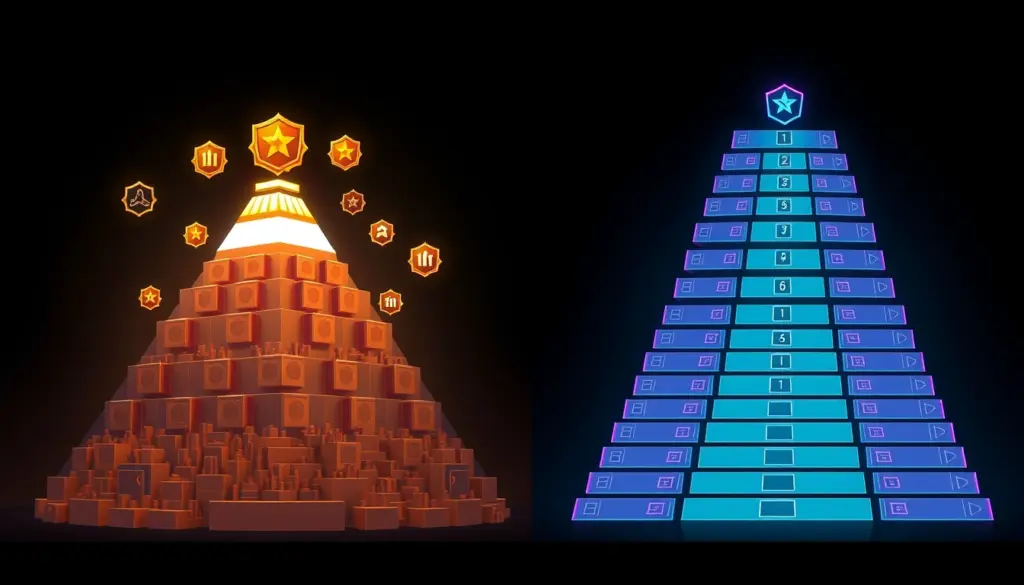
Fortnite added two brand-new ranks to its ladder in 2026, and the shakeup shows in the numbers. As of July 2026 (Chapter 7 Season 3), 38.1% of ranked Fortnite players sit in Bronze, according to tracking site Esports Tales. Compare that to Valorant, where the equivalent bottom tier, Iron, holds just 4.39% to 9.93% of the player base depending on which stat tracker you check. Two of the biggest ranked shooters on the planet, and their ladders look nothing alike. One rewards a huge chunk of casual players sitting near the entry point, the other spreads its population much closer to the middle of the ladder, and understanding why matters if you’re deciding where to spend your ranked hours in 2026.
This piece breaks down the Fortnite rank distribution for 2026 next to Valorant’s, tier by tier, with real numbers pulled from multiple trackers rather than a single source. We’ll cover structure, pricing, benchmarks, and which ladder actually rewards your time better depending on what kind of player you are. Both games run entirely different competitive formats (battle royale versus 5v5 tactical shooter), so a direct rank-for-rank comparison only tells part of the story. What the data does show clearly is how differently each developer chose to shape its skill curve, and that shapes everything from how fast you climb to how much a subscription actually saves you.
Fortnite Ranked Explained: Bronze to Unreal in 2026
Fortnite’s Ranked mode runs on eight ranks: Bronze, Silver, Gold, Platinum, Diamond, Elite, Champion, and Unreal. Bronze through Diamond each split into three divisions (I, II, III), while Elite, Champion, and Unreal stand as single tiers with no sub-ranks. Epic’s own official rules for the Ranked Cups describe this as “eight ranks separated into eighteen divisions,” and that structure has held steady since Ranked launched, even as the point system underneath it keeps shifting.
What changed heading into 2026 is the addition of Elite and Champion as competitive bands above Diamond. Rank-tracking site Tesoro.gg flags both as “new” tiers in its Chapter 7 Season 3 breakdown, sitting between Diamond and the top-end Unreal rank. That gives players who plateau around Diamond a longer climb before they hit the ceiling, instead of jumping straight from Diamond into a leaderboard-style Unreal rank the way earlier seasons worked.
Fortnite also runs two separate ranked ladders for the same rank names: Battle Royale and Zero Build. Your Bronze in Zero Build has nothing to do with your rank in standard Battle Royale, so a player can sit at Platinum in one mode and Silver in the other. That’s a structural quirk Valorant doesn’t share, since Riot only tracks one competitive ladder per act.
Progression uses hidden MMR under the hood, similar to most modern ranked shooters, with placements, eliminations, and match survival all feeding into rank points. Epic doesn’t publish the exact formula, but community trackers at FNDB and Tesoro.gg have reverse-engineered close approximations by watching thousands of matches across the 2026 seasons.
Placement carries more weight than raw kills once you get past Gold. A player who survives to top 10 without a single elimination still banks meaningful rank points, which is a deliberate design choice that rewards positioning over aggression. That’s a departure from how a lot of tactical shooters score ranked matches, and it’s part of why Fortnite’s climb feels different from Valorant’s even when both use a hidden-MMR backbone. Epic also resets a portion of everyone’s rank progress at the start of each new season, which is the main driver behind the early-season Bronze spikes both Profilerr and Esports Tales have documented.
Valorant Ranked Explained: Iron to Radiant in 2026
Valorant’s competitive ladder runs nine tiers: Iron, Bronze, Silver, Gold, Platinum, Diamond, Ascendant, Immortal, and Radiant. Every tier except Radiant splits into three divisions, which gives the ladder 25 total ranks from Iron 1 at the bottom to the single Radiant tier at the very top. Riot has kept this exact structure in place since Ascendant was introduced years ago, and nothing changed about the tier count heading into the 2026 acts.
Radiant isn’t a percentage-based rank the way the others are. It’s a leaderboard cap, roughly the top 500 players per region, which means its share of the total player base is effectively rounding-error small: trackers put it anywhere from 0.01% to 0.04% depending on the act and dataset. Immortal, one step down, still only holds around 0.4% to 1.6% of players across the different 2026 snapshots.
Unlike Fortnite, Valorant runs a single ranked queue: Competitive mode, 5v5, one map, one economy system per round. There’s no split between build modes or squad sizes complicating the picture. Rank Rating (RR) accumulates within each division, and a strong or weak performance (measured partly by Riot’s internal MMR estimate) adds or subtracts bonus RR on top of the standard win/loss swing.
Because Valorant ties Competitive access to account level, new players can’t dive into ranked immediately. That gatekeeping, combined with a single unified ladder, is part of why Valorant’s distribution curve looks tighter and more bell-shaped than Fortnite’s Bronze-heavy spread.
Each new act carries a soft rank reset too, though Riot’s version is gentler than Epic’s. Instead of dropping everyone back to Iron, Valorant compresses ranks toward the middle of the ladder, so a Diamond player from the previous act typically re-enters a tier or so lower rather than falling all the way to the bottom. That softer reset is one reason the Iron and Bronze percentages stay comparatively low even right after an act flips, unlike Fortnite where Bronze can jump above 50% in the opening weeks of a new season.
Fortnite Rank Distribution: Full Breakdown for July 2026
The clearest current snapshot comes from Esports Tales and Tesoro.gg, both citing Chapter 7 Season 3 data collected in July 2026. Bronze dominates at 38.1% of the ranked population, with Silver a distant second at 28.8%. After that the curve drops off fast: Gold sits at just 8.4%, actually lower than Platinum’s 13.6%, which is an unusual dip that both trackers flag as a real pattern rather than a data error.
| Rank | Share of Players (Jul 2026) | Top % Threshold |
|---|---|---|
| Bronze (I-III) | 38.1% | Top 99.9% |
| Silver (I-III) | 28.8% | Top 61.8% |
| Gold (I-III) | 8.4% | Top 33.0% |
| Platinum (I-III) | 13.6% | Top 24.6% |
| Diamond (I-III) | 3.8% | Top 11.0% |
| Elite | 3.1% | Top 7.2% |
| Champion | 2.3% | Top 4.1% |
| Unreal | 1.8% | Top 1.8% |
That table tells a specific story: nearly two-thirds of ranked Fortnite players (Bronze plus Silver) sit below Gold. It’s a distribution shape you’d normally expect right after a season reset, but Esports Tales’ archive shows this pattern holding fairly consistently across multiple 2026 checkpoints, not just as a temporary post-reset blip.
The source for this table, Esports Tales’ Fortnite rank distribution tracker, also breaks the numbers out separately for Battle Royale and Zero Build, and the two modes track closely enough that the combined figures above represent both reasonably well. A separate breakdown from FNDB’s ranks database confirms the same eight-tier, eighteen-division structure, giving a second independent source for the underlying rank framework even where the exact percentages shift week to week.
Valorant Rank Distribution: Full Breakdown for 2026
Valorant’s curve looks completely different. PC Gamer’s May 2026 breakdown, sourced from VStats.gg, puts Gold as the single largest tier at 23.03% of players, with Silver close behind at 20.06% and Platinum at 18.76%. Iron, the entry rank, holds a comparatively small 4.39% share.
| Rank | PC Gamer / VStats (May 2026) | LFCarry Cross-Check (Jul 2026) |
|---|---|---|
| Iron | 4.39% | 6.51% – 7.9% |
| Bronze | 13.78% | 20.7% – 21.3% |
| Silver | 20.06% | 21.5% |
| Gold | 23.03% | 21.1% |
| Platinum | 18.76% | 14.9% |
| Diamond | 11.67% | 9.6% |
| Ascendant | 6.67% | 3.3% |
| Immortal | 1.62% | 0.5% |
| Radiant | 0.01% | ~0% |
Notice that even the two Valorant sources disagree by several points at the low end. LFCarry’s July 2026 data, cross-checked against Valking.gg, shows Iron and Bronze both running heavier than PC Gamer’s May snapshot, which likely reflects normal act-to-act churn plus differences in which matches each tracker samples. Either way, Valorant’s curve peaks in the Gold-to-Platinum range rather than at the very bottom, the opposite of what Fortnite’s data shows.
Valking.gg, tracking a June 2026 snapshot, reported the median Valorant rank as Gold II, with Gold the single most common tier at 22.3% of players. That lines up closely with the PC Gamer and Gamsgo numbers, giving three independent trackers roughly agreeing that Gold, not the bottom rank, is where the average Valorant player lands. For anyone who started ranked Valorant expecting to breeze through Iron and Bronze the way they might in a more forgiving ladder, this is the reality check: those bottom two tiers combined still hold roughly a quarter of the entire player base, according to PC Gamer’s May 2026 breakdown.
Fortnite vs Valorant: Rank Structure Compared
Put the two systems side by side and the structural gaps become obvious. Valorant simply has more granularity: 25 distinct ranks against Fortnite’s 18. But Fortnite compensates with two full separate ladders (Battle Royale and Zero Build) that track independently, something Valorant’s single competitive queue doesn’t attempt. The table below pulls every structural metric into one place so you can see exactly where the two systems overlap and where they diverge.
| Metric | Fortnite Ranked | Valorant Competitive |
|---|---|---|
| Total tiers (broad bands) | 8 | 9 |
| Total ranks/divisions | 18 | 25 |
| Sub-divisions per tier | 3 for Bronze-Diamond, 1 for Elite/Champion/Unreal | 3 for Iron-Immortal, 1 for Radiant |
| Entry-level rank | Bronze I | Iron 1 |
| Top rank | Unreal (leaderboard-based) | Radiant (~top 500/region) |
| Top rank share (2026) | 1.8% | 0.01% – 0.04% |
| Ranked ladders tracked | 2 (Battle Royale + Zero Build) | 1 (Competitive) |
| Team size in ranked | Solo, duo, trio, or squad | 5v5 only |
| Newest tier additions (2026) | Elite, Champion | None new, structure unchanged |
| Most populated rank (2026) | Bronze (38.1%) | Gold (~22-23%) |
| Median/average rank | Between Silver and Gold | Gold II |
| Progression currency | V-Bucks | Valorant Points (VP) |
The most telling row is “most populated rank.” Fortnite’s ladder is bottom-heavy, with Bronze alone housing more players than Valorant’s bottom three tiers combined. Valorant’s curve, by contrast, bulges in the middle. Neither system is more accurate, but they send very different signals about what a given rank actually means. Reaching Gold in Valorant puts you around the statistical middle of the pack. Reaching Gold in Fortnite already puts you ahead of roughly two-thirds of ranked players, since so many accounts never climb past Silver.
The team-size row matters more than it looks. Valorant locking every ranked match to 5v5 keeps its MMR math relatively simple, since Riot only has to model one fixed group size. Fortnite’s MMR system has to account for solo players facing squads, duos facing trios, and every other combination, which is a much harder balancing problem. Epic’s approach is to weight rank gains and losses differently depending on party size, giving solo climbers a bit more protection against getting steamrolled by coordinated squads, though the exact weighting isn’t published.
Fortnite Battle Royale vs Zero Build: Do Ranks Match?
One question the raw distribution tables above don’t answer directly: does a Fortnite player’s Battle Royale rank predict their Zero Build rank? Esports Tales tracks both ladders separately in its July 2026 dataset, and the shapes are close but not identical. Both modes show Bronze as the largest band and both show the same rough drop-off pattern through Silver and Gold, but Zero Build tends to run slightly more top-heavy, with a marginally larger share of players in Diamond and above.
That makes sense given who actually plays Zero Build. It’s a smaller, more self-selected population, typically players who specifically prefer gunfights without the building mechanic, which skews the pool toward more experienced or aim-focused players compared to the full Battle Royale player base that includes a much larger casual and new-player contingent. Building is a real skill wall in standard Battle Royale, and removing it in Zero Build removes one of the biggest sources of rank variance between newer and veteran players. That single design difference explains more about the two modes’ distribution gap than anything in the underlying MMR formula.
Practically, this means you can’t assume your Battle Royale rank transfers to Zero Build or the reverse. A player sitting at Gold in standard Battle Royale, comfortable with builds and edits, might land in Silver in Zero Build simply because the mode strips away the mechanic they built their rank around. The opposite happens too: players who struggle with building often find their Zero Build rank sits a tier or more above their Battle Royale rank once the building skill gap is removed from the equation.
Valorant doesn’t have this problem since there’s only one Competitive queue to track. That’s a real structural advantage if what you want out of a ranked system is a single, unambiguous number that represents your skill. Fortnite trades that clarity for flexibility, letting players specialize in the mode that fits their strengths rather than forcing everyone through one universal ladder.
Benchmarks: What Three Trackers Say About Each Ladder
No single stat tracker sees every match, so cross-checking multiple sources matters more than trusting one dataset blindly. For Fortnite, Esports Tales and Tesoro.gg both independently landed on nearly identical July 2026 numbers (Bronze 38.1%, Silver 28.8%), which is a strong signal those figures are close to reality rather than a sampling fluke from one site. That kind of agreement between two separately-run trackers is the closest thing to a benchmark this space has, since neither Epic nor Riot publishes official distribution data.
Immortal Boost’s older 2025 snapshot tells a useful contrast story: Bronze at just 17.8%, Diamond at a relatively high 13.9%. That’s a much flatter, more evenly spread curve than the 2026 data shows. Something shifted the ladder toward Bronze over the following months, whether that’s population growth from new or returning players, a points-formula tweak, or the Elite/Champion tier split absorbing points that used to push people into Diamond faster.
On the Valorant side, three separate trackers (PC Gamer/VStats, Gamsgo, and LFCarry/Valking) each put Gold as the largest or second-largest tier, and all three show Immortal and Radiant combined at under 2% of the player base. That kind of agreement across independently-run trackers is about as close to a verified benchmark as third-party gaming data gets, since none of these sites share a common data pipeline.
Where the trackers diverge is the exact Iron/Bronze split for Valorant, with a nearly 5-point spread between the May 2026 PC Gamer numbers and the July 2026 LFCarry numbers. Act transitions reset some placement matches and shuffle new accounts into the bottom tiers temporarily, which likely explains at least part of that gap. Treat any single distribution snapshot as a moving target, not a fixed fact, for either game.
It’s worth being skeptical of any tracker claiming perfect precision. Sites like Esports Tales and VStats.gg pull data from public match APIs and community-submitted results, not from Epic’s or Riot’s internal databases, so their numbers are estimates built on large but incomplete samples. The value isn’t in trusting one number to the decimal point. It’s in watching whether independent trackers land in the same neighborhood, and for both games in 2026, they generally do, which is the closest thing to a verified benchmark this kind of third-party data can offer.
How the Distributions Shifted Across 2026
Looking at Fortnite’s distribution across three different points in the year shows how much a ranked ladder can move within months. In Chapter 7 Season 1 (early 2026), Profilerr’s data put Bronze at a striking 50.8% of players, with Unreal unusually high at 5.8%. By Chapter 7 Season 3 (July 2026), Bronze had dropped to 38.1% while Unreal fell to 1.8%. That’s a massive swing in both directions within a single chapter, and it’s the kind of movement that makes “what rank am I really” a harder question to answer than it looks.
- Season reset compression: Early-season Bronze spikes (50.8% in Season 1) happen because everyone gets pushed back down the ladder at once, then spreads back out as matches get played.
- The Elite/Champion split: Adding two new tiers between Diamond and Unreal in 2026 diluted what used to be a more direct Diamond-to-Unreal jump, which explains part of why Unreal’s share fell from 5.8% to 1.8%.
- Cross-tracker Iron gap in Valorant: PC Gamer’s 4.39% Iron figure versus LFCarry’s 7.9% shows how much a single stat-tracking methodology can swing results, even for the same game in the same general timeframe.
- Valorant’s Gold plateau: Unlike Fortnite’s shifting Bronze number, Valorant’s Gold share stayed in the low-to-mid 20s across every 2026 source checked for this article, suggesting a more stable mid-ladder population.
- The Unreal-Radiant scarcity gap: Fortnite’s top rank still houses roughly 45-180 times more players proportionally than Valorant’s Radiant, even after 2026’s Elite/Champion changes thinned out the top of Fortnite’s ladder.
Fortnite’s 2025-to-2026 trend, per Immortal Boost’s earlier data compared against the July 2026 numbers, also shows Diamond shrinking from 13.9% down to 3.8%. Combined with the new Elite and Champion tiers absorbing that space, the practical effect is a ladder that got harder to climb past the midpoint over the course of the year, even if the very bottom stayed just as crowded.
Fortnite vs Valorant Ranked Pricing: V-Bucks vs VP
Neither Fortnite nor Valorant charges to play ranked itself, but both games gate cosmetics, battle passes, and season content behind their own currencies, and the pricing structures diverge in 2026. Epic changed its V-Bucks packaging in March 2026, cutting the amount of currency in the entry-level pack without changing its price, a move multiple outlets covered as a quiet price increase.
| Item | Fortnite | Valorant |
|---|---|---|
| Entry currency pack | 800 V-Bucks – $8.99 | 475 VP – $4.99 |
| Mid-tier pack | 2,400 V-Bucks – $22.99 | 1,000 VP (950+50 bonus) – $9.99 |
| Large pack | 4,500 V-Bucks – $36.99 | N/A (next tier jumps higher) |
| Largest standard pack | 12,500 V-Bucks – $89.99 | 11,000 VP – $99.99 |
| Battle Pass cost | Included with Crew, or ~950-1,000 V-Bucks standalone | 1,000 VP (~$9.99) |
| Monthly subscription | Fortnite Crew – $11.99/mo | None (no recurring subscription option) |
| What the subscription includes | Current Battle Pass, 4 extra mode passes, monthly Crew Pack cosmetics, 800 V-Bucks/mo | N/A |
Fortnite Crew, at $11.99 a month, is the better value on paper since it bundles the standard Battle Pass, several extra mode passes (OG, LEGO, Music, Rocket Racing), and 800 V-Bucks back every month, per Paydomy’s 2026 cost breakdown. Valorant has no equivalent subscription. Every VP purchase is a standalone transaction, and the Battle Pass itself has held steady at 1,000 VP (roughly $9.99) with no subscription discount available, according to CoinGate’s 2026 pricing guide.
The March 2026 V-Bucks change matters here too. Players used to get 1,000 V-Bucks for $8.99. That same $8.99 now only buys 800. Anyone budgeting for cosmetics or a standalone Battle Pass purchase in Fortnite is getting roughly 20% less currency per dollar than they were a year ago, even though the sticker prices on the packs themselves didn’t move.
Valorant’s pricing has stayed flat by comparison. Marix’s price-history tracker shows the US price for 1,000 VP holding at $9.99 across 2024, 2025, and 2026 with no change, which gives Valorant players a more predictable budget line than Fortnite’s shifting V-Bucks packs. Neither currency converts to real cash value outside its own game, and neither game lets you trade or resell unused currency, so the comparison here is purely about how far a dollar stretches inside each shop.
5 Use Cases: Which Ranked Ladder Fits You
Neither game’s ranked system is objectively better, but they fit different players well. Here’s how to think about which ladder matches your priorities, based on the actual 2026 distribution and pricing data covered above rather than general reputation.
- Casual players who want quick rank movement: Fortnite’s Bronze-heavy 2026 distribution means climbing out of the bottom tier is a relatively short trip for anyone who plays consistently, since so much of the ladder is compressed at the entry level.
- Tactical shooter purists who want granular skill separation: Valorant’s 25-rank ladder and tighter 5v5 competitive format give a more precise read on relative skill, especially in the crowded Gold-to-Platinum middle where three separate trackers agree on the distribution shape.
- Squad and duo players: Fortnite supports ranked solo, duo, trio, and squad queues plus a separate Zero Build ladder, giving flexible group sizes that Valorant’s fixed 5v5 competitive queue doesn’t offer.
- Players chasing an esports pathway: Valorant’s Radiant leaderboard and VCT ecosystem give high-rank players a clearer competitive pipeline than Fortnite’s Unreal rank, which functions more as a skill ceiling than a direct esports on-ramp.
- Budget-conscious players who want bundled value: Fortnite Crew’s $11.99/month, covering the Battle Pass, multiple mode passes, and monthly V-Bucks, beats piecing together individual VP purchases in Valorant if you play regularly and care about cosmetics.
Migration Guide: Switching From One Ranked Ladder to the Other
Jumping from one game’s ranked ladder to the other trips up a lot of players who assume their rank should translate directly. It doesn’t, mostly because the underlying player pools and skill curves are shaped so differently. A Fortnite Diamond player isn’t automatically a Valorant Diamond player, and treating the rank names as interchangeable is the single most common mistake players make when switching. Here’s a practical path for making the switch without misjudging where you actually land.
- Step 1 – Reset your rank expectations. A Fortnite Platinum player is already ahead of roughly 76% of the ranked population (per the July 2026 top-% thresholds), while a Valorant Platinum player sits closer to the 30-40% range depending on the tracker. Don’t assume the same rank name means the same relative skill.
- Step 2 – Check the account requirements. Valorant gates Competitive behind an account level requirement and placement matches before you get a visible rank. Fortnite Ranked has its own placement process per season but doesn’t require a separate account-level unlock.
- Step 3 – Pick the right ladder, not just the right game. If you’re moving into Fortnite, decide upfront whether you’re grinding Battle Royale or Zero Build rank, since they track completely separately and splitting your matches between both slows progress in each.
- Step 4 – Adjust for team size. Valorant is always 5v5 with a fixed economy system. Fortnite ranked lets you queue solo, duo, trio, or full squad, and your MMR reads differently depending on which party size you play.
- Step 5 – Budget your currency separately. V-Bucks and VP aren’t interchangeable and the pricing structures differ (see the pricing table above), so don’t assume a good deal in one game’s shop translates to the other.
- Step 6 – Give it a full season before judging your rank. Both ladders show significant movement between early-season and late-season snapshots (Fortnite’s Bronze share alone swung from 50.8% to 38.1% across 2026), so an early placement isn’t necessarily where you’ll settle.
Pros and Cons: Fortnite Ranked
Fortnite’s ranked system rewards flexibility and build variety, but the current 2026 distribution data points to a ladder that’s still working out some kinks in its mid-tier balance. The Gold dip below Platinum in the July 2026 numbers is the clearest sign of that, and it’s worth weighing against the genuine upsides before deciding whether the system works for you.
| Pros | Cons |
|---|---|
| Multiple queue sizes (solo, duo, trio, squad) | Two separate ladders (BR/Zero Build) split your progress and playtime |
| Elite and Champion tiers add more room to climb past Diamond | Gold sits at only 8.4% share, an oddly thin band between Silver and Platinum |
| Crew subscription bundles pass, mode passes, and currency for $11.99/mo | March 2026 V-Bucks repricing cut ~20% of currency value per dollar |
| Large Bronze/Silver base means faster early climbs for new players | Nearly 67% of the ladder sits below Gold, per July 2026 data |
| Battle Royale format rewards positioning and survival, not just aim | Rank distribution has shifted significantly within a single year, making rank harder to use as a stable skill reference |
Pros and Cons: Valorant Ranked
Valorant’s tighter, more granular ladder appeals to players who want their rank to mean something specific, though that precision comes with its own tradeoffs, most of them tied to the game’s stricter access requirements and rigid format.
| Pros | Cons |
|---|---|
| 25 ranks give finer-grained skill separation than Fortnite’s 18 | Account level gate and placement matches slow down getting a visible rank |
| Single unified ladder (no split between modes) | Fixed 5v5 format only, no flexible party-size ranked queues |
| Distribution has stayed relatively stable across 2026 trackers | Radiant is a hard leaderboard cap (~top 500/region), not an achievable percentage rank for most players |
| Gold-centered curve gives a clearer sense of average skill | No subscription option, every VP purchase is a standalone cost |
| Clear esports pipeline tied to top-rank visibility | Tactical, round-based economy has a steeper learning curve for newcomers |
The Verdict: Which Rank System Is Fairer in 2026
Fair depends on what you want a rank to tell you. Valorant’s ladder is the more statistically balanced of the two right now. Three independent trackers (PC Gamer/VStats, Gamsgo, and LFCarry/Valking) converge on Gold as the center of the curve, and the top ranks (Immortal, Radiant) stay consistently under 2% combined across every 2026 snapshot checked for this piece. That consistency makes a Valorant rank a more reliable signal of relative skill from one act to the next.
Fortnite’s ladder, by contrast, moved a lot in 2026. Bronze alone swung from 50.8% early in the year down to 38.1% by July, and Unreal fell from 5.8% to 1.8% over the same stretch. Some of that reflects genuine season-to-season shifts (the new Elite and Champion tiers redistributing the top end), and some of it reflects the natural churn of early-season placement compression. Either way, a Bronze or Unreal rank from January 2026 doesn’t mean the same thing it does in July.
If you’re picking based on which system gives the most trustworthy read on skill, Valorant edges it out on data consistency alone. If you’re picking based on which system fits how you actually want to play, with flexible squad sizes and a build or no-build choice, Fortnite’s structure has more going for it despite the messier distribution numbers. Both are healthy, actively-tracked ladders as of August 2026, and neither shows signs of Epic or Riot overhauling the core tier structure again soon.
The numbers also suggest a practical takeaway for anyone chasing bragging rights. Climbing to Diamond in Fortnite (3.8% of players as of July 2026) is proportionally a rarer achievement right now than climbing to Diamond in Valorant (11.67% per PC Gamer’s May 2026 data). That’s a direct result of Fortnite’s Bronze-heavy base pulling more weight toward the bottom of the curve. If your goal is standing out on a leaderboard, Fortnite’s Diamond-and-above tiers currently carry more statistical weight than Valorant’s equivalent bands, even though Valorant’s overall ladder is the more evenly distributed of the two.
Frequently Asked Questions
What percentage of Fortnite players are Bronze in 2026?
As of July 2026 (Chapter 7 Season 3), Bronze accounts for 38.1% of ranked Fortnite players, according to Esports Tales and Tesoro.gg, making it by far the single largest rank band in the game.
Is Fortnite’s Unreal rank harder to reach than Valorant’s Radiant?
No. Unreal holds about 1.8% of the ranked Fortnite population as of July 2026, while Radiant sits at roughly 0.01% to 0.04% of Valorant’s player base. Proportionally, Radiant is far rarer.
How many total ranks does each game have?
Fortnite has 18 total ranks/divisions across 8 tiers (Bronze I through Unreal). Valorant has 25 total ranks across 9 tiers (Iron 1 through Radiant).
What is the average or median rank in each game?
Fortnite’s population skews toward Silver/Bronze per 2026 data, while Valorant’s median rank was reported as Gold II by Valking.gg in June 2026, with Gold the single most common tier at 22.3% of players.
Why do different rank distribution trackers show different numbers?
Each tracker (Esports Tales, PC Gamer/VStats, Gamsgo, LFCarry, Valking) samples a different slice of matches and updates on its own schedule. Act transitions, regional differences, and placement-match resets all shift the numbers, which is why cross-checking multiple sources gives a more reliable picture than trusting one site alone. None of these trackers pull from Epic’s or Riot’s internal servers, so treat every figure as a well-informed estimate rather than an official statistic.
Does Fortnite Ranked cost money to play?
No, Ranked mode itself is free. Fortnite Crew, an optional $11.99/month subscription, bundles the Battle Pass, extra mode passes, and monthly V-Bucks, but it isn’t required to play or rank up.
Is Valorant’s ranked ladder more competitive than Fortnite’s?
Valorant’s single 5v5 competitive queue and tighter, more stable distribution curve give it a stronger direct esports pipeline. Fortnite’s ranked system is competitive in its own right but splits players across Battle Royale and Zero Build, plus multiple party sizes, which spreads the competitive population thinner and makes any single ladder’s top ranks a bit less concentrated with elite talent than Valorant’s Radiant tier.
Did Fortnite add new ranks in 2026?
Yes. Elite and Champion were added as competitive tiers between Diamond and Unreal, giving the ladder more room between the mid-tier and the top rank, per Tesoro.gg’s 2026 breakdown.
Do Fortnite Battle Royale and Zero Build share the same rank?
No. Battle Royale and Zero Build track rank completely separately, so a player’s standing in one mode has no direct effect on their rank in the other. Esports Tales publishes distribution data for both modes independently.
Which game’s Battle Pass is the better deal in 2026?
Fortnite Crew, at $11.99 a month, bundles the Battle Pass with several extra mode passes and monthly V-Bucks, making it a stronger deal for regular players. Valorant’s Battle Pass costs 1,000 VP (about $9.99) as a standalone purchase with no subscription bundling available.