
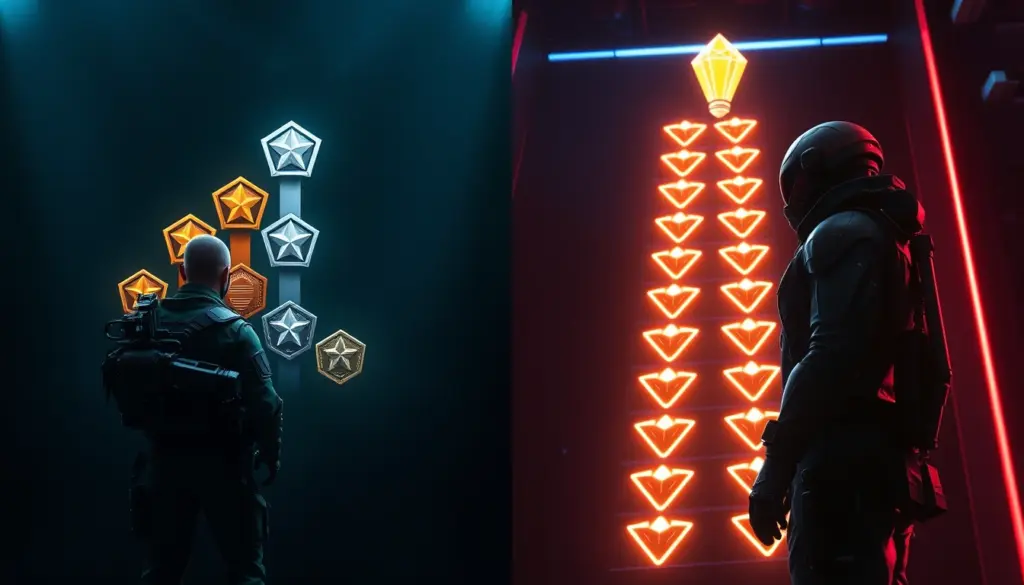
Rainbow Six Siege quietly ripped out one of the most argued-about pieces of its ranked mode on June 2, 2026. Operation System Override killed hidden MMR outright, replacing it with a single visible number called Rank Points, and pushed the ladder from 36 ranks to 40. Valorant did none of that. Riot’s rank system still runs on the same hidden-MMR-plus-visible-rank formula it has used since 2020. Two tactical shooters, two very different philosophies on how much a player should be allowed to see about their own climb. This piece lines up R6 Siege ranks against Valorant ranks tier by tier, using the distribution data, pricing, and esports numbers publishers and trackers have put out in 2026.
Both games sit in the same genre and pull from overlapping audiences, tactical, round-based, five-versus-five shooters where a single mistake can end a round. That overlap is exactly why the comparison matters. Players bounce between the two constantly, whether they are chasing a friend group, following a favorite pro scene, or just burned out on one game’s meta and looking for a change of pace. What they find on the other side is a ranked ladder built on a completely different trust model, and that difference shapes everything from how satisfying a win feels to how believable a loss feels.
Ranked 3.0 Explained: Inside R6 Siege’s 40-Rank Ladder
Ranked 3.0 launched alongside Operation System Override on June 2, 2026, and it changed the one thing longtime R6 Siege players complained about most: the gap between your visible rank and how the game actually rated you. Under the old Ranked 2.0 system, Ubisoft matched players using a hidden MMR value that sat separate from the rank shown on your profile. A player could sit in Gold on paper while the matchmaker quietly treated them as Platinum-strength, and vice versa. Ranked 3.0 deletes that second number. Rank Points, or RP, now do double duty: they set your visible rank and they are the only figure the matchmaker reads.
The tier list itself kept its shape: Copper, Bronze, Silver, Gold, Platinum, Emerald, Diamond, and Champion, eight tiers in total. What changed is Champion. Under Ranked 2.0 it was a single undivided rank sitting above Diamond. Ranked 3.0 splits it into five divisions, Champion V through Champion I, matching the structure every other tier already used. That took the total ladder from 36 ranks to 40, and it tied Champion I directly to R6 Siege’s global leaderboard.
RP Thresholds and What They Mean for Climbing
Ubisoft has not published a full RP-to-rank conversion chart for every tier under Ranked 3.0, but the confirmed anchor points give a decent read on the shape of the curve. Copper spans roughly 0 to 1,599 RP, and Champion begins somewhere north of 5,000 RP based on current guide data. Because RP now drives matchmaking directly, a hot streak translates into tougher lobbies almost immediately, instead of the delayed adjustment players got used to under hidden MMR. Ubisoft has framed the switch as a fix for what it called “MMR anomalies,” the term the studio has used for players stuck in low visible ranks despite a hidden rating that said otherwise.
The old Ranked 2.0 system had run since the ladder was last overhauled, and it worked the way most modern shooter ranks work: a visible tier for show, a hidden MMR for matchmaking. Players who tracked their stats closely noticed the friction first. Someone could post a strong win rate for weeks and still get placed against opponents who felt far stronger than their Gold or Platinum badge implied, because the hidden MMR had already adjusted upward while the visible rank lagged behind. Ranked 3.0 closes that gap by design. There is now exactly one number that moves after every match, and it is the same number stamped on the player’s profile.
Valorant’s Rank Ladder: Iron to Radiant in 25 Steps
Valorant’s ranked mode runs on nine tiers: Iron, Bronze, Silver, Gold, Platinum, Diamond, Ascendant, Immortal, and Radiant. The first eight each carry three divisions, and Radiant sits alone at the top with no subdivisions, for 25 total visible ranks. That is 15 fewer steps than R6 Siege ranks now offer, which means each Valorant promotion covers more ground than each R6 Siege promotion does.
Rank Rating, or RR, governs movement within Valorant ranks. Each division runs on a 0-to-100 RR scale. Hit 100 and a win bumps you up a division; drop below zero after a loss and you slide back one. The catch is that RR gains and losses are not fixed. They flex based on your hidden MMR relative to your visible rank. A player whose MMR sits above their shown rank earns more RR per win and loses less per defeat, which speeds up the climb. A player whose MMR has fallen behind their rank gets the opposite treatment until the numbers resync.
Ascendant: The Tier That Reshaped the Upper Ladder
Ascendant sits between Diamond and Immortal and exists specifically to spread out the top of the ladder, according to multiple 2026 rank-distribution guides. Before Ascendant existed, Immortal and Radiant absorbed a much larger share of strong players. Adding a tier in between thinned that crowd and gave Riot more room to calibrate matchmaking near the top. By mid-2026, Riot has treated the nine-tier, 25-rank structure as settled, with no major redesign announced for the system beyond the standard per-Act tuning Riot applies to RR gain and loss curves.
Valorant organizes its ranked calendar into Episodes and Acts, a structure separate from the seasonal cadence R6 Siege uses around its operation releases. Neither Riot nor Ubisoft has published a directly comparable reset schedule for 2026, so the two games are best compared on ladder shape rather than reset frequency. What the distribution data does show is that Valorant’s mid-to-upper tiers carry a larger share of the population than R6 Siege’s equivalent tiers, a gap the Ascendant tier’s addition was specifically built to create.
R6 Siege vs Valorant Ranks: Full Specs Comparison
Here is how the two systems stack up across every mechanic that actually affects a player’s climb.
| Category | R6 Siege Ranked 3.0 | Valorant Ranked |
|---|---|---|
| Total visible ranks | 40 | 25 |
| Number of tiers | 8 (Copper to Champion) | 9 (Iron to Radiant) |
| Divisions per tier | 5 (V–I), all 8 tiers including Champion | 3 (Iron–Immortal); Radiant has none |
| Hidden MMR | Removed June 2, 2026 | Still active in 2026 |
| Points system | RP (Rank Points), sets rank and matchmaking | RR (Rank Rating), 0–100 per division |
| Top rank | Champion I | Radiant |
| Top-rank population share | 0.4% (source: buyboosting.com) | 0.05% (source: LFCarry) |
| Most populated tier | Bronze, 28.7% | Silver, 22.3% |
| Latest system overhaul | Ranked 3.0, June 2, 2026 | Ascendant tier, stable since prior to 2026 |
| Matchmaking basis | Visible RP only | Hidden MMR plus visible RR |
| Global leaderboard tie-in | Champion I feeds the global leaderboard | Radiant hard-capped near the top 500 per region |
| 2026 flagship esports prize pool | $3,000,000 (Six Invitational 2026) | $5,000,000 (VCT 2026) |
| Publisher-confirmed monthly players | Not publicly disclosed by Ubisoft | 35 million-plus (Riot Games) |
The gap that jumps out first is granularity versus transparency. R6 Siege ranks give players 15 more visible steps to track progress against, but Valorant ranks still hide the number that actually decides who you play against. Neither approach is objectively correct. They optimize for different things, and which one feels better depends heavily on how a given player likes to track their own improvement.
Hidden MMR: Why R6 Siege Killed It and Valorant Kept It
Hidden MMR exists in competitive shooters to solve a real problem: visible rank alone is a slow, noisy signal of current skill. A player can be much better or worse than their shown rank suggests, especially right after a season reset or a long break. A second, invisible number lets the matchmaker react faster than the visible ladder can. The cost is trust. Players cannot see the number deciding their opponents, and when that number and the visible rank disagree, matches feel unfair even when the system is technically working as designed.
That trust gap is the exact complaint Ubisoft cited when explaining Ranked 3.0. A player could grind out a dozen wins in a row, watch their visible rank crawl upward by a division or two, and never understand why the climb felt slower than the win streak suggested. The hidden MMR was quietly absorbing most of the improvement before the visible number caught up. Community feedback around that disconnect built for seasons before Ubisoft acted, and Operation System Override is a direct response to it rather than a routine balance patch.
Ubisoft’s answer in 2026 was to remove the hidden layer entirely. Ranked 3.0 ties matchmaking to RP with no secondary rating running underneath it. Every RP gain now has one job: reflect skill and set the next opponent. Esports-news.co.uk reported that the change specifically targets “MMR anomalies,” Ubisoft’s term for players whose hidden rating diverged sharply from their shown rank.
Riot has made no equivalent move. Valorant’s hidden MMR still governs how much RR you gain or lose relative to your visible rank, and it becomes more influential the higher you climb. Near Immortal and Radiant, a player’s MMR essentially decides whether 100 RR at the top of a division is enough to promote, because Radiant additionally requires sitting within the regional top slice by rating, not just by RR total. Riot’s system rewards raw match volume less and rewards sustained high performance against strong opponents more, which is a deliberate design choice to keep the very top of the ladder scarce.
There is a case for keeping hidden MMR, and it is not just inertia. A purely visible points system can be gamed by farming easy wins against weaker lobbies before the matchmaker fully reacts, at least in theory. A hidden layer smooths that out by reacting to underlying performance signals the visible rank has not caught up to yet. Riot’s bet is that the smoothing is worth the opacity. Ubisoft’s bet, as of June 2026, is that transparency matters more to player trust than the smoothing benefit does. Neither company has walked either position back since the respective systems went live.
Rank Distribution 2026: Where Players Actually Sit
Distribution data tells you more about a rank than its name does. A Diamond in a game where Diamond covers the top 15% of players means something very different from a Diamond covering the top 2%. Here is how the two ladders compare using the most recent 2026 tracker data, cross-checked against Esports Tales and LFCarry for the Valorant side and buyboosting.com for R6 Siege.
| Position (top to bottom) | R6 Siege Tier | R6 Siege % | Valorant Tier | Valorant % |
|---|---|---|---|---|
| 1 (rarest) | Champion | 0.4% | Radiant | 0.05% |
| 2 | Diamond | 2.7% | Immortal | 0.79% |
| 3 | Emerald | 5.5% | Ascendant | 4.41% |
| 4 | Platinum | 7.5% | Diamond | 9.47% |
| 5 | Gold | 11.7% | Platinum | 14.41% |
| 6 | Silver | 18.3% | Gold | 20.94% |
| 7 | Bronze | 28.7% | Silver | 22.32% |
| 8 (largest / entry) | Copper | 25.1% | Bronze | 21.08% |
| 9 | – | – | Iron | 6.51% |
R6 Siege’s ladder is more top-heavy toward the entry tiers. Copper and Bronze together account for roughly 54% of the population, while Valorant’s Iron and Bronze combine for closer to 28%. That gap makes sense given the two games’ age and matchmaking history: R6 Siege’s playerbase includes years of accounts sitting dormant at low ranks, while Valorant’s Ascendant tier was specifically added to spread out its mid-to-upper ladder rather than let players bottleneck lower down. At the very top, both games converge on the same idea, less than half a percent of players ever see Champion or Radiant, but Valorant’s Radiant is roughly eight times rarer relative to its own playerbase than R6 Siege’s Champion is to its own.
It is worth flagging that these numbers move. Ranked 3.0 had only been live a few weeks when the first full distribution tables started circulating, and Ubisoft has not published an official percentage breakdown of its own. The buyboosting.com figures used here are the most complete third-party snapshot available as of July 2026, but expect the shape of the R6 Siege curve to keep shifting for a few more seasons as the playerbase settles into the new RP-only system. Valorant’s numbers, by contrast, are drawn from a mature, multi-year-stable ladder and have stayed within a few percentage points of each other across the LFCarry, BO3.gg, and Esports Tales datasets cited above, which is a good sign the Valorant figures are close to settled.
RP vs RR: How Points and Promotions Actually Work
Both systems use a points ladder under the hood, but they spend those points differently. R6 Siege’s RP is a single running total that maps directly onto your rank tier and division, with no separate cap per division the way Valorant enforces. Valorant’s RR resets to a 0-to-100 scale at every division, and crossing 100 or falling below zero is what triggers a promotion or demotion, rather than simply accumulating points on an open scale.
R6 SIEGE RANKED 3.0 LADDER (40 ranks)
Copper V-I > Bronze V-I > Silver V-I > Gold V-I >
Platinum V-I > Emerald V-I > Diamond V-I > Champion V-I

VALORANT RANKED LADDER (25 ranks)
Iron 1-3 > Bronze 1-3 > Silver 1-3 > Gold 1-3 > Platinum 1-3 >
Diamond 1-3 > Ascendant 1-3 > Immortal 1-3 > Radiant
The practical difference shows up in how deranking feels. R6 Siege ranks fall when RP drops below a tier’s floor, a straightforward function of losses outweighing wins. Valorant ranks can fall the same way inside a division, but Riot’s system also lets hidden MMR quietly throttle RR gains long before an outright demotion happens, so a Valorant player can feel like they are “losing progress” through smaller and smaller RR rewards well before their visible rank actually drops.
The division structure also changes how a comeback feels in each game. In Valorant, clawing back from 0 RR after a bad loss streak means rebuilding an entire 100-point bar before the next promotion registers, a visible, discrete goalpost every single time. In R6 Siege, RP is a continuous total, so a comeback shows up as a smoother climb without a hard division reset in the middle of it. Neither approach is faster in raw terms, they are built from the same underlying idea of points won and lost, but Valorant’s division gates give players more frequent, smaller milestones, while R6 Siege’s open RP scale rewards sustained momentum over a longer stretch of matches.
The Grind to the Top: Champion vs Radiant
Reaching the top rank in either game is a different kind of hard. R6 Siege’s Champion I sits at roughly 0.4% of the ranked population and connects directly to the game’s global leaderboard, so climbing into Champion means competing against a visible, ranked list of the best RP holders in the world. There is no fixed seat count. If enough players push their RP high enough, Champion simply grows to include them.
Valorant’s Radiant works differently. Multiple 2026 trackers, including LFCarry and Tapin.gg, describe it as effectively capped near the top 500 players per region rather than tied to a fixed percentage. That distinction matters more than it sounds. A player can play flawlessly and still not reach Radiant if the regional bar happens to be higher that Act, because Radiant is partly a function of how many other players are also performing well, not just an absolute RR threshold. Champion, by contrast, does not punish you for other players improving at the same time you are.
That soft cap also means Radiant can feel like a moving target across regions. A rating that would land a player in Radiant in a smaller region might only be good enough for Immortal 3 in a region with a deeper pool of elite players, since the cutoff floats with the top 500. R6 Siege’s Champion has no equivalent regional split described in current Ubisoft materials, which makes it a more consistent bar to aim for regardless of where a player queues from, even if the total size of Champion itself is not fixed.
Pricing Comparison: What It Costs to Rank Up
Both games are free to play at the base level, with $0 entry on Ubisoft Store, Steam, and Riot’s own launcher. Where they differ is in the optional spend layered on top, which is worth knowing before you commit hours to either ladder.
| Item | R6 Siege (Siege X) | Valorant |
|---|---|---|
| Base game | Free, $0 | Free, $0 |
| Entry premium edition | Elite Edition, $19.99 (often $9.99 on sale) | No paid editions |
| Top premium edition | Ultimate Edition, $39.99 (often $29.99 on sale) | No paid editions |
| Premium currency name | R6 Credits | Valorant Points (VP) |
| Smallest currency pack | 600 credits, $4.99 | 475 VP, $4.99 |
| Largest currency pack | 16,000 credits, $99.99 | 11,000 VP, $99.99 |
| Seasonal Battle Pass (cash) | Premium Bundle, $19.99 | ~$10 equivalent via VP |
| Seasonal Battle Pass (in-game currency) | 1,200 R6 Credits (~$10) | 1,000 VP (~$9.99) |
Neither game charges anything to play ranked. R6 Siege carries a slightly higher entry cost for players who want operator-unlock shortcuts through the Elite or Ultimate editions, while Valorant sells cosmetics without gatekeeping any agent behind a paywall. Season to season, the actual battle pass spend lands within a dollar of each other, roughly $10 per season either way. The bigger financial decision for most players is not the pass itself but whether to buy premium currency in bulk. Both games sell their top-tier bundle, 16,000 R6 Credits or 11,000 Valorant Points, at the same $99.99 price point, which suggests neither publisher is trying to undercut the other on whale-tier spending.
Esports Money: Six Invitational 2026 vs VCT 2026
The competitive scenes tell a similar story about scale. The Six Invitational 2026 carried a $3,000,000 total prize pool, with champions FaZe Clan, who beat Team Secret 3-1 in the grand final, taking home $1,000,000 of it, according to Ubisoft’s official tournament page and SixStats. The grand final peaked at 264,383 concurrent viewers with an average of 69,595 across the event, per Esports Charts data cited in post-event coverage, and the tournament logged 8,281,763 hours watched over roughly 119 hours of airtime.
Valorant’s competitive circuit outspent that. VCT 2026 opened with a record $5,000,000 total prize pool across the season, the largest financial commitment in the game’s competitive history according to 2026 esports reporting. Valorant Champions 2026, the season’s capstone event, is scheduled for September 24 to October 19, 2026, carrying a $2,250,000 event prize pool with $1,000,000 going to the winner. That gap, $5 million against $3 million, reflects Valorant’s larger overall audience more than it reflects anything about the quality of either game’s ranked ladder. Riot has publicly stated Valorant draws more than 35 million monthly players and around 6.5 million daily players across PC and console. Ubisoft has not released an equivalent official player count for R6 Siege in 2025 or 2026.
That asymmetry in disclosed numbers is itself telling. Riot leans on its player-count figures as a marketing point, publishing them alongside major esports announcements. Ubisoft has instead let viewership and prize-pool numbers speak for the Six Invitational’s health, without pairing them with a global player count. Both approaches can coexist with a healthy ranked ladder, but it does mean anyone trying to compare the true size of the two playerbases is working with an incomplete picture on the R6 Siege side.
Real-World Ranking Scenarios
Numbers on a chart only tell half the story. Here is how the mechanical differences between R6 Siege ranks and Valorant ranks actually play out for players.
- The stuck-in-Gold R6 player, pre-Ranked 3.0: Under the old hidden-MMR system, a player performing above their visible Gold rank could grind wins and barely move, because their hidden rating had already priced in the improvement. Under Ranked 3.0, that same performance now shows up directly as RP gain, closing the gap between how a player performs and where they sit. Community threads about this exact frustration were common in the months before Operation System Override shipped, and they are part of why Ubisoft framed the change as a fix rather than a cosmetic update.
- The Valorant Immortal 2 player whose MMR lags their rank: A player who reached Immortal 2 during a hot streak but has since cooled off will often see shrinking RR gains and steep RR losses, a sign their hidden MMR has fallen below their visible rank even though the rank itself has not moved yet. From the outside, this looks like a losing streak. From the system’s perspective, it is the hidden MMR pulling the visible rank back toward a more accurate read of current form.
- The returning R6 player after a year off: Logging back in after Operation System Override, a returning player finds Champion no longer a single flat rank. It is now five divisions deep, meaning old bragging rights about “reaching Champion” carry less weight than reaching Champion I specifically. The same returning player will also notice their old hidden MMR simply does not exist anymore, replaced entirely by whatever RP total placement or decay assigns them at login.
- The five-stack queuing Valorant across a rank spread: When friends at Gold and Platinum queue together, Valorant’s hidden MMR blends with visible rank to set lobby strength, which can produce noticeably harder games than either player would see solo, even though their visible ranks look moderate. The same group queuing R6 Siege ranks together sees a more predictable jump, since the game’s matchmaker is working from a single blended RP figure rather than a hidden layer stacked on top of it.
- The leaderboard chaser in each game: A player grinding for R6 Siege’s Champion I competes on an open leaderboard with no fixed number of seats. A player grinding for Valorant’s Radiant is effectively racing against a regional cap near the top 500 players, where other people’s performance that Act can shrink the available room at the top. Both chases demand elite play, but only one of them can be blocked purely by other people getting better at the same time.
Migration Guide: Switching Between R6 Siege and Valorant Ranked
Players moving between the two games often carry over instincts that do not transfer cleanly. A habit that made sense under one system can actively work against you under the other, especially anything built around reading your own rank as a literal measure of matchmaking strength. Here is what to adjust in both directions.
Moving from R6 Siege to Valorant
- Stop trusting your visible rank as the full picture. Valorant’s hidden MMR means your actual matchmaking strength can sit above or below what your rank badge shows.
- Expect RR swings to shrink or grow depending on recent form, not stay constant like R6 Siege’s more direct RP gains now do post-Ranked 3.0.
- Treat Immortal and Radiant as a different kind of climb entirely, one gated by regional competition, not just a fixed RR threshold.
- Budget for a five-match placement process before you get your first visible rank, a step R6 Siege’s current RP system handles differently.
Moving from Valorant to R6 Siege
- Take your RP total at face value. Since Ranked 3.0 removed hidden MMR, there is no second number secretly working against or for you.
- Recalibrate your sense of “top rank.” Champion now has five divisions, so reaching Champion V is a very different milestone from reaching Champion I.
- Expect matchmaking to respond faster to hot and cold streaks, since RP feeds the matchmaker directly instead of through a smoothing hidden layer.
- Don’t assume operators are gated by rank the way agents never are in Valorant. R6 Siege’s operator roster is unlocked through progression and purchases, separate from ranked standing.
Pros and Cons of Each Ranked System
R6 Siege Ranked 3.0: Pros and Cons
- Pro: No hidden MMR means the number you see is the number the matchmaker uses.
- Pro: 40 ranks give finer-grained progress tracking than Valorant’s 25.
- Pro: Champion I ties directly into a public global leaderboard with no fixed seat cap.
- Con: Over half the playerbase sits in Copper or Bronze, which can make early climbing feel slow against a wide range of skill levels.
- Con: Ubisoft has not published exact RP thresholds for every tier, leaving some guesswork around mid-ladder promotions.
Valorant Ranked: Pros and Cons
- Pro: Ascendant’s addition spread out the mid-to-upper ladder, reducing bottlenecks below Immortal.
- Pro: A larger, Riot-confirmed playerbase (35 million-plus monthly) means faster matchmaking across most ranks.
- Pro: Radiant’s rarity, 0.05% of players, gives the top rank real prestige.
- Con: Hidden MMR still decides how much RR you gain or lose, which frustrates players who cannot see why their climb slowed.
- Con: Radiant’s regional cap means individual performance alone does not guarantee the rank.
Which Rank System Fits Which Player: 5 Use Cases
- Solo queue grinders who distrust hidden systems: R6 Siege Ranked 3.0 fits best, since RP is the only number in play and matches the visible rank exactly.
- Players chasing the rarest possible achievement: Valorant’s Radiant, at 0.05% of the playerbase and capped by region, is statistically the harder target of the two.
- Squad-based players who queue with mixed skill levels: R6 Siege ranks respond more predictably to RP totals, which can make five-stack matchmaking feel more consistent than Valorant’s MMR-blended lobbies.
- New tactical shooter players choosing a first ranked ladder: Valorant’s simpler 25-rank structure and heavier population in Silver through Platinum offers a gentler on-ramp than R6 Siege’s 40-rank ladder.
- Competitive-scene spectators and aspiring pros: Valorant’s larger 2026 prize pool ($5,000,000 via VCT) and bigger confirmed playerbase point toward a deeper pro pathway, though R6 Siege’s Six Invitational still drew a peak of 264,383 concurrent viewers.
None of these use cases are mutually exclusive. A player can run R6 Siege as a primary competitive outlet while keeping Valorant installed for a change of pace, or the reverse. The point of laying out R6 Siege ranks against Valorant ranks side by side is not to crown one system correct, it is to make the tradeoffs visible enough that a player can pick the ladder that matches how they actually want to spend their climbing time.
The Verdict: Which Ranked System Wins in 2026
There is no single winner here, because the two systems are solving different problems. If the goal is trust, R6 Siege Ranked 3.0 takes it clearly. Removing hidden MMR on June 2, 2026 means R6 Siege ranks now say exactly what the matchmaker is doing, and the added Champion divisions give players a finer read on progress at the very top. If the goal is prestige and scale, Valorant keeps the edge. Its hidden MMR system is more opaque, but Radiant’s 0.05% rarity, the $5,000,000 VCT 2026 prize pool, and Riot’s confirmed 35-million-plus monthly player base give Valorant ranks a heavier competitive weight behind every promotion.
Cost is close to a wash. Both games are free at the door, both battle passes land around $10 a season, and neither publisher gates ranked play behind a purchase. The real deciding factor comes down to what frustrates a given player more: not knowing the number that decides your opponents, or knowing your rank ladder has fewer, coarser steps to climb. R6 Siege answers the first concern directly. Valorant never claimed to be solving it in the first place.
Players who have burned time distrusting a hidden number should lean toward R6 Siege. Players chasing the hardest possible rank to put on a resume should lean toward Valorant. Both are free to try, and switching costs nothing but the time it takes to relearn a new ladder.
Frequently Asked Questions
Does R6 Siege still use hidden MMR in 2026?
No. Ubisoft removed hidden MMR entirely with Ranked 3.0 on June 2, 2026. Rank Points now handle both the visible rank and matchmaking directly.
How many ranks does R6 Siege have now?
40, spread across 8 tiers (Copper, Bronze, Silver, Gold, Platinum, Emerald, Diamond, Champion), each with 5 divisions numbered V through I.
Does Valorant have hidden MMR in 2026?
Yes. Valorant’s ranked system still runs hidden MMR alongside visible RR, and it directly influences how much RR you gain or lose per match.
Which is harder to reach, R6 Siege Champion or Valorant Radiant?
Radiant is rarer relative to its own playerbase, at roughly 0.05% versus Champion’s 0.4%, and Radiant is effectively capped near the top 500 players per region rather than tied to an open threshold.
How much does it cost to play R6 Siege and Valorant?
Both are free to play, $0 for the base game. R6 Siege sells optional Elite ($19.99) and Ultimate ($39.99) editions for faster operator access, while Valorant sells cosmetics only.
How do the Battle Pass prices compare?
R6 Siege’s Premium Battle Pass runs 1,200 R6 Credits, about $10, or $19.99 as a cash bundle. Valorant’s Battle Pass costs 1,000 Valorant Points, roughly $9.99. They land within a dollar of each other.
Which game has the bigger esports prize pool in 2026?
Valorant. VCT 2026 carries a record $5,000,000 total prize pool, ahead of the Six Invitational 2026’s $3,000,000, which FaZe Clan won as champions.
Does rank carry over between seasons in either game?
Both games apply a seasonal soft reset that pushes players down relative to their prior rank, standard practice across tactical shooters. Neither Ubisoft nor Riot has published the exact reset math for 2026.
Can I still play R6 Siege ranked without touching the new Champion divisions?
Yes. Ranked 3.0 applies to every tier automatically, but the five Champion divisions only become relevant once a player’s RP crosses the Champion threshold. Everyone below that plays the same ranked mode as before, just with RP replacing hidden MMR as the only rating in play.
Is it easier to smurf in R6 Siege or Valorant?
Neither publisher has released 2026 data specifically on smurf rates. What the mechanics suggest is that Valorant’s placement process and hidden MMR are designed to correct a smurf’s visible rank faster than a flat RP climb would, though real-world results depend on how many games a smurf account plays before the system reacts.
Related Coverage
- Rainbow Six Siege Ranks Guide: 40 Ranks, 12 Steps [2026]
- Rainbow Six Siege Stats Tracker Setup: 10 Steps, 30 Min [2026]
- CS2 Ranks vs ESEA vs FACEIT: 25M vs 3M Players [2026]
- CS2 Premier vs Competitive Rank: 7 Tiers vs 18 Ranks [2026]
- Call of Duty Ranked Play Drops Hidden MMR, Flat SR [2026]
- More Esports Coverage