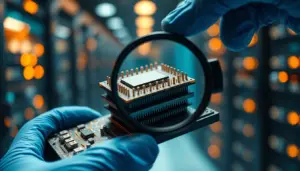

Hewlett Packard Enterprise closed at $58.79 on August 12, 2026, a fresh 52-week high, according to Yahoo Finance, which put the stock up 159.3% year to date and 188.9% over the trailing twelve months. The rally traces back to a single Taipei stage on June 1, 2026, when HPE unveiled the ProLiant Compute DL394 Gen12, the first server built around Nvidia’s new Vera CPU. Nvidia’s pitch, echoed across its own blog and HPE’s product materials, was blunt: agentic AI workloads chew through orchestration and tool calls in ways x86 chips were never designed to handle, and enterprises need a CPU built for that job specifically.
Three months later, the picture is messier than the headline number suggests. HPE stock has swung from that August 12 high down to $53.13 on August 19 (a 4.6% single-session drop), before settling around $54.31 to $55.10 as of today, August 27, 2026. Meanwhile Dell and Supermicro are racing HPE to market with their own Nvidia Vera and Blackwell-based systems, and HPE’s own fiscal Q3 2026 earnings call isn’t until September 2. This is a story about a real product, a real stock move, and a genuinely contested race for who controls the hardware layer under the next wave of AI agents.
What HPE Actually Shipped: Inside the ProLiant Compute DL394 Gen12
The HPE ProLiant Compute DL394 Gen12 is a 2U server built around Nvidia’s Vera CPU, positioned as a new addition to the “NVIDIA AI Computing by HPE” portfolio. HPE describes it as purpose-built for agentic AI and reinforcement learning workloads, pairing the Vera chip with HPE’s iLO 7 management controller and HPE Compute Ops Management for fleet-level monitoring. The system also carries HPE’s Silicon Root of Trust, the firmware-level security check the company has used across its ProLiant line for several generations now.
What separates this box from a standard AI server refresh is the CPU choice. Nvidia Vera isn’t a GPU accelerator riding shotgun on an Intel or AMD motherboard, it’s the primary processor, marketed as the first CPU designed from the ground up for the agent loop: the constant back-and-forth of tool calls, orchestration logic, and real-time data movement that autonomous AI agents generate when they’re planning and executing multi-step tasks rather than just answering a single prompt.
“Purpose-built for the age of agentic AI and reinforcement learning, the HPE ProLiant Compute DL394 Gen12 features the NVIDIA Vera CPU along with industry-leading iLO 7 for next-level security and HPE Compute Ops Management for AI-driven insights, delivering breakthrough performance and energy efficiency.”
Hewlett Packard Enterprise, official product page
HPE’s own announcement is direct about what the box is for: “HPE ProLiant Compute DL394 Gen12 is a 2U server that helps customers advance the adoption of AI computing in their organization,” the company said in its Computex press release. No public datasheet has surfaced yet with core counts, memory channels, or PCIe lane totals, which is unusual for HPE this close to a general-availability date and suggests final binning of the Vera silicon is still in progress.
Nvidia Vera: The First CPU Built for the Agent Loop
Nvidia has spent the past two years building out an entire chip family under the Vera Rubin banner, and Vera is the CPU half of that pairing (Rubin is the corresponding GPU generation). Nvidia frames Vera as a departure from general-purpose server CPUs, tuned instead for low-latency, deterministic performance inside AI factories, the term Nvidia and its hardware partners now use for data centers built specifically to run large-scale inference and agent workloads.
“Vera is the first CPU built for agents, designed for the tool calls, orchestration and real-time data processing required across the agent loop, bringing deterministic, low-latency performance into HPE Private Cloud AI.”
NVIDIA, official blog post
That framing matters commercially. For most of the GPU boom, CPUs in AI servers were a supporting cast member, cheap x86 parts from Intel or AMD that fed data to the GPUs doing the real work. Nvidia buying (through design partnership, not acquisition) its way into the CPU socket itself, rather than just the accelerator slot, is a bid to capture more of the bill of materials on every AI server sold, and to lock customers into a tighter Nvidia software and hardware stack. HPE isn’t alone in adopting Vera. Dell has its own Vera-based PowerEdge line in the pipeline, which tells you Nvidia is selling the chip broadly rather than giving HPE an exclusive.
On availability, there’s a real distinction worth flagging that’s easy to miss in the coverage: HPE’s press release says the standalone DL394 Gen12 server ships in fall 2026, while Nvidia’s own blog post describes the DL394 Gen12 as part of HPE Private Cloud AI, a turnkey AI factory bundle co-engineered with Nvidia, arriving in 2027. Those aren’t contradictory, they’re two different products on two different clocks: buy the server on its own this fall, or wait for the fully managed, pre-integrated rack-scale package next year.
HPE’s Stock Ride, From the Computex Pop to August’s Whipsaw
The stock move that gave this story its headline actually happened on June 1, 2026, the day of the Computex announcement, which landed alongside an HPE earnings report that CNBC described as the company’s biggest beat since 2018. HPE shares jumped roughly 30% that day, with Quartz separately reporting a premarket surge of more than 7% tied directly to the Vera CPU server reveal, enough to put the stock on track for a record open. That combination, an earnings beat plus a splashy Nvidia-aligned product launch, is what actually detonated the initial move, not the server announcement in isolation.
Since then, the stock has kept climbing but with real turbulence. Here’s the timeline as reported through August 27, 2026:
| Date | Price / Move | Detail | Source |
|---|---|---|---|
| June 1, 2026 | ~+30% intraday | Computex reveal of DL394 Gen12 lands alongside HPE’s biggest earnings beat since 2018 | CNBC |
| June 1, 2026 | +7%+ premarket | Stock positioned for a potential record open on the Vera CPU server news | Quartz |
| August 12, 2026 | $58.79 (52-week high) | YTD gain of 159.3%, trailing 12-month gain of 188.9% | Yahoo Finance |
| August 13, 2026 | +5.97% to $62.30 intraday | Reported roughly 3% shy of the stock’s 52-week peak in the same session | Market data report |
| August 19, 2026 | -4.6% to $53.13 | Single-session pullback amid broader tech valuation jitters | Valuation-focused coverage |
| August 27, 2026 | ~$54.31–$55.10 | Current trading range as of publication, per real-time quotes | Multiple market data feeds |
Two things stand out in that table. First, the August 12 and August 13 figures sit oddly close together despite coming from different reports, a reminder that intraday quote services and closing-price trackers don’t always agree to the dollar, and readers checking a live ticker should expect some noise against any single cited figure. Second, the swing from $58.79 to $53.13 in one week, a drop of roughly 9.6%, shows this is not a one-way trade. HPE stock is being priced on a live debate about whether the Vera CPU server business will actually convert into revenue on the fall 2026 schedule HPE has promised, or slip the way complex enterprise hardware launches often do.
Why September 2 Matters More Than Any Single August Headline
HPE announced on August 12, 2026 that its fiscal third-quarter 2026 earnings call is scheduled for September 2, 2026, covering the quarter that ended July 31, 2026. That’s the first earnings report to land fully inside the DL394 Gen12 pre-order and marketing window, and it’s the report investors will use to check whether server bookings tied to the Vera CPU line are actually materializing, or whether the June and August stock moves ran ahead of real demand.
That’s also the structural risk in a stock that’s already up roughly 159% for the year: expectations are now baked in. A server business needs signed orders and shipped units to justify a nearly 60% climb since the June low, and HPE has not yet reported a quarter that includes DL394 Gen12 bookings. Until September 2, every price move between now and then is trading on anticipation, not confirmed results.
Historical Context: HPE’s Long Climb Out of the Commodity Server Trap
It’s worth remembering where HPE was a decade ago to understand why this rally matters to the company specifically. HPE split from Hewlett-Packard’s PC and printer business in 2015, inheriting an enterprise server and services unit that spent years fighting margin compression as commodity x86 servers became a race-to-the-bottom business, squeezed by cloud providers building their own hardware and by rivals like Dell undercutting on price. HPE’s answer, pursued across multiple CEOs, was to push upmarket into higher-margin categories: hybrid cloud, high-performance computing (via the 2019 Cray acquisition), and more recently, AI infrastructure.
The Vera CPU partnership is the clearest sign yet that the strategy is paying off in market perception, if not yet in confirmed quarterly revenue. Being the launch partner for Nvidia’s first agentic-AI-specific CPU, ahead of (or at least alongside) Dell, put HPE back in a conversation about frontier AI infrastructure that it had largely ceded to Dell, Supermicro, and the hyperscalers’ custom silicon programs over the past three years. Whether that positioning holds depends heavily on shipping the DL394 Gen12 on time and at volume this fall.
Competitive Landscape: HPE vs. Dell vs. Supermicro on Vera and Blackwell
HPE is not winning the race to market on raw availability. As of late August 2026, Dell and Supermicro both have Nvidia-chip servers shipping sooner or already in production, even though HPE got the bigger stock reaction. Here’s how the three vendors compare on their current Nvidia-aligned AI server lines:
| Vendor | Flagship Nvidia-chip server | Nvidia silicon | Availability | Status as of August 2026 |
|---|---|---|---|---|
| HPE | ProLiant Compute DL394 Gen12 | Vera CPU | Fall 2026 (standalone); 2027 (as part of Private Cloud AI bundle) | Pre-launch, unveiled at Computex June 2026 |
| HPE | Vera Rubin NVL72 by HPE | Vera CPU + Rubin GPU (rack-scale) | December 2026 | Announced, not yet shipping |
| Dell | PowerEdge R9822 / M9822 | Vera CPU | September 2026 | Pre-launch, ahead of HPE’s standalone window |
| Dell | PowerEdge XE9812 | Vera Rubin (rack-scale) | Second half of 2026 | In development; some PowerEdge systems with RTX PRO 4500 Blackwell Server Edition already shipping |
| Supermicro | HGX B300 / HGX B200 / GB200 NVL72 | Blackwell family GPUs | Available now | Full production, shipping to customers today |
The pattern is clear: Supermicro built its business on being first to ship every new Nvidia platform, and it’s holding that position with Blackwell-family GPUs already in full production. Dell’s Vera-based PowerEdge R9822 and M9822 are targeting a September 2026 launch, which would put Dell’s CPU-level Vera servers on shelves before HPE’s DL394 Gen12 completes its fall rollout, even though HPE got the headline stock pop. HPE’s real advantage isn’t speed, it’s the co-marketing spotlight it captured at Computex and the fact that its Vera Rubin NVL72 rack-scale system, due in December 2026, extends the partnership into Nvidia’s full rack-scale category rather than a single server SKU.
What “Agentic AI” Actually Means for Buyers, Beyond the Marketing
“Agentic AI” has become one of 2026’s most overused phrases, but the underlying hardware argument here is specific and testable. A chatbot answering a single question completes one inference pass. An AI agent booking a flight, querying three internal databases, calling an external API, and reasoning about the results before taking an action generates a very different load pattern: bursty, latency-sensitive, and heavy on orchestration logic that traditionally runs on the CPU while the GPU handles the actual model math.
Nvidia’s argument is that a general-purpose x86 CPU becomes the bottleneck in that pattern once agent workloads scale, because it wasn’t designed for the tool-call-heavy, low-latency orchestration loop agents require. Vera is Nvidia’s answer to that specific bottleneck, not a faster CPU in the traditional sense, but one restructured around a different kind of workload. Enterprise buyers evaluating the DL394 Gen12 this fall should treat that claim as something to benchmark against their actual agent stack, not accept at face value, since Nvidia has every incentive to frame the comparison in Vera’s favor.
Market Impact: What This Means Beyond HPE
The DL394 Gen12 launch has ripple effects well past HPE’s own stock chart. It validates a new product category, CPU-centric agentic AI servers, that Dell, Lenovo, and other Nvidia partners will now need to answer with their own Vera-based or Vera-competitive offerings. It also reinforces Nvidia’s expanding footprint into the CPU socket, a category it barely touched five years ago, which puts incremental pressure on Intel and AMD’s server CPU businesses even though neither company has a like-for-like agentic AI part on the market yet.
For enterprise IT buyers, the practical effect is a new evaluation cycle this fall: whether to wait for Vera-based hardware from HPE or Dell, or to keep buying proven Blackwell-GPU systems from Supermicro that are shipping today. That’s a real trade-off between bleeding-edge CPU architecture built for agents and known-good availability, and it’s the decision procurement teams are actively working through right now, not a hypothetical for next year.
Is the Rally Overdone? The Case for Skepticism
A stock up 159% in a year on the strength of a product that hasn’t shipped yet, paired with an earnings report still ten days out as of this writing, is a legitimate setup for disappointment. The August 19 pullback to $53.13, a 4.6% single-day drop, shows the market is already second-guessing the pace of the climb. If HPE’s September 2 earnings call doesn’t show concrete DL394 Gen12 order momentum, or if Dell’s competing Vera-based PowerEdge servers land first and pull enterprise commitments away, the “record high” framing from mid-August could look premature within a single quarter.
There’s also the availability gap worth weighing: HPE’s own materials describe two different timelines for essentially the same technology, fall 2026 for the standalone server, 2027 for the fully bundled Private Cloud AI version. Customers who want the complete, supported AI factory experience rather than a standalone box are looking at a longer wait than the fall 2026 headline implies.
Predictions: Where This Goes Next
- HPE’s September 2 earnings call becomes the next major catalyst. Expect the stock to move sharply in either direction depending on whether HPE reports concrete DL394 Gen12 order backlog, not just marketing momentum.
- Dell’s PowerEdge R9822/M9822 launch in September will draw direct comparisons. If Dell ships its Vera-based servers before or alongside HPE’s fall window, expect enterprise buyers to treat pricing and support terms, not chip architecture, as the deciding factor.
- Intel and AMD will respond with their own agent-optimized CPU messaging by early 2027, even without a true architectural equivalent to Vera yet, simply to slow enterprise defection toward Nvidia’s CPU-plus-GPU bundle.
- The gap between “fall 2026 server” and “2027 Private Cloud AI bundle” will cause real customer confusion, and HPE will likely need to clarify pricing and packaging for each tier separately before broad enterprise adoption.
- Expect more stock volatility, not less, through year-end, as HPE, Dell, and Supermicro all report earnings on staggered schedules that will each be read as a referendum on the entire agentic AI hardware category.
What to Watch Before You Evaluate This Hardware
For technical buyers actually weighing a DL394 Gen12 purchase this fall, the practical checklist is straightforward: confirm which tier you’re buying (standalone server versus the full Private Cloud AI bundle), get a firm delivery date in writing given HPE hasn’t published a detailed datasheet yet, and benchmark Vera’s orchestration claims against your own agent workload rather than Nvidia’s marketing numbers. Compare total cost of ownership against Supermicro’s already-shipping Blackwell systems, which carry lower deployment risk simply by being available today rather than this fall.
Frequently Asked Questions
What is the HPE ProLiant Compute DL394 Gen12?
It’s a 2U server unveiled by HPE at Computex 2026 on June 1, built around Nvidia’s new Vera CPU. HPE markets it as purpose-built for agentic AI and reinforcement learning workloads, with iLO 7 management and Silicon Root of Trust security built in.
Why did HPE stock hit a 52-week high in August 2026?
HPE closed at $58.79 on August 12, 2026, per Yahoo Finance, extending a rally that started June 1 when the DL394 Gen12 launch coincided with what CNBC called HPE’s biggest earnings beat since 2018. The stock was up 159.3% year to date at that point.
When is the HPE ProLiant Compute DL394 Gen12 actually available?
HPE’s press release states fall 2026 for the standalone server. Nvidia’s blog describes the same server as part of HPE Private Cloud AI, a fully bundled turnkey AI factory offering, arriving in 2027. Buyers should clarify which version they’re ordering.
What is Nvidia Vera and how is it different from a normal server CPU?
Vera is Nvidia’s first CPU, part of the Vera Rubin platform, designed specifically for the orchestration and tool-call-heavy workload pattern generated by AI agents, rather than general-purpose computing. Nvidia describes it as delivering deterministic, low-latency performance for that specific use case.
Is HPE ahead of Dell and Supermicro on Nvidia AI servers?
Not on raw shipping dates. Supermicro’s Blackwell-based systems are already in full production. Dell’s Vera-based PowerEdge R9822 and M9822 are targeting September 2026, ahead of or roughly alongside HPE’s fall 2026 window for the DL394 Gen12.
Has HPE reported fiscal Q3 2026 earnings yet?
No. HPE announced on August 12, 2026 that its fiscal Q3 2026 earnings call, covering the quarter ended July 31, 2026, is scheduled for September 2, 2026. As of this article’s publication, results have not yet been reported.
Is HPE stock at an all-time high or a 52-week high?
Coverage from mid-August 2026 specifically describes a 52-week high of $58.79, not a confirmed all-time high. The stock has since pulled back to a range around $54–$55 as of August 27, 2026.
What is the HPE Vera Rubin NVL72 by HPE?
It’s HPE’s rack-scale AI system combining Nvidia’s Vera CPU and Rubin GPU generation, separate from the single-server DL394 Gen12. HPE has slated it for December 2026, positioning it as the company’s high-end answer to Nvidia’s full rack-scale category.
Related Coverage
- Jalapeño Chip: OpenAI Targets Nvidia’s 75% Margin [2026]
- AWS-NVIDIA Deal Adds 2M GPUs as AWS Buys DuckDB [2026]
- RAM Prices Up 89%: AI Memory Crunch Hits Gaming [2026]
- Run LLMs Locally on RTX 5090: 12 Steps, 45 Min [2026]
- Google Cloud Hits 63% Growth, Outpaces AWS, Azure [2026]
- More Hardware & Chips coverage