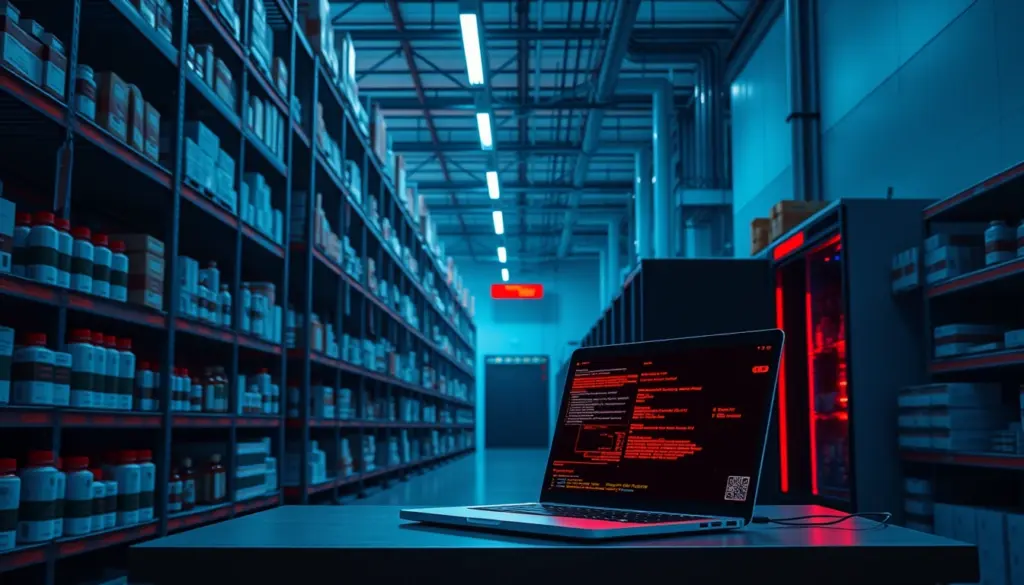
McKesson Corporation, the pharmaceutical distributor that moves roughly a third of all prescription drugs sold in the United States, spent the last weekend of August confirming what security researchers had already guessed: hackers had been inside its systems for days, and they wanted money to stay quiet. The company disclosed a cybersecurity incident on August 28, 2026, days after discovering unauthorized access to several cloud-hosted business applications. The extortion group ShinyHunters claims it walked away with 284 million patient-related records, roughly 1 terabyte of data, and is now demanding $55,236,150 to not publish it.
McKesson has not confirmed that number. Nobody outside the company and the attackers has independently verified it either. But the shape of the story, a healthcare giant, a well-known extortion crew, cloud platforms instead of on-premise servers, and a ransom demand precise to the dollar, has become the defining pattern of 2026’s breach economy. This is a look at what’s confirmed, what’s still just a claim, and why this particular breach may end up costing more than most.
What Happened: McKesson’s August 2026 Breach Timeline
According to McKesson’s own SEC 8-K filing, the company discovered the cybersecurity incident on August 25, 2026. That filing describes it as a material event affecting the company’s information systems, though the language stays deliberately high-level: unauthorized access, third-party applications, data exfiltration.
Three days later, on August 28, McKesson went public. Bleeping Computer reported that the healthcare and pharmaceutical distribution giant disclosed a cybersecurity incident involving unauthorized access to third-party applications and data theft, and that ShinyHunters was already claiming credit. By August 29, McKesson updated its own breach notification page to say the exfiltration was tied to a subset of customers within its Oncology & Multispecialty and Medical-Surgical business units.
ShinyHunters says the actual data theft happened earlier and faster than the public disclosure suggests. The group claims it exfiltrated data over a four-day window between August 21 and August 25, then reached out to McKesson once the haul was complete. By August 29, McKesson appeared on ShinyHunters’ leak site with a threat to publish everything if the company didn’t pay within 72 hours of first contact, putting the deadline right around September 1, 2026. TechCrunch reported that McKesson also warned customers to expect intermittent service degradation while it worked through the incident.
| Date (2026) | Event |
|---|---|
| Aug 21 | ShinyHunters claims exfiltration begins |
| Aug 25 | McKesson discovers the incident; ShinyHunters claims exfiltration ends and contacts the company |
| Aug 28 | McKesson publicly discloses the breach; files SEC 8-K |
| Aug 29 | McKesson updates breach page naming affected business units; McKesson appears on ShinyHunters’ leak site |
| Sept 1 (approx.) | ShinyHunters’ 72-hour ransom deadline lapses |
Who Is ShinyHunters and Why McKesson Is Its Biggest Target Yet
ShinyHunters has been one of the most active data-extortion crews of the past two years, according to TechCrunch’s reporting on the McKesson incident. The group doesn’t typically deploy ransomware that encrypts files. Instead, it steals data outright and threatens to publish or sell it unless it gets paid, a model that has proven cheaper to run and harder to defend against than traditional ransomware, since there’s no encryption to detect and no malware payload sitting on disk.
Shattered.io has tracked several ShinyHunters campaigns already this year, including breaches at Rockstar Games, Spectrum/Charter, Carnival Corporation, and Dutch telecom Odido. Those hits spanned gaming, telecom, and travel. McKesson is different: it’s the group’s deepest push yet into healthcare, and healthcare data carries a cost premium that entertainment and telecom records simply don’t.
The HIPAA eTool blog, tracking ShinyHunters’ pattern of targeting healthcare and pharmaceutical companies, has separately flagged the group’s renewed focus on the sector this year. The McKesson breach fits a recognizable playbook: compromise identity infrastructure first, then pivot into the cloud platforms that actually hold the valuable data.
The 284 Million Record Claim: What’s Confirmed and What Isn’t
Here’s where the story gets murkier. ShinyHunters says it took roughly 284 million patient-related data records, plus a separate haul from a Salesforce environment, adding up to about 1 terabyte of data. That number has been repeated across nearly every outlet covering the story. It has not been confirmed by McKesson.
The distinction matters more than it looks. 284 million is a count of database rows, not unique patients. A single patient’s record can generate dozens of rows across a Snowflake data warehouse: one for each prescription fill, each interaction log, each billing event. Security researchers covering the incident have pointed out that the true number of affected individuals is very likely far smaller than 284 million, possibly in the tens of millions, but nobody outside McKesson and the attackers currently knows the real figure. McKesson’s own public statements have stopped short of validating any specific record or patient count, describing the impact only as affecting a subset of customers in two named business units.
That gap between the headline number and the confirmed number is exactly the kind of thing that inflates panic in the first 72 hours of a breach story and then quietly gets revised downward weeks later, once forensic firms finish their work. It happened with several breaches in past years, and there’s no reason to assume this one will play out differently.
What Data Was Allegedly Stolen
According to TechCrunch’s reporting, the hackers say the stolen data includes names, addresses, and Social Security numbers, along with protected health information such as diagnoses, medications, allergies, and patient notes. Other coverage of the claim describes prescription records, billing details, and even hospice or terminal-illness information and causes of death among the exposed categories, given the sensitivity of the oncology-related business unit involved. TechCrunch also reported that the stolen data included McKesson employee information, including home addresses, separate from the patient-facing records.
If even a fraction of that description holds up under forensic review, this becomes one of the more sensitive healthcare exposures of the year, not because of the raw record count, but because of what’s in the records. Financial account numbers can be changed. A cause-of-death entry or a hospice referral tied to a real name cannot be undone once it’s public.
How the Breach Happened: Vishing, Okta and the Cloud
The attack vector lines up with ShinyHunters’ known method. According to Bleeping Computer and TechCrunch’s reporting on the incident, the group used voice phishing, commonly called vishing, and social engineering against McKesson employees to trick them into granting access to the company’s network. From there, attackers compromised Okta single sign-on accounts, which then opened the door into Salesforce and Snowflake, the two cloud platforms named across multiple reports as the source of the stolen data.
This is the same broad technique that has powered a wave of enterprise breaches over the past two years: call an employee, impersonate IT support, walk them through resetting or approving an SSO login, and use that single compromised identity to reach whatever cloud data platforms trust that identity provider. It doesn’t require a software vulnerability. It requires one distracted employee on one phone call.
Snowflake and Salesforce are not inherently less secure than on-premise databases, but they are frequently misconfigured, and they are reachable from anywhere once an attacker holds valid credentials. The 2026 pattern of Okta-to-Snowflake breaches is now well-established enough that identity providers and cloud data platforms are separately under pressure to add stronger phishing-resistant authentication by default rather than leaving it opt-in.
The $55.2 Million Ransom Demand
ShinyHunters demanded exactly $55,236,150 from McKesson, giving the company 72 hours to respond once the group made contact after finishing exfiltration on August 25. That is an unusually precise figure for a ransom demand, precise enough that it looks calculated rather than round-numbered for effect, though no outlet has reported the group’s methodology for arriving at it.
According to reporting based on ShinyHunters’ own claims, McKesson did not pay and did not engage in negotiation. That refusal is consistent with how most large, publicly traded companies now respond to extortion demands, partly on legal advice, partly because paying doesn’t guarantee data actually gets deleted, and partly because a growing number of jurisdictions are moving toward restricting or discouraging ransom payments altogether. The tradeoff is that refusal usually means the data gets published or auctioned, which is exactly the threat ShinyHunters put on the table with its leak-site posting on August 29.
McKesson’s Official Response and What It Hasn’t Said
McKesson’s public language has stayed carefully narrow. The company has confirmed unauthorized access to third-party applications, confirmed exfiltration of certain data, and confirmed that the impact touched a subset of customers within its Oncology & Multispecialty and Medical-Surgical business units. It has warned customers of intermittent service degradation while investigating.
What McKesson has not done, at least as of this writing, is confirm the 284 million figure, detail the exact data fields exposed, name a total number of affected individuals, or say whether it has engaged federal law enforcement. None of the outlets tracking this story have reported a specific stock price reaction for McKesson (NYSE: MCK), a formal HHS Office for Civil Rights investigation, a state attorney general action, or a filed class action lawsuit tied to this incident. Given typical timelines for healthcare breach litigation in the United States, legal filings are more likely to surface in the weeks ahead than in the initial 72 hours of disclosure.
McKesson vs. ShinyHunters’ Other 2026 Victims
McKesson is not ShinyHunters’ first big score this year, but it may be its most consequential, given the sensitivity of health data compared to gaming accounts or cable subscriber lists. Here’s how the claimed scale compares with other breaches shattered.io has covered involving the same extortion crew.
| Victim (2026) | Industry | Records/Data Claimed | Ransom Demand | Status |
|---|---|---|---|---|
| McKesson | Healthcare distribution | ~284M patient-related rows (unconfirmed) | $55,236,150 | Refused, per ShinyHunters |
| Canvas | Education tech | 275M records | Not publicly disclosed | Disputed scope |
| Rockstar Games | Gaming | 78.6M records | Not publicly disclosed | Under investigation |
| Coupang | E-commerce | 33.7M records | N/A | $409M regulatory fine issued |
| Odido | Telecom | 6.5M records | €1M | Refused |
| Carnival Corporation | Travel/cruise | 6M passports | Not publicly disclosed | Refused |
| Spectrum/Charter | Telecom | 4.9M records | Not publicly disclosed | Under investigation |
| Hasbro | Consumer goods | 436 employees (SSNs) | Not publicly disclosed | Under investigation |
The record count alone doesn’t tell the full story. Canvas and Rockstar Games both involve larger raw numbers of accounts than most of ShinyHunters’ other 2026 targets, but the data types at stake, gameplay accounts, student records, are far less permanently damaging than protected health information. McKesson sits in a category of its own because of what’s actually inside the alleged data set, not just how big it is.
Historical Context: Why Healthcare Breaches Cost the Most
This isn’t an isolated bad quarter for healthcare cybersecurity. According to IBM’s Cost of a Data Breach Report 2025, healthcare has now been the single costliest industry for data breaches for 14 consecutive years, averaging $7.42 million per incident, well above the $4.44 million global average across all industries. Healthcare breaches also take the longest to find and contain: 279 days on average, more than five weeks longer than the 241-day global average, according to the same report.
Part of that cost premium comes from regulation. Under HIPAA’s Breach Notification Rule, covered entities must notify affected individuals and the Department of Health and Human Services without unreasonable delay and no later than 60 days after discovering a breach affecting 500 or more people. That clock is already running for McKesson. According to HIPAA Journal’s tracking of HHS OCR’s public breach portal, 772 large healthcare data breaches were reported to federal regulators in 2025 alone, a record incident count even as the total number of affected individuals varied significantly depending on methodology and reporting source.
| Industry | Average Cost Per Breach (IBM, 2025) |
|---|---|
| Healthcare | $7.42 million |
| Financial services | $5.56 million |
| Industrial | $5.00 million |
| Energy | $4.83 million |
| Technology | $4.79 million |
| Pharmaceuticals | $4.61 million |
| Global average (all industries) | $4.44 million |
McKesson isn’t a hospital, but it sits close enough to patient care, distributing prescription drugs and oncology-related products, that the exposed data reportedly includes clinical detail typically associated with direct-care providers. That puts it closer to the high end of the healthcare cost curve than a typical pharmaceutical logistics breach might otherwise land.
Market and Industry Impact
McKesson is a Fortune 10 company and one of the three dominant pharmaceutical distributors in the United States, alongside Cencora and Cardinal Health. A breach at that scale, real or overstated, has implications that reach past McKesson’s own balance sheet. Hospitals, pharmacies, and oncology clinics that rely on McKesson’s distribution and billing systems are now facing their own disclosure obligations if patient data flowing through those systems was exposed, even though McKesson, not the clinics themselves, was the entry point.
There’s also a vendor-risk angle that extends well beyond healthcare. Snowflake-hosted breaches tied to compromised identity providers have now hit companies across telecom, travel, gaming, and healthcare in 2026. Every enterprise that stores customer data in a third-party cloud warehouse and authenticates through a centralized SSO provider is, in effect, watching a live case study in what happens when that chain breaks at the weakest link: a phone call to an employee who didn’t expect to be tested that day.
Regulatory and Legal Exposure Ahead
No regulator has taken formal action against McKesson over this incident as of this writing, and no class action lawsuit tied specifically to the breach has been reported by the outlets tracking it. But the regulatory machinery around healthcare breaches in the U.S. moves on a predictable schedule. HHS OCR requires notification within 60 days, and once that notification is filed, McKesson’s name will land on the same public breach portal that HIPAA Journal and other outlets use to compile their annual healthcare breach reports, the same portal that logged 772 large breaches in 2025 alone.
Plaintiffs’ firms have moved fast on comparable incidents this year. Shattered.io covered how a federal judge consolidated dozens of lawsuits against Suno after a breach affecting 55 million users, and a similar consolidation pattern is a reasonable expectation here if McKesson’s affected-individual count firms up anywhere near the scale ShinyHunters is claiming.
Competitive Comparison: How Distributors Are Hardening Cloud Access
McKesson’s two primary competitors, Cencora and Cardinal Health, run comparable Salesforce and cloud-data-warehouse footprints for the same reason McKesson does: distributing pharmaceuticals at national scale requires constant data exchange with pharmacies, hospitals, and insurers. Neither competitor has disclosed a comparable breach in 2026, which puts pressure on McKesson to explain, once its investigation concludes, whether the vishing attack succeeded because of a McKesson-specific gap in identity verification or because of a weakness common across the industry.
The broader industry response to Okta-to-Snowflake style attacks has increasingly centered on phishing-resistant multi-factor authentication, such as hardware security keys or passkeys, rather than SMS or app-based push approvals that a convincing phone call can still talk an employee into approving. Companies that made that switch earlier in 2026 have generally avoided appearing on extortion leak sites; companies still relying on push-based MFA have made up a disproportionate share of this year’s Okta-linked breach disclosures.
What Happens Next: Predictions
A few things are reasonably likely to happen over the coming weeks, based on how similar 2026 extortion cases have played out so far:
- McKesson’s confirmed record count will almost certainly come in lower than 284 million once forensic analysis is complete, since that figure counts database rows rather than unique patients.
- ShinyHunters will likely follow through on at least a partial data publication or auction now that its ransom deadline has passed without payment, consistent with the group’s pattern in other 2026 cases.
- Expect McKesson to file formal HIPAA breach notifications with HHS OCR within the 60-day statutory window, which would put the deadline in late October 2026.
- Plaintiffs’ law firms will likely begin soliciting affected individuals within days of any formal notification, following the same pattern seen after the Suno and Rockstar Games disclosures.
- Expect renewed pressure on Okta, Snowflake, and Salesforce to tighten default authentication requirements for enterprise customers, particularly in regulated industries, given how many 2026 breaches now trace back to the same identity-to-cloud-warehouse attack chain.
What Patients and McKesson Customers Should Do Now
Anyone who has interacted with a pharmacy, oncology clinic, or medical-surgical provider that uses McKesson’s distribution or billing systems should watch for an official notification letter, which is required under HIPAA if their data was among the confirmed exposure. In the meantime, security practitioners generally recommend treating any unsolicited call, text, or email referencing McKesson, prescriptions, or medical billing with heightened suspicion, since stolen PII and PHI datasets are frequently used to craft convincing follow-on phishing attempts. Freezing credit and monitoring for unusual medical billing activity are standard precautions after any breach involving Social Security numbers and health records.
Frequently Asked Questions
What is McKesson and why does its breach matter?
McKesson is one of the largest pharmaceutical and healthcare distribution companies in the United States, moving roughly a third of the prescription drugs sold nationwide. A breach at that scale can expose sensitive medical data tied to patients across thousands of pharmacies and clinics that rely on its systems.
Did McKesson confirm 284 million records were stolen?
No. That figure comes from the ShinyHunters extortion group’s own claim. McKesson has not confirmed the number, and researchers note it likely counts database rows rather than unique patients, meaning the real number of affected individuals is probably much lower.
Did McKesson pay the ransom?
According to reporting based on ShinyHunters’ own claims, McKesson did not pay the $55,236,150 demand and did not negotiate with the group.
What data was allegedly exposed?
Reported categories include names, addresses, Social Security numbers, diagnoses, medications, allergies, patient notes, prescription and billing details, and separately, some McKesson employee information such as home addresses. None of these categories have been formally itemized by McKesson.
How did the hackers get in?
Reports describe a vishing (voice phishing) and social engineering attack against McKesson employees that compromised Okta single sign-on accounts, which attackers then used to access Salesforce and Snowflake cloud environments.
Is this the same group behind other 2026 breaches?
Yes. ShinyHunters has claimed responsibility for multiple high-profile 2026 breaches, including incidents at Rockstar Games, Spectrum/Charter, Carnival Corporation, Canvas, and Odido.
What should I do if I think my data was affected?
Watch for an official notification letter from McKesson or your healthcare provider, monitor credit reports and medical billing statements for unusual activity, and treat unexpected calls or messages referencing McKesson or prescription records with caution.
Has any regulator taken action against McKesson yet?
Not as of this writing. HIPAA requires breach notification to HHS within 60 days of discovery, so formal regulatory filings are expected in the weeks ahead rather than immediately.