The White House pushed a new “Arcade” section live at whitehouse.gov/arcade and arcade.gov on September 3, 2026, packing in five browser-playable, retro-styled games built around Trump administration policy themes. Within 24 hours, the launch had reopened a fight that has been simmering since March: Nintendo, Sony, Microsoft, Sega and Japan’s own Foreign Ministry all have unresolved grievances with how the administration has used game industry branding and characters without permission.
None of this is happening in isolation. Nintendo of America is already suing the federal government in a separate case tied to Switch 2 tariffs. Japan’s Foreign Ministry has raised the broader IP pattern with the U.S. Embassy twice this year. And on September 4, the official Tetris account posted a statement distancing the company from one of the new arcade games. Taken together, the picture is a six-month-old dispute that just got a very public, very playable new chapter.
What Launched at Arcade.gov on September 3
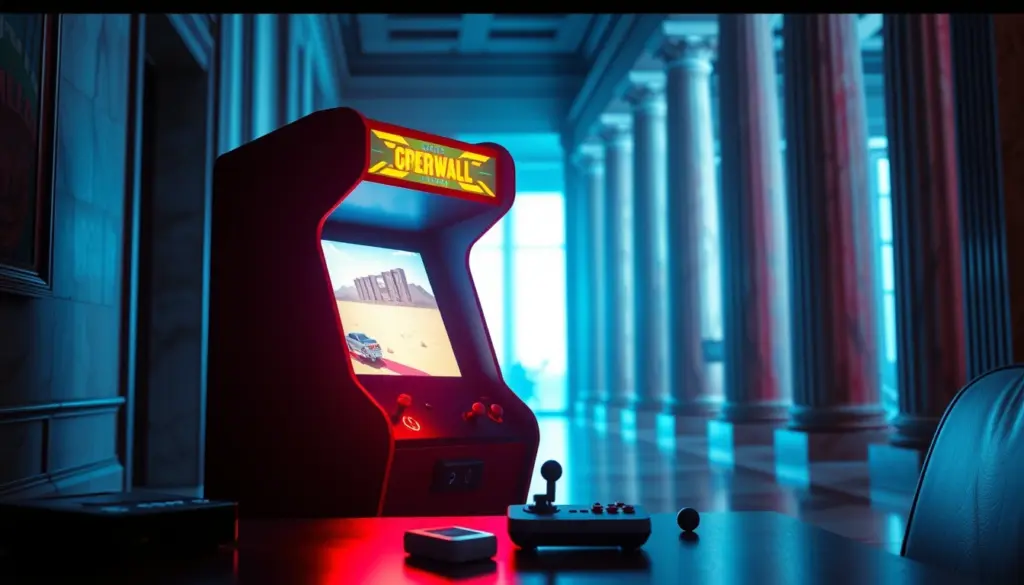
The White House Arcade is a set of five low-resolution, browser-playable games hosted on official U.S. government domains, according to reporting from Gamerant and Al Jazeera. Each game maps loosely onto an administration policy plank, from border enforcement to trade. The framing is unmistakably promotional: play the game, absorb the message.
Two of the five titles have been named consistently across outlets. “Build the Wall” is a Tetris-style stacking game themed around border construction. “Rio Run” is a Snake-style game that has players patrolling the Rio Grande. A third game, styled after Flappy Bird, has players flying an eagle through obstacles. Names and mechanics for the remaining two games have not been consistently reported and are not confirmed here.
What is consistent across coverage is the visual language borrowed to sell the games. Techtimes and other outlets note the site uses styling that evokes Nintendo’s GameCube era, an Xbox 360-style presentation nodding to Microsoft, PlayStation-style branding cues tied to Sony, and a modified startup chime resembling Sega’s classic audio ident. None of the four companies designed, licensed, or was credited for any of this.
Whose Branding Got Borrowed: Nintendo, Sony, Microsoft and Sega
Borrowing console-era visual identity is a different kind of infringement risk than reskinning a specific game mechanic. A stacking-block puzzle game is generic enough that plenty of clones exist; a startup chime that sounds like Sega’s is a much narrower, more recognizable piece of brand identity. That distinction matters for how each company might eventually respond, and it is likely why the loudest public reaction so far has come from the company whose actual gameplay mechanic was copied most directly, not just its branding.
As of this writing, Sony, Microsoft and Sega have not issued public statements specifically addressing the September 3 Arcade launch. That silence does not mean the companies are unaware or unbothered; corporate legal teams frequently take weeks to respond formally to unauthorized use of trademarks, especially when the alleged infringer is a government body rather than a private competitor.
Tetris Responds: “We Take Copyright Infringement Very Seriously”
The fastest and most direct public reaction came from Tetris. On September 4, the official Tetris account posted a statement responding to “Build the Wall,” according to Dexerto’s reporting. The company wrote: “At Tetris we believe in the power of connection and bringing people together, not dividing them.” It added a message to fans: “To our fans everywhere: we love you, we see you, and we’re grateful to have you in our community.”
The company followed with a more pointed clarification, stating plainly that “The Tetris Company was not involved in the creation of ‘Build the Wall.'” It closed the post with a line that reads less like boilerplate and more like a warning shot: “We take copyright infringement very seriously.” The statement stopped short of announcing a lawsuit or confirming a cease-and-desist letter had been sent, but the phrasing leaves the door open for further legal action if the game stays live.
Why a Statement, Not a Lawsuit, Came First
Suing the federal government over intellectual property used in a non-commercial, government-run arcade is legally messier than suing a private studio. Sovereign immunity doctrines, fair-use-adjacent parody defenses, and the political optics of a game company suing a sitting administration all complicate the calculus. A public statement costs nothing and puts the administration on notice; a lawsuit is a much bigger commitment that most companies reserve for when informal pressure fails.
This Isn’t New: Six Months of Unauthorized IP Use
The September 3 launch is not the administration’s first brush with Japanese game and anime IP. The Japan Times reported in March 2026 that White House social media posts, including content built around military airstrikes, incorporated imagery drawn from Mario, Pokémon, Naruto, Dragon Ball, Yu-Gi-Oh!, Wii Sports and Halo, none of it licensed. That earlier round of content is what first drew formal objections from Japanese rights holders and, subsequently, from the Japanese government itself.
Techtimes’ September 4 analysis describes the Arcade launch as the latest data point in “six months of apparent gaming IP misuse,” tying the new games directly to the unresolved March controversy rather than treating them as a standalone incident. That framing is significant for market watchers: a single unlicensed meme is a PR headache, but a repeated, months-long pattern is the kind of conduct that makes IP holders more willing to escalate.
Pokémon’s March Warning and Nintendo’s Tariff Lawsuit
The Pokémon Company was among the first to push back. According to My Nintendo News, the company issued a statement in early March 2026 objecting to the White House’s use of its intellectual property without authorization. That statement landed just one day before a much bigger headline: Nintendo of America filed suit against the U.S. government.
It is worth being precise about what Nintendo’s lawsuit actually covers, because coverage of the Arcade story has sometimes blurred the two issues together. Nintendo’s case, filed March 6, 2026, is not about unauthorized use of its characters or branding. It targets tariffs imposed under Trump administration executive orders, which Nintendo says raised costs tied to overseas manufacturing and the timing of the Switch 2 launch. The company is seeking a refund of the tariffs collected, “with interest,” per My Nintendo News’ reporting on the filing.
That distinction matters for anyone trying to gauge legal risk from the Arcade launch. Nintendo already has an active, unrelated case against the federal government over trade policy. Whether the company treats the GameCube-style branding used in the new Arcade as a separate grievance worth pursuing, or simply another irritant to note and move past, has not been confirmed by any Nintendo statement as of publication.
Japan’s Foreign Ministry Protests, Twice
The dispute has not stayed confined to corporate statements. Techtimes’ reporting on the September 4 Arcade fallout states that Japan’s Foreign Ministry raised the broader pattern of unauthorized IP use with U.S. Embassy officials on two separate occasions this year, in April and again in June 2026, through diplomatic channels rather than public statements. Japanese officials reportedly asked the U.S. government to stop using Pokémon and Mario characters in official social media posts.
A government-to-government diplomatic complaint over video game characters sounds unusual until you consider the scale of the industries involved. Nintendo, Sega, and the broader Japanese game and anime sector represent a significant slice of Japan’s cultural export economy, and unauthorized use of that IP by a foreign government carries a different weight than the same conduct from a private citizen. Two rounds of formal diplomatic engagement, both preceding the Arcade launch, suggest Tokyo views this as a pattern worth tracking rather than an isolated meme controversy.
Legal Analysis: Parody, Fair Use and Government Speech
Games like “Build the Wall” sit in an unusually contested legal space. Parody and commentary can qualify for fair-use-style defenses in some contexts, and government speech doctrine gives officials wide latitude in messaging. But those defenses tend to weaken the closer a work gets to reproducing a specific, recognizable trade dress, sound, or gameplay structure rather than merely referencing a cultural touchstone.
A generic falling-blocks puzzle game is one thing. A falling-blocks puzzle game paired with a startup chime that echoes a specific company’s audio trademark is a different, and legally riskier, combination. None of the companies involved has filed suit over the Arcade specifically as of September 5, 2026, which means any assessment of how a court would rule remains speculative. What is not speculative is that Tetris’s public statement, explicitly invoking “copyright infringement,” is the clearest signal yet that at least one rights holder is treating this as more than a joke.
Market and Reputational Impact
For Nintendo, the reputational stakes are compounded rather than created by the Arcade launch. The company is already in active litigation with the federal government over Switch 2 tariff costs, a case with direct financial consequences tied to its most important current product line. Adding an unrelated IP grievance to that relationship does not change the tariff case’s merits, but it does add friction to an already adversarial dynamic between one of gaming’s largest companies and the U.S. government.
For Tetris, the calculation is different. The Tetris brand is licensed broadly and depends heavily on being seen as an apolitical, universally beloved puzzle game. Being visually associated with a border-enforcement message, even involuntarily, is the kind of brand risk that explains why the company moved to respond within roughly 24 hours of the Arcade going live rather than waiting for lawyers to draft a slower, more formal response.
Sony, Microsoft and Sega face a quieter version of the same exposure. None of the three has confirmed a public statement, but each now has its branding tied, however loosely, to a piece of government messaging it never approved. Staying silent avoids amplifying the controversy; it does not eliminate the underlying trademark question.
Competitive Comparison: How Each Company Has Responded
| Company | IP or Branding Referenced | Public Response as of Sept. 5, 2026 |
|---|---|---|
| The Tetris Company | “Build the Wall” stacking-game mechanic and framing | Statement issued Sept. 4 disclaiming involvement, citing copyright infringement |
| Nintendo | GameCube-era branding style used in Arcade presentation | No statement on Arcade specifically; separate active tariff lawsuit since March 2026 |
| The Pokémon Company | Pokémon characters used in earlier 2026 social media posts (unrelated to Arcade) | Objection statement issued in early March 2026 |
| Sony | PlayStation-style branding cues in Arcade presentation | No confirmed public statement |
| Microsoft | Xbox 360-style branding cues in Arcade presentation | No confirmed public statement |
| SEGA | Modified startup chime used on the Arcade site | No confirmed public statement |
Historical Context: Governments and Borrowed Game IP
Government agencies referencing pop culture in official messaging is not new; plenty of public bodies have used memes, movie references, or gaming nostalgia to reach younger audiences without triggering a diplomatic incident. What sets this case apart is the combination of frequency, source material, and framing. Repeatedly drawing on the same handful of Japanese-origin franchises over six months, then building an entire interactive arcade around similar visual language, moves well past a one-off meme into what Techtimes and Japan Times both describe as a sustained pattern.
The March 2026 airstrike-video controversy set the template: use recognizable, beloved characters to soften or reframe a serious policy message, then face swift public criticism once the source material is identified. The Arcade takes the same approach and formalizes it into a permanent, government-hosted product rather than a single social media post that can be deleted. That permanence is likely part of why Japan’s Foreign Ministry escalated to direct diplomatic engagement rather than relying on public statements from individual companies to make the point.
Timeline: How the Dispute Reached September 2026
| Date | Event |
|---|---|
| March 2026 | Japan Times reports White House social posts, including airstrike-related content, used imagery from Mario, Pokémon, Naruto, Dragon Ball, Yu-Gi-Oh!, Wii Sports and Halo |
| Early March 2026 | The Pokémon Company issues a statement objecting to unauthorized use of its IP |
| March 6, 2026 | Nintendo of America files suit against the U.S. government over Switch 2-related tariffs, seeking a refund with interest |
| April 2026 | Japan’s Foreign Ministry raises unauthorized IP use with the U.S. Embassy (first formal diplomatic protest) |
| June 2026 | Japan’s Foreign Ministry raises the same issue again (second formal diplomatic protest) |
| Sept. 3, 2026 | White House launches the Arcade section with five browser games at whitehouse.gov/arcade and arcade.gov |
| Sept. 4, 2026 | The official Tetris account states it was not involved in “Build the Wall” and had not licensed its IP for the game |
What Comes Next: Five Predictions
- Tetris’s statement is more likely to be followed by a formal cease-and-desist letter than a lawsuit; the company’s own language leaves that path open without committing to it.
- Sony, Microsoft and Sega will most likely stay publicly quiet in the near term, mirroring their silence on the March controversy, unless the Arcade content expands or persists well beyond its launch week.
- Japan’s Foreign Ministry is likely to raise the issue with the U.S. a third time if the Arcade games remain live without changes, given the pattern of April and June diplomatic contacts.
- Nintendo’s tariff litigation and the Arcade branding dispute will likely stay legally separate, even if commentators continue to link them as part of the same broader tension.
- Expect the administration to either quietly modify or leave the games untouched rather than issue a formal response to any single company; the March precedent suggests deletion-without-comment is the more likely outcome if pressure mounts.
Why This Keeps Happening
Part of the reason this dispute has stretched across six months without a clean resolution is structural. There is no single, fast legal mechanism for a company to force a government website offline the way a DMCA takedown might work against a private host. Government bodies also don’t operate under the same brand-safety incentives that make most companies cautious about unlicensed IP use, since the political upside of a viral, on-message arcade game can outweigh the risk of a strongly worded corporate statement.
That asymmetry is exactly what makes Japan’s diplomatic route notable. A private company sending a cease-and-desist letter is a routine, low-stakes legal formality. A foreign ministry raising the same issue with a U.S. embassy, twice, elevates it into an actual bilateral irritant, even a minor one, between two allied governments.
The Bottom Line for Gamers and Rights Holders
Nothing about the September 3 Arcade launch has been resolved through a courtroom yet, and it may never be. What has changed is the durability and visibility of the underlying dispute. A social media post can be deleted quietly; a government-hosted arcade with a persistent URL invites ongoing scrutiny, screenshots, and, evidently, statements from the companies whose visual language it borrowed.
For now, the clearest signal of where this goes next is the gap between Tetris’s public, pointed statement and the silence from Nintendo, Sony, Microsoft and Sega. Whether that silence turns into formal legal letters, more diplomatic contacts from Tokyo, or simply fades as the news cycle moves on will likely become clearer within the next few weeks.
Frequently Asked Questions
Is Nintendo suing the White House over the Arcade games?
No. Nintendo of America’s lawsuit against the U.S. government, filed March 6, 2026, concerns tariffs tied to Switch 2 manufacturing and pricing, not the September 3 Arcade launch or any IP dispute. The two issues are separate, though they involve the same two parties.
What games are in the White House Arcade?
Reporting has consistently named two of the five games: “Build the Wall,” a Tetris-style stacking game, and “Rio Run,” a Snake-style border-patrol game. A third, Flappy Bird-styled game involving flying an eagle has also been described. Names for the remaining two games have not been consistently reported.
Has Japan formally protested the White House Arcade?
Japan’s Foreign Ministry raised the broader pattern of unauthorized use of Japanese game and anime IP with the U.S. Embassy twice in 2026, in April and June, according to Techtimes’ reporting. Those diplomatic contacts predate the September 3 Arcade launch but are described by outlets covering the story as part of the same ongoing pattern.
What did Tetris say about “Build the Wall”?
On September 4, 2026, the official Tetris account stated it “was not involved in the creation of ‘Build the Wall'” and had not licensed its brand for the game, adding that the company takes “copyright infringement very seriously,” per Dexerto’s reporting. Tetris has not confirmed a lawsuit or a formal cease-and-desist letter.
Have Sony, Microsoft or Sega commented on the Arcade launch?
As of September 5, 2026, none of the three companies has issued a public statement specifically addressing the Arcade launch, despite reporting that the site’s presentation echoes PlayStation, Xbox 360 and Sega branding cues.
Where can I find the White House Arcade?
The games are hosted on two official U.S. government domains: whitehouse.gov/arcade and arcade.gov, both of which went live on September 3, 2026.
Is this the first time the administration has used Japanese game or anime IP?
No. The Japan Times reported in March 2026 that earlier White House social media content, including posts related to military airstrikes, used imagery from Mario, Pokémon, Naruto, Dragon Ball, Yu-Gi-Oh!, Wii Sports and Halo without authorization. The September Arcade launch is described by outlets covering the story as a continuation of that pattern rather than an isolated incident.