
Does PAIR work with Windows, macOS, and Linux together in the same cluster?
Yes. PAIR’s beta supports all three operating systems, and NVIDIA’s design allows mixed-OS households to combine devices into one pool.
Is PAIR available now?
NVIDIA released PAIR as a beta following its September 3, 2026 announcement at IFA in Berlin, with source code published on GitHub.
Does PAIR work with Windows, macOS, and Linux together in the same cluster?
Yes. PAIR’s beta supports all three operating systems, and NVIDIA’s design allows mixed-OS households to combine devices into one pool.
Is PAIR available now?
NVIDIA released PAIR as a beta following its September 3, 2026 announcement at IFA in Berlin, with source code published on GitHub.
Does PAIR work with Windows, macOS, and Linux together in the same cluster?
Yes. PAIR’s beta supports all three operating systems, and NVIDIA’s design allows mixed-OS households to combine devices into one pool.
How much faster is AI inference with PAIR?
In NVIDIA’s own IFA 2026 demo, a five-subagent task that took 18 minutes on one laptop finished in 8 minutes and 48 seconds when spread across three devices. Real-world results will vary by hardware and network conditions.
Is PAIR available now?
NVIDIA released PAIR as a beta following its September 3, 2026 announcement at IFA in Berlin, with source code published on GitHub.
Does PAIR work with Windows, macOS, and Linux together in the same cluster?
Yes. PAIR’s beta supports all three operating systems, and NVIDIA’s design allows mixed-OS households to combine devices into one pool.
How much faster is AI inference with PAIR?
In NVIDIA’s own IFA 2026 demo, a five-subagent task that took 18 minutes on one laptop finished in 8 minutes and 48 seconds when spread across three devices. Real-world results will vary by hardware and network conditions.
Is PAIR available now?
NVIDIA released PAIR as a beta following its September 3, 2026 announcement at IFA in Berlin, with source code published on GitHub.
Does PAIR work with Windows, macOS, and Linux together in the same cluster?
Yes. PAIR’s beta supports all three operating systems, and NVIDIA’s design allows mixed-OS households to combine devices into one pool.
Which AI tools work with PAIR at launch?
Ollama and LM Studio are supported at launch, according to NVIDIA’s own announcement materials.
How much faster is AI inference with PAIR?
In NVIDIA’s own IFA 2026 demo, a five-subagent task that took 18 minutes on one laptop finished in 8 minutes and 48 seconds when spread across three devices. Real-world results will vary by hardware and network conditions.
Is PAIR available now?
NVIDIA released PAIR as a beta following its September 3, 2026 announcement at IFA in Berlin, with source code published on GitHub.
Does PAIR work with Windows, macOS, and Linux together in the same cluster?
Yes. PAIR’s beta supports all three operating systems, and NVIDIA’s design allows mixed-OS households to combine devices into one pool.
Which AI tools work with PAIR at launch?
Ollama and LM Studio are supported at launch, according to NVIDIA’s own announcement materials.
How much faster is AI inference with PAIR?
In NVIDIA’s own IFA 2026 demo, a five-subagent task that took 18 minutes on one laptop finished in 8 minutes and 48 seconds when spread across three devices. Real-world results will vary by hardware and network conditions.
Is PAIR available now?
NVIDIA released PAIR as a beta following its September 3, 2026 announcement at IFA in Berlin, with source code published on GitHub.
Does PAIR work with Windows, macOS, and Linux together in the same cluster?
Yes. PAIR’s beta supports all three operating systems, and NVIDIA’s design allows mixed-OS households to combine devices into one pool.
Does PAIR send my data to the cloud?
No. PAIR is designed to keep inference traffic on your local network. An internet connection is only needed to initially download AI models.
Which AI tools work with PAIR at launch?
Ollama and LM Studio are supported at launch, according to NVIDIA’s own announcement materials.
How much faster is AI inference with PAIR?
In NVIDIA’s own IFA 2026 demo, a five-subagent task that took 18 minutes on one laptop finished in 8 minutes and 48 seconds when spread across three devices. Real-world results will vary by hardware and network conditions.
Is PAIR available now?
NVIDIA released PAIR as a beta following its September 3, 2026 announcement at IFA in Berlin, with source code published on GitHub.
Does PAIR work with Windows, macOS, and Linux together in the same cluster?
Yes. PAIR’s beta supports all three operating systems, and NVIDIA’s design allows mixed-OS households to combine devices into one pool.
Does PAIR send my data to the cloud?
No. PAIR is designed to keep inference traffic on your local network. An internet connection is only needed to initially download AI models.
Which AI tools work with PAIR at launch?
Ollama and LM Studio are supported at launch, according to NVIDIA’s own announcement materials.
How much faster is AI inference with PAIR?
In NVIDIA’s own IFA 2026 demo, a five-subagent task that took 18 minutes on one laptop finished in 8 minutes and 48 seconds when spread across three devices. Real-world results will vary by hardware and network conditions.
Is PAIR available now?
NVIDIA released PAIR as a beta following its September 3, 2026 announcement at IFA in Berlin, with source code published on GitHub.
Does PAIR work with Windows, macOS, and Linux together in the same cluster?
Yes. PAIR’s beta supports all three operating systems, and NVIDIA’s design allows mixed-OS households to combine devices into one pool.
Do I need a new NVIDIA GPU to use PAIR?
No. PAIR works with GeForce RTX 20-series cards, meaning many existing gaming PCs already qualify without any hardware upgrade.
Does PAIR send my data to the cloud?
No. PAIR is designed to keep inference traffic on your local network. An internet connection is only needed to initially download AI models.
Which AI tools work with PAIR at launch?
Ollama and LM Studio are supported at launch, according to NVIDIA’s own announcement materials.
How much faster is AI inference with PAIR?
In NVIDIA’s own IFA 2026 demo, a five-subagent task that took 18 minutes on one laptop finished in 8 minutes and 48 seconds when spread across three devices. Real-world results will vary by hardware and network conditions.
Is PAIR available now?
NVIDIA released PAIR as a beta following its September 3, 2026 announcement at IFA in Berlin, with source code published on GitHub.
Does PAIR work with Windows, macOS, and Linux together in the same cluster?
Yes. PAIR’s beta supports all three operating systems, and NVIDIA’s design allows mixed-OS households to combine devices into one pool.
Do I need a new NVIDIA GPU to use PAIR?
No. PAIR works with GeForce RTX 20-series cards, meaning many existing gaming PCs already qualify without any hardware upgrade.
Does PAIR send my data to the cloud?
No. PAIR is designed to keep inference traffic on your local network. An internet connection is only needed to initially download AI models.
Which AI tools work with PAIR at launch?
Ollama and LM Studio are supported at launch, according to NVIDIA’s own announcement materials.
How much faster is AI inference with PAIR?
In NVIDIA’s own IFA 2026 demo, a five-subagent task that took 18 minutes on one laptop finished in 8 minutes and 48 seconds when spread across three devices. Real-world results will vary by hardware and network conditions.
Is PAIR available now?
NVIDIA released PAIR as a beta following its September 3, 2026 announcement at IFA in Berlin, with source code published on GitHub.
Does PAIR work with Windows, macOS, and Linux together in the same cluster?
Yes. PAIR’s beta supports all three operating systems, and NVIDIA’s design allows mixed-OS households to combine devices into one pool.
What GPUs does PAIR support?
NVIDIA GeForce RTX 20-series and newer, RTX PRO workstation GPUs, and DGX Spark systems. Apple Silicon Macs with M4 or newer chips are also supported.
Do I need a new NVIDIA GPU to use PAIR?
No. PAIR works with GeForce RTX 20-series cards, meaning many existing gaming PCs already qualify without any hardware upgrade.
Does PAIR send my data to the cloud?
No. PAIR is designed to keep inference traffic on your local network. An internet connection is only needed to initially download AI models.
Which AI tools work with PAIR at launch?
Ollama and LM Studio are supported at launch, according to NVIDIA’s own announcement materials.
How much faster is AI inference with PAIR?
In NVIDIA’s own IFA 2026 demo, a five-subagent task that took 18 minutes on one laptop finished in 8 minutes and 48 seconds when spread across three devices. Real-world results will vary by hardware and network conditions.
Is PAIR available now?
NVIDIA released PAIR as a beta following its September 3, 2026 announcement at IFA in Berlin, with source code published on GitHub.
Does PAIR work with Windows, macOS, and Linux together in the same cluster?
Yes. PAIR’s beta supports all three operating systems, and NVIDIA’s design allows mixed-OS households to combine devices into one pool.
What GPUs does PAIR support?
NVIDIA GeForce RTX 20-series and newer, RTX PRO workstation GPUs, and DGX Spark systems. Apple Silicon Macs with M4 or newer chips are also supported.
Do I need a new NVIDIA GPU to use PAIR?
No. PAIR works with GeForce RTX 20-series cards, meaning many existing gaming PCs already qualify without any hardware upgrade.
Does PAIR send my data to the cloud?
No. PAIR is designed to keep inference traffic on your local network. An internet connection is only needed to initially download AI models.
Which AI tools work with PAIR at launch?
Ollama and LM Studio are supported at launch, according to NVIDIA’s own announcement materials.
How much faster is AI inference with PAIR?
In NVIDIA’s own IFA 2026 demo, a five-subagent task that took 18 minutes on one laptop finished in 8 minutes and 48 seconds when spread across three devices. Real-world results will vary by hardware and network conditions.
Is PAIR available now?
NVIDIA released PAIR as a beta following its September 3, 2026 announcement at IFA in Berlin, with source code published on GitHub.
Does PAIR work with Windows, macOS, and Linux together in the same cluster?
Yes. PAIR’s beta supports all three operating systems, and NVIDIA’s design allows mixed-OS households to combine devices into one pool.
Is NVIDIA PAIR a physical router I need to buy?
No. Despite the name, PAIR is free, open-source software. It does not replace your Wi-Fi router or require any new networking hardware.
What GPUs does PAIR support?
NVIDIA GeForce RTX 20-series and newer, RTX PRO workstation GPUs, and DGX Spark systems. Apple Silicon Macs with M4 or newer chips are also supported.
Do I need a new NVIDIA GPU to use PAIR?
No. PAIR works with GeForce RTX 20-series cards, meaning many existing gaming PCs already qualify without any hardware upgrade.
Does PAIR send my data to the cloud?
No. PAIR is designed to keep inference traffic on your local network. An internet connection is only needed to initially download AI models.
Which AI tools work with PAIR at launch?
Ollama and LM Studio are supported at launch, according to NVIDIA’s own announcement materials.
How much faster is AI inference with PAIR?
In NVIDIA’s own IFA 2026 demo, a five-subagent task that took 18 minutes on one laptop finished in 8 minutes and 48 seconds when spread across three devices. Real-world results will vary by hardware and network conditions.
Is PAIR available now?
NVIDIA released PAIR as a beta following its September 3, 2026 announcement at IFA in Berlin, with source code published on GitHub.
Does PAIR work with Windows, macOS, and Linux together in the same cluster?
Yes. PAIR’s beta supports all three operating systems, and NVIDIA’s design allows mixed-OS households to combine devices into one pool.
Is NVIDIA PAIR a physical router I need to buy?
No. Despite the name, PAIR is free, open-source software. It does not replace your Wi-Fi router or require any new networking hardware.
What GPUs does PAIR support?
NVIDIA GeForce RTX 20-series and newer, RTX PRO workstation GPUs, and DGX Spark systems. Apple Silicon Macs with M4 or newer chips are also supported.
Do I need a new NVIDIA GPU to use PAIR?
No. PAIR works with GeForce RTX 20-series cards, meaning many existing gaming PCs already qualify without any hardware upgrade.
Does PAIR send my data to the cloud?
No. PAIR is designed to keep inference traffic on your local network. An internet connection is only needed to initially download AI models.
Which AI tools work with PAIR at launch?
Ollama and LM Studio are supported at launch, according to NVIDIA’s own announcement materials.
How much faster is AI inference with PAIR?
In NVIDIA’s own IFA 2026 demo, a five-subagent task that took 18 minutes on one laptop finished in 8 minutes and 48 seconds when spread across three devices. Real-world results will vary by hardware and network conditions.
Is PAIR available now?
NVIDIA released PAIR as a beta following its September 3, 2026 announcement at IFA in Berlin, with source code published on GitHub.
Does PAIR work with Windows, macOS, and Linux together in the same cluster?
Yes. PAIR’s beta supports all three operating systems, and NVIDIA’s design allows mixed-OS households to combine devices into one pool.
Whether PAIR becomes a mainstream tool or stays a niche project for enthusiasts with multiple GPUs will depend on how it performs outside NVIDIA’s own demo environment, and on whether the open-source community picks it up and extends it. The next few months of independent testing, security scrutiny, and framework integrations will tell that story far more clearly than the IFA announcement did.
Frequently Asked Questions
Is NVIDIA PAIR a physical router I need to buy?
No. Despite the name, PAIR is free, open-source software. It does not replace your Wi-Fi router or require any new networking hardware.
What GPUs does PAIR support?
NVIDIA GeForce RTX 20-series and newer, RTX PRO workstation GPUs, and DGX Spark systems. Apple Silicon Macs with M4 or newer chips are also supported.
Do I need a new NVIDIA GPU to use PAIR?
No. PAIR works with GeForce RTX 20-series cards, meaning many existing gaming PCs already qualify without any hardware upgrade.
Does PAIR send my data to the cloud?
No. PAIR is designed to keep inference traffic on your local network. An internet connection is only needed to initially download AI models.
Which AI tools work with PAIR at launch?
Ollama and LM Studio are supported at launch, according to NVIDIA’s own announcement materials.
How much faster is AI inference with PAIR?
In NVIDIA’s own IFA 2026 demo, a five-subagent task that took 18 minutes on one laptop finished in 8 minutes and 48 seconds when spread across three devices. Real-world results will vary by hardware and network conditions.
Is PAIR available now?
NVIDIA released PAIR as a beta following its September 3, 2026 announcement at IFA in Berlin, with source code published on GitHub.
Does PAIR work with Windows, macOS, and Linux together in the same cluster?
Yes. PAIR’s beta supports all three operating systems, and NVIDIA’s design allows mixed-OS households to combine devices into one pool.
Whether PAIR becomes a mainstream tool or stays a niche project for enthusiasts with multiple GPUs will depend on how it performs outside NVIDIA’s own demo environment, and on whether the open-source community picks it up and extends it. The next few months of independent testing, security scrutiny, and framework integrations will tell that story far more clearly than the IFA announcement did.
Frequently Asked Questions
Is NVIDIA PAIR a physical router I need to buy?
No. Despite the name, PAIR is free, open-source software. It does not replace your Wi-Fi router or require any new networking hardware.
What GPUs does PAIR support?
NVIDIA GeForce RTX 20-series and newer, RTX PRO workstation GPUs, and DGX Spark systems. Apple Silicon Macs with M4 or newer chips are also supported.
Do I need a new NVIDIA GPU to use PAIR?
No. PAIR works with GeForce RTX 20-series cards, meaning many existing gaming PCs already qualify without any hardware upgrade.
Does PAIR send my data to the cloud?
No. PAIR is designed to keep inference traffic on your local network. An internet connection is only needed to initially download AI models.
Which AI tools work with PAIR at launch?
Ollama and LM Studio are supported at launch, according to NVIDIA’s own announcement materials.
How much faster is AI inference with PAIR?
In NVIDIA’s own IFA 2026 demo, a five-subagent task that took 18 minutes on one laptop finished in 8 minutes and 48 seconds when spread across three devices. Real-world results will vary by hardware and network conditions.
Is PAIR available now?
NVIDIA released PAIR as a beta following its September 3, 2026 announcement at IFA in Berlin, with source code published on GitHub.
Does PAIR work with Windows, macOS, and Linux together in the same cluster?
Yes. PAIR’s beta supports all three operating systems, and NVIDIA’s design allows mixed-OS households to combine devices into one pool.
PAIR is a small download with a fairly large implication: NVIDIA is betting that the next phase of consumer AI competition isn’t just about who ships the fastest single chip, but who makes it easiest to combine the chips people already own. Cloud AI pricing pressure, growing privacy concerns around sending files and prompts off-device, and the sheer number of GPUs already sitting in homes worldwide all point toward local, distributed inference becoming a bigger part of how people actually use AI day to day.
Whether PAIR becomes a mainstream tool or stays a niche project for enthusiasts with multiple GPUs will depend on how it performs outside NVIDIA’s own demo environment, and on whether the open-source community picks it up and extends it. The next few months of independent testing, security scrutiny, and framework integrations will tell that story far more clearly than the IFA announcement did.
Frequently Asked Questions
Is NVIDIA PAIR a physical router I need to buy?
No. Despite the name, PAIR is free, open-source software. It does not replace your Wi-Fi router or require any new networking hardware.
What GPUs does PAIR support?
NVIDIA GeForce RTX 20-series and newer, RTX PRO workstation GPUs, and DGX Spark systems. Apple Silicon Macs with M4 or newer chips are also supported.
Do I need a new NVIDIA GPU to use PAIR?
No. PAIR works with GeForce RTX 20-series cards, meaning many existing gaming PCs already qualify without any hardware upgrade.
Does PAIR send my data to the cloud?
No. PAIR is designed to keep inference traffic on your local network. An internet connection is only needed to initially download AI models.
Which AI tools work with PAIR at launch?
Ollama and LM Studio are supported at launch, according to NVIDIA’s own announcement materials.
How much faster is AI inference with PAIR?
In NVIDIA’s own IFA 2026 demo, a five-subagent task that took 18 minutes on one laptop finished in 8 minutes and 48 seconds when spread across three devices. Real-world results will vary by hardware and network conditions.
Is PAIR available now?
NVIDIA released PAIR as a beta following its September 3, 2026 announcement at IFA in Berlin, with source code published on GitHub.
Does PAIR work with Windows, macOS, and Linux together in the same cluster?
Yes. PAIR’s beta supports all three operating systems, and NVIDIA’s design allows mixed-OS households to combine devices into one pool.
PAIR is a small download with a fairly large implication: NVIDIA is betting that the next phase of consumer AI competition isn’t just about who ships the fastest single chip, but who makes it easiest to combine the chips people already own. Cloud AI pricing pressure, growing privacy concerns around sending files and prompts off-device, and the sheer number of GPUs already sitting in homes worldwide all point toward local, distributed inference becoming a bigger part of how people actually use AI day to day.
Whether PAIR becomes a mainstream tool or stays a niche project for enthusiasts with multiple GPUs will depend on how it performs outside NVIDIA’s own demo environment, and on whether the open-source community picks it up and extends it. The next few months of independent testing, security scrutiny, and framework integrations will tell that story far more clearly than the IFA announcement did.
Frequently Asked Questions
Is NVIDIA PAIR a physical router I need to buy?
No. Despite the name, PAIR is free, open-source software. It does not replace your Wi-Fi router or require any new networking hardware.
What GPUs does PAIR support?
NVIDIA GeForce RTX 20-series and newer, RTX PRO workstation GPUs, and DGX Spark systems. Apple Silicon Macs with M4 or newer chips are also supported.
Do I need a new NVIDIA GPU to use PAIR?
No. PAIR works with GeForce RTX 20-series cards, meaning many existing gaming PCs already qualify without any hardware upgrade.
Does PAIR send my data to the cloud?
No. PAIR is designed to keep inference traffic on your local network. An internet connection is only needed to initially download AI models.
Which AI tools work with PAIR at launch?
Ollama and LM Studio are supported at launch, according to NVIDIA’s own announcement materials.
How much faster is AI inference with PAIR?
In NVIDIA’s own IFA 2026 demo, a five-subagent task that took 18 minutes on one laptop finished in 8 minutes and 48 seconds when spread across three devices. Real-world results will vary by hardware and network conditions.
Is PAIR available now?
NVIDIA released PAIR as a beta following its September 3, 2026 announcement at IFA in Berlin, with source code published on GitHub.
Does PAIR work with Windows, macOS, and Linux together in the same cluster?
Yes. PAIR’s beta supports all three operating systems, and NVIDIA’s design allows mixed-OS households to combine devices into one pool.
A few things seem likely to play out over the next two to three quarters:
- Independent benchmarks will emerge within weeks testing PAIR across mismatched GPU generations, and results will likely show more modest gains than NVIDIA’s controlled 18-minute-to-8:48 demo once network latency and older hardware enter the mix.
- NVIDIA will expand official support beyond Ollama and LM Studio to additional local-inference frameworks, given the open-source nature of the project invites community integrations.
- Expect NVIDIA to bundle PAIR more visibly into RTX Spark marketing as a reason to buy a second or third unit, positioning multi-device households as the ideal customer rather than single-PC buyers.
- Security researchers will publish the first independent audits of the open-source router within the coming months, given how much local network traffic PAIR now touches.
- Rival chipmakers will face pressure to answer with their own cross-device orchestration tools, though matching NVIDIA’s install base advantage (RTX 20-series and up) will be difficult for competitors starting from a smaller existing GPU footprint.
The Bigger Picture for Local AI
PAIR is a small download with a fairly large implication: NVIDIA is betting that the next phase of consumer AI competition isn’t just about who ships the fastest single chip, but who makes it easiest to combine the chips people already own. Cloud AI pricing pressure, growing privacy concerns around sending files and prompts off-device, and the sheer number of GPUs already sitting in homes worldwide all point toward local, distributed inference becoming a bigger part of how people actually use AI day to day.
Whether PAIR becomes a mainstream tool or stays a niche project for enthusiasts with multiple GPUs will depend on how it performs outside NVIDIA’s own demo environment, and on whether the open-source community picks it up and extends it. The next few months of independent testing, security scrutiny, and framework integrations will tell that story far more clearly than the IFA announcement did.
Frequently Asked Questions
Is NVIDIA PAIR a physical router I need to buy?
No. Despite the name, PAIR is free, open-source software. It does not replace your Wi-Fi router or require any new networking hardware.
What GPUs does PAIR support?
NVIDIA GeForce RTX 20-series and newer, RTX PRO workstation GPUs, and DGX Spark systems. Apple Silicon Macs with M4 or newer chips are also supported.
Do I need a new NVIDIA GPU to use PAIR?
No. PAIR works with GeForce RTX 20-series cards, meaning many existing gaming PCs already qualify without any hardware upgrade.
Does PAIR send my data to the cloud?
No. PAIR is designed to keep inference traffic on your local network. An internet connection is only needed to initially download AI models.
Which AI tools work with PAIR at launch?
Ollama and LM Studio are supported at launch, according to NVIDIA’s own announcement materials.
How much faster is AI inference with PAIR?
In NVIDIA’s own IFA 2026 demo, a five-subagent task that took 18 minutes on one laptop finished in 8 minutes and 48 seconds when spread across three devices. Real-world results will vary by hardware and network conditions.
Is PAIR available now?
NVIDIA released PAIR as a beta following its September 3, 2026 announcement at IFA in Berlin, with source code published on GitHub.
Does PAIR work with Windows, macOS, and Linux together in the same cluster?
Yes. PAIR’s beta supports all three operating systems, and NVIDIA’s design allows mixed-OS households to combine devices into one pool.
A few things seem likely to play out over the next two to three quarters:
- Independent benchmarks will emerge within weeks testing PAIR across mismatched GPU generations, and results will likely show more modest gains than NVIDIA’s controlled 18-minute-to-8:48 demo once network latency and older hardware enter the mix.
- NVIDIA will expand official support beyond Ollama and LM Studio to additional local-inference frameworks, given the open-source nature of the project invites community integrations.
- Expect NVIDIA to bundle PAIR more visibly into RTX Spark marketing as a reason to buy a second or third unit, positioning multi-device households as the ideal customer rather than single-PC buyers.
- Security researchers will publish the first independent audits of the open-source router within the coming months, given how much local network traffic PAIR now touches.
- Rival chipmakers will face pressure to answer with their own cross-device orchestration tools, though matching NVIDIA’s install base advantage (RTX 20-series and up) will be difficult for competitors starting from a smaller existing GPU footprint.
The Bigger Picture for Local AI
PAIR is a small download with a fairly large implication: NVIDIA is betting that the next phase of consumer AI competition isn’t just about who ships the fastest single chip, but who makes it easiest to combine the chips people already own. Cloud AI pricing pressure, growing privacy concerns around sending files and prompts off-device, and the sheer number of GPUs already sitting in homes worldwide all point toward local, distributed inference becoming a bigger part of how people actually use AI day to day.
Whether PAIR becomes a mainstream tool or stays a niche project for enthusiasts with multiple GPUs will depend on how it performs outside NVIDIA’s own demo environment, and on whether the open-source community picks it up and extends it. The next few months of independent testing, security scrutiny, and framework integrations will tell that story far more clearly than the IFA announcement did.
Frequently Asked Questions
Is NVIDIA PAIR a physical router I need to buy?
No. Despite the name, PAIR is free, open-source software. It does not replace your Wi-Fi router or require any new networking hardware.
What GPUs does PAIR support?
NVIDIA GeForce RTX 20-series and newer, RTX PRO workstation GPUs, and DGX Spark systems. Apple Silicon Macs with M4 or newer chips are also supported.
Do I need a new NVIDIA GPU to use PAIR?
No. PAIR works with GeForce RTX 20-series cards, meaning many existing gaming PCs already qualify without any hardware upgrade.
Does PAIR send my data to the cloud?
No. PAIR is designed to keep inference traffic on your local network. An internet connection is only needed to initially download AI models.
Which AI tools work with PAIR at launch?
Ollama and LM Studio are supported at launch, according to NVIDIA’s own announcement materials.
How much faster is AI inference with PAIR?
In NVIDIA’s own IFA 2026 demo, a five-subagent task that took 18 minutes on one laptop finished in 8 minutes and 48 seconds when spread across three devices. Real-world results will vary by hardware and network conditions.
Is PAIR available now?
NVIDIA released PAIR as a beta following its September 3, 2026 announcement at IFA in Berlin, with source code published on GitHub.
Does PAIR work with Windows, macOS, and Linux together in the same cluster?
Yes. PAIR’s beta supports all three operating systems, and NVIDIA’s design allows mixed-OS households to combine devices into one pool.
Because PAIR only shipped days ago, independent third-party benchmarks and long-term reliability reports are still thin. Early coverage, including a report from Tech Times, has focused on the same core pitch: idle GPUs across a household getting pooled into one inference target. Most public commentary right now is repeating NVIDIA’s own demo figures rather than reproducing them on separate hardware, which is normal for a beta this fresh but worth flagging for anyone deciding whether to build a multi-machine setup around it immediately versus waiting for outside verification.
Predictions: Where PAIR Goes From Here
A few things seem likely to play out over the next two to three quarters:
- Independent benchmarks will emerge within weeks testing PAIR across mismatched GPU generations, and results will likely show more modest gains than NVIDIA’s controlled 18-minute-to-8:48 demo once network latency and older hardware enter the mix.
- NVIDIA will expand official support beyond Ollama and LM Studio to additional local-inference frameworks, given the open-source nature of the project invites community integrations.
- Expect NVIDIA to bundle PAIR more visibly into RTX Spark marketing as a reason to buy a second or third unit, positioning multi-device households as the ideal customer rather than single-PC buyers.
- Security researchers will publish the first independent audits of the open-source router within the coming months, given how much local network traffic PAIR now touches.
- Rival chipmakers will face pressure to answer with their own cross-device orchestration tools, though matching NVIDIA’s install base advantage (RTX 20-series and up) will be difficult for competitors starting from a smaller existing GPU footprint.
The Bigger Picture for Local AI
PAIR is a small download with a fairly large implication: NVIDIA is betting that the next phase of consumer AI competition isn’t just about who ships the fastest single chip, but who makes it easiest to combine the chips people already own. Cloud AI pricing pressure, growing privacy concerns around sending files and prompts off-device, and the sheer number of GPUs already sitting in homes worldwide all point toward local, distributed inference becoming a bigger part of how people actually use AI day to day.
Whether PAIR becomes a mainstream tool or stays a niche project for enthusiasts with multiple GPUs will depend on how it performs outside NVIDIA’s own demo environment, and on whether the open-source community picks it up and extends it. The next few months of independent testing, security scrutiny, and framework integrations will tell that story far more clearly than the IFA announcement did.
Frequently Asked Questions
Is NVIDIA PAIR a physical router I need to buy?
No. Despite the name, PAIR is free, open-source software. It does not replace your Wi-Fi router or require any new networking hardware.
What GPUs does PAIR support?
NVIDIA GeForce RTX 20-series and newer, RTX PRO workstation GPUs, and DGX Spark systems. Apple Silicon Macs with M4 or newer chips are also supported.
Do I need a new NVIDIA GPU to use PAIR?
No. PAIR works with GeForce RTX 20-series cards, meaning many existing gaming PCs already qualify without any hardware upgrade.
Does PAIR send my data to the cloud?
No. PAIR is designed to keep inference traffic on your local network. An internet connection is only needed to initially download AI models.
Which AI tools work with PAIR at launch?
Ollama and LM Studio are supported at launch, according to NVIDIA’s own announcement materials.
How much faster is AI inference with PAIR?
In NVIDIA’s own IFA 2026 demo, a five-subagent task that took 18 minutes on one laptop finished in 8 minutes and 48 seconds when spread across three devices. Real-world results will vary by hardware and network conditions.
Is PAIR available now?
NVIDIA released PAIR as a beta following its September 3, 2026 announcement at IFA in Berlin, with source code published on GitHub.
Does PAIR work with Windows, macOS, and Linux together in the same cluster?
Yes. PAIR’s beta supports all three operating systems, and NVIDIA’s design allows mixed-OS households to combine devices into one pool.
Because PAIR only shipped days ago, independent third-party benchmarks and long-term reliability reports are still thin. Early coverage, including a report from Tech Times, has focused on the same core pitch: idle GPUs across a household getting pooled into one inference target. Most public commentary right now is repeating NVIDIA’s own demo figures rather than reproducing them on separate hardware, which is normal for a beta this fresh but worth flagging for anyone deciding whether to build a multi-machine setup around it immediately versus waiting for outside verification.
Predictions: Where PAIR Goes From Here
A few things seem likely to play out over the next two to three quarters:
- Independent benchmarks will emerge within weeks testing PAIR across mismatched GPU generations, and results will likely show more modest gains than NVIDIA’s controlled 18-minute-to-8:48 demo once network latency and older hardware enter the mix.
- NVIDIA will expand official support beyond Ollama and LM Studio to additional local-inference frameworks, given the open-source nature of the project invites community integrations.
- Expect NVIDIA to bundle PAIR more visibly into RTX Spark marketing as a reason to buy a second or third unit, positioning multi-device households as the ideal customer rather than single-PC buyers.
- Security researchers will publish the first independent audits of the open-source router within the coming months, given how much local network traffic PAIR now touches.
- Rival chipmakers will face pressure to answer with their own cross-device orchestration tools, though matching NVIDIA’s install base advantage (RTX 20-series and up) will be difficult for competitors starting from a smaller existing GPU footprint.
The Bigger Picture for Local AI
PAIR is a small download with a fairly large implication: NVIDIA is betting that the next phase of consumer AI competition isn’t just about who ships the fastest single chip, but who makes it easiest to combine the chips people already own. Cloud AI pricing pressure, growing privacy concerns around sending files and prompts off-device, and the sheer number of GPUs already sitting in homes worldwide all point toward local, distributed inference becoming a bigger part of how people actually use AI day to day.
Whether PAIR becomes a mainstream tool or stays a niche project for enthusiasts with multiple GPUs will depend on how it performs outside NVIDIA’s own demo environment, and on whether the open-source community picks it up and extends it. The next few months of independent testing, security scrutiny, and framework integrations will tell that story far more clearly than the IFA announcement did.
Frequently Asked Questions
Is NVIDIA PAIR a physical router I need to buy?
No. Despite the name, PAIR is free, open-source software. It does not replace your Wi-Fi router or require any new networking hardware.
What GPUs does PAIR support?
NVIDIA GeForce RTX 20-series and newer, RTX PRO workstation GPUs, and DGX Spark systems. Apple Silicon Macs with M4 or newer chips are also supported.
Do I need a new NVIDIA GPU to use PAIR?
No. PAIR works with GeForce RTX 20-series cards, meaning many existing gaming PCs already qualify without any hardware upgrade.
Does PAIR send my data to the cloud?
No. PAIR is designed to keep inference traffic on your local network. An internet connection is only needed to initially download AI models.
Which AI tools work with PAIR at launch?
Ollama and LM Studio are supported at launch, according to NVIDIA’s own announcement materials.
How much faster is AI inference with PAIR?
In NVIDIA’s own IFA 2026 demo, a five-subagent task that took 18 minutes on one laptop finished in 8 minutes and 48 seconds when spread across three devices. Real-world results will vary by hardware and network conditions.
Is PAIR available now?
NVIDIA released PAIR as a beta following its September 3, 2026 announcement at IFA in Berlin, with source code published on GitHub.
Does PAIR work with Windows, macOS, and Linux together in the same cluster?
Yes. PAIR’s beta supports all three operating systems, and NVIDIA’s design allows mixed-OS households to combine devices into one pool.
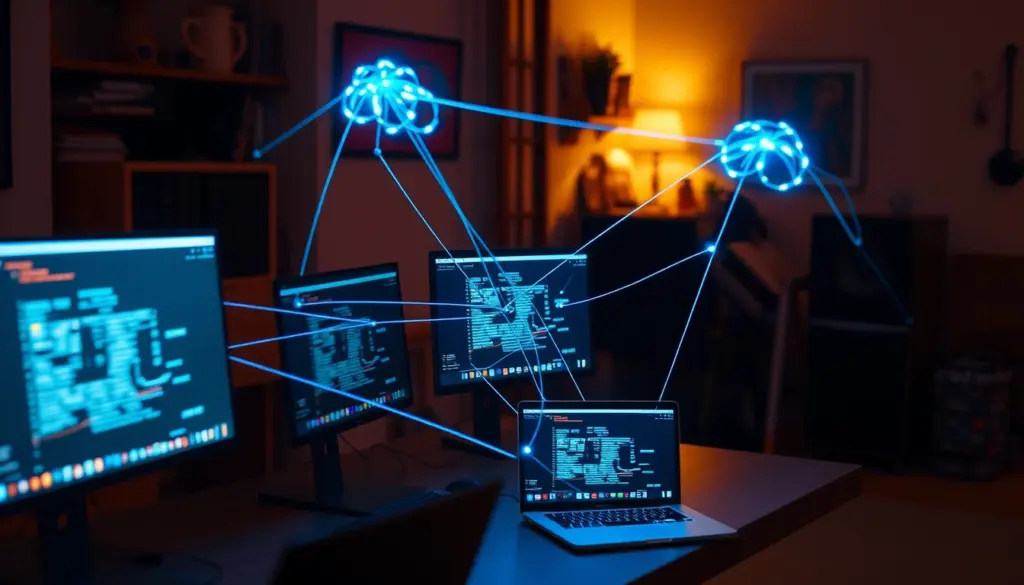
Coverage since the IFA announcement has focused heavily on the novelty of the idle-compute pitch. NVIDIA describes PAIR as software that “connects compatible macOS, Windows, and Linux systems with NVIDIA RTX GPUs and DGX Spark systems into a personal home AI cluster,” a description repeated nearly verbatim across NVIDIA’s own product page and FAQ. NVIDIA’s documentation frames the same idea more simply, stating that PAIR “turns several machines on your local network into one place to send inference requests,” according to NVIDIA’s official documentation.
Because PAIR only shipped days ago, independent third-party benchmarks and long-term reliability reports are still thin. Early coverage, including a report from Tech Times, has focused on the same core pitch: idle GPUs across a household getting pooled into one inference target. Most public commentary right now is repeating NVIDIA’s own demo figures rather than reproducing them on separate hardware, which is normal for a beta this fresh but worth flagging for anyone deciding whether to build a multi-machine setup around it immediately versus waiting for outside verification.
Predictions: Where PAIR Goes From Here
A few things seem likely to play out over the next two to three quarters:
- Independent benchmarks will emerge within weeks testing PAIR across mismatched GPU generations, and results will likely show more modest gains than NVIDIA’s controlled 18-minute-to-8:48 demo once network latency and older hardware enter the mix.
- NVIDIA will expand official support beyond Ollama and LM Studio to additional local-inference frameworks, given the open-source nature of the project invites community integrations.
- Expect NVIDIA to bundle PAIR more visibly into RTX Spark marketing as a reason to buy a second or third unit, positioning multi-device households as the ideal customer rather than single-PC buyers.
- Security researchers will publish the first independent audits of the open-source router within the coming months, given how much local network traffic PAIR now touches.
- Rival chipmakers will face pressure to answer with their own cross-device orchestration tools, though matching NVIDIA’s install base advantage (RTX 20-series and up) will be difficult for competitors starting from a smaller existing GPU footprint.
The Bigger Picture for Local AI
PAIR is a small download with a fairly large implication: NVIDIA is betting that the next phase of consumer AI competition isn’t just about who ships the fastest single chip, but who makes it easiest to combine the chips people already own. Cloud AI pricing pressure, growing privacy concerns around sending files and prompts off-device, and the sheer number of GPUs already sitting in homes worldwide all point toward local, distributed inference becoming a bigger part of how people actually use AI day to day.
Whether PAIR becomes a mainstream tool or stays a niche project for enthusiasts with multiple GPUs will depend on how it performs outside NVIDIA’s own demo environment, and on whether the open-source community picks it up and extends it. The next few months of independent testing, security scrutiny, and framework integrations will tell that story far more clearly than the IFA announcement did.
Frequently Asked Questions
Is NVIDIA PAIR a physical router I need to buy?
No. Despite the name, PAIR is free, open-source software. It does not replace your Wi-Fi router or require any new networking hardware.
What GPUs does PAIR support?
NVIDIA GeForce RTX 20-series and newer, RTX PRO workstation GPUs, and DGX Spark systems. Apple Silicon Macs with M4 or newer chips are also supported.
Do I need a new NVIDIA GPU to use PAIR?
No. PAIR works with GeForce RTX 20-series cards, meaning many existing gaming PCs already qualify without any hardware upgrade.
Does PAIR send my data to the cloud?
No. PAIR is designed to keep inference traffic on your local network. An internet connection is only needed to initially download AI models.
Which AI tools work with PAIR at launch?
Ollama and LM Studio are supported at launch, according to NVIDIA’s own announcement materials.
How much faster is AI inference with PAIR?
In NVIDIA’s own IFA 2026 demo, a five-subagent task that took 18 minutes on one laptop finished in 8 minutes and 48 seconds when spread across three devices. Real-world results will vary by hardware and network conditions.
Is PAIR available now?
NVIDIA released PAIR as a beta following its September 3, 2026 announcement at IFA in Berlin, with source code published on GitHub.
Does PAIR work with Windows, macOS, and Linux together in the same cluster?
Yes. PAIR’s beta supports all three operating systems, and NVIDIA’s design allows mixed-OS households to combine devices into one pool.
Coverage since the IFA announcement has focused heavily on the novelty of the idle-compute pitch. NVIDIA describes PAIR as software that “connects compatible macOS, Windows, and Linux systems with NVIDIA RTX GPUs and DGX Spark systems into a personal home AI cluster,” a description repeated nearly verbatim across NVIDIA’s own product page and FAQ. NVIDIA’s documentation frames the same idea more simply, stating that PAIR “turns several machines on your local network into one place to send inference requests,” according to NVIDIA’s official documentation.
Because PAIR only shipped days ago, independent third-party benchmarks and long-term reliability reports are still thin. Early coverage, including a report from Tech Times, has focused on the same core pitch: idle GPUs across a household getting pooled into one inference target. Most public commentary right now is repeating NVIDIA’s own demo figures rather than reproducing them on separate hardware, which is normal for a beta this fresh but worth flagging for anyone deciding whether to build a multi-machine setup around it immediately versus waiting for outside verification.
Predictions: Where PAIR Goes From Here
A few things seem likely to play out over the next two to three quarters:
- Independent benchmarks will emerge within weeks testing PAIR across mismatched GPU generations, and results will likely show more modest gains than NVIDIA’s controlled 18-minute-to-8:48 demo once network latency and older hardware enter the mix.
- NVIDIA will expand official support beyond Ollama and LM Studio to additional local-inference frameworks, given the open-source nature of the project invites community integrations.
- Expect NVIDIA to bundle PAIR more visibly into RTX Spark marketing as a reason to buy a second or third unit, positioning multi-device households as the ideal customer rather than single-PC buyers.
- Security researchers will publish the first independent audits of the open-source router within the coming months, given how much local network traffic PAIR now touches.
- Rival chipmakers will face pressure to answer with their own cross-device orchestration tools, though matching NVIDIA’s install base advantage (RTX 20-series and up) will be difficult for competitors starting from a smaller existing GPU footprint.
The Bigger Picture for Local AI
PAIR is a small download with a fairly large implication: NVIDIA is betting that the next phase of consumer AI competition isn’t just about who ships the fastest single chip, but who makes it easiest to combine the chips people already own. Cloud AI pricing pressure, growing privacy concerns around sending files and prompts off-device, and the sheer number of GPUs already sitting in homes worldwide all point toward local, distributed inference becoming a bigger part of how people actually use AI day to day.
Whether PAIR becomes a mainstream tool or stays a niche project for enthusiasts with multiple GPUs will depend on how it performs outside NVIDIA’s own demo environment, and on whether the open-source community picks it up and extends it. The next few months of independent testing, security scrutiny, and framework integrations will tell that story far more clearly than the IFA announcement did.
Frequently Asked Questions
Is NVIDIA PAIR a physical router I need to buy?
No. Despite the name, PAIR is free, open-source software. It does not replace your Wi-Fi router or require any new networking hardware.
What GPUs does PAIR support?
NVIDIA GeForce RTX 20-series and newer, RTX PRO workstation GPUs, and DGX Spark systems. Apple Silicon Macs with M4 or newer chips are also supported.
Do I need a new NVIDIA GPU to use PAIR?
No. PAIR works with GeForce RTX 20-series cards, meaning many existing gaming PCs already qualify without any hardware upgrade.
Does PAIR send my data to the cloud?
No. PAIR is designed to keep inference traffic on your local network. An internet connection is only needed to initially download AI models.
Which AI tools work with PAIR at launch?
Ollama and LM Studio are supported at launch, according to NVIDIA’s own announcement materials.
How much faster is AI inference with PAIR?
In NVIDIA’s own IFA 2026 demo, a five-subagent task that took 18 minutes on one laptop finished in 8 minutes and 48 seconds when spread across three devices. Real-world results will vary by hardware and network conditions.
Is PAIR available now?
NVIDIA released PAIR as a beta following its September 3, 2026 announcement at IFA in Berlin, with source code published on GitHub.
Does PAIR work with Windows, macOS, and Linux together in the same cluster?
Yes. PAIR’s beta supports all three operating systems, and NVIDIA’s design allows mixed-OS households to combine devices into one pool.
This is illustrative rather than an official NVIDIA code sample, but it reflects the core design principle NVIDIA has described: applications keep talking to what looks like a single local model endpoint, while PAIR handles discovery and routing behind that address.
What Reviewers and Early Users Are Saying
Coverage since the IFA announcement has focused heavily on the novelty of the idle-compute pitch. NVIDIA describes PAIR as software that “connects compatible macOS, Windows, and Linux systems with NVIDIA RTX GPUs and DGX Spark systems into a personal home AI cluster,” a description repeated nearly verbatim across NVIDIA’s own product page and FAQ. NVIDIA’s documentation frames the same idea more simply, stating that PAIR “turns several machines on your local network into one place to send inference requests,” according to NVIDIA’s official documentation.
Because PAIR only shipped days ago, independent third-party benchmarks and long-term reliability reports are still thin. Early coverage, including a report from Tech Times, has focused on the same core pitch: idle GPUs across a household getting pooled into one inference target. Most public commentary right now is repeating NVIDIA’s own demo figures rather than reproducing them on separate hardware, which is normal for a beta this fresh but worth flagging for anyone deciding whether to build a multi-machine setup around it immediately versus waiting for outside verification.
Predictions: Where PAIR Goes From Here
A few things seem likely to play out over the next two to three quarters:
- Independent benchmarks will emerge within weeks testing PAIR across mismatched GPU generations, and results will likely show more modest gains than NVIDIA’s controlled 18-minute-to-8:48 demo once network latency and older hardware enter the mix.
- NVIDIA will expand official support beyond Ollama and LM Studio to additional local-inference frameworks, given the open-source nature of the project invites community integrations.
- Expect NVIDIA to bundle PAIR more visibly into RTX Spark marketing as a reason to buy a second or third unit, positioning multi-device households as the ideal customer rather than single-PC buyers.
- Security researchers will publish the first independent audits of the open-source router within the coming months, given how much local network traffic PAIR now touches.
- Rival chipmakers will face pressure to answer with their own cross-device orchestration tools, though matching NVIDIA’s install base advantage (RTX 20-series and up) will be difficult for competitors starting from a smaller existing GPU footprint.
The Bigger Picture for Local AI
PAIR is a small download with a fairly large implication: NVIDIA is betting that the next phase of consumer AI competition isn’t just about who ships the fastest single chip, but who makes it easiest to combine the chips people already own. Cloud AI pricing pressure, growing privacy concerns around sending files and prompts off-device, and the sheer number of GPUs already sitting in homes worldwide all point toward local, distributed inference becoming a bigger part of how people actually use AI day to day.
Whether PAIR becomes a mainstream tool or stays a niche project for enthusiasts with multiple GPUs will depend on how it performs outside NVIDIA’s own demo environment, and on whether the open-source community picks it up and extends it. The next few months of independent testing, security scrutiny, and framework integrations will tell that story far more clearly than the IFA announcement did.
Frequently Asked Questions
Is NVIDIA PAIR a physical router I need to buy?
No. Despite the name, PAIR is free, open-source software. It does not replace your Wi-Fi router or require any new networking hardware.
What GPUs does PAIR support?
NVIDIA GeForce RTX 20-series and newer, RTX PRO workstation GPUs, and DGX Spark systems. Apple Silicon Macs with M4 or newer chips are also supported.
Do I need a new NVIDIA GPU to use PAIR?
No. PAIR works with GeForce RTX 20-series cards, meaning many existing gaming PCs already qualify without any hardware upgrade.
Does PAIR send my data to the cloud?
No. PAIR is designed to keep inference traffic on your local network. An internet connection is only needed to initially download AI models.
Which AI tools work with PAIR at launch?
Ollama and LM Studio are supported at launch, according to NVIDIA’s own announcement materials.
How much faster is AI inference with PAIR?
In NVIDIA’s own IFA 2026 demo, a five-subagent task that took 18 minutes on one laptop finished in 8 minutes and 48 seconds when spread across three devices. Real-world results will vary by hardware and network conditions.
Is PAIR available now?
NVIDIA released PAIR as a beta following its September 3, 2026 announcement at IFA in Berlin, with source code published on GitHub.
Does PAIR work with Windows, macOS, and Linux together in the same cluster?
Yes. PAIR’s beta supports all three operating systems, and NVIDIA’s design allows mixed-OS households to combine devices into one pool.
This is illustrative rather than an official NVIDIA code sample, but it reflects the core design principle NVIDIA has described: applications keep talking to what looks like a single local model endpoint, while PAIR handles discovery and routing behind that address.
What Reviewers and Early Users Are Saying
Coverage since the IFA announcement has focused heavily on the novelty of the idle-compute pitch. NVIDIA describes PAIR as software that “connects compatible macOS, Windows, and Linux systems with NVIDIA RTX GPUs and DGX Spark systems into a personal home AI cluster,” a description repeated nearly verbatim across NVIDIA’s own product page and FAQ. NVIDIA’s documentation frames the same idea more simply, stating that PAIR “turns several machines on your local network into one place to send inference requests,” according to NVIDIA’s official documentation.
Because PAIR only shipped days ago, independent third-party benchmarks and long-term reliability reports are still thin. Early coverage, including a report from Tech Times, has focused on the same core pitch: idle GPUs across a household getting pooled into one inference target. Most public commentary right now is repeating NVIDIA’s own demo figures rather than reproducing them on separate hardware, which is normal for a beta this fresh but worth flagging for anyone deciding whether to build a multi-machine setup around it immediately versus waiting for outside verification.
Predictions: Where PAIR Goes From Here
A few things seem likely to play out over the next two to three quarters:
- Independent benchmarks will emerge within weeks testing PAIR across mismatched GPU generations, and results will likely show more modest gains than NVIDIA’s controlled 18-minute-to-8:48 demo once network latency and older hardware enter the mix.
- NVIDIA will expand official support beyond Ollama and LM Studio to additional local-inference frameworks, given the open-source nature of the project invites community integrations.
- Expect NVIDIA to bundle PAIR more visibly into RTX Spark marketing as a reason to buy a second or third unit, positioning multi-device households as the ideal customer rather than single-PC buyers.
- Security researchers will publish the first independent audits of the open-source router within the coming months, given how much local network traffic PAIR now touches.
- Rival chipmakers will face pressure to answer with their own cross-device orchestration tools, though matching NVIDIA’s install base advantage (RTX 20-series and up) will be difficult for competitors starting from a smaller existing GPU footprint.
The Bigger Picture for Local AI
PAIR is a small download with a fairly large implication: NVIDIA is betting that the next phase of consumer AI competition isn’t just about who ships the fastest single chip, but who makes it easiest to combine the chips people already own. Cloud AI pricing pressure, growing privacy concerns around sending files and prompts off-device, and the sheer number of GPUs already sitting in homes worldwide all point toward local, distributed inference becoming a bigger part of how people actually use AI day to day.
Whether PAIR becomes a mainstream tool or stays a niche project for enthusiasts with multiple GPUs will depend on how it performs outside NVIDIA’s own demo environment, and on whether the open-source community picks it up and extends it. The next few months of independent testing, security scrutiny, and framework integrations will tell that story far more clearly than the IFA announcement did.
Frequently Asked Questions
Is NVIDIA PAIR a physical router I need to buy?
No. Despite the name, PAIR is free, open-source software. It does not replace your Wi-Fi router or require any new networking hardware.
What GPUs does PAIR support?
NVIDIA GeForce RTX 20-series and newer, RTX PRO workstation GPUs, and DGX Spark systems. Apple Silicon Macs with M4 or newer chips are also supported.
Do I need a new NVIDIA GPU to use PAIR?
No. PAIR works with GeForce RTX 20-series cards, meaning many existing gaming PCs already qualify without any hardware upgrade.
Does PAIR send my data to the cloud?
No. PAIR is designed to keep inference traffic on your local network. An internet connection is only needed to initially download AI models.
Which AI tools work with PAIR at launch?
Ollama and LM Studio are supported at launch, according to NVIDIA’s own announcement materials.
How much faster is AI inference with PAIR?
In NVIDIA’s own IFA 2026 demo, a five-subagent task that took 18 minutes on one laptop finished in 8 minutes and 48 seconds when spread across three devices. Real-world results will vary by hardware and network conditions.
Is PAIR available now?
NVIDIA released PAIR as a beta following its September 3, 2026 announcement at IFA in Berlin, with source code published on GitHub.
Does PAIR work with Windows, macOS, and Linux together in the same cluster?
Yes. PAIR’s beta supports all three operating systems, and NVIDIA’s design allows mixed-OS households to combine devices into one pool.
Because PAIR presents a single unified endpoint to applications, integrating it typically looks like swapping the base URL an existing Ollama or LM Studio client already points to. A simplified example:
# Before: pointing directly at a single local Ollama instance
export OLLAMA_HOST=http://localhost:11434

# After: pointing at the PAIR virtual router, which
# distributes the same request across every discovered
# device on the local network
export OLLAMA_HOST=http://pair.local:11434

# Application code does not need to change --
# PAIR intercepts the request, checks live GPU
# utilization across nodes, and routes accordingly.
curl http://pair.local:11434/api/generate -d '{
  "model": "llama3",
  "prompt": "Summarize this document."
}'
This is illustrative rather than an official NVIDIA code sample, but it reflects the core design principle NVIDIA has described: applications keep talking to what looks like a single local model endpoint, while PAIR handles discovery and routing behind that address.
What Reviewers and Early Users Are Saying
Coverage since the IFA announcement has focused heavily on the novelty of the idle-compute pitch. NVIDIA describes PAIR as software that “connects compatible macOS, Windows, and Linux systems with NVIDIA RTX GPUs and DGX Spark systems into a personal home AI cluster,” a description repeated nearly verbatim across NVIDIA’s own product page and FAQ. NVIDIA’s documentation frames the same idea more simply, stating that PAIR “turns several machines on your local network into one place to send inference requests,” according to NVIDIA’s official documentation.
Because PAIR only shipped days ago, independent third-party benchmarks and long-term reliability reports are still thin. Early coverage, including a report from Tech Times, has focused on the same core pitch: idle GPUs across a household getting pooled into one inference target. Most public commentary right now is repeating NVIDIA’s own demo figures rather than reproducing them on separate hardware, which is normal for a beta this fresh but worth flagging for anyone deciding whether to build a multi-machine setup around it immediately versus waiting for outside verification.
Predictions: Where PAIR Goes From Here
A few things seem likely to play out over the next two to three quarters:
- Independent benchmarks will emerge within weeks testing PAIR across mismatched GPU generations, and results will likely show more modest gains than NVIDIA’s controlled 18-minute-to-8:48 demo once network latency and older hardware enter the mix.
- NVIDIA will expand official support beyond Ollama and LM Studio to additional local-inference frameworks, given the open-source nature of the project invites community integrations.
- Expect NVIDIA to bundle PAIR more visibly into RTX Spark marketing as a reason to buy a second or third unit, positioning multi-device households as the ideal customer rather than single-PC buyers.
- Security researchers will publish the first independent audits of the open-source router within the coming months, given how much local network traffic PAIR now touches.
- Rival chipmakers will face pressure to answer with their own cross-device orchestration tools, though matching NVIDIA’s install base advantage (RTX 20-series and up) will be difficult for competitors starting from a smaller existing GPU footprint.
The Bigger Picture for Local AI
PAIR is a small download with a fairly large implication: NVIDIA is betting that the next phase of consumer AI competition isn’t just about who ships the fastest single chip, but who makes it easiest to combine the chips people already own. Cloud AI pricing pressure, growing privacy concerns around sending files and prompts off-device, and the sheer number of GPUs already sitting in homes worldwide all point toward local, distributed inference becoming a bigger part of how people actually use AI day to day.
Whether PAIR becomes a mainstream tool or stays a niche project for enthusiasts with multiple GPUs will depend on how it performs outside NVIDIA’s own demo environment, and on whether the open-source community picks it up and extends it. The next few months of independent testing, security scrutiny, and framework integrations will tell that story far more clearly than the IFA announcement did.
Frequently Asked Questions
Is NVIDIA PAIR a physical router I need to buy?
No. Despite the name, PAIR is free, open-source software. It does not replace your Wi-Fi router or require any new networking hardware.
What GPUs does PAIR support?
NVIDIA GeForce RTX 20-series and newer, RTX PRO workstation GPUs, and DGX Spark systems. Apple Silicon Macs with M4 or newer chips are also supported.
Do I need a new NVIDIA GPU to use PAIR?
No. PAIR works with GeForce RTX 20-series cards, meaning many existing gaming PCs already qualify without any hardware upgrade.
Does PAIR send my data to the cloud?
No. PAIR is designed to keep inference traffic on your local network. An internet connection is only needed to initially download AI models.
Which AI tools work with PAIR at launch?
Ollama and LM Studio are supported at launch, according to NVIDIA’s own announcement materials.
How much faster is AI inference with PAIR?
In NVIDIA’s own IFA 2026 demo, a five-subagent task that took 18 minutes on one laptop finished in 8 minutes and 48 seconds when spread across three devices. Real-world results will vary by hardware and network conditions.
Is PAIR available now?
NVIDIA released PAIR as a beta following its September 3, 2026 announcement at IFA in Berlin, with source code published on GitHub.
Does PAIR work with Windows, macOS, and Linux together in the same cluster?
Yes. PAIR’s beta supports all three operating systems, and NVIDIA’s design allows mixed-OS households to combine devices into one pool.
Because PAIR presents a single unified endpoint to applications, integrating it typically looks like swapping the base URL an existing Ollama or LM Studio client already points to. A simplified example:
# Before: pointing directly at a single local Ollama instance
export OLLAMA_HOST=http://localhost:11434

# After: pointing at the PAIR virtual router, which
# distributes the same request across every discovered
# device on the local network
export OLLAMA_HOST=http://pair.local:11434

# Application code does not need to change --
# PAIR intercepts the request, checks live GPU
# utilization across nodes, and routes accordingly.
curl http://pair.local:11434/api/generate -d '{
  "model": "llama3",
  "prompt": "Summarize this document."
}'
This is illustrative rather than an official NVIDIA code sample, but it reflects the core design principle NVIDIA has described: applications keep talking to what looks like a single local model endpoint, while PAIR handles discovery and routing behind that address.
What Reviewers and Early Users Are Saying
Coverage since the IFA announcement has focused heavily on the novelty of the idle-compute pitch. NVIDIA describes PAIR as software that “connects compatible macOS, Windows, and Linux systems with NVIDIA RTX GPUs and DGX Spark systems into a personal home AI cluster,” a description repeated nearly verbatim across NVIDIA’s own product page and FAQ. NVIDIA’s documentation frames the same idea more simply, stating that PAIR “turns several machines on your local network into one place to send inference requests,” according to NVIDIA’s official documentation.
Because PAIR only shipped days ago, independent third-party benchmarks and long-term reliability reports are still thin. Early coverage, including a report from Tech Times, has focused on the same core pitch: idle GPUs across a household getting pooled into one inference target. Most public commentary right now is repeating NVIDIA’s own demo figures rather than reproducing them on separate hardware, which is normal for a beta this fresh but worth flagging for anyone deciding whether to build a multi-machine setup around it immediately versus waiting for outside verification.
Predictions: Where PAIR Goes From Here
A few things seem likely to play out over the next two to three quarters:
- Independent benchmarks will emerge within weeks testing PAIR across mismatched GPU generations, and results will likely show more modest gains than NVIDIA’s controlled 18-minute-to-8:48 demo once network latency and older hardware enter the mix.
- NVIDIA will expand official support beyond Ollama and LM Studio to additional local-inference frameworks, given the open-source nature of the project invites community integrations.
- Expect NVIDIA to bundle PAIR more visibly into RTX Spark marketing as a reason to buy a second or third unit, positioning multi-device households as the ideal customer rather than single-PC buyers.
- Security researchers will publish the first independent audits of the open-source router within the coming months, given how much local network traffic PAIR now touches.
- Rival chipmakers will face pressure to answer with their own cross-device orchestration tools, though matching NVIDIA’s install base advantage (RTX 20-series and up) will be difficult for competitors starting from a smaller existing GPU footprint.
The Bigger Picture for Local AI
PAIR is a small download with a fairly large implication: NVIDIA is betting that the next phase of consumer AI competition isn’t just about who ships the fastest single chip, but who makes it easiest to combine the chips people already own. Cloud AI pricing pressure, growing privacy concerns around sending files and prompts off-device, and the sheer number of GPUs already sitting in homes worldwide all point toward local, distributed inference becoming a bigger part of how people actually use AI day to day.
Whether PAIR becomes a mainstream tool or stays a niche project for enthusiasts with multiple GPUs will depend on how it performs outside NVIDIA’s own demo environment, and on whether the open-source community picks it up and extends it. The next few months of independent testing, security scrutiny, and framework integrations will tell that story far more clearly than the IFA announcement did.
Frequently Asked Questions
Is NVIDIA PAIR a physical router I need to buy?
No. Despite the name, PAIR is free, open-source software. It does not replace your Wi-Fi router or require any new networking hardware.
What GPUs does PAIR support?
NVIDIA GeForce RTX 20-series and newer, RTX PRO workstation GPUs, and DGX Spark systems. Apple Silicon Macs with M4 or newer chips are also supported.
Do I need a new NVIDIA GPU to use PAIR?
No. PAIR works with GeForce RTX 20-series cards, meaning many existing gaming PCs already qualify without any hardware upgrade.
Does PAIR send my data to the cloud?
No. PAIR is designed to keep inference traffic on your local network. An internet connection is only needed to initially download AI models.
Which AI tools work with PAIR at launch?
Ollama and LM Studio are supported at launch, according to NVIDIA’s own announcement materials.
How much faster is AI inference with PAIR?
In NVIDIA’s own IFA 2026 demo, a five-subagent task that took 18 minutes on one laptop finished in 8 minutes and 48 seconds when spread across three devices. Real-world results will vary by hardware and network conditions.
Is PAIR available now?
NVIDIA released PAIR as a beta following its September 3, 2026 announcement at IFA in Berlin, with source code published on GitHub.
Does PAIR work with Windows, macOS, and Linux together in the same cluster?
Yes. PAIR’s beta supports all three operating systems, and NVIDIA’s design allows mixed-OS households to combine devices into one pool.
The clearest early use case is exactly the one NVIDIA demoed: agentic pipelines that spawn multiple sub-agents in parallel. A coding assistant that kicks off several tool calls at once, a research agent that fans out searches across sub-tasks, or a home automation system running several small models simultaneously are all workloads that benefit from spreading load rather than queuing it on one GPU. Single-model, single-request chat use cases will see far less benefit, since there’s nothing to parallelize when only one request exists at a time.
Code Example: Pointing an Agent at a PAIR Endpoint
Because PAIR presents a single unified endpoint to applications, integrating it typically looks like swapping the base URL an existing Ollama or LM Studio client already points to. A simplified example:
# Before: pointing directly at a single local Ollama instance
export OLLAMA_HOST=http://localhost:11434

# After: pointing at the PAIR virtual router, which
# distributes the same request across every discovered
# device on the local network
export OLLAMA_HOST=http://pair.local:11434

# Application code does not need to change --
# PAIR intercepts the request, checks live GPU
# utilization across nodes, and routes accordingly.
curl http://pair.local:11434/api/generate -d '{
  "model": "llama3",
  "prompt": "Summarize this document."
}'
This is illustrative rather than an official NVIDIA code sample, but it reflects the core design principle NVIDIA has described: applications keep talking to what looks like a single local model endpoint, while PAIR handles discovery and routing behind that address.
What Reviewers and Early Users Are Saying
Coverage since the IFA announcement has focused heavily on the novelty of the idle-compute pitch. NVIDIA describes PAIR as software that “connects compatible macOS, Windows, and Linux systems with NVIDIA RTX GPUs and DGX Spark systems into a personal home AI cluster,” a description repeated nearly verbatim across NVIDIA’s own product page and FAQ. NVIDIA’s documentation frames the same idea more simply, stating that PAIR “turns several machines on your local network into one place to send inference requests,” according to NVIDIA’s official documentation.
Because PAIR only shipped days ago, independent third-party benchmarks and long-term reliability reports are still thin. Early coverage, including a report from Tech Times, has focused on the same core pitch: idle GPUs across a household getting pooled into one inference target. Most public commentary right now is repeating NVIDIA’s own demo figures rather than reproducing them on separate hardware, which is normal for a beta this fresh but worth flagging for anyone deciding whether to build a multi-machine setup around it immediately versus waiting for outside verification.
Predictions: Where PAIR Goes From Here
A few things seem likely to play out over the next two to three quarters:
- Independent benchmarks will emerge within weeks testing PAIR across mismatched GPU generations, and results will likely show more modest gains than NVIDIA’s controlled 18-minute-to-8:48 demo once network latency and older hardware enter the mix.
- NVIDIA will expand official support beyond Ollama and LM Studio to additional local-inference frameworks, given the open-source nature of the project invites community integrations.
- Expect NVIDIA to bundle PAIR more visibly into RTX Spark marketing as a reason to buy a second or third unit, positioning multi-device households as the ideal customer rather than single-PC buyers.
- Security researchers will publish the first independent audits of the open-source router within the coming months, given how much local network traffic PAIR now touches.
- Rival chipmakers will face pressure to answer with their own cross-device orchestration tools, though matching NVIDIA’s install base advantage (RTX 20-series and up) will be difficult for competitors starting from a smaller existing GPU footprint.
The Bigger Picture for Local AI
PAIR is a small download with a fairly large implication: NVIDIA is betting that the next phase of consumer AI competition isn’t just about who ships the fastest single chip, but who makes it easiest to combine the chips people already own. Cloud AI pricing pressure, growing privacy concerns around sending files and prompts off-device, and the sheer number of GPUs already sitting in homes worldwide all point toward local, distributed inference becoming a bigger part of how people actually use AI day to day.
Whether PAIR becomes a mainstream tool or stays a niche project for enthusiasts with multiple GPUs will depend on how it performs outside NVIDIA’s own demo environment, and on whether the open-source community picks it up and extends it. The next few months of independent testing, security scrutiny, and framework integrations will tell that story far more clearly than the IFA announcement did.
Frequently Asked Questions
Is NVIDIA PAIR a physical router I need to buy?
No. Despite the name, PAIR is free, open-source software. It does not replace your Wi-Fi router or require any new networking hardware.
What GPUs does PAIR support?
NVIDIA GeForce RTX 20-series and newer, RTX PRO workstation GPUs, and DGX Spark systems. Apple Silicon Macs with M4 or newer chips are also supported.
Do I need a new NVIDIA GPU to use PAIR?
No. PAIR works with GeForce RTX 20-series cards, meaning many existing gaming PCs already qualify without any hardware upgrade.
Does PAIR send my data to the cloud?
No. PAIR is designed to keep inference traffic on your local network. An internet connection is only needed to initially download AI models.
Which AI tools work with PAIR at launch?
Ollama and LM Studio are supported at launch, according to NVIDIA’s own announcement materials.
How much faster is AI inference with PAIR?
In NVIDIA’s own IFA 2026 demo, a five-subagent task that took 18 minutes on one laptop finished in 8 minutes and 48 seconds when spread across three devices. Real-world results will vary by hardware and network conditions.
Is PAIR available now?
NVIDIA released PAIR as a beta following its September 3, 2026 announcement at IFA in Berlin, with source code published on GitHub.
Does PAIR work with Windows, macOS, and Linux together in the same cluster?
Yes. PAIR’s beta supports all three operating systems, and NVIDIA’s design allows mixed-OS households to combine devices into one pool.
The clearest early use case is exactly the one NVIDIA demoed: agentic pipelines that spawn multiple sub-agents in parallel. A coding assistant that kicks off several tool calls at once, a research agent that fans out searches across sub-tasks, or a home automation system running several small models simultaneously are all workloads that benefit from spreading load rather than queuing it on one GPU. Single-model, single-request chat use cases will see far less benefit, since there’s nothing to parallelize when only one request exists at a time.
Code Example: Pointing an Agent at a PAIR Endpoint
Because PAIR presents a single unified endpoint to applications, integrating it typically looks like swapping the base URL an existing Ollama or LM Studio client already points to. A simplified example:
# Before: pointing directly at a single local Ollama instance
export OLLAMA_HOST=http://localhost:11434

# After: pointing at the PAIR virtual router, which
# distributes the same request across every discovered
# device on the local network
export OLLAMA_HOST=http://pair.local:11434

# Application code does not need to change --
# PAIR intercepts the request, checks live GPU
# utilization across nodes, and routes accordingly.
curl http://pair.local:11434/api/generate -d '{
  "model": "llama3",
  "prompt": "Summarize this document."
}'
This is illustrative rather than an official NVIDIA code sample, but it reflects the core design principle NVIDIA has described: applications keep talking to what looks like a single local model endpoint, while PAIR handles discovery and routing behind that address.
What Reviewers and Early Users Are Saying
Coverage since the IFA announcement has focused heavily on the novelty of the idle-compute pitch. NVIDIA describes PAIR as software that “connects compatible macOS, Windows, and Linux systems with NVIDIA RTX GPUs and DGX Spark systems into a personal home AI cluster,” a description repeated nearly verbatim across NVIDIA’s own product page and FAQ. NVIDIA’s documentation frames the same idea more simply, stating that PAIR “turns several machines on your local network into one place to send inference requests,” according to NVIDIA’s official documentation.
Because PAIR only shipped days ago, independent third-party benchmarks and long-term reliability reports are still thin. Early coverage, including a report from Tech Times, has focused on the same core pitch: idle GPUs across a household getting pooled into one inference target. Most public commentary right now is repeating NVIDIA’s own demo figures rather than reproducing them on separate hardware, which is normal for a beta this fresh but worth flagging for anyone deciding whether to build a multi-machine setup around it immediately versus waiting for outside verification.
Predictions: Where PAIR Goes From Here
A few things seem likely to play out over the next two to three quarters:
- Independent benchmarks will emerge within weeks testing PAIR across mismatched GPU generations, and results will likely show more modest gains than NVIDIA’s controlled 18-minute-to-8:48 demo once network latency and older hardware enter the mix.
- NVIDIA will expand official support beyond Ollama and LM Studio to additional local-inference frameworks, given the open-source nature of the project invites community integrations.
- Expect NVIDIA to bundle PAIR more visibly into RTX Spark marketing as a reason to buy a second or third unit, positioning multi-device households as the ideal customer rather than single-PC buyers.
- Security researchers will publish the first independent audits of the open-source router within the coming months, given how much local network traffic PAIR now touches.
- Rival chipmakers will face pressure to answer with their own cross-device orchestration tools, though matching NVIDIA’s install base advantage (RTX 20-series and up) will be difficult for competitors starting from a smaller existing GPU footprint.
The Bigger Picture for Local AI
PAIR is a small download with a fairly large implication: NVIDIA is betting that the next phase of consumer AI competition isn’t just about who ships the fastest single chip, but who makes it easiest to combine the chips people already own. Cloud AI pricing pressure, growing privacy concerns around sending files and prompts off-device, and the sheer number of GPUs already sitting in homes worldwide all point toward local, distributed inference becoming a bigger part of how people actually use AI day to day.
Whether PAIR becomes a mainstream tool or stays a niche project for enthusiasts with multiple GPUs will depend on how it performs outside NVIDIA’s own demo environment, and on whether the open-source community picks it up and extends it. The next few months of independent testing, security scrutiny, and framework integrations will tell that story far more clearly than the IFA announcement did.
Frequently Asked Questions
Is NVIDIA PAIR a physical router I need to buy?
No. Despite the name, PAIR is free, open-source software. It does not replace your Wi-Fi router or require any new networking hardware.
What GPUs does PAIR support?
NVIDIA GeForce RTX 20-series and newer, RTX PRO workstation GPUs, and DGX Spark systems. Apple Silicon Macs with M4 or newer chips are also supported.
Do I need a new NVIDIA GPU to use PAIR?
No. PAIR works with GeForce RTX 20-series cards, meaning many existing gaming PCs already qualify without any hardware upgrade.
Does PAIR send my data to the cloud?
No. PAIR is designed to keep inference traffic on your local network. An internet connection is only needed to initially download AI models.
Which AI tools work with PAIR at launch?
Ollama and LM Studio are supported at launch, according to NVIDIA’s own announcement materials.
How much faster is AI inference with PAIR?
In NVIDIA’s own IFA 2026 demo, a five-subagent task that took 18 minutes on one laptop finished in 8 minutes and 48 seconds when spread across three devices. Real-world results will vary by hardware and network conditions.
Is PAIR available now?
NVIDIA released PAIR as a beta following its September 3, 2026 announcement at IFA in Berlin, with source code published on GitHub.
Does PAIR work with Windows, macOS, and Linux together in the same cluster?
Yes. PAIR’s beta supports all three operating systems, and NVIDIA’s design allows mixed-OS households to combine devices into one pool.
For developers already comfortable with Ollama or LM Studio, the practical entry point is straightforward: install PAIR on each machine you want to include in the cluster, let it discover peers on the network, and point existing agent workflows at the unified endpoint PAIR exposes. Nothing about how an application calls a local model needs to change, since PAIR sits transparently in front of the existing inference stack.
The clearest early use case is exactly the one NVIDIA demoed: agentic pipelines that spawn multiple sub-agents in parallel. A coding assistant that kicks off several tool calls at once, a research agent that fans out searches across sub-tasks, or a home automation system running several small models simultaneously are all workloads that benefit from spreading load rather than queuing it on one GPU. Single-model, single-request chat use cases will see far less benefit, since there’s nothing to parallelize when only one request exists at a time.
Code Example: Pointing an Agent at a PAIR Endpoint
Because PAIR presents a single unified endpoint to applications, integrating it typically looks like swapping the base URL an existing Ollama or LM Studio client already points to. A simplified example:
# Before: pointing directly at a single local Ollama instance
export OLLAMA_HOST=http://localhost:11434

# After: pointing at the PAIR virtual router, which
# distributes the same request across every discovered
# device on the local network
export OLLAMA_HOST=http://pair.local:11434

# Application code does not need to change --
# PAIR intercepts the request, checks live GPU
# utilization across nodes, and routes accordingly.
curl http://pair.local:11434/api/generate -d '{
  "model": "llama3",
  "prompt": "Summarize this document."
}'
This is illustrative rather than an official NVIDIA code sample, but it reflects the core design principle NVIDIA has described: applications keep talking to what looks like a single local model endpoint, while PAIR handles discovery and routing behind that address.
What Reviewers and Early Users Are Saying
Coverage since the IFA announcement has focused heavily on the novelty of the idle-compute pitch. NVIDIA describes PAIR as software that “connects compatible macOS, Windows, and Linux systems with NVIDIA RTX GPUs and DGX Spark systems into a personal home AI cluster,” a description repeated nearly verbatim across NVIDIA’s own product page and FAQ. NVIDIA’s documentation frames the same idea more simply, stating that PAIR “turns several machines on your local network into one place to send inference requests,” according to NVIDIA’s official documentation.
Because PAIR only shipped days ago, independent third-party benchmarks and long-term reliability reports are still thin. Early coverage, including a report from Tech Times, has focused on the same core pitch: idle GPUs across a household getting pooled into one inference target. Most public commentary right now is repeating NVIDIA’s own demo figures rather than reproducing them on separate hardware, which is normal for a beta this fresh but worth flagging for anyone deciding whether to build a multi-machine setup around it immediately versus waiting for outside verification.
Predictions: Where PAIR Goes From Here
A few things seem likely to play out over the next two to three quarters:
- Independent benchmarks will emerge within weeks testing PAIR across mismatched GPU generations, and results will likely show more modest gains than NVIDIA’s controlled 18-minute-to-8:48 demo once network latency and older hardware enter the mix.
- NVIDIA will expand official support beyond Ollama and LM Studio to additional local-inference frameworks, given the open-source nature of the project invites community integrations.
- Expect NVIDIA to bundle PAIR more visibly into RTX Spark marketing as a reason to buy a second or third unit, positioning multi-device households as the ideal customer rather than single-PC buyers.
- Security researchers will publish the first independent audits of the open-source router within the coming months, given how much local network traffic PAIR now touches.
- Rival chipmakers will face pressure to answer with their own cross-device orchestration tools, though matching NVIDIA’s install base advantage (RTX 20-series and up) will be difficult for competitors starting from a smaller existing GPU footprint.
The Bigger Picture for Local AI
PAIR is a small download with a fairly large implication: NVIDIA is betting that the next phase of consumer AI competition isn’t just about who ships the fastest single chip, but who makes it easiest to combine the chips people already own. Cloud AI pricing pressure, growing privacy concerns around sending files and prompts off-device, and the sheer number of GPUs already sitting in homes worldwide all point toward local, distributed inference becoming a bigger part of how people actually use AI day to day.
Whether PAIR becomes a mainstream tool or stays a niche project for enthusiasts with multiple GPUs will depend on how it performs outside NVIDIA’s own demo environment, and on whether the open-source community picks it up and extends it. The next few months of independent testing, security scrutiny, and framework integrations will tell that story far more clearly than the IFA announcement did.
Frequently Asked Questions
Is NVIDIA PAIR a physical router I need to buy?
No. Despite the name, PAIR is free, open-source software. It does not replace your Wi-Fi router or require any new networking hardware.
What GPUs does PAIR support?
NVIDIA GeForce RTX 20-series and newer, RTX PRO workstation GPUs, and DGX Spark systems. Apple Silicon Macs with M4 or newer chips are also supported.
Do I need a new NVIDIA GPU to use PAIR?
No. PAIR works with GeForce RTX 20-series cards, meaning many existing gaming PCs already qualify without any hardware upgrade.
Does PAIR send my data to the cloud?
No. PAIR is designed to keep inference traffic on your local network. An internet connection is only needed to initially download AI models.
Which AI tools work with PAIR at launch?
Ollama and LM Studio are supported at launch, according to NVIDIA’s own announcement materials.
How much faster is AI inference with PAIR?
In NVIDIA’s own IFA 2026 demo, a five-subagent task that took 18 minutes on one laptop finished in 8 minutes and 48 seconds when spread across three devices. Real-world results will vary by hardware and network conditions.
Is PAIR available now?
NVIDIA released PAIR as a beta following its September 3, 2026 announcement at IFA in Berlin, with source code published on GitHub.
Does PAIR work with Windows, macOS, and Linux together in the same cluster?
Yes. PAIR’s beta supports all three operating systems, and NVIDIA’s design allows mixed-OS households to combine devices into one pool.
For developers already comfortable with Ollama or LM Studio, the practical entry point is straightforward: install PAIR on each machine you want to include in the cluster, let it discover peers on the network, and point existing agent workflows at the unified endpoint PAIR exposes. Nothing about how an application calls a local model needs to change, since PAIR sits transparently in front of the existing inference stack.
The clearest early use case is exactly the one NVIDIA demoed: agentic pipelines that spawn multiple sub-agents in parallel. A coding assistant that kicks off several tool calls at once, a research agent that fans out searches across sub-tasks, or a home automation system running several small models simultaneously are all workloads that benefit from spreading load rather than queuing it on one GPU. Single-model, single-request chat use cases will see far less benefit, since there’s nothing to parallelize when only one request exists at a time.
Code Example: Pointing an Agent at a PAIR Endpoint
Because PAIR presents a single unified endpoint to applications, integrating it typically looks like swapping the base URL an existing Ollama or LM Studio client already points to. A simplified example:
# Before: pointing directly at a single local Ollama instance
export OLLAMA_HOST=http://localhost:11434

# After: pointing at the PAIR virtual router, which
# distributes the same request across every discovered
# device on the local network
export OLLAMA_HOST=http://pair.local:11434

# Application code does not need to change --
# PAIR intercepts the request, checks live GPU
# utilization across nodes, and routes accordingly.
curl http://pair.local:11434/api/generate -d '{
  "model": "llama3",
  "prompt": "Summarize this document."
}'
This is illustrative rather than an official NVIDIA code sample, but it reflects the core design principle NVIDIA has described: applications keep talking to what looks like a single local model endpoint, while PAIR handles discovery and routing behind that address.
What Reviewers and Early Users Are Saying
Coverage since the IFA announcement has focused heavily on the novelty of the idle-compute pitch. NVIDIA describes PAIR as software that “connects compatible macOS, Windows, and Linux systems with NVIDIA RTX GPUs and DGX Spark systems into a personal home AI cluster,” a description repeated nearly verbatim across NVIDIA’s own product page and FAQ. NVIDIA’s documentation frames the same idea more simply, stating that PAIR “turns several machines on your local network into one place to send inference requests,” according to NVIDIA’s official documentation.
Because PAIR only shipped days ago, independent third-party benchmarks and long-term reliability reports are still thin. Early coverage, including a report from Tech Times, has focused on the same core pitch: idle GPUs across a household getting pooled into one inference target. Most public commentary right now is repeating NVIDIA’s own demo figures rather than reproducing them on separate hardware, which is normal for a beta this fresh but worth flagging for anyone deciding whether to build a multi-machine setup around it immediately versus waiting for outside verification.
Predictions: Where PAIR Goes From Here
A few things seem likely to play out over the next two to three quarters:
- Independent benchmarks will emerge within weeks testing PAIR across mismatched GPU generations, and results will likely show more modest gains than NVIDIA’s controlled 18-minute-to-8:48 demo once network latency and older hardware enter the mix.
- NVIDIA will expand official support beyond Ollama and LM Studio to additional local-inference frameworks, given the open-source nature of the project invites community integrations.
- Expect NVIDIA to bundle PAIR more visibly into RTX Spark marketing as a reason to buy a second or third unit, positioning multi-device households as the ideal customer rather than single-PC buyers.
- Security researchers will publish the first independent audits of the open-source router within the coming months, given how much local network traffic PAIR now touches.
- Rival chipmakers will face pressure to answer with their own cross-device orchestration tools, though matching NVIDIA’s install base advantage (RTX 20-series and up) will be difficult for competitors starting from a smaller existing GPU footprint.
The Bigger Picture for Local AI
PAIR is a small download with a fairly large implication: NVIDIA is betting that the next phase of consumer AI competition isn’t just about who ships the fastest single chip, but who makes it easiest to combine the chips people already own. Cloud AI pricing pressure, growing privacy concerns around sending files and prompts off-device, and the sheer number of GPUs already sitting in homes worldwide all point toward local, distributed inference becoming a bigger part of how people actually use AI day to day.
Whether PAIR becomes a mainstream tool or stays a niche project for enthusiasts with multiple GPUs will depend on how it performs outside NVIDIA’s own demo environment, and on whether the open-source community picks it up and extends it. The next few months of independent testing, security scrutiny, and framework integrations will tell that story far more clearly than the IFA announcement did.
Frequently Asked Questions
Is NVIDIA PAIR a physical router I need to buy?
No. Despite the name, PAIR is free, open-source software. It does not replace your Wi-Fi router or require any new networking hardware.
What GPUs does PAIR support?
NVIDIA GeForce RTX 20-series and newer, RTX PRO workstation GPUs, and DGX Spark systems. Apple Silicon Macs with M4 or newer chips are also supported.
Do I need a new NVIDIA GPU to use PAIR?
No. PAIR works with GeForce RTX 20-series cards, meaning many existing gaming PCs already qualify without any hardware upgrade.
Does PAIR send my data to the cloud?
No. PAIR is designed to keep inference traffic on your local network. An internet connection is only needed to initially download AI models.
Which AI tools work with PAIR at launch?
Ollama and LM Studio are supported at launch, according to NVIDIA’s own announcement materials.
How much faster is AI inference with PAIR?
In NVIDIA’s own IFA 2026 demo, a five-subagent task that took 18 minutes on one laptop finished in 8 minutes and 48 seconds when spread across three devices. Real-world results will vary by hardware and network conditions.
Is PAIR available now?
NVIDIA released PAIR as a beta following its September 3, 2026 announcement at IFA in Berlin, with source code published on GitHub.
Does PAIR work with Windows, macOS, and Linux together in the same cluster?
Yes. PAIR’s beta supports all three operating systems, and NVIDIA’s design allows mixed-OS households to combine devices into one pool.
Households running PAIR should treat it the same way they’d treat any other service that exposes ports and shares resources across a LAN: keep router firmware current, avoid running it on a network shared with untrusted guest devices, and watch for updates addressing any vulnerabilities that surface now that the code is public on GitHub. Because the project is open source, the community can audit it directly rather than waiting on NVIDIA’s own disclosures, which is one advantage of the open approach over a closed, proprietary router would have had.
What Developers Can Do With PAIR Today
For developers already comfortable with Ollama or LM Studio, the practical entry point is straightforward: install PAIR on each machine you want to include in the cluster, let it discover peers on the network, and point existing agent workflows at the unified endpoint PAIR exposes. Nothing about how an application calls a local model needs to change, since PAIR sits transparently in front of the existing inference stack.
The clearest early use case is exactly the one NVIDIA demoed: agentic pipelines that spawn multiple sub-agents in parallel. A coding assistant that kicks off several tool calls at once, a research agent that fans out searches across sub-tasks, or a home automation system running several small models simultaneously are all workloads that benefit from spreading load rather than queuing it on one GPU. Single-model, single-request chat use cases will see far less benefit, since there’s nothing to parallelize when only one request exists at a time.
Code Example: Pointing an Agent at a PAIR Endpoint
Because PAIR presents a single unified endpoint to applications, integrating it typically looks like swapping the base URL an existing Ollama or LM Studio client already points to. A simplified example:
# Before: pointing directly at a single local Ollama instance
export OLLAMA_HOST=http://localhost:11434

# After: pointing at the PAIR virtual router, which
# distributes the same request across every discovered
# device on the local network
export OLLAMA_HOST=http://pair.local:11434

# Application code does not need to change --
# PAIR intercepts the request, checks live GPU
# utilization across nodes, and routes accordingly.
curl http://pair.local:11434/api/generate -d '{
  "model": "llama3",
  "prompt": "Summarize this document."
}'
This is illustrative rather than an official NVIDIA code sample, but it reflects the core design principle NVIDIA has described: applications keep talking to what looks like a single local model endpoint, while PAIR handles discovery and routing behind that address.
What Reviewers and Early Users Are Saying
Coverage since the IFA announcement has focused heavily on the novelty of the idle-compute pitch. NVIDIA describes PAIR as software that “connects compatible macOS, Windows, and Linux systems with NVIDIA RTX GPUs and DGX Spark systems into a personal home AI cluster,” a description repeated nearly verbatim across NVIDIA’s own product page and FAQ. NVIDIA’s documentation frames the same idea more simply, stating that PAIR “turns several machines on your local network into one place to send inference requests,” according to NVIDIA’s official documentation.
Because PAIR only shipped days ago, independent third-party benchmarks and long-term reliability reports are still thin. Early coverage, including a report from Tech Times, has focused on the same core pitch: idle GPUs across a household getting pooled into one inference target. Most public commentary right now is repeating NVIDIA’s own demo figures rather than reproducing them on separate hardware, which is normal for a beta this fresh but worth flagging for anyone deciding whether to build a multi-machine setup around it immediately versus waiting for outside verification.
Predictions: Where PAIR Goes From Here
A few things seem likely to play out over the next two to three quarters:
- Independent benchmarks will emerge within weeks testing PAIR across mismatched GPU generations, and results will likely show more modest gains than NVIDIA’s controlled 18-minute-to-8:48 demo once network latency and older hardware enter the mix.
- NVIDIA will expand official support beyond Ollama and LM Studio to additional local-inference frameworks, given the open-source nature of the project invites community integrations.
- Expect NVIDIA to bundle PAIR more visibly into RTX Spark marketing as a reason to buy a second or third unit, positioning multi-device households as the ideal customer rather than single-PC buyers.
- Security researchers will publish the first independent audits of the open-source router within the coming months, given how much local network traffic PAIR now touches.
- Rival chipmakers will face pressure to answer with their own cross-device orchestration tools, though matching NVIDIA’s install base advantage (RTX 20-series and up) will be difficult for competitors starting from a smaller existing GPU footprint.
The Bigger Picture for Local AI
PAIR is a small download with a fairly large implication: NVIDIA is betting that the next phase of consumer AI competition isn’t just about who ships the fastest single chip, but who makes it easiest to combine the chips people already own. Cloud AI pricing pressure, growing privacy concerns around sending files and prompts off-device, and the sheer number of GPUs already sitting in homes worldwide all point toward local, distributed inference becoming a bigger part of how people actually use AI day to day.
Whether PAIR becomes a mainstream tool or stays a niche project for enthusiasts with multiple GPUs will depend on how it performs outside NVIDIA’s own demo environment, and on whether the open-source community picks it up and extends it. The next few months of independent testing, security scrutiny, and framework integrations will tell that story far more clearly than the IFA announcement did.
Frequently Asked Questions
Is NVIDIA PAIR a physical router I need to buy?
No. Despite the name, PAIR is free, open-source software. It does not replace your Wi-Fi router or require any new networking hardware.
What GPUs does PAIR support?
NVIDIA GeForce RTX 20-series and newer, RTX PRO workstation GPUs, and DGX Spark systems. Apple Silicon Macs with M4 or newer chips are also supported.
Do I need a new NVIDIA GPU to use PAIR?
No. PAIR works with GeForce RTX 20-series cards, meaning many existing gaming PCs already qualify without any hardware upgrade.
Does PAIR send my data to the cloud?
No. PAIR is designed to keep inference traffic on your local network. An internet connection is only needed to initially download AI models.
Which AI tools work with PAIR at launch?
Ollama and LM Studio are supported at launch, according to NVIDIA’s own announcement materials.
How much faster is AI inference with PAIR?
In NVIDIA’s own IFA 2026 demo, a five-subagent task that took 18 minutes on one laptop finished in 8 minutes and 48 seconds when spread across three devices. Real-world results will vary by hardware and network conditions.
Is PAIR available now?
NVIDIA released PAIR as a beta following its September 3, 2026 announcement at IFA in Berlin, with source code published on GitHub.
Does PAIR work with Windows, macOS, and Linux together in the same cluster?
Yes. PAIR’s beta supports all three operating systems, and NVIDIA’s design allows mixed-OS households to combine devices into one pool.
Households running PAIR should treat it the same way they’d treat any other service that exposes ports and shares resources across a LAN: keep router firmware current, avoid running it on a network shared with untrusted guest devices, and watch for updates addressing any vulnerabilities that surface now that the code is public on GitHub. Because the project is open source, the community can audit it directly rather than waiting on NVIDIA’s own disclosures, which is one advantage of the open approach over a closed, proprietary router would have had.
What Developers Can Do With PAIR Today
For developers already comfortable with Ollama or LM Studio, the practical entry point is straightforward: install PAIR on each machine you want to include in the cluster, let it discover peers on the network, and point existing agent workflows at the unified endpoint PAIR exposes. Nothing about how an application calls a local model needs to change, since PAIR sits transparently in front of the existing inference stack.
The clearest early use case is exactly the one NVIDIA demoed: agentic pipelines that spawn multiple sub-agents in parallel. A coding assistant that kicks off several tool calls at once, a research agent that fans out searches across sub-tasks, or a home automation system running several small models simultaneously are all workloads that benefit from spreading load rather than queuing it on one GPU. Single-model, single-request chat use cases will see far less benefit, since there’s nothing to parallelize when only one request exists at a time.
Code Example: Pointing an Agent at a PAIR Endpoint
Because PAIR presents a single unified endpoint to applications, integrating it typically looks like swapping the base URL an existing Ollama or LM Studio client already points to. A simplified example:
# Before: pointing directly at a single local Ollama instance
export OLLAMA_HOST=http://localhost:11434

# After: pointing at the PAIR virtual router, which
# distributes the same request across every discovered
# device on the local network
export OLLAMA_HOST=http://pair.local:11434

# Application code does not need to change --
# PAIR intercepts the request, checks live GPU
# utilization across nodes, and routes accordingly.
curl http://pair.local:11434/api/generate -d '{
  "model": "llama3",
  "prompt": "Summarize this document."
}'
This is illustrative rather than an official NVIDIA code sample, but it reflects the core design principle NVIDIA has described: applications keep talking to what looks like a single local model endpoint, while PAIR handles discovery and routing behind that address.
What Reviewers and Early Users Are Saying
Coverage since the IFA announcement has focused heavily on the novelty of the idle-compute pitch. NVIDIA describes PAIR as software that “connects compatible macOS, Windows, and Linux systems with NVIDIA RTX GPUs and DGX Spark systems into a personal home AI cluster,” a description repeated nearly verbatim across NVIDIA’s own product page and FAQ. NVIDIA’s documentation frames the same idea more simply, stating that PAIR “turns several machines on your local network into one place to send inference requests,” according to NVIDIA’s official documentation.
Because PAIR only shipped days ago, independent third-party benchmarks and long-term reliability reports are still thin. Early coverage, including a report from Tech Times, has focused on the same core pitch: idle GPUs across a household getting pooled into one inference target. Most public commentary right now is repeating NVIDIA’s own demo figures rather than reproducing them on separate hardware, which is normal for a beta this fresh but worth flagging for anyone deciding whether to build a multi-machine setup around it immediately versus waiting for outside verification.
Predictions: Where PAIR Goes From Here
A few things seem likely to play out over the next two to three quarters:
- Independent benchmarks will emerge within weeks testing PAIR across mismatched GPU generations, and results will likely show more modest gains than NVIDIA’s controlled 18-minute-to-8:48 demo once network latency and older hardware enter the mix.
- NVIDIA will expand official support beyond Ollama and LM Studio to additional local-inference frameworks, given the open-source nature of the project invites community integrations.
- Expect NVIDIA to bundle PAIR more visibly into RTX Spark marketing as a reason to buy a second or third unit, positioning multi-device households as the ideal customer rather than single-PC buyers.
- Security researchers will publish the first independent audits of the open-source router within the coming months, given how much local network traffic PAIR now touches.
- Rival chipmakers will face pressure to answer with their own cross-device orchestration tools, though matching NVIDIA’s install base advantage (RTX 20-series and up) will be difficult for competitors starting from a smaller existing GPU footprint.
The Bigger Picture for Local AI
PAIR is a small download with a fairly large implication: NVIDIA is betting that the next phase of consumer AI competition isn’t just about who ships the fastest single chip, but who makes it easiest to combine the chips people already own. Cloud AI pricing pressure, growing privacy concerns around sending files and prompts off-device, and the sheer number of GPUs already sitting in homes worldwide all point toward local, distributed inference becoming a bigger part of how people actually use AI day to day.
Whether PAIR becomes a mainstream tool or stays a niche project for enthusiasts with multiple GPUs will depend on how it performs outside NVIDIA’s own demo environment, and on whether the open-source community picks it up and extends it. The next few months of independent testing, security scrutiny, and framework integrations will tell that story far more clearly than the IFA announcement did.
Frequently Asked Questions
Is NVIDIA PAIR a physical router I need to buy?
No. Despite the name, PAIR is free, open-source software. It does not replace your Wi-Fi router or require any new networking hardware.
What GPUs does PAIR support?
NVIDIA GeForce RTX 20-series and newer, RTX PRO workstation GPUs, and DGX Spark systems. Apple Silicon Macs with M4 or newer chips are also supported.
Do I need a new NVIDIA GPU to use PAIR?
No. PAIR works with GeForce RTX 20-series cards, meaning many existing gaming PCs already qualify without any hardware upgrade.
Does PAIR send my data to the cloud?
No. PAIR is designed to keep inference traffic on your local network. An internet connection is only needed to initially download AI models.
Which AI tools work with PAIR at launch?
Ollama and LM Studio are supported at launch, according to NVIDIA’s own announcement materials.
How much faster is AI inference with PAIR?
In NVIDIA’s own IFA 2026 demo, a five-subagent task that took 18 minutes on one laptop finished in 8 minutes and 48 seconds when spread across three devices. Real-world results will vary by hardware and network conditions.
Is PAIR available now?
NVIDIA released PAIR as a beta following its September 3, 2026 announcement at IFA in Berlin, with source code published on GitHub.
Does PAIR work with Windows, macOS, and Linux together in the same cluster?
Yes. PAIR’s beta supports all three operating systems, and NVIDIA’s design allows mixed-OS households to combine devices into one pool.
Turning every device on a home network into a node in an inference cluster raises the obvious question of what happens if that network isn’t well secured. PAIR’s design keeps traffic local, which limits exposure compared to sending prompts to a cloud API, but it also means a compromised device on the same Wi-Fi network could potentially be positioned to intercept or interfere with inference requests meant for another machine. NVIDIA has not published a detailed security architecture document alongside the beta launch, and independent security researchers have not yet had time to audit the open-source router in depth given how recently it shipped.
Households running PAIR should treat it the same way they’d treat any other service that exposes ports and shares resources across a LAN: keep router firmware current, avoid running it on a network shared with untrusted guest devices, and watch for updates addressing any vulnerabilities that surface now that the code is public on GitHub. Because the project is open source, the community can audit it directly rather than waiting on NVIDIA’s own disclosures, which is one advantage of the open approach over a closed, proprietary router would have had.
What Developers Can Do With PAIR Today
For developers already comfortable with Ollama or LM Studio, the practical entry point is straightforward: install PAIR on each machine you want to include in the cluster, let it discover peers on the network, and point existing agent workflows at the unified endpoint PAIR exposes. Nothing about how an application calls a local model needs to change, since PAIR sits transparently in front of the existing inference stack.
The clearest early use case is exactly the one NVIDIA demoed: agentic pipelines that spawn multiple sub-agents in parallel. A coding assistant that kicks off several tool calls at once, a research agent that fans out searches across sub-tasks, or a home automation system running several small models simultaneously are all workloads that benefit from spreading load rather than queuing it on one GPU. Single-model, single-request chat use cases will see far less benefit, since there’s nothing to parallelize when only one request exists at a time.
Code Example: Pointing an Agent at a PAIR Endpoint
Because PAIR presents a single unified endpoint to applications, integrating it typically looks like swapping the base URL an existing Ollama or LM Studio client already points to. A simplified example:
# Before: pointing directly at a single local Ollama instance
export OLLAMA_HOST=http://localhost:11434

# After: pointing at the PAIR virtual router, which
# distributes the same request across every discovered
# device on the local network
export OLLAMA_HOST=http://pair.local:11434

# Application code does not need to change --
# PAIR intercepts the request, checks live GPU
# utilization across nodes, and routes accordingly.
curl http://pair.local:11434/api/generate -d '{
  "model": "llama3",
  "prompt": "Summarize this document."
}'
This is illustrative rather than an official NVIDIA code sample, but it reflects the core design principle NVIDIA has described: applications keep talking to what looks like a single local model endpoint, while PAIR handles discovery and routing behind that address.
What Reviewers and Early Users Are Saying
Coverage since the IFA announcement has focused heavily on the novelty of the idle-compute pitch. NVIDIA describes PAIR as software that “connects compatible macOS, Windows, and Linux systems with NVIDIA RTX GPUs and DGX Spark systems into a personal home AI cluster,” a description repeated nearly verbatim across NVIDIA’s own product page and FAQ. NVIDIA’s documentation frames the same idea more simply, stating that PAIR “turns several machines on your local network into one place to send inference requests,” according to NVIDIA’s official documentation.
Because PAIR only shipped days ago, independent third-party benchmarks and long-term reliability reports are still thin. Early coverage, including a report from Tech Times, has focused on the same core pitch: idle GPUs across a household getting pooled into one inference target. Most public commentary right now is repeating NVIDIA’s own demo figures rather than reproducing them on separate hardware, which is normal for a beta this fresh but worth flagging for anyone deciding whether to build a multi-machine setup around it immediately versus waiting for outside verification.
Predictions: Where PAIR Goes From Here
A few things seem likely to play out over the next two to three quarters:
- Independent benchmarks will emerge within weeks testing PAIR across mismatched GPU generations, and results will likely show more modest gains than NVIDIA’s controlled 18-minute-to-8:48 demo once network latency and older hardware enter the mix.
- NVIDIA will expand official support beyond Ollama and LM Studio to additional local-inference frameworks, given the open-source nature of the project invites community integrations.
- Expect NVIDIA to bundle PAIR more visibly into RTX Spark marketing as a reason to buy a second or third unit, positioning multi-device households as the ideal customer rather than single-PC buyers.
- Security researchers will publish the first independent audits of the open-source router within the coming months, given how much local network traffic PAIR now touches.
- Rival chipmakers will face pressure to answer with their own cross-device orchestration tools, though matching NVIDIA’s install base advantage (RTX 20-series and up) will be difficult for competitors starting from a smaller existing GPU footprint.
The Bigger Picture for Local AI
PAIR is a small download with a fairly large implication: NVIDIA is betting that the next phase of consumer AI competition isn’t just about who ships the fastest single chip, but who makes it easiest to combine the chips people already own. Cloud AI pricing pressure, growing privacy concerns around sending files and prompts off-device, and the sheer number of GPUs already sitting in homes worldwide all point toward local, distributed inference becoming a bigger part of how people actually use AI day to day.
Whether PAIR becomes a mainstream tool or stays a niche project for enthusiasts with multiple GPUs will depend on how it performs outside NVIDIA’s own demo environment, and on whether the open-source community picks it up and extends it. The next few months of independent testing, security scrutiny, and framework integrations will tell that story far more clearly than the IFA announcement did.
Frequently Asked Questions
Is NVIDIA PAIR a physical router I need to buy?
No. Despite the name, PAIR is free, open-source software. It does not replace your Wi-Fi router or require any new networking hardware.
What GPUs does PAIR support?
NVIDIA GeForce RTX 20-series and newer, RTX PRO workstation GPUs, and DGX Spark systems. Apple Silicon Macs with M4 or newer chips are also supported.
Do I need a new NVIDIA GPU to use PAIR?
No. PAIR works with GeForce RTX 20-series cards, meaning many existing gaming PCs already qualify without any hardware upgrade.
Does PAIR send my data to the cloud?
No. PAIR is designed to keep inference traffic on your local network. An internet connection is only needed to initially download AI models.
Which AI tools work with PAIR at launch?
Ollama and LM Studio are supported at launch, according to NVIDIA’s own announcement materials.
How much faster is AI inference with PAIR?
In NVIDIA’s own IFA 2026 demo, a five-subagent task that took 18 minutes on one laptop finished in 8 minutes and 48 seconds when spread across three devices. Real-world results will vary by hardware and network conditions.
Is PAIR available now?
NVIDIA released PAIR as a beta following its September 3, 2026 announcement at IFA in Berlin, with source code published on GitHub.
Does PAIR work with Windows, macOS, and Linux together in the same cluster?
Yes. PAIR’s beta supports all three operating systems, and NVIDIA’s design allows mixed-OS households to combine devices into one pool.
Turning every device on a home network into a node in an inference cluster raises the obvious question of what happens if that network isn’t well secured. PAIR’s design keeps traffic local, which limits exposure compared to sending prompts to a cloud API, but it also means a compromised device on the same Wi-Fi network could potentially be positioned to intercept or interfere with inference requests meant for another machine. NVIDIA has not published a detailed security architecture document alongside the beta launch, and independent security researchers have not yet had time to audit the open-source router in depth given how recently it shipped.
Households running PAIR should treat it the same way they’d treat any other service that exposes ports and shares resources across a LAN: keep router firmware current, avoid running it on a network shared with untrusted guest devices, and watch for updates addressing any vulnerabilities that surface now that the code is public on GitHub. Because the project is open source, the community can audit it directly rather than waiting on NVIDIA’s own disclosures, which is one advantage of the open approach over a closed, proprietary router would have had.
What Developers Can Do With PAIR Today
For developers already comfortable with Ollama or LM Studio, the practical entry point is straightforward: install PAIR on each machine you want to include in the cluster, let it discover peers on the network, and point existing agent workflows at the unified endpoint PAIR exposes. Nothing about how an application calls a local model needs to change, since PAIR sits transparently in front of the existing inference stack.
The clearest early use case is exactly the one NVIDIA demoed: agentic pipelines that spawn multiple sub-agents in parallel. A coding assistant that kicks off several tool calls at once, a research agent that fans out searches across sub-tasks, or a home automation system running several small models simultaneously are all workloads that benefit from spreading load rather than queuing it on one GPU. Single-model, single-request chat use cases will see far less benefit, since there’s nothing to parallelize when only one request exists at a time.
Code Example: Pointing an Agent at a PAIR Endpoint
Because PAIR presents a single unified endpoint to applications, integrating it typically looks like swapping the base URL an existing Ollama or LM Studio client already points to. A simplified example:
# Before: pointing directly at a single local Ollama instance
export OLLAMA_HOST=http://localhost:11434

# After: pointing at the PAIR virtual router, which
# distributes the same request across every discovered
# device on the local network
export OLLAMA_HOST=http://pair.local:11434

# Application code does not need to change --
# PAIR intercepts the request, checks live GPU
# utilization across nodes, and routes accordingly.
curl http://pair.local:11434/api/generate -d '{
  "model": "llama3",
  "prompt": "Summarize this document."
}'
This is illustrative rather than an official NVIDIA code sample, but it reflects the core design principle NVIDIA has described: applications keep talking to what looks like a single local model endpoint, while PAIR handles discovery and routing behind that address.
What Reviewers and Early Users Are Saying
Coverage since the IFA announcement has focused heavily on the novelty of the idle-compute pitch. NVIDIA describes PAIR as software that “connects compatible macOS, Windows, and Linux systems with NVIDIA RTX GPUs and DGX Spark systems into a personal home AI cluster,” a description repeated nearly verbatim across NVIDIA’s own product page and FAQ. NVIDIA’s documentation frames the same idea more simply, stating that PAIR “turns several machines on your local network into one place to send inference requests,” according to NVIDIA’s official documentation.
Because PAIR only shipped days ago, independent third-party benchmarks and long-term reliability reports are still thin. Early coverage, including a report from Tech Times, has focused on the same core pitch: idle GPUs across a household getting pooled into one inference target. Most public commentary right now is repeating NVIDIA’s own demo figures rather than reproducing them on separate hardware, which is normal for a beta this fresh but worth flagging for anyone deciding whether to build a multi-machine setup around it immediately versus waiting for outside verification.
Predictions: Where PAIR Goes From Here
A few things seem likely to play out over the next two to three quarters:
- Independent benchmarks will emerge within weeks testing PAIR across mismatched GPU generations, and results will likely show more modest gains than NVIDIA’s controlled 18-minute-to-8:48 demo once network latency and older hardware enter the mix.
- NVIDIA will expand official support beyond Ollama and LM Studio to additional local-inference frameworks, given the open-source nature of the project invites community integrations.
- Expect NVIDIA to bundle PAIR more visibly into RTX Spark marketing as a reason to buy a second or third unit, positioning multi-device households as the ideal customer rather than single-PC buyers.
- Security researchers will publish the first independent audits of the open-source router within the coming months, given how much local network traffic PAIR now touches.
- Rival chipmakers will face pressure to answer with their own cross-device orchestration tools, though matching NVIDIA’s install base advantage (RTX 20-series and up) will be difficult for competitors starting from a smaller existing GPU footprint.
The Bigger Picture for Local AI
PAIR is a small download with a fairly large implication: NVIDIA is betting that the next phase of consumer AI competition isn’t just about who ships the fastest single chip, but who makes it easiest to combine the chips people already own. Cloud AI pricing pressure, growing privacy concerns around sending files and prompts off-device, and the sheer number of GPUs already sitting in homes worldwide all point toward local, distributed inference becoming a bigger part of how people actually use AI day to day.
Whether PAIR becomes a mainstream tool or stays a niche project for enthusiasts with multiple GPUs will depend on how it performs outside NVIDIA’s own demo environment, and on whether the open-source community picks it up and extends it. The next few months of independent testing, security scrutiny, and framework integrations will tell that story far more clearly than the IFA announcement did.
Frequently Asked Questions
Is NVIDIA PAIR a physical router I need to buy?
No. Despite the name, PAIR is free, open-source software. It does not replace your Wi-Fi router or require any new networking hardware.
What GPUs does PAIR support?
NVIDIA GeForce RTX 20-series and newer, RTX PRO workstation GPUs, and DGX Spark systems. Apple Silicon Macs with M4 or newer chips are also supported.
Do I need a new NVIDIA GPU to use PAIR?
No. PAIR works with GeForce RTX 20-series cards, meaning many existing gaming PCs already qualify without any hardware upgrade.
Does PAIR send my data to the cloud?
No. PAIR is designed to keep inference traffic on your local network. An internet connection is only needed to initially download AI models.
Which AI tools work with PAIR at launch?
Ollama and LM Studio are supported at launch, according to NVIDIA’s own announcement materials.
How much faster is AI inference with PAIR?
In NVIDIA’s own IFA 2026 demo, a five-subagent task that took 18 minutes on one laptop finished in 8 minutes and 48 seconds when spread across three devices. Real-world results will vary by hardware and network conditions.
Is PAIR available now?
NVIDIA released PAIR as a beta following its September 3, 2026 announcement at IFA in Berlin, with source code published on GitHub.
Does PAIR work with Windows, macOS, and Linux together in the same cluster?
Yes. PAIR’s beta supports all three operating systems, and NVIDIA’s design allows mixed-OS households to combine devices into one pool.
For the broader local-AI software ecosystem, PAIR’s day-one integration with Ollama and LM Studio is a signal of where NVIDIA expects adoption to start. Both tools have become the default on-ramp for developers and hobbyists running open models locally, and plugging PAIR directly into that existing workflow (rather than requiring a new app) lowers the switching cost to close to zero. Expect other local-inference projects to add PAIR compatibility if the beta gains traction, since NVIDIA has published the router as open source on GitHub rather than keeping the protocol closed.
Security and Network Considerations
Turning every device on a home network into a node in an inference cluster raises the obvious question of what happens if that network isn’t well secured. PAIR’s design keeps traffic local, which limits exposure compared to sending prompts to a cloud API, but it also means a compromised device on the same Wi-Fi network could potentially be positioned to intercept or interfere with inference requests meant for another machine. NVIDIA has not published a detailed security architecture document alongside the beta launch, and independent security researchers have not yet had time to audit the open-source router in depth given how recently it shipped.
Households running PAIR should treat it the same way they’d treat any other service that exposes ports and shares resources across a LAN: keep router firmware current, avoid running it on a network shared with untrusted guest devices, and watch for updates addressing any vulnerabilities that surface now that the code is public on GitHub. Because the project is open source, the community can audit it directly rather than waiting on NVIDIA’s own disclosures, which is one advantage of the open approach over a closed, proprietary router would have had.
What Developers Can Do With PAIR Today
For developers already comfortable with Ollama or LM Studio, the practical entry point is straightforward: install PAIR on each machine you want to include in the cluster, let it discover peers on the network, and point existing agent workflows at the unified endpoint PAIR exposes. Nothing about how an application calls a local model needs to change, since PAIR sits transparently in front of the existing inference stack.
The clearest early use case is exactly the one NVIDIA demoed: agentic pipelines that spawn multiple sub-agents in parallel. A coding assistant that kicks off several tool calls at once, a research agent that fans out searches across sub-tasks, or a home automation system running several small models simultaneously are all workloads that benefit from spreading load rather than queuing it on one GPU. Single-model, single-request chat use cases will see far less benefit, since there’s nothing to parallelize when only one request exists at a time.
Code Example: Pointing an Agent at a PAIR Endpoint
Because PAIR presents a single unified endpoint to applications, integrating it typically looks like swapping the base URL an existing Ollama or LM Studio client already points to. A simplified example:
# Before: pointing directly at a single local Ollama instance
export OLLAMA_HOST=http://localhost:11434

# After: pointing at the PAIR virtual router, which
# distributes the same request across every discovered
# device on the local network
export OLLAMA_HOST=http://pair.local:11434

# Application code does not need to change --
# PAIR intercepts the request, checks live GPU
# utilization across nodes, and routes accordingly.
curl http://pair.local:11434/api/generate -d '{
  "model": "llama3",
  "prompt": "Summarize this document."
}'
This is illustrative rather than an official NVIDIA code sample, but it reflects the core design principle NVIDIA has described: applications keep talking to what looks like a single local model endpoint, while PAIR handles discovery and routing behind that address.
What Reviewers and Early Users Are Saying
Coverage since the IFA announcement has focused heavily on the novelty of the idle-compute pitch. NVIDIA describes PAIR as software that “connects compatible macOS, Windows, and Linux systems with NVIDIA RTX GPUs and DGX Spark systems into a personal home AI cluster,” a description repeated nearly verbatim across NVIDIA’s own product page and FAQ. NVIDIA’s documentation frames the same idea more simply, stating that PAIR “turns several machines on your local network into one place to send inference requests,” according to NVIDIA’s official documentation.
Because PAIR only shipped days ago, independent third-party benchmarks and long-term reliability reports are still thin. Early coverage, including a report from Tech Times, has focused on the same core pitch: idle GPUs across a household getting pooled into one inference target. Most public commentary right now is repeating NVIDIA’s own demo figures rather than reproducing them on separate hardware, which is normal for a beta this fresh but worth flagging for anyone deciding whether to build a multi-machine setup around it immediately versus waiting for outside verification.
Predictions: Where PAIR Goes From Here
A few things seem likely to play out over the next two to three quarters:
- Independent benchmarks will emerge within weeks testing PAIR across mismatched GPU generations, and results will likely show more modest gains than NVIDIA’s controlled 18-minute-to-8:48 demo once network latency and older hardware enter the mix.
- NVIDIA will expand official support beyond Ollama and LM Studio to additional local-inference frameworks, given the open-source nature of the project invites community integrations.
- Expect NVIDIA to bundle PAIR more visibly into RTX Spark marketing as a reason to buy a second or third unit, positioning multi-device households as the ideal customer rather than single-PC buyers.
- Security researchers will publish the first independent audits of the open-source router within the coming months, given how much local network traffic PAIR now touches.
- Rival chipmakers will face pressure to answer with their own cross-device orchestration tools, though matching NVIDIA’s install base advantage (RTX 20-series and up) will be difficult for competitors starting from a smaller existing GPU footprint.
The Bigger Picture for Local AI
PAIR is a small download with a fairly large implication: NVIDIA is betting that the next phase of consumer AI competition isn’t just about who ships the fastest single chip, but who makes it easiest to combine the chips people already own. Cloud AI pricing pressure, growing privacy concerns around sending files and prompts off-device, and the sheer number of GPUs already sitting in homes worldwide all point toward local, distributed inference becoming a bigger part of how people actually use AI day to day.
Whether PAIR becomes a mainstream tool or stays a niche project for enthusiasts with multiple GPUs will depend on how it performs outside NVIDIA’s own demo environment, and on whether the open-source community picks it up and extends it. The next few months of independent testing, security scrutiny, and framework integrations will tell that story far more clearly than the IFA announcement did.
Frequently Asked Questions
Is NVIDIA PAIR a physical router I need to buy?
No. Despite the name, PAIR is free, open-source software. It does not replace your Wi-Fi router or require any new networking hardware.
What GPUs does PAIR support?
NVIDIA GeForce RTX 20-series and newer, RTX PRO workstation GPUs, and DGX Spark systems. Apple Silicon Macs with M4 or newer chips are also supported.
Do I need a new NVIDIA GPU to use PAIR?
No. PAIR works with GeForce RTX 20-series cards, meaning many existing gaming PCs already qualify without any hardware upgrade.
Does PAIR send my data to the cloud?
No. PAIR is designed to keep inference traffic on your local network. An internet connection is only needed to initially download AI models.
Which AI tools work with PAIR at launch?
Ollama and LM Studio are supported at launch, according to NVIDIA’s own announcement materials.
How much faster is AI inference with PAIR?
In NVIDIA’s own IFA 2026 demo, a five-subagent task that took 18 minutes on one laptop finished in 8 minutes and 48 seconds when spread across three devices. Real-world results will vary by hardware and network conditions.
Is PAIR available now?
NVIDIA released PAIR as a beta following its September 3, 2026 announcement at IFA in Berlin, with source code published on GitHub.
Does PAIR work with Windows, macOS, and Linux together in the same cluster?
Yes. PAIR’s beta supports all three operating systems, and NVIDIA’s design allows mixed-OS households to combine devices into one pool.
For the broader local-AI software ecosystem, PAIR’s day-one integration with Ollama and LM Studio is a signal of where NVIDIA expects adoption to start. Both tools have become the default on-ramp for developers and hobbyists running open models locally, and plugging PAIR directly into that existing workflow (rather than requiring a new app) lowers the switching cost to close to zero. Expect other local-inference projects to add PAIR compatibility if the beta gains traction, since NVIDIA has published the router as open source on GitHub rather than keeping the protocol closed.
Security and Network Considerations
Turning every device on a home network into a node in an inference cluster raises the obvious question of what happens if that network isn’t well secured. PAIR’s design keeps traffic local, which limits exposure compared to sending prompts to a cloud API, but it also means a compromised device on the same Wi-Fi network could potentially be positioned to intercept or interfere with inference requests meant for another machine. NVIDIA has not published a detailed security architecture document alongside the beta launch, and independent security researchers have not yet had time to audit the open-source router in depth given how recently it shipped.
Households running PAIR should treat it the same way they’d treat any other service that exposes ports and shares resources across a LAN: keep router firmware current, avoid running it on a network shared with untrusted guest devices, and watch for updates addressing any vulnerabilities that surface now that the code is public on GitHub. Because the project is open source, the community can audit it directly rather than waiting on NVIDIA’s own disclosures, which is one advantage of the open approach over a closed, proprietary router would have had.
What Developers Can Do With PAIR Today
For developers already comfortable with Ollama or LM Studio, the practical entry point is straightforward: install PAIR on each machine you want to include in the cluster, let it discover peers on the network, and point existing agent workflows at the unified endpoint PAIR exposes. Nothing about how an application calls a local model needs to change, since PAIR sits transparently in front of the existing inference stack.
The clearest early use case is exactly the one NVIDIA demoed: agentic pipelines that spawn multiple sub-agents in parallel. A coding assistant that kicks off several tool calls at once, a research agent that fans out searches across sub-tasks, or a home automation system running several small models simultaneously are all workloads that benefit from spreading load rather than queuing it on one GPU. Single-model, single-request chat use cases will see far less benefit, since there’s nothing to parallelize when only one request exists at a time.
Code Example: Pointing an Agent at a PAIR Endpoint
Because PAIR presents a single unified endpoint to applications, integrating it typically looks like swapping the base URL an existing Ollama or LM Studio client already points to. A simplified example:
# Before: pointing directly at a single local Ollama instance
export OLLAMA_HOST=http://localhost:11434

# After: pointing at the PAIR virtual router, which
# distributes the same request across every discovered
# device on the local network
export OLLAMA_HOST=http://pair.local:11434

# Application code does not need to change --
# PAIR intercepts the request, checks live GPU
# utilization across nodes, and routes accordingly.
curl http://pair.local:11434/api/generate -d '{
  "model": "llama3",
  "prompt": "Summarize this document."
}'
This is illustrative rather than an official NVIDIA code sample, but it reflects the core design principle NVIDIA has described: applications keep talking to what looks like a single local model endpoint, while PAIR handles discovery and routing behind that address.
What Reviewers and Early Users Are Saying
Coverage since the IFA announcement has focused heavily on the novelty of the idle-compute pitch. NVIDIA describes PAIR as software that “connects compatible macOS, Windows, and Linux systems with NVIDIA RTX GPUs and DGX Spark systems into a personal home AI cluster,” a description repeated nearly verbatim across NVIDIA’s own product page and FAQ. NVIDIA’s documentation frames the same idea more simply, stating that PAIR “turns several machines on your local network into one place to send inference requests,” according to NVIDIA’s official documentation.
Because PAIR only shipped days ago, independent third-party benchmarks and long-term reliability reports are still thin. Early coverage, including a report from Tech Times, has focused on the same core pitch: idle GPUs across a household getting pooled into one inference target. Most public commentary right now is repeating NVIDIA’s own demo figures rather than reproducing them on separate hardware, which is normal for a beta this fresh but worth flagging for anyone deciding whether to build a multi-machine setup around it immediately versus waiting for outside verification.
Predictions: Where PAIR Goes From Here
A few things seem likely to play out over the next two to three quarters:
- Independent benchmarks will emerge within weeks testing PAIR across mismatched GPU generations, and results will likely show more modest gains than NVIDIA’s controlled 18-minute-to-8:48 demo once network latency and older hardware enter the mix.
- NVIDIA will expand official support beyond Ollama and LM Studio to additional local-inference frameworks, given the open-source nature of the project invites community integrations.
- Expect NVIDIA to bundle PAIR more visibly into RTX Spark marketing as a reason to buy a second or third unit, positioning multi-device households as the ideal customer rather than single-PC buyers.
- Security researchers will publish the first independent audits of the open-source router within the coming months, given how much local network traffic PAIR now touches.
- Rival chipmakers will face pressure to answer with their own cross-device orchestration tools, though matching NVIDIA’s install base advantage (RTX 20-series and up) will be difficult for competitors starting from a smaller existing GPU footprint.
The Bigger Picture for Local AI
PAIR is a small download with a fairly large implication: NVIDIA is betting that the next phase of consumer AI competition isn’t just about who ships the fastest single chip, but who makes it easiest to combine the chips people already own. Cloud AI pricing pressure, growing privacy concerns around sending files and prompts off-device, and the sheer number of GPUs already sitting in homes worldwide all point toward local, distributed inference becoming a bigger part of how people actually use AI day to day.
Whether PAIR becomes a mainstream tool or stays a niche project for enthusiasts with multiple GPUs will depend on how it performs outside NVIDIA’s own demo environment, and on whether the open-source community picks it up and extends it. The next few months of independent testing, security scrutiny, and framework integrations will tell that story far more clearly than the IFA announcement did.
Frequently Asked Questions
Is NVIDIA PAIR a physical router I need to buy?
No. Despite the name, PAIR is free, open-source software. It does not replace your Wi-Fi router or require any new networking hardware.
What GPUs does PAIR support?
NVIDIA GeForce RTX 20-series and newer, RTX PRO workstation GPUs, and DGX Spark systems. Apple Silicon Macs with M4 or newer chips are also supported.
Do I need a new NVIDIA GPU to use PAIR?
No. PAIR works with GeForce RTX 20-series cards, meaning many existing gaming PCs already qualify without any hardware upgrade.
Does PAIR send my data to the cloud?
No. PAIR is designed to keep inference traffic on your local network. An internet connection is only needed to initially download AI models.
Which AI tools work with PAIR at launch?
Ollama and LM Studio are supported at launch, according to NVIDIA’s own announcement materials.
How much faster is AI inference with PAIR?
In NVIDIA’s own IFA 2026 demo, a five-subagent task that took 18 minutes on one laptop finished in 8 minutes and 48 seconds when spread across three devices. Real-world results will vary by hardware and network conditions.
Is PAIR available now?
NVIDIA released PAIR as a beta following its September 3, 2026 announcement at IFA in Berlin, with source code published on GitHub.
Does PAIR work with Windows, macOS, and Linux together in the same cluster?
Yes. PAIR’s beta supports all three operating systems, and NVIDIA’s design allows mixed-OS households to combine devices into one pool.
The most immediate effect of PAIR is likely to be indirect: it makes owning a second or third NVIDIA GPU more valuable than it was last week. If a five-year-old RTX 2080 in a closet can suddenly contribute meaningfully to a household’s AI throughput instead of sitting unused, that changes the resale and retention math for older cards. It also gives NVIDIA a reason for consumers to buy an entry-level RTX Spark unit as an addition to an existing setup rather than a full replacement, since PAIR is explicitly designed to pool devices rather than have one card do everything.
For the broader local-AI software ecosystem, PAIR’s day-one integration with Ollama and LM Studio is a signal of where NVIDIA expects adoption to start. Both tools have become the default on-ramp for developers and hobbyists running open models locally, and plugging PAIR directly into that existing workflow (rather than requiring a new app) lowers the switching cost to close to zero. Expect other local-inference projects to add PAIR compatibility if the beta gains traction, since NVIDIA has published the router as open source on GitHub rather than keeping the protocol closed.
Security and Network Considerations
Turning every device on a home network into a node in an inference cluster raises the obvious question of what happens if that network isn’t well secured. PAIR’s design keeps traffic local, which limits exposure compared to sending prompts to a cloud API, but it also means a compromised device on the same Wi-Fi network could potentially be positioned to intercept or interfere with inference requests meant for another machine. NVIDIA has not published a detailed security architecture document alongside the beta launch, and independent security researchers have not yet had time to audit the open-source router in depth given how recently it shipped.
Households running PAIR should treat it the same way they’d treat any other service that exposes ports and shares resources across a LAN: keep router firmware current, avoid running it on a network shared with untrusted guest devices, and watch for updates addressing any vulnerabilities that surface now that the code is public on GitHub. Because the project is open source, the community can audit it directly rather than waiting on NVIDIA’s own disclosures, which is one advantage of the open approach over a closed, proprietary router would have had.
What Developers Can Do With PAIR Today
For developers already comfortable with Ollama or LM Studio, the practical entry point is straightforward: install PAIR on each machine you want to include in the cluster, let it discover peers on the network, and point existing agent workflows at the unified endpoint PAIR exposes. Nothing about how an application calls a local model needs to change, since PAIR sits transparently in front of the existing inference stack.
The clearest early use case is exactly the one NVIDIA demoed: agentic pipelines that spawn multiple sub-agents in parallel. A coding assistant that kicks off several tool calls at once, a research agent that fans out searches across sub-tasks, or a home automation system running several small models simultaneously are all workloads that benefit from spreading load rather than queuing it on one GPU. Single-model, single-request chat use cases will see far less benefit, since there’s nothing to parallelize when only one request exists at a time.
Code Example: Pointing an Agent at a PAIR Endpoint
Because PAIR presents a single unified endpoint to applications, integrating it typically looks like swapping the base URL an existing Ollama or LM Studio client already points to. A simplified example:
# Before: pointing directly at a single local Ollama instance
export OLLAMA_HOST=http://localhost:11434

# After: pointing at the PAIR virtual router, which
# distributes the same request across every discovered
# device on the local network
export OLLAMA_HOST=http://pair.local:11434

# Application code does not need to change --
# PAIR intercepts the request, checks live GPU
# utilization across nodes, and routes accordingly.
curl http://pair.local:11434/api/generate -d '{
  "model": "llama3",
  "prompt": "Summarize this document."
}'
This is illustrative rather than an official NVIDIA code sample, but it reflects the core design principle NVIDIA has described: applications keep talking to what looks like a single local model endpoint, while PAIR handles discovery and routing behind that address.
What Reviewers and Early Users Are Saying
Coverage since the IFA announcement has focused heavily on the novelty of the idle-compute pitch. NVIDIA describes PAIR as software that “connects compatible macOS, Windows, and Linux systems with NVIDIA RTX GPUs and DGX Spark systems into a personal home AI cluster,” a description repeated nearly verbatim across NVIDIA’s own product page and FAQ. NVIDIA’s documentation frames the same idea more simply, stating that PAIR “turns several machines on your local network into one place to send inference requests,” according to NVIDIA’s official documentation.
Because PAIR only shipped days ago, independent third-party benchmarks and long-term reliability reports are still thin. Early coverage, including a report from Tech Times, has focused on the same core pitch: idle GPUs across a household getting pooled into one inference target. Most public commentary right now is repeating NVIDIA’s own demo figures rather than reproducing them on separate hardware, which is normal for a beta this fresh but worth flagging for anyone deciding whether to build a multi-machine setup around it immediately versus waiting for outside verification.
Predictions: Where PAIR Goes From Here
A few things seem likely to play out over the next two to three quarters:
- Independent benchmarks will emerge within weeks testing PAIR across mismatched GPU generations, and results will likely show more modest gains than NVIDIA’s controlled 18-minute-to-8:48 demo once network latency and older hardware enter the mix.
- NVIDIA will expand official support beyond Ollama and LM Studio to additional local-inference frameworks, given the open-source nature of the project invites community integrations.
- Expect NVIDIA to bundle PAIR more visibly into RTX Spark marketing as a reason to buy a second or third unit, positioning multi-device households as the ideal customer rather than single-PC buyers.
- Security researchers will publish the first independent audits of the open-source router within the coming months, given how much local network traffic PAIR now touches.
- Rival chipmakers will face pressure to answer with their own cross-device orchestration tools, though matching NVIDIA’s install base advantage (RTX 20-series and up) will be difficult for competitors starting from a smaller existing GPU footprint.
The Bigger Picture for Local AI
PAIR is a small download with a fairly large implication: NVIDIA is betting that the next phase of consumer AI competition isn’t just about who ships the fastest single chip, but who makes it easiest to combine the chips people already own. Cloud AI pricing pressure, growing privacy concerns around sending files and prompts off-device, and the sheer number of GPUs already sitting in homes worldwide all point toward local, distributed inference becoming a bigger part of how people actually use AI day to day.
Whether PAIR becomes a mainstream tool or stays a niche project for enthusiasts with multiple GPUs will depend on how it performs outside NVIDIA’s own demo environment, and on whether the open-source community picks it up and extends it. The next few months of independent testing, security scrutiny, and framework integrations will tell that story far more clearly than the IFA announcement did.
Frequently Asked Questions
Is NVIDIA PAIR a physical router I need to buy?
No. Despite the name, PAIR is free, open-source software. It does not replace your Wi-Fi router or require any new networking hardware.
What GPUs does PAIR support?
NVIDIA GeForce RTX 20-series and newer, RTX PRO workstation GPUs, and DGX Spark systems. Apple Silicon Macs with M4 or newer chips are also supported.
Do I need a new NVIDIA GPU to use PAIR?
No. PAIR works with GeForce RTX 20-series cards, meaning many existing gaming PCs already qualify without any hardware upgrade.
Does PAIR send my data to the cloud?
No. PAIR is designed to keep inference traffic on your local network. An internet connection is only needed to initially download AI models.
Which AI tools work with PAIR at launch?
Ollama and LM Studio are supported at launch, according to NVIDIA’s own announcement materials.
How much faster is AI inference with PAIR?
In NVIDIA’s own IFA 2026 demo, a five-subagent task that took 18 minutes on one laptop finished in 8 minutes and 48 seconds when spread across three devices. Real-world results will vary by hardware and network conditions.
Is PAIR available now?
NVIDIA released PAIR as a beta following its September 3, 2026 announcement at IFA in Berlin, with source code published on GitHub.
Does PAIR work with Windows, macOS, and Linux together in the same cluster?
Yes. PAIR’s beta supports all three operating systems, and NVIDIA’s design allows mixed-OS households to combine devices into one pool.
The most immediate effect of PAIR is likely to be indirect: it makes owning a second or third NVIDIA GPU more valuable than it was last week. If a five-year-old RTX 2080 in a closet can suddenly contribute meaningfully to a household’s AI throughput instead of sitting unused, that changes the resale and retention math for older cards. It also gives NVIDIA a reason for consumers to buy an entry-level RTX Spark unit as an addition to an existing setup rather than a full replacement, since PAIR is explicitly designed to pool devices rather than have one card do everything.
For the broader local-AI software ecosystem, PAIR’s day-one integration with Ollama and LM Studio is a signal of where NVIDIA expects adoption to start. Both tools have become the default on-ramp for developers and hobbyists running open models locally, and plugging PAIR directly into that existing workflow (rather than requiring a new app) lowers the switching cost to close to zero. Expect other local-inference projects to add PAIR compatibility if the beta gains traction, since NVIDIA has published the router as open source on GitHub rather than keeping the protocol closed.
Security and Network Considerations
Turning every device on a home network into a node in an inference cluster raises the obvious question of what happens if that network isn’t well secured. PAIR’s design keeps traffic local, which limits exposure compared to sending prompts to a cloud API, but it also means a compromised device on the same Wi-Fi network could potentially be positioned to intercept or interfere with inference requests meant for another machine. NVIDIA has not published a detailed security architecture document alongside the beta launch, and independent security researchers have not yet had time to audit the open-source router in depth given how recently it shipped.
Households running PAIR should treat it the same way they’d treat any other service that exposes ports and shares resources across a LAN: keep router firmware current, avoid running it on a network shared with untrusted guest devices, and watch for updates addressing any vulnerabilities that surface now that the code is public on GitHub. Because the project is open source, the community can audit it directly rather than waiting on NVIDIA’s own disclosures, which is one advantage of the open approach over a closed, proprietary router would have had.
What Developers Can Do With PAIR Today
For developers already comfortable with Ollama or LM Studio, the practical entry point is straightforward: install PAIR on each machine you want to include in the cluster, let it discover peers on the network, and point existing agent workflows at the unified endpoint PAIR exposes. Nothing about how an application calls a local model needs to change, since PAIR sits transparently in front of the existing inference stack.
The clearest early use case is exactly the one NVIDIA demoed: agentic pipelines that spawn multiple sub-agents in parallel. A coding assistant that kicks off several tool calls at once, a research agent that fans out searches across sub-tasks, or a home automation system running several small models simultaneously are all workloads that benefit from spreading load rather than queuing it on one GPU. Single-model, single-request chat use cases will see far less benefit, since there’s nothing to parallelize when only one request exists at a time.
Code Example: Pointing an Agent at a PAIR Endpoint
Because PAIR presents a single unified endpoint to applications, integrating it typically looks like swapping the base URL an existing Ollama or LM Studio client already points to. A simplified example:
# Before: pointing directly at a single local Ollama instance
export OLLAMA_HOST=http://localhost:11434

# After: pointing at the PAIR virtual router, which
# distributes the same request across every discovered
# device on the local network
export OLLAMA_HOST=http://pair.local:11434

# Application code does not need to change --
# PAIR intercepts the request, checks live GPU
# utilization across nodes, and routes accordingly.
curl http://pair.local:11434/api/generate -d '{
  "model": "llama3",
  "prompt": "Summarize this document."
}'
This is illustrative rather than an official NVIDIA code sample, but it reflects the core design principle NVIDIA has described: applications keep talking to what looks like a single local model endpoint, while PAIR handles discovery and routing behind that address.
What Reviewers and Early Users Are Saying
Coverage since the IFA announcement has focused heavily on the novelty of the idle-compute pitch. NVIDIA describes PAIR as software that “connects compatible macOS, Windows, and Linux systems with NVIDIA RTX GPUs and DGX Spark systems into a personal home AI cluster,” a description repeated nearly verbatim across NVIDIA’s own product page and FAQ. NVIDIA’s documentation frames the same idea more simply, stating that PAIR “turns several machines on your local network into one place to send inference requests,” according to NVIDIA’s official documentation.
Because PAIR only shipped days ago, independent third-party benchmarks and long-term reliability reports are still thin. Early coverage, including a report from Tech Times, has focused on the same core pitch: idle GPUs across a household getting pooled into one inference target. Most public commentary right now is repeating NVIDIA’s own demo figures rather than reproducing them on separate hardware, which is normal for a beta this fresh but worth flagging for anyone deciding whether to build a multi-machine setup around it immediately versus waiting for outside verification.
Predictions: Where PAIR Goes From Here
A few things seem likely to play out over the next two to three quarters:
- Independent benchmarks will emerge within weeks testing PAIR across mismatched GPU generations, and results will likely show more modest gains than NVIDIA’s controlled 18-minute-to-8:48 demo once network latency and older hardware enter the mix.
- NVIDIA will expand official support beyond Ollama and LM Studio to additional local-inference frameworks, given the open-source nature of the project invites community integrations.
- Expect NVIDIA to bundle PAIR more visibly into RTX Spark marketing as a reason to buy a second or third unit, positioning multi-device households as the ideal customer rather than single-PC buyers.
- Security researchers will publish the first independent audits of the open-source router within the coming months, given how much local network traffic PAIR now touches.
- Rival chipmakers will face pressure to answer with their own cross-device orchestration tools, though matching NVIDIA’s install base advantage (RTX 20-series and up) will be difficult for competitors starting from a smaller existing GPU footprint.
The Bigger Picture for Local AI
PAIR is a small download with a fairly large implication: NVIDIA is betting that the next phase of consumer AI competition isn’t just about who ships the fastest single chip, but who makes it easiest to combine the chips people already own. Cloud AI pricing pressure, growing privacy concerns around sending files and prompts off-device, and the sheer number of GPUs already sitting in homes worldwide all point toward local, distributed inference becoming a bigger part of how people actually use AI day to day.
Whether PAIR becomes a mainstream tool or stays a niche project for enthusiasts with multiple GPUs will depend on how it performs outside NVIDIA’s own demo environment, and on whether the open-source community picks it up and extends it. The next few months of independent testing, security scrutiny, and framework integrations will tell that story far more clearly than the IFA announcement did.
Frequently Asked Questions
Is NVIDIA PAIR a physical router I need to buy?
No. Despite the name, PAIR is free, open-source software. It does not replace your Wi-Fi router or require any new networking hardware.
What GPUs does PAIR support?
NVIDIA GeForce RTX 20-series and newer, RTX PRO workstation GPUs, and DGX Spark systems. Apple Silicon Macs with M4 or newer chips are also supported.
Do I need a new NVIDIA GPU to use PAIR?
No. PAIR works with GeForce RTX 20-series cards, meaning many existing gaming PCs already qualify without any hardware upgrade.
Does PAIR send my data to the cloud?
No. PAIR is designed to keep inference traffic on your local network. An internet connection is only needed to initially download AI models.
Which AI tools work with PAIR at launch?
Ollama and LM Studio are supported at launch, according to NVIDIA’s own announcement materials.
How much faster is AI inference with PAIR?
In NVIDIA’s own IFA 2026 demo, a five-subagent task that took 18 minutes on one laptop finished in 8 minutes and 48 seconds when spread across three devices. Real-world results will vary by hardware and network conditions.
Is PAIR available now?
NVIDIA released PAIR as a beta following its September 3, 2026 announcement at IFA in Berlin, with source code published on GitHub.
Does PAIR work with Windows, macOS, and Linux together in the same cluster?
Yes. PAIR’s beta supports all three operating systems, and NVIDIA’s design allows mixed-OS households to combine devices into one pool.
PAIR sidesteps almost every one of those constraints. It works across mixed hardware generations, mixed operating systems, and doesn’t need identical GPUs or a physical link between machines, since it operates entirely over the existing home network. That’s the bigger structural shift here: NVIDIA moved from a rigid, hardware-bridged multi-GPU model to a flexible, software-defined one that treats compute as a fungible pool rather than a fixed pairing. It’s the same conceptual leap that took data centers from dedicated physical servers to virtualized, orchestrated clusters, just compressed down to living-room scale.
Market Impact: What This Means for GPU Demand
The most immediate effect of PAIR is likely to be indirect: it makes owning a second or third NVIDIA GPU more valuable than it was last week. If a five-year-old RTX 2080 in a closet can suddenly contribute meaningfully to a household’s AI throughput instead of sitting unused, that changes the resale and retention math for older cards. It also gives NVIDIA a reason for consumers to buy an entry-level RTX Spark unit as an addition to an existing setup rather than a full replacement, since PAIR is explicitly designed to pool devices rather than have one card do everything.
For the broader local-AI software ecosystem, PAIR’s day-one integration with Ollama and LM Studio is a signal of where NVIDIA expects adoption to start. Both tools have become the default on-ramp for developers and hobbyists running open models locally, and plugging PAIR directly into that existing workflow (rather than requiring a new app) lowers the switching cost to close to zero. Expect other local-inference projects to add PAIR compatibility if the beta gains traction, since NVIDIA has published the router as open source on GitHub rather than keeping the protocol closed.
Security and Network Considerations
Turning every device on a home network into a node in an inference cluster raises the obvious question of what happens if that network isn’t well secured. PAIR’s design keeps traffic local, which limits exposure compared to sending prompts to a cloud API, but it also means a compromised device on the same Wi-Fi network could potentially be positioned to intercept or interfere with inference requests meant for another machine. NVIDIA has not published a detailed security architecture document alongside the beta launch, and independent security researchers have not yet had time to audit the open-source router in depth given how recently it shipped.
Households running PAIR should treat it the same way they’d treat any other service that exposes ports and shares resources across a LAN: keep router firmware current, avoid running it on a network shared with untrusted guest devices, and watch for updates addressing any vulnerabilities that surface now that the code is public on GitHub. Because the project is open source, the community can audit it directly rather than waiting on NVIDIA’s own disclosures, which is one advantage of the open approach over a closed, proprietary router would have had.
What Developers Can Do With PAIR Today
For developers already comfortable with Ollama or LM Studio, the practical entry point is straightforward: install PAIR on each machine you want to include in the cluster, let it discover peers on the network, and point existing agent workflows at the unified endpoint PAIR exposes. Nothing about how an application calls a local model needs to change, since PAIR sits transparently in front of the existing inference stack.
The clearest early use case is exactly the one NVIDIA demoed: agentic pipelines that spawn multiple sub-agents in parallel. A coding assistant that kicks off several tool calls at once, a research agent that fans out searches across sub-tasks, or a home automation system running several small models simultaneously are all workloads that benefit from spreading load rather than queuing it on one GPU. Single-model, single-request chat use cases will see far less benefit, since there’s nothing to parallelize when only one request exists at a time.
Code Example: Pointing an Agent at a PAIR Endpoint
Because PAIR presents a single unified endpoint to applications, integrating it typically looks like swapping the base URL an existing Ollama or LM Studio client already points to. A simplified example:
# Before: pointing directly at a single local Ollama instance
export OLLAMA_HOST=http://localhost:11434

# After: pointing at the PAIR virtual router, which
# distributes the same request across every discovered
# device on the local network
export OLLAMA_HOST=http://pair.local:11434

# Application code does not need to change --
# PAIR intercepts the request, checks live GPU
# utilization across nodes, and routes accordingly.
curl http://pair.local:11434/api/generate -d '{
  "model": "llama3",
  "prompt": "Summarize this document."
}'
This is illustrative rather than an official NVIDIA code sample, but it reflects the core design principle NVIDIA has described: applications keep talking to what looks like a single local model endpoint, while PAIR handles discovery and routing behind that address.
What Reviewers and Early Users Are Saying
Coverage since the IFA announcement has focused heavily on the novelty of the idle-compute pitch. NVIDIA describes PAIR as software that “connects compatible macOS, Windows, and Linux systems with NVIDIA RTX GPUs and DGX Spark systems into a personal home AI cluster,” a description repeated nearly verbatim across NVIDIA’s own product page and FAQ. NVIDIA’s documentation frames the same idea more simply, stating that PAIR “turns several machines on your local network into one place to send inference requests,” according to NVIDIA’s official documentation.
Because PAIR only shipped days ago, independent third-party benchmarks and long-term reliability reports are still thin. Early coverage, including a report from Tech Times, has focused on the same core pitch: idle GPUs across a household getting pooled into one inference target. Most public commentary right now is repeating NVIDIA’s own demo figures rather than reproducing them on separate hardware, which is normal for a beta this fresh but worth flagging for anyone deciding whether to build a multi-machine setup around it immediately versus waiting for outside verification.
Predictions: Where PAIR Goes From Here
A few things seem likely to play out over the next two to three quarters:
- Independent benchmarks will emerge within weeks testing PAIR across mismatched GPU generations, and results will likely show more modest gains than NVIDIA’s controlled 18-minute-to-8:48 demo once network latency and older hardware enter the mix.
- NVIDIA will expand official support beyond Ollama and LM Studio to additional local-inference frameworks, given the open-source nature of the project invites community integrations.
- Expect NVIDIA to bundle PAIR more visibly into RTX Spark marketing as a reason to buy a second or third unit, positioning multi-device households as the ideal customer rather than single-PC buyers.
- Security researchers will publish the first independent audits of the open-source router within the coming months, given how much local network traffic PAIR now touches.
- Rival chipmakers will face pressure to answer with their own cross-device orchestration tools, though matching NVIDIA’s install base advantage (RTX 20-series and up) will be difficult for competitors starting from a smaller existing GPU footprint.
The Bigger Picture for Local AI
PAIR is a small download with a fairly large implication: NVIDIA is betting that the next phase of consumer AI competition isn’t just about who ships the fastest single chip, but who makes it easiest to combine the chips people already own. Cloud AI pricing pressure, growing privacy concerns around sending files and prompts off-device, and the sheer number of GPUs already sitting in homes worldwide all point toward local, distributed inference becoming a bigger part of how people actually use AI day to day.
Whether PAIR becomes a mainstream tool or stays a niche project for enthusiasts with multiple GPUs will depend on how it performs outside NVIDIA’s own demo environment, and on whether the open-source community picks it up and extends it. The next few months of independent testing, security scrutiny, and framework integrations will tell that story far more clearly than the IFA announcement did.
Frequently Asked Questions
Is NVIDIA PAIR a physical router I need to buy?
No. Despite the name, PAIR is free, open-source software. It does not replace your Wi-Fi router or require any new networking hardware.
What GPUs does PAIR support?
NVIDIA GeForce RTX 20-series and newer, RTX PRO workstation GPUs, and DGX Spark systems. Apple Silicon Macs with M4 or newer chips are also supported.
Do I need a new NVIDIA GPU to use PAIR?
No. PAIR works with GeForce RTX 20-series cards, meaning many existing gaming PCs already qualify without any hardware upgrade.
Does PAIR send my data to the cloud?
No. PAIR is designed to keep inference traffic on your local network. An internet connection is only needed to initially download AI models.
Which AI tools work with PAIR at launch?
Ollama and LM Studio are supported at launch, according to NVIDIA’s own announcement materials.
How much faster is AI inference with PAIR?
In NVIDIA’s own IFA 2026 demo, a five-subagent task that took 18 minutes on one laptop finished in 8 minutes and 48 seconds when spread across three devices. Real-world results will vary by hardware and network conditions.
Is PAIR available now?
NVIDIA released PAIR as a beta following its September 3, 2026 announcement at IFA in Berlin, with source code published on GitHub.
Does PAIR work with Windows, macOS, and Linux together in the same cluster?
Yes. PAIR’s beta supports all three operating systems, and NVIDIA’s design allows mixed-OS households to combine devices into one pool.
PAIR sidesteps almost every one of those constraints. It works across mixed hardware generations, mixed operating systems, and doesn’t need identical GPUs or a physical link between machines, since it operates entirely over the existing home network. That’s the bigger structural shift here: NVIDIA moved from a rigid, hardware-bridged multi-GPU model to a flexible, software-defined one that treats compute as a fungible pool rather than a fixed pairing. It’s the same conceptual leap that took data centers from dedicated physical servers to virtualized, orchestrated clusters, just compressed down to living-room scale.
Market Impact: What This Means for GPU Demand
The most immediate effect of PAIR is likely to be indirect: it makes owning a second or third NVIDIA GPU more valuable than it was last week. If a five-year-old RTX 2080 in a closet can suddenly contribute meaningfully to a household’s AI throughput instead of sitting unused, that changes the resale and retention math for older cards. It also gives NVIDIA a reason for consumers to buy an entry-level RTX Spark unit as an addition to an existing setup rather than a full replacement, since PAIR is explicitly designed to pool devices rather than have one card do everything.
For the broader local-AI software ecosystem, PAIR’s day-one integration with Ollama and LM Studio is a signal of where NVIDIA expects adoption to start. Both tools have become the default on-ramp for developers and hobbyists running open models locally, and plugging PAIR directly into that existing workflow (rather than requiring a new app) lowers the switching cost to close to zero. Expect other local-inference projects to add PAIR compatibility if the beta gains traction, since NVIDIA has published the router as open source on GitHub rather than keeping the protocol closed.
Security and Network Considerations
Turning every device on a home network into a node in an inference cluster raises the obvious question of what happens if that network isn’t well secured. PAIR’s design keeps traffic local, which limits exposure compared to sending prompts to a cloud API, but it also means a compromised device on the same Wi-Fi network could potentially be positioned to intercept or interfere with inference requests meant for another machine. NVIDIA has not published a detailed security architecture document alongside the beta launch, and independent security researchers have not yet had time to audit the open-source router in depth given how recently it shipped.
Households running PAIR should treat it the same way they’d treat any other service that exposes ports and shares resources across a LAN: keep router firmware current, avoid running it on a network shared with untrusted guest devices, and watch for updates addressing any vulnerabilities that surface now that the code is public on GitHub. Because the project is open source, the community can audit it directly rather than waiting on NVIDIA’s own disclosures, which is one advantage of the open approach over a closed, proprietary router would have had.
What Developers Can Do With PAIR Today
For developers already comfortable with Ollama or LM Studio, the practical entry point is straightforward: install PAIR on each machine you want to include in the cluster, let it discover peers on the network, and point existing agent workflows at the unified endpoint PAIR exposes. Nothing about how an application calls a local model needs to change, since PAIR sits transparently in front of the existing inference stack.
The clearest early use case is exactly the one NVIDIA demoed: agentic pipelines that spawn multiple sub-agents in parallel. A coding assistant that kicks off several tool calls at once, a research agent that fans out searches across sub-tasks, or a home automation system running several small models simultaneously are all workloads that benefit from spreading load rather than queuing it on one GPU. Single-model, single-request chat use cases will see far less benefit, since there’s nothing to parallelize when only one request exists at a time.
Code Example: Pointing an Agent at a PAIR Endpoint
Because PAIR presents a single unified endpoint to applications, integrating it typically looks like swapping the base URL an existing Ollama or LM Studio client already points to. A simplified example:
# Before: pointing directly at a single local Ollama instance
export OLLAMA_HOST=http://localhost:11434

# After: pointing at the PAIR virtual router, which
# distributes the same request across every discovered
# device on the local network
export OLLAMA_HOST=http://pair.local:11434

# Application code does not need to change --
# PAIR intercepts the request, checks live GPU
# utilization across nodes, and routes accordingly.
curl http://pair.local:11434/api/generate -d '{
  "model": "llama3",
  "prompt": "Summarize this document."
}'
This is illustrative rather than an official NVIDIA code sample, but it reflects the core design principle NVIDIA has described: applications keep talking to what looks like a single local model endpoint, while PAIR handles discovery and routing behind that address.
What Reviewers and Early Users Are Saying
Coverage since the IFA announcement has focused heavily on the novelty of the idle-compute pitch. NVIDIA describes PAIR as software that “connects compatible macOS, Windows, and Linux systems with NVIDIA RTX GPUs and DGX Spark systems into a personal home AI cluster,” a description repeated nearly verbatim across NVIDIA’s own product page and FAQ. NVIDIA’s documentation frames the same idea more simply, stating that PAIR “turns several machines on your local network into one place to send inference requests,” according to NVIDIA’s official documentation.
Because PAIR only shipped days ago, independent third-party benchmarks and long-term reliability reports are still thin. Early coverage, including a report from Tech Times, has focused on the same core pitch: idle GPUs across a household getting pooled into one inference target. Most public commentary right now is repeating NVIDIA’s own demo figures rather than reproducing them on separate hardware, which is normal for a beta this fresh but worth flagging for anyone deciding whether to build a multi-machine setup around it immediately versus waiting for outside verification.
Predictions: Where PAIR Goes From Here
A few things seem likely to play out over the next two to three quarters:
- Independent benchmarks will emerge within weeks testing PAIR across mismatched GPU generations, and results will likely show more modest gains than NVIDIA’s controlled 18-minute-to-8:48 demo once network latency and older hardware enter the mix.
- NVIDIA will expand official support beyond Ollama and LM Studio to additional local-inference frameworks, given the open-source nature of the project invites community integrations.
- Expect NVIDIA to bundle PAIR more visibly into RTX Spark marketing as a reason to buy a second or third unit, positioning multi-device households as the ideal customer rather than single-PC buyers.
- Security researchers will publish the first independent audits of the open-source router within the coming months, given how much local network traffic PAIR now touches.
- Rival chipmakers will face pressure to answer with their own cross-device orchestration tools, though matching NVIDIA’s install base advantage (RTX 20-series and up) will be difficult for competitors starting from a smaller existing GPU footprint.
The Bigger Picture for Local AI
PAIR is a small download with a fairly large implication: NVIDIA is betting that the next phase of consumer AI competition isn’t just about who ships the fastest single chip, but who makes it easiest to combine the chips people already own. Cloud AI pricing pressure, growing privacy concerns around sending files and prompts off-device, and the sheer number of GPUs already sitting in homes worldwide all point toward local, distributed inference becoming a bigger part of how people actually use AI day to day.
Whether PAIR becomes a mainstream tool or stays a niche project for enthusiasts with multiple GPUs will depend on how it performs outside NVIDIA’s own demo environment, and on whether the open-source community picks it up and extends it. The next few months of independent testing, security scrutiny, and framework integrations will tell that story far more clearly than the IFA announcement did.
Frequently Asked Questions
Is NVIDIA PAIR a physical router I need to buy?
No. Despite the name, PAIR is free, open-source software. It does not replace your Wi-Fi router or require any new networking hardware.
What GPUs does PAIR support?
NVIDIA GeForce RTX 20-series and newer, RTX PRO workstation GPUs, and DGX Spark systems. Apple Silicon Macs with M4 or newer chips are also supported.
Do I need a new NVIDIA GPU to use PAIR?
No. PAIR works with GeForce RTX 20-series cards, meaning many existing gaming PCs already qualify without any hardware upgrade.
Does PAIR send my data to the cloud?
No. PAIR is designed to keep inference traffic on your local network. An internet connection is only needed to initially download AI models.
Which AI tools work with PAIR at launch?
Ollama and LM Studio are supported at launch, according to NVIDIA’s own announcement materials.
How much faster is AI inference with PAIR?
In NVIDIA’s own IFA 2026 demo, a five-subagent task that took 18 minutes on one laptop finished in 8 minutes and 48 seconds when spread across three devices. Real-world results will vary by hardware and network conditions.
Is PAIR available now?
NVIDIA released PAIR as a beta following its September 3, 2026 announcement at IFA in Berlin, with source code published on GitHub.
Does PAIR work with Windows, macOS, and Linux together in the same cluster?
Yes. PAIR’s beta supports all three operating systems, and NVIDIA’s design allows mixed-OS households to combine devices into one pool.
NVIDIA has tried to get multiple GPUs working together before, though under very different terms. SLI (Scalable Link Interface) let gamers pair two or more graphics cards for rendering back in the 2000s and 2010s, but it required matching GPUs, a physical bridge connector, and per-game driver support that developers slowly abandoned. NVIDIA quietly wound SLI down through the RTX 30-series era as the complexity-to-benefit ratio stopped making sense for most games.
PAIR sidesteps almost every one of those constraints. It works across mixed hardware generations, mixed operating systems, and doesn’t need identical GPUs or a physical link between machines, since it operates entirely over the existing home network. That’s the bigger structural shift here: NVIDIA moved from a rigid, hardware-bridged multi-GPU model to a flexible, software-defined one that treats compute as a fungible pool rather than a fixed pairing. It’s the same conceptual leap that took data centers from dedicated physical servers to virtualized, orchestrated clusters, just compressed down to living-room scale.
Market Impact: What This Means for GPU Demand
The most immediate effect of PAIR is likely to be indirect: it makes owning a second or third NVIDIA GPU more valuable than it was last week. If a five-year-old RTX 2080 in a closet can suddenly contribute meaningfully to a household’s AI throughput instead of sitting unused, that changes the resale and retention math for older cards. It also gives NVIDIA a reason for consumers to buy an entry-level RTX Spark unit as an addition to an existing setup rather than a full replacement, since PAIR is explicitly designed to pool devices rather than have one card do everything.
For the broader local-AI software ecosystem, PAIR’s day-one integration with Ollama and LM Studio is a signal of where NVIDIA expects adoption to start. Both tools have become the default on-ramp for developers and hobbyists running open models locally, and plugging PAIR directly into that existing workflow (rather than requiring a new app) lowers the switching cost to close to zero. Expect other local-inference projects to add PAIR compatibility if the beta gains traction, since NVIDIA has published the router as open source on GitHub rather than keeping the protocol closed.
Security and Network Considerations
Turning every device on a home network into a node in an inference cluster raises the obvious question of what happens if that network isn’t well secured. PAIR’s design keeps traffic local, which limits exposure compared to sending prompts to a cloud API, but it also means a compromised device on the same Wi-Fi network could potentially be positioned to intercept or interfere with inference requests meant for another machine. NVIDIA has not published a detailed security architecture document alongside the beta launch, and independent security researchers have not yet had time to audit the open-source router in depth given how recently it shipped.
Households running PAIR should treat it the same way they’d treat any other service that exposes ports and shares resources across a LAN: keep router firmware current, avoid running it on a network shared with untrusted guest devices, and watch for updates addressing any vulnerabilities that surface now that the code is public on GitHub. Because the project is open source, the community can audit it directly rather than waiting on NVIDIA’s own disclosures, which is one advantage of the open approach over a closed, proprietary router would have had.
What Developers Can Do With PAIR Today
For developers already comfortable with Ollama or LM Studio, the practical entry point is straightforward: install PAIR on each machine you want to include in the cluster, let it discover peers on the network, and point existing agent workflows at the unified endpoint PAIR exposes. Nothing about how an application calls a local model needs to change, since PAIR sits transparently in front of the existing inference stack.
The clearest early use case is exactly the one NVIDIA demoed: agentic pipelines that spawn multiple sub-agents in parallel. A coding assistant that kicks off several tool calls at once, a research agent that fans out searches across sub-tasks, or a home automation system running several small models simultaneously are all workloads that benefit from spreading load rather than queuing it on one GPU. Single-model, single-request chat use cases will see far less benefit, since there’s nothing to parallelize when only one request exists at a time.
Code Example: Pointing an Agent at a PAIR Endpoint
Because PAIR presents a single unified endpoint to applications, integrating it typically looks like swapping the base URL an existing Ollama or LM Studio client already points to. A simplified example:
# Before: pointing directly at a single local Ollama instance
export OLLAMA_HOST=http://localhost:11434

# After: pointing at the PAIR virtual router, which
# distributes the same request across every discovered
# device on the local network
export OLLAMA_HOST=http://pair.local:11434

# Application code does not need to change --
# PAIR intercepts the request, checks live GPU
# utilization across nodes, and routes accordingly.
curl http://pair.local:11434/api/generate -d '{
  "model": "llama3",
  "prompt": "Summarize this document."
}'
This is illustrative rather than an official NVIDIA code sample, but it reflects the core design principle NVIDIA has described: applications keep talking to what looks like a single local model endpoint, while PAIR handles discovery and routing behind that address.
What Reviewers and Early Users Are Saying
Coverage since the IFA announcement has focused heavily on the novelty of the idle-compute pitch. NVIDIA describes PAIR as software that “connects compatible macOS, Windows, and Linux systems with NVIDIA RTX GPUs and DGX Spark systems into a personal home AI cluster,” a description repeated nearly verbatim across NVIDIA’s own product page and FAQ. NVIDIA’s documentation frames the same idea more simply, stating that PAIR “turns several machines on your local network into one place to send inference requests,” according to NVIDIA’s official documentation.
Because PAIR only shipped days ago, independent third-party benchmarks and long-term reliability reports are still thin. Early coverage, including a report from Tech Times, has focused on the same core pitch: idle GPUs across a household getting pooled into one inference target. Most public commentary right now is repeating NVIDIA’s own demo figures rather than reproducing them on separate hardware, which is normal for a beta this fresh but worth flagging for anyone deciding whether to build a multi-machine setup around it immediately versus waiting for outside verification.
Predictions: Where PAIR Goes From Here
A few things seem likely to play out over the next two to three quarters:
- Independent benchmarks will emerge within weeks testing PAIR across mismatched GPU generations, and results will likely show more modest gains than NVIDIA’s controlled 18-minute-to-8:48 demo once network latency and older hardware enter the mix.
- NVIDIA will expand official support beyond Ollama and LM Studio to additional local-inference frameworks, given the open-source nature of the project invites community integrations.
- Expect NVIDIA to bundle PAIR more visibly into RTX Spark marketing as a reason to buy a second or third unit, positioning multi-device households as the ideal customer rather than single-PC buyers.
- Security researchers will publish the first independent audits of the open-source router within the coming months, given how much local network traffic PAIR now touches.
- Rival chipmakers will face pressure to answer with their own cross-device orchestration tools, though matching NVIDIA’s install base advantage (RTX 20-series and up) will be difficult for competitors starting from a smaller existing GPU footprint.
The Bigger Picture for Local AI
PAIR is a small download with a fairly large implication: NVIDIA is betting that the next phase of consumer AI competition isn’t just about who ships the fastest single chip, but who makes it easiest to combine the chips people already own. Cloud AI pricing pressure, growing privacy concerns around sending files and prompts off-device, and the sheer number of GPUs already sitting in homes worldwide all point toward local, distributed inference becoming a bigger part of how people actually use AI day to day.
Whether PAIR becomes a mainstream tool or stays a niche project for enthusiasts with multiple GPUs will depend on how it performs outside NVIDIA’s own demo environment, and on whether the open-source community picks it up and extends it. The next few months of independent testing, security scrutiny, and framework integrations will tell that story far more clearly than the IFA announcement did.
Frequently Asked Questions
Is NVIDIA PAIR a physical router I need to buy?
No. Despite the name, PAIR is free, open-source software. It does not replace your Wi-Fi router or require any new networking hardware.
What GPUs does PAIR support?
NVIDIA GeForce RTX 20-series and newer, RTX PRO workstation GPUs, and DGX Spark systems. Apple Silicon Macs with M4 or newer chips are also supported.
Do I need a new NVIDIA GPU to use PAIR?
No. PAIR works with GeForce RTX 20-series cards, meaning many existing gaming PCs already qualify without any hardware upgrade.
Does PAIR send my data to the cloud?
No. PAIR is designed to keep inference traffic on your local network. An internet connection is only needed to initially download AI models.
Which AI tools work with PAIR at launch?
Ollama and LM Studio are supported at launch, according to NVIDIA’s own announcement materials.
How much faster is AI inference with PAIR?
In NVIDIA’s own IFA 2026 demo, a five-subagent task that took 18 minutes on one laptop finished in 8 minutes and 48 seconds when spread across three devices. Real-world results will vary by hardware and network conditions.
Is PAIR available now?
NVIDIA released PAIR as a beta following its September 3, 2026 announcement at IFA in Berlin, with source code published on GitHub.
Does PAIR work with Windows, macOS, and Linux together in the same cluster?
Yes. PAIR’s beta supports all three operating systems, and NVIDIA’s design allows mixed-OS households to combine devices into one pool.
NVIDIA has tried to get multiple GPUs working together before, though under very different terms. SLI (Scalable Link Interface) let gamers pair two or more graphics cards for rendering back in the 2000s and 2010s, but it required matching GPUs, a physical bridge connector, and per-game driver support that developers slowly abandoned. NVIDIA quietly wound SLI down through the RTX 30-series era as the complexity-to-benefit ratio stopped making sense for most games.
PAIR sidesteps almost every one of those constraints. It works across mixed hardware generations, mixed operating systems, and doesn’t need identical GPUs or a physical link between machines, since it operates entirely over the existing home network. That’s the bigger structural shift here: NVIDIA moved from a rigid, hardware-bridged multi-GPU model to a flexible, software-defined one that treats compute as a fungible pool rather than a fixed pairing. It’s the same conceptual leap that took data centers from dedicated physical servers to virtualized, orchestrated clusters, just compressed down to living-room scale.
Market Impact: What This Means for GPU Demand
The most immediate effect of PAIR is likely to be indirect: it makes owning a second or third NVIDIA GPU more valuable than it was last week. If a five-year-old RTX 2080 in a closet can suddenly contribute meaningfully to a household’s AI throughput instead of sitting unused, that changes the resale and retention math for older cards. It also gives NVIDIA a reason for consumers to buy an entry-level RTX Spark unit as an addition to an existing setup rather than a full replacement, since PAIR is explicitly designed to pool devices rather than have one card do everything.
For the broader local-AI software ecosystem, PAIR’s day-one integration with Ollama and LM Studio is a signal of where NVIDIA expects adoption to start. Both tools have become the default on-ramp for developers and hobbyists running open models locally, and plugging PAIR directly into that existing workflow (rather than requiring a new app) lowers the switching cost to close to zero. Expect other local-inference projects to add PAIR compatibility if the beta gains traction, since NVIDIA has published the router as open source on GitHub rather than keeping the protocol closed.
Security and Network Considerations
Turning every device on a home network into a node in an inference cluster raises the obvious question of what happens if that network isn’t well secured. PAIR’s design keeps traffic local, which limits exposure compared to sending prompts to a cloud API, but it also means a compromised device on the same Wi-Fi network could potentially be positioned to intercept or interfere with inference requests meant for another machine. NVIDIA has not published a detailed security architecture document alongside the beta launch, and independent security researchers have not yet had time to audit the open-source router in depth given how recently it shipped.
Households running PAIR should treat it the same way they’d treat any other service that exposes ports and shares resources across a LAN: keep router firmware current, avoid running it on a network shared with untrusted guest devices, and watch for updates addressing any vulnerabilities that surface now that the code is public on GitHub. Because the project is open source, the community can audit it directly rather than waiting on NVIDIA’s own disclosures, which is one advantage of the open approach over a closed, proprietary router would have had.
What Developers Can Do With PAIR Today
For developers already comfortable with Ollama or LM Studio, the practical entry point is straightforward: install PAIR on each machine you want to include in the cluster, let it discover peers on the network, and point existing agent workflows at the unified endpoint PAIR exposes. Nothing about how an application calls a local model needs to change, since PAIR sits transparently in front of the existing inference stack.
The clearest early use case is exactly the one NVIDIA demoed: agentic pipelines that spawn multiple sub-agents in parallel. A coding assistant that kicks off several tool calls at once, a research agent that fans out searches across sub-tasks, or a home automation system running several small models simultaneously are all workloads that benefit from spreading load rather than queuing it on one GPU. Single-model, single-request chat use cases will see far less benefit, since there’s nothing to parallelize when only one request exists at a time.
Code Example: Pointing an Agent at a PAIR Endpoint
Because PAIR presents a single unified endpoint to applications, integrating it typically looks like swapping the base URL an existing Ollama or LM Studio client already points to. A simplified example:
# Before: pointing directly at a single local Ollama instance
export OLLAMA_HOST=http://localhost:11434

# After: pointing at the PAIR virtual router, which
# distributes the same request across every discovered
# device on the local network
export OLLAMA_HOST=http://pair.local:11434

# Application code does not need to change --
# PAIR intercepts the request, checks live GPU
# utilization across nodes, and routes accordingly.
curl http://pair.local:11434/api/generate -d '{
  "model": "llama3",
  "prompt": "Summarize this document."
}'
This is illustrative rather than an official NVIDIA code sample, but it reflects the core design principle NVIDIA has described: applications keep talking to what looks like a single local model endpoint, while PAIR handles discovery and routing behind that address.
What Reviewers and Early Users Are Saying
Coverage since the IFA announcement has focused heavily on the novelty of the idle-compute pitch. NVIDIA describes PAIR as software that “connects compatible macOS, Windows, and Linux systems with NVIDIA RTX GPUs and DGX Spark systems into a personal home AI cluster,” a description repeated nearly verbatim across NVIDIA’s own product page and FAQ. NVIDIA’s documentation frames the same idea more simply, stating that PAIR “turns several machines on your local network into one place to send inference requests,” according to NVIDIA’s official documentation.
Because PAIR only shipped days ago, independent third-party benchmarks and long-term reliability reports are still thin. Early coverage, including a report from Tech Times, has focused on the same core pitch: idle GPUs across a household getting pooled into one inference target. Most public commentary right now is repeating NVIDIA’s own demo figures rather than reproducing them on separate hardware, which is normal for a beta this fresh but worth flagging for anyone deciding whether to build a multi-machine setup around it immediately versus waiting for outside verification.
Predictions: Where PAIR Goes From Here
A few things seem likely to play out over the next two to three quarters:
- Independent benchmarks will emerge within weeks testing PAIR across mismatched GPU generations, and results will likely show more modest gains than NVIDIA’s controlled 18-minute-to-8:48 demo once network latency and older hardware enter the mix.
- NVIDIA will expand official support beyond Ollama and LM Studio to additional local-inference frameworks, given the open-source nature of the project invites community integrations.
- Expect NVIDIA to bundle PAIR more visibly into RTX Spark marketing as a reason to buy a second or third unit, positioning multi-device households as the ideal customer rather than single-PC buyers.
- Security researchers will publish the first independent audits of the open-source router within the coming months, given how much local network traffic PAIR now touches.
- Rival chipmakers will face pressure to answer with their own cross-device orchestration tools, though matching NVIDIA’s install base advantage (RTX 20-series and up) will be difficult for competitors starting from a smaller existing GPU footprint.
The Bigger Picture for Local AI
PAIR is a small download with a fairly large implication: NVIDIA is betting that the next phase of consumer AI competition isn’t just about who ships the fastest single chip, but who makes it easiest to combine the chips people already own. Cloud AI pricing pressure, growing privacy concerns around sending files and prompts off-device, and the sheer number of GPUs already sitting in homes worldwide all point toward local, distributed inference becoming a bigger part of how people actually use AI day to day.
Whether PAIR becomes a mainstream tool or stays a niche project for enthusiasts with multiple GPUs will depend on how it performs outside NVIDIA’s own demo environment, and on whether the open-source community picks it up and extends it. The next few months of independent testing, security scrutiny, and framework integrations will tell that story far more clearly than the IFA announcement did.
Frequently Asked Questions
Is NVIDIA PAIR a physical router I need to buy?
No. Despite the name, PAIR is free, open-source software. It does not replace your Wi-Fi router or require any new networking hardware.
What GPUs does PAIR support?
NVIDIA GeForce RTX 20-series and newer, RTX PRO workstation GPUs, and DGX Spark systems. Apple Silicon Macs with M4 or newer chips are also supported.
Do I need a new NVIDIA GPU to use PAIR?
No. PAIR works with GeForce RTX 20-series cards, meaning many existing gaming PCs already qualify without any hardware upgrade.
Does PAIR send my data to the cloud?
No. PAIR is designed to keep inference traffic on your local network. An internet connection is only needed to initially download AI models.
Which AI tools work with PAIR at launch?
Ollama and LM Studio are supported at launch, according to NVIDIA’s own announcement materials.
How much faster is AI inference with PAIR?
In NVIDIA’s own IFA 2026 demo, a five-subagent task that took 18 minutes on one laptop finished in 8 minutes and 48 seconds when spread across three devices. Real-world results will vary by hardware and network conditions.
Is PAIR available now?
NVIDIA released PAIR as a beta following its September 3, 2026 announcement at IFA in Berlin, with source code published on GitHub.
Does PAIR work with Windows, macOS, and Linux together in the same cluster?
Yes. PAIR’s beta supports all three operating systems, and NVIDIA’s design allows mixed-OS households to combine devices into one pool.
The distinction that matters for buyers: PAIR doesn’t require anyone to replace their existing GPU to benefit. It works with GeForce RTX 20-series cards that are more than six years old, which means the addressable install base is already enormous. That’s a very different go-to-market from a chip launch, and it’s likely why NVIDIA chose to give the software away rather than bundle it exclusively with new Spark hardware.
Historical Context: From SLI to Software-Defined Clusters
NVIDIA has tried to get multiple GPUs working together before, though under very different terms. SLI (Scalable Link Interface) let gamers pair two or more graphics cards for rendering back in the 2000s and 2010s, but it required matching GPUs, a physical bridge connector, and per-game driver support that developers slowly abandoned. NVIDIA quietly wound SLI down through the RTX 30-series era as the complexity-to-benefit ratio stopped making sense for most games.
PAIR sidesteps almost every one of those constraints. It works across mixed hardware generations, mixed operating systems, and doesn’t need identical GPUs or a physical link between machines, since it operates entirely over the existing home network. That’s the bigger structural shift here: NVIDIA moved from a rigid, hardware-bridged multi-GPU model to a flexible, software-defined one that treats compute as a fungible pool rather than a fixed pairing. It’s the same conceptual leap that took data centers from dedicated physical servers to virtualized, orchestrated clusters, just compressed down to living-room scale.
Market Impact: What This Means for GPU Demand
The most immediate effect of PAIR is likely to be indirect: it makes owning a second or third NVIDIA GPU more valuable than it was last week. If a five-year-old RTX 2080 in a closet can suddenly contribute meaningfully to a household’s AI throughput instead of sitting unused, that changes the resale and retention math for older cards. It also gives NVIDIA a reason for consumers to buy an entry-level RTX Spark unit as an addition to an existing setup rather than a full replacement, since PAIR is explicitly designed to pool devices rather than have one card do everything.
For the broader local-AI software ecosystem, PAIR’s day-one integration with Ollama and LM Studio is a signal of where NVIDIA expects adoption to start. Both tools have become the default on-ramp for developers and hobbyists running open models locally, and plugging PAIR directly into that existing workflow (rather than requiring a new app) lowers the switching cost to close to zero. Expect other local-inference projects to add PAIR compatibility if the beta gains traction, since NVIDIA has published the router as open source on GitHub rather than keeping the protocol closed.
Security and Network Considerations
Turning every device on a home network into a node in an inference cluster raises the obvious question of what happens if that network isn’t well secured. PAIR’s design keeps traffic local, which limits exposure compared to sending prompts to a cloud API, but it also means a compromised device on the same Wi-Fi network could potentially be positioned to intercept or interfere with inference requests meant for another machine. NVIDIA has not published a detailed security architecture document alongside the beta launch, and independent security researchers have not yet had time to audit the open-source router in depth given how recently it shipped.
Households running PAIR should treat it the same way they’d treat any other service that exposes ports and shares resources across a LAN: keep router firmware current, avoid running it on a network shared with untrusted guest devices, and watch for updates addressing any vulnerabilities that surface now that the code is public on GitHub. Because the project is open source, the community can audit it directly rather than waiting on NVIDIA’s own disclosures, which is one advantage of the open approach over a closed, proprietary router would have had.
What Developers Can Do With PAIR Today
For developers already comfortable with Ollama or LM Studio, the practical entry point is straightforward: install PAIR on each machine you want to include in the cluster, let it discover peers on the network, and point existing agent workflows at the unified endpoint PAIR exposes. Nothing about how an application calls a local model needs to change, since PAIR sits transparently in front of the existing inference stack.
The clearest early use case is exactly the one NVIDIA demoed: agentic pipelines that spawn multiple sub-agents in parallel. A coding assistant that kicks off several tool calls at once, a research agent that fans out searches across sub-tasks, or a home automation system running several small models simultaneously are all workloads that benefit from spreading load rather than queuing it on one GPU. Single-model, single-request chat use cases will see far less benefit, since there’s nothing to parallelize when only one request exists at a time.
Code Example: Pointing an Agent at a PAIR Endpoint
Because PAIR presents a single unified endpoint to applications, integrating it typically looks like swapping the base URL an existing Ollama or LM Studio client already points to. A simplified example:
# Before: pointing directly at a single local Ollama instance
export OLLAMA_HOST=http://localhost:11434

# After: pointing at the PAIR virtual router, which
# distributes the same request across every discovered
# device on the local network
export OLLAMA_HOST=http://pair.local:11434

# Application code does not need to change --
# PAIR intercepts the request, checks live GPU
# utilization across nodes, and routes accordingly.
curl http://pair.local:11434/api/generate -d '{
  "model": "llama3",
  "prompt": "Summarize this document."
}'
This is illustrative rather than an official NVIDIA code sample, but it reflects the core design principle NVIDIA has described: applications keep talking to what looks like a single local model endpoint, while PAIR handles discovery and routing behind that address.
What Reviewers and Early Users Are Saying
Coverage since the IFA announcement has focused heavily on the novelty of the idle-compute pitch. NVIDIA describes PAIR as software that “connects compatible macOS, Windows, and Linux systems with NVIDIA RTX GPUs and DGX Spark systems into a personal home AI cluster,” a description repeated nearly verbatim across NVIDIA’s own product page and FAQ. NVIDIA’s documentation frames the same idea more simply, stating that PAIR “turns several machines on your local network into one place to send inference requests,” according to NVIDIA’s official documentation.
Because PAIR only shipped days ago, independent third-party benchmarks and long-term reliability reports are still thin. Early coverage, including a report from Tech Times, has focused on the same core pitch: idle GPUs across a household getting pooled into one inference target. Most public commentary right now is repeating NVIDIA’s own demo figures rather than reproducing them on separate hardware, which is normal for a beta this fresh but worth flagging for anyone deciding whether to build a multi-machine setup around it immediately versus waiting for outside verification.
Predictions: Where PAIR Goes From Here
A few things seem likely to play out over the next two to three quarters:
- Independent benchmarks will emerge within weeks testing PAIR across mismatched GPU generations, and results will likely show more modest gains than NVIDIA’s controlled 18-minute-to-8:48 demo once network latency and older hardware enter the mix.
- NVIDIA will expand official support beyond Ollama and LM Studio to additional local-inference frameworks, given the open-source nature of the project invites community integrations.
- Expect NVIDIA to bundle PAIR more visibly into RTX Spark marketing as a reason to buy a second or third unit, positioning multi-device households as the ideal customer rather than single-PC buyers.
- Security researchers will publish the first independent audits of the open-source router within the coming months, given how much local network traffic PAIR now touches.
- Rival chipmakers will face pressure to answer with their own cross-device orchestration tools, though matching NVIDIA’s install base advantage (RTX 20-series and up) will be difficult for competitors starting from a smaller existing GPU footprint.
The Bigger Picture for Local AI
PAIR is a small download with a fairly large implication: NVIDIA is betting that the next phase of consumer AI competition isn’t just about who ships the fastest single chip, but who makes it easiest to combine the chips people already own. Cloud AI pricing pressure, growing privacy concerns around sending files and prompts off-device, and the sheer number of GPUs already sitting in homes worldwide all point toward local, distributed inference becoming a bigger part of how people actually use AI day to day.
Whether PAIR becomes a mainstream tool or stays a niche project for enthusiasts with multiple GPUs will depend on how it performs outside NVIDIA’s own demo environment, and on whether the open-source community picks it up and extends it. The next few months of independent testing, security scrutiny, and framework integrations will tell that story far more clearly than the IFA announcement did.
Frequently Asked Questions
Is NVIDIA PAIR a physical router I need to buy?
No. Despite the name, PAIR is free, open-source software. It does not replace your Wi-Fi router or require any new networking hardware.
What GPUs does PAIR support?
NVIDIA GeForce RTX 20-series and newer, RTX PRO workstation GPUs, and DGX Spark systems. Apple Silicon Macs with M4 or newer chips are also supported.
Do I need a new NVIDIA GPU to use PAIR?
No. PAIR works with GeForce RTX 20-series cards, meaning many existing gaming PCs already qualify without any hardware upgrade.
Does PAIR send my data to the cloud?
No. PAIR is designed to keep inference traffic on your local network. An internet connection is only needed to initially download AI models.
Which AI tools work with PAIR at launch?
Ollama and LM Studio are supported at launch, according to NVIDIA’s own announcement materials.
How much faster is AI inference with PAIR?
In NVIDIA’s own IFA 2026 demo, a five-subagent task that took 18 minutes on one laptop finished in 8 minutes and 48 seconds when spread across three devices. Real-world results will vary by hardware and network conditions.
Is PAIR available now?
NVIDIA released PAIR as a beta following its September 3, 2026 announcement at IFA in Berlin, with source code published on GitHub.
Does PAIR work with Windows, macOS, and Linux together in the same cluster?
Yes. PAIR’s beta supports all three operating systems, and NVIDIA’s design allows mixed-OS households to combine devices into one pool.
The distinction that matters for buyers: PAIR doesn’t require anyone to replace their existing GPU to benefit. It works with GeForce RTX 20-series cards that are more than six years old, which means the addressable install base is already enormous. That’s a very different go-to-market from a chip launch, and it’s likely why NVIDIA chose to give the software away rather than bundle it exclusively with new Spark hardware.
Historical Context: From SLI to Software-Defined Clusters
NVIDIA has tried to get multiple GPUs working together before, though under very different terms. SLI (Scalable Link Interface) let gamers pair two or more graphics cards for rendering back in the 2000s and 2010s, but it required matching GPUs, a physical bridge connector, and per-game driver support that developers slowly abandoned. NVIDIA quietly wound SLI down through the RTX 30-series era as the complexity-to-benefit ratio stopped making sense for most games.
PAIR sidesteps almost every one of those constraints. It works across mixed hardware generations, mixed operating systems, and doesn’t need identical GPUs or a physical link between machines, since it operates entirely over the existing home network. That’s the bigger structural shift here: NVIDIA moved from a rigid, hardware-bridged multi-GPU model to a flexible, software-defined one that treats compute as a fungible pool rather than a fixed pairing. It’s the same conceptual leap that took data centers from dedicated physical servers to virtualized, orchestrated clusters, just compressed down to living-room scale.
Market Impact: What This Means for GPU Demand
The most immediate effect of PAIR is likely to be indirect: it makes owning a second or third NVIDIA GPU more valuable than it was last week. If a five-year-old RTX 2080 in a closet can suddenly contribute meaningfully to a household’s AI throughput instead of sitting unused, that changes the resale and retention math for older cards. It also gives NVIDIA a reason for consumers to buy an entry-level RTX Spark unit as an addition to an existing setup rather than a full replacement, since PAIR is explicitly designed to pool devices rather than have one card do everything.
For the broader local-AI software ecosystem, PAIR’s day-one integration with Ollama and LM Studio is a signal of where NVIDIA expects adoption to start. Both tools have become the default on-ramp for developers and hobbyists running open models locally, and plugging PAIR directly into that existing workflow (rather than requiring a new app) lowers the switching cost to close to zero. Expect other local-inference projects to add PAIR compatibility if the beta gains traction, since NVIDIA has published the router as open source on GitHub rather than keeping the protocol closed.
Security and Network Considerations
Turning every device on a home network into a node in an inference cluster raises the obvious question of what happens if that network isn’t well secured. PAIR’s design keeps traffic local, which limits exposure compared to sending prompts to a cloud API, but it also means a compromised device on the same Wi-Fi network could potentially be positioned to intercept or interfere with inference requests meant for another machine. NVIDIA has not published a detailed security architecture document alongside the beta launch, and independent security researchers have not yet had time to audit the open-source router in depth given how recently it shipped.
Households running PAIR should treat it the same way they’d treat any other service that exposes ports and shares resources across a LAN: keep router firmware current, avoid running it on a network shared with untrusted guest devices, and watch for updates addressing any vulnerabilities that surface now that the code is public on GitHub. Because the project is open source, the community can audit it directly rather than waiting on NVIDIA’s own disclosures, which is one advantage of the open approach over a closed, proprietary router would have had.
What Developers Can Do With PAIR Today
For developers already comfortable with Ollama or LM Studio, the practical entry point is straightforward: install PAIR on each machine you want to include in the cluster, let it discover peers on the network, and point existing agent workflows at the unified endpoint PAIR exposes. Nothing about how an application calls a local model needs to change, since PAIR sits transparently in front of the existing inference stack.
The clearest early use case is exactly the one NVIDIA demoed: agentic pipelines that spawn multiple sub-agents in parallel. A coding assistant that kicks off several tool calls at once, a research agent that fans out searches across sub-tasks, or a home automation system running several small models simultaneously are all workloads that benefit from spreading load rather than queuing it on one GPU. Single-model, single-request chat use cases will see far less benefit, since there’s nothing to parallelize when only one request exists at a time.
Code Example: Pointing an Agent at a PAIR Endpoint
Because PAIR presents a single unified endpoint to applications, integrating it typically looks like swapping the base URL an existing Ollama or LM Studio client already points to. A simplified example:
# Before: pointing directly at a single local Ollama instance
export OLLAMA_HOST=http://localhost:11434

# After: pointing at the PAIR virtual router, which
# distributes the same request across every discovered
# device on the local network
export OLLAMA_HOST=http://pair.local:11434

# Application code does not need to change --
# PAIR intercepts the request, checks live GPU
# utilization across nodes, and routes accordingly.
curl http://pair.local:11434/api/generate -d '{
  "model": "llama3",
  "prompt": "Summarize this document."
}'
This is illustrative rather than an official NVIDIA code sample, but it reflects the core design principle NVIDIA has described: applications keep talking to what looks like a single local model endpoint, while PAIR handles discovery and routing behind that address.
What Reviewers and Early Users Are Saying
Coverage since the IFA announcement has focused heavily on the novelty of the idle-compute pitch. NVIDIA describes PAIR as software that “connects compatible macOS, Windows, and Linux systems with NVIDIA RTX GPUs and DGX Spark systems into a personal home AI cluster,” a description repeated nearly verbatim across NVIDIA’s own product page and FAQ. NVIDIA’s documentation frames the same idea more simply, stating that PAIR “turns several machines on your local network into one place to send inference requests,” according to NVIDIA’s official documentation.
Because PAIR only shipped days ago, independent third-party benchmarks and long-term reliability reports are still thin. Early coverage, including a report from Tech Times, has focused on the same core pitch: idle GPUs across a household getting pooled into one inference target. Most public commentary right now is repeating NVIDIA’s own demo figures rather than reproducing them on separate hardware, which is normal for a beta this fresh but worth flagging for anyone deciding whether to build a multi-machine setup around it immediately versus waiting for outside verification.
Predictions: Where PAIR Goes From Here
A few things seem likely to play out over the next two to three quarters:
- Independent benchmarks will emerge within weeks testing PAIR across mismatched GPU generations, and results will likely show more modest gains than NVIDIA’s controlled 18-minute-to-8:48 demo once network latency and older hardware enter the mix.
- NVIDIA will expand official support beyond Ollama and LM Studio to additional local-inference frameworks, given the open-source nature of the project invites community integrations.
- Expect NVIDIA to bundle PAIR more visibly into RTX Spark marketing as a reason to buy a second or third unit, positioning multi-device households as the ideal customer rather than single-PC buyers.
- Security researchers will publish the first independent audits of the open-source router within the coming months, given how much local network traffic PAIR now touches.
- Rival chipmakers will face pressure to answer with their own cross-device orchestration tools, though matching NVIDIA’s install base advantage (RTX 20-series and up) will be difficult for competitors starting from a smaller existing GPU footprint.
The Bigger Picture for Local AI
PAIR is a small download with a fairly large implication: NVIDIA is betting that the next phase of consumer AI competition isn’t just about who ships the fastest single chip, but who makes it easiest to combine the chips people already own. Cloud AI pricing pressure, growing privacy concerns around sending files and prompts off-device, and the sheer number of GPUs already sitting in homes worldwide all point toward local, distributed inference becoming a bigger part of how people actually use AI day to day.
Whether PAIR becomes a mainstream tool or stays a niche project for enthusiasts with multiple GPUs will depend on how it performs outside NVIDIA’s own demo environment, and on whether the open-source community picks it up and extends it. The next few months of independent testing, security scrutiny, and framework integrations will tell that story far more clearly than the IFA announcement did.
Frequently Asked Questions
Is NVIDIA PAIR a physical router I need to buy?
No. Despite the name, PAIR is free, open-source software. It does not replace your Wi-Fi router or require any new networking hardware.
What GPUs does PAIR support?
NVIDIA GeForce RTX 20-series and newer, RTX PRO workstation GPUs, and DGX Spark systems. Apple Silicon Macs with M4 or newer chips are also supported.
Do I need a new NVIDIA GPU to use PAIR?
No. PAIR works with GeForce RTX 20-series cards, meaning many existing gaming PCs already qualify without any hardware upgrade.
Does PAIR send my data to the cloud?
No. PAIR is designed to keep inference traffic on your local network. An internet connection is only needed to initially download AI models.
Which AI tools work with PAIR at launch?
Ollama and LM Studio are supported at launch, according to NVIDIA’s own announcement materials.
How much faster is AI inference with PAIR?
In NVIDIA’s own IFA 2026 demo, a five-subagent task that took 18 minutes on one laptop finished in 8 minutes and 48 seconds when spread across three devices. Real-world results will vary by hardware and network conditions.
Is PAIR available now?
NVIDIA released PAIR as a beta following its September 3, 2026 announcement at IFA in Berlin, with source code published on GitHub.
Does PAIR work with Windows, macOS, and Linux together in the same cluster?
Yes. PAIR’s beta supports all three operating systems, and NVIDIA’s design allows mixed-OS households to combine devices into one pool.
NVIDIA isn’t the only company racing to make distributed local inference practical, but its approach differs from rivals in a specific way: PAIR is free and hardware-agnostic across NVIDIA’s own product line, rather than tied to a single new chip. AMD and Intel have both pushed local AI acceleration through NPUs baked into recent laptop chips, but neither has shipped a comparable cross-device routing layer that automatically clusters multiple machines on a home network. Apple’s approach leans on its own Neural Engine and unified memory architecture for on-device inference, but Apple has not released an equivalent tool for federating inference across multiple Macs on a home LAN.
| Approach | Vendor | Cross-device clustering | Cost to user |
|---|---|---|---|
| Personal AI Router (PAIR) | NVIDIA | Yes, automatic discovery and routing | Free, open source |
| Ollama (standalone) | Ollama | No, single-machine by default | Free |
| LM Studio (standalone) | Element Labs | No, single-machine by default | Free |
| NPU-accelerated laptops | AMD, Intel | No cross-device orchestration shipped | Built into hardware price |
| On-device Neural Engine | Apple | No equivalent home-cluster tool | Built into hardware price |
The distinction that matters for buyers: PAIR doesn’t require anyone to replace their existing GPU to benefit. It works with GeForce RTX 20-series cards that are more than six years old, which means the addressable install base is already enormous. That’s a very different go-to-market from a chip launch, and it’s likely why NVIDIA chose to give the software away rather than bundle it exclusively with new Spark hardware.
Historical Context: From SLI to Software-Defined Clusters
NVIDIA has tried to get multiple GPUs working together before, though under very different terms. SLI (Scalable Link Interface) let gamers pair two or more graphics cards for rendering back in the 2000s and 2010s, but it required matching GPUs, a physical bridge connector, and per-game driver support that developers slowly abandoned. NVIDIA quietly wound SLI down through the RTX 30-series era as the complexity-to-benefit ratio stopped making sense for most games.
PAIR sidesteps almost every one of those constraints. It works across mixed hardware generations, mixed operating systems, and doesn’t need identical GPUs or a physical link between machines, since it operates entirely over the existing home network. That’s the bigger structural shift here: NVIDIA moved from a rigid, hardware-bridged multi-GPU model to a flexible, software-defined one that treats compute as a fungible pool rather than a fixed pairing. It’s the same conceptual leap that took data centers from dedicated physical servers to virtualized, orchestrated clusters, just compressed down to living-room scale.
Market Impact: What This Means for GPU Demand
The most immediate effect of PAIR is likely to be indirect: it makes owning a second or third NVIDIA GPU more valuable than it was last week. If a five-year-old RTX 2080 in a closet can suddenly contribute meaningfully to a household’s AI throughput instead of sitting unused, that changes the resale and retention math for older cards. It also gives NVIDIA a reason for consumers to buy an entry-level RTX Spark unit as an addition to an existing setup rather than a full replacement, since PAIR is explicitly designed to pool devices rather than have one card do everything.
For the broader local-AI software ecosystem, PAIR’s day-one integration with Ollama and LM Studio is a signal of where NVIDIA expects adoption to start. Both tools have become the default on-ramp for developers and hobbyists running open models locally, and plugging PAIR directly into that existing workflow (rather than requiring a new app) lowers the switching cost to close to zero. Expect other local-inference projects to add PAIR compatibility if the beta gains traction, since NVIDIA has published the router as open source on GitHub rather than keeping the protocol closed.
Security and Network Considerations
Turning every device on a home network into a node in an inference cluster raises the obvious question of what happens if that network isn’t well secured. PAIR’s design keeps traffic local, which limits exposure compared to sending prompts to a cloud API, but it also means a compromised device on the same Wi-Fi network could potentially be positioned to intercept or interfere with inference requests meant for another machine. NVIDIA has not published a detailed security architecture document alongside the beta launch, and independent security researchers have not yet had time to audit the open-source router in depth given how recently it shipped.
Households running PAIR should treat it the same way they’d treat any other service that exposes ports and shares resources across a LAN: keep router firmware current, avoid running it on a network shared with untrusted guest devices, and watch for updates addressing any vulnerabilities that surface now that the code is public on GitHub. Because the project is open source, the community can audit it directly rather than waiting on NVIDIA’s own disclosures, which is one advantage of the open approach over a closed, proprietary router would have had.
What Developers Can Do With PAIR Today
For developers already comfortable with Ollama or LM Studio, the practical entry point is straightforward: install PAIR on each machine you want to include in the cluster, let it discover peers on the network, and point existing agent workflows at the unified endpoint PAIR exposes. Nothing about how an application calls a local model needs to change, since PAIR sits transparently in front of the existing inference stack.
The clearest early use case is exactly the one NVIDIA demoed: agentic pipelines that spawn multiple sub-agents in parallel. A coding assistant that kicks off several tool calls at once, a research agent that fans out searches across sub-tasks, or a home automation system running several small models simultaneously are all workloads that benefit from spreading load rather than queuing it on one GPU. Single-model, single-request chat use cases will see far less benefit, since there’s nothing to parallelize when only one request exists at a time.
Code Example: Pointing an Agent at a PAIR Endpoint
Because PAIR presents a single unified endpoint to applications, integrating it typically looks like swapping the base URL an existing Ollama or LM Studio client already points to. A simplified example:
# Before: pointing directly at a single local Ollama instance
export OLLAMA_HOST=http://localhost:11434

# After: pointing at the PAIR virtual router, which
# distributes the same request across every discovered
# device on the local network
export OLLAMA_HOST=http://pair.local:11434

# Application code does not need to change --
# PAIR intercepts the request, checks live GPU
# utilization across nodes, and routes accordingly.
curl http://pair.local:11434/api/generate -d '{
  "model": "llama3",
  "prompt": "Summarize this document."
}'
This is illustrative rather than an official NVIDIA code sample, but it reflects the core design principle NVIDIA has described: applications keep talking to what looks like a single local model endpoint, while PAIR handles discovery and routing behind that address.
What Reviewers and Early Users Are Saying
Coverage since the IFA announcement has focused heavily on the novelty of the idle-compute pitch. NVIDIA describes PAIR as software that “connects compatible macOS, Windows, and Linux systems with NVIDIA RTX GPUs and DGX Spark systems into a personal home AI cluster,” a description repeated nearly verbatim across NVIDIA’s own product page and FAQ. NVIDIA’s documentation frames the same idea more simply, stating that PAIR “turns several machines on your local network into one place to send inference requests,” according to NVIDIA’s official documentation.
Because PAIR only shipped days ago, independent third-party benchmarks and long-term reliability reports are still thin. Early coverage, including a report from Tech Times, has focused on the same core pitch: idle GPUs across a household getting pooled into one inference target. Most public commentary right now is repeating NVIDIA’s own demo figures rather than reproducing them on separate hardware, which is normal for a beta this fresh but worth flagging for anyone deciding whether to build a multi-machine setup around it immediately versus waiting for outside verification.
Predictions: Where PAIR Goes From Here
A few things seem likely to play out over the next two to three quarters:
- Independent benchmarks will emerge within weeks testing PAIR across mismatched GPU generations, and results will likely show more modest gains than NVIDIA’s controlled 18-minute-to-8:48 demo once network latency and older hardware enter the mix.
- NVIDIA will expand official support beyond Ollama and LM Studio to additional local-inference frameworks, given the open-source nature of the project invites community integrations.
- Expect NVIDIA to bundle PAIR more visibly into RTX Spark marketing as a reason to buy a second or third unit, positioning multi-device households as the ideal customer rather than single-PC buyers.
- Security researchers will publish the first independent audits of the open-source router within the coming months, given how much local network traffic PAIR now touches.
- Rival chipmakers will face pressure to answer with their own cross-device orchestration tools, though matching NVIDIA’s install base advantage (RTX 20-series and up) will be difficult for competitors starting from a smaller existing GPU footprint.
The Bigger Picture for Local AI
PAIR is a small download with a fairly large implication: NVIDIA is betting that the next phase of consumer AI competition isn’t just about who ships the fastest single chip, but who makes it easiest to combine the chips people already own. Cloud AI pricing pressure, growing privacy concerns around sending files and prompts off-device, and the sheer number of GPUs already sitting in homes worldwide all point toward local, distributed inference becoming a bigger part of how people actually use AI day to day.
Whether PAIR becomes a mainstream tool or stays a niche project for enthusiasts with multiple GPUs will depend on how it performs outside NVIDIA’s own demo environment, and on whether the open-source community picks it up and extends it. The next few months of independent testing, security scrutiny, and framework integrations will tell that story far more clearly than the IFA announcement did.
Frequently Asked Questions
Is NVIDIA PAIR a physical router I need to buy?
No. Despite the name, PAIR is free, open-source software. It does not replace your Wi-Fi router or require any new networking hardware.
What GPUs does PAIR support?
NVIDIA GeForce RTX 20-series and newer, RTX PRO workstation GPUs, and DGX Spark systems. Apple Silicon Macs with M4 or newer chips are also supported.
Do I need a new NVIDIA GPU to use PAIR?
No. PAIR works with GeForce RTX 20-series cards, meaning many existing gaming PCs already qualify without any hardware upgrade.
Does PAIR send my data to the cloud?
No. PAIR is designed to keep inference traffic on your local network. An internet connection is only needed to initially download AI models.
Which AI tools work with PAIR at launch?
Ollama and LM Studio are supported at launch, according to NVIDIA’s own announcement materials.
How much faster is AI inference with PAIR?
In NVIDIA’s own IFA 2026 demo, a five-subagent task that took 18 minutes on one laptop finished in 8 minutes and 48 seconds when spread across three devices. Real-world results will vary by hardware and network conditions.
Is PAIR available now?
NVIDIA released PAIR as a beta following its September 3, 2026 announcement at IFA in Berlin, with source code published on GitHub.
Does PAIR work with Windows, macOS, and Linux together in the same cluster?
Yes. PAIR’s beta supports all three operating systems, and NVIDIA’s design allows mixed-OS households to combine devices into one pool.
NVIDIA isn’t the only company racing to make distributed local inference practical, but its approach differs from rivals in a specific way: PAIR is free and hardware-agnostic across NVIDIA’s own product line, rather than tied to a single new chip. AMD and Intel have both pushed local AI acceleration through NPUs baked into recent laptop chips, but neither has shipped a comparable cross-device routing layer that automatically clusters multiple machines on a home network. Apple’s approach leans on its own Neural Engine and unified memory architecture for on-device inference, but Apple has not released an equivalent tool for federating inference across multiple Macs on a home LAN.
| Approach | Vendor | Cross-device clustering | Cost to user |
|---|---|---|---|
| Personal AI Router (PAIR) | NVIDIA | Yes, automatic discovery and routing | Free, open source |
| Ollama (standalone) | Ollama | No, single-machine by default | Free |
| LM Studio (standalone) | Element Labs | No, single-machine by default | Free |
| NPU-accelerated laptops | AMD, Intel | No cross-device orchestration shipped | Built into hardware price |
| On-device Neural Engine | Apple | No equivalent home-cluster tool | Built into hardware price |
The distinction that matters for buyers: PAIR doesn’t require anyone to replace their existing GPU to benefit. It works with GeForce RTX 20-series cards that are more than six years old, which means the addressable install base is already enormous. That’s a very different go-to-market from a chip launch, and it’s likely why NVIDIA chose to give the software away rather than bundle it exclusively with new Spark hardware.
Historical Context: From SLI to Software-Defined Clusters
NVIDIA has tried to get multiple GPUs working together before, though under very different terms. SLI (Scalable Link Interface) let gamers pair two or more graphics cards for rendering back in the 2000s and 2010s, but it required matching GPUs, a physical bridge connector, and per-game driver support that developers slowly abandoned. NVIDIA quietly wound SLI down through the RTX 30-series era as the complexity-to-benefit ratio stopped making sense for most games.
PAIR sidesteps almost every one of those constraints. It works across mixed hardware generations, mixed operating systems, and doesn’t need identical GPUs or a physical link between machines, since it operates entirely over the existing home network. That’s the bigger structural shift here: NVIDIA moved from a rigid, hardware-bridged multi-GPU model to a flexible, software-defined one that treats compute as a fungible pool rather than a fixed pairing. It’s the same conceptual leap that took data centers from dedicated physical servers to virtualized, orchestrated clusters, just compressed down to living-room scale.
Market Impact: What This Means for GPU Demand
The most immediate effect of PAIR is likely to be indirect: it makes owning a second or third NVIDIA GPU more valuable than it was last week. If a five-year-old RTX 2080 in a closet can suddenly contribute meaningfully to a household’s AI throughput instead of sitting unused, that changes the resale and retention math for older cards. It also gives NVIDIA a reason for consumers to buy an entry-level RTX Spark unit as an addition to an existing setup rather than a full replacement, since PAIR is explicitly designed to pool devices rather than have one card do everything.
For the broader local-AI software ecosystem, PAIR’s day-one integration with Ollama and LM Studio is a signal of where NVIDIA expects adoption to start. Both tools have become the default on-ramp for developers and hobbyists running open models locally, and plugging PAIR directly into that existing workflow (rather than requiring a new app) lowers the switching cost to close to zero. Expect other local-inference projects to add PAIR compatibility if the beta gains traction, since NVIDIA has published the router as open source on GitHub rather than keeping the protocol closed.
Security and Network Considerations
Turning every device on a home network into a node in an inference cluster raises the obvious question of what happens if that network isn’t well secured. PAIR’s design keeps traffic local, which limits exposure compared to sending prompts to a cloud API, but it also means a compromised device on the same Wi-Fi network could potentially be positioned to intercept or interfere with inference requests meant for another machine. NVIDIA has not published a detailed security architecture document alongside the beta launch, and independent security researchers have not yet had time to audit the open-source router in depth given how recently it shipped.
Households running PAIR should treat it the same way they’d treat any other service that exposes ports and shares resources across a LAN: keep router firmware current, avoid running it on a network shared with untrusted guest devices, and watch for updates addressing any vulnerabilities that surface now that the code is public on GitHub. Because the project is open source, the community can audit it directly rather than waiting on NVIDIA’s own disclosures, which is one advantage of the open approach over a closed, proprietary router would have had.
What Developers Can Do With PAIR Today
For developers already comfortable with Ollama or LM Studio, the practical entry point is straightforward: install PAIR on each machine you want to include in the cluster, let it discover peers on the network, and point existing agent workflows at the unified endpoint PAIR exposes. Nothing about how an application calls a local model needs to change, since PAIR sits transparently in front of the existing inference stack.
The clearest early use case is exactly the one NVIDIA demoed: agentic pipelines that spawn multiple sub-agents in parallel. A coding assistant that kicks off several tool calls at once, a research agent that fans out searches across sub-tasks, or a home automation system running several small models simultaneously are all workloads that benefit from spreading load rather than queuing it on one GPU. Single-model, single-request chat use cases will see far less benefit, since there’s nothing to parallelize when only one request exists at a time.
Code Example: Pointing an Agent at a PAIR Endpoint
Because PAIR presents a single unified endpoint to applications, integrating it typically looks like swapping the base URL an existing Ollama or LM Studio client already points to. A simplified example:
# Before: pointing directly at a single local Ollama instance
export OLLAMA_HOST=http://localhost:11434

# After: pointing at the PAIR virtual router, which
# distributes the same request across every discovered
# device on the local network
export OLLAMA_HOST=http://pair.local:11434

# Application code does not need to change --
# PAIR intercepts the request, checks live GPU
# utilization across nodes, and routes accordingly.
curl http://pair.local:11434/api/generate -d '{
  "model": "llama3",
  "prompt": "Summarize this document."
}'
This is illustrative rather than an official NVIDIA code sample, but it reflects the core design principle NVIDIA has described: applications keep talking to what looks like a single local model endpoint, while PAIR handles discovery and routing behind that address.
What Reviewers and Early Users Are Saying
Coverage since the IFA announcement has focused heavily on the novelty of the idle-compute pitch. NVIDIA describes PAIR as software that “connects compatible macOS, Windows, and Linux systems with NVIDIA RTX GPUs and DGX Spark systems into a personal home AI cluster,” a description repeated nearly verbatim across NVIDIA’s own product page and FAQ. NVIDIA’s documentation frames the same idea more simply, stating that PAIR “turns several machines on your local network into one place to send inference requests,” according to NVIDIA’s official documentation.
Because PAIR only shipped days ago, independent third-party benchmarks and long-term reliability reports are still thin. Early coverage, including a report from Tech Times, has focused on the same core pitch: idle GPUs across a household getting pooled into one inference target. Most public commentary right now is repeating NVIDIA’s own demo figures rather than reproducing them on separate hardware, which is normal for a beta this fresh but worth flagging for anyone deciding whether to build a multi-machine setup around it immediately versus waiting for outside verification.
Predictions: Where PAIR Goes From Here
A few things seem likely to play out over the next two to three quarters:
- Independent benchmarks will emerge within weeks testing PAIR across mismatched GPU generations, and results will likely show more modest gains than NVIDIA’s controlled 18-minute-to-8:48 demo once network latency and older hardware enter the mix.
- NVIDIA will expand official support beyond Ollama and LM Studio to additional local-inference frameworks, given the open-source nature of the project invites community integrations.
- Expect NVIDIA to bundle PAIR more visibly into RTX Spark marketing as a reason to buy a second or third unit, positioning multi-device households as the ideal customer rather than single-PC buyers.
- Security researchers will publish the first independent audits of the open-source router within the coming months, given how much local network traffic PAIR now touches.
- Rival chipmakers will face pressure to answer with their own cross-device orchestration tools, though matching NVIDIA’s install base advantage (RTX 20-series and up) will be difficult for competitors starting from a smaller existing GPU footprint.
The Bigger Picture for Local AI
PAIR is a small download with a fairly large implication: NVIDIA is betting that the next phase of consumer AI competition isn’t just about who ships the fastest single chip, but who makes it easiest to combine the chips people already own. Cloud AI pricing pressure, growing privacy concerns around sending files and prompts off-device, and the sheer number of GPUs already sitting in homes worldwide all point toward local, distributed inference becoming a bigger part of how people actually use AI day to day.
Whether PAIR becomes a mainstream tool or stays a niche project for enthusiasts with multiple GPUs will depend on how it performs outside NVIDIA’s own demo environment, and on whether the open-source community picks it up and extends it. The next few months of independent testing, security scrutiny, and framework integrations will tell that story far more clearly than the IFA announcement did.
Frequently Asked Questions
Is NVIDIA PAIR a physical router I need to buy?
No. Despite the name, PAIR is free, open-source software. It does not replace your Wi-Fi router or require any new networking hardware.
What GPUs does PAIR support?
NVIDIA GeForce RTX 20-series and newer, RTX PRO workstation GPUs, and DGX Spark systems. Apple Silicon Macs with M4 or newer chips are also supported.
Do I need a new NVIDIA GPU to use PAIR?
No. PAIR works with GeForce RTX 20-series cards, meaning many existing gaming PCs already qualify without any hardware upgrade.
Does PAIR send my data to the cloud?
No. PAIR is designed to keep inference traffic on your local network. An internet connection is only needed to initially download AI models.
Which AI tools work with PAIR at launch?
Ollama and LM Studio are supported at launch, according to NVIDIA’s own announcement materials.
How much faster is AI inference with PAIR?
In NVIDIA’s own IFA 2026 demo, a five-subagent task that took 18 minutes on one laptop finished in 8 minutes and 48 seconds when spread across three devices. Real-world results will vary by hardware and network conditions.
Is PAIR available now?
NVIDIA released PAIR as a beta following its September 3, 2026 announcement at IFA in Berlin, with source code published on GitHub.
Does PAIR work with Windows, macOS, and Linux together in the same cluster?
Yes. PAIR’s beta supports all three operating systems, and NVIDIA’s design allows mixed-OS households to combine devices into one pool.
PAIR is the software glue that makes a house full of RTX Spark devices, plus whatever older RTX cards are already installed, behave as one cluster instead of a pile of disconnected boxes. That’s the strategic bet: sell the hardware, then give away the orchestration layer that makes owning more than one piece of it worthwhile. It mirrors how NVIDIA has approached the data center market for years with CUDA, except now the “data center” is a spare bedroom.
Competitive Landscape: Who Else Is Chasing Home AI Clusters
NVIDIA isn’t the only company racing to make distributed local inference practical, but its approach differs from rivals in a specific way: PAIR is free and hardware-agnostic across NVIDIA’s own product line, rather than tied to a single new chip. AMD and Intel have both pushed local AI acceleration through NPUs baked into recent laptop chips, but neither has shipped a comparable cross-device routing layer that automatically clusters multiple machines on a home network. Apple’s approach leans on its own Neural Engine and unified memory architecture for on-device inference, but Apple has not released an equivalent tool for federating inference across multiple Macs on a home LAN.
| Approach | Vendor | Cross-device clustering | Cost to user |
|---|---|---|---|
| Personal AI Router (PAIR) | NVIDIA | Yes, automatic discovery and routing | Free, open source |
| Ollama (standalone) | Ollama | No, single-machine by default | Free |
| LM Studio (standalone) | Element Labs | No, single-machine by default | Free |
| NPU-accelerated laptops | AMD, Intel | No cross-device orchestration shipped | Built into hardware price |
| On-device Neural Engine | Apple | No equivalent home-cluster tool | Built into hardware price |
The distinction that matters for buyers: PAIR doesn’t require anyone to replace their existing GPU to benefit. It works with GeForce RTX 20-series cards that are more than six years old, which means the addressable install base is already enormous. That’s a very different go-to-market from a chip launch, and it’s likely why NVIDIA chose to give the software away rather than bundle it exclusively with new Spark hardware.
Historical Context: From SLI to Software-Defined Clusters
NVIDIA has tried to get multiple GPUs working together before, though under very different terms. SLI (Scalable Link Interface) let gamers pair two or more graphics cards for rendering back in the 2000s and 2010s, but it required matching GPUs, a physical bridge connector, and per-game driver support that developers slowly abandoned. NVIDIA quietly wound SLI down through the RTX 30-series era as the complexity-to-benefit ratio stopped making sense for most games.
PAIR sidesteps almost every one of those constraints. It works across mixed hardware generations, mixed operating systems, and doesn’t need identical GPUs or a physical link between machines, since it operates entirely over the existing home network. That’s the bigger structural shift here: NVIDIA moved from a rigid, hardware-bridged multi-GPU model to a flexible, software-defined one that treats compute as a fungible pool rather than a fixed pairing. It’s the same conceptual leap that took data centers from dedicated physical servers to virtualized, orchestrated clusters, just compressed down to living-room scale.
Market Impact: What This Means for GPU Demand
The most immediate effect of PAIR is likely to be indirect: it makes owning a second or third NVIDIA GPU more valuable than it was last week. If a five-year-old RTX 2080 in a closet can suddenly contribute meaningfully to a household’s AI throughput instead of sitting unused, that changes the resale and retention math for older cards. It also gives NVIDIA a reason for consumers to buy an entry-level RTX Spark unit as an addition to an existing setup rather than a full replacement, since PAIR is explicitly designed to pool devices rather than have one card do everything.
For the broader local-AI software ecosystem, PAIR’s day-one integration with Ollama and LM Studio is a signal of where NVIDIA expects adoption to start. Both tools have become the default on-ramp for developers and hobbyists running open models locally, and plugging PAIR directly into that existing workflow (rather than requiring a new app) lowers the switching cost to close to zero. Expect other local-inference projects to add PAIR compatibility if the beta gains traction, since NVIDIA has published the router as open source on GitHub rather than keeping the protocol closed.
Security and Network Considerations
Turning every device on a home network into a node in an inference cluster raises the obvious question of what happens if that network isn’t well secured. PAIR’s design keeps traffic local, which limits exposure compared to sending prompts to a cloud API, but it also means a compromised device on the same Wi-Fi network could potentially be positioned to intercept or interfere with inference requests meant for another machine. NVIDIA has not published a detailed security architecture document alongside the beta launch, and independent security researchers have not yet had time to audit the open-source router in depth given how recently it shipped.
Households running PAIR should treat it the same way they’d treat any other service that exposes ports and shares resources across a LAN: keep router firmware current, avoid running it on a network shared with untrusted guest devices, and watch for updates addressing any vulnerabilities that surface now that the code is public on GitHub. Because the project is open source, the community can audit it directly rather than waiting on NVIDIA’s own disclosures, which is one advantage of the open approach over a closed, proprietary router would have had.
What Developers Can Do With PAIR Today
For developers already comfortable with Ollama or LM Studio, the practical entry point is straightforward: install PAIR on each machine you want to include in the cluster, let it discover peers on the network, and point existing agent workflows at the unified endpoint PAIR exposes. Nothing about how an application calls a local model needs to change, since PAIR sits transparently in front of the existing inference stack.
The clearest early use case is exactly the one NVIDIA demoed: agentic pipelines that spawn multiple sub-agents in parallel. A coding assistant that kicks off several tool calls at once, a research agent that fans out searches across sub-tasks, or a home automation system running several small models simultaneously are all workloads that benefit from spreading load rather than queuing it on one GPU. Single-model, single-request chat use cases will see far less benefit, since there’s nothing to parallelize when only one request exists at a time.
Code Example: Pointing an Agent at a PAIR Endpoint
Because PAIR presents a single unified endpoint to applications, integrating it typically looks like swapping the base URL an existing Ollama or LM Studio client already points to. A simplified example:
# Before: pointing directly at a single local Ollama instance
export OLLAMA_HOST=http://localhost:11434

# After: pointing at the PAIR virtual router, which
# distributes the same request across every discovered
# device on the local network
export OLLAMA_HOST=http://pair.local:11434

# Application code does not need to change --
# PAIR intercepts the request, checks live GPU
# utilization across nodes, and routes accordingly.
curl http://pair.local:11434/api/generate -d '{
  "model": "llama3",
  "prompt": "Summarize this document."
}'
This is illustrative rather than an official NVIDIA code sample, but it reflects the core design principle NVIDIA has described: applications keep talking to what looks like a single local model endpoint, while PAIR handles discovery and routing behind that address.
What Reviewers and Early Users Are Saying
Coverage since the IFA announcement has focused heavily on the novelty of the idle-compute pitch. NVIDIA describes PAIR as software that “connects compatible macOS, Windows, and Linux systems with NVIDIA RTX GPUs and DGX Spark systems into a personal home AI cluster,” a description repeated nearly verbatim across NVIDIA’s own product page and FAQ. NVIDIA’s documentation frames the same idea more simply, stating that PAIR “turns several machines on your local network into one place to send inference requests,” according to NVIDIA’s official documentation.
Because PAIR only shipped days ago, independent third-party benchmarks and long-term reliability reports are still thin. Early coverage, including a report from Tech Times, has focused on the same core pitch: idle GPUs across a household getting pooled into one inference target. Most public commentary right now is repeating NVIDIA’s own demo figures rather than reproducing them on separate hardware, which is normal for a beta this fresh but worth flagging for anyone deciding whether to build a multi-machine setup around it immediately versus waiting for outside verification.
Predictions: Where PAIR Goes From Here
A few things seem likely to play out over the next two to three quarters:
- Independent benchmarks will emerge within weeks testing PAIR across mismatched GPU generations, and results will likely show more modest gains than NVIDIA’s controlled 18-minute-to-8:48 demo once network latency and older hardware enter the mix.
- NVIDIA will expand official support beyond Ollama and LM Studio to additional local-inference frameworks, given the open-source nature of the project invites community integrations.
- Expect NVIDIA to bundle PAIR more visibly into RTX Spark marketing as a reason to buy a second or third unit, positioning multi-device households as the ideal customer rather than single-PC buyers.
- Security researchers will publish the first independent audits of the open-source router within the coming months, given how much local network traffic PAIR now touches.
- Rival chipmakers will face pressure to answer with their own cross-device orchestration tools, though matching NVIDIA’s install base advantage (RTX 20-series and up) will be difficult for competitors starting from a smaller existing GPU footprint.
The Bigger Picture for Local AI
PAIR is a small download with a fairly large implication: NVIDIA is betting that the next phase of consumer AI competition isn’t just about who ships the fastest single chip, but who makes it easiest to combine the chips people already own. Cloud AI pricing pressure, growing privacy concerns around sending files and prompts off-device, and the sheer number of GPUs already sitting in homes worldwide all point toward local, distributed inference becoming a bigger part of how people actually use AI day to day.
Whether PAIR becomes a mainstream tool or stays a niche project for enthusiasts with multiple GPUs will depend on how it performs outside NVIDIA’s own demo environment, and on whether the open-source community picks it up and extends it. The next few months of independent testing, security scrutiny, and framework integrations will tell that story far more clearly than the IFA announcement did.
Frequently Asked Questions
Is NVIDIA PAIR a physical router I need to buy?
No. Despite the name, PAIR is free, open-source software. It does not replace your Wi-Fi router or require any new networking hardware.
What GPUs does PAIR support?
NVIDIA GeForce RTX 20-series and newer, RTX PRO workstation GPUs, and DGX Spark systems. Apple Silicon Macs with M4 or newer chips are also supported.
Do I need a new NVIDIA GPU to use PAIR?
No. PAIR works with GeForce RTX 20-series cards, meaning many existing gaming PCs already qualify without any hardware upgrade.
Does PAIR send my data to the cloud?
No. PAIR is designed to keep inference traffic on your local network. An internet connection is only needed to initially download AI models.
Which AI tools work with PAIR at launch?
Ollama and LM Studio are supported at launch, according to NVIDIA’s own announcement materials.
How much faster is AI inference with PAIR?
In NVIDIA’s own IFA 2026 demo, a five-subagent task that took 18 minutes on one laptop finished in 8 minutes and 48 seconds when spread across three devices. Real-world results will vary by hardware and network conditions.
Is PAIR available now?
NVIDIA released PAIR as a beta following its September 3, 2026 announcement at IFA in Berlin, with source code published on GitHub.
Does PAIR work with Windows, macOS, and Linux together in the same cluster?
Yes. PAIR’s beta supports all three operating systems, and NVIDIA’s design allows mixed-OS households to combine devices into one pool.
PAIR is the software glue that makes a house full of RTX Spark devices, plus whatever older RTX cards are already installed, behave as one cluster instead of a pile of disconnected boxes. That’s the strategic bet: sell the hardware, then give away the orchestration layer that makes owning more than one piece of it worthwhile. It mirrors how NVIDIA has approached the data center market for years with CUDA, except now the “data center” is a spare bedroom.
Competitive Landscape: Who Else Is Chasing Home AI Clusters
NVIDIA isn’t the only company racing to make distributed local inference practical, but its approach differs from rivals in a specific way: PAIR is free and hardware-agnostic across NVIDIA’s own product line, rather than tied to a single new chip. AMD and Intel have both pushed local AI acceleration through NPUs baked into recent laptop chips, but neither has shipped a comparable cross-device routing layer that automatically clusters multiple machines on a home network. Apple’s approach leans on its own Neural Engine and unified memory architecture for on-device inference, but Apple has not released an equivalent tool for federating inference across multiple Macs on a home LAN.
| Approach | Vendor | Cross-device clustering | Cost to user |
|---|---|---|---|
| Personal AI Router (PAIR) | NVIDIA | Yes, automatic discovery and routing | Free, open source |
| Ollama (standalone) | Ollama | No, single-machine by default | Free |
| LM Studio (standalone) | Element Labs | No, single-machine by default | Free |
| NPU-accelerated laptops | AMD, Intel | No cross-device orchestration shipped | Built into hardware price |
| On-device Neural Engine | Apple | No equivalent home-cluster tool | Built into hardware price |
The distinction that matters for buyers: PAIR doesn’t require anyone to replace their existing GPU to benefit. It works with GeForce RTX 20-series cards that are more than six years old, which means the addressable install base is already enormous. That’s a very different go-to-market from a chip launch, and it’s likely why NVIDIA chose to give the software away rather than bundle it exclusively with new Spark hardware.
Historical Context: From SLI to Software-Defined Clusters
NVIDIA has tried to get multiple GPUs working together before, though under very different terms. SLI (Scalable Link Interface) let gamers pair two or more graphics cards for rendering back in the 2000s and 2010s, but it required matching GPUs, a physical bridge connector, and per-game driver support that developers slowly abandoned. NVIDIA quietly wound SLI down through the RTX 30-series era as the complexity-to-benefit ratio stopped making sense for most games.
PAIR sidesteps almost every one of those constraints. It works across mixed hardware generations, mixed operating systems, and doesn’t need identical GPUs or a physical link between machines, since it operates entirely over the existing home network. That’s the bigger structural shift here: NVIDIA moved from a rigid, hardware-bridged multi-GPU model to a flexible, software-defined one that treats compute as a fungible pool rather than a fixed pairing. It’s the same conceptual leap that took data centers from dedicated physical servers to virtualized, orchestrated clusters, just compressed down to living-room scale.
Market Impact: What This Means for GPU Demand
The most immediate effect of PAIR is likely to be indirect: it makes owning a second or third NVIDIA GPU more valuable than it was last week. If a five-year-old RTX 2080 in a closet can suddenly contribute meaningfully to a household’s AI throughput instead of sitting unused, that changes the resale and retention math for older cards. It also gives NVIDIA a reason for consumers to buy an entry-level RTX Spark unit as an addition to an existing setup rather than a full replacement, since PAIR is explicitly designed to pool devices rather than have one card do everything.
For the broader local-AI software ecosystem, PAIR’s day-one integration with Ollama and LM Studio is a signal of where NVIDIA expects adoption to start. Both tools have become the default on-ramp for developers and hobbyists running open models locally, and plugging PAIR directly into that existing workflow (rather than requiring a new app) lowers the switching cost to close to zero. Expect other local-inference projects to add PAIR compatibility if the beta gains traction, since NVIDIA has published the router as open source on GitHub rather than keeping the protocol closed.
Security and Network Considerations
Turning every device on a home network into a node in an inference cluster raises the obvious question of what happens if that network isn’t well secured. PAIR’s design keeps traffic local, which limits exposure compared to sending prompts to a cloud API, but it also means a compromised device on the same Wi-Fi network could potentially be positioned to intercept or interfere with inference requests meant for another machine. NVIDIA has not published a detailed security architecture document alongside the beta launch, and independent security researchers have not yet had time to audit the open-source router in depth given how recently it shipped.
Households running PAIR should treat it the same way they’d treat any other service that exposes ports and shares resources across a LAN: keep router firmware current, avoid running it on a network shared with untrusted guest devices, and watch for updates addressing any vulnerabilities that surface now that the code is public on GitHub. Because the project is open source, the community can audit it directly rather than waiting on NVIDIA’s own disclosures, which is one advantage of the open approach over a closed, proprietary router would have had.
What Developers Can Do With PAIR Today
For developers already comfortable with Ollama or LM Studio, the practical entry point is straightforward: install PAIR on each machine you want to include in the cluster, let it discover peers on the network, and point existing agent workflows at the unified endpoint PAIR exposes. Nothing about how an application calls a local model needs to change, since PAIR sits transparently in front of the existing inference stack.
The clearest early use case is exactly the one NVIDIA demoed: agentic pipelines that spawn multiple sub-agents in parallel. A coding assistant that kicks off several tool calls at once, a research agent that fans out searches across sub-tasks, or a home automation system running several small models simultaneously are all workloads that benefit from spreading load rather than queuing it on one GPU. Single-model, single-request chat use cases will see far less benefit, since there’s nothing to parallelize when only one request exists at a time.
Code Example: Pointing an Agent at a PAIR Endpoint
Because PAIR presents a single unified endpoint to applications, integrating it typically looks like swapping the base URL an existing Ollama or LM Studio client already points to. A simplified example:
# Before: pointing directly at a single local Ollama instance
export OLLAMA_HOST=http://localhost:11434

# After: pointing at the PAIR virtual router, which
# distributes the same request across every discovered
# device on the local network
export OLLAMA_HOST=http://pair.local:11434

# Application code does not need to change --
# PAIR intercepts the request, checks live GPU
# utilization across nodes, and routes accordingly.
curl http://pair.local:11434/api/generate -d '{
  "model": "llama3",
  "prompt": "Summarize this document."
}'
This is illustrative rather than an official NVIDIA code sample, but it reflects the core design principle NVIDIA has described: applications keep talking to what looks like a single local model endpoint, while PAIR handles discovery and routing behind that address.
What Reviewers and Early Users Are Saying
Coverage since the IFA announcement has focused heavily on the novelty of the idle-compute pitch. NVIDIA describes PAIR as software that “connects compatible macOS, Windows, and Linux systems with NVIDIA RTX GPUs and DGX Spark systems into a personal home AI cluster,” a description repeated nearly verbatim across NVIDIA’s own product page and FAQ. NVIDIA’s documentation frames the same idea more simply, stating that PAIR “turns several machines on your local network into one place to send inference requests,” according to NVIDIA’s official documentation.
Because PAIR only shipped days ago, independent third-party benchmarks and long-term reliability reports are still thin. Early coverage, including a report from Tech Times, has focused on the same core pitch: idle GPUs across a household getting pooled into one inference target. Most public commentary right now is repeating NVIDIA’s own demo figures rather than reproducing them on separate hardware, which is normal for a beta this fresh but worth flagging for anyone deciding whether to build a multi-machine setup around it immediately versus waiting for outside verification.
Predictions: Where PAIR Goes From Here
A few things seem likely to play out over the next two to three quarters:
- Independent benchmarks will emerge within weeks testing PAIR across mismatched GPU generations, and results will likely show more modest gains than NVIDIA’s controlled 18-minute-to-8:48 demo once network latency and older hardware enter the mix.
- NVIDIA will expand official support beyond Ollama and LM Studio to additional local-inference frameworks, given the open-source nature of the project invites community integrations.
- Expect NVIDIA to bundle PAIR more visibly into RTX Spark marketing as a reason to buy a second or third unit, positioning multi-device households as the ideal customer rather than single-PC buyers.
- Security researchers will publish the first independent audits of the open-source router within the coming months, given how much local network traffic PAIR now touches.
- Rival chipmakers will face pressure to answer with their own cross-device orchestration tools, though matching NVIDIA’s install base advantage (RTX 20-series and up) will be difficult for competitors starting from a smaller existing GPU footprint.
The Bigger Picture for Local AI
PAIR is a small download with a fairly large implication: NVIDIA is betting that the next phase of consumer AI competition isn’t just about who ships the fastest single chip, but who makes it easiest to combine the chips people already own. Cloud AI pricing pressure, growing privacy concerns around sending files and prompts off-device, and the sheer number of GPUs already sitting in homes worldwide all point toward local, distributed inference becoming a bigger part of how people actually use AI day to day.
Whether PAIR becomes a mainstream tool or stays a niche project for enthusiasts with multiple GPUs will depend on how it performs outside NVIDIA’s own demo environment, and on whether the open-source community picks it up and extends it. The next few months of independent testing, security scrutiny, and framework integrations will tell that story far more clearly than the IFA announcement did.
Frequently Asked Questions
Is NVIDIA PAIR a physical router I need to buy?
No. Despite the name, PAIR is free, open-source software. It does not replace your Wi-Fi router or require any new networking hardware.
What GPUs does PAIR support?
NVIDIA GeForce RTX 20-series and newer, RTX PRO workstation GPUs, and DGX Spark systems. Apple Silicon Macs with M4 or newer chips are also supported.
Do I need a new NVIDIA GPU to use PAIR?
No. PAIR works with GeForce RTX 20-series cards, meaning many existing gaming PCs already qualify without any hardware upgrade.
Does PAIR send my data to the cloud?
No. PAIR is designed to keep inference traffic on your local network. An internet connection is only needed to initially download AI models.
Which AI tools work with PAIR at launch?
Ollama and LM Studio are supported at launch, according to NVIDIA’s own announcement materials.
How much faster is AI inference with PAIR?
In NVIDIA’s own IFA 2026 demo, a five-subagent task that took 18 minutes on one laptop finished in 8 minutes and 48 seconds when spread across three devices. Real-world results will vary by hardware and network conditions.
Is PAIR available now?
NVIDIA released PAIR as a beta following its September 3, 2026 announcement at IFA in Berlin, with source code published on GitHub.
Does PAIR work with Windows, macOS, and Linux together in the same cluster?
Yes. PAIR’s beta supports all three operating systems, and NVIDIA’s design allows mixed-OS households to combine devices into one pool.
PAIR doesn’t exist in isolation. NVIDIA has spent 2026 building out RTX Spark, a compact “personal AI PC” platform that pairs a 20-core Grace CPU with a Blackwell RTX GPU over NVLink-C2C, delivering roughly 1 petaflop of AI compute for on-device agent workloads. RTX Spark ships with 6,144 CUDA cores and fifth-generation Tensor Cores running FP4 precision, and NVIDIA has been pushing OEM partners including ASUS and MSI to bring Spark-based laptops and mini-PCs to market through the back half of 2026.
PAIR is the software glue that makes a house full of RTX Spark devices, plus whatever older RTX cards are already installed, behave as one cluster instead of a pile of disconnected boxes. That’s the strategic bet: sell the hardware, then give away the orchestration layer that makes owning more than one piece of it worthwhile. It mirrors how NVIDIA has approached the data center market for years with CUDA, except now the “data center” is a spare bedroom.
Competitive Landscape: Who Else Is Chasing Home AI Clusters
NVIDIA isn’t the only company racing to make distributed local inference practical, but its approach differs from rivals in a specific way: PAIR is free and hardware-agnostic across NVIDIA’s own product line, rather than tied to a single new chip. AMD and Intel have both pushed local AI acceleration through NPUs baked into recent laptop chips, but neither has shipped a comparable cross-device routing layer that automatically clusters multiple machines on a home network. Apple’s approach leans on its own Neural Engine and unified memory architecture for on-device inference, but Apple has not released an equivalent tool for federating inference across multiple Macs on a home LAN.
| Approach | Vendor | Cross-device clustering | Cost to user |
|---|---|---|---|
| Personal AI Router (PAIR) | NVIDIA | Yes, automatic discovery and routing | Free, open source |
| Ollama (standalone) | Ollama | No, single-machine by default | Free |
| LM Studio (standalone) | Element Labs | No, single-machine by default | Free |
| NPU-accelerated laptops | AMD, Intel | No cross-device orchestration shipped | Built into hardware price |
| On-device Neural Engine | Apple | No equivalent home-cluster tool | Built into hardware price |
The distinction that matters for buyers: PAIR doesn’t require anyone to replace their existing GPU to benefit. It works with GeForce RTX 20-series cards that are more than six years old, which means the addressable install base is already enormous. That’s a very different go-to-market from a chip launch, and it’s likely why NVIDIA chose to give the software away rather than bundle it exclusively with new Spark hardware.
Historical Context: From SLI to Software-Defined Clusters
NVIDIA has tried to get multiple GPUs working together before, though under very different terms. SLI (Scalable Link Interface) let gamers pair two or more graphics cards for rendering back in the 2000s and 2010s, but it required matching GPUs, a physical bridge connector, and per-game driver support that developers slowly abandoned. NVIDIA quietly wound SLI down through the RTX 30-series era as the complexity-to-benefit ratio stopped making sense for most games.
PAIR sidesteps almost every one of those constraints. It works across mixed hardware generations, mixed operating systems, and doesn’t need identical GPUs or a physical link between machines, since it operates entirely over the existing home network. That’s the bigger structural shift here: NVIDIA moved from a rigid, hardware-bridged multi-GPU model to a flexible, software-defined one that treats compute as a fungible pool rather than a fixed pairing. It’s the same conceptual leap that took data centers from dedicated physical servers to virtualized, orchestrated clusters, just compressed down to living-room scale.
Market Impact: What This Means for GPU Demand
The most immediate effect of PAIR is likely to be indirect: it makes owning a second or third NVIDIA GPU more valuable than it was last week. If a five-year-old RTX 2080 in a closet can suddenly contribute meaningfully to a household’s AI throughput instead of sitting unused, that changes the resale and retention math for older cards. It also gives NVIDIA a reason for consumers to buy an entry-level RTX Spark unit as an addition to an existing setup rather than a full replacement, since PAIR is explicitly designed to pool devices rather than have one card do everything.
For the broader local-AI software ecosystem, PAIR’s day-one integration with Ollama and LM Studio is a signal of where NVIDIA expects adoption to start. Both tools have become the default on-ramp for developers and hobbyists running open models locally, and plugging PAIR directly into that existing workflow (rather than requiring a new app) lowers the switching cost to close to zero. Expect other local-inference projects to add PAIR compatibility if the beta gains traction, since NVIDIA has published the router as open source on GitHub rather than keeping the protocol closed.
Security and Network Considerations
Turning every device on a home network into a node in an inference cluster raises the obvious question of what happens if that network isn’t well secured. PAIR’s design keeps traffic local, which limits exposure compared to sending prompts to a cloud API, but it also means a compromised device on the same Wi-Fi network could potentially be positioned to intercept or interfere with inference requests meant for another machine. NVIDIA has not published a detailed security architecture document alongside the beta launch, and independent security researchers have not yet had time to audit the open-source router in depth given how recently it shipped.
Households running PAIR should treat it the same way they’d treat any other service that exposes ports and shares resources across a LAN: keep router firmware current, avoid running it on a network shared with untrusted guest devices, and watch for updates addressing any vulnerabilities that surface now that the code is public on GitHub. Because the project is open source, the community can audit it directly rather than waiting on NVIDIA’s own disclosures, which is one advantage of the open approach over a closed, proprietary router would have had.
What Developers Can Do With PAIR Today
For developers already comfortable with Ollama or LM Studio, the practical entry point is straightforward: install PAIR on each machine you want to include in the cluster, let it discover peers on the network, and point existing agent workflows at the unified endpoint PAIR exposes. Nothing about how an application calls a local model needs to change, since PAIR sits transparently in front of the existing inference stack.
The clearest early use case is exactly the one NVIDIA demoed: agentic pipelines that spawn multiple sub-agents in parallel. A coding assistant that kicks off several tool calls at once, a research agent that fans out searches across sub-tasks, or a home automation system running several small models simultaneously are all workloads that benefit from spreading load rather than queuing it on one GPU. Single-model, single-request chat use cases will see far less benefit, since there’s nothing to parallelize when only one request exists at a time.
Code Example: Pointing an Agent at a PAIR Endpoint
Because PAIR presents a single unified endpoint to applications, integrating it typically looks like swapping the base URL an existing Ollama or LM Studio client already points to. A simplified example:
# Before: pointing directly at a single local Ollama instance
export OLLAMA_HOST=http://localhost:11434

# After: pointing at the PAIR virtual router, which
# distributes the same request across every discovered
# device on the local network
export OLLAMA_HOST=http://pair.local:11434

# Application code does not need to change --
# PAIR intercepts the request, checks live GPU
# utilization across nodes, and routes accordingly.
curl http://pair.local:11434/api/generate -d '{
  "model": "llama3",
  "prompt": "Summarize this document."
}'
This is illustrative rather than an official NVIDIA code sample, but it reflects the core design principle NVIDIA has described: applications keep talking to what looks like a single local model endpoint, while PAIR handles discovery and routing behind that address.
What Reviewers and Early Users Are Saying
Coverage since the IFA announcement has focused heavily on the novelty of the idle-compute pitch. NVIDIA describes PAIR as software that “connects compatible macOS, Windows, and Linux systems with NVIDIA RTX GPUs and DGX Spark systems into a personal home AI cluster,” a description repeated nearly verbatim across NVIDIA’s own product page and FAQ. NVIDIA’s documentation frames the same idea more simply, stating that PAIR “turns several machines on your local network into one place to send inference requests,” according to NVIDIA’s official documentation.
Because PAIR only shipped days ago, independent third-party benchmarks and long-term reliability reports are still thin. Early coverage, including a report from Tech Times, has focused on the same core pitch: idle GPUs across a household getting pooled into one inference target. Most public commentary right now is repeating NVIDIA’s own demo figures rather than reproducing them on separate hardware, which is normal for a beta this fresh but worth flagging for anyone deciding whether to build a multi-machine setup around it immediately versus waiting for outside verification.
Predictions: Where PAIR Goes From Here
A few things seem likely to play out over the next two to three quarters:
- Independent benchmarks will emerge within weeks testing PAIR across mismatched GPU generations, and results will likely show more modest gains than NVIDIA’s controlled 18-minute-to-8:48 demo once network latency and older hardware enter the mix.
- NVIDIA will expand official support beyond Ollama and LM Studio to additional local-inference frameworks, given the open-source nature of the project invites community integrations.
- Expect NVIDIA to bundle PAIR more visibly into RTX Spark marketing as a reason to buy a second or third unit, positioning multi-device households as the ideal customer rather than single-PC buyers.
- Security researchers will publish the first independent audits of the open-source router within the coming months, given how much local network traffic PAIR now touches.
- Rival chipmakers will face pressure to answer with their own cross-device orchestration tools, though matching NVIDIA’s install base advantage (RTX 20-series and up) will be difficult for competitors starting from a smaller existing GPU footprint.
The Bigger Picture for Local AI
PAIR is a small download with a fairly large implication: NVIDIA is betting that the next phase of consumer AI competition isn’t just about who ships the fastest single chip, but who makes it easiest to combine the chips people already own. Cloud AI pricing pressure, growing privacy concerns around sending files and prompts off-device, and the sheer number of GPUs already sitting in homes worldwide all point toward local, distributed inference becoming a bigger part of how people actually use AI day to day.
Whether PAIR becomes a mainstream tool or stays a niche project for enthusiasts with multiple GPUs will depend on how it performs outside NVIDIA’s own demo environment, and on whether the open-source community picks it up and extends it. The next few months of independent testing, security scrutiny, and framework integrations will tell that story far more clearly than the IFA announcement did.
Frequently Asked Questions
Is NVIDIA PAIR a physical router I need to buy?
No. Despite the name, PAIR is free, open-source software. It does not replace your Wi-Fi router or require any new networking hardware.
What GPUs does PAIR support?
NVIDIA GeForce RTX 20-series and newer, RTX PRO workstation GPUs, and DGX Spark systems. Apple Silicon Macs with M4 or newer chips are also supported.
Do I need a new NVIDIA GPU to use PAIR?
No. PAIR works with GeForce RTX 20-series cards, meaning many existing gaming PCs already qualify without any hardware upgrade.
Does PAIR send my data to the cloud?
No. PAIR is designed to keep inference traffic on your local network. An internet connection is only needed to initially download AI models.
Which AI tools work with PAIR at launch?
Ollama and LM Studio are supported at launch, according to NVIDIA’s own announcement materials.
How much faster is AI inference with PAIR?
In NVIDIA’s own IFA 2026 demo, a five-subagent task that took 18 minutes on one laptop finished in 8 minutes and 48 seconds when spread across three devices. Real-world results will vary by hardware and network conditions.
Is PAIR available now?
NVIDIA released PAIR as a beta following its September 3, 2026 announcement at IFA in Berlin, with source code published on GitHub.
Does PAIR work with Windows, macOS, and Linux together in the same cluster?
Yes. PAIR’s beta supports all three operating systems, and NVIDIA’s design allows mixed-OS households to combine devices into one pool.
PAIR doesn’t exist in isolation. NVIDIA has spent 2026 building out RTX Spark, a compact “personal AI PC” platform that pairs a 20-core Grace CPU with a Blackwell RTX GPU over NVLink-C2C, delivering roughly 1 petaflop of AI compute for on-device agent workloads. RTX Spark ships with 6,144 CUDA cores and fifth-generation Tensor Cores running FP4 precision, and NVIDIA has been pushing OEM partners including ASUS and MSI to bring Spark-based laptops and mini-PCs to market through the back half of 2026.
PAIR is the software glue that makes a house full of RTX Spark devices, plus whatever older RTX cards are already installed, behave as one cluster instead of a pile of disconnected boxes. That’s the strategic bet: sell the hardware, then give away the orchestration layer that makes owning more than one piece of it worthwhile. It mirrors how NVIDIA has approached the data center market for years with CUDA, except now the “data center” is a spare bedroom.
Competitive Landscape: Who Else Is Chasing Home AI Clusters
NVIDIA isn’t the only company racing to make distributed local inference practical, but its approach differs from rivals in a specific way: PAIR is free and hardware-agnostic across NVIDIA’s own product line, rather than tied to a single new chip. AMD and Intel have both pushed local AI acceleration through NPUs baked into recent laptop chips, but neither has shipped a comparable cross-device routing layer that automatically clusters multiple machines on a home network. Apple’s approach leans on its own Neural Engine and unified memory architecture for on-device inference, but Apple has not released an equivalent tool for federating inference across multiple Macs on a home LAN.
| Approach | Vendor | Cross-device clustering | Cost to user |
|---|---|---|---|
| Personal AI Router (PAIR) | NVIDIA | Yes, automatic discovery and routing | Free, open source |
| Ollama (standalone) | Ollama | No, single-machine by default | Free |
| LM Studio (standalone) | Element Labs | No, single-machine by default | Free |
| NPU-accelerated laptops | AMD, Intel | No cross-device orchestration shipped | Built into hardware price |
| On-device Neural Engine | Apple | No equivalent home-cluster tool | Built into hardware price |
The distinction that matters for buyers: PAIR doesn’t require anyone to replace their existing GPU to benefit. It works with GeForce RTX 20-series cards that are more than six years old, which means the addressable install base is already enormous. That’s a very different go-to-market from a chip launch, and it’s likely why NVIDIA chose to give the software away rather than bundle it exclusively with new Spark hardware.
Historical Context: From SLI to Software-Defined Clusters
NVIDIA has tried to get multiple GPUs working together before, though under very different terms. SLI (Scalable Link Interface) let gamers pair two or more graphics cards for rendering back in the 2000s and 2010s, but it required matching GPUs, a physical bridge connector, and per-game driver support that developers slowly abandoned. NVIDIA quietly wound SLI down through the RTX 30-series era as the complexity-to-benefit ratio stopped making sense for most games.
PAIR sidesteps almost every one of those constraints. It works across mixed hardware generations, mixed operating systems, and doesn’t need identical GPUs or a physical link between machines, since it operates entirely over the existing home network. That’s the bigger structural shift here: NVIDIA moved from a rigid, hardware-bridged multi-GPU model to a flexible, software-defined one that treats compute as a fungible pool rather than a fixed pairing. It’s the same conceptual leap that took data centers from dedicated physical servers to virtualized, orchestrated clusters, just compressed down to living-room scale.
Market Impact: What This Means for GPU Demand
The most immediate effect of PAIR is likely to be indirect: it makes owning a second or third NVIDIA GPU more valuable than it was last week. If a five-year-old RTX 2080 in a closet can suddenly contribute meaningfully to a household’s AI throughput instead of sitting unused, that changes the resale and retention math for older cards. It also gives NVIDIA a reason for consumers to buy an entry-level RTX Spark unit as an addition to an existing setup rather than a full replacement, since PAIR is explicitly designed to pool devices rather than have one card do everything.
For the broader local-AI software ecosystem, PAIR’s day-one integration with Ollama and LM Studio is a signal of where NVIDIA expects adoption to start. Both tools have become the default on-ramp for developers and hobbyists running open models locally, and plugging PAIR directly into that existing workflow (rather than requiring a new app) lowers the switching cost to close to zero. Expect other local-inference projects to add PAIR compatibility if the beta gains traction, since NVIDIA has published the router as open source on GitHub rather than keeping the protocol closed.
Security and Network Considerations
Turning every device on a home network into a node in an inference cluster raises the obvious question of what happens if that network isn’t well secured. PAIR’s design keeps traffic local, which limits exposure compared to sending prompts to a cloud API, but it also means a compromised device on the same Wi-Fi network could potentially be positioned to intercept or interfere with inference requests meant for another machine. NVIDIA has not published a detailed security architecture document alongside the beta launch, and independent security researchers have not yet had time to audit the open-source router in depth given how recently it shipped.
Households running PAIR should treat it the same way they’d treat any other service that exposes ports and shares resources across a LAN: keep router firmware current, avoid running it on a network shared with untrusted guest devices, and watch for updates addressing any vulnerabilities that surface now that the code is public on GitHub. Because the project is open source, the community can audit it directly rather than waiting on NVIDIA’s own disclosures, which is one advantage of the open approach over a closed, proprietary router would have had.
What Developers Can Do With PAIR Today
For developers already comfortable with Ollama or LM Studio, the practical entry point is straightforward: install PAIR on each machine you want to include in the cluster, let it discover peers on the network, and point existing agent workflows at the unified endpoint PAIR exposes. Nothing about how an application calls a local model needs to change, since PAIR sits transparently in front of the existing inference stack.
The clearest early use case is exactly the one NVIDIA demoed: agentic pipelines that spawn multiple sub-agents in parallel. A coding assistant that kicks off several tool calls at once, a research agent that fans out searches across sub-tasks, or a home automation system running several small models simultaneously are all workloads that benefit from spreading load rather than queuing it on one GPU. Single-model, single-request chat use cases will see far less benefit, since there’s nothing to parallelize when only one request exists at a time.
Code Example: Pointing an Agent at a PAIR Endpoint
Because PAIR presents a single unified endpoint to applications, integrating it typically looks like swapping the base URL an existing Ollama or LM Studio client already points to. A simplified example:
# Before: pointing directly at a single local Ollama instance
export OLLAMA_HOST=http://localhost:11434

# After: pointing at the PAIR virtual router, which
# distributes the same request across every discovered
# device on the local network
export OLLAMA_HOST=http://pair.local:11434

# Application code does not need to change --
# PAIR intercepts the request, checks live GPU
# utilization across nodes, and routes accordingly.
curl http://pair.local:11434/api/generate -d '{
  "model": "llama3",
  "prompt": "Summarize this document."
}'
This is illustrative rather than an official NVIDIA code sample, but it reflects the core design principle NVIDIA has described: applications keep talking to what looks like a single local model endpoint, while PAIR handles discovery and routing behind that address.
What Reviewers and Early Users Are Saying
Coverage since the IFA announcement has focused heavily on the novelty of the idle-compute pitch. NVIDIA describes PAIR as software that “connects compatible macOS, Windows, and Linux systems with NVIDIA RTX GPUs and DGX Spark systems into a personal home AI cluster,” a description repeated nearly verbatim across NVIDIA’s own product page and FAQ. NVIDIA’s documentation frames the same idea more simply, stating that PAIR “turns several machines on your local network into one place to send inference requests,” according to NVIDIA’s official documentation.
Because PAIR only shipped days ago, independent third-party benchmarks and long-term reliability reports are still thin. Early coverage, including a report from Tech Times, has focused on the same core pitch: idle GPUs across a household getting pooled into one inference target. Most public commentary right now is repeating NVIDIA’s own demo figures rather than reproducing them on separate hardware, which is normal for a beta this fresh but worth flagging for anyone deciding whether to build a multi-machine setup around it immediately versus waiting for outside verification.
Predictions: Where PAIR Goes From Here
A few things seem likely to play out over the next two to three quarters:
- Independent benchmarks will emerge within weeks testing PAIR across mismatched GPU generations, and results will likely show more modest gains than NVIDIA’s controlled 18-minute-to-8:48 demo once network latency and older hardware enter the mix.
- NVIDIA will expand official support beyond Ollama and LM Studio to additional local-inference frameworks, given the open-source nature of the project invites community integrations.
- Expect NVIDIA to bundle PAIR more visibly into RTX Spark marketing as a reason to buy a second or third unit, positioning multi-device households as the ideal customer rather than single-PC buyers.
- Security researchers will publish the first independent audits of the open-source router within the coming months, given how much local network traffic PAIR now touches.
- Rival chipmakers will face pressure to answer with their own cross-device orchestration tools, though matching NVIDIA’s install base advantage (RTX 20-series and up) will be difficult for competitors starting from a smaller existing GPU footprint.
The Bigger Picture for Local AI
PAIR is a small download with a fairly large implication: NVIDIA is betting that the next phase of consumer AI competition isn’t just about who ships the fastest single chip, but who makes it easiest to combine the chips people already own. Cloud AI pricing pressure, growing privacy concerns around sending files and prompts off-device, and the sheer number of GPUs already sitting in homes worldwide all point toward local, distributed inference becoming a bigger part of how people actually use AI day to day.
Whether PAIR becomes a mainstream tool or stays a niche project for enthusiasts with multiple GPUs will depend on how it performs outside NVIDIA’s own demo environment, and on whether the open-source community picks it up and extends it. The next few months of independent testing, security scrutiny, and framework integrations will tell that story far more clearly than the IFA announcement did.
Frequently Asked Questions
Is NVIDIA PAIR a physical router I need to buy?
No. Despite the name, PAIR is free, open-source software. It does not replace your Wi-Fi router or require any new networking hardware.
What GPUs does PAIR support?
NVIDIA GeForce RTX 20-series and newer, RTX PRO workstation GPUs, and DGX Spark systems. Apple Silicon Macs with M4 or newer chips are also supported.
Do I need a new NVIDIA GPU to use PAIR?
No. PAIR works with GeForce RTX 20-series cards, meaning many existing gaming PCs already qualify without any hardware upgrade.
Does PAIR send my data to the cloud?
No. PAIR is designed to keep inference traffic on your local network. An internet connection is only needed to initially download AI models.
Which AI tools work with PAIR at launch?
Ollama and LM Studio are supported at launch, according to NVIDIA’s own announcement materials.
How much faster is AI inference with PAIR?
In NVIDIA’s own IFA 2026 demo, a five-subagent task that took 18 minutes on one laptop finished in 8 minutes and 48 seconds when spread across three devices. Real-world results will vary by hardware and network conditions.
Is PAIR available now?
NVIDIA released PAIR as a beta following its September 3, 2026 announcement at IFA in Berlin, with source code published on GitHub.
Does PAIR work with Windows, macOS, and Linux together in the same cluster?
Yes. PAIR’s beta supports all three operating systems, and NVIDIA’s design allows mixed-OS households to combine devices into one pool.
The table below summarizes what NVIDIA has confirmed about PAIR’s beta compatibility list.
| Category | Supported / Confirmed |
|---|---|
| Operating systems | Windows, macOS, Linux |
| NVIDIA GPUs | GeForce RTX 20-series and newer |
| Workstation GPUs | RTX PRO series |
| NVIDIA systems | DGX Spark |
| Apple Silicon | M4 or newer |
| Third-party AI tools at launch | Ollama, LM Studio |
| Interfaces | Graphical UI and terminal/CLI |
| License | Free, open source (beta) |
| Network requirement | Local network only; internet needed solely to download models |
PAIR and RTX Spark: A Package Deal
PAIR doesn’t exist in isolation. NVIDIA has spent 2026 building out RTX Spark, a compact “personal AI PC” platform that pairs a 20-core Grace CPU with a Blackwell RTX GPU over NVLink-C2C, delivering roughly 1 petaflop of AI compute for on-device agent workloads. RTX Spark ships with 6,144 CUDA cores and fifth-generation Tensor Cores running FP4 precision, and NVIDIA has been pushing OEM partners including ASUS and MSI to bring Spark-based laptops and mini-PCs to market through the back half of 2026.
PAIR is the software glue that makes a house full of RTX Spark devices, plus whatever older RTX cards are already installed, behave as one cluster instead of a pile of disconnected boxes. That’s the strategic bet: sell the hardware, then give away the orchestration layer that makes owning more than one piece of it worthwhile. It mirrors how NVIDIA has approached the data center market for years with CUDA, except now the “data center” is a spare bedroom.
Competitive Landscape: Who Else Is Chasing Home AI Clusters
NVIDIA isn’t the only company racing to make distributed local inference practical, but its approach differs from rivals in a specific way: PAIR is free and hardware-agnostic across NVIDIA’s own product line, rather than tied to a single new chip. AMD and Intel have both pushed local AI acceleration through NPUs baked into recent laptop chips, but neither has shipped a comparable cross-device routing layer that automatically clusters multiple machines on a home network. Apple’s approach leans on its own Neural Engine and unified memory architecture for on-device inference, but Apple has not released an equivalent tool for federating inference across multiple Macs on a home LAN.
| Approach | Vendor | Cross-device clustering | Cost to user |
|---|---|---|---|
| Personal AI Router (PAIR) | NVIDIA | Yes, automatic discovery and routing | Free, open source |
| Ollama (standalone) | Ollama | No, single-machine by default | Free |
| LM Studio (standalone) | Element Labs | No, single-machine by default | Free |
| NPU-accelerated laptops | AMD, Intel | No cross-device orchestration shipped | Built into hardware price |
| On-device Neural Engine | Apple | No equivalent home-cluster tool | Built into hardware price |
The distinction that matters for buyers: PAIR doesn’t require anyone to replace their existing GPU to benefit. It works with GeForce RTX 20-series cards that are more than six years old, which means the addressable install base is already enormous. That’s a very different go-to-market from a chip launch, and it’s likely why NVIDIA chose to give the software away rather than bundle it exclusively with new Spark hardware.
Historical Context: From SLI to Software-Defined Clusters
NVIDIA has tried to get multiple GPUs working together before, though under very different terms. SLI (Scalable Link Interface) let gamers pair two or more graphics cards for rendering back in the 2000s and 2010s, but it required matching GPUs, a physical bridge connector, and per-game driver support that developers slowly abandoned. NVIDIA quietly wound SLI down through the RTX 30-series era as the complexity-to-benefit ratio stopped making sense for most games.
PAIR sidesteps almost every one of those constraints. It works across mixed hardware generations, mixed operating systems, and doesn’t need identical GPUs or a physical link between machines, since it operates entirely over the existing home network. That’s the bigger structural shift here: NVIDIA moved from a rigid, hardware-bridged multi-GPU model to a flexible, software-defined one that treats compute as a fungible pool rather than a fixed pairing. It’s the same conceptual leap that took data centers from dedicated physical servers to virtualized, orchestrated clusters, just compressed down to living-room scale.
Market Impact: What This Means for GPU Demand
The most immediate effect of PAIR is likely to be indirect: it makes owning a second or third NVIDIA GPU more valuable than it was last week. If a five-year-old RTX 2080 in a closet can suddenly contribute meaningfully to a household’s AI throughput instead of sitting unused, that changes the resale and retention math for older cards. It also gives NVIDIA a reason for consumers to buy an entry-level RTX Spark unit as an addition to an existing setup rather than a full replacement, since PAIR is explicitly designed to pool devices rather than have one card do everything.
For the broader local-AI software ecosystem, PAIR’s day-one integration with Ollama and LM Studio is a signal of where NVIDIA expects adoption to start. Both tools have become the default on-ramp for developers and hobbyists running open models locally, and plugging PAIR directly into that existing workflow (rather than requiring a new app) lowers the switching cost to close to zero. Expect other local-inference projects to add PAIR compatibility if the beta gains traction, since NVIDIA has published the router as open source on GitHub rather than keeping the protocol closed.
Security and Network Considerations
Turning every device on a home network into a node in an inference cluster raises the obvious question of what happens if that network isn’t well secured. PAIR’s design keeps traffic local, which limits exposure compared to sending prompts to a cloud API, but it also means a compromised device on the same Wi-Fi network could potentially be positioned to intercept or interfere with inference requests meant for another machine. NVIDIA has not published a detailed security architecture document alongside the beta launch, and independent security researchers have not yet had time to audit the open-source router in depth given how recently it shipped.
Households running PAIR should treat it the same way they’d treat any other service that exposes ports and shares resources across a LAN: keep router firmware current, avoid running it on a network shared with untrusted guest devices, and watch for updates addressing any vulnerabilities that surface now that the code is public on GitHub. Because the project is open source, the community can audit it directly rather than waiting on NVIDIA’s own disclosures, which is one advantage of the open approach over a closed, proprietary router would have had.
What Developers Can Do With PAIR Today
For developers already comfortable with Ollama or LM Studio, the practical entry point is straightforward: install PAIR on each machine you want to include in the cluster, let it discover peers on the network, and point existing agent workflows at the unified endpoint PAIR exposes. Nothing about how an application calls a local model needs to change, since PAIR sits transparently in front of the existing inference stack.
The clearest early use case is exactly the one NVIDIA demoed: agentic pipelines that spawn multiple sub-agents in parallel. A coding assistant that kicks off several tool calls at once, a research agent that fans out searches across sub-tasks, or a home automation system running several small models simultaneously are all workloads that benefit from spreading load rather than queuing it on one GPU. Single-model, single-request chat use cases will see far less benefit, since there’s nothing to parallelize when only one request exists at a time.
Code Example: Pointing an Agent at a PAIR Endpoint
Because PAIR presents a single unified endpoint to applications, integrating it typically looks like swapping the base URL an existing Ollama or LM Studio client already points to. A simplified example:
# Before: pointing directly at a single local Ollama instance
export OLLAMA_HOST=http://localhost:11434

# After: pointing at the PAIR virtual router, which
# distributes the same request across every discovered
# device on the local network
export OLLAMA_HOST=http://pair.local:11434

# Application code does not need to change --
# PAIR intercepts the request, checks live GPU
# utilization across nodes, and routes accordingly.
curl http://pair.local:11434/api/generate -d '{
  "model": "llama3",
  "prompt": "Summarize this document."
}'
This is illustrative rather than an official NVIDIA code sample, but it reflects the core design principle NVIDIA has described: applications keep talking to what looks like a single local model endpoint, while PAIR handles discovery and routing behind that address.
What Reviewers and Early Users Are Saying
Coverage since the IFA announcement has focused heavily on the novelty of the idle-compute pitch. NVIDIA describes PAIR as software that “connects compatible macOS, Windows, and Linux systems with NVIDIA RTX GPUs and DGX Spark systems into a personal home AI cluster,” a description repeated nearly verbatim across NVIDIA’s own product page and FAQ. NVIDIA’s documentation frames the same idea more simply, stating that PAIR “turns several machines on your local network into one place to send inference requests,” according to NVIDIA’s official documentation.
Because PAIR only shipped days ago, independent third-party benchmarks and long-term reliability reports are still thin. Early coverage, including a report from Tech Times, has focused on the same core pitch: idle GPUs across a household getting pooled into one inference target. Most public commentary right now is repeating NVIDIA’s own demo figures rather than reproducing them on separate hardware, which is normal for a beta this fresh but worth flagging for anyone deciding whether to build a multi-machine setup around it immediately versus waiting for outside verification.
Predictions: Where PAIR Goes From Here
A few things seem likely to play out over the next two to three quarters:
- Independent benchmarks will emerge within weeks testing PAIR across mismatched GPU generations, and results will likely show more modest gains than NVIDIA’s controlled 18-minute-to-8:48 demo once network latency and older hardware enter the mix.
- NVIDIA will expand official support beyond Ollama and LM Studio to additional local-inference frameworks, given the open-source nature of the project invites community integrations.
- Expect NVIDIA to bundle PAIR more visibly into RTX Spark marketing as a reason to buy a second or third unit, positioning multi-device households as the ideal customer rather than single-PC buyers.
- Security researchers will publish the first independent audits of the open-source router within the coming months, given how much local network traffic PAIR now touches.
- Rival chipmakers will face pressure to answer with their own cross-device orchestration tools, though matching NVIDIA’s install base advantage (RTX 20-series and up) will be difficult for competitors starting from a smaller existing GPU footprint.
The Bigger Picture for Local AI
PAIR is a small download with a fairly large implication: NVIDIA is betting that the next phase of consumer AI competition isn’t just about who ships the fastest single chip, but who makes it easiest to combine the chips people already own. Cloud AI pricing pressure, growing privacy concerns around sending files and prompts off-device, and the sheer number of GPUs already sitting in homes worldwide all point toward local, distributed inference becoming a bigger part of how people actually use AI day to day.
Whether PAIR becomes a mainstream tool or stays a niche project for enthusiasts with multiple GPUs will depend on how it performs outside NVIDIA’s own demo environment, and on whether the open-source community picks it up and extends it. The next few months of independent testing, security scrutiny, and framework integrations will tell that story far more clearly than the IFA announcement did.
Frequently Asked Questions
Is NVIDIA PAIR a physical router I need to buy?
No. Despite the name, PAIR is free, open-source software. It does not replace your Wi-Fi router or require any new networking hardware.
What GPUs does PAIR support?
NVIDIA GeForce RTX 20-series and newer, RTX PRO workstation GPUs, and DGX Spark systems. Apple Silicon Macs with M4 or newer chips are also supported.
Do I need a new NVIDIA GPU to use PAIR?
No. PAIR works with GeForce RTX 20-series cards, meaning many existing gaming PCs already qualify without any hardware upgrade.
Does PAIR send my data to the cloud?
No. PAIR is designed to keep inference traffic on your local network. An internet connection is only needed to initially download AI models.
Which AI tools work with PAIR at launch?
Ollama and LM Studio are supported at launch, according to NVIDIA’s own announcement materials.
How much faster is AI inference with PAIR?
In NVIDIA’s own IFA 2026 demo, a five-subagent task that took 18 minutes on one laptop finished in 8 minutes and 48 seconds when spread across three devices. Real-world results will vary by hardware and network conditions.
Is PAIR available now?
NVIDIA released PAIR as a beta following its September 3, 2026 announcement at IFA in Berlin, with source code published on GitHub.
Does PAIR work with Windows, macOS, and Linux together in the same cluster?
Yes. PAIR’s beta supports all three operating systems, and NVIDIA’s design allows mixed-OS households to combine devices into one pool.
The table below summarizes what NVIDIA has confirmed about PAIR’s beta compatibility list.
| Category | Supported / Confirmed |
|---|---|
| Operating systems | Windows, macOS, Linux |
| NVIDIA GPUs | GeForce RTX 20-series and newer |
| Workstation GPUs | RTX PRO series |
| NVIDIA systems | DGX Spark |
| Apple Silicon | M4 or newer |
| Third-party AI tools at launch | Ollama, LM Studio |
| Interfaces | Graphical UI and terminal/CLI |
| License | Free, open source (beta) |
| Network requirement | Local network only; internet needed solely to download models |
PAIR and RTX Spark: A Package Deal
PAIR doesn’t exist in isolation. NVIDIA has spent 2026 building out RTX Spark, a compact “personal AI PC” platform that pairs a 20-core Grace CPU with a Blackwell RTX GPU over NVLink-C2C, delivering roughly 1 petaflop of AI compute for on-device agent workloads. RTX Spark ships with 6,144 CUDA cores and fifth-generation Tensor Cores running FP4 precision, and NVIDIA has been pushing OEM partners including ASUS and MSI to bring Spark-based laptops and mini-PCs to market through the back half of 2026.
PAIR is the software glue that makes a house full of RTX Spark devices, plus whatever older RTX cards are already installed, behave as one cluster instead of a pile of disconnected boxes. That’s the strategic bet: sell the hardware, then give away the orchestration layer that makes owning more than one piece of it worthwhile. It mirrors how NVIDIA has approached the data center market for years with CUDA, except now the “data center” is a spare bedroom.
Competitive Landscape: Who Else Is Chasing Home AI Clusters
NVIDIA isn’t the only company racing to make distributed local inference practical, but its approach differs from rivals in a specific way: PAIR is free and hardware-agnostic across NVIDIA’s own product line, rather than tied to a single new chip. AMD and Intel have both pushed local AI acceleration through NPUs baked into recent laptop chips, but neither has shipped a comparable cross-device routing layer that automatically clusters multiple machines on a home network. Apple’s approach leans on its own Neural Engine and unified memory architecture for on-device inference, but Apple has not released an equivalent tool for federating inference across multiple Macs on a home LAN.
| Approach | Vendor | Cross-device clustering | Cost to user |
|---|---|---|---|
| Personal AI Router (PAIR) | NVIDIA | Yes, automatic discovery and routing | Free, open source |
| Ollama (standalone) | Ollama | No, single-machine by default | Free |
| LM Studio (standalone) | Element Labs | No, single-machine by default | Free |
| NPU-accelerated laptops | AMD, Intel | No cross-device orchestration shipped | Built into hardware price |
| On-device Neural Engine | Apple | No equivalent home-cluster tool | Built into hardware price |
The distinction that matters for buyers: PAIR doesn’t require anyone to replace their existing GPU to benefit. It works with GeForce RTX 20-series cards that are more than six years old, which means the addressable install base is already enormous. That’s a very different go-to-market from a chip launch, and it’s likely why NVIDIA chose to give the software away rather than bundle it exclusively with new Spark hardware.
Historical Context: From SLI to Software-Defined Clusters
NVIDIA has tried to get multiple GPUs working together before, though under very different terms. SLI (Scalable Link Interface) let gamers pair two or more graphics cards for rendering back in the 2000s and 2010s, but it required matching GPUs, a physical bridge connector, and per-game driver support that developers slowly abandoned. NVIDIA quietly wound SLI down through the RTX 30-series era as the complexity-to-benefit ratio stopped making sense for most games.
PAIR sidesteps almost every one of those constraints. It works across mixed hardware generations, mixed operating systems, and doesn’t need identical GPUs or a physical link between machines, since it operates entirely over the existing home network. That’s the bigger structural shift here: NVIDIA moved from a rigid, hardware-bridged multi-GPU model to a flexible, software-defined one that treats compute as a fungible pool rather than a fixed pairing. It’s the same conceptual leap that took data centers from dedicated physical servers to virtualized, orchestrated clusters, just compressed down to living-room scale.
Market Impact: What This Means for GPU Demand
The most immediate effect of PAIR is likely to be indirect: it makes owning a second or third NVIDIA GPU more valuable than it was last week. If a five-year-old RTX 2080 in a closet can suddenly contribute meaningfully to a household’s AI throughput instead of sitting unused, that changes the resale and retention math for older cards. It also gives NVIDIA a reason for consumers to buy an entry-level RTX Spark unit as an addition to an existing setup rather than a full replacement, since PAIR is explicitly designed to pool devices rather than have one card do everything.
For the broader local-AI software ecosystem, PAIR’s day-one integration with Ollama and LM Studio is a signal of where NVIDIA expects adoption to start. Both tools have become the default on-ramp for developers and hobbyists running open models locally, and plugging PAIR directly into that existing workflow (rather than requiring a new app) lowers the switching cost to close to zero. Expect other local-inference projects to add PAIR compatibility if the beta gains traction, since NVIDIA has published the router as open source on GitHub rather than keeping the protocol closed.
Security and Network Considerations
Turning every device on a home network into a node in an inference cluster raises the obvious question of what happens if that network isn’t well secured. PAIR’s design keeps traffic local, which limits exposure compared to sending prompts to a cloud API, but it also means a compromised device on the same Wi-Fi network could potentially be positioned to intercept or interfere with inference requests meant for another machine. NVIDIA has not published a detailed security architecture document alongside the beta launch, and independent security researchers have not yet had time to audit the open-source router in depth given how recently it shipped.
Households running PAIR should treat it the same way they’d treat any other service that exposes ports and shares resources across a LAN: keep router firmware current, avoid running it on a network shared with untrusted guest devices, and watch for updates addressing any vulnerabilities that surface now that the code is public on GitHub. Because the project is open source, the community can audit it directly rather than waiting on NVIDIA’s own disclosures, which is one advantage of the open approach over a closed, proprietary router would have had.
What Developers Can Do With PAIR Today
For developers already comfortable with Ollama or LM Studio, the practical entry point is straightforward: install PAIR on each machine you want to include in the cluster, let it discover peers on the network, and point existing agent workflows at the unified endpoint PAIR exposes. Nothing about how an application calls a local model needs to change, since PAIR sits transparently in front of the existing inference stack.
The clearest early use case is exactly the one NVIDIA demoed: agentic pipelines that spawn multiple sub-agents in parallel. A coding assistant that kicks off several tool calls at once, a research agent that fans out searches across sub-tasks, or a home automation system running several small models simultaneously are all workloads that benefit from spreading load rather than queuing it on one GPU. Single-model, single-request chat use cases will see far less benefit, since there’s nothing to parallelize when only one request exists at a time.
Code Example: Pointing an Agent at a PAIR Endpoint
Because PAIR presents a single unified endpoint to applications, integrating it typically looks like swapping the base URL an existing Ollama or LM Studio client already points to. A simplified example:
# Before: pointing directly at a single local Ollama instance
export OLLAMA_HOST=http://localhost:11434

# After: pointing at the PAIR virtual router, which
# distributes the same request across every discovered
# device on the local network
export OLLAMA_HOST=http://pair.local:11434

# Application code does not need to change --
# PAIR intercepts the request, checks live GPU
# utilization across nodes, and routes accordingly.
curl http://pair.local:11434/api/generate -d '{
  "model": "llama3",
  "prompt": "Summarize this document."
}'
This is illustrative rather than an official NVIDIA code sample, but it reflects the core design principle NVIDIA has described: applications keep talking to what looks like a single local model endpoint, while PAIR handles discovery and routing behind that address.
What Reviewers and Early Users Are Saying
Coverage since the IFA announcement has focused heavily on the novelty of the idle-compute pitch. NVIDIA describes PAIR as software that “connects compatible macOS, Windows, and Linux systems with NVIDIA RTX GPUs and DGX Spark systems into a personal home AI cluster,” a description repeated nearly verbatim across NVIDIA’s own product page and FAQ. NVIDIA’s documentation frames the same idea more simply, stating that PAIR “turns several machines on your local network into one place to send inference requests,” according to NVIDIA’s official documentation.
Because PAIR only shipped days ago, independent third-party benchmarks and long-term reliability reports are still thin. Early coverage, including a report from Tech Times, has focused on the same core pitch: idle GPUs across a household getting pooled into one inference target. Most public commentary right now is repeating NVIDIA’s own demo figures rather than reproducing them on separate hardware, which is normal for a beta this fresh but worth flagging for anyone deciding whether to build a multi-machine setup around it immediately versus waiting for outside verification.
Predictions: Where PAIR Goes From Here
A few things seem likely to play out over the next two to three quarters:
- Independent benchmarks will emerge within weeks testing PAIR across mismatched GPU generations, and results will likely show more modest gains than NVIDIA’s controlled 18-minute-to-8:48 demo once network latency and older hardware enter the mix.
- NVIDIA will expand official support beyond Ollama and LM Studio to additional local-inference frameworks, given the open-source nature of the project invites community integrations.
- Expect NVIDIA to bundle PAIR more visibly into RTX Spark marketing as a reason to buy a second or third unit, positioning multi-device households as the ideal customer rather than single-PC buyers.
- Security researchers will publish the first independent audits of the open-source router within the coming months, given how much local network traffic PAIR now touches.
- Rival chipmakers will face pressure to answer with their own cross-device orchestration tools, though matching NVIDIA’s install base advantage (RTX 20-series and up) will be difficult for competitors starting from a smaller existing GPU footprint.
The Bigger Picture for Local AI
PAIR is a small download with a fairly large implication: NVIDIA is betting that the next phase of consumer AI competition isn’t just about who ships the fastest single chip, but who makes it easiest to combine the chips people already own. Cloud AI pricing pressure, growing privacy concerns around sending files and prompts off-device, and the sheer number of GPUs already sitting in homes worldwide all point toward local, distributed inference becoming a bigger part of how people actually use AI day to day.
Whether PAIR becomes a mainstream tool or stays a niche project for enthusiasts with multiple GPUs will depend on how it performs outside NVIDIA’s own demo environment, and on whether the open-source community picks it up and extends it. The next few months of independent testing, security scrutiny, and framework integrations will tell that story far more clearly than the IFA announcement did.
Frequently Asked Questions
Is NVIDIA PAIR a physical router I need to buy?
No. Despite the name, PAIR is free, open-source software. It does not replace your Wi-Fi router or require any new networking hardware.
What GPUs does PAIR support?
NVIDIA GeForce RTX 20-series and newer, RTX PRO workstation GPUs, and DGX Spark systems. Apple Silicon Macs with M4 or newer chips are also supported.
Do I need a new NVIDIA GPU to use PAIR?
No. PAIR works with GeForce RTX 20-series cards, meaning many existing gaming PCs already qualify without any hardware upgrade.
Does PAIR send my data to the cloud?
No. PAIR is designed to keep inference traffic on your local network. An internet connection is only needed to initially download AI models.
Which AI tools work with PAIR at launch?
Ollama and LM Studio are supported at launch, according to NVIDIA’s own announcement materials.
How much faster is AI inference with PAIR?
In NVIDIA’s own IFA 2026 demo, a five-subagent task that took 18 minutes on one laptop finished in 8 minutes and 48 seconds when spread across three devices. Real-world results will vary by hardware and network conditions.
Is PAIR available now?
NVIDIA released PAIR as a beta following its September 3, 2026 announcement at IFA in Berlin, with source code published on GitHub.
Does PAIR work with Windows, macOS, and Linux together in the same cluster?
Yes. PAIR’s beta supports all three operating systems, and NVIDIA’s design allows mixed-OS households to combine devices into one pool.
There’s also a privacy angle NVIDIA is leaning on directly. Because PAIR keeps every hop of the inference pipeline on the local network, prompts, file contents, and agent context never touch a cloud API. For anyone running AI over sensitive documents, financial data, or unreleased code, that’s a real advantage over sending the same workload to a hosted model. The tradeoff, of course, is that local models are still generally smaller and less capable than the frontier models running in the cloud, so PAIR extends what’s possible locally rather than closing the gap entirely.
System Requirements and Supported Hardware
The table below summarizes what NVIDIA has confirmed about PAIR’s beta compatibility list.
| Category | Supported / Confirmed |
|---|---|
| Operating systems | Windows, macOS, Linux |
| NVIDIA GPUs | GeForce RTX 20-series and newer |
| Workstation GPUs | RTX PRO series |
| NVIDIA systems | DGX Spark |
| Apple Silicon | M4 or newer |
| Third-party AI tools at launch | Ollama, LM Studio |
| Interfaces | Graphical UI and terminal/CLI |
| License | Free, open source (beta) |
| Network requirement | Local network only; internet needed solely to download models |
PAIR and RTX Spark: A Package Deal
PAIR doesn’t exist in isolation. NVIDIA has spent 2026 building out RTX Spark, a compact “personal AI PC” platform that pairs a 20-core Grace CPU with a Blackwell RTX GPU over NVLink-C2C, delivering roughly 1 petaflop of AI compute for on-device agent workloads. RTX Spark ships with 6,144 CUDA cores and fifth-generation Tensor Cores running FP4 precision, and NVIDIA has been pushing OEM partners including ASUS and MSI to bring Spark-based laptops and mini-PCs to market through the back half of 2026.
PAIR is the software glue that makes a house full of RTX Spark devices, plus whatever older RTX cards are already installed, behave as one cluster instead of a pile of disconnected boxes. That’s the strategic bet: sell the hardware, then give away the orchestration layer that makes owning more than one piece of it worthwhile. It mirrors how NVIDIA has approached the data center market for years with CUDA, except now the “data center” is a spare bedroom.
Competitive Landscape: Who Else Is Chasing Home AI Clusters
NVIDIA isn’t the only company racing to make distributed local inference practical, but its approach differs from rivals in a specific way: PAIR is free and hardware-agnostic across NVIDIA’s own product line, rather than tied to a single new chip. AMD and Intel have both pushed local AI acceleration through NPUs baked into recent laptop chips, but neither has shipped a comparable cross-device routing layer that automatically clusters multiple machines on a home network. Apple’s approach leans on its own Neural Engine and unified memory architecture for on-device inference, but Apple has not released an equivalent tool for federating inference across multiple Macs on a home LAN.
| Approach | Vendor | Cross-device clustering | Cost to user |
|---|---|---|---|
| Personal AI Router (PAIR) | NVIDIA | Yes, automatic discovery and routing | Free, open source |
| Ollama (standalone) | Ollama | No, single-machine by default | Free |
| LM Studio (standalone) | Element Labs | No, single-machine by default | Free |
| NPU-accelerated laptops | AMD, Intel | No cross-device orchestration shipped | Built into hardware price |
| On-device Neural Engine | Apple | No equivalent home-cluster tool | Built into hardware price |
The distinction that matters for buyers: PAIR doesn’t require anyone to replace their existing GPU to benefit. It works with GeForce RTX 20-series cards that are more than six years old, which means the addressable install base is already enormous. That’s a very different go-to-market from a chip launch, and it’s likely why NVIDIA chose to give the software away rather than bundle it exclusively with new Spark hardware.
Historical Context: From SLI to Software-Defined Clusters
NVIDIA has tried to get multiple GPUs working together before, though under very different terms. SLI (Scalable Link Interface) let gamers pair two or more graphics cards for rendering back in the 2000s and 2010s, but it required matching GPUs, a physical bridge connector, and per-game driver support that developers slowly abandoned. NVIDIA quietly wound SLI down through the RTX 30-series era as the complexity-to-benefit ratio stopped making sense for most games.
PAIR sidesteps almost every one of those constraints. It works across mixed hardware generations, mixed operating systems, and doesn’t need identical GPUs or a physical link between machines, since it operates entirely over the existing home network. That’s the bigger structural shift here: NVIDIA moved from a rigid, hardware-bridged multi-GPU model to a flexible, software-defined one that treats compute as a fungible pool rather than a fixed pairing. It’s the same conceptual leap that took data centers from dedicated physical servers to virtualized, orchestrated clusters, just compressed down to living-room scale.
Market Impact: What This Means for GPU Demand
The most immediate effect of PAIR is likely to be indirect: it makes owning a second or third NVIDIA GPU more valuable than it was last week. If a five-year-old RTX 2080 in a closet can suddenly contribute meaningfully to a household’s AI throughput instead of sitting unused, that changes the resale and retention math for older cards. It also gives NVIDIA a reason for consumers to buy an entry-level RTX Spark unit as an addition to an existing setup rather than a full replacement, since PAIR is explicitly designed to pool devices rather than have one card do everything.
For the broader local-AI software ecosystem, PAIR’s day-one integration with Ollama and LM Studio is a signal of where NVIDIA expects adoption to start. Both tools have become the default on-ramp for developers and hobbyists running open models locally, and plugging PAIR directly into that existing workflow (rather than requiring a new app) lowers the switching cost to close to zero. Expect other local-inference projects to add PAIR compatibility if the beta gains traction, since NVIDIA has published the router as open source on GitHub rather than keeping the protocol closed.
Security and Network Considerations
Turning every device on a home network into a node in an inference cluster raises the obvious question of what happens if that network isn’t well secured. PAIR’s design keeps traffic local, which limits exposure compared to sending prompts to a cloud API, but it also means a compromised device on the same Wi-Fi network could potentially be positioned to intercept or interfere with inference requests meant for another machine. NVIDIA has not published a detailed security architecture document alongside the beta launch, and independent security researchers have not yet had time to audit the open-source router in depth given how recently it shipped.
Households running PAIR should treat it the same way they’d treat any other service that exposes ports and shares resources across a LAN: keep router firmware current, avoid running it on a network shared with untrusted guest devices, and watch for updates addressing any vulnerabilities that surface now that the code is public on GitHub. Because the project is open source, the community can audit it directly rather than waiting on NVIDIA’s own disclosures, which is one advantage of the open approach over a closed, proprietary router would have had.
What Developers Can Do With PAIR Today
For developers already comfortable with Ollama or LM Studio, the practical entry point is straightforward: install PAIR on each machine you want to include in the cluster, let it discover peers on the network, and point existing agent workflows at the unified endpoint PAIR exposes. Nothing about how an application calls a local model needs to change, since PAIR sits transparently in front of the existing inference stack.
The clearest early use case is exactly the one NVIDIA demoed: agentic pipelines that spawn multiple sub-agents in parallel. A coding assistant that kicks off several tool calls at once, a research agent that fans out searches across sub-tasks, or a home automation system running several small models simultaneously are all workloads that benefit from spreading load rather than queuing it on one GPU. Single-model, single-request chat use cases will see far less benefit, since there’s nothing to parallelize when only one request exists at a time.
Code Example: Pointing an Agent at a PAIR Endpoint
Because PAIR presents a single unified endpoint to applications, integrating it typically looks like swapping the base URL an existing Ollama or LM Studio client already points to. A simplified example:
# Before: pointing directly at a single local Ollama instance
export OLLAMA_HOST=http://localhost:11434

# After: pointing at the PAIR virtual router, which
# distributes the same request across every discovered
# device on the local network
export OLLAMA_HOST=http://pair.local:11434

# Application code does not need to change --
# PAIR intercepts the request, checks live GPU
# utilization across nodes, and routes accordingly.
curl http://pair.local:11434/api/generate -d '{
  "model": "llama3",
  "prompt": "Summarize this document."
}'
This is illustrative rather than an official NVIDIA code sample, but it reflects the core design principle NVIDIA has described: applications keep talking to what looks like a single local model endpoint, while PAIR handles discovery and routing behind that address.
What Reviewers and Early Users Are Saying
Coverage since the IFA announcement has focused heavily on the novelty of the idle-compute pitch. NVIDIA describes PAIR as software that “connects compatible macOS, Windows, and Linux systems with NVIDIA RTX GPUs and DGX Spark systems into a personal home AI cluster,” a description repeated nearly verbatim across NVIDIA’s own product page and FAQ. NVIDIA’s documentation frames the same idea more simply, stating that PAIR “turns several machines on your local network into one place to send inference requests,” according to NVIDIA’s official documentation.
Because PAIR only shipped days ago, independent third-party benchmarks and long-term reliability reports are still thin. Early coverage, including a report from Tech Times, has focused on the same core pitch: idle GPUs across a household getting pooled into one inference target. Most public commentary right now is repeating NVIDIA’s own demo figures rather than reproducing them on separate hardware, which is normal for a beta this fresh but worth flagging for anyone deciding whether to build a multi-machine setup around it immediately versus waiting for outside verification.
Predictions: Where PAIR Goes From Here
A few things seem likely to play out over the next two to three quarters:
- Independent benchmarks will emerge within weeks testing PAIR across mismatched GPU generations, and results will likely show more modest gains than NVIDIA’s controlled 18-minute-to-8:48 demo once network latency and older hardware enter the mix.
- NVIDIA will expand official support beyond Ollama and LM Studio to additional local-inference frameworks, given the open-source nature of the project invites community integrations.
- Expect NVIDIA to bundle PAIR more visibly into RTX Spark marketing as a reason to buy a second or third unit, positioning multi-device households as the ideal customer rather than single-PC buyers.
- Security researchers will publish the first independent audits of the open-source router within the coming months, given how much local network traffic PAIR now touches.
- Rival chipmakers will face pressure to answer with their own cross-device orchestration tools, though matching NVIDIA’s install base advantage (RTX 20-series and up) will be difficult for competitors starting from a smaller existing GPU footprint.
The Bigger Picture for Local AI
PAIR is a small download with a fairly large implication: NVIDIA is betting that the next phase of consumer AI competition isn’t just about who ships the fastest single chip, but who makes it easiest to combine the chips people already own. Cloud AI pricing pressure, growing privacy concerns around sending files and prompts off-device, and the sheer number of GPUs already sitting in homes worldwide all point toward local, distributed inference becoming a bigger part of how people actually use AI day to day.
Whether PAIR becomes a mainstream tool or stays a niche project for enthusiasts with multiple GPUs will depend on how it performs outside NVIDIA’s own demo environment, and on whether the open-source community picks it up and extends it. The next few months of independent testing, security scrutiny, and framework integrations will tell that story far more clearly than the IFA announcement did.
Frequently Asked Questions
Is NVIDIA PAIR a physical router I need to buy?
No. Despite the name, PAIR is free, open-source software. It does not replace your Wi-Fi router or require any new networking hardware.
What GPUs does PAIR support?
NVIDIA GeForce RTX 20-series and newer, RTX PRO workstation GPUs, and DGX Spark systems. Apple Silicon Macs with M4 or newer chips are also supported.
Do I need a new NVIDIA GPU to use PAIR?
No. PAIR works with GeForce RTX 20-series cards, meaning many existing gaming PCs already qualify without any hardware upgrade.
Does PAIR send my data to the cloud?
No. PAIR is designed to keep inference traffic on your local network. An internet connection is only needed to initially download AI models.
Which AI tools work with PAIR at launch?
Ollama and LM Studio are supported at launch, according to NVIDIA’s own announcement materials.
How much faster is AI inference with PAIR?
In NVIDIA’s own IFA 2026 demo, a five-subagent task that took 18 minutes on one laptop finished in 8 minutes and 48 seconds when spread across three devices. Real-world results will vary by hardware and network conditions.
Is PAIR available now?
NVIDIA released PAIR as a beta following its September 3, 2026 announcement at IFA in Berlin, with source code published on GitHub.
Does PAIR work with Windows, macOS, and Linux together in the same cluster?
Yes. PAIR’s beta supports all three operating systems, and NVIDIA’s design allows mixed-OS households to combine devices into one pool.
There’s also a privacy angle NVIDIA is leaning on directly. Because PAIR keeps every hop of the inference pipeline on the local network, prompts, file contents, and agent context never touch a cloud API. For anyone running AI over sensitive documents, financial data, or unreleased code, that’s a real advantage over sending the same workload to a hosted model. The tradeoff, of course, is that local models are still generally smaller and less capable than the frontier models running in the cloud, so PAIR extends what’s possible locally rather than closing the gap entirely.
System Requirements and Supported Hardware
The table below summarizes what NVIDIA has confirmed about PAIR’s beta compatibility list.
| Category | Supported / Confirmed |
|---|---|
| Operating systems | Windows, macOS, Linux |
| NVIDIA GPUs | GeForce RTX 20-series and newer |
| Workstation GPUs | RTX PRO series |
| NVIDIA systems | DGX Spark |
| Apple Silicon | M4 or newer |
| Third-party AI tools at launch | Ollama, LM Studio |
| Interfaces | Graphical UI and terminal/CLI |
| License | Free, open source (beta) |
| Network requirement | Local network only; internet needed solely to download models |
PAIR and RTX Spark: A Package Deal
PAIR doesn’t exist in isolation. NVIDIA has spent 2026 building out RTX Spark, a compact “personal AI PC” platform that pairs a 20-core Grace CPU with a Blackwell RTX GPU over NVLink-C2C, delivering roughly 1 petaflop of AI compute for on-device agent workloads. RTX Spark ships with 6,144 CUDA cores and fifth-generation Tensor Cores running FP4 precision, and NVIDIA has been pushing OEM partners including ASUS and MSI to bring Spark-based laptops and mini-PCs to market through the back half of 2026.
PAIR is the software glue that makes a house full of RTX Spark devices, plus whatever older RTX cards are already installed, behave as one cluster instead of a pile of disconnected boxes. That’s the strategic bet: sell the hardware, then give away the orchestration layer that makes owning more than one piece of it worthwhile. It mirrors how NVIDIA has approached the data center market for years with CUDA, except now the “data center” is a spare bedroom.
Competitive Landscape: Who Else Is Chasing Home AI Clusters
NVIDIA isn’t the only company racing to make distributed local inference practical, but its approach differs from rivals in a specific way: PAIR is free and hardware-agnostic across NVIDIA’s own product line, rather than tied to a single new chip. AMD and Intel have both pushed local AI acceleration through NPUs baked into recent laptop chips, but neither has shipped a comparable cross-device routing layer that automatically clusters multiple machines on a home network. Apple’s approach leans on its own Neural Engine and unified memory architecture for on-device inference, but Apple has not released an equivalent tool for federating inference across multiple Macs on a home LAN.
| Approach | Vendor | Cross-device clustering | Cost to user |
|---|---|---|---|
| Personal AI Router (PAIR) | NVIDIA | Yes, automatic discovery and routing | Free, open source |
| Ollama (standalone) | Ollama | No, single-machine by default | Free |
| LM Studio (standalone) | Element Labs | No, single-machine by default | Free |
| NPU-accelerated laptops | AMD, Intel | No cross-device orchestration shipped | Built into hardware price |
| On-device Neural Engine | Apple | No equivalent home-cluster tool | Built into hardware price |
The distinction that matters for buyers: PAIR doesn’t require anyone to replace their existing GPU to benefit. It works with GeForce RTX 20-series cards that are more than six years old, which means the addressable install base is already enormous. That’s a very different go-to-market from a chip launch, and it’s likely why NVIDIA chose to give the software away rather than bundle it exclusively with new Spark hardware.
Historical Context: From SLI to Software-Defined Clusters
NVIDIA has tried to get multiple GPUs working together before, though under very different terms. SLI (Scalable Link Interface) let gamers pair two or more graphics cards for rendering back in the 2000s and 2010s, but it required matching GPUs, a physical bridge connector, and per-game driver support that developers slowly abandoned. NVIDIA quietly wound SLI down through the RTX 30-series era as the complexity-to-benefit ratio stopped making sense for most games.
PAIR sidesteps almost every one of those constraints. It works across mixed hardware generations, mixed operating systems, and doesn’t need identical GPUs or a physical link between machines, since it operates entirely over the existing home network. That’s the bigger structural shift here: NVIDIA moved from a rigid, hardware-bridged multi-GPU model to a flexible, software-defined one that treats compute as a fungible pool rather than a fixed pairing. It’s the same conceptual leap that took data centers from dedicated physical servers to virtualized, orchestrated clusters, just compressed down to living-room scale.
Market Impact: What This Means for GPU Demand
The most immediate effect of PAIR is likely to be indirect: it makes owning a second or third NVIDIA GPU more valuable than it was last week. If a five-year-old RTX 2080 in a closet can suddenly contribute meaningfully to a household’s AI throughput instead of sitting unused, that changes the resale and retention math for older cards. It also gives NVIDIA a reason for consumers to buy an entry-level RTX Spark unit as an addition to an existing setup rather than a full replacement, since PAIR is explicitly designed to pool devices rather than have one card do everything.
For the broader local-AI software ecosystem, PAIR’s day-one integration with Ollama and LM Studio is a signal of where NVIDIA expects adoption to start. Both tools have become the default on-ramp for developers and hobbyists running open models locally, and plugging PAIR directly into that existing workflow (rather than requiring a new app) lowers the switching cost to close to zero. Expect other local-inference projects to add PAIR compatibility if the beta gains traction, since NVIDIA has published the router as open source on GitHub rather than keeping the protocol closed.
Security and Network Considerations
Turning every device on a home network into a node in an inference cluster raises the obvious question of what happens if that network isn’t well secured. PAIR’s design keeps traffic local, which limits exposure compared to sending prompts to a cloud API, but it also means a compromised device on the same Wi-Fi network could potentially be positioned to intercept or interfere with inference requests meant for another machine. NVIDIA has not published a detailed security architecture document alongside the beta launch, and independent security researchers have not yet had time to audit the open-source router in depth given how recently it shipped.
Households running PAIR should treat it the same way they’d treat any other service that exposes ports and shares resources across a LAN: keep router firmware current, avoid running it on a network shared with untrusted guest devices, and watch for updates addressing any vulnerabilities that surface now that the code is public on GitHub. Because the project is open source, the community can audit it directly rather than waiting on NVIDIA’s own disclosures, which is one advantage of the open approach over a closed, proprietary router would have had.
What Developers Can Do With PAIR Today
For developers already comfortable with Ollama or LM Studio, the practical entry point is straightforward: install PAIR on each machine you want to include in the cluster, let it discover peers on the network, and point existing agent workflows at the unified endpoint PAIR exposes. Nothing about how an application calls a local model needs to change, since PAIR sits transparently in front of the existing inference stack.
The clearest early use case is exactly the one NVIDIA demoed: agentic pipelines that spawn multiple sub-agents in parallel. A coding assistant that kicks off several tool calls at once, a research agent that fans out searches across sub-tasks, or a home automation system running several small models simultaneously are all workloads that benefit from spreading load rather than queuing it on one GPU. Single-model, single-request chat use cases will see far less benefit, since there’s nothing to parallelize when only one request exists at a time.
Code Example: Pointing an Agent at a PAIR Endpoint
Because PAIR presents a single unified endpoint to applications, integrating it typically looks like swapping the base URL an existing Ollama or LM Studio client already points to. A simplified example:
# Before: pointing directly at a single local Ollama instance
export OLLAMA_HOST=http://localhost:11434

# After: pointing at the PAIR virtual router, which
# distributes the same request across every discovered
# device on the local network
export OLLAMA_HOST=http://pair.local:11434

# Application code does not need to change --
# PAIR intercepts the request, checks live GPU
# utilization across nodes, and routes accordingly.
curl http://pair.local:11434/api/generate -d '{
  "model": "llama3",
  "prompt": "Summarize this document."
}'
This is illustrative rather than an official NVIDIA code sample, but it reflects the core design principle NVIDIA has described: applications keep talking to what looks like a single local model endpoint, while PAIR handles discovery and routing behind that address.
What Reviewers and Early Users Are Saying
Coverage since the IFA announcement has focused heavily on the novelty of the idle-compute pitch. NVIDIA describes PAIR as software that “connects compatible macOS, Windows, and Linux systems with NVIDIA RTX GPUs and DGX Spark systems into a personal home AI cluster,” a description repeated nearly verbatim across NVIDIA’s own product page and FAQ. NVIDIA’s documentation frames the same idea more simply, stating that PAIR “turns several machines on your local network into one place to send inference requests,” according to NVIDIA’s official documentation.
Because PAIR only shipped days ago, independent third-party benchmarks and long-term reliability reports are still thin. Early coverage, including a report from Tech Times, has focused on the same core pitch: idle GPUs across a household getting pooled into one inference target. Most public commentary right now is repeating NVIDIA’s own demo figures rather than reproducing them on separate hardware, which is normal for a beta this fresh but worth flagging for anyone deciding whether to build a multi-machine setup around it immediately versus waiting for outside verification.
Predictions: Where PAIR Goes From Here
A few things seem likely to play out over the next two to three quarters:
- Independent benchmarks will emerge within weeks testing PAIR across mismatched GPU generations, and results will likely show more modest gains than NVIDIA’s controlled 18-minute-to-8:48 demo once network latency and older hardware enter the mix.
- NVIDIA will expand official support beyond Ollama and LM Studio to additional local-inference frameworks, given the open-source nature of the project invites community integrations.
- Expect NVIDIA to bundle PAIR more visibly into RTX Spark marketing as a reason to buy a second or third unit, positioning multi-device households as the ideal customer rather than single-PC buyers.
- Security researchers will publish the first independent audits of the open-source router within the coming months, given how much local network traffic PAIR now touches.
- Rival chipmakers will face pressure to answer with their own cross-device orchestration tools, though matching NVIDIA’s install base advantage (RTX 20-series and up) will be difficult for competitors starting from a smaller existing GPU footprint.
The Bigger Picture for Local AI
PAIR is a small download with a fairly large implication: NVIDIA is betting that the next phase of consumer AI competition isn’t just about who ships the fastest single chip, but who makes it easiest to combine the chips people already own. Cloud AI pricing pressure, growing privacy concerns around sending files and prompts off-device, and the sheer number of GPUs already sitting in homes worldwide all point toward local, distributed inference becoming a bigger part of how people actually use AI day to day.
Whether PAIR becomes a mainstream tool or stays a niche project for enthusiasts with multiple GPUs will depend on how it performs outside NVIDIA’s own demo environment, and on whether the open-source community picks it up and extends it. The next few months of independent testing, security scrutiny, and framework integrations will tell that story far more clearly than the IFA announcement did.
Frequently Asked Questions
Is NVIDIA PAIR a physical router I need to buy?
No. Despite the name, PAIR is free, open-source software. It does not replace your Wi-Fi router or require any new networking hardware.
What GPUs does PAIR support?
NVIDIA GeForce RTX 20-series and newer, RTX PRO workstation GPUs, and DGX Spark systems. Apple Silicon Macs with M4 or newer chips are also supported.
Do I need a new NVIDIA GPU to use PAIR?
No. PAIR works with GeForce RTX 20-series cards, meaning many existing gaming PCs already qualify without any hardware upgrade.
Does PAIR send my data to the cloud?
No. PAIR is designed to keep inference traffic on your local network. An internet connection is only needed to initially download AI models.
Which AI tools work with PAIR at launch?
Ollama and LM Studio are supported at launch, according to NVIDIA’s own announcement materials.
How much faster is AI inference with PAIR?
In NVIDIA’s own IFA 2026 demo, a five-subagent task that took 18 minutes on one laptop finished in 8 minutes and 48 seconds when spread across three devices. Real-world results will vary by hardware and network conditions.
Is PAIR available now?
NVIDIA released PAIR as a beta following its September 3, 2026 announcement at IFA in Berlin, with source code published on GitHub.
Does PAIR work with Windows, macOS, and Linux together in the same cluster?
Yes. PAIR’s beta supports all three operating systems, and NVIDIA’s design allows mixed-OS households to combine devices into one pool.
PAIR lands at a moment when running AI locally has gotten both more desirable and more expensive to do well. Cloud GPU rental prices have been volatile through 2026 as AI demand strains supply, and NVIDIA itself has raised AI server prices amid a memory shortage this year. For a household or small team, the calculus of “buy one very expensive GPU” versus “network together the GPUs I already own” has shifted meaningfully toward the second option, especially with local inference tools like Ollama and LM Studio now mainstream enough that non-experts run them at home.
There’s also a privacy angle NVIDIA is leaning on directly. Because PAIR keeps every hop of the inference pipeline on the local network, prompts, file contents, and agent context never touch a cloud API. For anyone running AI over sensitive documents, financial data, or unreleased code, that’s a real advantage over sending the same workload to a hosted model. The tradeoff, of course, is that local models are still generally smaller and less capable than the frontier models running in the cloud, so PAIR extends what’s possible locally rather than closing the gap entirely.
System Requirements and Supported Hardware
The table below summarizes what NVIDIA has confirmed about PAIR’s beta compatibility list.
| Category | Supported / Confirmed |
|---|---|
| Operating systems | Windows, macOS, Linux |
| NVIDIA GPUs | GeForce RTX 20-series and newer |
| Workstation GPUs | RTX PRO series |
| NVIDIA systems | DGX Spark |
| Apple Silicon | M4 or newer |
| Third-party AI tools at launch | Ollama, LM Studio |
| Interfaces | Graphical UI and terminal/CLI |
| License | Free, open source (beta) |
| Network requirement | Local network only; internet needed solely to download models |
PAIR and RTX Spark: A Package Deal
PAIR doesn’t exist in isolation. NVIDIA has spent 2026 building out RTX Spark, a compact “personal AI PC” platform that pairs a 20-core Grace CPU with a Blackwell RTX GPU over NVLink-C2C, delivering roughly 1 petaflop of AI compute for on-device agent workloads. RTX Spark ships with 6,144 CUDA cores and fifth-generation Tensor Cores running FP4 precision, and NVIDIA has been pushing OEM partners including ASUS and MSI to bring Spark-based laptops and mini-PCs to market through the back half of 2026.
PAIR is the software glue that makes a house full of RTX Spark devices, plus whatever older RTX cards are already installed, behave as one cluster instead of a pile of disconnected boxes. That’s the strategic bet: sell the hardware, then give away the orchestration layer that makes owning more than one piece of it worthwhile. It mirrors how NVIDIA has approached the data center market for years with CUDA, except now the “data center” is a spare bedroom.
Competitive Landscape: Who Else Is Chasing Home AI Clusters
NVIDIA isn’t the only company racing to make distributed local inference practical, but its approach differs from rivals in a specific way: PAIR is free and hardware-agnostic across NVIDIA’s own product line, rather than tied to a single new chip. AMD and Intel have both pushed local AI acceleration through NPUs baked into recent laptop chips, but neither has shipped a comparable cross-device routing layer that automatically clusters multiple machines on a home network. Apple’s approach leans on its own Neural Engine and unified memory architecture for on-device inference, but Apple has not released an equivalent tool for federating inference across multiple Macs on a home LAN.
| Approach | Vendor | Cross-device clustering | Cost to user |
|---|---|---|---|
| Personal AI Router (PAIR) | NVIDIA | Yes, automatic discovery and routing | Free, open source |
| Ollama (standalone) | Ollama | No, single-machine by default | Free |
| LM Studio (standalone) | Element Labs | No, single-machine by default | Free |
| NPU-accelerated laptops | AMD, Intel | No cross-device orchestration shipped | Built into hardware price |
| On-device Neural Engine | Apple | No equivalent home-cluster tool | Built into hardware price |
The distinction that matters for buyers: PAIR doesn’t require anyone to replace their existing GPU to benefit. It works with GeForce RTX 20-series cards that are more than six years old, which means the addressable install base is already enormous. That’s a very different go-to-market from a chip launch, and it’s likely why NVIDIA chose to give the software away rather than bundle it exclusively with new Spark hardware.
Historical Context: From SLI to Software-Defined Clusters
NVIDIA has tried to get multiple GPUs working together before, though under very different terms. SLI (Scalable Link Interface) let gamers pair two or more graphics cards for rendering back in the 2000s and 2010s, but it required matching GPUs, a physical bridge connector, and per-game driver support that developers slowly abandoned. NVIDIA quietly wound SLI down through the RTX 30-series era as the complexity-to-benefit ratio stopped making sense for most games.
PAIR sidesteps almost every one of those constraints. It works across mixed hardware generations, mixed operating systems, and doesn’t need identical GPUs or a physical link between machines, since it operates entirely over the existing home network. That’s the bigger structural shift here: NVIDIA moved from a rigid, hardware-bridged multi-GPU model to a flexible, software-defined one that treats compute as a fungible pool rather than a fixed pairing. It’s the same conceptual leap that took data centers from dedicated physical servers to virtualized, orchestrated clusters, just compressed down to living-room scale.
Market Impact: What This Means for GPU Demand
The most immediate effect of PAIR is likely to be indirect: it makes owning a second or third NVIDIA GPU more valuable than it was last week. If a five-year-old RTX 2080 in a closet can suddenly contribute meaningfully to a household’s AI throughput instead of sitting unused, that changes the resale and retention math for older cards. It also gives NVIDIA a reason for consumers to buy an entry-level RTX Spark unit as an addition to an existing setup rather than a full replacement, since PAIR is explicitly designed to pool devices rather than have one card do everything.
For the broader local-AI software ecosystem, PAIR’s day-one integration with Ollama and LM Studio is a signal of where NVIDIA expects adoption to start. Both tools have become the default on-ramp for developers and hobbyists running open models locally, and plugging PAIR directly into that existing workflow (rather than requiring a new app) lowers the switching cost to close to zero. Expect other local-inference projects to add PAIR compatibility if the beta gains traction, since NVIDIA has published the router as open source on GitHub rather than keeping the protocol closed.
Security and Network Considerations
Turning every device on a home network into a node in an inference cluster raises the obvious question of what happens if that network isn’t well secured. PAIR’s design keeps traffic local, which limits exposure compared to sending prompts to a cloud API, but it also means a compromised device on the same Wi-Fi network could potentially be positioned to intercept or interfere with inference requests meant for another machine. NVIDIA has not published a detailed security architecture document alongside the beta launch, and independent security researchers have not yet had time to audit the open-source router in depth given how recently it shipped.
Households running PAIR should treat it the same way they’d treat any other service that exposes ports and shares resources across a LAN: keep router firmware current, avoid running it on a network shared with untrusted guest devices, and watch for updates addressing any vulnerabilities that surface now that the code is public on GitHub. Because the project is open source, the community can audit it directly rather than waiting on NVIDIA’s own disclosures, which is one advantage of the open approach over a closed, proprietary router would have had.
What Developers Can Do With PAIR Today
For developers already comfortable with Ollama or LM Studio, the practical entry point is straightforward: install PAIR on each machine you want to include in the cluster, let it discover peers on the network, and point existing agent workflows at the unified endpoint PAIR exposes. Nothing about how an application calls a local model needs to change, since PAIR sits transparently in front of the existing inference stack.
The clearest early use case is exactly the one NVIDIA demoed: agentic pipelines that spawn multiple sub-agents in parallel. A coding assistant that kicks off several tool calls at once, a research agent that fans out searches across sub-tasks, or a home automation system running several small models simultaneously are all workloads that benefit from spreading load rather than queuing it on one GPU. Single-model, single-request chat use cases will see far less benefit, since there’s nothing to parallelize when only one request exists at a time.
Code Example: Pointing an Agent at a PAIR Endpoint
Because PAIR presents a single unified endpoint to applications, integrating it typically looks like swapping the base URL an existing Ollama or LM Studio client already points to. A simplified example:
# Before: pointing directly at a single local Ollama instance
export OLLAMA_HOST=http://localhost:11434

# After: pointing at the PAIR virtual router, which
# distributes the same request across every discovered
# device on the local network
export OLLAMA_HOST=http://pair.local:11434

# Application code does not need to change --
# PAIR intercepts the request, checks live GPU
# utilization across nodes, and routes accordingly.
curl http://pair.local:11434/api/generate -d '{
  "model": "llama3",
  "prompt": "Summarize this document."
}'
This is illustrative rather than an official NVIDIA code sample, but it reflects the core design principle NVIDIA has described: applications keep talking to what looks like a single local model endpoint, while PAIR handles discovery and routing behind that address.
What Reviewers and Early Users Are Saying
Coverage since the IFA announcement has focused heavily on the novelty of the idle-compute pitch. NVIDIA describes PAIR as software that “connects compatible macOS, Windows, and Linux systems with NVIDIA RTX GPUs and DGX Spark systems into a personal home AI cluster,” a description repeated nearly verbatim across NVIDIA’s own product page and FAQ. NVIDIA’s documentation frames the same idea more simply, stating that PAIR “turns several machines on your local network into one place to send inference requests,” according to NVIDIA’s official documentation.
Because PAIR only shipped days ago, independent third-party benchmarks and long-term reliability reports are still thin. Early coverage, including a report from Tech Times, has focused on the same core pitch: idle GPUs across a household getting pooled into one inference target. Most public commentary right now is repeating NVIDIA’s own demo figures rather than reproducing them on separate hardware, which is normal for a beta this fresh but worth flagging for anyone deciding whether to build a multi-machine setup around it immediately versus waiting for outside verification.
Predictions: Where PAIR Goes From Here
A few things seem likely to play out over the next two to three quarters:
- Independent benchmarks will emerge within weeks testing PAIR across mismatched GPU generations, and results will likely show more modest gains than NVIDIA’s controlled 18-minute-to-8:48 demo once network latency and older hardware enter the mix.
- NVIDIA will expand official support beyond Ollama and LM Studio to additional local-inference frameworks, given the open-source nature of the project invites community integrations.
- Expect NVIDIA to bundle PAIR more visibly into RTX Spark marketing as a reason to buy a second or third unit, positioning multi-device households as the ideal customer rather than single-PC buyers.
- Security researchers will publish the first independent audits of the open-source router within the coming months, given how much local network traffic PAIR now touches.
- Rival chipmakers will face pressure to answer with their own cross-device orchestration tools, though matching NVIDIA’s install base advantage (RTX 20-series and up) will be difficult for competitors starting from a smaller existing GPU footprint.
The Bigger Picture for Local AI
PAIR is a small download with a fairly large implication: NVIDIA is betting that the next phase of consumer AI competition isn’t just about who ships the fastest single chip, but who makes it easiest to combine the chips people already own. Cloud AI pricing pressure, growing privacy concerns around sending files and prompts off-device, and the sheer number of GPUs already sitting in homes worldwide all point toward local, distributed inference becoming a bigger part of how people actually use AI day to day.
Whether PAIR becomes a mainstream tool or stays a niche project for enthusiasts with multiple GPUs will depend on how it performs outside NVIDIA’s own demo environment, and on whether the open-source community picks it up and extends it. The next few months of independent testing, security scrutiny, and framework integrations will tell that story far more clearly than the IFA announcement did.
Frequently Asked Questions
Is NVIDIA PAIR a physical router I need to buy?
No. Despite the name, PAIR is free, open-source software. It does not replace your Wi-Fi router or require any new networking hardware.
What GPUs does PAIR support?
NVIDIA GeForce RTX 20-series and newer, RTX PRO workstation GPUs, and DGX Spark systems. Apple Silicon Macs with M4 or newer chips are also supported.
Do I need a new NVIDIA GPU to use PAIR?
No. PAIR works with GeForce RTX 20-series cards, meaning many existing gaming PCs already qualify without any hardware upgrade.
Does PAIR send my data to the cloud?
No. PAIR is designed to keep inference traffic on your local network. An internet connection is only needed to initially download AI models.
Which AI tools work with PAIR at launch?
Ollama and LM Studio are supported at launch, according to NVIDIA’s own announcement materials.
How much faster is AI inference with PAIR?
In NVIDIA’s own IFA 2026 demo, a five-subagent task that took 18 minutes on one laptop finished in 8 minutes and 48 seconds when spread across three devices. Real-world results will vary by hardware and network conditions.
Is PAIR available now?
NVIDIA released PAIR as a beta following its September 3, 2026 announcement at IFA in Berlin, with source code published on GitHub.
Does PAIR work with Windows, macOS, and Linux together in the same cluster?
Yes. PAIR’s beta supports all three operating systems, and NVIDIA’s design allows mixed-OS households to combine devices into one pool.
PAIR lands at a moment when running AI locally has gotten both more desirable and more expensive to do well. Cloud GPU rental prices have been volatile through 2026 as AI demand strains supply, and NVIDIA itself has raised AI server prices amid a memory shortage this year. For a household or small team, the calculus of “buy one very expensive GPU” versus “network together the GPUs I already own” has shifted meaningfully toward the second option, especially with local inference tools like Ollama and LM Studio now mainstream enough that non-experts run them at home.
There’s also a privacy angle NVIDIA is leaning on directly. Because PAIR keeps every hop of the inference pipeline on the local network, prompts, file contents, and agent context never touch a cloud API. For anyone running AI over sensitive documents, financial data, or unreleased code, that’s a real advantage over sending the same workload to a hosted model. The tradeoff, of course, is that local models are still generally smaller and less capable than the frontier models running in the cloud, so PAIR extends what’s possible locally rather than closing the gap entirely.
System Requirements and Supported Hardware
The table below summarizes what NVIDIA has confirmed about PAIR’s beta compatibility list.
| Category | Supported / Confirmed |
|---|---|
| Operating systems | Windows, macOS, Linux |
| NVIDIA GPUs | GeForce RTX 20-series and newer |
| Workstation GPUs | RTX PRO series |
| NVIDIA systems | DGX Spark |
| Apple Silicon | M4 or newer |
| Third-party AI tools at launch | Ollama, LM Studio |
| Interfaces | Graphical UI and terminal/CLI |
| License | Free, open source (beta) |
| Network requirement | Local network only; internet needed solely to download models |
PAIR and RTX Spark: A Package Deal
PAIR doesn’t exist in isolation. NVIDIA has spent 2026 building out RTX Spark, a compact “personal AI PC” platform that pairs a 20-core Grace CPU with a Blackwell RTX GPU over NVLink-C2C, delivering roughly 1 petaflop of AI compute for on-device agent workloads. RTX Spark ships with 6,144 CUDA cores and fifth-generation Tensor Cores running FP4 precision, and NVIDIA has been pushing OEM partners including ASUS and MSI to bring Spark-based laptops and mini-PCs to market through the back half of 2026.
PAIR is the software glue that makes a house full of RTX Spark devices, plus whatever older RTX cards are already installed, behave as one cluster instead of a pile of disconnected boxes. That’s the strategic bet: sell the hardware, then give away the orchestration layer that makes owning more than one piece of it worthwhile. It mirrors how NVIDIA has approached the data center market for years with CUDA, except now the “data center” is a spare bedroom.
Competitive Landscape: Who Else Is Chasing Home AI Clusters
NVIDIA isn’t the only company racing to make distributed local inference practical, but its approach differs from rivals in a specific way: PAIR is free and hardware-agnostic across NVIDIA’s own product line, rather than tied to a single new chip. AMD and Intel have both pushed local AI acceleration through NPUs baked into recent laptop chips, but neither has shipped a comparable cross-device routing layer that automatically clusters multiple machines on a home network. Apple’s approach leans on its own Neural Engine and unified memory architecture for on-device inference, but Apple has not released an equivalent tool for federating inference across multiple Macs on a home LAN.
| Approach | Vendor | Cross-device clustering | Cost to user |
|---|---|---|---|
| Personal AI Router (PAIR) | NVIDIA | Yes, automatic discovery and routing | Free, open source |
| Ollama (standalone) | Ollama | No, single-machine by default | Free |
| LM Studio (standalone) | Element Labs | No, single-machine by default | Free |
| NPU-accelerated laptops | AMD, Intel | No cross-device orchestration shipped | Built into hardware price |
| On-device Neural Engine | Apple | No equivalent home-cluster tool | Built into hardware price |
The distinction that matters for buyers: PAIR doesn’t require anyone to replace their existing GPU to benefit. It works with GeForce RTX 20-series cards that are more than six years old, which means the addressable install base is already enormous. That’s a very different go-to-market from a chip launch, and it’s likely why NVIDIA chose to give the software away rather than bundle it exclusively with new Spark hardware.
Historical Context: From SLI to Software-Defined Clusters
NVIDIA has tried to get multiple GPUs working together before, though under very different terms. SLI (Scalable Link Interface) let gamers pair two or more graphics cards for rendering back in the 2000s and 2010s, but it required matching GPUs, a physical bridge connector, and per-game driver support that developers slowly abandoned. NVIDIA quietly wound SLI down through the RTX 30-series era as the complexity-to-benefit ratio stopped making sense for most games.
PAIR sidesteps almost every one of those constraints. It works across mixed hardware generations, mixed operating systems, and doesn’t need identical GPUs or a physical link between machines, since it operates entirely over the existing home network. That’s the bigger structural shift here: NVIDIA moved from a rigid, hardware-bridged multi-GPU model to a flexible, software-defined one that treats compute as a fungible pool rather than a fixed pairing. It’s the same conceptual leap that took data centers from dedicated physical servers to virtualized, orchestrated clusters, just compressed down to living-room scale.
Market Impact: What This Means for GPU Demand
The most immediate effect of PAIR is likely to be indirect: it makes owning a second or third NVIDIA GPU more valuable than it was last week. If a five-year-old RTX 2080 in a closet can suddenly contribute meaningfully to a household’s AI throughput instead of sitting unused, that changes the resale and retention math for older cards. It also gives NVIDIA a reason for consumers to buy an entry-level RTX Spark unit as an addition to an existing setup rather than a full replacement, since PAIR is explicitly designed to pool devices rather than have one card do everything.
For the broader local-AI software ecosystem, PAIR’s day-one integration with Ollama and LM Studio is a signal of where NVIDIA expects adoption to start. Both tools have become the default on-ramp for developers and hobbyists running open models locally, and plugging PAIR directly into that existing workflow (rather than requiring a new app) lowers the switching cost to close to zero. Expect other local-inference projects to add PAIR compatibility if the beta gains traction, since NVIDIA has published the router as open source on GitHub rather than keeping the protocol closed.
Security and Network Considerations
Turning every device on a home network into a node in an inference cluster raises the obvious question of what happens if that network isn’t well secured. PAIR’s design keeps traffic local, which limits exposure compared to sending prompts to a cloud API, but it also means a compromised device on the same Wi-Fi network could potentially be positioned to intercept or interfere with inference requests meant for another machine. NVIDIA has not published a detailed security architecture document alongside the beta launch, and independent security researchers have not yet had time to audit the open-source router in depth given how recently it shipped.
Households running PAIR should treat it the same way they’d treat any other service that exposes ports and shares resources across a LAN: keep router firmware current, avoid running it on a network shared with untrusted guest devices, and watch for updates addressing any vulnerabilities that surface now that the code is public on GitHub. Because the project is open source, the community can audit it directly rather than waiting on NVIDIA’s own disclosures, which is one advantage of the open approach over a closed, proprietary router would have had.
What Developers Can Do With PAIR Today
For developers already comfortable with Ollama or LM Studio, the practical entry point is straightforward: install PAIR on each machine you want to include in the cluster, let it discover peers on the network, and point existing agent workflows at the unified endpoint PAIR exposes. Nothing about how an application calls a local model needs to change, since PAIR sits transparently in front of the existing inference stack.
The clearest early use case is exactly the one NVIDIA demoed: agentic pipelines that spawn multiple sub-agents in parallel. A coding assistant that kicks off several tool calls at once, a research agent that fans out searches across sub-tasks, or a home automation system running several small models simultaneously are all workloads that benefit from spreading load rather than queuing it on one GPU. Single-model, single-request chat use cases will see far less benefit, since there’s nothing to parallelize when only one request exists at a time.
Code Example: Pointing an Agent at a PAIR Endpoint
Because PAIR presents a single unified endpoint to applications, integrating it typically looks like swapping the base URL an existing Ollama or LM Studio client already points to. A simplified example:
# Before: pointing directly at a single local Ollama instance
export OLLAMA_HOST=http://localhost:11434

# After: pointing at the PAIR virtual router, which
# distributes the same request across every discovered
# device on the local network
export OLLAMA_HOST=http://pair.local:11434

# Application code does not need to change --
# PAIR intercepts the request, checks live GPU
# utilization across nodes, and routes accordingly.
curl http://pair.local:11434/api/generate -d '{
  "model": "llama3",
  "prompt": "Summarize this document."
}'
This is illustrative rather than an official NVIDIA code sample, but it reflects the core design principle NVIDIA has described: applications keep talking to what looks like a single local model endpoint, while PAIR handles discovery and routing behind that address.
What Reviewers and Early Users Are Saying
Coverage since the IFA announcement has focused heavily on the novelty of the idle-compute pitch. NVIDIA describes PAIR as software that “connects compatible macOS, Windows, and Linux systems with NVIDIA RTX GPUs and DGX Spark systems into a personal home AI cluster,” a description repeated nearly verbatim across NVIDIA’s own product page and FAQ. NVIDIA’s documentation frames the same idea more simply, stating that PAIR “turns several machines on your local network into one place to send inference requests,” according to NVIDIA’s official documentation.
Because PAIR only shipped days ago, independent third-party benchmarks and long-term reliability reports are still thin. Early coverage, including a report from Tech Times, has focused on the same core pitch: idle GPUs across a household getting pooled into one inference target. Most public commentary right now is repeating NVIDIA’s own demo figures rather than reproducing them on separate hardware, which is normal for a beta this fresh but worth flagging for anyone deciding whether to build a multi-machine setup around it immediately versus waiting for outside verification.
Predictions: Where PAIR Goes From Here
A few things seem likely to play out over the next two to three quarters:
- Independent benchmarks will emerge within weeks testing PAIR across mismatched GPU generations, and results will likely show more modest gains than NVIDIA’s controlled 18-minute-to-8:48 demo once network latency and older hardware enter the mix.
- NVIDIA will expand official support beyond Ollama and LM Studio to additional local-inference frameworks, given the open-source nature of the project invites community integrations.
- Expect NVIDIA to bundle PAIR more visibly into RTX Spark marketing as a reason to buy a second or third unit, positioning multi-device households as the ideal customer rather than single-PC buyers.
- Security researchers will publish the first independent audits of the open-source router within the coming months, given how much local network traffic PAIR now touches.
- Rival chipmakers will face pressure to answer with their own cross-device orchestration tools, though matching NVIDIA’s install base advantage (RTX 20-series and up) will be difficult for competitors starting from a smaller existing GPU footprint.
The Bigger Picture for Local AI
PAIR is a small download with a fairly large implication: NVIDIA is betting that the next phase of consumer AI competition isn’t just about who ships the fastest single chip, but who makes it easiest to combine the chips people already own. Cloud AI pricing pressure, growing privacy concerns around sending files and prompts off-device, and the sheer number of GPUs already sitting in homes worldwide all point toward local, distributed inference becoming a bigger part of how people actually use AI day to day.
Whether PAIR becomes a mainstream tool or stays a niche project for enthusiasts with multiple GPUs will depend on how it performs outside NVIDIA’s own demo environment, and on whether the open-source community picks it up and extends it. The next few months of independent testing, security scrutiny, and framework integrations will tell that story far more clearly than the IFA announcement did.
Frequently Asked Questions
Is NVIDIA PAIR a physical router I need to buy?
No. Despite the name, PAIR is free, open-source software. It does not replace your Wi-Fi router or require any new networking hardware.
What GPUs does PAIR support?
NVIDIA GeForce RTX 20-series and newer, RTX PRO workstation GPUs, and DGX Spark systems. Apple Silicon Macs with M4 or newer chips are also supported.
Do I need a new NVIDIA GPU to use PAIR?
No. PAIR works with GeForce RTX 20-series cards, meaning many existing gaming PCs already qualify without any hardware upgrade.
Does PAIR send my data to the cloud?
No. PAIR is designed to keep inference traffic on your local network. An internet connection is only needed to initially download AI models.
Which AI tools work with PAIR at launch?
Ollama and LM Studio are supported at launch, according to NVIDIA’s own announcement materials.
How much faster is AI inference with PAIR?
In NVIDIA’s own IFA 2026 demo, a five-subagent task that took 18 minutes on one laptop finished in 8 minutes and 48 seconds when spread across three devices. Real-world results will vary by hardware and network conditions.
Is PAIR available now?
NVIDIA released PAIR as a beta following its September 3, 2026 announcement at IFA in Berlin, with source code published on GitHub.
Does PAIR work with Windows, macOS, and Linux together in the same cluster?
Yes. PAIR’s beta supports all three operating systems, and NVIDIA’s design allows mixed-OS households to combine devices into one pool.
It’s worth being honest about what that number does and doesn’t prove. One demo, one workload type, one hardware configuration. Real households will see results that vary by GPU generation, network speed, and how many machines are actually free at the moment a job runs. Still, a 2x-plus speedup on a genuinely common workload (multi-agent tasks) is the kind of result that will get tested independently fast, given how much attention the announcement has already drawn.
Why Now: The Home Compute Squeeze
PAIR lands at a moment when running AI locally has gotten both more desirable and more expensive to do well. Cloud GPU rental prices have been volatile through 2026 as AI demand strains supply, and NVIDIA itself has raised AI server prices amid a memory shortage this year. For a household or small team, the calculus of “buy one very expensive GPU” versus “network together the GPUs I already own” has shifted meaningfully toward the second option, especially with local inference tools like Ollama and LM Studio now mainstream enough that non-experts run them at home.
There’s also a privacy angle NVIDIA is leaning on directly. Because PAIR keeps every hop of the inference pipeline on the local network, prompts, file contents, and agent context never touch a cloud API. For anyone running AI over sensitive documents, financial data, or unreleased code, that’s a real advantage over sending the same workload to a hosted model. The tradeoff, of course, is that local models are still generally smaller and less capable than the frontier models running in the cloud, so PAIR extends what’s possible locally rather than closing the gap entirely.
System Requirements and Supported Hardware
The table below summarizes what NVIDIA has confirmed about PAIR’s beta compatibility list.
| Category | Supported / Confirmed |
|---|---|
| Operating systems | Windows, macOS, Linux |
| NVIDIA GPUs | GeForce RTX 20-series and newer |
| Workstation GPUs | RTX PRO series |
| NVIDIA systems | DGX Spark |
| Apple Silicon | M4 or newer |
| Third-party AI tools at launch | Ollama, LM Studio |
| Interfaces | Graphical UI and terminal/CLI |
| License | Free, open source (beta) |
| Network requirement | Local network only; internet needed solely to download models |
PAIR and RTX Spark: A Package Deal
PAIR doesn’t exist in isolation. NVIDIA has spent 2026 building out RTX Spark, a compact “personal AI PC” platform that pairs a 20-core Grace CPU with a Blackwell RTX GPU over NVLink-C2C, delivering roughly 1 petaflop of AI compute for on-device agent workloads. RTX Spark ships with 6,144 CUDA cores and fifth-generation Tensor Cores running FP4 precision, and NVIDIA has been pushing OEM partners including ASUS and MSI to bring Spark-based laptops and mini-PCs to market through the back half of 2026.
PAIR is the software glue that makes a house full of RTX Spark devices, plus whatever older RTX cards are already installed, behave as one cluster instead of a pile of disconnected boxes. That’s the strategic bet: sell the hardware, then give away the orchestration layer that makes owning more than one piece of it worthwhile. It mirrors how NVIDIA has approached the data center market for years with CUDA, except now the “data center” is a spare bedroom.
Competitive Landscape: Who Else Is Chasing Home AI Clusters
NVIDIA isn’t the only company racing to make distributed local inference practical, but its approach differs from rivals in a specific way: PAIR is free and hardware-agnostic across NVIDIA’s own product line, rather than tied to a single new chip. AMD and Intel have both pushed local AI acceleration through NPUs baked into recent laptop chips, but neither has shipped a comparable cross-device routing layer that automatically clusters multiple machines on a home network. Apple’s approach leans on its own Neural Engine and unified memory architecture for on-device inference, but Apple has not released an equivalent tool for federating inference across multiple Macs on a home LAN.
| Approach | Vendor | Cross-device clustering | Cost to user |
|---|---|---|---|
| Personal AI Router (PAIR) | NVIDIA | Yes, automatic discovery and routing | Free, open source |
| Ollama (standalone) | Ollama | No, single-machine by default | Free |
| LM Studio (standalone) | Element Labs | No, single-machine by default | Free |
| NPU-accelerated laptops | AMD, Intel | No cross-device orchestration shipped | Built into hardware price |
| On-device Neural Engine | Apple | No equivalent home-cluster tool | Built into hardware price |
The distinction that matters for buyers: PAIR doesn’t require anyone to replace their existing GPU to benefit. It works with GeForce RTX 20-series cards that are more than six years old, which means the addressable install base is already enormous. That’s a very different go-to-market from a chip launch, and it’s likely why NVIDIA chose to give the software away rather than bundle it exclusively with new Spark hardware.
Historical Context: From SLI to Software-Defined Clusters
NVIDIA has tried to get multiple GPUs working together before, though under very different terms. SLI (Scalable Link Interface) let gamers pair two or more graphics cards for rendering back in the 2000s and 2010s, but it required matching GPUs, a physical bridge connector, and per-game driver support that developers slowly abandoned. NVIDIA quietly wound SLI down through the RTX 30-series era as the complexity-to-benefit ratio stopped making sense for most games.
PAIR sidesteps almost every one of those constraints. It works across mixed hardware generations, mixed operating systems, and doesn’t need identical GPUs or a physical link between machines, since it operates entirely over the existing home network. That’s the bigger structural shift here: NVIDIA moved from a rigid, hardware-bridged multi-GPU model to a flexible, software-defined one that treats compute as a fungible pool rather than a fixed pairing. It’s the same conceptual leap that took data centers from dedicated physical servers to virtualized, orchestrated clusters, just compressed down to living-room scale.
Market Impact: What This Means for GPU Demand
The most immediate effect of PAIR is likely to be indirect: it makes owning a second or third NVIDIA GPU more valuable than it was last week. If a five-year-old RTX 2080 in a closet can suddenly contribute meaningfully to a household’s AI throughput instead of sitting unused, that changes the resale and retention math for older cards. It also gives NVIDIA a reason for consumers to buy an entry-level RTX Spark unit as an addition to an existing setup rather than a full replacement, since PAIR is explicitly designed to pool devices rather than have one card do everything.
For the broader local-AI software ecosystem, PAIR’s day-one integration with Ollama and LM Studio is a signal of where NVIDIA expects adoption to start. Both tools have become the default on-ramp for developers and hobbyists running open models locally, and plugging PAIR directly into that existing workflow (rather than requiring a new app) lowers the switching cost to close to zero. Expect other local-inference projects to add PAIR compatibility if the beta gains traction, since NVIDIA has published the router as open source on GitHub rather than keeping the protocol closed.
Security and Network Considerations
Turning every device on a home network into a node in an inference cluster raises the obvious question of what happens if that network isn’t well secured. PAIR’s design keeps traffic local, which limits exposure compared to sending prompts to a cloud API, but it also means a compromised device on the same Wi-Fi network could potentially be positioned to intercept or interfere with inference requests meant for another machine. NVIDIA has not published a detailed security architecture document alongside the beta launch, and independent security researchers have not yet had time to audit the open-source router in depth given how recently it shipped.
Households running PAIR should treat it the same way they’d treat any other service that exposes ports and shares resources across a LAN: keep router firmware current, avoid running it on a network shared with untrusted guest devices, and watch for updates addressing any vulnerabilities that surface now that the code is public on GitHub. Because the project is open source, the community can audit it directly rather than waiting on NVIDIA’s own disclosures, which is one advantage of the open approach over a closed, proprietary router would have had.
What Developers Can Do With PAIR Today
For developers already comfortable with Ollama or LM Studio, the practical entry point is straightforward: install PAIR on each machine you want to include in the cluster, let it discover peers on the network, and point existing agent workflows at the unified endpoint PAIR exposes. Nothing about how an application calls a local model needs to change, since PAIR sits transparently in front of the existing inference stack.
The clearest early use case is exactly the one NVIDIA demoed: agentic pipelines that spawn multiple sub-agents in parallel. A coding assistant that kicks off several tool calls at once, a research agent that fans out searches across sub-tasks, or a home automation system running several small models simultaneously are all workloads that benefit from spreading load rather than queuing it on one GPU. Single-model, single-request chat use cases will see far less benefit, since there’s nothing to parallelize when only one request exists at a time.
Code Example: Pointing an Agent at a PAIR Endpoint
Because PAIR presents a single unified endpoint to applications, integrating it typically looks like swapping the base URL an existing Ollama or LM Studio client already points to. A simplified example:
# Before: pointing directly at a single local Ollama instance
export OLLAMA_HOST=http://localhost:11434

# After: pointing at the PAIR virtual router, which
# distributes the same request across every discovered
# device on the local network
export OLLAMA_HOST=http://pair.local:11434

# Application code does not need to change --
# PAIR intercepts the request, checks live GPU
# utilization across nodes, and routes accordingly.
curl http://pair.local:11434/api/generate -d '{
  "model": "llama3",
  "prompt": "Summarize this document."
}'
This is illustrative rather than an official NVIDIA code sample, but it reflects the core design principle NVIDIA has described: applications keep talking to what looks like a single local model endpoint, while PAIR handles discovery and routing behind that address.
What Reviewers and Early Users Are Saying
Coverage since the IFA announcement has focused heavily on the novelty of the idle-compute pitch. NVIDIA describes PAIR as software that “connects compatible macOS, Windows, and Linux systems with NVIDIA RTX GPUs and DGX Spark systems into a personal home AI cluster,” a description repeated nearly verbatim across NVIDIA’s own product page and FAQ. NVIDIA’s documentation frames the same idea more simply, stating that PAIR “turns several machines on your local network into one place to send inference requests,” according to NVIDIA’s official documentation.
Because PAIR only shipped days ago, independent third-party benchmarks and long-term reliability reports are still thin. Early coverage, including a report from Tech Times, has focused on the same core pitch: idle GPUs across a household getting pooled into one inference target. Most public commentary right now is repeating NVIDIA’s own demo figures rather than reproducing them on separate hardware, which is normal for a beta this fresh but worth flagging for anyone deciding whether to build a multi-machine setup around it immediately versus waiting for outside verification.
Predictions: Where PAIR Goes From Here
A few things seem likely to play out over the next two to three quarters:
- Independent benchmarks will emerge within weeks testing PAIR across mismatched GPU generations, and results will likely show more modest gains than NVIDIA’s controlled 18-minute-to-8:48 demo once network latency and older hardware enter the mix.
- NVIDIA will expand official support beyond Ollama and LM Studio to additional local-inference frameworks, given the open-source nature of the project invites community integrations.
- Expect NVIDIA to bundle PAIR more visibly into RTX Spark marketing as a reason to buy a second or third unit, positioning multi-device households as the ideal customer rather than single-PC buyers.
- Security researchers will publish the first independent audits of the open-source router within the coming months, given how much local network traffic PAIR now touches.
- Rival chipmakers will face pressure to answer with their own cross-device orchestration tools, though matching NVIDIA’s install base advantage (RTX 20-series and up) will be difficult for competitors starting from a smaller existing GPU footprint.
The Bigger Picture for Local AI
PAIR is a small download with a fairly large implication: NVIDIA is betting that the next phase of consumer AI competition isn’t just about who ships the fastest single chip, but who makes it easiest to combine the chips people already own. Cloud AI pricing pressure, growing privacy concerns around sending files and prompts off-device, and the sheer number of GPUs already sitting in homes worldwide all point toward local, distributed inference becoming a bigger part of how people actually use AI day to day.
Whether PAIR becomes a mainstream tool or stays a niche project for enthusiasts with multiple GPUs will depend on how it performs outside NVIDIA’s own demo environment, and on whether the open-source community picks it up and extends it. The next few months of independent testing, security scrutiny, and framework integrations will tell that story far more clearly than the IFA announcement did.
Frequently Asked Questions
Is NVIDIA PAIR a physical router I need to buy?
No. Despite the name, PAIR is free, open-source software. It does not replace your Wi-Fi router or require any new networking hardware.
What GPUs does PAIR support?
NVIDIA GeForce RTX 20-series and newer, RTX PRO workstation GPUs, and DGX Spark systems. Apple Silicon Macs with M4 or newer chips are also supported.
Do I need a new NVIDIA GPU to use PAIR?
No. PAIR works with GeForce RTX 20-series cards, meaning many existing gaming PCs already qualify without any hardware upgrade.
Does PAIR send my data to the cloud?
No. PAIR is designed to keep inference traffic on your local network. An internet connection is only needed to initially download AI models.
Which AI tools work with PAIR at launch?
Ollama and LM Studio are supported at launch, according to NVIDIA’s own announcement materials.
How much faster is AI inference with PAIR?
In NVIDIA’s own IFA 2026 demo, a five-subagent task that took 18 minutes on one laptop finished in 8 minutes and 48 seconds when spread across three devices. Real-world results will vary by hardware and network conditions.
Is PAIR available now?
NVIDIA released PAIR as a beta following its September 3, 2026 announcement at IFA in Berlin, with source code published on GitHub.
Does PAIR work with Windows, macOS, and Linux together in the same cluster?
Yes. PAIR’s beta supports all three operating systems, and NVIDIA’s design allows mixed-OS households to combine devices into one pool.
It’s worth being honest about what that number does and doesn’t prove. One demo, one workload type, one hardware configuration. Real households will see results that vary by GPU generation, network speed, and how many machines are actually free at the moment a job runs. Still, a 2x-plus speedup on a genuinely common workload (multi-agent tasks) is the kind of result that will get tested independently fast, given how much attention the announcement has already drawn.
Why Now: The Home Compute Squeeze
PAIR lands at a moment when running AI locally has gotten both more desirable and more expensive to do well. Cloud GPU rental prices have been volatile through 2026 as AI demand strains supply, and NVIDIA itself has raised AI server prices amid a memory shortage this year. For a household or small team, the calculus of “buy one very expensive GPU” versus “network together the GPUs I already own” has shifted meaningfully toward the second option, especially with local inference tools like Ollama and LM Studio now mainstream enough that non-experts run them at home.
There’s also a privacy angle NVIDIA is leaning on directly. Because PAIR keeps every hop of the inference pipeline on the local network, prompts, file contents, and agent context never touch a cloud API. For anyone running AI over sensitive documents, financial data, or unreleased code, that’s a real advantage over sending the same workload to a hosted model. The tradeoff, of course, is that local models are still generally smaller and less capable than the frontier models running in the cloud, so PAIR extends what’s possible locally rather than closing the gap entirely.
System Requirements and Supported Hardware
The table below summarizes what NVIDIA has confirmed about PAIR’s beta compatibility list.
| Category | Supported / Confirmed |
|---|---|
| Operating systems | Windows, macOS, Linux |
| NVIDIA GPUs | GeForce RTX 20-series and newer |
| Workstation GPUs | RTX PRO series |
| NVIDIA systems | DGX Spark |
| Apple Silicon | M4 or newer |
| Third-party AI tools at launch | Ollama, LM Studio |
| Interfaces | Graphical UI and terminal/CLI |
| License | Free, open source (beta) |
| Network requirement | Local network only; internet needed solely to download models |
PAIR and RTX Spark: A Package Deal
PAIR doesn’t exist in isolation. NVIDIA has spent 2026 building out RTX Spark, a compact “personal AI PC” platform that pairs a 20-core Grace CPU with a Blackwell RTX GPU over NVLink-C2C, delivering roughly 1 petaflop of AI compute for on-device agent workloads. RTX Spark ships with 6,144 CUDA cores and fifth-generation Tensor Cores running FP4 precision, and NVIDIA has been pushing OEM partners including ASUS and MSI to bring Spark-based laptops and mini-PCs to market through the back half of 2026.
PAIR is the software glue that makes a house full of RTX Spark devices, plus whatever older RTX cards are already installed, behave as one cluster instead of a pile of disconnected boxes. That’s the strategic bet: sell the hardware, then give away the orchestration layer that makes owning more than one piece of it worthwhile. It mirrors how NVIDIA has approached the data center market for years with CUDA, except now the “data center” is a spare bedroom.
Competitive Landscape: Who Else Is Chasing Home AI Clusters
NVIDIA isn’t the only company racing to make distributed local inference practical, but its approach differs from rivals in a specific way: PAIR is free and hardware-agnostic across NVIDIA’s own product line, rather than tied to a single new chip. AMD and Intel have both pushed local AI acceleration through NPUs baked into recent laptop chips, but neither has shipped a comparable cross-device routing layer that automatically clusters multiple machines on a home network. Apple’s approach leans on its own Neural Engine and unified memory architecture for on-device inference, but Apple has not released an equivalent tool for federating inference across multiple Macs on a home LAN.
| Approach | Vendor | Cross-device clustering | Cost to user |
|---|---|---|---|
| Personal AI Router (PAIR) | NVIDIA | Yes, automatic discovery and routing | Free, open source |
| Ollama (standalone) | Ollama | No, single-machine by default | Free |
| LM Studio (standalone) | Element Labs | No, single-machine by default | Free |
| NPU-accelerated laptops | AMD, Intel | No cross-device orchestration shipped | Built into hardware price |
| On-device Neural Engine | Apple | No equivalent home-cluster tool | Built into hardware price |
The distinction that matters for buyers: PAIR doesn’t require anyone to replace their existing GPU to benefit. It works with GeForce RTX 20-series cards that are more than six years old, which means the addressable install base is already enormous. That’s a very different go-to-market from a chip launch, and it’s likely why NVIDIA chose to give the software away rather than bundle it exclusively with new Spark hardware.
Historical Context: From SLI to Software-Defined Clusters
NVIDIA has tried to get multiple GPUs working together before, though under very different terms. SLI (Scalable Link Interface) let gamers pair two or more graphics cards for rendering back in the 2000s and 2010s, but it required matching GPUs, a physical bridge connector, and per-game driver support that developers slowly abandoned. NVIDIA quietly wound SLI down through the RTX 30-series era as the complexity-to-benefit ratio stopped making sense for most games.
PAIR sidesteps almost every one of those constraints. It works across mixed hardware generations, mixed operating systems, and doesn’t need identical GPUs or a physical link between machines, since it operates entirely over the existing home network. That’s the bigger structural shift here: NVIDIA moved from a rigid, hardware-bridged multi-GPU model to a flexible, software-defined one that treats compute as a fungible pool rather than a fixed pairing. It’s the same conceptual leap that took data centers from dedicated physical servers to virtualized, orchestrated clusters, just compressed down to living-room scale.
Market Impact: What This Means for GPU Demand
The most immediate effect of PAIR is likely to be indirect: it makes owning a second or third NVIDIA GPU more valuable than it was last week. If a five-year-old RTX 2080 in a closet can suddenly contribute meaningfully to a household’s AI throughput instead of sitting unused, that changes the resale and retention math for older cards. It also gives NVIDIA a reason for consumers to buy an entry-level RTX Spark unit as an addition to an existing setup rather than a full replacement, since PAIR is explicitly designed to pool devices rather than have one card do everything.
For the broader local-AI software ecosystem, PAIR’s day-one integration with Ollama and LM Studio is a signal of where NVIDIA expects adoption to start. Both tools have become the default on-ramp for developers and hobbyists running open models locally, and plugging PAIR directly into that existing workflow (rather than requiring a new app) lowers the switching cost to close to zero. Expect other local-inference projects to add PAIR compatibility if the beta gains traction, since NVIDIA has published the router as open source on GitHub rather than keeping the protocol closed.
Security and Network Considerations
Turning every device on a home network into a node in an inference cluster raises the obvious question of what happens if that network isn’t well secured. PAIR’s design keeps traffic local, which limits exposure compared to sending prompts to a cloud API, but it also means a compromised device on the same Wi-Fi network could potentially be positioned to intercept or interfere with inference requests meant for another machine. NVIDIA has not published a detailed security architecture document alongside the beta launch, and independent security researchers have not yet had time to audit the open-source router in depth given how recently it shipped.
Households running PAIR should treat it the same way they’d treat any other service that exposes ports and shares resources across a LAN: keep router firmware current, avoid running it on a network shared with untrusted guest devices, and watch for updates addressing any vulnerabilities that surface now that the code is public on GitHub. Because the project is open source, the community can audit it directly rather than waiting on NVIDIA’s own disclosures, which is one advantage of the open approach over a closed, proprietary router would have had.
What Developers Can Do With PAIR Today
For developers already comfortable with Ollama or LM Studio, the practical entry point is straightforward: install PAIR on each machine you want to include in the cluster, let it discover peers on the network, and point existing agent workflows at the unified endpoint PAIR exposes. Nothing about how an application calls a local model needs to change, since PAIR sits transparently in front of the existing inference stack.
The clearest early use case is exactly the one NVIDIA demoed: agentic pipelines that spawn multiple sub-agents in parallel. A coding assistant that kicks off several tool calls at once, a research agent that fans out searches across sub-tasks, or a home automation system running several small models simultaneously are all workloads that benefit from spreading load rather than queuing it on one GPU. Single-model, single-request chat use cases will see far less benefit, since there’s nothing to parallelize when only one request exists at a time.
Code Example: Pointing an Agent at a PAIR Endpoint
Because PAIR presents a single unified endpoint to applications, integrating it typically looks like swapping the base URL an existing Ollama or LM Studio client already points to. A simplified example:
# Before: pointing directly at a single local Ollama instance
export OLLAMA_HOST=http://localhost:11434

# After: pointing at the PAIR virtual router, which
# distributes the same request across every discovered
# device on the local network
export OLLAMA_HOST=http://pair.local:11434

# Application code does not need to change --
# PAIR intercepts the request, checks live GPU
# utilization across nodes, and routes accordingly.
curl http://pair.local:11434/api/generate -d '{
  "model": "llama3",
  "prompt": "Summarize this document."
}'
This is illustrative rather than an official NVIDIA code sample, but it reflects the core design principle NVIDIA has described: applications keep talking to what looks like a single local model endpoint, while PAIR handles discovery and routing behind that address.
What Reviewers and Early Users Are Saying
Coverage since the IFA announcement has focused heavily on the novelty of the idle-compute pitch. NVIDIA describes PAIR as software that “connects compatible macOS, Windows, and Linux systems with NVIDIA RTX GPUs and DGX Spark systems into a personal home AI cluster,” a description repeated nearly verbatim across NVIDIA’s own product page and FAQ. NVIDIA’s documentation frames the same idea more simply, stating that PAIR “turns several machines on your local network into one place to send inference requests,” according to NVIDIA’s official documentation.
Because PAIR only shipped days ago, independent third-party benchmarks and long-term reliability reports are still thin. Early coverage, including a report from Tech Times, has focused on the same core pitch: idle GPUs across a household getting pooled into one inference target. Most public commentary right now is repeating NVIDIA’s own demo figures rather than reproducing them on separate hardware, which is normal for a beta this fresh but worth flagging for anyone deciding whether to build a multi-machine setup around it immediately versus waiting for outside verification.
Predictions: Where PAIR Goes From Here
A few things seem likely to play out over the next two to three quarters:
- Independent benchmarks will emerge within weeks testing PAIR across mismatched GPU generations, and results will likely show more modest gains than NVIDIA’s controlled 18-minute-to-8:48 demo once network latency and older hardware enter the mix.
- NVIDIA will expand official support beyond Ollama and LM Studio to additional local-inference frameworks, given the open-source nature of the project invites community integrations.
- Expect NVIDIA to bundle PAIR more visibly into RTX Spark marketing as a reason to buy a second or third unit, positioning multi-device households as the ideal customer rather than single-PC buyers.
- Security researchers will publish the first independent audits of the open-source router within the coming months, given how much local network traffic PAIR now touches.
- Rival chipmakers will face pressure to answer with their own cross-device orchestration tools, though matching NVIDIA’s install base advantage (RTX 20-series and up) will be difficult for competitors starting from a smaller existing GPU footprint.
The Bigger Picture for Local AI
PAIR is a small download with a fairly large implication: NVIDIA is betting that the next phase of consumer AI competition isn’t just about who ships the fastest single chip, but who makes it easiest to combine the chips people already own. Cloud AI pricing pressure, growing privacy concerns around sending files and prompts off-device, and the sheer number of GPUs already sitting in homes worldwide all point toward local, distributed inference becoming a bigger part of how people actually use AI day to day.
Whether PAIR becomes a mainstream tool or stays a niche project for enthusiasts with multiple GPUs will depend on how it performs outside NVIDIA’s own demo environment, and on whether the open-source community picks it up and extends it. The next few months of independent testing, security scrutiny, and framework integrations will tell that story far more clearly than the IFA announcement did.
Frequently Asked Questions
Is NVIDIA PAIR a physical router I need to buy?
No. Despite the name, PAIR is free, open-source software. It does not replace your Wi-Fi router or require any new networking hardware.
What GPUs does PAIR support?
NVIDIA GeForce RTX 20-series and newer, RTX PRO workstation GPUs, and DGX Spark systems. Apple Silicon Macs with M4 or newer chips are also supported.
Do I need a new NVIDIA GPU to use PAIR?
No. PAIR works with GeForce RTX 20-series cards, meaning many existing gaming PCs already qualify without any hardware upgrade.
Does PAIR send my data to the cloud?
No. PAIR is designed to keep inference traffic on your local network. An internet connection is only needed to initially download AI models.
Which AI tools work with PAIR at launch?
Ollama and LM Studio are supported at launch, according to NVIDIA’s own announcement materials.
How much faster is AI inference with PAIR?
In NVIDIA’s own IFA 2026 demo, a five-subagent task that took 18 minutes on one laptop finished in 8 minutes and 48 seconds when spread across three devices. Real-world results will vary by hardware and network conditions.
Is PAIR available now?
NVIDIA released PAIR as a beta following its September 3, 2026 announcement at IFA in Berlin, with source code published on GitHub.
Does PAIR work with Windows, macOS, and Linux together in the same cluster?
Yes. PAIR’s beta supports all three operating systems, and NVIDIA’s design allows mixed-OS households to combine devices into one pool.
NVIDIA’s own demo at IFA 2026 is the clearest data point so far. Researchers ran a five-subagent AI task on a single laptop, and the job took 18 minutes start to finish. The same task, split across three devices with PAIR managing the routing, finished in 8 minutes and 48 seconds, cutting total runtime by more than half. That single benchmark is doing a lot of the marketing work here, since it’s the only concrete performance figure NVIDIA has released publicly so far.
It’s worth being honest about what that number does and doesn’t prove. One demo, one workload type, one hardware configuration. Real households will see results that vary by GPU generation, network speed, and how many machines are actually free at the moment a job runs. Still, a 2x-plus speedup on a genuinely common workload (multi-agent tasks) is the kind of result that will get tested independently fast, given how much attention the announcement has already drawn.
Why Now: The Home Compute Squeeze
PAIR lands at a moment when running AI locally has gotten both more desirable and more expensive to do well. Cloud GPU rental prices have been volatile through 2026 as AI demand strains supply, and NVIDIA itself has raised AI server prices amid a memory shortage this year. For a household or small team, the calculus of “buy one very expensive GPU” versus “network together the GPUs I already own” has shifted meaningfully toward the second option, especially with local inference tools like Ollama and LM Studio now mainstream enough that non-experts run them at home.
There’s also a privacy angle NVIDIA is leaning on directly. Because PAIR keeps every hop of the inference pipeline on the local network, prompts, file contents, and agent context never touch a cloud API. For anyone running AI over sensitive documents, financial data, or unreleased code, that’s a real advantage over sending the same workload to a hosted model. The tradeoff, of course, is that local models are still generally smaller and less capable than the frontier models running in the cloud, so PAIR extends what’s possible locally rather than closing the gap entirely.
System Requirements and Supported Hardware
The table below summarizes what NVIDIA has confirmed about PAIR’s beta compatibility list.
| Category | Supported / Confirmed |
|---|---|
| Operating systems | Windows, macOS, Linux |
| NVIDIA GPUs | GeForce RTX 20-series and newer |
| Workstation GPUs | RTX PRO series |
| NVIDIA systems | DGX Spark |
| Apple Silicon | M4 or newer |
| Third-party AI tools at launch | Ollama, LM Studio |
| Interfaces | Graphical UI and terminal/CLI |
| License | Free, open source (beta) |
| Network requirement | Local network only; internet needed solely to download models |
PAIR and RTX Spark: A Package Deal
PAIR doesn’t exist in isolation. NVIDIA has spent 2026 building out RTX Spark, a compact “personal AI PC” platform that pairs a 20-core Grace CPU with a Blackwell RTX GPU over NVLink-C2C, delivering roughly 1 petaflop of AI compute for on-device agent workloads. RTX Spark ships with 6,144 CUDA cores and fifth-generation Tensor Cores running FP4 precision, and NVIDIA has been pushing OEM partners including ASUS and MSI to bring Spark-based laptops and mini-PCs to market through the back half of 2026.
PAIR is the software glue that makes a house full of RTX Spark devices, plus whatever older RTX cards are already installed, behave as one cluster instead of a pile of disconnected boxes. That’s the strategic bet: sell the hardware, then give away the orchestration layer that makes owning more than one piece of it worthwhile. It mirrors how NVIDIA has approached the data center market for years with CUDA, except now the “data center” is a spare bedroom.
Competitive Landscape: Who Else Is Chasing Home AI Clusters
NVIDIA isn’t the only company racing to make distributed local inference practical, but its approach differs from rivals in a specific way: PAIR is free and hardware-agnostic across NVIDIA’s own product line, rather than tied to a single new chip. AMD and Intel have both pushed local AI acceleration through NPUs baked into recent laptop chips, but neither has shipped a comparable cross-device routing layer that automatically clusters multiple machines on a home network. Apple’s approach leans on its own Neural Engine and unified memory architecture for on-device inference, but Apple has not released an equivalent tool for federating inference across multiple Macs on a home LAN.
| Approach | Vendor | Cross-device clustering | Cost to user |
|---|---|---|---|
| Personal AI Router (PAIR) | NVIDIA | Yes, automatic discovery and routing | Free, open source |
| Ollama (standalone) | Ollama | No, single-machine by default | Free |
| LM Studio (standalone) | Element Labs | No, single-machine by default | Free |
| NPU-accelerated laptops | AMD, Intel | No cross-device orchestration shipped | Built into hardware price |
| On-device Neural Engine | Apple | No equivalent home-cluster tool | Built into hardware price |
The distinction that matters for buyers: PAIR doesn’t require anyone to replace their existing GPU to benefit. It works with GeForce RTX 20-series cards that are more than six years old, which means the addressable install base is already enormous. That’s a very different go-to-market from a chip launch, and it’s likely why NVIDIA chose to give the software away rather than bundle it exclusively with new Spark hardware.
Historical Context: From SLI to Software-Defined Clusters
NVIDIA has tried to get multiple GPUs working together before, though under very different terms. SLI (Scalable Link Interface) let gamers pair two or more graphics cards for rendering back in the 2000s and 2010s, but it required matching GPUs, a physical bridge connector, and per-game driver support that developers slowly abandoned. NVIDIA quietly wound SLI down through the RTX 30-series era as the complexity-to-benefit ratio stopped making sense for most games.
PAIR sidesteps almost every one of those constraints. It works across mixed hardware generations, mixed operating systems, and doesn’t need identical GPUs or a physical link between machines, since it operates entirely over the existing home network. That’s the bigger structural shift here: NVIDIA moved from a rigid, hardware-bridged multi-GPU model to a flexible, software-defined one that treats compute as a fungible pool rather than a fixed pairing. It’s the same conceptual leap that took data centers from dedicated physical servers to virtualized, orchestrated clusters, just compressed down to living-room scale.
Market Impact: What This Means for GPU Demand
The most immediate effect of PAIR is likely to be indirect: it makes owning a second or third NVIDIA GPU more valuable than it was last week. If a five-year-old RTX 2080 in a closet can suddenly contribute meaningfully to a household’s AI throughput instead of sitting unused, that changes the resale and retention math for older cards. It also gives NVIDIA a reason for consumers to buy an entry-level RTX Spark unit as an addition to an existing setup rather than a full replacement, since PAIR is explicitly designed to pool devices rather than have one card do everything.
For the broader local-AI software ecosystem, PAIR’s day-one integration with Ollama and LM Studio is a signal of where NVIDIA expects adoption to start. Both tools have become the default on-ramp for developers and hobbyists running open models locally, and plugging PAIR directly into that existing workflow (rather than requiring a new app) lowers the switching cost to close to zero. Expect other local-inference projects to add PAIR compatibility if the beta gains traction, since NVIDIA has published the router as open source on GitHub rather than keeping the protocol closed.
Security and Network Considerations
Turning every device on a home network into a node in an inference cluster raises the obvious question of what happens if that network isn’t well secured. PAIR’s design keeps traffic local, which limits exposure compared to sending prompts to a cloud API, but it also means a compromised device on the same Wi-Fi network could potentially be positioned to intercept or interfere with inference requests meant for another machine. NVIDIA has not published a detailed security architecture document alongside the beta launch, and independent security researchers have not yet had time to audit the open-source router in depth given how recently it shipped.
Households running PAIR should treat it the same way they’d treat any other service that exposes ports and shares resources across a LAN: keep router firmware current, avoid running it on a network shared with untrusted guest devices, and watch for updates addressing any vulnerabilities that surface now that the code is public on GitHub. Because the project is open source, the community can audit it directly rather than waiting on NVIDIA’s own disclosures, which is one advantage of the open approach over a closed, proprietary router would have had.
What Developers Can Do With PAIR Today
For developers already comfortable with Ollama or LM Studio, the practical entry point is straightforward: install PAIR on each machine you want to include in the cluster, let it discover peers on the network, and point existing agent workflows at the unified endpoint PAIR exposes. Nothing about how an application calls a local model needs to change, since PAIR sits transparently in front of the existing inference stack.
The clearest early use case is exactly the one NVIDIA demoed: agentic pipelines that spawn multiple sub-agents in parallel. A coding assistant that kicks off several tool calls at once, a research agent that fans out searches across sub-tasks, or a home automation system running several small models simultaneously are all workloads that benefit from spreading load rather than queuing it on one GPU. Single-model, single-request chat use cases will see far less benefit, since there’s nothing to parallelize when only one request exists at a time.
Code Example: Pointing an Agent at a PAIR Endpoint
Because PAIR presents a single unified endpoint to applications, integrating it typically looks like swapping the base URL an existing Ollama or LM Studio client already points to. A simplified example:
# Before: pointing directly at a single local Ollama instance
export OLLAMA_HOST=http://localhost:11434

# After: pointing at the PAIR virtual router, which
# distributes the same request across every discovered
# device on the local network
export OLLAMA_HOST=http://pair.local:11434

# Application code does not need to change --
# PAIR intercepts the request, checks live GPU
# utilization across nodes, and routes accordingly.
curl http://pair.local:11434/api/generate -d '{
  "model": "llama3",
  "prompt": "Summarize this document."
}'
This is illustrative rather than an official NVIDIA code sample, but it reflects the core design principle NVIDIA has described: applications keep talking to what looks like a single local model endpoint, while PAIR handles discovery and routing behind that address.
What Reviewers and Early Users Are Saying
Coverage since the IFA announcement has focused heavily on the novelty of the idle-compute pitch. NVIDIA describes PAIR as software that “connects compatible macOS, Windows, and Linux systems with NVIDIA RTX GPUs and DGX Spark systems into a personal home AI cluster,” a description repeated nearly verbatim across NVIDIA’s own product page and FAQ. NVIDIA’s documentation frames the same idea more simply, stating that PAIR “turns several machines on your local network into one place to send inference requests,” according to NVIDIA’s official documentation.
Because PAIR only shipped days ago, independent third-party benchmarks and long-term reliability reports are still thin. Early coverage, including a report from Tech Times, has focused on the same core pitch: idle GPUs across a household getting pooled into one inference target. Most public commentary right now is repeating NVIDIA’s own demo figures rather than reproducing them on separate hardware, which is normal for a beta this fresh but worth flagging for anyone deciding whether to build a multi-machine setup around it immediately versus waiting for outside verification.
Predictions: Where PAIR Goes From Here
A few things seem likely to play out over the next two to three quarters:
- Independent benchmarks will emerge within weeks testing PAIR across mismatched GPU generations, and results will likely show more modest gains than NVIDIA’s controlled 18-minute-to-8:48 demo once network latency and older hardware enter the mix.
- NVIDIA will expand official support beyond Ollama and LM Studio to additional local-inference frameworks, given the open-source nature of the project invites community integrations.
- Expect NVIDIA to bundle PAIR more visibly into RTX Spark marketing as a reason to buy a second or third unit, positioning multi-device households as the ideal customer rather than single-PC buyers.
- Security researchers will publish the first independent audits of the open-source router within the coming months, given how much local network traffic PAIR now touches.
- Rival chipmakers will face pressure to answer with their own cross-device orchestration tools, though matching NVIDIA’s install base advantage (RTX 20-series and up) will be difficult for competitors starting from a smaller existing GPU footprint.
The Bigger Picture for Local AI
PAIR is a small download with a fairly large implication: NVIDIA is betting that the next phase of consumer AI competition isn’t just about who ships the fastest single chip, but who makes it easiest to combine the chips people already own. Cloud AI pricing pressure, growing privacy concerns around sending files and prompts off-device, and the sheer number of GPUs already sitting in homes worldwide all point toward local, distributed inference becoming a bigger part of how people actually use AI day to day.
Whether PAIR becomes a mainstream tool or stays a niche project for enthusiasts with multiple GPUs will depend on how it performs outside NVIDIA’s own demo environment, and on whether the open-source community picks it up and extends it. The next few months of independent testing, security scrutiny, and framework integrations will tell that story far more clearly than the IFA announcement did.
Frequently Asked Questions
Is NVIDIA PAIR a physical router I need to buy?
No. Despite the name, PAIR is free, open-source software. It does not replace your Wi-Fi router or require any new networking hardware.
What GPUs does PAIR support?
NVIDIA GeForce RTX 20-series and newer, RTX PRO workstation GPUs, and DGX Spark systems. Apple Silicon Macs with M4 or newer chips are also supported.
Do I need a new NVIDIA GPU to use PAIR?
No. PAIR works with GeForce RTX 20-series cards, meaning many existing gaming PCs already qualify without any hardware upgrade.
Does PAIR send my data to the cloud?
No. PAIR is designed to keep inference traffic on your local network. An internet connection is only needed to initially download AI models.
Which AI tools work with PAIR at launch?
Ollama and LM Studio are supported at launch, according to NVIDIA’s own announcement materials.
How much faster is AI inference with PAIR?
In NVIDIA’s own IFA 2026 demo, a five-subagent task that took 18 minutes on one laptop finished in 8 minutes and 48 seconds when spread across three devices. Real-world results will vary by hardware and network conditions.
Is PAIR available now?
NVIDIA released PAIR as a beta following its September 3, 2026 announcement at IFA in Berlin, with source code published on GitHub.
Does PAIR work with Windows, macOS, and Linux together in the same cluster?
Yes. PAIR’s beta supports all three operating systems, and NVIDIA’s design allows mixed-OS households to combine devices into one pool.
NVIDIA’s own demo at IFA 2026 is the clearest data point so far. Researchers ran a five-subagent AI task on a single laptop, and the job took 18 minutes start to finish. The same task, split across three devices with PAIR managing the routing, finished in 8 minutes and 48 seconds, cutting total runtime by more than half. That single benchmark is doing a lot of the marketing work here, since it’s the only concrete performance figure NVIDIA has released publicly so far.
It’s worth being honest about what that number does and doesn’t prove. One demo, one workload type, one hardware configuration. Real households will see results that vary by GPU generation, network speed, and how many machines are actually free at the moment a job runs. Still, a 2x-plus speedup on a genuinely common workload (multi-agent tasks) is the kind of result that will get tested independently fast, given how much attention the announcement has already drawn.
Why Now: The Home Compute Squeeze
PAIR lands at a moment when running AI locally has gotten both more desirable and more expensive to do well. Cloud GPU rental prices have been volatile through 2026 as AI demand strains supply, and NVIDIA itself has raised AI server prices amid a memory shortage this year. For a household or small team, the calculus of “buy one very expensive GPU” versus “network together the GPUs I already own” has shifted meaningfully toward the second option, especially with local inference tools like Ollama and LM Studio now mainstream enough that non-experts run them at home.
There’s also a privacy angle NVIDIA is leaning on directly. Because PAIR keeps every hop of the inference pipeline on the local network, prompts, file contents, and agent context never touch a cloud API. For anyone running AI over sensitive documents, financial data, or unreleased code, that’s a real advantage over sending the same workload to a hosted model. The tradeoff, of course, is that local models are still generally smaller and less capable than the frontier models running in the cloud, so PAIR extends what’s possible locally rather than closing the gap entirely.
System Requirements and Supported Hardware
The table below summarizes what NVIDIA has confirmed about PAIR’s beta compatibility list.
| Category | Supported / Confirmed |
|---|---|
| Operating systems | Windows, macOS, Linux |
| NVIDIA GPUs | GeForce RTX 20-series and newer |
| Workstation GPUs | RTX PRO series |
| NVIDIA systems | DGX Spark |
| Apple Silicon | M4 or newer |
| Third-party AI tools at launch | Ollama, LM Studio |
| Interfaces | Graphical UI and terminal/CLI |
| License | Free, open source (beta) |
| Network requirement | Local network only; internet needed solely to download models |
PAIR and RTX Spark: A Package Deal
PAIR doesn’t exist in isolation. NVIDIA has spent 2026 building out RTX Spark, a compact “personal AI PC” platform that pairs a 20-core Grace CPU with a Blackwell RTX GPU over NVLink-C2C, delivering roughly 1 petaflop of AI compute for on-device agent workloads. RTX Spark ships with 6,144 CUDA cores and fifth-generation Tensor Cores running FP4 precision, and NVIDIA has been pushing OEM partners including ASUS and MSI to bring Spark-based laptops and mini-PCs to market through the back half of 2026.
PAIR is the software glue that makes a house full of RTX Spark devices, plus whatever older RTX cards are already installed, behave as one cluster instead of a pile of disconnected boxes. That’s the strategic bet: sell the hardware, then give away the orchestration layer that makes owning more than one piece of it worthwhile. It mirrors how NVIDIA has approached the data center market for years with CUDA, except now the “data center” is a spare bedroom.
Competitive Landscape: Who Else Is Chasing Home AI Clusters
NVIDIA isn’t the only company racing to make distributed local inference practical, but its approach differs from rivals in a specific way: PAIR is free and hardware-agnostic across NVIDIA’s own product line, rather than tied to a single new chip. AMD and Intel have both pushed local AI acceleration through NPUs baked into recent laptop chips, but neither has shipped a comparable cross-device routing layer that automatically clusters multiple machines on a home network. Apple’s approach leans on its own Neural Engine and unified memory architecture for on-device inference, but Apple has not released an equivalent tool for federating inference across multiple Macs on a home LAN.
| Approach | Vendor | Cross-device clustering | Cost to user |
|---|---|---|---|
| Personal AI Router (PAIR) | NVIDIA | Yes, automatic discovery and routing | Free, open source |
| Ollama (standalone) | Ollama | No, single-machine by default | Free |
| LM Studio (standalone) | Element Labs | No, single-machine by default | Free |
| NPU-accelerated laptops | AMD, Intel | No cross-device orchestration shipped | Built into hardware price |
| On-device Neural Engine | Apple | No equivalent home-cluster tool | Built into hardware price |
The distinction that matters for buyers: PAIR doesn’t require anyone to replace their existing GPU to benefit. It works with GeForce RTX 20-series cards that are more than six years old, which means the addressable install base is already enormous. That’s a very different go-to-market from a chip launch, and it’s likely why NVIDIA chose to give the software away rather than bundle it exclusively with new Spark hardware.
Historical Context: From SLI to Software-Defined Clusters
NVIDIA has tried to get multiple GPUs working together before, though under very different terms. SLI (Scalable Link Interface) let gamers pair two or more graphics cards for rendering back in the 2000s and 2010s, but it required matching GPUs, a physical bridge connector, and per-game driver support that developers slowly abandoned. NVIDIA quietly wound SLI down through the RTX 30-series era as the complexity-to-benefit ratio stopped making sense for most games.
PAIR sidesteps almost every one of those constraints. It works across mixed hardware generations, mixed operating systems, and doesn’t need identical GPUs or a physical link between machines, since it operates entirely over the existing home network. That’s the bigger structural shift here: NVIDIA moved from a rigid, hardware-bridged multi-GPU model to a flexible, software-defined one that treats compute as a fungible pool rather than a fixed pairing. It’s the same conceptual leap that took data centers from dedicated physical servers to virtualized, orchestrated clusters, just compressed down to living-room scale.
Market Impact: What This Means for GPU Demand
The most immediate effect of PAIR is likely to be indirect: it makes owning a second or third NVIDIA GPU more valuable than it was last week. If a five-year-old RTX 2080 in a closet can suddenly contribute meaningfully to a household’s AI throughput instead of sitting unused, that changes the resale and retention math for older cards. It also gives NVIDIA a reason for consumers to buy an entry-level RTX Spark unit as an addition to an existing setup rather than a full replacement, since PAIR is explicitly designed to pool devices rather than have one card do everything.
For the broader local-AI software ecosystem, PAIR’s day-one integration with Ollama and LM Studio is a signal of where NVIDIA expects adoption to start. Both tools have become the default on-ramp for developers and hobbyists running open models locally, and plugging PAIR directly into that existing workflow (rather than requiring a new app) lowers the switching cost to close to zero. Expect other local-inference projects to add PAIR compatibility if the beta gains traction, since NVIDIA has published the router as open source on GitHub rather than keeping the protocol closed.
Security and Network Considerations
Turning every device on a home network into a node in an inference cluster raises the obvious question of what happens if that network isn’t well secured. PAIR’s design keeps traffic local, which limits exposure compared to sending prompts to a cloud API, but it also means a compromised device on the same Wi-Fi network could potentially be positioned to intercept or interfere with inference requests meant for another machine. NVIDIA has not published a detailed security architecture document alongside the beta launch, and independent security researchers have not yet had time to audit the open-source router in depth given how recently it shipped.
Households running PAIR should treat it the same way they’d treat any other service that exposes ports and shares resources across a LAN: keep router firmware current, avoid running it on a network shared with untrusted guest devices, and watch for updates addressing any vulnerabilities that surface now that the code is public on GitHub. Because the project is open source, the community can audit it directly rather than waiting on NVIDIA’s own disclosures, which is one advantage of the open approach over a closed, proprietary router would have had.
What Developers Can Do With PAIR Today
For developers already comfortable with Ollama or LM Studio, the practical entry point is straightforward: install PAIR on each machine you want to include in the cluster, let it discover peers on the network, and point existing agent workflows at the unified endpoint PAIR exposes. Nothing about how an application calls a local model needs to change, since PAIR sits transparently in front of the existing inference stack.
The clearest early use case is exactly the one NVIDIA demoed: agentic pipelines that spawn multiple sub-agents in parallel. A coding assistant that kicks off several tool calls at once, a research agent that fans out searches across sub-tasks, or a home automation system running several small models simultaneously are all workloads that benefit from spreading load rather than queuing it on one GPU. Single-model, single-request chat use cases will see far less benefit, since there’s nothing to parallelize when only one request exists at a time.
Code Example: Pointing an Agent at a PAIR Endpoint
Because PAIR presents a single unified endpoint to applications, integrating it typically looks like swapping the base URL an existing Ollama or LM Studio client already points to. A simplified example:
# Before: pointing directly at a single local Ollama instance
export OLLAMA_HOST=http://localhost:11434

# After: pointing at the PAIR virtual router, which
# distributes the same request across every discovered
# device on the local network
export OLLAMA_HOST=http://pair.local:11434

# Application code does not need to change --
# PAIR intercepts the request, checks live GPU
# utilization across nodes, and routes accordingly.
curl http://pair.local:11434/api/generate -d '{
  "model": "llama3",
  "prompt": "Summarize this document."
}'
This is illustrative rather than an official NVIDIA code sample, but it reflects the core design principle NVIDIA has described: applications keep talking to what looks like a single local model endpoint, while PAIR handles discovery and routing behind that address.
What Reviewers and Early Users Are Saying
Coverage since the IFA announcement has focused heavily on the novelty of the idle-compute pitch. NVIDIA describes PAIR as software that “connects compatible macOS, Windows, and Linux systems with NVIDIA RTX GPUs and DGX Spark systems into a personal home AI cluster,” a description repeated nearly verbatim across NVIDIA’s own product page and FAQ. NVIDIA’s documentation frames the same idea more simply, stating that PAIR “turns several machines on your local network into one place to send inference requests,” according to NVIDIA’s official documentation.
Because PAIR only shipped days ago, independent third-party benchmarks and long-term reliability reports are still thin. Early coverage, including a report from Tech Times, has focused on the same core pitch: idle GPUs across a household getting pooled into one inference target. Most public commentary right now is repeating NVIDIA’s own demo figures rather than reproducing them on separate hardware, which is normal for a beta this fresh but worth flagging for anyone deciding whether to build a multi-machine setup around it immediately versus waiting for outside verification.
Predictions: Where PAIR Goes From Here
A few things seem likely to play out over the next two to three quarters:
- Independent benchmarks will emerge within weeks testing PAIR across mismatched GPU generations, and results will likely show more modest gains than NVIDIA’s controlled 18-minute-to-8:48 demo once network latency and older hardware enter the mix.
- NVIDIA will expand official support beyond Ollama and LM Studio to additional local-inference frameworks, given the open-source nature of the project invites community integrations.
- Expect NVIDIA to bundle PAIR more visibly into RTX Spark marketing as a reason to buy a second or third unit, positioning multi-device households as the ideal customer rather than single-PC buyers.
- Security researchers will publish the first independent audits of the open-source router within the coming months, given how much local network traffic PAIR now touches.
- Rival chipmakers will face pressure to answer with their own cross-device orchestration tools, though matching NVIDIA’s install base advantage (RTX 20-series and up) will be difficult for competitors starting from a smaller existing GPU footprint.
The Bigger Picture for Local AI
PAIR is a small download with a fairly large implication: NVIDIA is betting that the next phase of consumer AI competition isn’t just about who ships the fastest single chip, but who makes it easiest to combine the chips people already own. Cloud AI pricing pressure, growing privacy concerns around sending files and prompts off-device, and the sheer number of GPUs already sitting in homes worldwide all point toward local, distributed inference becoming a bigger part of how people actually use AI day to day.
Whether PAIR becomes a mainstream tool or stays a niche project for enthusiasts with multiple GPUs will depend on how it performs outside NVIDIA’s own demo environment, and on whether the open-source community picks it up and extends it. The next few months of independent testing, security scrutiny, and framework integrations will tell that story far more clearly than the IFA announcement did.
Frequently Asked Questions
Is NVIDIA PAIR a physical router I need to buy?
No. Despite the name, PAIR is free, open-source software. It does not replace your Wi-Fi router or require any new networking hardware.
What GPUs does PAIR support?
NVIDIA GeForce RTX 20-series and newer, RTX PRO workstation GPUs, and DGX Spark systems. Apple Silicon Macs with M4 or newer chips are also supported.
Do I need a new NVIDIA GPU to use PAIR?
No. PAIR works with GeForce RTX 20-series cards, meaning many existing gaming PCs already qualify without any hardware upgrade.
Does PAIR send my data to the cloud?
No. PAIR is designed to keep inference traffic on your local network. An internet connection is only needed to initially download AI models.
Which AI tools work with PAIR at launch?
Ollama and LM Studio are supported at launch, according to NVIDIA’s own announcement materials.
How much faster is AI inference with PAIR?
In NVIDIA’s own IFA 2026 demo, a five-subagent task that took 18 minutes on one laptop finished in 8 minutes and 48 seconds when spread across three devices. Real-world results will vary by hardware and network conditions.
Is PAIR available now?
NVIDIA released PAIR as a beta following its September 3, 2026 announcement at IFA in Berlin, with source code published on GitHub.
Does PAIR work with Windows, macOS, and Linux together in the same cluster?
Yes. PAIR’s beta supports all three operating systems, and NVIDIA’s design allows mixed-OS households to combine devices into one pool.
That design matters most for agentic AI, where a single task can spin up five, ten, or more sub-agents that each need their own inference call. Historically, all of that load stacked up on one machine’s GPU, creating a queue. PAIR’s answer is to let those sub-agent calls fan out across every idle GPU in the house instead of waiting in line on one box. NVIDIA also built in an idle-first policy: PAIR is tuned to lean on spare compute cycles so a housemate’s gaming session or video render doesn’t get starved by someone else’s AI workload running in the background.
The Numbers: 18 Minutes vs. 8 Minutes, 48 Seconds
NVIDIA’s own demo at IFA 2026 is the clearest data point so far. Researchers ran a five-subagent AI task on a single laptop, and the job took 18 minutes start to finish. The same task, split across three devices with PAIR managing the routing, finished in 8 minutes and 48 seconds, cutting total runtime by more than half. That single benchmark is doing a lot of the marketing work here, since it’s the only concrete performance figure NVIDIA has released publicly so far.
It’s worth being honest about what that number does and doesn’t prove. One demo, one workload type, one hardware configuration. Real households will see results that vary by GPU generation, network speed, and how many machines are actually free at the moment a job runs. Still, a 2x-plus speedup on a genuinely common workload (multi-agent tasks) is the kind of result that will get tested independently fast, given how much attention the announcement has already drawn.
Why Now: The Home Compute Squeeze
PAIR lands at a moment when running AI locally has gotten both more desirable and more expensive to do well. Cloud GPU rental prices have been volatile through 2026 as AI demand strains supply, and NVIDIA itself has raised AI server prices amid a memory shortage this year. For a household or small team, the calculus of “buy one very expensive GPU” versus “network together the GPUs I already own” has shifted meaningfully toward the second option, especially with local inference tools like Ollama and LM Studio now mainstream enough that non-experts run them at home.
There’s also a privacy angle NVIDIA is leaning on directly. Because PAIR keeps every hop of the inference pipeline on the local network, prompts, file contents, and agent context never touch a cloud API. For anyone running AI over sensitive documents, financial data, or unreleased code, that’s a real advantage over sending the same workload to a hosted model. The tradeoff, of course, is that local models are still generally smaller and less capable than the frontier models running in the cloud, so PAIR extends what’s possible locally rather than closing the gap entirely.
System Requirements and Supported Hardware
The table below summarizes what NVIDIA has confirmed about PAIR’s beta compatibility list.
| Category | Supported / Confirmed |
|---|---|
| Operating systems | Windows, macOS, Linux |
| NVIDIA GPUs | GeForce RTX 20-series and newer |
| Workstation GPUs | RTX PRO series |
| NVIDIA systems | DGX Spark |
| Apple Silicon | M4 or newer |
| Third-party AI tools at launch | Ollama, LM Studio |
| Interfaces | Graphical UI and terminal/CLI |
| License | Free, open source (beta) |
| Network requirement | Local network only; internet needed solely to download models |
PAIR and RTX Spark: A Package Deal
PAIR doesn’t exist in isolation. NVIDIA has spent 2026 building out RTX Spark, a compact “personal AI PC” platform that pairs a 20-core Grace CPU with a Blackwell RTX GPU over NVLink-C2C, delivering roughly 1 petaflop of AI compute for on-device agent workloads. RTX Spark ships with 6,144 CUDA cores and fifth-generation Tensor Cores running FP4 precision, and NVIDIA has been pushing OEM partners including ASUS and MSI to bring Spark-based laptops and mini-PCs to market through the back half of 2026.
PAIR is the software glue that makes a house full of RTX Spark devices, plus whatever older RTX cards are already installed, behave as one cluster instead of a pile of disconnected boxes. That’s the strategic bet: sell the hardware, then give away the orchestration layer that makes owning more than one piece of it worthwhile. It mirrors how NVIDIA has approached the data center market for years with CUDA, except now the “data center” is a spare bedroom.
Competitive Landscape: Who Else Is Chasing Home AI Clusters
NVIDIA isn’t the only company racing to make distributed local inference practical, but its approach differs from rivals in a specific way: PAIR is free and hardware-agnostic across NVIDIA’s own product line, rather than tied to a single new chip. AMD and Intel have both pushed local AI acceleration through NPUs baked into recent laptop chips, but neither has shipped a comparable cross-device routing layer that automatically clusters multiple machines on a home network. Apple’s approach leans on its own Neural Engine and unified memory architecture for on-device inference, but Apple has not released an equivalent tool for federating inference across multiple Macs on a home LAN.
| Approach | Vendor | Cross-device clustering | Cost to user |
|---|---|---|---|
| Personal AI Router (PAIR) | NVIDIA | Yes, automatic discovery and routing | Free, open source |
| Ollama (standalone) | Ollama | No, single-machine by default | Free |
| LM Studio (standalone) | Element Labs | No, single-machine by default | Free |
| NPU-accelerated laptops | AMD, Intel | No cross-device orchestration shipped | Built into hardware price |
| On-device Neural Engine | Apple | No equivalent home-cluster tool | Built into hardware price |
The distinction that matters for buyers: PAIR doesn’t require anyone to replace their existing GPU to benefit. It works with GeForce RTX 20-series cards that are more than six years old, which means the addressable install base is already enormous. That’s a very different go-to-market from a chip launch, and it’s likely why NVIDIA chose to give the software away rather than bundle it exclusively with new Spark hardware.
Historical Context: From SLI to Software-Defined Clusters
NVIDIA has tried to get multiple GPUs working together before, though under very different terms. SLI (Scalable Link Interface) let gamers pair two or more graphics cards for rendering back in the 2000s and 2010s, but it required matching GPUs, a physical bridge connector, and per-game driver support that developers slowly abandoned. NVIDIA quietly wound SLI down through the RTX 30-series era as the complexity-to-benefit ratio stopped making sense for most games.
PAIR sidesteps almost every one of those constraints. It works across mixed hardware generations, mixed operating systems, and doesn’t need identical GPUs or a physical link between machines, since it operates entirely over the existing home network. That’s the bigger structural shift here: NVIDIA moved from a rigid, hardware-bridged multi-GPU model to a flexible, software-defined one that treats compute as a fungible pool rather than a fixed pairing. It’s the same conceptual leap that took data centers from dedicated physical servers to virtualized, orchestrated clusters, just compressed down to living-room scale.
Market Impact: What This Means for GPU Demand
The most immediate effect of PAIR is likely to be indirect: it makes owning a second or third NVIDIA GPU more valuable than it was last week. If a five-year-old RTX 2080 in a closet can suddenly contribute meaningfully to a household’s AI throughput instead of sitting unused, that changes the resale and retention math for older cards. It also gives NVIDIA a reason for consumers to buy an entry-level RTX Spark unit as an addition to an existing setup rather than a full replacement, since PAIR is explicitly designed to pool devices rather than have one card do everything.
For the broader local-AI software ecosystem, PAIR’s day-one integration with Ollama and LM Studio is a signal of where NVIDIA expects adoption to start. Both tools have become the default on-ramp for developers and hobbyists running open models locally, and plugging PAIR directly into that existing workflow (rather than requiring a new app) lowers the switching cost to close to zero. Expect other local-inference projects to add PAIR compatibility if the beta gains traction, since NVIDIA has published the router as open source on GitHub rather than keeping the protocol closed.
Security and Network Considerations
Turning every device on a home network into a node in an inference cluster raises the obvious question of what happens if that network isn’t well secured. PAIR’s design keeps traffic local, which limits exposure compared to sending prompts to a cloud API, but it also means a compromised device on the same Wi-Fi network could potentially be positioned to intercept or interfere with inference requests meant for another machine. NVIDIA has not published a detailed security architecture document alongside the beta launch, and independent security researchers have not yet had time to audit the open-source router in depth given how recently it shipped.
Households running PAIR should treat it the same way they’d treat any other service that exposes ports and shares resources across a LAN: keep router firmware current, avoid running it on a network shared with untrusted guest devices, and watch for updates addressing any vulnerabilities that surface now that the code is public on GitHub. Because the project is open source, the community can audit it directly rather than waiting on NVIDIA’s own disclosures, which is one advantage of the open approach over a closed, proprietary router would have had.
What Developers Can Do With PAIR Today
For developers already comfortable with Ollama or LM Studio, the practical entry point is straightforward: install PAIR on each machine you want to include in the cluster, let it discover peers on the network, and point existing agent workflows at the unified endpoint PAIR exposes. Nothing about how an application calls a local model needs to change, since PAIR sits transparently in front of the existing inference stack.
The clearest early use case is exactly the one NVIDIA demoed: agentic pipelines that spawn multiple sub-agents in parallel. A coding assistant that kicks off several tool calls at once, a research agent that fans out searches across sub-tasks, or a home automation system running several small models simultaneously are all workloads that benefit from spreading load rather than queuing it on one GPU. Single-model, single-request chat use cases will see far less benefit, since there’s nothing to parallelize when only one request exists at a time.
Code Example: Pointing an Agent at a PAIR Endpoint
Because PAIR presents a single unified endpoint to applications, integrating it typically looks like swapping the base URL an existing Ollama or LM Studio client already points to. A simplified example:
# Before: pointing directly at a single local Ollama instance
export OLLAMA_HOST=http://localhost:11434

# After: pointing at the PAIR virtual router, which
# distributes the same request across every discovered
# device on the local network
export OLLAMA_HOST=http://pair.local:11434

# Application code does not need to change --
# PAIR intercepts the request, checks live GPU
# utilization across nodes, and routes accordingly.
curl http://pair.local:11434/api/generate -d '{
  "model": "llama3",
  "prompt": "Summarize this document."
}'
This is illustrative rather than an official NVIDIA code sample, but it reflects the core design principle NVIDIA has described: applications keep talking to what looks like a single local model endpoint, while PAIR handles discovery and routing behind that address.
What Reviewers and Early Users Are Saying
Coverage since the IFA announcement has focused heavily on the novelty of the idle-compute pitch. NVIDIA describes PAIR as software that “connects compatible macOS, Windows, and Linux systems with NVIDIA RTX GPUs and DGX Spark systems into a personal home AI cluster,” a description repeated nearly verbatim across NVIDIA’s own product page and FAQ. NVIDIA’s documentation frames the same idea more simply, stating that PAIR “turns several machines on your local network into one place to send inference requests,” according to NVIDIA’s official documentation.
Because PAIR only shipped days ago, independent third-party benchmarks and long-term reliability reports are still thin. Early coverage, including a report from Tech Times, has focused on the same core pitch: idle GPUs across a household getting pooled into one inference target. Most public commentary right now is repeating NVIDIA’s own demo figures rather than reproducing them on separate hardware, which is normal for a beta this fresh but worth flagging for anyone deciding whether to build a multi-machine setup around it immediately versus waiting for outside verification.
Predictions: Where PAIR Goes From Here
A few things seem likely to play out over the next two to three quarters:
- Independent benchmarks will emerge within weeks testing PAIR across mismatched GPU generations, and results will likely show more modest gains than NVIDIA’s controlled 18-minute-to-8:48 demo once network latency and older hardware enter the mix.
- NVIDIA will expand official support beyond Ollama and LM Studio to additional local-inference frameworks, given the open-source nature of the project invites community integrations.
- Expect NVIDIA to bundle PAIR more visibly into RTX Spark marketing as a reason to buy a second or third unit, positioning multi-device households as the ideal customer rather than single-PC buyers.
- Security researchers will publish the first independent audits of the open-source router within the coming months, given how much local network traffic PAIR now touches.
- Rival chipmakers will face pressure to answer with their own cross-device orchestration tools, though matching NVIDIA’s install base advantage (RTX 20-series and up) will be difficult for competitors starting from a smaller existing GPU footprint.
The Bigger Picture for Local AI
PAIR is a small download with a fairly large implication: NVIDIA is betting that the next phase of consumer AI competition isn’t just about who ships the fastest single chip, but who makes it easiest to combine the chips people already own. Cloud AI pricing pressure, growing privacy concerns around sending files and prompts off-device, and the sheer number of GPUs already sitting in homes worldwide all point toward local, distributed inference becoming a bigger part of how people actually use AI day to day.
Whether PAIR becomes a mainstream tool or stays a niche project for enthusiasts with multiple GPUs will depend on how it performs outside NVIDIA’s own demo environment, and on whether the open-source community picks it up and extends it. The next few months of independent testing, security scrutiny, and framework integrations will tell that story far more clearly than the IFA announcement did.
Frequently Asked Questions
Is NVIDIA PAIR a physical router I need to buy?
No. Despite the name, PAIR is free, open-source software. It does not replace your Wi-Fi router or require any new networking hardware.
What GPUs does PAIR support?
NVIDIA GeForce RTX 20-series and newer, RTX PRO workstation GPUs, and DGX Spark systems. Apple Silicon Macs with M4 or newer chips are also supported.
Do I need a new NVIDIA GPU to use PAIR?
No. PAIR works with GeForce RTX 20-series cards, meaning many existing gaming PCs already qualify without any hardware upgrade.
Does PAIR send my data to the cloud?
No. PAIR is designed to keep inference traffic on your local network. An internet connection is only needed to initially download AI models.
Which AI tools work with PAIR at launch?
Ollama and LM Studio are supported at launch, according to NVIDIA’s own announcement materials.
How much faster is AI inference with PAIR?
In NVIDIA’s own IFA 2026 demo, a five-subagent task that took 18 minutes on one laptop finished in 8 minutes and 48 seconds when spread across three devices. Real-world results will vary by hardware and network conditions.
Is PAIR available now?
NVIDIA released PAIR as a beta following its September 3, 2026 announcement at IFA in Berlin, with source code published on GitHub.
Does PAIR work with Windows, macOS, and Linux together in the same cluster?
Yes. PAIR’s beta supports all three operating systems, and NVIDIA’s design allows mixed-OS households to combine devices into one pool.
That design matters most for agentic AI, where a single task can spin up five, ten, or more sub-agents that each need their own inference call. Historically, all of that load stacked up on one machine’s GPU, creating a queue. PAIR’s answer is to let those sub-agent calls fan out across every idle GPU in the house instead of waiting in line on one box. NVIDIA also built in an idle-first policy: PAIR is tuned to lean on spare compute cycles so a housemate’s gaming session or video render doesn’t get starved by someone else’s AI workload running in the background.
The Numbers: 18 Minutes vs. 8 Minutes, 48 Seconds
NVIDIA’s own demo at IFA 2026 is the clearest data point so far. Researchers ran a five-subagent AI task on a single laptop, and the job took 18 minutes start to finish. The same task, split across three devices with PAIR managing the routing, finished in 8 minutes and 48 seconds, cutting total runtime by more than half. That single benchmark is doing a lot of the marketing work here, since it’s the only concrete performance figure NVIDIA has released publicly so far.
It’s worth being honest about what that number does and doesn’t prove. One demo, one workload type, one hardware configuration. Real households will see results that vary by GPU generation, network speed, and how many machines are actually free at the moment a job runs. Still, a 2x-plus speedup on a genuinely common workload (multi-agent tasks) is the kind of result that will get tested independently fast, given how much attention the announcement has already drawn.
Why Now: The Home Compute Squeeze
PAIR lands at a moment when running AI locally has gotten both more desirable and more expensive to do well. Cloud GPU rental prices have been volatile through 2026 as AI demand strains supply, and NVIDIA itself has raised AI server prices amid a memory shortage this year. For a household or small team, the calculus of “buy one very expensive GPU” versus “network together the GPUs I already own” has shifted meaningfully toward the second option, especially with local inference tools like Ollama and LM Studio now mainstream enough that non-experts run them at home.
There’s also a privacy angle NVIDIA is leaning on directly. Because PAIR keeps every hop of the inference pipeline on the local network, prompts, file contents, and agent context never touch a cloud API. For anyone running AI over sensitive documents, financial data, or unreleased code, that’s a real advantage over sending the same workload to a hosted model. The tradeoff, of course, is that local models are still generally smaller and less capable than the frontier models running in the cloud, so PAIR extends what’s possible locally rather than closing the gap entirely.
System Requirements and Supported Hardware
The table below summarizes what NVIDIA has confirmed about PAIR’s beta compatibility list.
| Category | Supported / Confirmed |
|---|---|
| Operating systems | Windows, macOS, Linux |
| NVIDIA GPUs | GeForce RTX 20-series and newer |
| Workstation GPUs | RTX PRO series |
| NVIDIA systems | DGX Spark |
| Apple Silicon | M4 or newer |
| Third-party AI tools at launch | Ollama, LM Studio |
| Interfaces | Graphical UI and terminal/CLI |
| License | Free, open source (beta) |
| Network requirement | Local network only; internet needed solely to download models |
PAIR and RTX Spark: A Package Deal
PAIR doesn’t exist in isolation. NVIDIA has spent 2026 building out RTX Spark, a compact “personal AI PC” platform that pairs a 20-core Grace CPU with a Blackwell RTX GPU over NVLink-C2C, delivering roughly 1 petaflop of AI compute for on-device agent workloads. RTX Spark ships with 6,144 CUDA cores and fifth-generation Tensor Cores running FP4 precision, and NVIDIA has been pushing OEM partners including ASUS and MSI to bring Spark-based laptops and mini-PCs to market through the back half of 2026.
PAIR is the software glue that makes a house full of RTX Spark devices, plus whatever older RTX cards are already installed, behave as one cluster instead of a pile of disconnected boxes. That’s the strategic bet: sell the hardware, then give away the orchestration layer that makes owning more than one piece of it worthwhile. It mirrors how NVIDIA has approached the data center market for years with CUDA, except now the “data center” is a spare bedroom.
Competitive Landscape: Who Else Is Chasing Home AI Clusters
NVIDIA isn’t the only company racing to make distributed local inference practical, but its approach differs from rivals in a specific way: PAIR is free and hardware-agnostic across NVIDIA’s own product line, rather than tied to a single new chip. AMD and Intel have both pushed local AI acceleration through NPUs baked into recent laptop chips, but neither has shipped a comparable cross-device routing layer that automatically clusters multiple machines on a home network. Apple’s approach leans on its own Neural Engine and unified memory architecture for on-device inference, but Apple has not released an equivalent tool for federating inference across multiple Macs on a home LAN.
| Approach | Vendor | Cross-device clustering | Cost to user |
|---|---|---|---|
| Personal AI Router (PAIR) | NVIDIA | Yes, automatic discovery and routing | Free, open source |
| Ollama (standalone) | Ollama | No, single-machine by default | Free |
| LM Studio (standalone) | Element Labs | No, single-machine by default | Free |
| NPU-accelerated laptops | AMD, Intel | No cross-device orchestration shipped | Built into hardware price |
| On-device Neural Engine | Apple | No equivalent home-cluster tool | Built into hardware price |
The distinction that matters for buyers: PAIR doesn’t require anyone to replace their existing GPU to benefit. It works with GeForce RTX 20-series cards that are more than six years old, which means the addressable install base is already enormous. That’s a very different go-to-market from a chip launch, and it’s likely why NVIDIA chose to give the software away rather than bundle it exclusively with new Spark hardware.
Historical Context: From SLI to Software-Defined Clusters
NVIDIA has tried to get multiple GPUs working together before, though under very different terms. SLI (Scalable Link Interface) let gamers pair two or more graphics cards for rendering back in the 2000s and 2010s, but it required matching GPUs, a physical bridge connector, and per-game driver support that developers slowly abandoned. NVIDIA quietly wound SLI down through the RTX 30-series era as the complexity-to-benefit ratio stopped making sense for most games.
PAIR sidesteps almost every one of those constraints. It works across mixed hardware generations, mixed operating systems, and doesn’t need identical GPUs or a physical link between machines, since it operates entirely over the existing home network. That’s the bigger structural shift here: NVIDIA moved from a rigid, hardware-bridged multi-GPU model to a flexible, software-defined one that treats compute as a fungible pool rather than a fixed pairing. It’s the same conceptual leap that took data centers from dedicated physical servers to virtualized, orchestrated clusters, just compressed down to living-room scale.
Market Impact: What This Means for GPU Demand
The most immediate effect of PAIR is likely to be indirect: it makes owning a second or third NVIDIA GPU more valuable than it was last week. If a five-year-old RTX 2080 in a closet can suddenly contribute meaningfully to a household’s AI throughput instead of sitting unused, that changes the resale and retention math for older cards. It also gives NVIDIA a reason for consumers to buy an entry-level RTX Spark unit as an addition to an existing setup rather than a full replacement, since PAIR is explicitly designed to pool devices rather than have one card do everything.
For the broader local-AI software ecosystem, PAIR’s day-one integration with Ollama and LM Studio is a signal of where NVIDIA expects adoption to start. Both tools have become the default on-ramp for developers and hobbyists running open models locally, and plugging PAIR directly into that existing workflow (rather than requiring a new app) lowers the switching cost to close to zero. Expect other local-inference projects to add PAIR compatibility if the beta gains traction, since NVIDIA has published the router as open source on GitHub rather than keeping the protocol closed.
Security and Network Considerations
Turning every device on a home network into a node in an inference cluster raises the obvious question of what happens if that network isn’t well secured. PAIR’s design keeps traffic local, which limits exposure compared to sending prompts to a cloud API, but it also means a compromised device on the same Wi-Fi network could potentially be positioned to intercept or interfere with inference requests meant for another machine. NVIDIA has not published a detailed security architecture document alongside the beta launch, and independent security researchers have not yet had time to audit the open-source router in depth given how recently it shipped.
Households running PAIR should treat it the same way they’d treat any other service that exposes ports and shares resources across a LAN: keep router firmware current, avoid running it on a network shared with untrusted guest devices, and watch for updates addressing any vulnerabilities that surface now that the code is public on GitHub. Because the project is open source, the community can audit it directly rather than waiting on NVIDIA’s own disclosures, which is one advantage of the open approach over a closed, proprietary router would have had.
What Developers Can Do With PAIR Today
For developers already comfortable with Ollama or LM Studio, the practical entry point is straightforward: install PAIR on each machine you want to include in the cluster, let it discover peers on the network, and point existing agent workflows at the unified endpoint PAIR exposes. Nothing about how an application calls a local model needs to change, since PAIR sits transparently in front of the existing inference stack.
The clearest early use case is exactly the one NVIDIA demoed: agentic pipelines that spawn multiple sub-agents in parallel. A coding assistant that kicks off several tool calls at once, a research agent that fans out searches across sub-tasks, or a home automation system running several small models simultaneously are all workloads that benefit from spreading load rather than queuing it on one GPU. Single-model, single-request chat use cases will see far less benefit, since there’s nothing to parallelize when only one request exists at a time.
Code Example: Pointing an Agent at a PAIR Endpoint
Because PAIR presents a single unified endpoint to applications, integrating it typically looks like swapping the base URL an existing Ollama or LM Studio client already points to. A simplified example:
# Before: pointing directly at a single local Ollama instance
export OLLAMA_HOST=http://localhost:11434

# After: pointing at the PAIR virtual router, which
# distributes the same request across every discovered
# device on the local network
export OLLAMA_HOST=http://pair.local:11434

# Application code does not need to change --
# PAIR intercepts the request, checks live GPU
# utilization across nodes, and routes accordingly.
curl http://pair.local:11434/api/generate -d '{
  "model": "llama3",
  "prompt": "Summarize this document."
}'
This is illustrative rather than an official NVIDIA code sample, but it reflects the core design principle NVIDIA has described: applications keep talking to what looks like a single local model endpoint, while PAIR handles discovery and routing behind that address.
What Reviewers and Early Users Are Saying
Coverage since the IFA announcement has focused heavily on the novelty of the idle-compute pitch. NVIDIA describes PAIR as software that “connects compatible macOS, Windows, and Linux systems with NVIDIA RTX GPUs and DGX Spark systems into a personal home AI cluster,” a description repeated nearly verbatim across NVIDIA’s own product page and FAQ. NVIDIA’s documentation frames the same idea more simply, stating that PAIR “turns several machines on your local network into one place to send inference requests,” according to NVIDIA’s official documentation.
Because PAIR only shipped days ago, independent third-party benchmarks and long-term reliability reports are still thin. Early coverage, including a report from Tech Times, has focused on the same core pitch: idle GPUs across a household getting pooled into one inference target. Most public commentary right now is repeating NVIDIA’s own demo figures rather than reproducing them on separate hardware, which is normal for a beta this fresh but worth flagging for anyone deciding whether to build a multi-machine setup around it immediately versus waiting for outside verification.
Predictions: Where PAIR Goes From Here
A few things seem likely to play out over the next two to three quarters:
- Independent benchmarks will emerge within weeks testing PAIR across mismatched GPU generations, and results will likely show more modest gains than NVIDIA’s controlled 18-minute-to-8:48 demo once network latency and older hardware enter the mix.
- NVIDIA will expand official support beyond Ollama and LM Studio to additional local-inference frameworks, given the open-source nature of the project invites community integrations.
- Expect NVIDIA to bundle PAIR more visibly into RTX Spark marketing as a reason to buy a second or third unit, positioning multi-device households as the ideal customer rather than single-PC buyers.
- Security researchers will publish the first independent audits of the open-source router within the coming months, given how much local network traffic PAIR now touches.
- Rival chipmakers will face pressure to answer with their own cross-device orchestration tools, though matching NVIDIA’s install base advantage (RTX 20-series and up) will be difficult for competitors starting from a smaller existing GPU footprint.
The Bigger Picture for Local AI
PAIR is a small download with a fairly large implication: NVIDIA is betting that the next phase of consumer AI competition isn’t just about who ships the fastest single chip, but who makes it easiest to combine the chips people already own. Cloud AI pricing pressure, growing privacy concerns around sending files and prompts off-device, and the sheer number of GPUs already sitting in homes worldwide all point toward local, distributed inference becoming a bigger part of how people actually use AI day to day.
Whether PAIR becomes a mainstream tool or stays a niche project for enthusiasts with multiple GPUs will depend on how it performs outside NVIDIA’s own demo environment, and on whether the open-source community picks it up and extends it. The next few months of independent testing, security scrutiny, and framework integrations will tell that story far more clearly than the IFA announcement did.
Frequently Asked Questions
Is NVIDIA PAIR a physical router I need to buy?
No. Despite the name, PAIR is free, open-source software. It does not replace your Wi-Fi router or require any new networking hardware.
What GPUs does PAIR support?
NVIDIA GeForce RTX 20-series and newer, RTX PRO workstation GPUs, and DGX Spark systems. Apple Silicon Macs with M4 or newer chips are also supported.
Do I need a new NVIDIA GPU to use PAIR?
No. PAIR works with GeForce RTX 20-series cards, meaning many existing gaming PCs already qualify without any hardware upgrade.
Does PAIR send my data to the cloud?
No. PAIR is designed to keep inference traffic on your local network. An internet connection is only needed to initially download AI models.
Which AI tools work with PAIR at launch?
Ollama and LM Studio are supported at launch, according to NVIDIA’s own announcement materials.
How much faster is AI inference with PAIR?
In NVIDIA’s own IFA 2026 demo, a five-subagent task that took 18 minutes on one laptop finished in 8 minutes and 48 seconds when spread across three devices. Real-world results will vary by hardware and network conditions.
Is PAIR available now?
NVIDIA released PAIR as a beta following its September 3, 2026 announcement at IFA in Berlin, with source code published on GitHub.
Does PAIR work with Windows, macOS, and Linux together in the same cluster?
Yes. PAIR’s beta supports all three operating systems, and NVIDIA’s design allows mixed-OS households to combine devices into one pool.
The mechanics are what separate PAIR from a simple network-attached GPU. When an AI agent on your machine fires off a model call, PAIR intercepts that request before it hits a single GPU. It checks every eligible device on the network in real time, reads live signals like GPU utilization and current workload, and sends the request to whichever node is best positioned to answer it fast. Applications never see the complexity. They talk to what looks like one endpoint, and PAIR handles the traffic-cop work behind the scenes.
That design matters most for agentic AI, where a single task can spin up five, ten, or more sub-agents that each need their own inference call. Historically, all of that load stacked up on one machine’s GPU, creating a queue. PAIR’s answer is to let those sub-agent calls fan out across every idle GPU in the house instead of waiting in line on one box. NVIDIA also built in an idle-first policy: PAIR is tuned to lean on spare compute cycles so a housemate’s gaming session or video render doesn’t get starved by someone else’s AI workload running in the background.
The Numbers: 18 Minutes vs. 8 Minutes, 48 Seconds
NVIDIA’s own demo at IFA 2026 is the clearest data point so far. Researchers ran a five-subagent AI task on a single laptop, and the job took 18 minutes start to finish. The same task, split across three devices with PAIR managing the routing, finished in 8 minutes and 48 seconds, cutting total runtime by more than half. That single benchmark is doing a lot of the marketing work here, since it’s the only concrete performance figure NVIDIA has released publicly so far.
It’s worth being honest about what that number does and doesn’t prove. One demo, one workload type, one hardware configuration. Real households will see results that vary by GPU generation, network speed, and how many machines are actually free at the moment a job runs. Still, a 2x-plus speedup on a genuinely common workload (multi-agent tasks) is the kind of result that will get tested independently fast, given how much attention the announcement has already drawn.
Why Now: The Home Compute Squeeze
PAIR lands at a moment when running AI locally has gotten both more desirable and more expensive to do well. Cloud GPU rental prices have been volatile through 2026 as AI demand strains supply, and NVIDIA itself has raised AI server prices amid a memory shortage this year. For a household or small team, the calculus of “buy one very expensive GPU” versus “network together the GPUs I already own” has shifted meaningfully toward the second option, especially with local inference tools like Ollama and LM Studio now mainstream enough that non-experts run them at home.
There’s also a privacy angle NVIDIA is leaning on directly. Because PAIR keeps every hop of the inference pipeline on the local network, prompts, file contents, and agent context never touch a cloud API. For anyone running AI over sensitive documents, financial data, or unreleased code, that’s a real advantage over sending the same workload to a hosted model. The tradeoff, of course, is that local models are still generally smaller and less capable than the frontier models running in the cloud, so PAIR extends what’s possible locally rather than closing the gap entirely.
System Requirements and Supported Hardware
The table below summarizes what NVIDIA has confirmed about PAIR’s beta compatibility list.
| Category | Supported / Confirmed |
|---|---|
| Operating systems | Windows, macOS, Linux |
| NVIDIA GPUs | GeForce RTX 20-series and newer |
| Workstation GPUs | RTX PRO series |
| NVIDIA systems | DGX Spark |
| Apple Silicon | M4 or newer |
| Third-party AI tools at launch | Ollama, LM Studio |
| Interfaces | Graphical UI and terminal/CLI |
| License | Free, open source (beta) |
| Network requirement | Local network only; internet needed solely to download models |
PAIR and RTX Spark: A Package Deal
PAIR doesn’t exist in isolation. NVIDIA has spent 2026 building out RTX Spark, a compact “personal AI PC” platform that pairs a 20-core Grace CPU with a Blackwell RTX GPU over NVLink-C2C, delivering roughly 1 petaflop of AI compute for on-device agent workloads. RTX Spark ships with 6,144 CUDA cores and fifth-generation Tensor Cores running FP4 precision, and NVIDIA has been pushing OEM partners including ASUS and MSI to bring Spark-based laptops and mini-PCs to market through the back half of 2026.
PAIR is the software glue that makes a house full of RTX Spark devices, plus whatever older RTX cards are already installed, behave as one cluster instead of a pile of disconnected boxes. That’s the strategic bet: sell the hardware, then give away the orchestration layer that makes owning more than one piece of it worthwhile. It mirrors how NVIDIA has approached the data center market for years with CUDA, except now the “data center” is a spare bedroom.
Competitive Landscape: Who Else Is Chasing Home AI Clusters
NVIDIA isn’t the only company racing to make distributed local inference practical, but its approach differs from rivals in a specific way: PAIR is free and hardware-agnostic across NVIDIA’s own product line, rather than tied to a single new chip. AMD and Intel have both pushed local AI acceleration through NPUs baked into recent laptop chips, but neither has shipped a comparable cross-device routing layer that automatically clusters multiple machines on a home network. Apple’s approach leans on its own Neural Engine and unified memory architecture for on-device inference, but Apple has not released an equivalent tool for federating inference across multiple Macs on a home LAN.
| Approach | Vendor | Cross-device clustering | Cost to user |
|---|---|---|---|
| Personal AI Router (PAIR) | NVIDIA | Yes, automatic discovery and routing | Free, open source |
| Ollama (standalone) | Ollama | No, single-machine by default | Free |
| LM Studio (standalone) | Element Labs | No, single-machine by default | Free |
| NPU-accelerated laptops | AMD, Intel | No cross-device orchestration shipped | Built into hardware price |
| On-device Neural Engine | Apple | No equivalent home-cluster tool | Built into hardware price |
The distinction that matters for buyers: PAIR doesn’t require anyone to replace their existing GPU to benefit. It works with GeForce RTX 20-series cards that are more than six years old, which means the addressable install base is already enormous. That’s a very different go-to-market from a chip launch, and it’s likely why NVIDIA chose to give the software away rather than bundle it exclusively with new Spark hardware.
Historical Context: From SLI to Software-Defined Clusters
NVIDIA has tried to get multiple GPUs working together before, though under very different terms. SLI (Scalable Link Interface) let gamers pair two or more graphics cards for rendering back in the 2000s and 2010s, but it required matching GPUs, a physical bridge connector, and per-game driver support that developers slowly abandoned. NVIDIA quietly wound SLI down through the RTX 30-series era as the complexity-to-benefit ratio stopped making sense for most games.
PAIR sidesteps almost every one of those constraints. It works across mixed hardware generations, mixed operating systems, and doesn’t need identical GPUs or a physical link between machines, since it operates entirely over the existing home network. That’s the bigger structural shift here: NVIDIA moved from a rigid, hardware-bridged multi-GPU model to a flexible, software-defined one that treats compute as a fungible pool rather than a fixed pairing. It’s the same conceptual leap that took data centers from dedicated physical servers to virtualized, orchestrated clusters, just compressed down to living-room scale.
Market Impact: What This Means for GPU Demand
The most immediate effect of PAIR is likely to be indirect: it makes owning a second or third NVIDIA GPU more valuable than it was last week. If a five-year-old RTX 2080 in a closet can suddenly contribute meaningfully to a household’s AI throughput instead of sitting unused, that changes the resale and retention math for older cards. It also gives NVIDIA a reason for consumers to buy an entry-level RTX Spark unit as an addition to an existing setup rather than a full replacement, since PAIR is explicitly designed to pool devices rather than have one card do everything.
For the broader local-AI software ecosystem, PAIR’s day-one integration with Ollama and LM Studio is a signal of where NVIDIA expects adoption to start. Both tools have become the default on-ramp for developers and hobbyists running open models locally, and plugging PAIR directly into that existing workflow (rather than requiring a new app) lowers the switching cost to close to zero. Expect other local-inference projects to add PAIR compatibility if the beta gains traction, since NVIDIA has published the router as open source on GitHub rather than keeping the protocol closed.
Security and Network Considerations
Turning every device on a home network into a node in an inference cluster raises the obvious question of what happens if that network isn’t well secured. PAIR’s design keeps traffic local, which limits exposure compared to sending prompts to a cloud API, but it also means a compromised device on the same Wi-Fi network could potentially be positioned to intercept or interfere with inference requests meant for another machine. NVIDIA has not published a detailed security architecture document alongside the beta launch, and independent security researchers have not yet had time to audit the open-source router in depth given how recently it shipped.
Households running PAIR should treat it the same way they’d treat any other service that exposes ports and shares resources across a LAN: keep router firmware current, avoid running it on a network shared with untrusted guest devices, and watch for updates addressing any vulnerabilities that surface now that the code is public on GitHub. Because the project is open source, the community can audit it directly rather than waiting on NVIDIA’s own disclosures, which is one advantage of the open approach over a closed, proprietary router would have had.
What Developers Can Do With PAIR Today
For developers already comfortable with Ollama or LM Studio, the practical entry point is straightforward: install PAIR on each machine you want to include in the cluster, let it discover peers on the network, and point existing agent workflows at the unified endpoint PAIR exposes. Nothing about how an application calls a local model needs to change, since PAIR sits transparently in front of the existing inference stack.
The clearest early use case is exactly the one NVIDIA demoed: agentic pipelines that spawn multiple sub-agents in parallel. A coding assistant that kicks off several tool calls at once, a research agent that fans out searches across sub-tasks, or a home automation system running several small models simultaneously are all workloads that benefit from spreading load rather than queuing it on one GPU. Single-model, single-request chat use cases will see far less benefit, since there’s nothing to parallelize when only one request exists at a time.
Code Example: Pointing an Agent at a PAIR Endpoint
Because PAIR presents a single unified endpoint to applications, integrating it typically looks like swapping the base URL an existing Ollama or LM Studio client already points to. A simplified example:
# Before: pointing directly at a single local Ollama instance
export OLLAMA_HOST=http://localhost:11434

# After: pointing at the PAIR virtual router, which
# distributes the same request across every discovered
# device on the local network
export OLLAMA_HOST=http://pair.local:11434

# Application code does not need to change --
# PAIR intercepts the request, checks live GPU
# utilization across nodes, and routes accordingly.
curl http://pair.local:11434/api/generate -d '{
  "model": "llama3",
  "prompt": "Summarize this document."
}'
This is illustrative rather than an official NVIDIA code sample, but it reflects the core design principle NVIDIA has described: applications keep talking to what looks like a single local model endpoint, while PAIR handles discovery and routing behind that address.
What Reviewers and Early Users Are Saying
Coverage since the IFA announcement has focused heavily on the novelty of the idle-compute pitch. NVIDIA describes PAIR as software that “connects compatible macOS, Windows, and Linux systems with NVIDIA RTX GPUs and DGX Spark systems into a personal home AI cluster,” a description repeated nearly verbatim across NVIDIA’s own product page and FAQ. NVIDIA’s documentation frames the same idea more simply, stating that PAIR “turns several machines on your local network into one place to send inference requests,” according to NVIDIA’s official documentation.
Because PAIR only shipped days ago, independent third-party benchmarks and long-term reliability reports are still thin. Early coverage, including a report from Tech Times, has focused on the same core pitch: idle GPUs across a household getting pooled into one inference target. Most public commentary right now is repeating NVIDIA’s own demo figures rather than reproducing them on separate hardware, which is normal for a beta this fresh but worth flagging for anyone deciding whether to build a multi-machine setup around it immediately versus waiting for outside verification.
Predictions: Where PAIR Goes From Here
A few things seem likely to play out over the next two to three quarters:
- Independent benchmarks will emerge within weeks testing PAIR across mismatched GPU generations, and results will likely show more modest gains than NVIDIA’s controlled 18-minute-to-8:48 demo once network latency and older hardware enter the mix.
- NVIDIA will expand official support beyond Ollama and LM Studio to additional local-inference frameworks, given the open-source nature of the project invites community integrations.
- Expect NVIDIA to bundle PAIR more visibly into RTX Spark marketing as a reason to buy a second or third unit, positioning multi-device households as the ideal customer rather than single-PC buyers.
- Security researchers will publish the first independent audits of the open-source router within the coming months, given how much local network traffic PAIR now touches.
- Rival chipmakers will face pressure to answer with their own cross-device orchestration tools, though matching NVIDIA’s install base advantage (RTX 20-series and up) will be difficult for competitors starting from a smaller existing GPU footprint.
The Bigger Picture for Local AI
PAIR is a small download with a fairly large implication: NVIDIA is betting that the next phase of consumer AI competition isn’t just about who ships the fastest single chip, but who makes it easiest to combine the chips people already own. Cloud AI pricing pressure, growing privacy concerns around sending files and prompts off-device, and the sheer number of GPUs already sitting in homes worldwide all point toward local, distributed inference becoming a bigger part of how people actually use AI day to day.
Whether PAIR becomes a mainstream tool or stays a niche project for enthusiasts with multiple GPUs will depend on how it performs outside NVIDIA’s own demo environment, and on whether the open-source community picks it up and extends it. The next few months of independent testing, security scrutiny, and framework integrations will tell that story far more clearly than the IFA announcement did.
Frequently Asked Questions
Is NVIDIA PAIR a physical router I need to buy?
No. Despite the name, PAIR is free, open-source software. It does not replace your Wi-Fi router or require any new networking hardware.
What GPUs does PAIR support?
NVIDIA GeForce RTX 20-series and newer, RTX PRO workstation GPUs, and DGX Spark systems. Apple Silicon Macs with M4 or newer chips are also supported.
Do I need a new NVIDIA GPU to use PAIR?
No. PAIR works with GeForce RTX 20-series cards, meaning many existing gaming PCs already qualify without any hardware upgrade.
Does PAIR send my data to the cloud?
No. PAIR is designed to keep inference traffic on your local network. An internet connection is only needed to initially download AI models.
Which AI tools work with PAIR at launch?
Ollama and LM Studio are supported at launch, according to NVIDIA’s own announcement materials.
How much faster is AI inference with PAIR?
In NVIDIA’s own IFA 2026 demo, a five-subagent task that took 18 minutes on one laptop finished in 8 minutes and 48 seconds when spread across three devices. Real-world results will vary by hardware and network conditions.
Is PAIR available now?
NVIDIA released PAIR as a beta following its September 3, 2026 announcement at IFA in Berlin, with source code published on GitHub.
Does PAIR work with Windows, macOS, and Linux together in the same cluster?
Yes. PAIR’s beta supports all three operating systems, and NVIDIA’s design allows mixed-OS households to combine devices into one pool.
The mechanics are what separate PAIR from a simple network-attached GPU. When an AI agent on your machine fires off a model call, PAIR intercepts that request before it hits a single GPU. It checks every eligible device on the network in real time, reads live signals like GPU utilization and current workload, and sends the request to whichever node is best positioned to answer it fast. Applications never see the complexity. They talk to what looks like one endpoint, and PAIR handles the traffic-cop work behind the scenes.
That design matters most for agentic AI, where a single task can spin up five, ten, or more sub-agents that each need their own inference call. Historically, all of that load stacked up on one machine’s GPU, creating a queue. PAIR’s answer is to let those sub-agent calls fan out across every idle GPU in the house instead of waiting in line on one box. NVIDIA also built in an idle-first policy: PAIR is tuned to lean on spare compute cycles so a housemate’s gaming session or video render doesn’t get starved by someone else’s AI workload running in the background.
The Numbers: 18 Minutes vs. 8 Minutes, 48 Seconds
NVIDIA’s own demo at IFA 2026 is the clearest data point so far. Researchers ran a five-subagent AI task on a single laptop, and the job took 18 minutes start to finish. The same task, split across three devices with PAIR managing the routing, finished in 8 minutes and 48 seconds, cutting total runtime by more than half. That single benchmark is doing a lot of the marketing work here, since it’s the only concrete performance figure NVIDIA has released publicly so far.
It’s worth being honest about what that number does and doesn’t prove. One demo, one workload type, one hardware configuration. Real households will see results that vary by GPU generation, network speed, and how many machines are actually free at the moment a job runs. Still, a 2x-plus speedup on a genuinely common workload (multi-agent tasks) is the kind of result that will get tested independently fast, given how much attention the announcement has already drawn.
Why Now: The Home Compute Squeeze
PAIR lands at a moment when running AI locally has gotten both more desirable and more expensive to do well. Cloud GPU rental prices have been volatile through 2026 as AI demand strains supply, and NVIDIA itself has raised AI server prices amid a memory shortage this year. For a household or small team, the calculus of “buy one very expensive GPU” versus “network together the GPUs I already own” has shifted meaningfully toward the second option, especially with local inference tools like Ollama and LM Studio now mainstream enough that non-experts run them at home.
There’s also a privacy angle NVIDIA is leaning on directly. Because PAIR keeps every hop of the inference pipeline on the local network, prompts, file contents, and agent context never touch a cloud API. For anyone running AI over sensitive documents, financial data, or unreleased code, that’s a real advantage over sending the same workload to a hosted model. The tradeoff, of course, is that local models are still generally smaller and less capable than the frontier models running in the cloud, so PAIR extends what’s possible locally rather than closing the gap entirely.
System Requirements and Supported Hardware
The table below summarizes what NVIDIA has confirmed about PAIR’s beta compatibility list.
| Category | Supported / Confirmed |
|---|---|
| Operating systems | Windows, macOS, Linux |
| NVIDIA GPUs | GeForce RTX 20-series and newer |
| Workstation GPUs | RTX PRO series |
| NVIDIA systems | DGX Spark |
| Apple Silicon | M4 or newer |
| Third-party AI tools at launch | Ollama, LM Studio |
| Interfaces | Graphical UI and terminal/CLI |
| License | Free, open source (beta) |
| Network requirement | Local network only; internet needed solely to download models |
PAIR and RTX Spark: A Package Deal
PAIR doesn’t exist in isolation. NVIDIA has spent 2026 building out RTX Spark, a compact “personal AI PC” platform that pairs a 20-core Grace CPU with a Blackwell RTX GPU over NVLink-C2C, delivering roughly 1 petaflop of AI compute for on-device agent workloads. RTX Spark ships with 6,144 CUDA cores and fifth-generation Tensor Cores running FP4 precision, and NVIDIA has been pushing OEM partners including ASUS and MSI to bring Spark-based laptops and mini-PCs to market through the back half of 2026.
PAIR is the software glue that makes a house full of RTX Spark devices, plus whatever older RTX cards are already installed, behave as one cluster instead of a pile of disconnected boxes. That’s the strategic bet: sell the hardware, then give away the orchestration layer that makes owning more than one piece of it worthwhile. It mirrors how NVIDIA has approached the data center market for years with CUDA, except now the “data center” is a spare bedroom.
Competitive Landscape: Who Else Is Chasing Home AI Clusters
NVIDIA isn’t the only company racing to make distributed local inference practical, but its approach differs from rivals in a specific way: PAIR is free and hardware-agnostic across NVIDIA’s own product line, rather than tied to a single new chip. AMD and Intel have both pushed local AI acceleration through NPUs baked into recent laptop chips, but neither has shipped a comparable cross-device routing layer that automatically clusters multiple machines on a home network. Apple’s approach leans on its own Neural Engine and unified memory architecture for on-device inference, but Apple has not released an equivalent tool for federating inference across multiple Macs on a home LAN.
| Approach | Vendor | Cross-device clustering | Cost to user |
|---|---|---|---|
| Personal AI Router (PAIR) | NVIDIA | Yes, automatic discovery and routing | Free, open source |
| Ollama (standalone) | Ollama | No, single-machine by default | Free |
| LM Studio (standalone) | Element Labs | No, single-machine by default | Free |
| NPU-accelerated laptops | AMD, Intel | No cross-device orchestration shipped | Built into hardware price |
| On-device Neural Engine | Apple | No equivalent home-cluster tool | Built into hardware price |
The distinction that matters for buyers: PAIR doesn’t require anyone to replace their existing GPU to benefit. It works with GeForce RTX 20-series cards that are more than six years old, which means the addressable install base is already enormous. That’s a very different go-to-market from a chip launch, and it’s likely why NVIDIA chose to give the software away rather than bundle it exclusively with new Spark hardware.
Historical Context: From SLI to Software-Defined Clusters
NVIDIA has tried to get multiple GPUs working together before, though under very different terms. SLI (Scalable Link Interface) let gamers pair two or more graphics cards for rendering back in the 2000s and 2010s, but it required matching GPUs, a physical bridge connector, and per-game driver support that developers slowly abandoned. NVIDIA quietly wound SLI down through the RTX 30-series era as the complexity-to-benefit ratio stopped making sense for most games.
PAIR sidesteps almost every one of those constraints. It works across mixed hardware generations, mixed operating systems, and doesn’t need identical GPUs or a physical link between machines, since it operates entirely over the existing home network. That’s the bigger structural shift here: NVIDIA moved from a rigid, hardware-bridged multi-GPU model to a flexible, software-defined one that treats compute as a fungible pool rather than a fixed pairing. It’s the same conceptual leap that took data centers from dedicated physical servers to virtualized, orchestrated clusters, just compressed down to living-room scale.
Market Impact: What This Means for GPU Demand
The most immediate effect of PAIR is likely to be indirect: it makes owning a second or third NVIDIA GPU more valuable than it was last week. If a five-year-old RTX 2080 in a closet can suddenly contribute meaningfully to a household’s AI throughput instead of sitting unused, that changes the resale and retention math for older cards. It also gives NVIDIA a reason for consumers to buy an entry-level RTX Spark unit as an addition to an existing setup rather than a full replacement, since PAIR is explicitly designed to pool devices rather than have one card do everything.
For the broader local-AI software ecosystem, PAIR’s day-one integration with Ollama and LM Studio is a signal of where NVIDIA expects adoption to start. Both tools have become the default on-ramp for developers and hobbyists running open models locally, and plugging PAIR directly into that existing workflow (rather than requiring a new app) lowers the switching cost to close to zero. Expect other local-inference projects to add PAIR compatibility if the beta gains traction, since NVIDIA has published the router as open source on GitHub rather than keeping the protocol closed.
Security and Network Considerations
Turning every device on a home network into a node in an inference cluster raises the obvious question of what happens if that network isn’t well secured. PAIR’s design keeps traffic local, which limits exposure compared to sending prompts to a cloud API, but it also means a compromised device on the same Wi-Fi network could potentially be positioned to intercept or interfere with inference requests meant for another machine. NVIDIA has not published a detailed security architecture document alongside the beta launch, and independent security researchers have not yet had time to audit the open-source router in depth given how recently it shipped.
Households running PAIR should treat it the same way they’d treat any other service that exposes ports and shares resources across a LAN: keep router firmware current, avoid running it on a network shared with untrusted guest devices, and watch for updates addressing any vulnerabilities that surface now that the code is public on GitHub. Because the project is open source, the community can audit it directly rather than waiting on NVIDIA’s own disclosures, which is one advantage of the open approach over a closed, proprietary router would have had.
What Developers Can Do With PAIR Today
For developers already comfortable with Ollama or LM Studio, the practical entry point is straightforward: install PAIR on each machine you want to include in the cluster, let it discover peers on the network, and point existing agent workflows at the unified endpoint PAIR exposes. Nothing about how an application calls a local model needs to change, since PAIR sits transparently in front of the existing inference stack.
The clearest early use case is exactly the one NVIDIA demoed: agentic pipelines that spawn multiple sub-agents in parallel. A coding assistant that kicks off several tool calls at once, a research agent that fans out searches across sub-tasks, or a home automation system running several small models simultaneously are all workloads that benefit from spreading load rather than queuing it on one GPU. Single-model, single-request chat use cases will see far less benefit, since there’s nothing to parallelize when only one request exists at a time.
Code Example: Pointing an Agent at a PAIR Endpoint
Because PAIR presents a single unified endpoint to applications, integrating it typically looks like swapping the base URL an existing Ollama or LM Studio client already points to. A simplified example:
# Before: pointing directly at a single local Ollama instance
export OLLAMA_HOST=http://localhost:11434

# After: pointing at the PAIR virtual router, which
# distributes the same request across every discovered
# device on the local network
export OLLAMA_HOST=http://pair.local:11434

# Application code does not need to change --
# PAIR intercepts the request, checks live GPU
# utilization across nodes, and routes accordingly.
curl http://pair.local:11434/api/generate -d '{
  "model": "llama3",
  "prompt": "Summarize this document."
}'
This is illustrative rather than an official NVIDIA code sample, but it reflects the core design principle NVIDIA has described: applications keep talking to what looks like a single local model endpoint, while PAIR handles discovery and routing behind that address.
What Reviewers and Early Users Are Saying
Coverage since the IFA announcement has focused heavily on the novelty of the idle-compute pitch. NVIDIA describes PAIR as software that “connects compatible macOS, Windows, and Linux systems with NVIDIA RTX GPUs and DGX Spark systems into a personal home AI cluster,” a description repeated nearly verbatim across NVIDIA’s own product page and FAQ. NVIDIA’s documentation frames the same idea more simply, stating that PAIR “turns several machines on your local network into one place to send inference requests,” according to NVIDIA’s official documentation.
Because PAIR only shipped days ago, independent third-party benchmarks and long-term reliability reports are still thin. Early coverage, including a report from Tech Times, has focused on the same core pitch: idle GPUs across a household getting pooled into one inference target. Most public commentary right now is repeating NVIDIA’s own demo figures rather than reproducing them on separate hardware, which is normal for a beta this fresh but worth flagging for anyone deciding whether to build a multi-machine setup around it immediately versus waiting for outside verification.
Predictions: Where PAIR Goes From Here
A few things seem likely to play out over the next two to three quarters:
- Independent benchmarks will emerge within weeks testing PAIR across mismatched GPU generations, and results will likely show more modest gains than NVIDIA’s controlled 18-minute-to-8:48 demo once network latency and older hardware enter the mix.
- NVIDIA will expand official support beyond Ollama and LM Studio to additional local-inference frameworks, given the open-source nature of the project invites community integrations.
- Expect NVIDIA to bundle PAIR more visibly into RTX Spark marketing as a reason to buy a second or third unit, positioning multi-device households as the ideal customer rather than single-PC buyers.
- Security researchers will publish the first independent audits of the open-source router within the coming months, given how much local network traffic PAIR now touches.
- Rival chipmakers will face pressure to answer with their own cross-device orchestration tools, though matching NVIDIA’s install base advantage (RTX 20-series and up) will be difficult for competitors starting from a smaller existing GPU footprint.
The Bigger Picture for Local AI
PAIR is a small download with a fairly large implication: NVIDIA is betting that the next phase of consumer AI competition isn’t just about who ships the fastest single chip, but who makes it easiest to combine the chips people already own. Cloud AI pricing pressure, growing privacy concerns around sending files and prompts off-device, and the sheer number of GPUs already sitting in homes worldwide all point toward local, distributed inference becoming a bigger part of how people actually use AI day to day.
Whether PAIR becomes a mainstream tool or stays a niche project for enthusiasts with multiple GPUs will depend on how it performs outside NVIDIA’s own demo environment, and on whether the open-source community picks it up and extends it. The next few months of independent testing, security scrutiny, and framework integrations will tell that story far more clearly than the IFA announcement did.
Frequently Asked Questions
Is NVIDIA PAIR a physical router I need to buy?
No. Despite the name, PAIR is free, open-source software. It does not replace your Wi-Fi router or require any new networking hardware.
What GPUs does PAIR support?
NVIDIA GeForce RTX 20-series and newer, RTX PRO workstation GPUs, and DGX Spark systems. Apple Silicon Macs with M4 or newer chips are also supported.
Do I need a new NVIDIA GPU to use PAIR?
No. PAIR works with GeForce RTX 20-series cards, meaning many existing gaming PCs already qualify without any hardware upgrade.
Does PAIR send my data to the cloud?
No. PAIR is designed to keep inference traffic on your local network. An internet connection is only needed to initially download AI models.
Which AI tools work with PAIR at launch?
Ollama and LM Studio are supported at launch, according to NVIDIA’s own announcement materials.
How much faster is AI inference with PAIR?
In NVIDIA’s own IFA 2026 demo, a five-subagent task that took 18 minutes on one laptop finished in 8 minutes and 48 seconds when spread across three devices. Real-world results will vary by hardware and network conditions.
Is PAIR available now?
NVIDIA released PAIR as a beta following its September 3, 2026 announcement at IFA in Berlin, with source code published on GitHub.
Does PAIR work with Windows, macOS, and Linux together in the same cluster?
Yes. PAIR’s beta supports all three operating systems, and NVIDIA’s design allows mixed-OS households to combine devices into one pool.
The beta release supports Windows, macOS, and Linux, and works with GeForce RTX 20-series GPUs and newer, RTX PRO workstation cards, DGX Spark systems, and Apple M4 or newer silicon. NVIDIA has also published the project on GitHub under NVIDIA/Personal-AI-Router, framing it there as a router that “virtually distributes inference across connected devices in the home.” Both a graphical interface and a terminal interface ship with the beta, and setup requires no changes to how existing AI applications are configured, per NVIDIA’s own product FAQ.
How PAIR Routes AI Workloads Across Your House
The mechanics are what separate PAIR from a simple network-attached GPU. When an AI agent on your machine fires off a model call, PAIR intercepts that request before it hits a single GPU. It checks every eligible device on the network in real time, reads live signals like GPU utilization and current workload, and sends the request to whichever node is best positioned to answer it fast. Applications never see the complexity. They talk to what looks like one endpoint, and PAIR handles the traffic-cop work behind the scenes.
That design matters most for agentic AI, where a single task can spin up five, ten, or more sub-agents that each need their own inference call. Historically, all of that load stacked up on one machine’s GPU, creating a queue. PAIR’s answer is to let those sub-agent calls fan out across every idle GPU in the house instead of waiting in line on one box. NVIDIA also built in an idle-first policy: PAIR is tuned to lean on spare compute cycles so a housemate’s gaming session or video render doesn’t get starved by someone else’s AI workload running in the background.
The Numbers: 18 Minutes vs. 8 Minutes, 48 Seconds
NVIDIA’s own demo at IFA 2026 is the clearest data point so far. Researchers ran a five-subagent AI task on a single laptop, and the job took 18 minutes start to finish. The same task, split across three devices with PAIR managing the routing, finished in 8 minutes and 48 seconds, cutting total runtime by more than half. That single benchmark is doing a lot of the marketing work here, since it’s the only concrete performance figure NVIDIA has released publicly so far.
It’s worth being honest about what that number does and doesn’t prove. One demo, one workload type, one hardware configuration. Real households will see results that vary by GPU generation, network speed, and how many machines are actually free at the moment a job runs. Still, a 2x-plus speedup on a genuinely common workload (multi-agent tasks) is the kind of result that will get tested independently fast, given how much attention the announcement has already drawn.
Why Now: The Home Compute Squeeze
PAIR lands at a moment when running AI locally has gotten both more desirable and more expensive to do well. Cloud GPU rental prices have been volatile through 2026 as AI demand strains supply, and NVIDIA itself has raised AI server prices amid a memory shortage this year. For a household or small team, the calculus of “buy one very expensive GPU” versus “network together the GPUs I already own” has shifted meaningfully toward the second option, especially with local inference tools like Ollama and LM Studio now mainstream enough that non-experts run them at home.
There’s also a privacy angle NVIDIA is leaning on directly. Because PAIR keeps every hop of the inference pipeline on the local network, prompts, file contents, and agent context never touch a cloud API. For anyone running AI over sensitive documents, financial data, or unreleased code, that’s a real advantage over sending the same workload to a hosted model. The tradeoff, of course, is that local models are still generally smaller and less capable than the frontier models running in the cloud, so PAIR extends what’s possible locally rather than closing the gap entirely.
System Requirements and Supported Hardware
The table below summarizes what NVIDIA has confirmed about PAIR’s beta compatibility list.
| Category | Supported / Confirmed |
|---|---|
| Operating systems | Windows, macOS, Linux |
| NVIDIA GPUs | GeForce RTX 20-series and newer |
| Workstation GPUs | RTX PRO series |
| NVIDIA systems | DGX Spark |
| Apple Silicon | M4 or newer |
| Third-party AI tools at launch | Ollama, LM Studio |
| Interfaces | Graphical UI and terminal/CLI |
| License | Free, open source (beta) |
| Network requirement | Local network only; internet needed solely to download models |
PAIR and RTX Spark: A Package Deal
PAIR doesn’t exist in isolation. NVIDIA has spent 2026 building out RTX Spark, a compact “personal AI PC” platform that pairs a 20-core Grace CPU with a Blackwell RTX GPU over NVLink-C2C, delivering roughly 1 petaflop of AI compute for on-device agent workloads. RTX Spark ships with 6,144 CUDA cores and fifth-generation Tensor Cores running FP4 precision, and NVIDIA has been pushing OEM partners including ASUS and MSI to bring Spark-based laptops and mini-PCs to market through the back half of 2026.
PAIR is the software glue that makes a house full of RTX Spark devices, plus whatever older RTX cards are already installed, behave as one cluster instead of a pile of disconnected boxes. That’s the strategic bet: sell the hardware, then give away the orchestration layer that makes owning more than one piece of it worthwhile. It mirrors how NVIDIA has approached the data center market for years with CUDA, except now the “data center” is a spare bedroom.
Competitive Landscape: Who Else Is Chasing Home AI Clusters
NVIDIA isn’t the only company racing to make distributed local inference practical, but its approach differs from rivals in a specific way: PAIR is free and hardware-agnostic across NVIDIA’s own product line, rather than tied to a single new chip. AMD and Intel have both pushed local AI acceleration through NPUs baked into recent laptop chips, but neither has shipped a comparable cross-device routing layer that automatically clusters multiple machines on a home network. Apple’s approach leans on its own Neural Engine and unified memory architecture for on-device inference, but Apple has not released an equivalent tool for federating inference across multiple Macs on a home LAN.
| Approach | Vendor | Cross-device clustering | Cost to user |
|---|---|---|---|
| Personal AI Router (PAIR) | NVIDIA | Yes, automatic discovery and routing | Free, open source |
| Ollama (standalone) | Ollama | No, single-machine by default | Free |
| LM Studio (standalone) | Element Labs | No, single-machine by default | Free |
| NPU-accelerated laptops | AMD, Intel | No cross-device orchestration shipped | Built into hardware price |
| On-device Neural Engine | Apple | No equivalent home-cluster tool | Built into hardware price |
The distinction that matters for buyers: PAIR doesn’t require anyone to replace their existing GPU to benefit. It works with GeForce RTX 20-series cards that are more than six years old, which means the addressable install base is already enormous. That’s a very different go-to-market from a chip launch, and it’s likely why NVIDIA chose to give the software away rather than bundle it exclusively with new Spark hardware.
Historical Context: From SLI to Software-Defined Clusters
NVIDIA has tried to get multiple GPUs working together before, though under very different terms. SLI (Scalable Link Interface) let gamers pair two or more graphics cards for rendering back in the 2000s and 2010s, but it required matching GPUs, a physical bridge connector, and per-game driver support that developers slowly abandoned. NVIDIA quietly wound SLI down through the RTX 30-series era as the complexity-to-benefit ratio stopped making sense for most games.
PAIR sidesteps almost every one of those constraints. It works across mixed hardware generations, mixed operating systems, and doesn’t need identical GPUs or a physical link between machines, since it operates entirely over the existing home network. That’s the bigger structural shift here: NVIDIA moved from a rigid, hardware-bridged multi-GPU model to a flexible, software-defined one that treats compute as a fungible pool rather than a fixed pairing. It’s the same conceptual leap that took data centers from dedicated physical servers to virtualized, orchestrated clusters, just compressed down to living-room scale.
Market Impact: What This Means for GPU Demand
The most immediate effect of PAIR is likely to be indirect: it makes owning a second or third NVIDIA GPU more valuable than it was last week. If a five-year-old RTX 2080 in a closet can suddenly contribute meaningfully to a household’s AI throughput instead of sitting unused, that changes the resale and retention math for older cards. It also gives NVIDIA a reason for consumers to buy an entry-level RTX Spark unit as an addition to an existing setup rather than a full replacement, since PAIR is explicitly designed to pool devices rather than have one card do everything.
For the broader local-AI software ecosystem, PAIR’s day-one integration with Ollama and LM Studio is a signal of where NVIDIA expects adoption to start. Both tools have become the default on-ramp for developers and hobbyists running open models locally, and plugging PAIR directly into that existing workflow (rather than requiring a new app) lowers the switching cost to close to zero. Expect other local-inference projects to add PAIR compatibility if the beta gains traction, since NVIDIA has published the router as open source on GitHub rather than keeping the protocol closed.
Security and Network Considerations
Turning every device on a home network into a node in an inference cluster raises the obvious question of what happens if that network isn’t well secured. PAIR’s design keeps traffic local, which limits exposure compared to sending prompts to a cloud API, but it also means a compromised device on the same Wi-Fi network could potentially be positioned to intercept or interfere with inference requests meant for another machine. NVIDIA has not published a detailed security architecture document alongside the beta launch, and independent security researchers have not yet had time to audit the open-source router in depth given how recently it shipped.
Households running PAIR should treat it the same way they’d treat any other service that exposes ports and shares resources across a LAN: keep router firmware current, avoid running it on a network shared with untrusted guest devices, and watch for updates addressing any vulnerabilities that surface now that the code is public on GitHub. Because the project is open source, the community can audit it directly rather than waiting on NVIDIA’s own disclosures, which is one advantage of the open approach over a closed, proprietary router would have had.
What Developers Can Do With PAIR Today
For developers already comfortable with Ollama or LM Studio, the practical entry point is straightforward: install PAIR on each machine you want to include in the cluster, let it discover peers on the network, and point existing agent workflows at the unified endpoint PAIR exposes. Nothing about how an application calls a local model needs to change, since PAIR sits transparently in front of the existing inference stack.
The clearest early use case is exactly the one NVIDIA demoed: agentic pipelines that spawn multiple sub-agents in parallel. A coding assistant that kicks off several tool calls at once, a research agent that fans out searches across sub-tasks, or a home automation system running several small models simultaneously are all workloads that benefit from spreading load rather than queuing it on one GPU. Single-model, single-request chat use cases will see far less benefit, since there’s nothing to parallelize when only one request exists at a time.
Code Example: Pointing an Agent at a PAIR Endpoint
Because PAIR presents a single unified endpoint to applications, integrating it typically looks like swapping the base URL an existing Ollama or LM Studio client already points to. A simplified example:
# Before: pointing directly at a single local Ollama instance
export OLLAMA_HOST=http://localhost:11434

# After: pointing at the PAIR virtual router, which
# distributes the same request across every discovered
# device on the local network
export OLLAMA_HOST=http://pair.local:11434

# Application code does not need to change --
# PAIR intercepts the request, checks live GPU
# utilization across nodes, and routes accordingly.
curl http://pair.local:11434/api/generate -d '{
  "model": "llama3",
  "prompt": "Summarize this document."
}'
This is illustrative rather than an official NVIDIA code sample, but it reflects the core design principle NVIDIA has described: applications keep talking to what looks like a single local model endpoint, while PAIR handles discovery and routing behind that address.
What Reviewers and Early Users Are Saying
Coverage since the IFA announcement has focused heavily on the novelty of the idle-compute pitch. NVIDIA describes PAIR as software that “connects compatible macOS, Windows, and Linux systems with NVIDIA RTX GPUs and DGX Spark systems into a personal home AI cluster,” a description repeated nearly verbatim across NVIDIA’s own product page and FAQ. NVIDIA’s documentation frames the same idea more simply, stating that PAIR “turns several machines on your local network into one place to send inference requests,” according to NVIDIA’s official documentation.
Because PAIR only shipped days ago, independent third-party benchmarks and long-term reliability reports are still thin. Early coverage, including a report from Tech Times, has focused on the same core pitch: idle GPUs across a household getting pooled into one inference target. Most public commentary right now is repeating NVIDIA’s own demo figures rather than reproducing them on separate hardware, which is normal for a beta this fresh but worth flagging for anyone deciding whether to build a multi-machine setup around it immediately versus waiting for outside verification.
Predictions: Where PAIR Goes From Here
A few things seem likely to play out over the next two to three quarters:
- Independent benchmarks will emerge within weeks testing PAIR across mismatched GPU generations, and results will likely show more modest gains than NVIDIA’s controlled 18-minute-to-8:48 demo once network latency and older hardware enter the mix.
- NVIDIA will expand official support beyond Ollama and LM Studio to additional local-inference frameworks, given the open-source nature of the project invites community integrations.
- Expect NVIDIA to bundle PAIR more visibly into RTX Spark marketing as a reason to buy a second or third unit, positioning multi-device households as the ideal customer rather than single-PC buyers.
- Security researchers will publish the first independent audits of the open-source router within the coming months, given how much local network traffic PAIR now touches.
- Rival chipmakers will face pressure to answer with their own cross-device orchestration tools, though matching NVIDIA’s install base advantage (RTX 20-series and up) will be difficult for competitors starting from a smaller existing GPU footprint.
The Bigger Picture for Local AI
PAIR is a small download with a fairly large implication: NVIDIA is betting that the next phase of consumer AI competition isn’t just about who ships the fastest single chip, but who makes it easiest to combine the chips people already own. Cloud AI pricing pressure, growing privacy concerns around sending files and prompts off-device, and the sheer number of GPUs already sitting in homes worldwide all point toward local, distributed inference becoming a bigger part of how people actually use AI day to day.
Whether PAIR becomes a mainstream tool or stays a niche project for enthusiasts with multiple GPUs will depend on how it performs outside NVIDIA’s own demo environment, and on whether the open-source community picks it up and extends it. The next few months of independent testing, security scrutiny, and framework integrations will tell that story far more clearly than the IFA announcement did.
Frequently Asked Questions
Is NVIDIA PAIR a physical router I need to buy?
No. Despite the name, PAIR is free, open-source software. It does not replace your Wi-Fi router or require any new networking hardware.
What GPUs does PAIR support?
NVIDIA GeForce RTX 20-series and newer, RTX PRO workstation GPUs, and DGX Spark systems. Apple Silicon Macs with M4 or newer chips are also supported.
Do I need a new NVIDIA GPU to use PAIR?
No. PAIR works with GeForce RTX 20-series cards, meaning many existing gaming PCs already qualify without any hardware upgrade.
Does PAIR send my data to the cloud?
No. PAIR is designed to keep inference traffic on your local network. An internet connection is only needed to initially download AI models.
Which AI tools work with PAIR at launch?
Ollama and LM Studio are supported at launch, according to NVIDIA’s own announcement materials.
How much faster is AI inference with PAIR?
In NVIDIA’s own IFA 2026 demo, a five-subagent task that took 18 minutes on one laptop finished in 8 minutes and 48 seconds when spread across three devices. Real-world results will vary by hardware and network conditions.
Is PAIR available now?
NVIDIA released PAIR as a beta following its September 3, 2026 announcement at IFA in Berlin, with source code published on GitHub.
Does PAIR work with Windows, macOS, and Linux together in the same cluster?
Yes. PAIR’s beta supports all three operating systems, and NVIDIA’s design allows mixed-OS households to combine devices into one pool.
The beta release supports Windows, macOS, and Linux, and works with GeForce RTX 20-series GPUs and newer, RTX PRO workstation cards, DGX Spark systems, and Apple M4 or newer silicon. NVIDIA has also published the project on GitHub under NVIDIA/Personal-AI-Router, framing it there as a router that “virtually distributes inference across connected devices in the home.” Both a graphical interface and a terminal interface ship with the beta, and setup requires no changes to how existing AI applications are configured, per NVIDIA’s own product FAQ.
How PAIR Routes AI Workloads Across Your House
The mechanics are what separate PAIR from a simple network-attached GPU. When an AI agent on your machine fires off a model call, PAIR intercepts that request before it hits a single GPU. It checks every eligible device on the network in real time, reads live signals like GPU utilization and current workload, and sends the request to whichever node is best positioned to answer it fast. Applications never see the complexity. They talk to what looks like one endpoint, and PAIR handles the traffic-cop work behind the scenes.
That design matters most for agentic AI, where a single task can spin up five, ten, or more sub-agents that each need their own inference call. Historically, all of that load stacked up on one machine’s GPU, creating a queue. PAIR’s answer is to let those sub-agent calls fan out across every idle GPU in the house instead of waiting in line on one box. NVIDIA also built in an idle-first policy: PAIR is tuned to lean on spare compute cycles so a housemate’s gaming session or video render doesn’t get starved by someone else’s AI workload running in the background.
The Numbers: 18 Minutes vs. 8 Minutes, 48 Seconds
NVIDIA’s own demo at IFA 2026 is the clearest data point so far. Researchers ran a five-subagent AI task on a single laptop, and the job took 18 minutes start to finish. The same task, split across three devices with PAIR managing the routing, finished in 8 minutes and 48 seconds, cutting total runtime by more than half. That single benchmark is doing a lot of the marketing work here, since it’s the only concrete performance figure NVIDIA has released publicly so far.
It’s worth being honest about what that number does and doesn’t prove. One demo, one workload type, one hardware configuration. Real households will see results that vary by GPU generation, network speed, and how many machines are actually free at the moment a job runs. Still, a 2x-plus speedup on a genuinely common workload (multi-agent tasks) is the kind of result that will get tested independently fast, given how much attention the announcement has already drawn.
Why Now: The Home Compute Squeeze
PAIR lands at a moment when running AI locally has gotten both more desirable and more expensive to do well. Cloud GPU rental prices have been volatile through 2026 as AI demand strains supply, and NVIDIA itself has raised AI server prices amid a memory shortage this year. For a household or small team, the calculus of “buy one very expensive GPU” versus “network together the GPUs I already own” has shifted meaningfully toward the second option, especially with local inference tools like Ollama and LM Studio now mainstream enough that non-experts run them at home.
There’s also a privacy angle NVIDIA is leaning on directly. Because PAIR keeps every hop of the inference pipeline on the local network, prompts, file contents, and agent context never touch a cloud API. For anyone running AI over sensitive documents, financial data, or unreleased code, that’s a real advantage over sending the same workload to a hosted model. The tradeoff, of course, is that local models are still generally smaller and less capable than the frontier models running in the cloud, so PAIR extends what’s possible locally rather than closing the gap entirely.
System Requirements and Supported Hardware
The table below summarizes what NVIDIA has confirmed about PAIR’s beta compatibility list.
| Category | Supported / Confirmed |
|---|---|
| Operating systems | Windows, macOS, Linux |
| NVIDIA GPUs | GeForce RTX 20-series and newer |
| Workstation GPUs | RTX PRO series |
| NVIDIA systems | DGX Spark |
| Apple Silicon | M4 or newer |
| Third-party AI tools at launch | Ollama, LM Studio |
| Interfaces | Graphical UI and terminal/CLI |
| License | Free, open source (beta) |
| Network requirement | Local network only; internet needed solely to download models |
PAIR and RTX Spark: A Package Deal
PAIR doesn’t exist in isolation. NVIDIA has spent 2026 building out RTX Spark, a compact “personal AI PC” platform that pairs a 20-core Grace CPU with a Blackwell RTX GPU over NVLink-C2C, delivering roughly 1 petaflop of AI compute for on-device agent workloads. RTX Spark ships with 6,144 CUDA cores and fifth-generation Tensor Cores running FP4 precision, and NVIDIA has been pushing OEM partners including ASUS and MSI to bring Spark-based laptops and mini-PCs to market through the back half of 2026.
PAIR is the software glue that makes a house full of RTX Spark devices, plus whatever older RTX cards are already installed, behave as one cluster instead of a pile of disconnected boxes. That’s the strategic bet: sell the hardware, then give away the orchestration layer that makes owning more than one piece of it worthwhile. It mirrors how NVIDIA has approached the data center market for years with CUDA, except now the “data center” is a spare bedroom.
Competitive Landscape: Who Else Is Chasing Home AI Clusters
NVIDIA isn’t the only company racing to make distributed local inference practical, but its approach differs from rivals in a specific way: PAIR is free and hardware-agnostic across NVIDIA’s own product line, rather than tied to a single new chip. AMD and Intel have both pushed local AI acceleration through NPUs baked into recent laptop chips, but neither has shipped a comparable cross-device routing layer that automatically clusters multiple machines on a home network. Apple’s approach leans on its own Neural Engine and unified memory architecture for on-device inference, but Apple has not released an equivalent tool for federating inference across multiple Macs on a home LAN.
| Approach | Vendor | Cross-device clustering | Cost to user |
|---|---|---|---|
| Personal AI Router (PAIR) | NVIDIA | Yes, automatic discovery and routing | Free, open source |
| Ollama (standalone) | Ollama | No, single-machine by default | Free |
| LM Studio (standalone) | Element Labs | No, single-machine by default | Free |
| NPU-accelerated laptops | AMD, Intel | No cross-device orchestration shipped | Built into hardware price |
| On-device Neural Engine | Apple | No equivalent home-cluster tool | Built into hardware price |
The distinction that matters for buyers: PAIR doesn’t require anyone to replace their existing GPU to benefit. It works with GeForce RTX 20-series cards that are more than six years old, which means the addressable install base is already enormous. That’s a very different go-to-market from a chip launch, and it’s likely why NVIDIA chose to give the software away rather than bundle it exclusively with new Spark hardware.
Historical Context: From SLI to Software-Defined Clusters
NVIDIA has tried to get multiple GPUs working together before, though under very different terms. SLI (Scalable Link Interface) let gamers pair two or more graphics cards for rendering back in the 2000s and 2010s, but it required matching GPUs, a physical bridge connector, and per-game driver support that developers slowly abandoned. NVIDIA quietly wound SLI down through the RTX 30-series era as the complexity-to-benefit ratio stopped making sense for most games.
PAIR sidesteps almost every one of those constraints. It works across mixed hardware generations, mixed operating systems, and doesn’t need identical GPUs or a physical link between machines, since it operates entirely over the existing home network. That’s the bigger structural shift here: NVIDIA moved from a rigid, hardware-bridged multi-GPU model to a flexible, software-defined one that treats compute as a fungible pool rather than a fixed pairing. It’s the same conceptual leap that took data centers from dedicated physical servers to virtualized, orchestrated clusters, just compressed down to living-room scale.
Market Impact: What This Means for GPU Demand
The most immediate effect of PAIR is likely to be indirect: it makes owning a second or third NVIDIA GPU more valuable than it was last week. If a five-year-old RTX 2080 in a closet can suddenly contribute meaningfully to a household’s AI throughput instead of sitting unused, that changes the resale and retention math for older cards. It also gives NVIDIA a reason for consumers to buy an entry-level RTX Spark unit as an addition to an existing setup rather than a full replacement, since PAIR is explicitly designed to pool devices rather than have one card do everything.
For the broader local-AI software ecosystem, PAIR’s day-one integration with Ollama and LM Studio is a signal of where NVIDIA expects adoption to start. Both tools have become the default on-ramp for developers and hobbyists running open models locally, and plugging PAIR directly into that existing workflow (rather than requiring a new app) lowers the switching cost to close to zero. Expect other local-inference projects to add PAIR compatibility if the beta gains traction, since NVIDIA has published the router as open source on GitHub rather than keeping the protocol closed.
Security and Network Considerations
Turning every device on a home network into a node in an inference cluster raises the obvious question of what happens if that network isn’t well secured. PAIR’s design keeps traffic local, which limits exposure compared to sending prompts to a cloud API, but it also means a compromised device on the same Wi-Fi network could potentially be positioned to intercept or interfere with inference requests meant for another machine. NVIDIA has not published a detailed security architecture document alongside the beta launch, and independent security researchers have not yet had time to audit the open-source router in depth given how recently it shipped.
Households running PAIR should treat it the same way they’d treat any other service that exposes ports and shares resources across a LAN: keep router firmware current, avoid running it on a network shared with untrusted guest devices, and watch for updates addressing any vulnerabilities that surface now that the code is public on GitHub. Because the project is open source, the community can audit it directly rather than waiting on NVIDIA’s own disclosures, which is one advantage of the open approach over a closed, proprietary router would have had.
What Developers Can Do With PAIR Today
For developers already comfortable with Ollama or LM Studio, the practical entry point is straightforward: install PAIR on each machine you want to include in the cluster, let it discover peers on the network, and point existing agent workflows at the unified endpoint PAIR exposes. Nothing about how an application calls a local model needs to change, since PAIR sits transparently in front of the existing inference stack.
The clearest early use case is exactly the one NVIDIA demoed: agentic pipelines that spawn multiple sub-agents in parallel. A coding assistant that kicks off several tool calls at once, a research agent that fans out searches across sub-tasks, or a home automation system running several small models simultaneously are all workloads that benefit from spreading load rather than queuing it on one GPU. Single-model, single-request chat use cases will see far less benefit, since there’s nothing to parallelize when only one request exists at a time.
Code Example: Pointing an Agent at a PAIR Endpoint
Because PAIR presents a single unified endpoint to applications, integrating it typically looks like swapping the base URL an existing Ollama or LM Studio client already points to. A simplified example:
# Before: pointing directly at a single local Ollama instance
export OLLAMA_HOST=http://localhost:11434

# After: pointing at the PAIR virtual router, which
# distributes the same request across every discovered
# device on the local network
export OLLAMA_HOST=http://pair.local:11434

# Application code does not need to change --
# PAIR intercepts the request, checks live GPU
# utilization across nodes, and routes accordingly.
curl http://pair.local:11434/api/generate -d '{
  "model": "llama3",
  "prompt": "Summarize this document."
}'
This is illustrative rather than an official NVIDIA code sample, but it reflects the core design principle NVIDIA has described: applications keep talking to what looks like a single local model endpoint, while PAIR handles discovery and routing behind that address.
What Reviewers and Early Users Are Saying
Coverage since the IFA announcement has focused heavily on the novelty of the idle-compute pitch. NVIDIA describes PAIR as software that “connects compatible macOS, Windows, and Linux systems with NVIDIA RTX GPUs and DGX Spark systems into a personal home AI cluster,” a description repeated nearly verbatim across NVIDIA’s own product page and FAQ. NVIDIA’s documentation frames the same idea more simply, stating that PAIR “turns several machines on your local network into one place to send inference requests,” according to NVIDIA’s official documentation.
Because PAIR only shipped days ago, independent third-party benchmarks and long-term reliability reports are still thin. Early coverage, including a report from Tech Times, has focused on the same core pitch: idle GPUs across a household getting pooled into one inference target. Most public commentary right now is repeating NVIDIA’s own demo figures rather than reproducing them on separate hardware, which is normal for a beta this fresh but worth flagging for anyone deciding whether to build a multi-machine setup around it immediately versus waiting for outside verification.
Predictions: Where PAIR Goes From Here
A few things seem likely to play out over the next two to three quarters:
- Independent benchmarks will emerge within weeks testing PAIR across mismatched GPU generations, and results will likely show more modest gains than NVIDIA’s controlled 18-minute-to-8:48 demo once network latency and older hardware enter the mix.
- NVIDIA will expand official support beyond Ollama and LM Studio to additional local-inference frameworks, given the open-source nature of the project invites community integrations.
- Expect NVIDIA to bundle PAIR more visibly into RTX Spark marketing as a reason to buy a second or third unit, positioning multi-device households as the ideal customer rather than single-PC buyers.
- Security researchers will publish the first independent audits of the open-source router within the coming months, given how much local network traffic PAIR now touches.
- Rival chipmakers will face pressure to answer with their own cross-device orchestration tools, though matching NVIDIA’s install base advantage (RTX 20-series and up) will be difficult for competitors starting from a smaller existing GPU footprint.
The Bigger Picture for Local AI
PAIR is a small download with a fairly large implication: NVIDIA is betting that the next phase of consumer AI competition isn’t just about who ships the fastest single chip, but who makes it easiest to combine the chips people already own. Cloud AI pricing pressure, growing privacy concerns around sending files and prompts off-device, and the sheer number of GPUs already sitting in homes worldwide all point toward local, distributed inference becoming a bigger part of how people actually use AI day to day.
Whether PAIR becomes a mainstream tool or stays a niche project for enthusiasts with multiple GPUs will depend on how it performs outside NVIDIA’s own demo environment, and on whether the open-source community picks it up and extends it. The next few months of independent testing, security scrutiny, and framework integrations will tell that story far more clearly than the IFA announcement did.
Frequently Asked Questions
Is NVIDIA PAIR a physical router I need to buy?
No. Despite the name, PAIR is free, open-source software. It does not replace your Wi-Fi router or require any new networking hardware.
What GPUs does PAIR support?
NVIDIA GeForce RTX 20-series and newer, RTX PRO workstation GPUs, and DGX Spark systems. Apple Silicon Macs with M4 or newer chips are also supported.
Do I need a new NVIDIA GPU to use PAIR?
No. PAIR works with GeForce RTX 20-series cards, meaning many existing gaming PCs already qualify without any hardware upgrade.
Does PAIR send my data to the cloud?
No. PAIR is designed to keep inference traffic on your local network. An internet connection is only needed to initially download AI models.
Which AI tools work with PAIR at launch?
Ollama and LM Studio are supported at launch, according to NVIDIA’s own announcement materials.
How much faster is AI inference with PAIR?
In NVIDIA’s own IFA 2026 demo, a five-subagent task that took 18 minutes on one laptop finished in 8 minutes and 48 seconds when spread across three devices. Real-world results will vary by hardware and network conditions.
Is PAIR available now?
NVIDIA released PAIR as a beta following its September 3, 2026 announcement at IFA in Berlin, with source code published on GitHub.
Does PAIR work with Windows, macOS, and Linux together in the same cluster?
Yes. PAIR’s beta supports all three operating systems, and NVIDIA’s design allows mixed-OS households to combine devices into one pool.
PAIR is not a piece of hardware, despite the “router” in its name. It’s a software layer, distributed as a free, open-source download, that sits between AI applications like Ollama or LM Studio and every machine on the local network. NVIDIA’s developer blog describes PAIR as a tool that “leverages your local hardware to relieve this multi-agent and subagent bottleneck,” and calls it, more plainly, “a virtual inference router that maximizes the AI compute in your home,” according to the NVIDIA Technical Blog.
The beta release supports Windows, macOS, and Linux, and works with GeForce RTX 20-series GPUs and newer, RTX PRO workstation cards, DGX Spark systems, and Apple M4 or newer silicon. NVIDIA has also published the project on GitHub under NVIDIA/Personal-AI-Router, framing it there as a router that “virtually distributes inference across connected devices in the home.” Both a graphical interface and a terminal interface ship with the beta, and setup requires no changes to how existing AI applications are configured, per NVIDIA’s own product FAQ.
How PAIR Routes AI Workloads Across Your House
The mechanics are what separate PAIR from a simple network-attached GPU. When an AI agent on your machine fires off a model call, PAIR intercepts that request before it hits a single GPU. It checks every eligible device on the network in real time, reads live signals like GPU utilization and current workload, and sends the request to whichever node is best positioned to answer it fast. Applications never see the complexity. They talk to what looks like one endpoint, and PAIR handles the traffic-cop work behind the scenes.
That design matters most for agentic AI, where a single task can spin up five, ten, or more sub-agents that each need their own inference call. Historically, all of that load stacked up on one machine’s GPU, creating a queue. PAIR’s answer is to let those sub-agent calls fan out across every idle GPU in the house instead of waiting in line on one box. NVIDIA also built in an idle-first policy: PAIR is tuned to lean on spare compute cycles so a housemate’s gaming session or video render doesn’t get starved by someone else’s AI workload running in the background.
The Numbers: 18 Minutes vs. 8 Minutes, 48 Seconds
NVIDIA’s own demo at IFA 2026 is the clearest data point so far. Researchers ran a five-subagent AI task on a single laptop, and the job took 18 minutes start to finish. The same task, split across three devices with PAIR managing the routing, finished in 8 minutes and 48 seconds, cutting total runtime by more than half. That single benchmark is doing a lot of the marketing work here, since it’s the only concrete performance figure NVIDIA has released publicly so far.
It’s worth being honest about what that number does and doesn’t prove. One demo, one workload type, one hardware configuration. Real households will see results that vary by GPU generation, network speed, and how many machines are actually free at the moment a job runs. Still, a 2x-plus speedup on a genuinely common workload (multi-agent tasks) is the kind of result that will get tested independently fast, given how much attention the announcement has already drawn.
Why Now: The Home Compute Squeeze
PAIR lands at a moment when running AI locally has gotten both more desirable and more expensive to do well. Cloud GPU rental prices have been volatile through 2026 as AI demand strains supply, and NVIDIA itself has raised AI server prices amid a memory shortage this year. For a household or small team, the calculus of “buy one very expensive GPU” versus “network together the GPUs I already own” has shifted meaningfully toward the second option, especially with local inference tools like Ollama and LM Studio now mainstream enough that non-experts run them at home.
There’s also a privacy angle NVIDIA is leaning on directly. Because PAIR keeps every hop of the inference pipeline on the local network, prompts, file contents, and agent context never touch a cloud API. For anyone running AI over sensitive documents, financial data, or unreleased code, that’s a real advantage over sending the same workload to a hosted model. The tradeoff, of course, is that local models are still generally smaller and less capable than the frontier models running in the cloud, so PAIR extends what’s possible locally rather than closing the gap entirely.
System Requirements and Supported Hardware
The table below summarizes what NVIDIA has confirmed about PAIR’s beta compatibility list.
| Category | Supported / Confirmed |
|---|---|
| Operating systems | Windows, macOS, Linux |
| NVIDIA GPUs | GeForce RTX 20-series and newer |
| Workstation GPUs | RTX PRO series |
| NVIDIA systems | DGX Spark |
| Apple Silicon | M4 or newer |
| Third-party AI tools at launch | Ollama, LM Studio |
| Interfaces | Graphical UI and terminal/CLI |
| License | Free, open source (beta) |
| Network requirement | Local network only; internet needed solely to download models |
PAIR and RTX Spark: A Package Deal
PAIR doesn’t exist in isolation. NVIDIA has spent 2026 building out RTX Spark, a compact “personal AI PC” platform that pairs a 20-core Grace CPU with a Blackwell RTX GPU over NVLink-C2C, delivering roughly 1 petaflop of AI compute for on-device agent workloads. RTX Spark ships with 6,144 CUDA cores and fifth-generation Tensor Cores running FP4 precision, and NVIDIA has been pushing OEM partners including ASUS and MSI to bring Spark-based laptops and mini-PCs to market through the back half of 2026.
PAIR is the software glue that makes a house full of RTX Spark devices, plus whatever older RTX cards are already installed, behave as one cluster instead of a pile of disconnected boxes. That’s the strategic bet: sell the hardware, then give away the orchestration layer that makes owning more than one piece of it worthwhile. It mirrors how NVIDIA has approached the data center market for years with CUDA, except now the “data center” is a spare bedroom.
Competitive Landscape: Who Else Is Chasing Home AI Clusters
NVIDIA isn’t the only company racing to make distributed local inference practical, but its approach differs from rivals in a specific way: PAIR is free and hardware-agnostic across NVIDIA’s own product line, rather than tied to a single new chip. AMD and Intel have both pushed local AI acceleration through NPUs baked into recent laptop chips, but neither has shipped a comparable cross-device routing layer that automatically clusters multiple machines on a home network. Apple’s approach leans on its own Neural Engine and unified memory architecture for on-device inference, but Apple has not released an equivalent tool for federating inference across multiple Macs on a home LAN.
| Approach | Vendor | Cross-device clustering | Cost to user |
|---|---|---|---|
| Personal AI Router (PAIR) | NVIDIA | Yes, automatic discovery and routing | Free, open source |
| Ollama (standalone) | Ollama | No, single-machine by default | Free |
| LM Studio (standalone) | Element Labs | No, single-machine by default | Free |
| NPU-accelerated laptops | AMD, Intel | No cross-device orchestration shipped | Built into hardware price |
| On-device Neural Engine | Apple | No equivalent home-cluster tool | Built into hardware price |
The distinction that matters for buyers: PAIR doesn’t require anyone to replace their existing GPU to benefit. It works with GeForce RTX 20-series cards that are more than six years old, which means the addressable install base is already enormous. That’s a very different go-to-market from a chip launch, and it’s likely why NVIDIA chose to give the software away rather than bundle it exclusively with new Spark hardware.
Historical Context: From SLI to Software-Defined Clusters
NVIDIA has tried to get multiple GPUs working together before, though under very different terms. SLI (Scalable Link Interface) let gamers pair two or more graphics cards for rendering back in the 2000s and 2010s, but it required matching GPUs, a physical bridge connector, and per-game driver support that developers slowly abandoned. NVIDIA quietly wound SLI down through the RTX 30-series era as the complexity-to-benefit ratio stopped making sense for most games.
PAIR sidesteps almost every one of those constraints. It works across mixed hardware generations, mixed operating systems, and doesn’t need identical GPUs or a physical link between machines, since it operates entirely over the existing home network. That’s the bigger structural shift here: NVIDIA moved from a rigid, hardware-bridged multi-GPU model to a flexible, software-defined one that treats compute as a fungible pool rather than a fixed pairing. It’s the same conceptual leap that took data centers from dedicated physical servers to virtualized, orchestrated clusters, just compressed down to living-room scale.
Market Impact: What This Means for GPU Demand
The most immediate effect of PAIR is likely to be indirect: it makes owning a second or third NVIDIA GPU more valuable than it was last week. If a five-year-old RTX 2080 in a closet can suddenly contribute meaningfully to a household’s AI throughput instead of sitting unused, that changes the resale and retention math for older cards. It also gives NVIDIA a reason for consumers to buy an entry-level RTX Spark unit as an addition to an existing setup rather than a full replacement, since PAIR is explicitly designed to pool devices rather than have one card do everything.
For the broader local-AI software ecosystem, PAIR’s day-one integration with Ollama and LM Studio is a signal of where NVIDIA expects adoption to start. Both tools have become the default on-ramp for developers and hobbyists running open models locally, and plugging PAIR directly into that existing workflow (rather than requiring a new app) lowers the switching cost to close to zero. Expect other local-inference projects to add PAIR compatibility if the beta gains traction, since NVIDIA has published the router as open source on GitHub rather than keeping the protocol closed.
Security and Network Considerations
Turning every device on a home network into a node in an inference cluster raises the obvious question of what happens if that network isn’t well secured. PAIR’s design keeps traffic local, which limits exposure compared to sending prompts to a cloud API, but it also means a compromised device on the same Wi-Fi network could potentially be positioned to intercept or interfere with inference requests meant for another machine. NVIDIA has not published a detailed security architecture document alongside the beta launch, and independent security researchers have not yet had time to audit the open-source router in depth given how recently it shipped.
Households running PAIR should treat it the same way they’d treat any other service that exposes ports and shares resources across a LAN: keep router firmware current, avoid running it on a network shared with untrusted guest devices, and watch for updates addressing any vulnerabilities that surface now that the code is public on GitHub. Because the project is open source, the community can audit it directly rather than waiting on NVIDIA’s own disclosures, which is one advantage of the open approach over a closed, proprietary router would have had.
What Developers Can Do With PAIR Today
For developers already comfortable with Ollama or LM Studio, the practical entry point is straightforward: install PAIR on each machine you want to include in the cluster, let it discover peers on the network, and point existing agent workflows at the unified endpoint PAIR exposes. Nothing about how an application calls a local model needs to change, since PAIR sits transparently in front of the existing inference stack.
The clearest early use case is exactly the one NVIDIA demoed: agentic pipelines that spawn multiple sub-agents in parallel. A coding assistant that kicks off several tool calls at once, a research agent that fans out searches across sub-tasks, or a home automation system running several small models simultaneously are all workloads that benefit from spreading load rather than queuing it on one GPU. Single-model, single-request chat use cases will see far less benefit, since there’s nothing to parallelize when only one request exists at a time.
Code Example: Pointing an Agent at a PAIR Endpoint
Because PAIR presents a single unified endpoint to applications, integrating it typically looks like swapping the base URL an existing Ollama or LM Studio client already points to. A simplified example:
# Before: pointing directly at a single local Ollama instance
export OLLAMA_HOST=http://localhost:11434

# After: pointing at the PAIR virtual router, which
# distributes the same request across every discovered
# device on the local network
export OLLAMA_HOST=http://pair.local:11434

# Application code does not need to change --
# PAIR intercepts the request, checks live GPU
# utilization across nodes, and routes accordingly.
curl http://pair.local:11434/api/generate -d '{
  "model": "llama3",
  "prompt": "Summarize this document."
}'
This is illustrative rather than an official NVIDIA code sample, but it reflects the core design principle NVIDIA has described: applications keep talking to what looks like a single local model endpoint, while PAIR handles discovery and routing behind that address.
What Reviewers and Early Users Are Saying
Coverage since the IFA announcement has focused heavily on the novelty of the idle-compute pitch. NVIDIA describes PAIR as software that “connects compatible macOS, Windows, and Linux systems with NVIDIA RTX GPUs and DGX Spark systems into a personal home AI cluster,” a description repeated nearly verbatim across NVIDIA’s own product page and FAQ. NVIDIA’s documentation frames the same idea more simply, stating that PAIR “turns several machines on your local network into one place to send inference requests,” according to NVIDIA’s official documentation.
Because PAIR only shipped days ago, independent third-party benchmarks and long-term reliability reports are still thin. Early coverage, including a report from Tech Times, has focused on the same core pitch: idle GPUs across a household getting pooled into one inference target. Most public commentary right now is repeating NVIDIA’s own demo figures rather than reproducing them on separate hardware, which is normal for a beta this fresh but worth flagging for anyone deciding whether to build a multi-machine setup around it immediately versus waiting for outside verification.
Predictions: Where PAIR Goes From Here
A few things seem likely to play out over the next two to three quarters:
- Independent benchmarks will emerge within weeks testing PAIR across mismatched GPU generations, and results will likely show more modest gains than NVIDIA’s controlled 18-minute-to-8:48 demo once network latency and older hardware enter the mix.
- NVIDIA will expand official support beyond Ollama and LM Studio to additional local-inference frameworks, given the open-source nature of the project invites community integrations.
- Expect NVIDIA to bundle PAIR more visibly into RTX Spark marketing as a reason to buy a second or third unit, positioning multi-device households as the ideal customer rather than single-PC buyers.
- Security researchers will publish the first independent audits of the open-source router within the coming months, given how much local network traffic PAIR now touches.
- Rival chipmakers will face pressure to answer with their own cross-device orchestration tools, though matching NVIDIA’s install base advantage (RTX 20-series and up) will be difficult for competitors starting from a smaller existing GPU footprint.
The Bigger Picture for Local AI
PAIR is a small download with a fairly large implication: NVIDIA is betting that the next phase of consumer AI competition isn’t just about who ships the fastest single chip, but who makes it easiest to combine the chips people already own. Cloud AI pricing pressure, growing privacy concerns around sending files and prompts off-device, and the sheer number of GPUs already sitting in homes worldwide all point toward local, distributed inference becoming a bigger part of how people actually use AI day to day.
Whether PAIR becomes a mainstream tool or stays a niche project for enthusiasts with multiple GPUs will depend on how it performs outside NVIDIA’s own demo environment, and on whether the open-source community picks it up and extends it. The next few months of independent testing, security scrutiny, and framework integrations will tell that story far more clearly than the IFA announcement did.
Frequently Asked Questions
Is NVIDIA PAIR a physical router I need to buy?
No. Despite the name, PAIR is free, open-source software. It does not replace your Wi-Fi router or require any new networking hardware.
What GPUs does PAIR support?
NVIDIA GeForce RTX 20-series and newer, RTX PRO workstation GPUs, and DGX Spark systems. Apple Silicon Macs with M4 or newer chips are also supported.
Do I need a new NVIDIA GPU to use PAIR?
No. PAIR works with GeForce RTX 20-series cards, meaning many existing gaming PCs already qualify without any hardware upgrade.
Does PAIR send my data to the cloud?
No. PAIR is designed to keep inference traffic on your local network. An internet connection is only needed to initially download AI models.
Which AI tools work with PAIR at launch?
Ollama and LM Studio are supported at launch, according to NVIDIA’s own announcement materials.
How much faster is AI inference with PAIR?
In NVIDIA’s own IFA 2026 demo, a five-subagent task that took 18 minutes on one laptop finished in 8 minutes and 48 seconds when spread across three devices. Real-world results will vary by hardware and network conditions.
Is PAIR available now?
NVIDIA released PAIR as a beta following its September 3, 2026 announcement at IFA in Berlin, with source code published on GitHub.
Does PAIR work with Windows, macOS, and Linux together in the same cluster?
Yes. PAIR’s beta supports all three operating systems, and NVIDIA’s design allows mixed-OS households to combine devices into one pool.
PAIR is not a piece of hardware, despite the “router” in its name. It’s a software layer, distributed as a free, open-source download, that sits between AI applications like Ollama or LM Studio and every machine on the local network. NVIDIA’s developer blog describes PAIR as a tool that “leverages your local hardware to relieve this multi-agent and subagent bottleneck,” and calls it, more plainly, “a virtual inference router that maximizes the AI compute in your home,” according to the NVIDIA Technical Blog.
The beta release supports Windows, macOS, and Linux, and works with GeForce RTX 20-series GPUs and newer, RTX PRO workstation cards, DGX Spark systems, and Apple M4 or newer silicon. NVIDIA has also published the project on GitHub under NVIDIA/Personal-AI-Router, framing it there as a router that “virtually distributes inference across connected devices in the home.” Both a graphical interface and a terminal interface ship with the beta, and setup requires no changes to how existing AI applications are configured, per NVIDIA’s own product FAQ.
How PAIR Routes AI Workloads Across Your House
The mechanics are what separate PAIR from a simple network-attached GPU. When an AI agent on your machine fires off a model call, PAIR intercepts that request before it hits a single GPU. It checks every eligible device on the network in real time, reads live signals like GPU utilization and current workload, and sends the request to whichever node is best positioned to answer it fast. Applications never see the complexity. They talk to what looks like one endpoint, and PAIR handles the traffic-cop work behind the scenes.
That design matters most for agentic AI, where a single task can spin up five, ten, or more sub-agents that each need their own inference call. Historically, all of that load stacked up on one machine’s GPU, creating a queue. PAIR’s answer is to let those sub-agent calls fan out across every idle GPU in the house instead of waiting in line on one box. NVIDIA also built in an idle-first policy: PAIR is tuned to lean on spare compute cycles so a housemate’s gaming session or video render doesn’t get starved by someone else’s AI workload running in the background.
The Numbers: 18 Minutes vs. 8 Minutes, 48 Seconds
NVIDIA’s own demo at IFA 2026 is the clearest data point so far. Researchers ran a five-subagent AI task on a single laptop, and the job took 18 minutes start to finish. The same task, split across three devices with PAIR managing the routing, finished in 8 minutes and 48 seconds, cutting total runtime by more than half. That single benchmark is doing a lot of the marketing work here, since it’s the only concrete performance figure NVIDIA has released publicly so far.
It’s worth being honest about what that number does and doesn’t prove. One demo, one workload type, one hardware configuration. Real households will see results that vary by GPU generation, network speed, and how many machines are actually free at the moment a job runs. Still, a 2x-plus speedup on a genuinely common workload (multi-agent tasks) is the kind of result that will get tested independently fast, given how much attention the announcement has already drawn.
Why Now: The Home Compute Squeeze
PAIR lands at a moment when running AI locally has gotten both more desirable and more expensive to do well. Cloud GPU rental prices have been volatile through 2026 as AI demand strains supply, and NVIDIA itself has raised AI server prices amid a memory shortage this year. For a household or small team, the calculus of “buy one very expensive GPU” versus “network together the GPUs I already own” has shifted meaningfully toward the second option, especially with local inference tools like Ollama and LM Studio now mainstream enough that non-experts run them at home.
There’s also a privacy angle NVIDIA is leaning on directly. Because PAIR keeps every hop of the inference pipeline on the local network, prompts, file contents, and agent context never touch a cloud API. For anyone running AI over sensitive documents, financial data, or unreleased code, that’s a real advantage over sending the same workload to a hosted model. The tradeoff, of course, is that local models are still generally smaller and less capable than the frontier models running in the cloud, so PAIR extends what’s possible locally rather than closing the gap entirely.
System Requirements and Supported Hardware
The table below summarizes what NVIDIA has confirmed about PAIR’s beta compatibility list.
| Category | Supported / Confirmed |
|---|---|
| Operating systems | Windows, macOS, Linux |
| NVIDIA GPUs | GeForce RTX 20-series and newer |
| Workstation GPUs | RTX PRO series |
| NVIDIA systems | DGX Spark |
| Apple Silicon | M4 or newer |
| Third-party AI tools at launch | Ollama, LM Studio |
| Interfaces | Graphical UI and terminal/CLI |
| License | Free, open source (beta) |
| Network requirement | Local network only; internet needed solely to download models |
PAIR and RTX Spark: A Package Deal
PAIR doesn’t exist in isolation. NVIDIA has spent 2026 building out RTX Spark, a compact “personal AI PC” platform that pairs a 20-core Grace CPU with a Blackwell RTX GPU over NVLink-C2C, delivering roughly 1 petaflop of AI compute for on-device agent workloads. RTX Spark ships with 6,144 CUDA cores and fifth-generation Tensor Cores running FP4 precision, and NVIDIA has been pushing OEM partners including ASUS and MSI to bring Spark-based laptops and mini-PCs to market through the back half of 2026.
PAIR is the software glue that makes a house full of RTX Spark devices, plus whatever older RTX cards are already installed, behave as one cluster instead of a pile of disconnected boxes. That’s the strategic bet: sell the hardware, then give away the orchestration layer that makes owning more than one piece of it worthwhile. It mirrors how NVIDIA has approached the data center market for years with CUDA, except now the “data center” is a spare bedroom.
Competitive Landscape: Who Else Is Chasing Home AI Clusters
NVIDIA isn’t the only company racing to make distributed local inference practical, but its approach differs from rivals in a specific way: PAIR is free and hardware-agnostic across NVIDIA’s own product line, rather than tied to a single new chip. AMD and Intel have both pushed local AI acceleration through NPUs baked into recent laptop chips, but neither has shipped a comparable cross-device routing layer that automatically clusters multiple machines on a home network. Apple’s approach leans on its own Neural Engine and unified memory architecture for on-device inference, but Apple has not released an equivalent tool for federating inference across multiple Macs on a home LAN.
| Approach | Vendor | Cross-device clustering | Cost to user |
|---|---|---|---|
| Personal AI Router (PAIR) | NVIDIA | Yes, automatic discovery and routing | Free, open source |
| Ollama (standalone) | Ollama | No, single-machine by default | Free |
| LM Studio (standalone) | Element Labs | No, single-machine by default | Free |
| NPU-accelerated laptops | AMD, Intel | No cross-device orchestration shipped | Built into hardware price |
| On-device Neural Engine | Apple | No equivalent home-cluster tool | Built into hardware price |
The distinction that matters for buyers: PAIR doesn’t require anyone to replace their existing GPU to benefit. It works with GeForce RTX 20-series cards that are more than six years old, which means the addressable install base is already enormous. That’s a very different go-to-market from a chip launch, and it’s likely why NVIDIA chose to give the software away rather than bundle it exclusively with new Spark hardware.
Historical Context: From SLI to Software-Defined Clusters
NVIDIA has tried to get multiple GPUs working together before, though under very different terms. SLI (Scalable Link Interface) let gamers pair two or more graphics cards for rendering back in the 2000s and 2010s, but it required matching GPUs, a physical bridge connector, and per-game driver support that developers slowly abandoned. NVIDIA quietly wound SLI down through the RTX 30-series era as the complexity-to-benefit ratio stopped making sense for most games.
PAIR sidesteps almost every one of those constraints. It works across mixed hardware generations, mixed operating systems, and doesn’t need identical GPUs or a physical link between machines, since it operates entirely over the existing home network. That’s the bigger structural shift here: NVIDIA moved from a rigid, hardware-bridged multi-GPU model to a flexible, software-defined one that treats compute as a fungible pool rather than a fixed pairing. It’s the same conceptual leap that took data centers from dedicated physical servers to virtualized, orchestrated clusters, just compressed down to living-room scale.
Market Impact: What This Means for GPU Demand
The most immediate effect of PAIR is likely to be indirect: it makes owning a second or third NVIDIA GPU more valuable than it was last week. If a five-year-old RTX 2080 in a closet can suddenly contribute meaningfully to a household’s AI throughput instead of sitting unused, that changes the resale and retention math for older cards. It also gives NVIDIA a reason for consumers to buy an entry-level RTX Spark unit as an addition to an existing setup rather than a full replacement, since PAIR is explicitly designed to pool devices rather than have one card do everything.
For the broader local-AI software ecosystem, PAIR’s day-one integration with Ollama and LM Studio is a signal of where NVIDIA expects adoption to start. Both tools have become the default on-ramp for developers and hobbyists running open models locally, and plugging PAIR directly into that existing workflow (rather than requiring a new app) lowers the switching cost to close to zero. Expect other local-inference projects to add PAIR compatibility if the beta gains traction, since NVIDIA has published the router as open source on GitHub rather than keeping the protocol closed.
Security and Network Considerations
Turning every device on a home network into a node in an inference cluster raises the obvious question of what happens if that network isn’t well secured. PAIR’s design keeps traffic local, which limits exposure compared to sending prompts to a cloud API, but it also means a compromised device on the same Wi-Fi network could potentially be positioned to intercept or interfere with inference requests meant for another machine. NVIDIA has not published a detailed security architecture document alongside the beta launch, and independent security researchers have not yet had time to audit the open-source router in depth given how recently it shipped.
Households running PAIR should treat it the same way they’d treat any other service that exposes ports and shares resources across a LAN: keep router firmware current, avoid running it on a network shared with untrusted guest devices, and watch for updates addressing any vulnerabilities that surface now that the code is public on GitHub. Because the project is open source, the community can audit it directly rather than waiting on NVIDIA’s own disclosures, which is one advantage of the open approach over a closed, proprietary router would have had.
What Developers Can Do With PAIR Today
For developers already comfortable with Ollama or LM Studio, the practical entry point is straightforward: install PAIR on each machine you want to include in the cluster, let it discover peers on the network, and point existing agent workflows at the unified endpoint PAIR exposes. Nothing about how an application calls a local model needs to change, since PAIR sits transparently in front of the existing inference stack.
The clearest early use case is exactly the one NVIDIA demoed: agentic pipelines that spawn multiple sub-agents in parallel. A coding assistant that kicks off several tool calls at once, a research agent that fans out searches across sub-tasks, or a home automation system running several small models simultaneously are all workloads that benefit from spreading load rather than queuing it on one GPU. Single-model, single-request chat use cases will see far less benefit, since there’s nothing to parallelize when only one request exists at a time.
Code Example: Pointing an Agent at a PAIR Endpoint
Because PAIR presents a single unified endpoint to applications, integrating it typically looks like swapping the base URL an existing Ollama or LM Studio client already points to. A simplified example:
# Before: pointing directly at a single local Ollama instance
export OLLAMA_HOST=http://localhost:11434

# After: pointing at the PAIR virtual router, which
# distributes the same request across every discovered
# device on the local network
export OLLAMA_HOST=http://pair.local:11434

# Application code does not need to change --
# PAIR intercepts the request, checks live GPU
# utilization across nodes, and routes accordingly.
curl http://pair.local:11434/api/generate -d '{
  "model": "llama3",
  "prompt": "Summarize this document."
}'
This is illustrative rather than an official NVIDIA code sample, but it reflects the core design principle NVIDIA has described: applications keep talking to what looks like a single local model endpoint, while PAIR handles discovery and routing behind that address.
What Reviewers and Early Users Are Saying
Coverage since the IFA announcement has focused heavily on the novelty of the idle-compute pitch. NVIDIA describes PAIR as software that “connects compatible macOS, Windows, and Linux systems with NVIDIA RTX GPUs and DGX Spark systems into a personal home AI cluster,” a description repeated nearly verbatim across NVIDIA’s own product page and FAQ. NVIDIA’s documentation frames the same idea more simply, stating that PAIR “turns several machines on your local network into one place to send inference requests,” according to NVIDIA’s official documentation.
Because PAIR only shipped days ago, independent third-party benchmarks and long-term reliability reports are still thin. Early coverage, including a report from Tech Times, has focused on the same core pitch: idle GPUs across a household getting pooled into one inference target. Most public commentary right now is repeating NVIDIA’s own demo figures rather than reproducing them on separate hardware, which is normal for a beta this fresh but worth flagging for anyone deciding whether to build a multi-machine setup around it immediately versus waiting for outside verification.
Predictions: Where PAIR Goes From Here
A few things seem likely to play out over the next two to three quarters:
- Independent benchmarks will emerge within weeks testing PAIR across mismatched GPU generations, and results will likely show more modest gains than NVIDIA’s controlled 18-minute-to-8:48 demo once network latency and older hardware enter the mix.
- NVIDIA will expand official support beyond Ollama and LM Studio to additional local-inference frameworks, given the open-source nature of the project invites community integrations.
- Expect NVIDIA to bundle PAIR more visibly into RTX Spark marketing as a reason to buy a second or third unit, positioning multi-device households as the ideal customer rather than single-PC buyers.
- Security researchers will publish the first independent audits of the open-source router within the coming months, given how much local network traffic PAIR now touches.
- Rival chipmakers will face pressure to answer with their own cross-device orchestration tools, though matching NVIDIA’s install base advantage (RTX 20-series and up) will be difficult for competitors starting from a smaller existing GPU footprint.
The Bigger Picture for Local AI
PAIR is a small download with a fairly large implication: NVIDIA is betting that the next phase of consumer AI competition isn’t just about who ships the fastest single chip, but who makes it easiest to combine the chips people already own. Cloud AI pricing pressure, growing privacy concerns around sending files and prompts off-device, and the sheer number of GPUs already sitting in homes worldwide all point toward local, distributed inference becoming a bigger part of how people actually use AI day to day.
Whether PAIR becomes a mainstream tool or stays a niche project for enthusiasts with multiple GPUs will depend on how it performs outside NVIDIA’s own demo environment, and on whether the open-source community picks it up and extends it. The next few months of independent testing, security scrutiny, and framework integrations will tell that story far more clearly than the IFA announcement did.
Frequently Asked Questions
Is NVIDIA PAIR a physical router I need to buy?
No. Despite the name, PAIR is free, open-source software. It does not replace your Wi-Fi router or require any new networking hardware.
What GPUs does PAIR support?
NVIDIA GeForce RTX 20-series and newer, RTX PRO workstation GPUs, and DGX Spark systems. Apple Silicon Macs with M4 or newer chips are also supported.
Do I need a new NVIDIA GPU to use PAIR?
No. PAIR works with GeForce RTX 20-series cards, meaning many existing gaming PCs already qualify without any hardware upgrade.
Does PAIR send my data to the cloud?
No. PAIR is designed to keep inference traffic on your local network. An internet connection is only needed to initially download AI models.
Which AI tools work with PAIR at launch?
Ollama and LM Studio are supported at launch, according to NVIDIA’s own announcement materials.
How much faster is AI inference with PAIR?
In NVIDIA’s own IFA 2026 demo, a five-subagent task that took 18 minutes on one laptop finished in 8 minutes and 48 seconds when spread across three devices. Real-world results will vary by hardware and network conditions.
Is PAIR available now?
NVIDIA released PAIR as a beta following its September 3, 2026 announcement at IFA in Berlin, with source code published on GitHub.
Does PAIR work with Windows, macOS, and Linux together in the same cluster?
Yes. PAIR’s beta supports all three operating systems, and NVIDIA’s design allows mixed-OS households to combine devices into one pool.
The pitch is simple: most homes now have two, three, or four devices with a capable GPU or NPU sitting idle most of the day. A gaming rig with an RTX 4080. A work laptop with an RTX 40-series mobile chip. Maybe a DGX Spark or an Apple Silicon Mac. PAIR treats that scattered hardware as one pool and routes AI requests to whichever machine has spare capacity right now, the same way a load balancer spreads traffic across web servers.
What NVIDIA Actually Announced
PAIR is not a piece of hardware, despite the “router” in its name. It’s a software layer, distributed as a free, open-source download, that sits between AI applications like Ollama or LM Studio and every machine on the local network. NVIDIA’s developer blog describes PAIR as a tool that “leverages your local hardware to relieve this multi-agent and subagent bottleneck,” and calls it, more plainly, “a virtual inference router that maximizes the AI compute in your home,” according to the NVIDIA Technical Blog.
The beta release supports Windows, macOS, and Linux, and works with GeForce RTX 20-series GPUs and newer, RTX PRO workstation cards, DGX Spark systems, and Apple M4 or newer silicon. NVIDIA has also published the project on GitHub under NVIDIA/Personal-AI-Router, framing it there as a router that “virtually distributes inference across connected devices in the home.” Both a graphical interface and a terminal interface ship with the beta, and setup requires no changes to how existing AI applications are configured, per NVIDIA’s own product FAQ.
How PAIR Routes AI Workloads Across Your House
The mechanics are what separate PAIR from a simple network-attached GPU. When an AI agent on your machine fires off a model call, PAIR intercepts that request before it hits a single GPU. It checks every eligible device on the network in real time, reads live signals like GPU utilization and current workload, and sends the request to whichever node is best positioned to answer it fast. Applications never see the complexity. They talk to what looks like one endpoint, and PAIR handles the traffic-cop work behind the scenes.
That design matters most for agentic AI, where a single task can spin up five, ten, or more sub-agents that each need their own inference call. Historically, all of that load stacked up on one machine’s GPU, creating a queue. PAIR’s answer is to let those sub-agent calls fan out across every idle GPU in the house instead of waiting in line on one box. NVIDIA also built in an idle-first policy: PAIR is tuned to lean on spare compute cycles so a housemate’s gaming session or video render doesn’t get starved by someone else’s AI workload running in the background.
The Numbers: 18 Minutes vs. 8 Minutes, 48 Seconds
NVIDIA’s own demo at IFA 2026 is the clearest data point so far. Researchers ran a five-subagent AI task on a single laptop, and the job took 18 minutes start to finish. The same task, split across three devices with PAIR managing the routing, finished in 8 minutes and 48 seconds, cutting total runtime by more than half. That single benchmark is doing a lot of the marketing work here, since it’s the only concrete performance figure NVIDIA has released publicly so far.
It’s worth being honest about what that number does and doesn’t prove. One demo, one workload type, one hardware configuration. Real households will see results that vary by GPU generation, network speed, and how many machines are actually free at the moment a job runs. Still, a 2x-plus speedup on a genuinely common workload (multi-agent tasks) is the kind of result that will get tested independently fast, given how much attention the announcement has already drawn.
Why Now: The Home Compute Squeeze
PAIR lands at a moment when running AI locally has gotten both more desirable and more expensive to do well. Cloud GPU rental prices have been volatile through 2026 as AI demand strains supply, and NVIDIA itself has raised AI server prices amid a memory shortage this year. For a household or small team, the calculus of “buy one very expensive GPU” versus “network together the GPUs I already own” has shifted meaningfully toward the second option, especially with local inference tools like Ollama and LM Studio now mainstream enough that non-experts run them at home.
There’s also a privacy angle NVIDIA is leaning on directly. Because PAIR keeps every hop of the inference pipeline on the local network, prompts, file contents, and agent context never touch a cloud API. For anyone running AI over sensitive documents, financial data, or unreleased code, that’s a real advantage over sending the same workload to a hosted model. The tradeoff, of course, is that local models are still generally smaller and less capable than the frontier models running in the cloud, so PAIR extends what’s possible locally rather than closing the gap entirely.
System Requirements and Supported Hardware
The table below summarizes what NVIDIA has confirmed about PAIR’s beta compatibility list.
| Category | Supported / Confirmed |
|---|---|
| Operating systems | Windows, macOS, Linux |
| NVIDIA GPUs | GeForce RTX 20-series and newer |
| Workstation GPUs | RTX PRO series |
| NVIDIA systems | DGX Spark |
| Apple Silicon | M4 or newer |
| Third-party AI tools at launch | Ollama, LM Studio |
| Interfaces | Graphical UI and terminal/CLI |
| License | Free, open source (beta) |
| Network requirement | Local network only; internet needed solely to download models |
PAIR and RTX Spark: A Package Deal
PAIR doesn’t exist in isolation. NVIDIA has spent 2026 building out RTX Spark, a compact “personal AI PC” platform that pairs a 20-core Grace CPU with a Blackwell RTX GPU over NVLink-C2C, delivering roughly 1 petaflop of AI compute for on-device agent workloads. RTX Spark ships with 6,144 CUDA cores and fifth-generation Tensor Cores running FP4 precision, and NVIDIA has been pushing OEM partners including ASUS and MSI to bring Spark-based laptops and mini-PCs to market through the back half of 2026.
PAIR is the software glue that makes a house full of RTX Spark devices, plus whatever older RTX cards are already installed, behave as one cluster instead of a pile of disconnected boxes. That’s the strategic bet: sell the hardware, then give away the orchestration layer that makes owning more than one piece of it worthwhile. It mirrors how NVIDIA has approached the data center market for years with CUDA, except now the “data center” is a spare bedroom.
Competitive Landscape: Who Else Is Chasing Home AI Clusters
NVIDIA isn’t the only company racing to make distributed local inference practical, but its approach differs from rivals in a specific way: PAIR is free and hardware-agnostic across NVIDIA’s own product line, rather than tied to a single new chip. AMD and Intel have both pushed local AI acceleration through NPUs baked into recent laptop chips, but neither has shipped a comparable cross-device routing layer that automatically clusters multiple machines on a home network. Apple’s approach leans on its own Neural Engine and unified memory architecture for on-device inference, but Apple has not released an equivalent tool for federating inference across multiple Macs on a home LAN.
| Approach | Vendor | Cross-device clustering | Cost to user |
|---|---|---|---|
| Personal AI Router (PAIR) | NVIDIA | Yes, automatic discovery and routing | Free, open source |
| Ollama (standalone) | Ollama | No, single-machine by default | Free |
| LM Studio (standalone) | Element Labs | No, single-machine by default | Free |
| NPU-accelerated laptops | AMD, Intel | No cross-device orchestration shipped | Built into hardware price |
| On-device Neural Engine | Apple | No equivalent home-cluster tool | Built into hardware price |
The distinction that matters for buyers: PAIR doesn’t require anyone to replace their existing GPU to benefit. It works with GeForce RTX 20-series cards that are more than six years old, which means the addressable install base is already enormous. That’s a very different go-to-market from a chip launch, and it’s likely why NVIDIA chose to give the software away rather than bundle it exclusively with new Spark hardware.
Historical Context: From SLI to Software-Defined Clusters
NVIDIA has tried to get multiple GPUs working together before, though under very different terms. SLI (Scalable Link Interface) let gamers pair two or more graphics cards for rendering back in the 2000s and 2010s, but it required matching GPUs, a physical bridge connector, and per-game driver support that developers slowly abandoned. NVIDIA quietly wound SLI down through the RTX 30-series era as the complexity-to-benefit ratio stopped making sense for most games.
PAIR sidesteps almost every one of those constraints. It works across mixed hardware generations, mixed operating systems, and doesn’t need identical GPUs or a physical link between machines, since it operates entirely over the existing home network. That’s the bigger structural shift here: NVIDIA moved from a rigid, hardware-bridged multi-GPU model to a flexible, software-defined one that treats compute as a fungible pool rather than a fixed pairing. It’s the same conceptual leap that took data centers from dedicated physical servers to virtualized, orchestrated clusters, just compressed down to living-room scale.
Market Impact: What This Means for GPU Demand
The most immediate effect of PAIR is likely to be indirect: it makes owning a second or third NVIDIA GPU more valuable than it was last week. If a five-year-old RTX 2080 in a closet can suddenly contribute meaningfully to a household’s AI throughput instead of sitting unused, that changes the resale and retention math for older cards. It also gives NVIDIA a reason for consumers to buy an entry-level RTX Spark unit as an addition to an existing setup rather than a full replacement, since PAIR is explicitly designed to pool devices rather than have one card do everything.
For the broader local-AI software ecosystem, PAIR’s day-one integration with Ollama and LM Studio is a signal of where NVIDIA expects adoption to start. Both tools have become the default on-ramp for developers and hobbyists running open models locally, and plugging PAIR directly into that existing workflow (rather than requiring a new app) lowers the switching cost to close to zero. Expect other local-inference projects to add PAIR compatibility if the beta gains traction, since NVIDIA has published the router as open source on GitHub rather than keeping the protocol closed.
Security and Network Considerations
Turning every device on a home network into a node in an inference cluster raises the obvious question of what happens if that network isn’t well secured. PAIR’s design keeps traffic local, which limits exposure compared to sending prompts to a cloud API, but it also means a compromised device on the same Wi-Fi network could potentially be positioned to intercept or interfere with inference requests meant for another machine. NVIDIA has not published a detailed security architecture document alongside the beta launch, and independent security researchers have not yet had time to audit the open-source router in depth given how recently it shipped.
Households running PAIR should treat it the same way they’d treat any other service that exposes ports and shares resources across a LAN: keep router firmware current, avoid running it on a network shared with untrusted guest devices, and watch for updates addressing any vulnerabilities that surface now that the code is public on GitHub. Because the project is open source, the community can audit it directly rather than waiting on NVIDIA’s own disclosures, which is one advantage of the open approach over a closed, proprietary router would have had.
What Developers Can Do With PAIR Today
For developers already comfortable with Ollama or LM Studio, the practical entry point is straightforward: install PAIR on each machine you want to include in the cluster, let it discover peers on the network, and point existing agent workflows at the unified endpoint PAIR exposes. Nothing about how an application calls a local model needs to change, since PAIR sits transparently in front of the existing inference stack.
The clearest early use case is exactly the one NVIDIA demoed: agentic pipelines that spawn multiple sub-agents in parallel. A coding assistant that kicks off several tool calls at once, a research agent that fans out searches across sub-tasks, or a home automation system running several small models simultaneously are all workloads that benefit from spreading load rather than queuing it on one GPU. Single-model, single-request chat use cases will see far less benefit, since there’s nothing to parallelize when only one request exists at a time.
Code Example: Pointing an Agent at a PAIR Endpoint
Because PAIR presents a single unified endpoint to applications, integrating it typically looks like swapping the base URL an existing Ollama or LM Studio client already points to. A simplified example:
# Before: pointing directly at a single local Ollama instance
export OLLAMA_HOST=http://localhost:11434

# After: pointing at the PAIR virtual router, which
# distributes the same request across every discovered
# device on the local network
export OLLAMA_HOST=http://pair.local:11434

# Application code does not need to change --
# PAIR intercepts the request, checks live GPU
# utilization across nodes, and routes accordingly.
curl http://pair.local:11434/api/generate -d '{
  "model": "llama3",
  "prompt": "Summarize this document."
}'
This is illustrative rather than an official NVIDIA code sample, but it reflects the core design principle NVIDIA has described: applications keep talking to what looks like a single local model endpoint, while PAIR handles discovery and routing behind that address.
What Reviewers and Early Users Are Saying
Coverage since the IFA announcement has focused heavily on the novelty of the idle-compute pitch. NVIDIA describes PAIR as software that “connects compatible macOS, Windows, and Linux systems with NVIDIA RTX GPUs and DGX Spark systems into a personal home AI cluster,” a description repeated nearly verbatim across NVIDIA’s own product page and FAQ. NVIDIA’s documentation frames the same idea more simply, stating that PAIR “turns several machines on your local network into one place to send inference requests,” according to NVIDIA’s official documentation.
Because PAIR only shipped days ago, independent third-party benchmarks and long-term reliability reports are still thin. Early coverage, including a report from Tech Times, has focused on the same core pitch: idle GPUs across a household getting pooled into one inference target. Most public commentary right now is repeating NVIDIA’s own demo figures rather than reproducing them on separate hardware, which is normal for a beta this fresh but worth flagging for anyone deciding whether to build a multi-machine setup around it immediately versus waiting for outside verification.
Predictions: Where PAIR Goes From Here
A few things seem likely to play out over the next two to three quarters:
- Independent benchmarks will emerge within weeks testing PAIR across mismatched GPU generations, and results will likely show more modest gains than NVIDIA’s controlled 18-minute-to-8:48 demo once network latency and older hardware enter the mix.
- NVIDIA will expand official support beyond Ollama and LM Studio to additional local-inference frameworks, given the open-source nature of the project invites community integrations.
- Expect NVIDIA to bundle PAIR more visibly into RTX Spark marketing as a reason to buy a second or third unit, positioning multi-device households as the ideal customer rather than single-PC buyers.
- Security researchers will publish the first independent audits of the open-source router within the coming months, given how much local network traffic PAIR now touches.
- Rival chipmakers will face pressure to answer with their own cross-device orchestration tools, though matching NVIDIA’s install base advantage (RTX 20-series and up) will be difficult for competitors starting from a smaller existing GPU footprint.
The Bigger Picture for Local AI
PAIR is a small download with a fairly large implication: NVIDIA is betting that the next phase of consumer AI competition isn’t just about who ships the fastest single chip, but who makes it easiest to combine the chips people already own. Cloud AI pricing pressure, growing privacy concerns around sending files and prompts off-device, and the sheer number of GPUs already sitting in homes worldwide all point toward local, distributed inference becoming a bigger part of how people actually use AI day to day.
Whether PAIR becomes a mainstream tool or stays a niche project for enthusiasts with multiple GPUs will depend on how it performs outside NVIDIA’s own demo environment, and on whether the open-source community picks it up and extends it. The next few months of independent testing, security scrutiny, and framework integrations will tell that story far more clearly than the IFA announcement did.
Frequently Asked Questions
Is NVIDIA PAIR a physical router I need to buy?
No. Despite the name, PAIR is free, open-source software. It does not replace your Wi-Fi router or require any new networking hardware.
What GPUs does PAIR support?
NVIDIA GeForce RTX 20-series and newer, RTX PRO workstation GPUs, and DGX Spark systems. Apple Silicon Macs with M4 or newer chips are also supported.
Do I need a new NVIDIA GPU to use PAIR?
No. PAIR works with GeForce RTX 20-series cards, meaning many existing gaming PCs already qualify without any hardware upgrade.
Does PAIR send my data to the cloud?
No. PAIR is designed to keep inference traffic on your local network. An internet connection is only needed to initially download AI models.
Which AI tools work with PAIR at launch?
Ollama and LM Studio are supported at launch, according to NVIDIA’s own announcement materials.
How much faster is AI inference with PAIR?
In NVIDIA’s own IFA 2026 demo, a five-subagent task that took 18 minutes on one laptop finished in 8 minutes and 48 seconds when spread across three devices. Real-world results will vary by hardware and network conditions.
Is PAIR available now?
NVIDIA released PAIR as a beta following its September 3, 2026 announcement at IFA in Berlin, with source code published on GitHub.
Does PAIR work with Windows, macOS, and Linux together in the same cluster?
Yes. PAIR’s beta supports all three operating systems, and NVIDIA’s design allows mixed-OS households to combine devices into one pool.
The pitch is simple: most homes now have two, three, or four devices with a capable GPU or NPU sitting idle most of the day. A gaming rig with an RTX 4080. A work laptop with an RTX 40-series mobile chip. Maybe a DGX Spark or an Apple Silicon Mac. PAIR treats that scattered hardware as one pool and routes AI requests to whichever machine has spare capacity right now, the same way a load balancer spreads traffic across web servers.
What NVIDIA Actually Announced
PAIR is not a piece of hardware, despite the “router” in its name. It’s a software layer, distributed as a free, open-source download, that sits between AI applications like Ollama or LM Studio and every machine on the local network. NVIDIA’s developer blog describes PAIR as a tool that “leverages your local hardware to relieve this multi-agent and subagent bottleneck,” and calls it, more plainly, “a virtual inference router that maximizes the AI compute in your home,” according to the NVIDIA Technical Blog.
The beta release supports Windows, macOS, and Linux, and works with GeForce RTX 20-series GPUs and newer, RTX PRO workstation cards, DGX Spark systems, and Apple M4 or newer silicon. NVIDIA has also published the project on GitHub under NVIDIA/Personal-AI-Router, framing it there as a router that “virtually distributes inference across connected devices in the home.” Both a graphical interface and a terminal interface ship with the beta, and setup requires no changes to how existing AI applications are configured, per NVIDIA’s own product FAQ.
How PAIR Routes AI Workloads Across Your House
The mechanics are what separate PAIR from a simple network-attached GPU. When an AI agent on your machine fires off a model call, PAIR intercepts that request before it hits a single GPU. It checks every eligible device on the network in real time, reads live signals like GPU utilization and current workload, and sends the request to whichever node is best positioned to answer it fast. Applications never see the complexity. They talk to what looks like one endpoint, and PAIR handles the traffic-cop work behind the scenes.
That design matters most for agentic AI, where a single task can spin up five, ten, or more sub-agents that each need their own inference call. Historically, all of that load stacked up on one machine’s GPU, creating a queue. PAIR’s answer is to let those sub-agent calls fan out across every idle GPU in the house instead of waiting in line on one box. NVIDIA also built in an idle-first policy: PAIR is tuned to lean on spare compute cycles so a housemate’s gaming session or video render doesn’t get starved by someone else’s AI workload running in the background.
The Numbers: 18 Minutes vs. 8 Minutes, 48 Seconds
NVIDIA’s own demo at IFA 2026 is the clearest data point so far. Researchers ran a five-subagent AI task on a single laptop, and the job took 18 minutes start to finish. The same task, split across three devices with PAIR managing the routing, finished in 8 minutes and 48 seconds, cutting total runtime by more than half. That single benchmark is doing a lot of the marketing work here, since it’s the only concrete performance figure NVIDIA has released publicly so far.
It’s worth being honest about what that number does and doesn’t prove. One demo, one workload type, one hardware configuration. Real households will see results that vary by GPU generation, network speed, and how many machines are actually free at the moment a job runs. Still, a 2x-plus speedup on a genuinely common workload (multi-agent tasks) is the kind of result that will get tested independently fast, given how much attention the announcement has already drawn.
Why Now: The Home Compute Squeeze
PAIR lands at a moment when running AI locally has gotten both more desirable and more expensive to do well. Cloud GPU rental prices have been volatile through 2026 as AI demand strains supply, and NVIDIA itself has raised AI server prices amid a memory shortage this year. For a household or small team, the calculus of “buy one very expensive GPU” versus “network together the GPUs I already own” has shifted meaningfully toward the second option, especially with local inference tools like Ollama and LM Studio now mainstream enough that non-experts run them at home.
There’s also a privacy angle NVIDIA is leaning on directly. Because PAIR keeps every hop of the inference pipeline on the local network, prompts, file contents, and agent context never touch a cloud API. For anyone running AI over sensitive documents, financial data, or unreleased code, that’s a real advantage over sending the same workload to a hosted model. The tradeoff, of course, is that local models are still generally smaller and less capable than the frontier models running in the cloud, so PAIR extends what’s possible locally rather than closing the gap entirely.
System Requirements and Supported Hardware
The table below summarizes what NVIDIA has confirmed about PAIR’s beta compatibility list.
| Category | Supported / Confirmed |
|---|---|
| Operating systems | Windows, macOS, Linux |
| NVIDIA GPUs | GeForce RTX 20-series and newer |
| Workstation GPUs | RTX PRO series |
| NVIDIA systems | DGX Spark |
| Apple Silicon | M4 or newer |
| Third-party AI tools at launch | Ollama, LM Studio |
| Interfaces | Graphical UI and terminal/CLI |
| License | Free, open source (beta) |
| Network requirement | Local network only; internet needed solely to download models |
PAIR and RTX Spark: A Package Deal
PAIR doesn’t exist in isolation. NVIDIA has spent 2026 building out RTX Spark, a compact “personal AI PC” platform that pairs a 20-core Grace CPU with a Blackwell RTX GPU over NVLink-C2C, delivering roughly 1 petaflop of AI compute for on-device agent workloads. RTX Spark ships with 6,144 CUDA cores and fifth-generation Tensor Cores running FP4 precision, and NVIDIA has been pushing OEM partners including ASUS and MSI to bring Spark-based laptops and mini-PCs to market through the back half of 2026.
PAIR is the software glue that makes a house full of RTX Spark devices, plus whatever older RTX cards are already installed, behave as one cluster instead of a pile of disconnected boxes. That’s the strategic bet: sell the hardware, then give away the orchestration layer that makes owning more than one piece of it worthwhile. It mirrors how NVIDIA has approached the data center market for years with CUDA, except now the “data center” is a spare bedroom.
Competitive Landscape: Who Else Is Chasing Home AI Clusters
NVIDIA isn’t the only company racing to make distributed local inference practical, but its approach differs from rivals in a specific way: PAIR is free and hardware-agnostic across NVIDIA’s own product line, rather than tied to a single new chip. AMD and Intel have both pushed local AI acceleration through NPUs baked into recent laptop chips, but neither has shipped a comparable cross-device routing layer that automatically clusters multiple machines on a home network. Apple’s approach leans on its own Neural Engine and unified memory architecture for on-device inference, but Apple has not released an equivalent tool for federating inference across multiple Macs on a home LAN.
| Approach | Vendor | Cross-device clustering | Cost to user |
|---|---|---|---|
| Personal AI Router (PAIR) | NVIDIA | Yes, automatic discovery and routing | Free, open source |
| Ollama (standalone) | Ollama | No, single-machine by default | Free |
| LM Studio (standalone) | Element Labs | No, single-machine by default | Free |
| NPU-accelerated laptops | AMD, Intel | No cross-device orchestration shipped | Built into hardware price |
| On-device Neural Engine | Apple | No equivalent home-cluster tool | Built into hardware price |
The distinction that matters for buyers: PAIR doesn’t require anyone to replace their existing GPU to benefit. It works with GeForce RTX 20-series cards that are more than six years old, which means the addressable install base is already enormous. That’s a very different go-to-market from a chip launch, and it’s likely why NVIDIA chose to give the software away rather than bundle it exclusively with new Spark hardware.
Historical Context: From SLI to Software-Defined Clusters
NVIDIA has tried to get multiple GPUs working together before, though under very different terms. SLI (Scalable Link Interface) let gamers pair two or more graphics cards for rendering back in the 2000s and 2010s, but it required matching GPUs, a physical bridge connector, and per-game driver support that developers slowly abandoned. NVIDIA quietly wound SLI down through the RTX 30-series era as the complexity-to-benefit ratio stopped making sense for most games.
PAIR sidesteps almost every one of those constraints. It works across mixed hardware generations, mixed operating systems, and doesn’t need identical GPUs or a physical link between machines, since it operates entirely over the existing home network. That’s the bigger structural shift here: NVIDIA moved from a rigid, hardware-bridged multi-GPU model to a flexible, software-defined one that treats compute as a fungible pool rather than a fixed pairing. It’s the same conceptual leap that took data centers from dedicated physical servers to virtualized, orchestrated clusters, just compressed down to living-room scale.
Market Impact: What This Means for GPU Demand
The most immediate effect of PAIR is likely to be indirect: it makes owning a second or third NVIDIA GPU more valuable than it was last week. If a five-year-old RTX 2080 in a closet can suddenly contribute meaningfully to a household’s AI throughput instead of sitting unused, that changes the resale and retention math for older cards. It also gives NVIDIA a reason for consumers to buy an entry-level RTX Spark unit as an addition to an existing setup rather than a full replacement, since PAIR is explicitly designed to pool devices rather than have one card do everything.
For the broader local-AI software ecosystem, PAIR’s day-one integration with Ollama and LM Studio is a signal of where NVIDIA expects adoption to start. Both tools have become the default on-ramp for developers and hobbyists running open models locally, and plugging PAIR directly into that existing workflow (rather than requiring a new app) lowers the switching cost to close to zero. Expect other local-inference projects to add PAIR compatibility if the beta gains traction, since NVIDIA has published the router as open source on GitHub rather than keeping the protocol closed.
Security and Network Considerations
Turning every device on a home network into a node in an inference cluster raises the obvious question of what happens if that network isn’t well secured. PAIR’s design keeps traffic local, which limits exposure compared to sending prompts to a cloud API, but it also means a compromised device on the same Wi-Fi network could potentially be positioned to intercept or interfere with inference requests meant for another machine. NVIDIA has not published a detailed security architecture document alongside the beta launch, and independent security researchers have not yet had time to audit the open-source router in depth given how recently it shipped.
Households running PAIR should treat it the same way they’d treat any other service that exposes ports and shares resources across a LAN: keep router firmware current, avoid running it on a network shared with untrusted guest devices, and watch for updates addressing any vulnerabilities that surface now that the code is public on GitHub. Because the project is open source, the community can audit it directly rather than waiting on NVIDIA’s own disclosures, which is one advantage of the open approach over a closed, proprietary router would have had.
What Developers Can Do With PAIR Today
For developers already comfortable with Ollama or LM Studio, the practical entry point is straightforward: install PAIR on each machine you want to include in the cluster, let it discover peers on the network, and point existing agent workflows at the unified endpoint PAIR exposes. Nothing about how an application calls a local model needs to change, since PAIR sits transparently in front of the existing inference stack.
The clearest early use case is exactly the one NVIDIA demoed: agentic pipelines that spawn multiple sub-agents in parallel. A coding assistant that kicks off several tool calls at once, a research agent that fans out searches across sub-tasks, or a home automation system running several small models simultaneously are all workloads that benefit from spreading load rather than queuing it on one GPU. Single-model, single-request chat use cases will see far less benefit, since there’s nothing to parallelize when only one request exists at a time.
Code Example: Pointing an Agent at a PAIR Endpoint
Because PAIR presents a single unified endpoint to applications, integrating it typically looks like swapping the base URL an existing Ollama or LM Studio client already points to. A simplified example:
# Before: pointing directly at a single local Ollama instance
export OLLAMA_HOST=http://localhost:11434

# After: pointing at the PAIR virtual router, which
# distributes the same request across every discovered
# device on the local network
export OLLAMA_HOST=http://pair.local:11434

# Application code does not need to change --
# PAIR intercepts the request, checks live GPU
# utilization across nodes, and routes accordingly.
curl http://pair.local:11434/api/generate -d '{
  "model": "llama3",
  "prompt": "Summarize this document."
}'
This is illustrative rather than an official NVIDIA code sample, but it reflects the core design principle NVIDIA has described: applications keep talking to what looks like a single local model endpoint, while PAIR handles discovery and routing behind that address.
What Reviewers and Early Users Are Saying
Coverage since the IFA announcement has focused heavily on the novelty of the idle-compute pitch. NVIDIA describes PAIR as software that “connects compatible macOS, Windows, and Linux systems with NVIDIA RTX GPUs and DGX Spark systems into a personal home AI cluster,” a description repeated nearly verbatim across NVIDIA’s own product page and FAQ. NVIDIA’s documentation frames the same idea more simply, stating that PAIR “turns several machines on your local network into one place to send inference requests,” according to NVIDIA’s official documentation.
Because PAIR only shipped days ago, independent third-party benchmarks and long-term reliability reports are still thin. Early coverage, including a report from Tech Times, has focused on the same core pitch: idle GPUs across a household getting pooled into one inference target. Most public commentary right now is repeating NVIDIA’s own demo figures rather than reproducing them on separate hardware, which is normal for a beta this fresh but worth flagging for anyone deciding whether to build a multi-machine setup around it immediately versus waiting for outside verification.
Predictions: Where PAIR Goes From Here
A few things seem likely to play out over the next two to three quarters:
- Independent benchmarks will emerge within weeks testing PAIR across mismatched GPU generations, and results will likely show more modest gains than NVIDIA’s controlled 18-minute-to-8:48 demo once network latency and older hardware enter the mix.
- NVIDIA will expand official support beyond Ollama and LM Studio to additional local-inference frameworks, given the open-source nature of the project invites community integrations.
- Expect NVIDIA to bundle PAIR more visibly into RTX Spark marketing as a reason to buy a second or third unit, positioning multi-device households as the ideal customer rather than single-PC buyers.
- Security researchers will publish the first independent audits of the open-source router within the coming months, given how much local network traffic PAIR now touches.
- Rival chipmakers will face pressure to answer with their own cross-device orchestration tools, though matching NVIDIA’s install base advantage (RTX 20-series and up) will be difficult for competitors starting from a smaller existing GPU footprint.
The Bigger Picture for Local AI
PAIR is a small download with a fairly large implication: NVIDIA is betting that the next phase of consumer AI competition isn’t just about who ships the fastest single chip, but who makes it easiest to combine the chips people already own. Cloud AI pricing pressure, growing privacy concerns around sending files and prompts off-device, and the sheer number of GPUs already sitting in homes worldwide all point toward local, distributed inference becoming a bigger part of how people actually use AI day to day.
Whether PAIR becomes a mainstream tool or stays a niche project for enthusiasts with multiple GPUs will depend on how it performs outside NVIDIA’s own demo environment, and on whether the open-source community picks it up and extends it. The next few months of independent testing, security scrutiny, and framework integrations will tell that story far more clearly than the IFA announcement did.
Frequently Asked Questions
Is NVIDIA PAIR a physical router I need to buy?
No. Despite the name, PAIR is free, open-source software. It does not replace your Wi-Fi router or require any new networking hardware.
What GPUs does PAIR support?
NVIDIA GeForce RTX 20-series and newer, RTX PRO workstation GPUs, and DGX Spark systems. Apple Silicon Macs with M4 or newer chips are also supported.
Do I need a new NVIDIA GPU to use PAIR?
No. PAIR works with GeForce RTX 20-series cards, meaning many existing gaming PCs already qualify without any hardware upgrade.
Does PAIR send my data to the cloud?
No. PAIR is designed to keep inference traffic on your local network. An internet connection is only needed to initially download AI models.
Which AI tools work with PAIR at launch?
Ollama and LM Studio are supported at launch, according to NVIDIA’s own announcement materials.
How much faster is AI inference with PAIR?
In NVIDIA’s own IFA 2026 demo, a five-subagent task that took 18 minutes on one laptop finished in 8 minutes and 48 seconds when spread across three devices. Real-world results will vary by hardware and network conditions.
Is PAIR available now?
NVIDIA released PAIR as a beta following its September 3, 2026 announcement at IFA in Berlin, with source code published on GitHub.
Does PAIR work with Windows, macOS, and Linux together in the same cluster?
Yes. PAIR’s beta supports all three operating systems, and NVIDIA’s design allows mixed-OS households to combine devices into one pool.
NVIDIA wants the PCs already sitting in your house to start acting like a small data center. On September 3, 2026, at IFA in Berlin, the company introduced NVIDIA Personal AI Router (PAIR), a free, open-source tool that finds every compatible machine on a home network and spreads AI inference jobs across them automatically. No new hardware purchase required, no cloud subscription, no data leaving the house.
The pitch is simple: most homes now have two, three, or four devices with a capable GPU or NPU sitting idle most of the day. A gaming rig with an RTX 4080. A work laptop with an RTX 40-series mobile chip. Maybe a DGX Spark or an Apple Silicon Mac. PAIR treats that scattered hardware as one pool and routes AI requests to whichever machine has spare capacity right now, the same way a load balancer spreads traffic across web servers.
What NVIDIA Actually Announced
PAIR is not a piece of hardware, despite the “router” in its name. It’s a software layer, distributed as a free, open-source download, that sits between AI applications like Ollama or LM Studio and every machine on the local network. NVIDIA’s developer blog describes PAIR as a tool that “leverages your local hardware to relieve this multi-agent and subagent bottleneck,” and calls it, more plainly, “a virtual inference router that maximizes the AI compute in your home,” according to the NVIDIA Technical Blog.
The beta release supports Windows, macOS, and Linux, and works with GeForce RTX 20-series GPUs and newer, RTX PRO workstation cards, DGX Spark systems, and Apple M4 or newer silicon. NVIDIA has also published the project on GitHub under NVIDIA/Personal-AI-Router, framing it there as a router that “virtually distributes inference across connected devices in the home.” Both a graphical interface and a terminal interface ship with the beta, and setup requires no changes to how existing AI applications are configured, per NVIDIA’s own product FAQ.
How PAIR Routes AI Workloads Across Your House
The mechanics are what separate PAIR from a simple network-attached GPU. When an AI agent on your machine fires off a model call, PAIR intercepts that request before it hits a single GPU. It checks every eligible device on the network in real time, reads live signals like GPU utilization and current workload, and sends the request to whichever node is best positioned to answer it fast. Applications never see the complexity. They talk to what looks like one endpoint, and PAIR handles the traffic-cop work behind the scenes.
That design matters most for agentic AI, where a single task can spin up five, ten, or more sub-agents that each need their own inference call. Historically, all of that load stacked up on one machine’s GPU, creating a queue. PAIR’s answer is to let those sub-agent calls fan out across every idle GPU in the house instead of waiting in line on one box. NVIDIA also built in an idle-first policy: PAIR is tuned to lean on spare compute cycles so a housemate’s gaming session or video render doesn’t get starved by someone else’s AI workload running in the background.
The Numbers: 18 Minutes vs. 8 Minutes, 48 Seconds
NVIDIA’s own demo at IFA 2026 is the clearest data point so far. Researchers ran a five-subagent AI task on a single laptop, and the job took 18 minutes start to finish. The same task, split across three devices with PAIR managing the routing, finished in 8 minutes and 48 seconds, cutting total runtime by more than half. That single benchmark is doing a lot of the marketing work here, since it’s the only concrete performance figure NVIDIA has released publicly so far.
It’s worth being honest about what that number does and doesn’t prove. One demo, one workload type, one hardware configuration. Real households will see results that vary by GPU generation, network speed, and how many machines are actually free at the moment a job runs. Still, a 2x-plus speedup on a genuinely common workload (multi-agent tasks) is the kind of result that will get tested independently fast, given how much attention the announcement has already drawn.
Why Now: The Home Compute Squeeze
PAIR lands at a moment when running AI locally has gotten both more desirable and more expensive to do well. Cloud GPU rental prices have been volatile through 2026 as AI demand strains supply, and NVIDIA itself has raised AI server prices amid a memory shortage this year. For a household or small team, the calculus of “buy one very expensive GPU” versus “network together the GPUs I already own” has shifted meaningfully toward the second option, especially with local inference tools like Ollama and LM Studio now mainstream enough that non-experts run them at home.
There’s also a privacy angle NVIDIA is leaning on directly. Because PAIR keeps every hop of the inference pipeline on the local network, prompts, file contents, and agent context never touch a cloud API. For anyone running AI over sensitive documents, financial data, or unreleased code, that’s a real advantage over sending the same workload to a hosted model. The tradeoff, of course, is that local models are still generally smaller and less capable than the frontier models running in the cloud, so PAIR extends what’s possible locally rather than closing the gap entirely.
System Requirements and Supported Hardware
The table below summarizes what NVIDIA has confirmed about PAIR’s beta compatibility list.
| Category | Supported / Confirmed |
|---|---|
| Operating systems | Windows, macOS, Linux |
| NVIDIA GPUs | GeForce RTX 20-series and newer |
| Workstation GPUs | RTX PRO series |
| NVIDIA systems | DGX Spark |
| Apple Silicon | M4 or newer |
| Third-party AI tools at launch | Ollama, LM Studio |
| Interfaces | Graphical UI and terminal/CLI |
| License | Free, open source (beta) |
| Network requirement | Local network only; internet needed solely to download models |
PAIR and RTX Spark: A Package Deal
PAIR doesn’t exist in isolation. NVIDIA has spent 2026 building out RTX Spark, a compact “personal AI PC” platform that pairs a 20-core Grace CPU with a Blackwell RTX GPU over NVLink-C2C, delivering roughly 1 petaflop of AI compute for on-device agent workloads. RTX Spark ships with 6,144 CUDA cores and fifth-generation Tensor Cores running FP4 precision, and NVIDIA has been pushing OEM partners including ASUS and MSI to bring Spark-based laptops and mini-PCs to market through the back half of 2026.
PAIR is the software glue that makes a house full of RTX Spark devices, plus whatever older RTX cards are already installed, behave as one cluster instead of a pile of disconnected boxes. That’s the strategic bet: sell the hardware, then give away the orchestration layer that makes owning more than one piece of it worthwhile. It mirrors how NVIDIA has approached the data center market for years with CUDA, except now the “data center” is a spare bedroom.
Competitive Landscape: Who Else Is Chasing Home AI Clusters
NVIDIA isn’t the only company racing to make distributed local inference practical, but its approach differs from rivals in a specific way: PAIR is free and hardware-agnostic across NVIDIA’s own product line, rather than tied to a single new chip. AMD and Intel have both pushed local AI acceleration through NPUs baked into recent laptop chips, but neither has shipped a comparable cross-device routing layer that automatically clusters multiple machines on a home network. Apple’s approach leans on its own Neural Engine and unified memory architecture for on-device inference, but Apple has not released an equivalent tool for federating inference across multiple Macs on a home LAN.
| Approach | Vendor | Cross-device clustering | Cost to user |
|---|---|---|---|
| Personal AI Router (PAIR) | NVIDIA | Yes, automatic discovery and routing | Free, open source |
| Ollama (standalone) | Ollama | No, single-machine by default | Free |
| LM Studio (standalone) | Element Labs | No, single-machine by default | Free |
| NPU-accelerated laptops | AMD, Intel | No cross-device orchestration shipped | Built into hardware price |
| On-device Neural Engine | Apple | No equivalent home-cluster tool | Built into hardware price |
The distinction that matters for buyers: PAIR doesn’t require anyone to replace their existing GPU to benefit. It works with GeForce RTX 20-series cards that are more than six years old, which means the addressable install base is already enormous. That’s a very different go-to-market from a chip launch, and it’s likely why NVIDIA chose to give the software away rather than bundle it exclusively with new Spark hardware.
Historical Context: From SLI to Software-Defined Clusters
NVIDIA has tried to get multiple GPUs working together before, though under very different terms. SLI (Scalable Link Interface) let gamers pair two or more graphics cards for rendering back in the 2000s and 2010s, but it required matching GPUs, a physical bridge connector, and per-game driver support that developers slowly abandoned. NVIDIA quietly wound SLI down through the RTX 30-series era as the complexity-to-benefit ratio stopped making sense for most games.
PAIR sidesteps almost every one of those constraints. It works across mixed hardware generations, mixed operating systems, and doesn’t need identical GPUs or a physical link between machines, since it operates entirely over the existing home network. That’s the bigger structural shift here: NVIDIA moved from a rigid, hardware-bridged multi-GPU model to a flexible, software-defined one that treats compute as a fungible pool rather than a fixed pairing. It’s the same conceptual leap that took data centers from dedicated physical servers to virtualized, orchestrated clusters, just compressed down to living-room scale.
Market Impact: What This Means for GPU Demand
The most immediate effect of PAIR is likely to be indirect: it makes owning a second or third NVIDIA GPU more valuable than it was last week. If a five-year-old RTX 2080 in a closet can suddenly contribute meaningfully to a household’s AI throughput instead of sitting unused, that changes the resale and retention math for older cards. It also gives NVIDIA a reason for consumers to buy an entry-level RTX Spark unit as an addition to an existing setup rather than a full replacement, since PAIR is explicitly designed to pool devices rather than have one card do everything.
For the broader local-AI software ecosystem, PAIR’s day-one integration with Ollama and LM Studio is a signal of where NVIDIA expects adoption to start. Both tools have become the default on-ramp for developers and hobbyists running open models locally, and plugging PAIR directly into that existing workflow (rather than requiring a new app) lowers the switching cost to close to zero. Expect other local-inference projects to add PAIR compatibility if the beta gains traction, since NVIDIA has published the router as open source on GitHub rather than keeping the protocol closed.
Security and Network Considerations
Turning every device on a home network into a node in an inference cluster raises the obvious question of what happens if that network isn’t well secured. PAIR’s design keeps traffic local, which limits exposure compared to sending prompts to a cloud API, but it also means a compromised device on the same Wi-Fi network could potentially be positioned to intercept or interfere with inference requests meant for another machine. NVIDIA has not published a detailed security architecture document alongside the beta launch, and independent security researchers have not yet had time to audit the open-source router in depth given how recently it shipped.
Households running PAIR should treat it the same way they’d treat any other service that exposes ports and shares resources across a LAN: keep router firmware current, avoid running it on a network shared with untrusted guest devices, and watch for updates addressing any vulnerabilities that surface now that the code is public on GitHub. Because the project is open source, the community can audit it directly rather than waiting on NVIDIA’s own disclosures, which is one advantage of the open approach over a closed, proprietary router would have had.
What Developers Can Do With PAIR Today
For developers already comfortable with Ollama or LM Studio, the practical entry point is straightforward: install PAIR on each machine you want to include in the cluster, let it discover peers on the network, and point existing agent workflows at the unified endpoint PAIR exposes. Nothing about how an application calls a local model needs to change, since PAIR sits transparently in front of the existing inference stack.
The clearest early use case is exactly the one NVIDIA demoed: agentic pipelines that spawn multiple sub-agents in parallel. A coding assistant that kicks off several tool calls at once, a research agent that fans out searches across sub-tasks, or a home automation system running several small models simultaneously are all workloads that benefit from spreading load rather than queuing it on one GPU. Single-model, single-request chat use cases will see far less benefit, since there’s nothing to parallelize when only one request exists at a time.
Code Example: Pointing an Agent at a PAIR Endpoint
Because PAIR presents a single unified endpoint to applications, integrating it typically looks like swapping the base URL an existing Ollama or LM Studio client already points to. A simplified example:
# Before: pointing directly at a single local Ollama instance
export OLLAMA_HOST=http://localhost:11434

# After: pointing at the PAIR virtual router, which
# distributes the same request across every discovered
# device on the local network
export OLLAMA_HOST=http://pair.local:11434

# Application code does not need to change --
# PAIR intercepts the request, checks live GPU
# utilization across nodes, and routes accordingly.
curl http://pair.local:11434/api/generate -d '{
  "model": "llama3",
  "prompt": "Summarize this document."
}'
This is illustrative rather than an official NVIDIA code sample, but it reflects the core design principle NVIDIA has described: applications keep talking to what looks like a single local model endpoint, while PAIR handles discovery and routing behind that address.
What Reviewers and Early Users Are Saying
Coverage since the IFA announcement has focused heavily on the novelty of the idle-compute pitch. NVIDIA describes PAIR as software that “connects compatible macOS, Windows, and Linux systems with NVIDIA RTX GPUs and DGX Spark systems into a personal home AI cluster,” a description repeated nearly verbatim across NVIDIA’s own product page and FAQ. NVIDIA’s documentation frames the same idea more simply, stating that PAIR “turns several machines on your local network into one place to send inference requests,” according to NVIDIA’s official documentation.
Because PAIR only shipped days ago, independent third-party benchmarks and long-term reliability reports are still thin. Early coverage, including a report from Tech Times, has focused on the same core pitch: idle GPUs across a household getting pooled into one inference target. Most public commentary right now is repeating NVIDIA’s own demo figures rather than reproducing them on separate hardware, which is normal for a beta this fresh but worth flagging for anyone deciding whether to build a multi-machine setup around it immediately versus waiting for outside verification.
Predictions: Where PAIR Goes From Here
A few things seem likely to play out over the next two to three quarters:
- Independent benchmarks will emerge within weeks testing PAIR across mismatched GPU generations, and results will likely show more modest gains than NVIDIA’s controlled 18-minute-to-8:48 demo once network latency and older hardware enter the mix.
- NVIDIA will expand official support beyond Ollama and LM Studio to additional local-inference frameworks, given the open-source nature of the project invites community integrations.
- Expect NVIDIA to bundle PAIR more visibly into RTX Spark marketing as a reason to buy a second or third unit, positioning multi-device households as the ideal customer rather than single-PC buyers.
- Security researchers will publish the first independent audits of the open-source router within the coming months, given how much local network traffic PAIR now touches.
- Rival chipmakers will face pressure to answer with their own cross-device orchestration tools, though matching NVIDIA’s install base advantage (RTX 20-series and up) will be difficult for competitors starting from a smaller existing GPU footprint.
The Bigger Picture for Local AI
PAIR is a small download with a fairly large implication: NVIDIA is betting that the next phase of consumer AI competition isn’t just about who ships the fastest single chip, but who makes it easiest to combine the chips people already own. Cloud AI pricing pressure, growing privacy concerns around sending files and prompts off-device, and the sheer number of GPUs already sitting in homes worldwide all point toward local, distributed inference becoming a bigger part of how people actually use AI day to day.
Whether PAIR becomes a mainstream tool or stays a niche project for enthusiasts with multiple GPUs will depend on how it performs outside NVIDIA’s own demo environment, and on whether the open-source community picks it up and extends it. The next few months of independent testing, security scrutiny, and framework integrations will tell that story far more clearly than the IFA announcement did.
Frequently Asked Questions
Is NVIDIA PAIR a physical router I need to buy?
No. Despite the name, PAIR is free, open-source software. It does not replace your Wi-Fi router or require any new networking hardware.
What GPUs does PAIR support?
NVIDIA GeForce RTX 20-series and newer, RTX PRO workstation GPUs, and DGX Spark systems. Apple Silicon Macs with M4 or newer chips are also supported.
Do I need a new NVIDIA GPU to use PAIR?
No. PAIR works with GeForce RTX 20-series cards, meaning many existing gaming PCs already qualify without any hardware upgrade.
Does PAIR send my data to the cloud?
No. PAIR is designed to keep inference traffic on your local network. An internet connection is only needed to initially download AI models.
Which AI tools work with PAIR at launch?
Ollama and LM Studio are supported at launch, according to NVIDIA’s own announcement materials.
How much faster is AI inference with PAIR?
In NVIDIA’s own IFA 2026 demo, a five-subagent task that took 18 minutes on one laptop finished in 8 minutes and 48 seconds when spread across three devices. Real-world results will vary by hardware and network conditions.
Is PAIR available now?
NVIDIA released PAIR as a beta following its September 3, 2026 announcement at IFA in Berlin, with source code published on GitHub.
Does PAIR work with Windows, macOS, and Linux together in the same cluster?
Yes. PAIR’s beta supports all three operating systems, and NVIDIA’s design allows mixed-OS households to combine devices into one pool.
NVIDIA wants the PCs already sitting in your house to start acting like a small data center. On September 3, 2026, at IFA in Berlin, the company introduced NVIDIA Personal AI Router (PAIR), a free, open-source tool that finds every compatible machine on a home network and spreads AI inference jobs across them automatically. No new hardware purchase required, no cloud subscription, no data leaving the house.
The pitch is simple: most homes now have two, three, or four devices with a capable GPU or NPU sitting idle most of the day. A gaming rig with an RTX 4080. A work laptop with an RTX 40-series mobile chip. Maybe a DGX Spark or an Apple Silicon Mac. PAIR treats that scattered hardware as one pool and routes AI requests to whichever machine has spare capacity right now, the same way a load balancer spreads traffic across web servers.
What NVIDIA Actually Announced
PAIR is not a piece of hardware, despite the “router” in its name. It’s a software layer, distributed as a free, open-source download, that sits between AI applications like Ollama or LM Studio and every machine on the local network. NVIDIA’s developer blog describes PAIR as a tool that “leverages your local hardware to relieve this multi-agent and subagent bottleneck,” and calls it, more plainly, “a virtual inference router that maximizes the AI compute in your home,” according to the NVIDIA Technical Blog.
The beta release supports Windows, macOS, and Linux, and works with GeForce RTX 20-series GPUs and newer, RTX PRO workstation cards, DGX Spark systems, and Apple M4 or newer silicon. NVIDIA has also published the project on GitHub under NVIDIA/Personal-AI-Router, framing it there as a router that “virtually distributes inference across connected devices in the home.” Both a graphical interface and a terminal interface ship with the beta, and setup requires no changes to how existing AI applications are configured, per NVIDIA’s own product FAQ.
How PAIR Routes AI Workloads Across Your House
The mechanics are what separate PAIR from a simple network-attached GPU. When an AI agent on your machine fires off a model call, PAIR intercepts that request before it hits a single GPU. It checks every eligible device on the network in real time, reads live signals like GPU utilization and current workload, and sends the request to whichever node is best positioned to answer it fast. Applications never see the complexity. They talk to what looks like one endpoint, and PAIR handles the traffic-cop work behind the scenes.
That design matters most for agentic AI, where a single task can spin up five, ten, or more sub-agents that each need their own inference call. Historically, all of that load stacked up on one machine’s GPU, creating a queue. PAIR’s answer is to let those sub-agent calls fan out across every idle GPU in the house instead of waiting in line on one box. NVIDIA also built in an idle-first policy: PAIR is tuned to lean on spare compute cycles so a housemate’s gaming session or video render doesn’t get starved by someone else’s AI workload running in the background.
The Numbers: 18 Minutes vs. 8 Minutes, 48 Seconds
NVIDIA’s own demo at IFA 2026 is the clearest data point so far. Researchers ran a five-subagent AI task on a single laptop, and the job took 18 minutes start to finish. The same task, split across three devices with PAIR managing the routing, finished in 8 minutes and 48 seconds, cutting total runtime by more than half. That single benchmark is doing a lot of the marketing work here, since it’s the only concrete performance figure NVIDIA has released publicly so far.
It’s worth being honest about what that number does and doesn’t prove. One demo, one workload type, one hardware configuration. Real households will see results that vary by GPU generation, network speed, and how many machines are actually free at the moment a job runs. Still, a 2x-plus speedup on a genuinely common workload (multi-agent tasks) is the kind of result that will get tested independently fast, given how much attention the announcement has already drawn.
Why Now: The Home Compute Squeeze
PAIR lands at a moment when running AI locally has gotten both more desirable and more expensive to do well. Cloud GPU rental prices have been volatile through 2026 as AI demand strains supply, and NVIDIA itself has raised AI server prices amid a memory shortage this year. For a household or small team, the calculus of “buy one very expensive GPU” versus “network together the GPUs I already own” has shifted meaningfully toward the second option, especially with local inference tools like Ollama and LM Studio now mainstream enough that non-experts run them at home.
There’s also a privacy angle NVIDIA is leaning on directly. Because PAIR keeps every hop of the inference pipeline on the local network, prompts, file contents, and agent context never touch a cloud API. For anyone running AI over sensitive documents, financial data, or unreleased code, that’s a real advantage over sending the same workload to a hosted model. The tradeoff, of course, is that local models are still generally smaller and less capable than the frontier models running in the cloud, so PAIR extends what’s possible locally rather than closing the gap entirely.
System Requirements and Supported Hardware
The table below summarizes what NVIDIA has confirmed about PAIR’s beta compatibility list.
| Category | Supported / Confirmed |
|---|---|
| Operating systems | Windows, macOS, Linux |
| NVIDIA GPUs | GeForce RTX 20-series and newer |
| Workstation GPUs | RTX PRO series |
| NVIDIA systems | DGX Spark |
| Apple Silicon | M4 or newer |
| Third-party AI tools at launch | Ollama, LM Studio |
| Interfaces | Graphical UI and terminal/CLI |
| License | Free, open source (beta) |
| Network requirement | Local network only; internet needed solely to download models |
PAIR and RTX Spark: A Package Deal
PAIR doesn’t exist in isolation. NVIDIA has spent 2026 building out RTX Spark, a compact “personal AI PC” platform that pairs a 20-core Grace CPU with a Blackwell RTX GPU over NVLink-C2C, delivering roughly 1 petaflop of AI compute for on-device agent workloads. RTX Spark ships with 6,144 CUDA cores and fifth-generation Tensor Cores running FP4 precision, and NVIDIA has been pushing OEM partners including ASUS and MSI to bring Spark-based laptops and mini-PCs to market through the back half of 2026.
PAIR is the software glue that makes a house full of RTX Spark devices, plus whatever older RTX cards are already installed, behave as one cluster instead of a pile of disconnected boxes. That’s the strategic bet: sell the hardware, then give away the orchestration layer that makes owning more than one piece of it worthwhile. It mirrors how NVIDIA has approached the data center market for years with CUDA, except now the “data center” is a spare bedroom.
Competitive Landscape: Who Else Is Chasing Home AI Clusters
NVIDIA isn’t the only company racing to make distributed local inference practical, but its approach differs from rivals in a specific way: PAIR is free and hardware-agnostic across NVIDIA’s own product line, rather than tied to a single new chip. AMD and Intel have both pushed local AI acceleration through NPUs baked into recent laptop chips, but neither has shipped a comparable cross-device routing layer that automatically clusters multiple machines on a home network. Apple’s approach leans on its own Neural Engine and unified memory architecture for on-device inference, but Apple has not released an equivalent tool for federating inference across multiple Macs on a home LAN.
| Approach | Vendor | Cross-device clustering | Cost to user |
|---|---|---|---|
| Personal AI Router (PAIR) | NVIDIA | Yes, automatic discovery and routing | Free, open source |
| Ollama (standalone) | Ollama | No, single-machine by default | Free |
| LM Studio (standalone) | Element Labs | No, single-machine by default | Free |
| NPU-accelerated laptops | AMD, Intel | No cross-device orchestration shipped | Built into hardware price |
| On-device Neural Engine | Apple | No equivalent home-cluster tool | Built into hardware price |
The distinction that matters for buyers: PAIR doesn’t require anyone to replace their existing GPU to benefit. It works with GeForce RTX 20-series cards that are more than six years old, which means the addressable install base is already enormous. That’s a very different go-to-market from a chip launch, and it’s likely why NVIDIA chose to give the software away rather than bundle it exclusively with new Spark hardware.
Historical Context: From SLI to Software-Defined Clusters
NVIDIA has tried to get multiple GPUs working together before, though under very different terms. SLI (Scalable Link Interface) let gamers pair two or more graphics cards for rendering back in the 2000s and 2010s, but it required matching GPUs, a physical bridge connector, and per-game driver support that developers slowly abandoned. NVIDIA quietly wound SLI down through the RTX 30-series era as the complexity-to-benefit ratio stopped making sense for most games.
PAIR sidesteps almost every one of those constraints. It works across mixed hardware generations, mixed operating systems, and doesn’t need identical GPUs or a physical link between machines, since it operates entirely over the existing home network. That’s the bigger structural shift here: NVIDIA moved from a rigid, hardware-bridged multi-GPU model to a flexible, software-defined one that treats compute as a fungible pool rather than a fixed pairing. It’s the same conceptual leap that took data centers from dedicated physical servers to virtualized, orchestrated clusters, just compressed down to living-room scale.
Market Impact: What This Means for GPU Demand
The most immediate effect of PAIR is likely to be indirect: it makes owning a second or third NVIDIA GPU more valuable than it was last week. If a five-year-old RTX 2080 in a closet can suddenly contribute meaningfully to a household’s AI throughput instead of sitting unused, that changes the resale and retention math for older cards. It also gives NVIDIA a reason for consumers to buy an entry-level RTX Spark unit as an addition to an existing setup rather than a full replacement, since PAIR is explicitly designed to pool devices rather than have one card do everything.
For the broader local-AI software ecosystem, PAIR’s day-one integration with Ollama and LM Studio is a signal of where NVIDIA expects adoption to start. Both tools have become the default on-ramp for developers and hobbyists running open models locally, and plugging PAIR directly into that existing workflow (rather than requiring a new app) lowers the switching cost to close to zero. Expect other local-inference projects to add PAIR compatibility if the beta gains traction, since NVIDIA has published the router as open source on GitHub rather than keeping the protocol closed.
Security and Network Considerations
Turning every device on a home network into a node in an inference cluster raises the obvious question of what happens if that network isn’t well secured. PAIR’s design keeps traffic local, which limits exposure compared to sending prompts to a cloud API, but it also means a compromised device on the same Wi-Fi network could potentially be positioned to intercept or interfere with inference requests meant for another machine. NVIDIA has not published a detailed security architecture document alongside the beta launch, and independent security researchers have not yet had time to audit the open-source router in depth given how recently it shipped.
Households running PAIR should treat it the same way they’d treat any other service that exposes ports and shares resources across a LAN: keep router firmware current, avoid running it on a network shared with untrusted guest devices, and watch for updates addressing any vulnerabilities that surface now that the code is public on GitHub. Because the project is open source, the community can audit it directly rather than waiting on NVIDIA’s own disclosures, which is one advantage of the open approach over a closed, proprietary router would have had.
What Developers Can Do With PAIR Today
For developers already comfortable with Ollama or LM Studio, the practical entry point is straightforward: install PAIR on each machine you want to include in the cluster, let it discover peers on the network, and point existing agent workflows at the unified endpoint PAIR exposes. Nothing about how an application calls a local model needs to change, since PAIR sits transparently in front of the existing inference stack.
The clearest early use case is exactly the one NVIDIA demoed: agentic pipelines that spawn multiple sub-agents in parallel. A coding assistant that kicks off several tool calls at once, a research agent that fans out searches across sub-tasks, or a home automation system running several small models simultaneously are all workloads that benefit from spreading load rather than queuing it on one GPU. Single-model, single-request chat use cases will see far less benefit, since there’s nothing to parallelize when only one request exists at a time.
Code Example: Pointing an Agent at a PAIR Endpoint
Because PAIR presents a single unified endpoint to applications, integrating it typically looks like swapping the base URL an existing Ollama or LM Studio client already points to. A simplified example:
# Before: pointing directly at a single local Ollama instance
export OLLAMA_HOST=http://localhost:11434

# After: pointing at the PAIR virtual router, which
# distributes the same request across every discovered
# device on the local network
export OLLAMA_HOST=http://pair.local:11434

# Application code does not need to change --
# PAIR intercepts the request, checks live GPU
# utilization across nodes, and routes accordingly.
curl http://pair.local:11434/api/generate -d '{
  "model": "llama3",
  "prompt": "Summarize this document."
}'
This is illustrative rather than an official NVIDIA code sample, but it reflects the core design principle NVIDIA has described: applications keep talking to what looks like a single local model endpoint, while PAIR handles discovery and routing behind that address.
What Reviewers and Early Users Are Saying
Coverage since the IFA announcement has focused heavily on the novelty of the idle-compute pitch. NVIDIA describes PAIR as software that “connects compatible macOS, Windows, and Linux systems with NVIDIA RTX GPUs and DGX Spark systems into a personal home AI cluster,” a description repeated nearly verbatim across NVIDIA’s own product page and FAQ. NVIDIA’s documentation frames the same idea more simply, stating that PAIR “turns several machines on your local network into one place to send inference requests,” according to NVIDIA’s official documentation.
Because PAIR only shipped days ago, independent third-party benchmarks and long-term reliability reports are still thin. Early coverage, including a report from Tech Times, has focused on the same core pitch: idle GPUs across a household getting pooled into one inference target. Most public commentary right now is repeating NVIDIA’s own demo figures rather than reproducing them on separate hardware, which is normal for a beta this fresh but worth flagging for anyone deciding whether to build a multi-machine setup around it immediately versus waiting for outside verification.
Predictions: Where PAIR Goes From Here
A few things seem likely to play out over the next two to three quarters:
- Independent benchmarks will emerge within weeks testing PAIR across mismatched GPU generations, and results will likely show more modest gains than NVIDIA’s controlled 18-minute-to-8:48 demo once network latency and older hardware enter the mix.
- NVIDIA will expand official support beyond Ollama and LM Studio to additional local-inference frameworks, given the open-source nature of the project invites community integrations.
- Expect NVIDIA to bundle PAIR more visibly into RTX Spark marketing as a reason to buy a second or third unit, positioning multi-device households as the ideal customer rather than single-PC buyers.
- Security researchers will publish the first independent audits of the open-source router within the coming months, given how much local network traffic PAIR now touches.
- Rival chipmakers will face pressure to answer with their own cross-device orchestration tools, though matching NVIDIA’s install base advantage (RTX 20-series and up) will be difficult for competitors starting from a smaller existing GPU footprint.
The Bigger Picture for Local AI
PAIR is a small download with a fairly large implication: NVIDIA is betting that the next phase of consumer AI competition isn’t just about who ships the fastest single chip, but who makes it easiest to combine the chips people already own. Cloud AI pricing pressure, growing privacy concerns around sending files and prompts off-device, and the sheer number of GPUs already sitting in homes worldwide all point toward local, distributed inference becoming a bigger part of how people actually use AI day to day.
Whether PAIR becomes a mainstream tool or stays a niche project for enthusiasts with multiple GPUs will depend on how it performs outside NVIDIA’s own demo environment, and on whether the open-source community picks it up and extends it. The next few months of independent testing, security scrutiny, and framework integrations will tell that story far more clearly than the IFA announcement did.
Frequently Asked Questions
Is NVIDIA PAIR a physical router I need to buy?
No. Despite the name, PAIR is free, open-source software. It does not replace your Wi-Fi router or require any new networking hardware.
What GPUs does PAIR support?
NVIDIA GeForce RTX 20-series and newer, RTX PRO workstation GPUs, and DGX Spark systems. Apple Silicon Macs with M4 or newer chips are also supported.
Do I need a new NVIDIA GPU to use PAIR?
No. PAIR works with GeForce RTX 20-series cards, meaning many existing gaming PCs already qualify without any hardware upgrade.
Does PAIR send my data to the cloud?
No. PAIR is designed to keep inference traffic on your local network. An internet connection is only needed to initially download AI models.
Which AI tools work with PAIR at launch?
Ollama and LM Studio are supported at launch, according to NVIDIA’s own announcement materials.
How much faster is AI inference with PAIR?
In NVIDIA’s own IFA 2026 demo, a five-subagent task that took 18 minutes on one laptop finished in 8 minutes and 48 seconds when spread across three devices. Real-world results will vary by hardware and network conditions.
Is PAIR available now?
NVIDIA released PAIR as a beta following its September 3, 2026 announcement at IFA in Berlin, with source code published on GitHub.
Does PAIR work with Windows, macOS, and Linux together in the same cluster?
Yes. PAIR’s beta supports all three operating systems, and NVIDIA’s design allows mixed-OS households to combine devices into one pool.
NVIDIA wants the PCs already sitting in your house to start acting like a small data center. On September 3, 2026, at IFA in Berlin, the company introduced NVIDIA Personal AI Router (PAIR), a free, open-source tool that finds every compatible machine on a home network and spreads AI inference jobs across them automatically. No new hardware purchase required, no cloud subscription, no data leaving the house.
The pitch is simple: most homes now have two, three, or four devices with a capable GPU or NPU sitting idle most of the day. A gaming rig with an RTX 4080. A work laptop with an RTX 40-series mobile chip. Maybe a DGX Spark or an Apple Silicon Mac. PAIR treats that scattered hardware as one pool and routes AI requests to whichever machine has spare capacity right now, the same way a load balancer spreads traffic across web servers.
What NVIDIA Actually Announced
PAIR is not a piece of hardware, despite the “router” in its name. It’s a software layer, distributed as a free, open-source download, that sits between AI applications like Ollama or LM Studio and every machine on the local network. NVIDIA’s developer blog describes PAIR as a tool that “leverages your local hardware to relieve this multi-agent and subagent bottleneck,” and calls it, more plainly, “a virtual inference router that maximizes the AI compute in your home,” according to the NVIDIA Technical Blog.
The beta release supports Windows, macOS, and Linux, and works with GeForce RTX 20-series GPUs and newer, RTX PRO workstation cards, DGX Spark systems, and Apple M4 or newer silicon. NVIDIA has also published the project on GitHub under NVIDIA/Personal-AI-Router, framing it there as a router that “virtually distributes inference across connected devices in the home.” Both a graphical interface and a terminal interface ship with the beta, and setup requires no changes to how existing AI applications are configured, per NVIDIA’s own product FAQ.
How PAIR Routes AI Workloads Across Your House
The mechanics are what separate PAIR from a simple network-attached GPU. When an AI agent on your machine fires off a model call, PAIR intercepts that request before it hits a single GPU. It checks every eligible device on the network in real time, reads live signals like GPU utilization and current workload, and sends the request to whichever node is best positioned to answer it fast. Applications never see the complexity. They talk to what looks like one endpoint, and PAIR handles the traffic-cop work behind the scenes.
That design matters most for agentic AI, where a single task can spin up five, ten, or more sub-agents that each need their own inference call. Historically, all of that load stacked up on one machine’s GPU, creating a queue. PAIR’s answer is to let those sub-agent calls fan out across every idle GPU in the house instead of waiting in line on one box. NVIDIA also built in an idle-first policy: PAIR is tuned to lean on spare compute cycles so a housemate’s gaming session or video render doesn’t get starved by someone else’s AI workload running in the background.
The Numbers: 18 Minutes vs. 8 Minutes, 48 Seconds
NVIDIA’s own demo at IFA 2026 is the clearest data point so far. Researchers ran a five-subagent AI task on a single laptop, and the job took 18 minutes start to finish. The same task, split across three devices with PAIR managing the routing, finished in 8 minutes and 48 seconds, cutting total runtime by more than half. That single benchmark is doing a lot of the marketing work here, since it’s the only concrete performance figure NVIDIA has released publicly so far.
It’s worth being honest about what that number does and doesn’t prove. One demo, one workload type, one hardware configuration. Real households will see results that vary by GPU generation, network speed, and how many machines are actually free at the moment a job runs. Still, a 2x-plus speedup on a genuinely common workload (multi-agent tasks) is the kind of result that will get tested independently fast, given how much attention the announcement has already drawn.
Why Now: The Home Compute Squeeze
PAIR lands at a moment when running AI locally has gotten both more desirable and more expensive to do well. Cloud GPU rental prices have been volatile through 2026 as AI demand strains supply, and NVIDIA itself has raised AI server prices amid a memory shortage this year. For a household or small team, the calculus of “buy one very expensive GPU” versus “network together the GPUs I already own” has shifted meaningfully toward the second option, especially with local inference tools like Ollama and LM Studio now mainstream enough that non-experts run them at home.
There’s also a privacy angle NVIDIA is leaning on directly. Because PAIR keeps every hop of the inference pipeline on the local network, prompts, file contents, and agent context never touch a cloud API. For anyone running AI over sensitive documents, financial data, or unreleased code, that’s a real advantage over sending the same workload to a hosted model. The tradeoff, of course, is that local models are still generally smaller and less capable than the frontier models running in the cloud, so PAIR extends what’s possible locally rather than closing the gap entirely.
System Requirements and Supported Hardware
The table below summarizes what NVIDIA has confirmed about PAIR’s beta compatibility list.
| Category | Supported / Confirmed |
|---|---|
| Operating systems | Windows, macOS, Linux |
| NVIDIA GPUs | GeForce RTX 20-series and newer |
| Workstation GPUs | RTX PRO series |
| NVIDIA systems | DGX Spark |
| Apple Silicon | M4 or newer |
| Third-party AI tools at launch | Ollama, LM Studio |
| Interfaces | Graphical UI and terminal/CLI |
| License | Free, open source (beta) |
| Network requirement | Local network only; internet needed solely to download models |
PAIR and RTX Spark: A Package Deal
PAIR doesn’t exist in isolation. NVIDIA has spent 2026 building out RTX Spark, a compact “personal AI PC” platform that pairs a 20-core Grace CPU with a Blackwell RTX GPU over NVLink-C2C, delivering roughly 1 petaflop of AI compute for on-device agent workloads. RTX Spark ships with 6,144 CUDA cores and fifth-generation Tensor Cores running FP4 precision, and NVIDIA has been pushing OEM partners including ASUS and MSI to bring Spark-based laptops and mini-PCs to market through the back half of 2026.
PAIR is the software glue that makes a house full of RTX Spark devices, plus whatever older RTX cards are already installed, behave as one cluster instead of a pile of disconnected boxes. That’s the strategic bet: sell the hardware, then give away the orchestration layer that makes owning more than one piece of it worthwhile. It mirrors how NVIDIA has approached the data center market for years with CUDA, except now the “data center” is a spare bedroom.
Competitive Landscape: Who Else Is Chasing Home AI Clusters
NVIDIA isn’t the only company racing to make distributed local inference practical, but its approach differs from rivals in a specific way: PAIR is free and hardware-agnostic across NVIDIA’s own product line, rather than tied to a single new chip. AMD and Intel have both pushed local AI acceleration through NPUs baked into recent laptop chips, but neither has shipped a comparable cross-device routing layer that automatically clusters multiple machines on a home network. Apple’s approach leans on its own Neural Engine and unified memory architecture for on-device inference, but Apple has not released an equivalent tool for federating inference across multiple Macs on a home LAN.
| Approach | Vendor | Cross-device clustering | Cost to user |
|---|---|---|---|
| Personal AI Router (PAIR) | NVIDIA | Yes, automatic discovery and routing | Free, open source |
| Ollama (standalone) | Ollama | No, single-machine by default | Free |
| LM Studio (standalone) | Element Labs | No, single-machine by default | Free |
| NPU-accelerated laptops | AMD, Intel | No cross-device orchestration shipped | Built into hardware price |
| On-device Neural Engine | Apple | No equivalent home-cluster tool | Built into hardware price |
The distinction that matters for buyers: PAIR doesn’t require anyone to replace their existing GPU to benefit. It works with GeForce RTX 20-series cards that are more than six years old, which means the addressable install base is already enormous. That’s a very different go-to-market from a chip launch, and it’s likely why NVIDIA chose to give the software away rather than bundle it exclusively with new Spark hardware.
Historical Context: From SLI to Software-Defined Clusters
NVIDIA has tried to get multiple GPUs working together before, though under very different terms. SLI (Scalable Link Interface) let gamers pair two or more graphics cards for rendering back in the 2000s and 2010s, but it required matching GPUs, a physical bridge connector, and per-game driver support that developers slowly abandoned. NVIDIA quietly wound SLI down through the RTX 30-series era as the complexity-to-benefit ratio stopped making sense for most games.
PAIR sidesteps almost every one of those constraints. It works across mixed hardware generations, mixed operating systems, and doesn’t need identical GPUs or a physical link between machines, since it operates entirely over the existing home network. That’s the bigger structural shift here: NVIDIA moved from a rigid, hardware-bridged multi-GPU model to a flexible, software-defined one that treats compute as a fungible pool rather than a fixed pairing. It’s the same conceptual leap that took data centers from dedicated physical servers to virtualized, orchestrated clusters, just compressed down to living-room scale.
Market Impact: What This Means for GPU Demand
The most immediate effect of PAIR is likely to be indirect: it makes owning a second or third NVIDIA GPU more valuable than it was last week. If a five-year-old RTX 2080 in a closet can suddenly contribute meaningfully to a household’s AI throughput instead of sitting unused, that changes the resale and retention math for older cards. It also gives NVIDIA a reason for consumers to buy an entry-level RTX Spark unit as an addition to an existing setup rather than a full replacement, since PAIR is explicitly designed to pool devices rather than have one card do everything.
For the broader local-AI software ecosystem, PAIR’s day-one integration with Ollama and LM Studio is a signal of where NVIDIA expects adoption to start. Both tools have become the default on-ramp for developers and hobbyists running open models locally, and plugging PAIR directly into that existing workflow (rather than requiring a new app) lowers the switching cost to close to zero. Expect other local-inference projects to add PAIR compatibility if the beta gains traction, since NVIDIA has published the router as open source on GitHub rather than keeping the protocol closed.
Security and Network Considerations
Turning every device on a home network into a node in an inference cluster raises the obvious question of what happens if that network isn’t well secured. PAIR’s design keeps traffic local, which limits exposure compared to sending prompts to a cloud API, but it also means a compromised device on the same Wi-Fi network could potentially be positioned to intercept or interfere with inference requests meant for another machine. NVIDIA has not published a detailed security architecture document alongside the beta launch, and independent security researchers have not yet had time to audit the open-source router in depth given how recently it shipped.
Households running PAIR should treat it the same way they’d treat any other service that exposes ports and shares resources across a LAN: keep router firmware current, avoid running it on a network shared with untrusted guest devices, and watch for updates addressing any vulnerabilities that surface now that the code is public on GitHub. Because the project is open source, the community can audit it directly rather than waiting on NVIDIA’s own disclosures, which is one advantage of the open approach over a closed, proprietary router would have had.
What Developers Can Do With PAIR Today
For developers already comfortable with Ollama or LM Studio, the practical entry point is straightforward: install PAIR on each machine you want to include in the cluster, let it discover peers on the network, and point existing agent workflows at the unified endpoint PAIR exposes. Nothing about how an application calls a local model needs to change, since PAIR sits transparently in front of the existing inference stack.
The clearest early use case is exactly the one NVIDIA demoed: agentic pipelines that spawn multiple sub-agents in parallel. A coding assistant that kicks off several tool calls at once, a research agent that fans out searches across sub-tasks, or a home automation system running several small models simultaneously are all workloads that benefit from spreading load rather than queuing it on one GPU. Single-model, single-request chat use cases will see far less benefit, since there’s nothing to parallelize when only one request exists at a time.
Code Example: Pointing an Agent at a PAIR Endpoint
Because PAIR presents a single unified endpoint to applications, integrating it typically looks like swapping the base URL an existing Ollama or LM Studio client already points to. A simplified example:
# Before: pointing directly at a single local Ollama instance
export OLLAMA_HOST=http://localhost:11434

# After: pointing at the PAIR virtual router, which
# distributes the same request across every discovered
# device on the local network
export OLLAMA_HOST=http://pair.local:11434

# Application code does not need to change --
# PAIR intercepts the request, checks live GPU
# utilization across nodes, and routes accordingly.
curl http://pair.local:11434/api/generate -d '{
  "model": "llama3",
  "prompt": "Summarize this document."
}'
This is illustrative rather than an official NVIDIA code sample, but it reflects the core design principle NVIDIA has described: applications keep talking to what looks like a single local model endpoint, while PAIR handles discovery and routing behind that address.
What Reviewers and Early Users Are Saying
Coverage since the IFA announcement has focused heavily on the novelty of the idle-compute pitch. NVIDIA describes PAIR as software that “connects compatible macOS, Windows, and Linux systems with NVIDIA RTX GPUs and DGX Spark systems into a personal home AI cluster,” a description repeated nearly verbatim across NVIDIA’s own product page and FAQ. NVIDIA’s documentation frames the same idea more simply, stating that PAIR “turns several machines on your local network into one place to send inference requests,” according to NVIDIA’s official documentation.
Because PAIR only shipped days ago, independent third-party benchmarks and long-term reliability reports are still thin. Early coverage, including a report from Tech Times, has focused on the same core pitch: idle GPUs across a household getting pooled into one inference target. Most public commentary right now is repeating NVIDIA’s own demo figures rather than reproducing them on separate hardware, which is normal for a beta this fresh but worth flagging for anyone deciding whether to build a multi-machine setup around it immediately versus waiting for outside verification.
Predictions: Where PAIR Goes From Here
A few things seem likely to play out over the next two to three quarters:
- Independent benchmarks will emerge within weeks testing PAIR across mismatched GPU generations, and results will likely show more modest gains than NVIDIA’s controlled 18-minute-to-8:48 demo once network latency and older hardware enter the mix.
- NVIDIA will expand official support beyond Ollama and LM Studio to additional local-inference frameworks, given the open-source nature of the project invites community integrations.
- Expect NVIDIA to bundle PAIR more visibly into RTX Spark marketing as a reason to buy a second or third unit, positioning multi-device households as the ideal customer rather than single-PC buyers.
- Security researchers will publish the first independent audits of the open-source router within the coming months, given how much local network traffic PAIR now touches.
- Rival chipmakers will face pressure to answer with their own cross-device orchestration tools, though matching NVIDIA’s install base advantage (RTX 20-series and up) will be difficult for competitors starting from a smaller existing GPU footprint.
The Bigger Picture for Local AI
PAIR is a small download with a fairly large implication: NVIDIA is betting that the next phase of consumer AI competition isn’t just about who ships the fastest single chip, but who makes it easiest to combine the chips people already own. Cloud AI pricing pressure, growing privacy concerns around sending files and prompts off-device, and the sheer number of GPUs already sitting in homes worldwide all point toward local, distributed inference becoming a bigger part of how people actually use AI day to day.
Whether PAIR becomes a mainstream tool or stays a niche project for enthusiasts with multiple GPUs will depend on how it performs outside NVIDIA’s own demo environment, and on whether the open-source community picks it up and extends it. The next few months of independent testing, security scrutiny, and framework integrations will tell that story far more clearly than the IFA announcement did.
Frequently Asked Questions
Is NVIDIA PAIR a physical router I need to buy?
No. Despite the name, PAIR is free, open-source software. It does not replace your Wi-Fi router or require any new networking hardware.
What GPUs does PAIR support?
NVIDIA GeForce RTX 20-series and newer, RTX PRO workstation GPUs, and DGX Spark systems. Apple Silicon Macs with M4 or newer chips are also supported.
Do I need a new NVIDIA GPU to use PAIR?
No. PAIR works with GeForce RTX 20-series cards, meaning many existing gaming PCs already qualify without any hardware upgrade.
Does PAIR send my data to the cloud?
No. PAIR is designed to keep inference traffic on your local network. An internet connection is only needed to initially download AI models.
Which AI tools work with PAIR at launch?
Ollama and LM Studio are supported at launch, according to NVIDIA’s own announcement materials.
How much faster is AI inference with PAIR?
In NVIDIA’s own IFA 2026 demo, a five-subagent task that took 18 minutes on one laptop finished in 8 minutes and 48 seconds when spread across three devices. Real-world results will vary by hardware and network conditions.
Is PAIR available now?
NVIDIA released PAIR as a beta following its September 3, 2026 announcement at IFA in Berlin, with source code published on GitHub.
Does PAIR work with Windows, macOS, and Linux together in the same cluster?
Yes. PAIR’s beta supports all three operating systems, and NVIDIA’s design allows mixed-OS households to combine devices into one pool.