
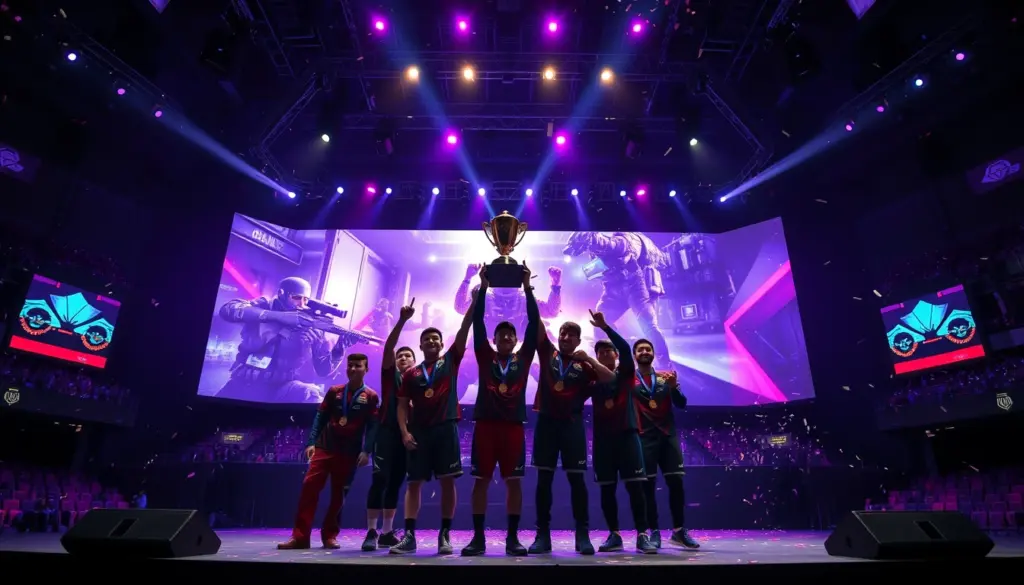
Global Esports beat Nongshim RedForce 3-2 in a reverse sweep to win the 2026 VCT Pacific Stage 2 grand final on September 6 in Busan, South Korea, according to Riot Games’ announcement reported by Inven Global. The Indian-founded organization dropped the first two maps of the best-of-five series, then clawed back three straight to close out Haven 13-10 and claim its first VCT Pacific title in franchise history, TalkEsport reported. The win also locks in a spot at VALORANT Champions Shanghai later this year, the season-ending event that decides the world’s best Valorant roster.
The result caps a wild eight days for Global Esports (GE), who entered the upper bracket final against Nongshim RedForce (NS) on September 4 as underdogs, lost that match 2-1, then fought back through the lower bracket to force a rematch in the grand final two days later. Philstar described the run as a “stunning lower-bracket resurgence,” and the numbers back that framing: GE needed to win four consecutive maps across two matches just to reach the trophy, then needed three more to actually take it. For a region that Riot Games has spent years trying to grow beyond South Korea’s traditional dominance, an Indian org lifting the Pacific trophy for the first time is a genuine story, not just a line in a bracket recap.
What happened in Busan: the grand final breakdown
Riot Games hosted the 2026 VCT Pacific Finals Busan at the Sajik Indoor Gymnasium from September 4 to 6, the culmination of a Stage 2 season that ran since July 16 across South Korea, according to Inven Global’s tournament preview. Four teams made the live finals: Nongshim RedForce, T1, Global Esports, and VARREL. Paper Rex and Nongshim RedForce had already banked enough Championship Points earlier in the year to secure their Champions Shanghai berths regardless of how Busan played out, which meant the finals were really a fight over the Pacific trophy itself and the two remaining Shanghai slots.
The bracket format worked against Global Esports from the start. Nongshim RedForce beat GE 2-1 in the upper bracket final on September 4, sending GE to the lower bracket while NS advanced straight to the grand final with a bye. GE then had to win a lower-bracket match just to earn a second shot at NS, and did, setting up a rematch on September 6 in a full best-of-five grand final. That format meant NS came into the decider fresh off a week-old win over the same opponent, while GE arrived having just played its way through an elimination gauntlet.
None of that mattered once the maps started. NS took Sunset 13-11 and Split 13-2, the second map a rout that looked like it might end the series in a sweep. Instead GE won Abyss 13-10, then Lotus 13-5, then closed out Haven 13-10 to complete the comeback. TalkEsport’s box score shows GE outscoring NS 39-25 across the final three maps, a swing that suggests something changed at the halfway point of the series rather than a gradual grind-back.
Map-by-map: how the reverse sweep actually happened
The table below lays out the full map sequence, based on the scoreline published by TalkEsport and corroborated by community match threads tracking the same series.
| Map order | Map | Winner | Score | Series status after map |
|---|---|---|---|---|
| 1 | Sunset | Nongshim RedForce | 13-11 | NS leads 1-0 |
| 2 | Split | Nongshim RedForce | 13-2 | NS leads 2-0 |
| 3 | Abyss | Global Esports | 13-10 | NS leads 2-1 |
| 4 | Lotus | Global Esports | 13-5 | Series tied 2-2 |
| 5 | Haven | Global Esports | 13-10 | GE wins 3-2 |
The Split scoreline is the one that stands out. A 13-2 loss on a map is about as close to a no-contest as competitive Valorant produces, and it’s the kind of result that usually precedes a sweep, not a comeback. Whatever adjustment Global Esports made between Split and Abyss, it flipped the series completely: GE won the next three maps by a combined score of 39-25, never trailing by more than a couple of rounds after halftime on any of them.
Global Esports’ road to the title
Global Esports’ path through Stage 2 playoffs wasn’t a straight line to the final. According to bracket coverage from BO3.gg, GE opened the playoffs against DRX in the upper bracket first round, while Nongshim RedForce faced Paper Rex in the same round. GE and NS both advanced, setting up their first meeting of the playoffs in the upper bracket final on September 4, which NS won 2-1 to send GE to the lower bracket.
That wasn’t the first time these two teams had met this season, either. CryptoBriefing’s season recap notes that Global Esports beat Nongshim RedForce 2-1 back on May 2 during Stage 1, a result the outlet called a genuine upset at the time. The two organizations have effectively been trading wins against each other all year, which makes the September 6 result less of a surprise in hindsight than the “stunning” framing in some headlines might suggest, even if the manner of the win (down 0-2, then three straight) was still dramatic.
SportsAdda’s pre-finals coverage captured how tight the qualification math was for GE heading into the week. The outlet noted that beating NS in the upper final on September 4 would have punched GE’s Champions ticket outright regardless of the grand final result, since the tournament runner-up also qualifies. GE lost that match, which meant the team’s Shanghai spot was never guaranteed until the lower bracket run and grand final win sealed it two days later.
Prize money and what was actually on the line
TalkEsport reported that Global Esports collected $100,000 for winning VCT Pacific Stage 2, while Nongshim RedForce took home $65,000 as runner-up. Those figures are modest by the standards of Valorant’s biggest events, Valorant Champions and Masters, where prize pools run into the millions, but Stage 2 finals aren’t really about the cash. The real prize was one of the two remaining Champions Shanghai slots, since Paper Rex and Nongshim RedForce had already locked in their spots on Championship Points before the Busan bracket even started.
That structure is worth sitting with for a second, because it explains why a $100,000 first-place check drew this much attention. Every team at Busan understood that reaching the grand final, win or lose, meant a trip to Shanghai. Losing the upper bracket final on September 4 didn’t eliminate GE’s Champions hopes; it just meant taking the harder path through the lower bracket to get there. The prize money was almost incidental to the actual stakes.
Valorant Champions Shanghai: who’s actually qualified now
With the Busan finals complete, the Pacific region’s representation at Valorant Champions Shanghai is set. Inven Global’s tournament preview had already confirmed Paper Rex and Nongshim RedForce as qualified via Championship Points before the live finals began. Global Esports’ grand final win adds the team as the Stage 2 champion, and as the tournament runner-up, Nongshim RedForce’s finals result doesn’t cost it anything since it had already qualified separately.
| Team | Qualification route | Result at Busan finals | Champions Shanghai status |
|---|---|---|---|
| Paper Rex | Championship Points | Did not reach Busan grand final | Qualified (pre-finals) |
| Nongshim RedForce | Championship Points | Runner-up (lost grand final 2-3) | Qualified (pre-finals) |
| Global Esports | Stage 2 champion | Won grand final 3-2 | Qualified (Stage 2 title) |
| VARREL | Stage 2 playoffs | Eliminated before grand final | Not qualified via Busan |
| T1 | Stage 2 playoffs | Eliminated before grand final | Not qualified via Busan |
EsportNow’s coverage of the qualification framed it plainly: Global Esports’ win at Busan “confirmed its VALORANT Champions Shanghai ticket,” language that matches how Riot has structured most of its regional splits since introducing the franchised VCT format. The takeaway for fans tracking the Shanghai field is that the Pacific region’s slots are now locked, barring any late roster or eligibility issues, and attention shifts to how GE, NS, and Paper Rex stack up against the Americas, EMEA, and China representatives once the full bracket is announced.
“Everyone doubted us”: what the players said
Global Esports player PatMen Mendoza captured the underdog framing in post-match comments reported by Philstar: “This trophy means very much to me because we’re the team that no one expected to be here. Everyone doubted us, everyone looked down on us, some players, some teams, and now look at us. We’re able to lift the trophy. I don’t need a superstar team. I don’t need superstar players. We can win.”
Teammate Xavier Juan described the mentality shift that fueled the actual comeback, also quoted by Philstar: “The reverse sweep was amazing. We were down 0-2 and I think on the third map we all just rallied together and, you know, we had nothing to lose anymore. If we lose, we’re out, so might as well just give it our all. And after that, the momentum just came back and we won the next three maps.”
Mendoza also spoke to the toll of the season leading into the final, per the same Philstar report: “We don’t expect to be here actually. But we made it through. We’re at the lowest lows and highest highs also in the last few months. There’s a lot of things that shouldn’t happen. But things can be stressful. It’s inevitable. I’m so proud of everyone that we’re able to make it to the grand finals.”
The organization’s official account struck a similar tone in a post picked up by EsportNow after the Champions qualification was confirmed: “2026 has been a year of many firsts. A lot of ups and downs, a lot of sacrifices, and a lot of hard work has resulted in this. For those who have stuck by us since Day 0 and to those who joined us on this beautiful journey, this one is for you. Finally, we can say, WE ARE HEADED TO [CHAMPIONS] SHANGHAI!”
Historical context: Pacific’s shifting hierarchy
VCT Pacific has been dominated for most of its existence by South Korean and Japanese organizations, along with Southeast Asian powerhouse Paper Rex. Since Riot moved to the franchised VCT structure, the region’s Champions and Masters representation has skewed heavily toward those established rosters. Global Esports, one of the earliest Indian esports organizations to build a Valorant program, had never previously won a VCT Pacific stage title, per Inven Global and Philstar’s framing of the September 6 result as the org’s “first-ever” Pacific championship.
That matters for the broader Valorant scene in South and Southeast Asia, a region Riot has repeatedly said it wants to grow. An Indian-founded org reaching Valorant Champions, the sport’s biggest annual event, gives the region a data point beyond Paper Rex’s now-established run of success. Whether GE can carry that momentum into Shanghai against Americas and EMEA rosters that have historically outperformed Pacific teams at Champions is a separate question, but the qualification itself is already a notable shift in who gets a seat at the table.
Competitive comparison: VCT Pacific vs the other VCT regions
Riot’s franchised VCT structure splits the world into four regional leagues, each running its own Kickoff, Stage 1, and Stage 2 seasons before Masters and Champions. Pacific has generally been viewed as a step behind EMEA and Americas at the very top of the game, with Paper Rex the clearest exception as a team that regularly competes for international titles. Nongshim RedForce’s run to Masters London runner-up earlier this year, referenced in Inven Global’s Busan preview, was part of what already had NS pre-qualified for Shanghai on points before the Stage 2 finals even started.
What the Busan result adds to that picture is depth. A region is generally judged not just by its best team but by how many organizations can realistically win a stage title in a given season. Pacific now has at least three teams, Paper Rex, Nongshim RedForce, and Global Esports, that have shown they can beat each other on a given week, plus T1 and VARREL pushing from just outside the top tier. That’s a meaningfully different competitive picture than a region carried by a single dominant roster, and it’s the kind of parity Riot has said it wants across all four VCT leagues.
Market impact: sponsorships, viewership, and the Pacific circuit
Neither Riot Games nor the outlets covering the Busan finals published official viewership figures for the grand final at the time of writing, so any specific concurrent-viewer number circulating online should be treated as unverified until Riot or a tracking service like Esports Charts publishes confirmed data. What is confirmed is the structural stakes: a Championship Points system that ties regular-season performance directly to Champions qualification, which gives every Stage 2 match commercial weight beyond a single event’s prize pool.
For sponsors and franchise investors, an Indian organization reaching Valorant’s biggest stage is a meaningful data point regardless of the exact viewership number. Esports sponsorship deals in South and Southeast Asia have lagged behind the more mature EMEA and North American markets, and a Champions berth for a team with a built-in Indian fanbase gives Global Esports leverage it didn’t have a week ago heading into sponsorship renewal conversations. It also gives Riot a marketing story for the region beyond Paper Rex, which has effectively been Pacific’s lone international face for several seasons.
Analysis: why this result matters beyond one bracket
Reverse sweeps in best-of-five Valorant are rare enough that each one tends to get remembered individually, but this one carries extra weight because of the qualification stakes layered on top. Losing 0-2 in a match that also determines whether your organization reaches the sport’s premier event is a specific kind of pressure that doesn’t show up in the box score. GE’s players losing Split 13-2, then winning three straight by a combined 14-round margin, is the kind of swing that either reflects a real tactical adjustment or a mental unraveling on the other side of the server. Either explanation is a story worth tracking once VOD review and player interviews go deeper than the immediate post-match comments captured by Philstar.
There’s also a franchising angle here that’s easy to miss. Under Riot’s closed-franchise VCT model, there’s no relegation risk for underperforming a season, which means an org like Global Esports can have a rough stretch, as Mendoza’s comments about “lowest lows” suggest, without losing its league spot the way a promotion-and-relegation system might have forced. That stability arguably makes a run like this possible in the first place: GE could afford to rebuild form mid-season because a bad Stage 1 didn’t threaten its franchise slot for the following year.
What comes next: predictions for the rest of 2026
A few things look likely heading into Valorant Champions Shanghai based on how the Pacific field has shaken out:
- Global Esports will enter Shanghai as a lower seed than Paper Rex and Nongshim RedForce given its lower-bracket run through Stage 2, which typically affects group draw and early scheduling in Riot’s Champions format.
- Expect Riot and regional broadcasters to lean heavily into the underdog narrative around GE in pre-Champions marketing, similar to how Riot has promoted breakout runs from other regional teams in prior Champions cycles.
- Nongshim RedForce, despite the Busan loss, remains a live threat at Champions given its Masters London runner-up finish earlier in the year; a single stage-final loss doesn’t erase that resume.
- Sponsorship interest in Global Esports is likely to increase heading into Shanghai, particularly from brands targeting the Indian gaming market, though any specific deal figures should be treated as speculative until announced.
- Watch for VARREL and T1 to be the teams under the most roster-change pressure heading into the 2027 season, since both were eliminated before the Busan grand final without a Champions berth to show for Stage 2.
How the bracket actually played out
For readers trying to follow the full playoff sequence, the path both finalists took through Stage 2 looked like this, based on BO3.gg’s bracket reporting and match records from Strafe and Rib.gg:
Upper Bracket Round 1: Global Esports def. DRX
Upper Bracket Round 1: Nongshim RedForce def. Paper Rex
Upper Bracket Final (Sept 4): Nongshim RedForce def. Global Esports, 2-1
  -> NS advances directly to Grand Final
  -> GE drops to Lower Bracket Final
Lower Bracket Final: Global Esports advances to Grand Final
Grand Final (Sept 6, Bo5): Global Esports def. Nongshim RedForce, 3-2
  Sunset: NS 13-11 | Split: NS 13-2 | Abyss: GE 13-10 | Lotus: GE 13-5 | Haven: GE 13-10
That structure explains why NS entered the grand final as the betting favorite. Win.gg’s pre-match odds had Nongshim RedForce favored at 1.54 to Global Esports’ 2.36, reflecting both NS’s head start (a bye straight to the final) and its earlier win over the same opponent four days prior. GE overturning both the bracket disadvantage and the odds in the same series is a big part of why the result generated coverage well beyond typical stage-final recaps.
The broader Valorant esports economy in late 2026
This result lands at a moment when esports organizations broadly are under pressure to prove commercial sustainability rather than just competitive success. Franchised leagues like VCT were built partly to give investors and sponsors more predictable, long-term partnerships than the older open-circuit model offered. A Champions berth is one of the clearest ways a mid-tier organization can justify that investment to backers, since it guarantees exposure at Valorant’s most-watched event of the year alongside whatever prize money and Championship Points come with a deep run.
For Global Esports specifically, reaching Shanghai for the first time gives the organization a concrete achievement to point to as it competes for sponsorship dollars against better-resourced orgs in the region. It’s also a reminder that Riot’s franchised model, whatever its tradeoffs around relegation and roster stability, still allows for genuine competitive upsets. A team can lose an upper bracket final 2-1, get written off, and still win the whole thing five days later.
Frequently asked questions
Did Global Esports really win VCT Pacific 2026?
Yes. Riot Games’ announcement, reported by Inven Global, confirmed Global Esports defeated Nongshim RedForce 3-2 in the grand final of VCT Pacific Stage 2 on September 6, 2026, at the Sajik Indoor Gymnasium in Busan, South Korea.
What is a “reverse sweep” in Valorant?
It refers to a team losing the first two maps of a best-of-five series, then winning the next three to take the match. Global Esports lost Sunset and Split before winning Abyss, Lotus, and Haven to complete the reverse sweep against Nongshim RedForce.
Has Global Esports won a VCT Pacific title before?
No. Both Inven Global and Philstar described the September 6 win as Global Esports’ first VCT Pacific championship since the organization entered Valorant esports.
How much prize money did the teams win?
TalkEsport reported that Global Esports received $100,000 for winning VCT Pacific Stage 2, while runner-up Nongshim RedForce received $65,000.
Which Pacific teams are going to Valorant Champions Shanghai?
Paper Rex and Nongshim RedForce qualified earlier via Championship Points, and Global Esports qualified by winning the Stage 2 title at Busan. VARREL and T1 were eliminated before the grand final and did not qualify through this event.
When and where is Valorant Champions Shanghai?
Riot Games has designated Shanghai as the host city for the 2026 Valorant Champions season finale; exact dates for the event were not specified in the coverage of the Pacific finals and should be confirmed through Riot’s official Champions announcements as they’re released.
Who was named MVP of the grand final?
Coverage of the grand final’s individual MVP was inconsistent across outlets at the time of writing, so no MVP designation is confirmed here. Readers should check Riot’s official VCT statistics pages for the verified MVP once published.
Why did Nongshim RedForce still qualify for Champions despite losing the final?
Nongshim RedForce had already secured a Champions Shanghai berth earlier in the season through Championship Points, a system that rewards consistent performance across the whole VCT Pacific season rather than just the final bracket. Losing the Stage 2 grand final cost NS the stage title and the larger prize check, but not its already-secured Champions spot.