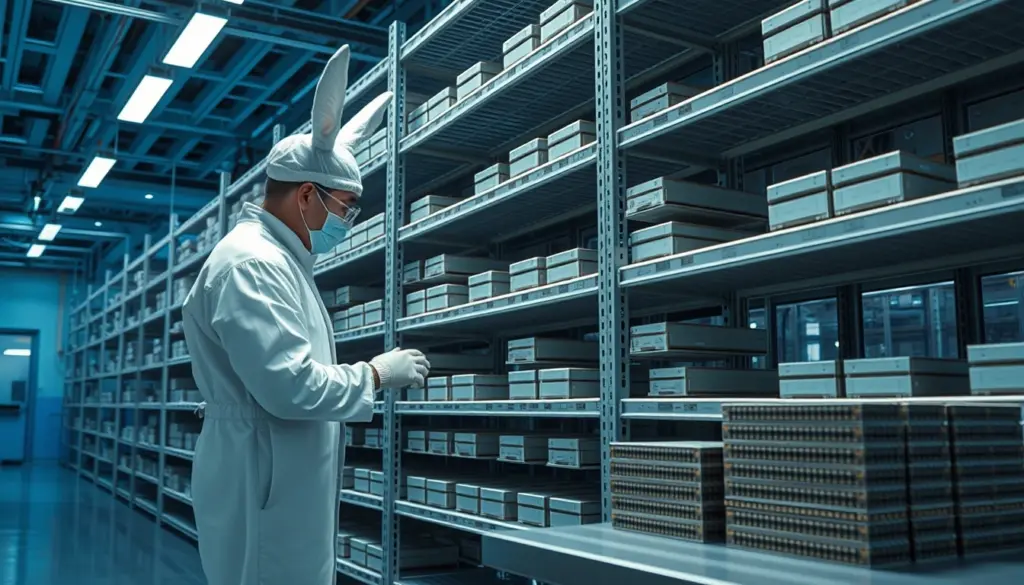
Samsung Electronics and SK hynix are running their memory chip warehouses closer to empty than at any point in recent memory. Reports out of South Korea this week put combined inventories at both companies below 10 days’ worth of supply, an unusually thin cushion for an industry that normally carries weeks of buffer stock. The cause isn’t a factory fire or a trade embargo. It’s demand for artificial intelligence hardware eating into the wafer capacity that used to make ordinary DRAM and NAND chips.
The Chosun Daily reported on September 8, 2026 that inventories at both memory makers had fallen under the 10-day mark, citing analysis from KB Securities. A day earlier, Sedaily carried the same figure, adding that KB Securities expects DRAM and NAND bit-demand growth in 2027 to outpace supply growth by more than 10 percentage points. Neither Samsung nor SK hynix has published an official inventory figure to confirm the exact number, but the direction of travel matches what buyers, distributors and analysts have been describing since midsummer: less memory on hand, and it’s getting worse.
This is the memory chip shortage 2026 story in its rawest form. It isn’t abstract anymore. It shows up as a smaller number on a warehouse inventory sheet in Icheon and Pyeongtaek, and it’s about to show up as a bigger number on invoices for anyone who buys a laptop, a server, or a graphics card over the next year.
What’s Actually Driving the 2026 Memory Chip Shortage
The mechanism behind this shortage is capacity substitution, not a shortage of raw silicon. High-bandwidth memory, the stacked chip that feeds data to AI accelerators, has become the priority product on every major memory maker’s roadmap. According to the Chosun Daily’s sourcing from KB Securities, the transition to HBM4 is a key factor worsening the broader memory shortage because HBM4 consumes roughly three times the wafer production capacity of general-purpose DRAM. Sedaily’s separate report on September 7 repeated the same three-to-one figure, describing it as a structural constraint rather than a temporary bottleneck.
In practical terms, every wafer that Samsung or SK hynix diverts to HBM4 production removes roughly three wafers’ worth of standard DDR5 or DDR4 output from the market. Memory fabs can’t simply add a second shift to cover the gap. Building new cleanroom capacity takes years, and the tools used for advanced HBM stacking, including TSV etching and hybrid bonding equipment, are themselves in short supply. That’s why the shortage is hitting server DRAM, enterprise SSDs and consumer RAM all at once, even though none of those products directly compete with HBM4 for a customer’s wallet. They compete with it for the same production lines.
Shattered.io covered the supply side of this earlier this year when Samsung began shipping 8-layer HBM4E stacks to Nvidia and when HBM4 yields climbed toward 80% ahead of Nvidia’s Rubin platform. Both of those milestones were framed as good news for AI infrastructure. They’re also, directly, the reason a laptop buyer in September 2026 is paying more for a RAM upgrade.
Spot Prices Are Already Reacting to the Squeeze
Spot markets, where buyers pay for memory outside of long-term supply contracts, are the first place a shortage shows up in dollar terms. By September 4, 2026, a 36-gigabyte HBM3E module was trading at roughly $2,100 on the spot market, according to a report from Intuition Labs. That’s four to five times the $300 to $400 that buyers typically pay under long-term agreements for the same module. Spot prices are volatile by nature and don’t reflect what most large customers actually pay, but a four-to-five-times premium is a meaningful signal that supply has tightened faster than contracts can adjust.
Micron and SK hynix stock both moved on the news cycle around the shortage reports. Micron Technology shares gained about 4% and SK hynix rose around 3%, according to a Yahoo Finance report published in the first week of September. Investors appear to be reading a tight memory market as a pricing-power story for the companies that make the chips, even as it becomes a cost story for the companies and consumers that buy them.
DDR4 and DDR5 Prices Climb as Legacy Memory Gets Squeezed
The pain isn’t confined to exotic AI hardware. DDR4 and high-density DDR5 modules have seen 30% to 40% year-over-year price increases, according to a Tech Insider report last updated on September 6, 2026. Some enterprise-grade DDR5 modules are now priced at more than double their early-2025 levels. That’s notable because DDR4 is a legacy standard that most of the industry expected to keep getting cheaper as production shifted to DDR5. Instead, DDR4 lines are being kept running longer than planned, and in some configurations DDR4 spot prices have actually pushed past DDR5, an inversion of the normal pricing hierarchy between an aging standard and its replacement.
Separately, Network World reported that Samsung raised prices for 32GB DDR5 modules to $239 from $149, a 60% jump, while contract pricing for DDR5 surged more than 100% to around $19.50 per unit compared to roughly $7 earlier in 2025. PC builders and system integrators who priced out a build in January are now looking at a materially different bill of materials in September, and the increases haven’t fully worked their way through to every retail SKU yet. Shattered.io’s earlier reporting on RAM prices climbing 89% as the AI memory crunch hit gaming hardware flagged this trend months before the inventory data confirmed how tight the supply chain had become.
Memory Price and Inventory Snapshot: September 2026
The table below pulls together the specific, sourced figures from the past two weeks of reporting to show how fast conditions have moved.
| Metric | Baseline / Early Reference | September 2026 Reading | Change | Source |
|---|---|---|---|---|
| Samsung / SK hynix memory inventory | Multi-week buffer (typical) | Under 10 days | Sharp drawdown | Chosun Daily, Sept. 8; Sedaily, Sept. 7 |
| 36GB HBM3E module, long-term contract price | $300–$400 | ~$2,100 (spot, Sept. 4) | 4–5x spot premium | Intuition Labs |
| 32GB DDR5 module (Samsung) | $149 | $239 | +60% | Network World |
| DDR5 contract price per unit | ~$7 (early 2025) | ~$19.50 | +100%+ | Network World |
| DDR4 / high-density DDR5 modules, YoY | Baseline | +30% to +40% | Some SKUs 2x+ vs. early 2025 | Tech Insider |
| Supplier demand fulfillment, H2 2026 | Near full supply | 75%–80% | -20 to -25 points | Meritz Securities via Tech Times |
Supplier Fulfillment Rates Point to a Worse 2027
The forward-looking numbers are arguably more alarming than the spot prices. Meritz Securities estimates that memory suppliers are currently meeting only 75% to 80% of demand in the second half of 2026, and that fulfillment rate could drop to 60% in 2027, according to Tech Times’ report from September 7, 2026. A fulfillment rate below 100% means buyers with signed contracts may not receive the full volume they ordered, forcing them to ration allocation across product lines or push back shipment dates.
KB Securities’ forecast, cited by Sedaily, frames the imbalance in bit terms rather than unit terms: DRAM and NAND bit-demand growth is expected to exceed supply growth by more than 10 percentage points in 2027. Bit growth accounts for rising storage density per chip, so the shortfall isn’t something that gets solved just by running existing fabs harder. It requires new capacity, and new capacity takes two to three years to come online from the point a fab breaks ground.
Who’s Affected: Samsung, SK Hynix and Micron Compared
Samsung, SK hynix and Micron are all navigating the same structural squeeze, but they’re not identically positioned. Samsung and SK hynix both reported inventories under 10 days, and both are widely reported to be prioritizing HBM4 output over legacy DRAM and NAND lines to serve AI accelerator customers first. SK hynix, according to a September 2, 2026 report from Collyer Bridge, is also weighing a new memory chip plant in Japan, with SK Group Chairman Chey Tae-won describing a possible joint production arrangement with Japanese NAND maker Kioxia as one option under consideration. That would mark a geographic diversification away from South Korea’s existing manufacturing base.
Micron, the largest US-based memory maker, has ridden the same investor enthusiasm that lifted SK hynix shares, gaining around 4% in the same trading window, per Yahoo Finance’s reporting. None of the three companies has announced an emergency capacity expansion specific to this month’s inventory data, which suggests the current response is pricing and allocation, not a rush to build new fabs. New fab construction, when it happens, changes supply on a multi-year timeline, not a multi-month one.
| Company | September 2026 Position | Key Data Point | Source |
|---|---|---|---|
| Samsung Electronics | Inventory below 10 days | HBM4 uses ~3x the wafer capacity of general DRAM | Chosun Daily / Sedaily |
| SK hynix | Inventory below 10 days; exploring overseas capacity | Weighing new Japan plant, possible Kioxia joint production | Collyer Bridge, Sept. 2 |
| Micron Technology | Share price up ~4% on shortage news | Riding sector-wide memory stock rally | Yahoo Finance |
| KB Securities (analyst) | Forecast | DRAM/NAND bit demand to outpace supply by 10+ points in 2027 | Sedaily, Sept. 7 |
| Meritz Securities (analyst) | Forecast | Supplier fulfillment could fall to 60% in 2027 | Tech Times, Sept. 7 |
Historical Context: This Isn’t the First Memory Supercycle
Memory markets are cyclical by nature, swinging between oversupply, where prices crash and manufacturers cut production, and shortage, where prices spike and buyers scramble for allocation. The industry went through a well-documented DRAM price spike in 2017 and 2018 driven by tight supply and strong smartphone and server demand, followed by a glut that pushed prices back down within a couple of years. The 2021 global chip shortage, triggered by a mix of pandemic-driven demand shifts and manufacturing disruption, squeezed automakers and consumer electronics makers alike and took roughly two years to fully unwind.
What sets the 2026 cycle apart is the driver. Past shortages were largely demand-side shocks or short-term supply disruptions that resolved once production caught up. This one is being described by analysts as structural, tied to a permanent reallocation of fab capacity toward AI infrastructure rather than a temporary spike that reverses on its own. If HBM demand keeps consuming wafer capacity at a three-to-one ratio against conventional DRAM, the industry doesn’t naturally revert to its old supply-demand balance even after new fabs come online, because those new fabs are also likely to be weighted toward HBM.
Market Impact: Who Actually Pays for the Shortage
The cost of tight memory supply doesn’t stay contained to server rooms. PC makers building budget and mid-range laptops are the most exposed, since RAM and storage make up a larger share of the bill of materials on a $600 machine than on a $2,000 workstation. Shattered.io has already tracked one knock-on effect directly: Nvidia raised AI server prices by more than 15% citing the memory crunch, passing the cost of tight HBM and DRAM supply straight through to cloud providers and enterprise buyers.
Consumer graphics cards have felt it too. Earlier reporting on the RTX 5090’s price surge toward $5,000 pointed to the same underlying memory constraint driving up the cost of the GDDR7 modules that sit alongside the GPU die. Gamers, PC builders and small businesses buying off-the-shelf workstations are effectively competing with hyperscale AI data centers for the same wafer starts, and the data centers have both the budget and the contractual priority to win that competition most of the time.
Wall Street’s Reaction: Memory Stocks Rally on Shortage News
Equity markets have treated the shortage as a pricing-power story rather than a warning sign. Micron and SK hynix both traded higher in the days around the inventory reports, and broader memory-sector sentiment has stayed upbeat through early September, according to Yahoo Finance’s coverage of the rally. That reaction makes sense from a margins perspective: when supply is constrained and demand keeps climbing, memory makers get to set higher prices without discounting to move volume, which tends to expand margins even if unit shipments stay flat or decline slightly.
The risk for investors is timing. Memory cycles have historically ended in oversupply once new capacity finally lands, and pricing power can reverse quickly when that happens. For now, though, the inventory data gives the bulls a concrete number to point to: less than 10 days of stock on hand is not a level that supports discounting.
South Korea’s Widening Lead Over China
The shortage is also reshaping the competitive map between South Korea and China in memory manufacturing. A Bank of Korea-linked analysis reported by Bloomberg on September 4, 2026, concluded that South Korea’s lead over China in memory chip production is expected to widen further as Samsung and SK hynix push ahead with aggressive facility expansion. Chinese memory makers have been investing heavily in domestic DRAM and NAND capacity for years, but the capital intensity and technical difficulty of HBM production, combined with export controls on advanced chipmaking tools, have kept Chinese suppliers further from the cutting edge than in more mature chip categories.
That dynamic matters for the shortage’s duration. If South Korea remains the dominant source of advanced HBM and high-density DRAM for the next several years, global supply stays concentrated in two companies, Samsung and SK hynix, that are already running near-empty warehouses. A third major supplier scaling up quickly would ease the crunch faster than either company can on its own, and right now that third supplier isn’t close to ready.
What to Watch Next: Five Predictions for the Memory Market
- Fulfillment rates keep sliding into 2027. If Meritz Securities’ forecast holds, expect supplier fulfillment to drop from the current 75%-80% range toward 60% next year, forcing more customers onto allocation.
- DDR4 keeps getting more expensive than it should. As long as fabs prioritize DDR5 and HBM, legacy DDR4 lines will stay under-supplied relative to lingering demand from older systems and industrial buyers.
- Entry-level PC and laptop prices rise further. Budget hardware absorbs memory cost increases faster and more visibly than premium products, where RAM is a smaller share of the total build cost.
- Samsung and SK hynix announce concrete new capacity. Watch for formal capital expenditure commitments, including any update on SK hynix’s reported Japan plant discussions with Kioxia, as the clearest signal of when relief might actually arrive.
- Spot prices stay volatile but don’t set the real market. Expect headline-grabbing spot prices like the $2,100 HBM3E module to keep making news, even as most large buyers continue operating under long-term contracts at a fraction of that price.
None of these are certainties. Memory markets have a track record of overshooting in both directions, and a faster-than-expected capacity ramp from any of the three major suppliers could ease the crunch sooner than analysts currently expect. But the inventory data from this week gives the shortage narrative a harder edge than it had even a month ago, when the conversation was mostly about rising prices rather than physical stock running out.
Frequently Asked Questions
Why is there a memory chip shortage in 2026?
Memory makers are diverting wafer capacity to high-bandwidth memory (HBM) for AI accelerators. Because HBM4 uses roughly three times the wafer capacity of standard DRAM, according to KB Securities’ analysis reported by Chosun Daily and Sedaily, every wafer redirected to HBM4 removes capacity that would otherwise make conventional DRAM and NAND chips.
How low are Samsung and SK hynix’s memory inventories right now?
Reports from Chosun Daily and Sedaily, both published in the first week of September 2026, put combined inventories at both companies below 10 days’ worth of supply, a thin buffer compared with the multi-week stockpiles memory makers typically carry.
How much have memory prices actually gone up?
Figures vary by product. Network World reported Samsung’s 32GB DDR5 module list price rising from $149 to $239, a 60% increase, with DDR5 contract pricing up more than 100% year over year. Tech Insider reported DDR4 and high-density DDR5 modules climbing 30% to 40% year over year. Spot HBM3E pricing hit roughly $2,100 per 36GB module in early September, four to five times typical contract pricing, according to Intuition Labs.
Will the memory chip shortage last into 2027?
Analysts cited by Tech Times and Sedaily expect the shortage to persist and potentially worsen through 2027, with Meritz Securities projecting supplier fulfillment rates could fall to 60% next year, down from 75%-80% in the second half of 2026.
Does the memory shortage affect gaming PCs and graphics cards?
Yes. Graphics cards use GDDR memory that competes for the same production capacity as DRAM and HBM. Shattered.io has tracked this directly in coverage of rising RTX 5090 prices and broader RAM price increases hitting gaming hardware through 2026.
Which companies make most of the world’s advanced memory chips?
Samsung Electronics and SK hynix, both based in South Korea, are the two companies at the center of this shortage. Micron Technology, based in the United States, is the other major global supplier. A Bloomberg-reported analysis from early September 2026 found South Korea’s lead over China in memory chip production is expected to widen further as Samsung and SK hynix expand domestic facilities.
Is this shortage the same as the 2021 global chip shortage?
No. The 2021 shortage was driven mainly by pandemic-related demand shifts and manufacturing disruptions across logic chips used in cars and consumer electronics, and it resolved within a couple of years as production normalized. The 2026 memory shortage is being described by analysts as a structural shift, where fab capacity is being permanently reallocated toward AI-driven HBM production rather than a temporary disruption that reverses once conditions settle.
What can buyers do about rising memory prices right now?
Industry guidance generally points to locking in purchases or contracts earlier rather than waiting, since analysts expect prices to keep climbing through at least 2027. Businesses planning large hardware refreshes may want to model higher memory costs into budgets now rather than assuming prices will normalize in the near term.