
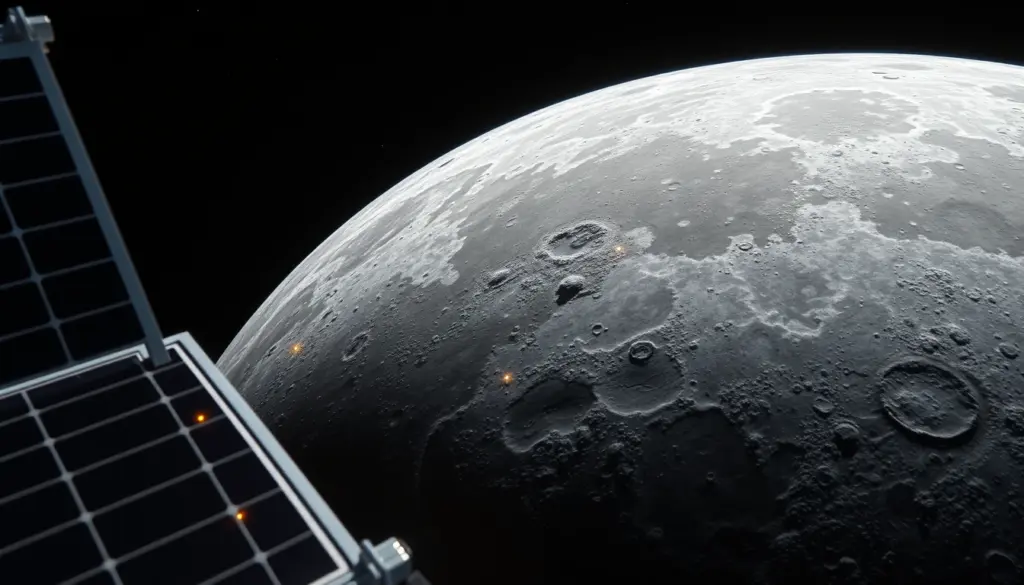
IBM and NASA on September 10, 2026 announced the open-source release of the NASA-IBM Lunar Foundation Model, a system the two organizations describe as one of the first publicly available foundation models built specifically for scientific exploration of the Moon. The announcement, dated from IBM’s Yorktown Heights, N.Y. research campus, positions the model as a tool for turning decades of scattered lunar observation data into a single resource scientists can query, fine-tune, and build on.
The release matters beyond the space science beat. It is the clearest signal yet that the foundation-model approach, the same architecture pattern behind large language models, is now standard practice for turning raw scientific instrument data into a reusable AI asset. NASA and IBM have done this before with Earth observation data. This time the target is 384,000 kilometers away, and the stated goal is supporting a sustained human presence on the Moon.
What IBM and NASA actually announced
According to the IBM Newsroom announcement, the NASA-IBM Lunar Foundation Model is now available as an open-source release. IBM frames it as a way to help researchers “turn decades of complex, multi-instrument data into insights to support the establishment of a sustained human presence on the Moon.” That framing ties the release directly to NASA’s Artemis-era planning, where identifying safe landing zones, usable resources, and stable terrain has become a hard science problem rather than a purely engineering one.
IBM Research described the release in blunter terms, calling it, in its own words, “one of the first AI model[s] to integrate observations captured in a range of modalities, and at different viewing angles and spatial scales.” That is a specific and testable claim: rather than a model trained on a single instrument’s imagery, the Lunar Foundation Model is designed to fuse data types that previously lived in separate archives and required separate analysis pipelines.
The dual-branded name is deliberate. Both organizations are listed as co-developers, and both are treating the release as a flagship example of applied AI for science, a category IBM has been building out publicly since its Prithvi partnership with NASA began several years ago.
Inside the training data: nine instruments, four missions
The most concrete technical detail to emerge from the coverage so far comes from Reuters, which reported that the model was trained on more than 30 layers of data collected by nine instruments across four NASA missions, including the Lunar Reconnaissance Orbiter (LRO). NASA’s own science page confirms the model draws primarily on LRO data, the spacecraft that has been mapping the Moon in high resolution since 2009.
That multi-instrument, multi-mission scope is the point. Individually, each of those data layers, from laser altimetry to thermal imaging to spectral reflectance, already exists in NASA’s Planetary Data System archives. What has not existed until now is a single model trained to reason across all of them together, letting a researcher ask a question that spans several types of measurement instead of running separate analyses and manually cross-referencing results.
Reuters also reported a specific performance claim from NASA and IBM: in benchmark testing, the model identified key lunar surface features up to 23% more accurately than the methods researchers have relied on until now. Neither organization has published a full peer-reviewed benchmark paper alongside the announcement as of this writing, so that figure should be read as the developers’ own reported result rather than an independently replicated one. Still, a 23% jump in feature-identification accuracy, if it holds up under outside scrutiny, is a meaningful improvement for a field where manual crater counting and shadow-region analysis have long been bottlenecks.
What the model is built to do
NASA and IBM point to three concrete use cases for the Lunar Foundation Model:
- Identifying potential ice deposits inside the Moon’s permanently shadowed regions, the deep polar craters that never see sunlight and are considered the most promising sites for extracting water for future crewed missions.
- Mapping craters at scale to help mission planners select safer landing sites, a task that has traditionally required painstaking manual review of orbital imagery.
- Studying volcanic features on the lunar surface, supporting broader geological research into the Moon’s formation and history.
The ice-deposit use case is arguably the highest-stakes of the three. Water ice at the lunar poles is treated as a strategic resource in NASA’s Artemis planning, both as a potential source of drinking water and as feedstock for producing rocket propellant on-site. Any tool that improves confidence in where that ice actually sits, without requiring a rover to physically drill and check, directly de-risks mission planning.
Open weights, public code: what “open-source” means here
Per NASA’s science communications team, the model is being distributed as an open-source release, with the trained weights hosted on Hugging Face and the supporting codebase published on GitHub. That distribution pattern mirrors how IBM released its earlier Prithvi Earth observation models, and it means the Lunar Foundation Model is not locked behind a NASA-only research agreement or an IBM commercial license. Any research group, university lab, or independent developer can, in principle, download the weights and fine-tune the model for their own lunar or planetary science questions.
That is a meaningfully different posture than how most frontier AI labs are currently handling their flagship models. While companies building general-purpose systems increasingly keep weights closed and gate access through APIs, NASA and IBM are treating this scientific foundation model the way open-source infrastructure has traditionally been treated: publish it, let outside researchers extend it, and treat community contributions as part of the model’s long-term value.
NASA-IBM Lunar Foundation Model: key facts at a glance
| Attribute | Reported detail |
|---|---|
| Official name | NASA-IBM Lunar Foundation Model |
| Announced | September 10, 2026 (Yorktown Heights, N.Y.) |
| Developers | IBM Research and NASA |
| Model type | Multimodal foundation model for lunar science |
| Primary data source | NASA’s Lunar Reconnaissance Orbiter (LRO) |
| Training data scope | 30+ data layers from 9 instruments across 4 NASA missions (per Reuters) |
| Core use cases | Ice-deposit detection, crater mapping, volcanic-feature study |
| Reported accuracy gain | Up to 23% more accurate than prior methods on feature identification, per NASA/IBM benchmarks reported by Reuters |
| Distribution | Open-source; weights on Hugging Face, code on GitHub (per NASA Science) |
| Related prior work | Prithvi-EO-1.0, Prithvi-EO-2.0, Prithvi-WxC-1.0 (Earth observation and weather) |
The Prithvi lineage: this isn’t IBM and NASA’s first foundation model
The Lunar Foundation Model did not appear out of nowhere. It extends a partnership that started with Earth observation. IBM Research and NASA, working with Germany’s Jülich Supercomputing Centre, previously co-developed the Prithvi family of geospatial foundation models: Prithvi-EO-1.0, Prithvi-EO-2.0, and Prithvi-WxC-1.0 for weather and climate data. Prithvi-EO-2.0 was trained on NASA’s Harmonized Landsat and Sentinel-2 (HLS) dataset, using roughly 4.2 million training samples and 45,568 validation samples, and it pioneered large-scale use of vision transformer architectures for multi-temporal Earth-observation imagery.
That effort sits inside a broader NASA initiative sometimes referred to internally as the “5+1 AI for Science” strategy, an approach that applies the foundation-model pattern, originally built for language, across NASA’s science divisions one domain at a time. According to NASA’s own account of the collaboration, a Moon-focused model for the agency’s Planetary Science division was already underway well before this week’s announcement, meaning the Lunar Foundation Model is best understood as the execution of a roadmap NASA had already signaled, not a surprise pivot.
That lineage also explains why the technical approach feels familiar rather than experimental. IBM has now shipped the same basic architecture pattern, a large pretrained model that other researchers fine-tune for narrower tasks, across Earth imagery, weather data, and now lunar surface data. Reusing a proven architecture and open-source distribution model lowers the technical risk of the lunar release considerably compared to building a lunar-specific model from scratch.
How this compares to other space and Earth-science AI models
The Lunar Foundation Model enters a field that already has several serious players, though none of the models below are built specifically for the Moon, which is precisely the gap NASA and IBM say they are filling.
| Model / platform | Developer(s) | Domain focus | Key reported capability |
|---|---|---|---|
| NASA-IBM Lunar Foundation Model | IBM Research, NASA | Lunar surface science | Multi-instrument fusion for ice, craters, and volcanic features |
| Prithvi-EO-2.0 | IBM Research, NASA, Jülich Supercomputing Centre | Earth observation (land/imagery) | Vision-transformer model trained on ~4.2M Harmonized Landsat/Sentinel-2 samples |
| NVIDIA Earth-2 / CorrDiff | NVIDIA | Climate and weather simulation | Diffusion-based super-resolution downscaling of weather and climate fields |
| Google DeepMind GenCast | Google DeepMind | Global weather forecasting | Open probabilistic ensemble forecasts up to 15 days ahead |
| Google DeepMind WeatherNext 3 | Google DeepMind | Global weather forecasting | Hourly forecast generation using satellite data |
| Microsoft Planetary Computer | Microsoft | Geospatial data infrastructure | Cloud-scale storage and analytics for Earth-observation datasets |
The pattern across this table is consistent: NVIDIA, Google DeepMind, and Microsoft have all built serious AI infrastructure for Earth’s weather and climate, an obviously large and commercially relevant market. None of them have publicly released a foundation model purpose-built for another planetary body’s surface. That gives NASA and IBM a genuine first-mover position in a much smaller, non-commercial niche, planetary science, where the customer base is space agencies and university researchers rather than insurers, farmers, or energy traders.
It also raises an obvious follow-up question for IBM’s competitive positioning in AI more broadly. In a landscape crowded with fast-moving general-purpose model releases, including recent frontier launches like GPT-6 Astra and DeepSeek’s V4.1 Flash, IBM has largely stayed out of the race to build the biggest general chatbot. Instead, it has carved out a scientific-domain niche with government partners, a strategy that trades headline-grabbing scale for durable, low-competition applications.
Why NASA needs this now
The timing lines up with where NASA’s Artemis program planning currently sits. Selecting landing sites, characterizing resource-rich regions, and understanding surface hazards are all tasks that become more urgent as the agency moves toward putting people back on the lunar surface for extended stays rather than short visits. Manually reviewing decades of accumulated LRO imagery and instrument data, one dataset at a time, does not scale to that timeline.
A foundation model changes the economics of that analysis. Once trained, it can be pointed at new regions of interest, fine-tuned by a mission planning team for a specific candidate landing zone, or used by an outside research group studying a completely different scientific question, all without NASA needing to run a bespoke data-processing project each time. That reusability is the entire argument for the foundation-model approach over building narrow, single-purpose models for each individual question.
What experts and the organizations involved are saying
IBM Research described the significance of the release directly: “Today, IBM and NASA are open-sourcing the most thorough model for mapping the Moon to date,” according to the IBM Research blog. The same post emphasized the model’s multi-source design, noting it is “the first AI model to integrate observations captured in a range of modalities, and at different viewing angles and spatial scales.”
IBM’s newsroom framed the release in terms of scale and access, stating that “IBM (NYSE: IBM) and NASA today announced the open-source release of the NASA-IBM Lunar Foundation Model, one of the first publicly available foundation models for scientific exploration of the Moon, now available,” per the official IBM Newsroom announcement.
NASA’s own science communications echoed the “first of its kind” framing, describing the release as “among the first open-source AI models built specifically for lunar science,” according to NASA Science. And in a public post summarizing the release, the IBM News account described the practical value for working scientists this way: “The NASA-IBM Lunar Foundation Model gives scientists a foundation to explore the Moon at scale, connecting observations across instruments, revealing patterns that are difficult to see in isolation,” via IBM News on X.
Notably absent from the public coverage so far are named individual scientists or executives attached to specific quotes, a common pattern for same-day corporate and agency announcements before the fuller research paper and follow-up interviews arrive.
Market and strategic impact for IBM
For IBM, the Lunar Foundation Model is less about direct revenue and more about reputation and positioning in a specific, defensible lane: applied AI for public-sector science. IBM has spent recent years pointing to its NASA partnership as proof that its research division can ship credible, working AI systems outside the general-purpose chatbot race that OpenAI, Google, and Anthropic currently dominate in public attention.
That positioning has value even without a direct product to sell. Government and research-lab customers evaluating AI vendors for scientific and mission-critical work want evidence of applied, domain-specific success, not just benchmark scores. A working, open-source model built with a marquee government partner like NASA is exactly that kind of evidence. It also strengthens IBM’s argument, at a time when AI infrastructure spending across the industry is under close scrutiny following moves like Anthropic’s own government and enterprise access expansions, that scientific AI partnerships are a durable business even when broader AI valuations swing.
For NASA, the calculus is different but complementary. An open-source release costs the agency little beyond the original R&D investment, while distributing the analytical workload of lunar research across every university lab, contractor, and international partner that downloads the weights. That is a way to multiply NASA’s limited in-house data-science headcount without expanding it.
Historical context: from language models to planetary models
The foundation-model pattern, pretrain once on a broad dataset, then fine-tune cheaply for many downstream tasks, was popularized by large language models earlier this decade. What has changed over the past two to three years is how quickly that pattern has been adapted to non-language, non-text scientific data: satellite imagery, weather fields, genomic sequences, and now planetary surface data.
IBM and NASA’s own path traces that shift clearly. Prithvi-EO-1.0 established the Earth-imagery version of the pattern. Prithvi-WxC-1.0 extended it to weather and climate fields. The Lunar Foundation Model extends it again, this time off-world. Each step reused the core transformer-based architecture while retraining on a new domain’s data, which is exactly why NASA could plausibly have a Moon model “underway” even before the general public knew the Prithvi program’s roadmap included planetary science.
Framed that way, the lunar release is not a one-off PR moment. It is a checkpoint in a multi-year, multi-domain rollout that increasingly looks like a template other space agencies and research institutions could copy for Mars, asteroid, or outer-planet moon data, assuming NASA and IBM’s public-release model gets validated first.
What’s confirmed and what remains open
It is worth being precise about what has and has not been independently verified in the first wave of coverage. Confirmed: the model’s name, the September 10, 2026 announcement date, the open-source distribution plan, the three headline use cases, and the primary reliance on Lunar Reconnaissance Orbiter data. Reported but not yet independently replicated: the specific 23% accuracy improvement figure and the exact composition of the “30+ data layers” training set beyond what Reuters described.
Not yet disclosed in public materials as of this writing: the model’s parameter count, its precise architecture beyond the general “foundation model” and multimodal descriptions, and the total volume of training data in storage terms. Those details typically surface in an accompanying technical paper or a follow-up developer blog post once the initial announcement cycle settles, and outside researchers who download the Hugging Face weights will likely fill in some of those blanks independently within days.
Predictions: where this goes next
Based on how the Prithvi program unfolded and how NASA has structured this release, a few outcomes look likely over the coming months:
- Expect university and international space-agency research groups to publish fine-tuned variants of the model within weeks of the Hugging Face weights going live, mirroring how quickly the Prithvi-EO models attracted downstream forks.
- NASA’s “5+1 AI for Science” pattern suggests another planetary or heliophysics-focused foundation model is plausible as a next step, following the same IBM Research collaboration structure.
- Landing-site selection teams working on future Artemis surface missions are the most likely near-term operational users, since crater mapping and hazard identification map directly onto their existing workflows.
- Independent researchers will likely attempt to replicate or challenge the reported 23% accuracy improvement, standard practice once an open-source model with a specific benchmark claim becomes downloadable.
- IBM will likely continue leaning on this partnership publicly as evidence of its applied-science AI credibility, particularly in contrast to the consumer and enterprise chatbot competition dominating headlines elsewhere in the AI-models space.
Why open-sourcing a lunar AI model is a bigger deal than it sounds
It’s easy to read “NASA and IBM release AI model” as a routine agency press release. The more interesting story is what it says about where public-sector AI investment is actually going. While the loudest AI news cycles remain dominated by chatbot benchmarks, pricing wars, and GPU procurement deals, a meaningful and growing share of applied AI work is happening in narrower scientific domains where the value isn’t a flashy demo, it’s cutting the time a planetary scientist spends manually cross-referencing four missions’ worth of instrument data.
That distinction matters for how the industry should be read going forward. Foundation models built for science don’t need billions of users or subscription revenue to justify their existence. They need to be useful to the few hundred researchers who actually do the work, and open-sourcing them, rather than gating them behind a paid API, is often the fastest way to get that narrow but expert audience actually using the tool.
Frequently asked questions
What is the NASA-IBM Lunar Foundation Model?
It is an open-source AI foundation model, jointly developed by IBM Research and NASA and announced on September 10, 2026, built to analyze lunar surface data for scientific research and mission planning.
What can the model actually do?
According to NASA and IBM, it can help identify potential ice deposits in permanently shadowed lunar craters, map craters to support safer landing-site selection, and study volcanic features on the Moon’s surface.
What data was it trained on?
Reuters reported the model was trained on more than 30 layers of data from nine instruments across four NASA missions, with NASA confirming the Lunar Reconnaissance Orbiter as the primary data source.
Is the model really free to use?
Yes. NASA’s release materials describe the model as open-source, with the trained weights distributed on Hugging Face and the supporting code published on GitHub, meaning outside researchers can download and fine-tune it without a commercial license.
How accurate is it compared to older methods?
Reuters reported a NASA/IBM benchmark claim of up to 23% higher accuracy identifying lunar surface features compared to previously used methods. That figure comes from the developers and has not yet been independently replicated in a published peer-reviewed study.
Is this IBM and NASA’s first AI model collaboration?
No. IBM and NASA, along with Germany’s Jülich Supercomputing Centre, previously released the Prithvi family of Earth observation and weather foundation models, including Prithvi-EO-1.0, Prithvi-EO-2.0, and Prithvi-WxC-1.0. The Lunar Foundation Model extends that same collaboration to planetary science.
How does this compare to other space or climate AI models?
Platforms like NVIDIA’s Earth-2, Google DeepMind’s GenCast and WeatherNext 3, and Microsoft’s Planetary Computer focus on Earth’s weather and climate. The NASA-IBM Lunar Foundation Model is distinct in being purpose-built for another planetary body’s surface data rather than Earth’s atmosphere or land cover.
Why does this matter for NASA’s Artemis program?
Identifying safe landing zones and locating water ice are both cited as priorities for supporting a sustained human presence on the Moon. A model that speeds up analysis of decades of orbital data directly supports that mission-planning work without requiring NASA to expand its in-house data-science staff.