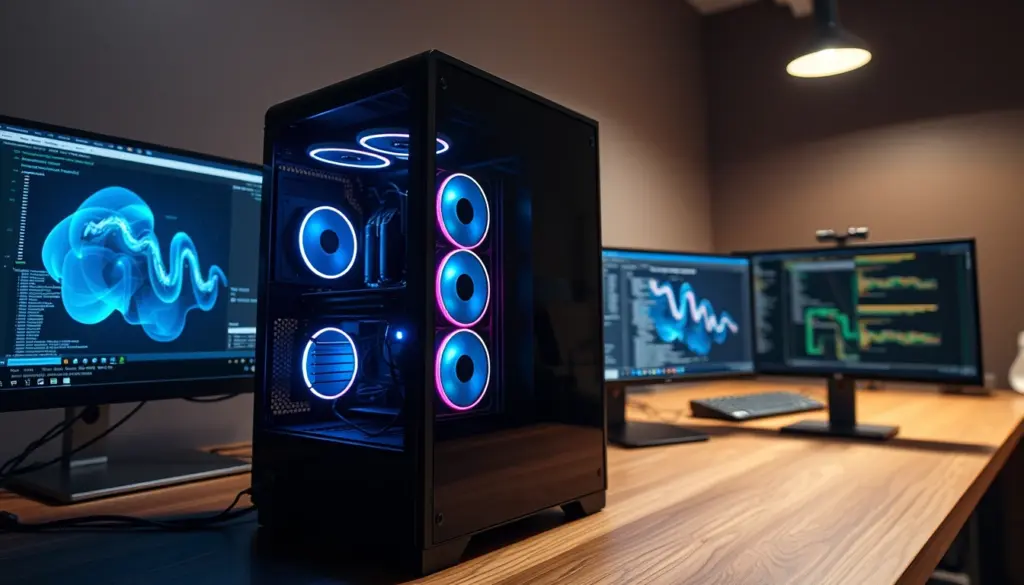
System76 has started shipping a new Linux workstation built for one job: running AI models on your own hardware instead of renting someone else’s GPUs by the hour. The Thelio Mira AI went live on September 9, 2026, priced from $3,299, and its top configuration packs 192GB of dedicated GPU memory across two Nvidia cards. That number matters more than almost anything else in the spec sheet, because GPU memory, not clock speed, is what decides how large a model you can actually load and run.
System76 Unveils the Thelio Mira AI Workstation
System76’s own announcement carries a blunt headline: “Accelerate Your AI Development with the New Thelio Mira AI.” The Denver-based Linux hardware maker built the machine for developers, researchers, and small AI teams who want to train, fine-tune, and run inference locally rather than depend on a cloud provider’s queue. The company’s product page describes the Thelio Mira AI as a GPU-intensive AI Workstation, a label that tells you exactly where the engineering budget went.
The timing is not an accident. Cloud GPU rental prices have been volatile through 2026, and teams running frequent fine-tuning jobs have started doing the math on buying versus renting. System76 is betting that a $3,299 entry price, with a clear upgrade path to serious GPU memory, beats writing a monthly cloud invoice for a lot of small and mid-size AI shops.
Founder and CEO Carl Richell framed the design goal directly: “Thelio Mira AI is built for developers who want to put more of their investment into GPU compute,” he said in the announcement. That single sentence explains most of the choices System76 made on the spec sheet, from the CPU it picked to the power budget it left for the graphics cards.
Thelio Mira AI Specs: The Full Breakdown
The base configuration of the Thelio Mira AI runs an AMD Ryzen 7 9700X, a single Nvidia RTX A400 GPU, 64GB of DDR5 memory, and a 1TB PCIe Gen5 SSD, all for $3,299. From there, buyers can step up the CPU to a Ryzen 9 9900X or a 16-core Ryzen 9 9950X, add a second GPU, and push storage capacity as high as 28TB. System76 lists the chassis at 17.31 by 9.96 by 15.12 inches, small enough to sit under a desk rather than in a server closet.
Connectivity keeps the same practical bent: four USB 10Gbps ports split between Type-A and Type-C, dual 5GbE RJ-45 Ethernet jacks, Wi-Fi 7, and Bluetooth 5.4. None of that is exotic, but it’s the right toolkit for a workstation that’s meant to sit on a home network and move large model checkpoints around without choking on the transfer.
| Component | Base Configuration ($3,299) | Top Configuration |
|---|---|---|
| CPU | AMD Ryzen 7 9700X | AMD Ryzen 9 9950X (16-core) |
| GPU | 1x Nvidia RTX A400 | 2x Nvidia RTX PRO 6000 Blackwell |
| GPU Memory | Entry-level (single card) | 192GB total (96GB per card, ECC) |
| System Memory | 64GB DDR5 | Up to 192GB DDR5 |
| Storage | 1TB PCIe Gen5 SSD | Up to 28TB |
| Networking | 2x 5GbE, Wi-Fi 7, Bluetooth 5.4 | Same across all configs |
Why the $3,299 Starting Price Matters
Pricing for the Thelio Mira AI starts at $3,299, and that number is doing a lot of marketing work. It undercuts most dual-GPU AI workstations from the big three PC makers, and it lands well below a fully loaded Threadripper build. System76 isn’t hiding the comparison either. The company’s own marketing calls the Ryzen 9000 platform a high-performance, lower-cost alternative to the AMD Threadripper in this specific model, which is a direct shot at the workstation segment System76 itself used to compete in with older Thelio Major builds.
The base configuration is deliberately modest. A Ryzen 7 9700X and a single RTX A400 will not fine-tune a 70-billion-parameter model, and System76 knows that. The $3,299 price point exists to get buyers into the product line, with the real story sitting in the configurator once someone starts adding a second RTX PRO 6000 Blackwell card.
System76’s own product copy makes the pitch plainly: “Accelerate your AI development with Thelio Mira AI, System76’s affordable, GPU-focused workstations, built for local AI development — so you can train, fine-tune, and iterate challenging AI workloads entirely on your own hardware.” The word “affordable” is relative, but next to a rack of rented H100 instances, a one-time $3,299 to $15,000-plus purchase does change the calculus for a team running weekly fine-tuning jobs.
Dual RTX PRO 6000 Blackwell GPUs and the 192GB Memory Advantage
The headline spec is the GPU memory. Each Nvidia RTX PRO 6000 Blackwell card in the Thelio Mira AI carries 96GB of ECC memory, and System76 supports up to two of them in a single chassis for 192GB combined. That’s dedicated video memory, not memory shared with the CPU, which is the detail that separates this machine from smaller mini PCs marketed for “local AI.”
System76’s own AI and machine learning page explains the tradeoff behind the design: “Thelio Mira AI prioritizes GPU compute with a 16-core CPU that requires less power, leaving more watts for dual, full-performance NVIDIA RTX Pro 6000 GPUs.” In plain terms, System76 capped the CPU on purpose so the power supply and cooling budget could go toward the graphics cards instead.
Why does 192GB matter so much? A 70-billion-parameter model in 16-bit precision needs roughly 140GB of memory just to load the weights, before accounting for the context window or any batching. Quantized down to 4-bit, that same model fits in well under half the Thelio Mira AI’s GPU budget, leaving room to run multiple smaller models side by side or to keep a large context window open during long coding or research sessions. Checking available memory on a dual-GPU Linux box is a one-line command:
nvidia-smi --query-gpu=name,memory.total,memory.used --format=csv
name, memory.total [MiB], memory.used [MiB]
NVIDIA RTX PRO 6000 Blackwell, 98304 MiB, 4102 MiB
NVIDIA RTX PRO 6000 Blackwell, 98304 MiB, 3988 MiB
That output, roughly 96GB per card, is what a fully configured Thelio Mira AI reports before a single model gets loaded. For teams doing local fine-tuning, that headroom is the entire point of the purchase.
AMD Ryzen 9000 Instead of Threadripper: An Unusual CPU Call
Most GPU-heavy workstations from Dell, Lenovo, or HP default to a Threadripper or Xeon platform, chips built around dozens of PCIe lanes and multi-socket memory bandwidth. System76 went the other way, building the Thelio Mira AI on AMD’s consumer AM5 desktop platform with Ryzen 9000 Series chips, topping out at the 16-core Ryzen 9 9950X.
That choice cuts cost and power draw at the same time. A Ryzen 9000 chip pulls a fraction of the power a comparable Threadripper Pro part needs, and AM5 motherboards cost far less than the workstation-class boards Threadripper requires. The tradeoff is fewer PCIe lanes, which is why System76 caps the Thelio Mira AI at two GPUs rather than the four or eight some Threadripper-based AI boxes support.
For a two-GPU workstation aimed at individual developers rather than a shared lab rig, that ceiling is unlikely to matter much. Two RTX PRO 6000 Blackwell cards already deliver more raw GPU memory than most cloud instances a solo developer could reasonably afford to rent for more than a few hours a week.
Thelio Mira AI vs Nvidia DGX Spark: Price and Memory Compared
The most direct rival to the Thelio Mira AI isn’t another workstation tower, it’s Nvidia’s own DGX Spark, a compact desktop AI box built around unified memory shared between CPU and GPU. Retailer listings put the DGX Spark at roughly $4,699, about $1,400 above the Thelio Mira AI’s starting price, though that comparison gets more interesting once you look past the sticker.
DGX Spark ships with 128GB of unified memory, shared between the CPU and GPU rather than dedicated purely to the graphics side. A maxed-out Thelio Mira AI carries 192GB of memory that belongs entirely to the two GPUs, plus a separate pool of up to 192GB of system DDR5. For workloads that need to load the largest possible model into VRAM without fighting the CPU for the same memory pool, System76’s approach has a real edge.
| System | Starting Price | GPU Memory | Memory Type |
|---|---|---|---|
| System76 Thelio Mira AI | $3,299 | Up to 192GB | Dedicated GPU VRAM (ECC) |
| Nvidia DGX Spark | ~$4,699 (retail) | 128GB | Unified CPU/GPU memory |
| AMD Ryzen AI Max (Strix Halo) | Varies by build | Up to 128GB (LPDDR5X, unified) | System memory, not dedicated VRAM |
| Cloud H100 instance (rented) | ~$3.38/hr | 80GB per GPU | Dedicated GPU VRAM, pay-per-hour |
Neither machine wins outright. DGX Spark is smaller, quieter, and built around Nvidia’s own Grace CPU integration, which suits developers who want a tightly optimized single-vendor stack. Thelio Mira AI trades some of that integration for raw dedicated VRAM and a lower buy-in price, aimed at developers who care more about model size than industrial design.
Buying a Workstation vs Renting Cloud GPUs: Doing the Math
Cloud GPU pricing has fallen through 2026, but it hasn’t fallen enough to make renting free. H100 instances now go for around $3.38 an hour at the cheap end of the market, with B200 capacity running closer to $5.66 an hour. Run a single H100 forty hours a week and the bill clears $700 a month before storage, egress, or idle time between jobs gets counted.
A fully configured Thelio Mira AI with dual RTX PRO 6000 Blackwell cards costs several times a single month of that rental, but it belongs to the buyer outright, with no usage meter running and no risk of capacity shortages during a GPU crunch. For a developer who fine-tunes models daily rather than occasionally, the breakeven point against sustained cloud rental can land inside a single year, especially once egress fees and storage costs on the cloud side get added in.
The calculation flips for teams with bursty, occasional workloads. Someone who fine-tunes a model once a quarter is almost always better off renting an hour of B200 time than tying up capital in a workstation that sits idle the rest of the year. System76 is chasing the steady-use developer, not the occasional hobbyist.
Local AI Development Is Having a Moment
The Thelio Mira AI lands in the middle of a broader shift toward running AI workloads on hardware people actually own. Data privacy rules, rising cloud GPU prices during periods of shortage, and a general appetite for control over training data have pushed a slice of the developer market toward local inference and fine-tuning setups. System76 is explicit about who it’s targeting: computer vision teams, simulation work, quantitative finance shops, and researchers in defense and scientific fields, all of whom have reasons to keep data and models off someone else’s servers.
Open-weight models have made this shift practical in a way it wasn’t a few years ago. A developer with 192GB of GPU memory can now load and fine-tune models that would have required a multi-node cluster not long ago. The hardware and the software curve have met in the middle, and workstations like the Thelio Mira AI are the physical result.
System76’s Thelio Line: From Linux Desktops to AI Workstations
System76 has built its business on Linux-first hardware for well over a decade, but the Thelio brand itself is newer, built around a redesigned chassis line the company introduced to modernize its desktop and workstation offerings. The standard Thelio Mira desktop, the non-AI sibling this workstation borrows its name and chassis language from, is available with custom and preconfigured options starting well under the AI variant’s price, according to System76’s own product announcements for that line.
The Thelio Mira AI effectively takes that same chassis and rebuilds the internals around GPU throughput instead of general desktop use. It’s a familiar move in PC hardware: take a proven case design, swap the motherboard and power delivery for something GPU-heavy, and ship it as a distinct SKU. Framework, Puget Systems, and several boutique builders have run the same playbook, but System76’s version comes with its own Linux distribution baked in from day one.
Pop!_OS, COSMIC, and the Open Source AI Stack
Every Thelio Mira AI ships running System76’s own Linux distribution, Pop!_OS, built on the company’s COSMIC desktop environment, with Ubuntu available as an alternative for teams that want a more conventional base. That matters for AI development specifically because most of the open-source training and inference stack, from PyTorch to vLLM to llama.cpp, is developed and tested against Linux first, with Windows and macOS support trailing behind.
Buying a machine that ships Linux-ready out of the box removes a real setup tax. Anyone who has spent a weekend fighting driver conflicts to get a dual-GPU Linux box running CUDA properly will understand why System76 leans on that as a selling point rather than treating it as a footnote.
Market Impact: Pressure on Nvidia, Dell, and Lenovo
System76 is a small company next to Dell, HP, and Lenovo, and the Thelio Mira AI won’t move the needle on those companies’ quarterly numbers. But it does add pressure at the low end of the AI workstation market, a segment the big three have mostly left to expensive Precision, ThinkStation, and Z-series configurations that routinely start well above $5,000 once a serious GPU gets added.
The bigger pressure point sits on Nvidia itself. DGX Spark was built to give Nvidia a foothold in the same desktop AI workstation category, and a $3,299 competitor with more dedicated GPU memory is exactly the kind of comparison Nvidia’s own marketing would rather avoid. System76 doesn’t manufacture the GPUs, of course. It’s still buying RTX PRO 6000 Blackwell cards from Nvidia, which means Nvidia profits either way. The competition here is over the chassis and platform around the GPU, not the silicon itself.
Early Reaction From the Developer Community
System76 teased the launch before the official date, building anticipation on social media. “Technically, the new Thelio Mira AI workstation from System76 debuts on Sept. 9 — but we’re spilling the tea NOW so you can …,” the company posted ahead of the reveal, a tone that fits System76’s usual direct-to-community marketing style rather than a traditional press embargo.
Coverage from Linux-focused outlets picked up quickly after launch, with the machine getting framed consistently as a multi-GPU option that stays out of Threadripper-tier pricing. That framing lines up with how System76 itself describes the product, and it’s the same angle that’s likely to drive most of the organic search interest around the launch over the next few weeks.
Historical Context: The Shift From CPU-First to GPU-First Workstations
Workstation design spent most of the last two decades optimizing for CPU core count and multi-socket memory bandwidth, chasing rendering, simulation, and CAD workloads that scaled with cores. AMD’s Threadripper and Threadripper Pro lines, along with Intel Xeon, defined that era, and machines like System76’s own Thelio Major and rivals from Puget Systems built entire product lines around that CPU-first philosophy.
The generative AI boom flipped that priority. Training and inference workloads scale with GPU memory and parallel throughput far more than they scale with CPU core count, and a 16-core consumer chip paired with two workstation GPUs now outperforms a 64-core Threadripper Pro system on the workloads that matter most to AI developers. The Thelio Mira AI is a clean example of a workstation built for the priorities of 2026, not the priorities of 2016.
What This Means for Developers and Small AI Teams
For a solo developer or a small startup, the practical takeaway is straightforward. A $3,299 entry point gets a Linux-ready machine in the door, and the meaningful upgrade decision is whether to spend the extra several thousand dollars on a second RTX PRO 6000 Blackwell card. That single decision roughly doubles GPU memory from 96GB to 192GB, which is often the difference between running a mid-size model and running a genuinely large one.
Teams evaluating the purchase should weigh it against how often they actually run heavy training jobs. Daily or weekly fine-tuning work favors owning the hardware. Occasional, bursty workloads still favor renting cloud capacity by the hour, at least until usage climbs high enough to justify the upfront cost.
Predictions: Where Local AI Workstations Go From Here
- Expect Dell, Lenovo, and HP to respond within two to three quarters with their own lower-priced, dual-GPU AI workstation configurations aimed squarely at the price band the Thelio Mira AI just opened up.
- GPU memory capacity, not CPU core count, will keep dominating workstation marketing through 2027, as buyers increasingly shop by VRAM total rather than clock speed.
- Nvidia will likely face growing pressure to cut DGX Spark’s street price or bump its unified memory ceiling past 128GB to stay competitive with dedicated-VRAM alternatives.
- More boutique Linux-first builders will follow System76’s lead in pairing consumer AM5 or Intel platforms with workstation-class GPUs, rather than defaulting to Threadripper or Xeon.
- Buy-versus-rent calculators comparing workstations like the Thelio Mira AI against hourly cloud GPU pricing will become a standard part of AI team budgeting conversations by early 2027.
Frequently Asked Questions
What is the System76 Thelio Mira AI?
The Thelio Mira AI is a Linux workstation from System76, launched September 9, 2026, built specifically for local AI development. It runs AMD Ryzen 9000 Series CPUs paired with up to two Nvidia RTX PRO 6000 Blackwell GPUs, and it ships with Pop!_OS or Ubuntu preinstalled.
How much does the Thelio Mira AI cost?
Pricing starts at $3,299 for the base configuration, which includes an AMD Ryzen 7 9700X, a single Nvidia RTX A400 GPU, 64GB of DDR5 memory, and a 1TB PCIe Gen5 SSD. Fully configured builds with dual RTX PRO 6000 Blackwell GPUs cost significantly more, though System76 has not published a fixed top-end price.
How much GPU memory does the Thelio Mira AI have?
A fully configured Thelio Mira AI carries up to 192GB of dedicated GPU memory, split across two Nvidia RTX PRO 6000 Blackwell cards with 96GB of ECC memory each.
How does the Thelio Mira AI compare to Nvidia’s DGX Spark?
The Thelio Mira AI starts at $3,299, roughly $1,400 below DGX Spark’s retail listings of around $4,699, and it offers up to 192GB of dedicated GPU VRAM compared to DGX Spark’s 128GB of memory shared between CPU and GPU.
What operating system does the Thelio Mira AI run?
The Thelio Mira AI ships with System76’s own Pop!_OS 24.04 LTS, built on the COSMIC desktop environment, with Ubuntu offered as an alternative operating system option.
Is the Thelio Mira AI better than a Threadripper workstation for AI work?
For workloads bound by GPU memory rather than CPU core count, the Thelio Mira AI’s two RTX PRO 6000 Blackwell GPUs can outperform a Threadripper-based system on training and inference tasks, while costing considerably less. Threadripper platforms still win on PCIe lane count and multi-GPU scaling beyond two cards.
Who is the Thelio Mira AI built for?
System76 markets the Thelio Mira AI toward developers and researchers in computer vision, simulation, quantitative finance, defense, and scientific research, along with any individual developer or small team that wants to train and fine-tune models locally rather than through a cloud provider.