
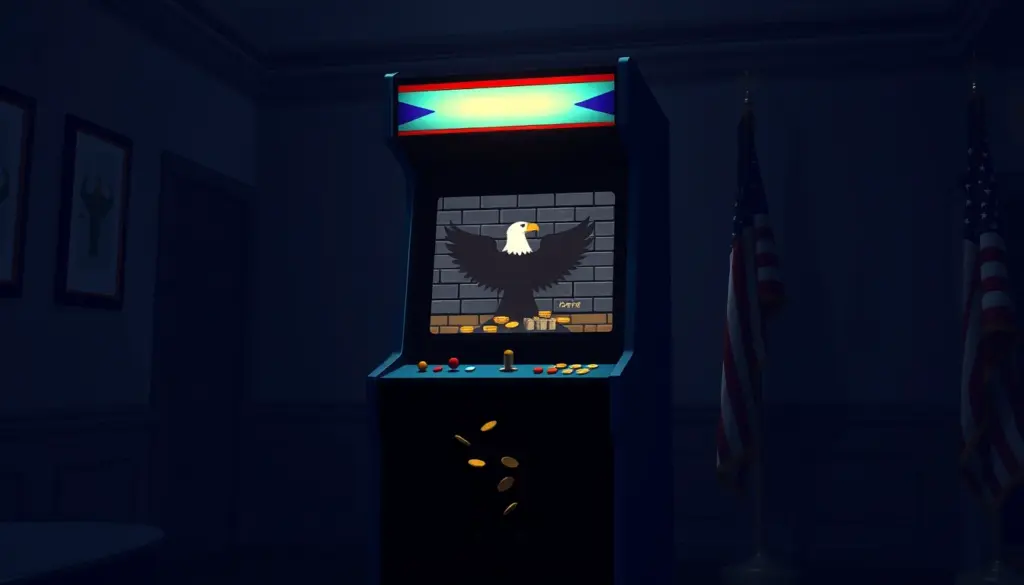
The White House spent September rolling out a set of retro-style browser games that reskin Trump administration policy as an arcade cabinet. Days later, a separate report landed that Saudi Arabia’s Public Investment Fund is weighing a merger between Electronic Arts and Savvy Games Group, the same fund’s gaming holding company. Both stories broke inside a single week, and Video Games Industry Memo writer George E. Osborn used his September 13, 2026 newsletter, titled “Playing Politics,” to tie them together as evidence that the games business can no longer treat politics as background noise.
Osborn’s opening line set the tone: “Oh s***, here we go again.” The phrase captures a mood that has been building across the industry all year, as layoffs, consolidation, and now direct government involvement in game design collide in the same news cycle. This piece breaks down what actually shipped in the White House arcade, what is and is not confirmed about the EA-Savvy talks, and what both stories signal about where gaming sits in 2026’s political and financial landscape.
What the White House Actually Shipped
On September 3-4, 2026, the White House added a page to its official website hosting five low-resolution browser games, each one built on the skeleton of a familiar arcade or mobile classic. Coverage from the Washington Post, ABC News, and NPR described the collection as a deliberate mix of nostalgia and policy messaging, timed roughly a year ahead of the 2026 midterms. None of the games require a login or payment. All five run directly in a browser tab, styled with pixel graphics reminiscent of early-1980s cabinets.
The White House told USA Today that the games are “an effort to further contrast between a culture of fun and winning and the dark socialist vision Democrats have for America.” That statement, issued directly to the outlet, is the only on-record explanation the administration has given for building the arcade rather than simply running television ads or social posts.
The Five Games, Game by Game
Reporting from ABC News and the Washington Post lays out the mechanics behind each title. “Build the Wall” borrows Tetris’s falling-block structure and reframes it as border fortification. “Rio Run” plays like Snake, with a Trump-styled avatar gathering icons representing migrants. “Supply Line” compresses the old arcade game Tapper into a sorting task, where players reject items that fail “Make America Healthy Again” standards. “Flappy Bill” is a Flappy Bird clone in which an eagle carries a piece of legislation across the National Mall. “Trump Savings Tycoon” has players catching falling money to fund children’s Trump Accounts, the administration’s $1,000-per-child savings program.
| Game | Classic Template | In-Game Objective | Policy Message |
|---|---|---|---|
| Build the Wall | Tetris | Stack blocks to fortify a border line | Border security |
| Rio Run | Snake | Collect icons representing border crossers | Immigration enforcement |
| Supply Line | Tapper | Sort and reject non-compliant food items | “Make America Healthy Again” agenda |
| Flappy Bill | Flappy Bird | Fly a bill across the National Mall | Legislative agenda promotion |
| Trump Savings Tycoon | Falling-object collector | Catch money for children’s accounts | Trump Accounts savings program |
Rights groups pushed back within hours of launch. ABC News and NPR both reported criticism describing the arcade as a way to gamify mass deportation and soften public reaction to enforcement policy. The White House has not walked back the project or the framing it gave USA Today, and as of this writing the games remain live on the official site.
The Backlash Nobody at the White House Seems Worried About
The criticism lines up with a pattern seen in earlier MAGA-branded merchandise and media pushes: outside groups object loudly, coverage spreads the objection further than the original launch, and the administration keeps the product live regardless. NPR and ABC News both noted that advocacy organizations focused specifically on “Build the Wall” and “Rio Run,” arguing that turning enforcement actions into a Tetris or Snake clone trivializes the real consequences for the people depicted as obstacles to clear. Fox News covered the launch with a friendlier framing, describing the games as a “MAGA makeover” of classic arcade nostalgia rather than a policy statement requiring scrutiny.
That split in coverage is itself part of the story. Outlets across the political spectrum agree on what the games do mechanically. They disagree entirely on whether that mechanic is harmless nostalgia or a way to normalize policy that would draw more resistance if presented plainly. No independent traffic figures for the arcade page have been published by the White House or by any outlet as of September 14, 2026, so it remains unclear how many people have actually played the games versus simply read about them.
Why an Arcade, and Why Now
Government-produced games are not new. Recruitment titles and public-messaging tools have existed for decades, usually built by outside studios under contract and released with far less fanfare than a full White House rollout. What sets this launch apart is the directness of the branding: every game names the president, reuses his campaign visual language, and links straight to policy pages. There is no attempt to disguise the source or soften the partisanship, which is itself the story reporters at Fox News, The Hill, and NPR converged on independently.
The timing lines up with the run-up to the 2026 midterms, when campaigns typically shift toward channels that reach younger, terminally-online audiences who don’t watch cable news. A browser game costs a fraction of a television buy and can be shared as a link across platforms without a media-buying budget. Whether it moves any votes is unmeasurable from the outside, but the low production cost makes it a cheap experiment regardless of the payoff.
A Separate Story: Riyadh Money Reshapes EA
While the arcade story played out, a second and financially heavier story broke about the same week. Reports first surfaced around September 10, 2026, saying Saudi Arabia’s Public Investment Fund is weighing a merger between Electronic Arts and Savvy Games Group, the PIF’s dedicated gaming vehicle. PC Gamer and several other outlets corroborated the reporting through people familiar with the discussions who spoke anonymously because the talks remain private. EA, Savvy, and PIF all declined to comment when asked directly.
The backdrop matters here. A consortium led by PIF, alongside Silver Lake and Jared Kushner’s Affinity Partners, closed a $55 billion take-private acquisition of Electronic Arts on August 4, 2026, making it one of the largest leveraged buyouts in gaming history. Folding EA into Savvy would combine that deal with Savvy’s existing portfolio, which already includes Scopely, the mobile studio behind Monopoly Go and the license for Pokémon Go. Savvy is also reportedly still working through its own acquisition of Moonton, the Mobile Legends developer, a deal put at roughly $6 billion by prior reporting. Any EA-Savvy combination is unlikely to close before that Moonton deal wraps up.
What a Combined EA-Savvy Would Actually Own
Put together, a merged company would sit across EA Sports FC, Madden NFL, Battlefield, and The Sims on the EA side, plus Monopoly Go, Pokémon Go, and Mobile Legends on the Savvy side, assuming the Moonton deal closes first. That is a portfolio spanning console sports simulation, military shooters, life simulation, and two of mobile gaming’s highest-grossing live-service titles under one Saudi-controlled roof. No source has put a valuation on the combined entity, and no party has confirmed the talks have advanced beyond an early, exploratory stage.
| Deal or Event | Parties | Reported Figure | Status (as of Sept. 14, 2026) |
|---|---|---|---|
| EA take-private buyout | PIF, Silver Lake, Affinity Partners | $55 billion | Closed Aug. 4, 2026 |
| Savvy-Moonton acquisition | Savvy Games Group, Moonton | ~$6 billion (reported) | Pending |
| EA-Savvy merger talks | PIF | Not disclosed | Reported Sept. 10, 2026, unconfirmed by parties |
| 2026 industry layoffs tracked | Multiple studios and publishers | 14,666 roles cut | Year-to-date |
| Xbox Redmond WARN cuts | Microsoft | 605 jobs (3,200 total division-wide) | 2026 |
| Don’t Nod restructuring | Don’t Nod Entertainment | 90 jobs cut | 2026 |
Sweeney’s Warning: An Industry Already Under Strain
Neither story landed in a vacuum. Epic Games CEO Tim Sweeney has spent the back half of 2026 warning publicly that the games business is contracting faster than any downturn since the 1980s home-console crash. In comments reported by Video Games Industry Memo, Sweeney argued that soaring hardware costs, not the games themselves, are pushing the video game industry into its biggest crash since the 1980s.
“It’s an unexpected, severe disruption.”
Tim Sweeney, CEO, Epic Games, via Kotaku
Sweeney’s framing puts rising GPU and memory prices, not oversupply of mediocre games, at the center of the squeeze. That view lines up with the layoffs shattered.io has tracked through 2026, from Xbox’s Redmond cuts to Don’t Nod’s restructuring in France, all landing in the same year that a $55 billion EA buyout closed and a second mega-merger is being floated. Consolidation and layoffs are running on parallel tracks, and Sweeney’s comments suggest the underlying cost pressure isn’t going away just because the biggest publishers are getting bigger.
Why an Industry Newsletter Named Both Stories in One Piece
Osborn’s “Playing Politics” newsletter didn’t cover the arcade and the EA-Savvy talks as two unrelated items. He grouped them alongside a recommended read, Anu Bradford’s Digital Empires, and used the pairing to argue that the industry can no longer stay neutral on political questions, even when doing so is uncomfortable for publishers with government and sovereign-wealth ties.
“The White House had launched a video game arcade featuring five Trump-ified popular video games to promote its talking points.”
George E. Osborn, Writer, Video Games Industry Memo
That framing matters because Osborn’s newsletter is read heavily inside the industry itself, not just by consumer press. Naming the arcade and the Saudi-backed merger talk in the same column signals that trade press is starting to treat government messaging and sovereign investment as part of the same governance conversation, rather than as separate beats covered by different reporters.
Historical Context: Governments Have Made Games Before
Government involvement in game production is not a 2026 invention. Military branches have funded recruitment titles for years, and public-health agencies have commissioned games to push vaccination or safety messaging. What separates the current arcade from those precedents is branding. Older government-funded titles tended to obscure or downplay their sponsor, often shipping under a studio’s name with the agency credited only in fine print. The White House arcade does the opposite: every game leads with the president’s name and campaign visual identity, with no separation between messenger and message.
The EA-Savvy story also has precedent, just a much larger one. Sovereign wealth funds, particularly PIF, have spent years buying stakes in Nintendo, Take-Two, Activision Blizzard, and other major publishers before eventually taking EA fully private in August. A potential Savvy merger would be the next visible step in a strategy that has been building since at least 2020, when PIF’s public stake purchases in gaming companies first drew scrutiny from analysts and rights organizations over the fund’s ties to the Saudi state.
PIF’s Long Game in Gaming
What makes the EA-Savvy talk different from earlier PIF moves is directness. Buying a minority stake in a public company draws far less scrutiny than merging two majority-owned studios into a single house. EA went from a public company to a $55 billion private holding in one step, and folding it into Savvy would remove even the limited transparency that came with EA’s old quarterly earnings calls. Analysts who track sovereign wealth activity in gaming have flagged that pattern before, especially around Savvy’s earlier acquisition of Scopely, which gave the fund control over two of mobile gaming’s highest-grossing titles without the deal ever facing a public shareholder vote.
The esports side of PIF’s portfolio tells a similar story. The fund has also poured money into competitive gaming infrastructure, including hosting rights for the Esports World Cup, giving it influence over both the games people play and the events built around them. A combined EA-Savvy entity would extend that reach from tournaments and mobile live-service games into console sports simulation and mainstream shooters, a scope no single gaming company has held before.
Market Impact: What This Means for Publishers and Platform Holders
For publicly traded publishers still on the open market, a confirmed EA-Savvy merger would reset expectations for how large a single gaming portfolio can get before regulators step in. A combined entity spanning sports sims, mobile live-service games, and shooters would draw antitrust attention in the US, EU, and UK almost automatically, given the scale of the underlying deal and the fact that a foreign sovereign fund would sit at the center of it.
For platform holders like Microsoft and Sony, the more immediate pressure is cost, not consolidation. Sweeney’s comments about hardware prices echo what shattered.io has reported across 2026: memory shortages, GPU price spikes, and component costs bleeding into console and PC hardware pricing. Layoffs at Xbox, Don’t Nod, and other studios this year suggest publishers are cutting headcount to offset rising production costs rather than simply chasing weak sales. The White House arcade, by contrast, has no direct financial stakes for the industry itself. Its impact is reputational and political rather than fiscal, but it adds to a narrative that games are now squarely inside partisan messaging, a status that publishers with government contracts or overseas ownership may find harder to navigate going forward.
Competitive Comparison: How Different Players Are Positioned
Epic Games, through Sweeney, has taken the most public stance of any major industry figure this year, framing the downturn as a structural hardware problem rather than a creative one. EA, now under PIF control, has stayed silent on both the arcade and the merger reporting, declining comment when reporters asked directly. Savvy Games Group has taken the same posture. Microsoft has said nothing publicly connecting its own 2026 layoffs to either story, and Sony has not commented on the EA-Savvy reporting at all. That silence from the companies most directly affected leaves independent commentary, like Osborn’s newsletter and Sweeney’s interviews, as the most detailed public record of how insiders are reading the moment.
Regulatory Outlook: Who Actually Reviews a Deal Like This
No formal EA-Savvy filing exists yet, so no regulator has an official deal to review. That said, a merger combining two PIF-controlled companies of this size would likely trigger review in the US under the Hart-Scott-Rodino Act, plus separate scrutiny from the European Commission and the UK’s Competition and Markets Authority given both companies’ large European and British player bases. The CMA in particular has taken an active role in prior gaming mergers, including its extended review of Microsoft’s Activision Blizzard acquisition. A deal built on foreign sovereign ownership adds a national-security review layer in the US that a purely private-equity merger would not face, through the Committee on Foreign Investment in the United States.
None of that review can start, however, until PIF, EA, or Savvy confirm the talks are real and file the required paperwork. Every regulatory body named above has stayed silent because there is nothing yet on the record for them to act on.
What Comes Next: Five Predictions
- Expect at least one more government agency or campaign to copy the browser-arcade format before the 2026 midterms, since the production cost is low and the reach is easy to measure through link shares.
- The EA-Savvy merger talk will likely stay unconfirmed for weeks. Deals of this size rarely get an official announcement until financing and regulatory review are further along, and the pending Moonton acquisition gives Savvy a built-in reason to delay.
- Regulators in the EU and UK are more likely than US agencies to open early inquiries into any formal EA-Savvy filing, given both regions’ more aggressive recent posture toward large tech and gaming mergers.
- Sweeney’s hardware-cost argument will keep gaining traction as more publishers report earnings this quarter, especially if memory and GPU pricing stays elevated into 2027.
- More trade outlets will start covering sovereign wealth ownership and government game-messaging projects under the same lens Osborn used, treating them as a single governance story rather than separate entertainment and policy beats.
The Bigger Picture
Two stories broke in the same week for different reasons but land on the same underlying point: video games are no longer treated as a neutral hobby by the people who fund or govern them. A sitting administration built campaign tools out of Tetris and Flappy Bird clones. A sovereign wealth fund that just spent $55 billion taking a major publisher private is reportedly weighing folding it into an even larger holding. Both moves happened while the industry’s most visible executive was telling reporters that the business is contracting at a pace not seen since the 1980s. None of these threads fully explains the others, but together they describe an industry where politics, sovereign capital, and financial strain are converging faster than the companies involved seem willing to discuss on the record.
Frequently Asked Questions
What games are in the White House’s arcade?
Five browser games: Build the Wall (a Tetris-style block game about border security), Rio Run (a Snake-style game about border enforcement), Supply Line (a Tapper-style sorting game tied to the “Make America Healthy Again” agenda), Flappy Bill (a Flappy Bird clone about legislation), and Trump Savings Tycoon (a money-collecting game tied to the Trump Accounts savings program).
When did the White House arcade launch?
Coverage from the Washington Post, ABC News, and NPR places the launch around September 3-4, 2026.
Is Electronic Arts actually merging with Savvy Games Group?
Not confirmed. Reports first surfaced around September 10, 2026, saying Saudi Arabia’s Public Investment Fund is weighing the idea. EA, Savvy, and PIF have all declined to comment, and no formal announcement has been made.
Who owns EA now?
A consortium led by Saudi Arabia’s Public Investment Fund, alongside Silver Lake and Jared Kushner’s Affinity Partners, closed a $55 billion take-private acquisition of Electronic Arts on August 4, 2026.
What did Tim Sweeney say about the games industry?
Sweeney has described the current downturn as an unexpected, severe disruption and has argued that soaring hardware costs, rather than weak games, are driving what he calls the industry’s biggest crash since the 1980s.
What is Video Games Industry Memo?
It’s an industry newsletter written by George E. Osborn. His September 13, 2026 edition, “Playing Politics,” connected the White House arcade launch to the EA-Savvy merger reporting and to broader questions about the industry’s relationship with political power.
Has the White House responded to criticism of the arcade?
The White House has not withdrawn the games or altered its messaging. Its only on-record explanation, given to USA Today, describes the project as contrasting “a culture of fun and winning” with what it called the opposing party’s vision for the country.
What would a combined EA-Savvy company own?
If the reported merger happens and Savvy’s pending Moonton acquisition closes first, the combined company would span EA Sports FC, Madden NFL, Battlefield, and The Sims alongside Savvy’s Scopely-owned titles Monopoly Go and Pokémon Go, plus Moonton’s Mobile Legends.