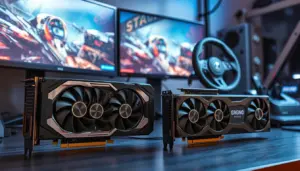
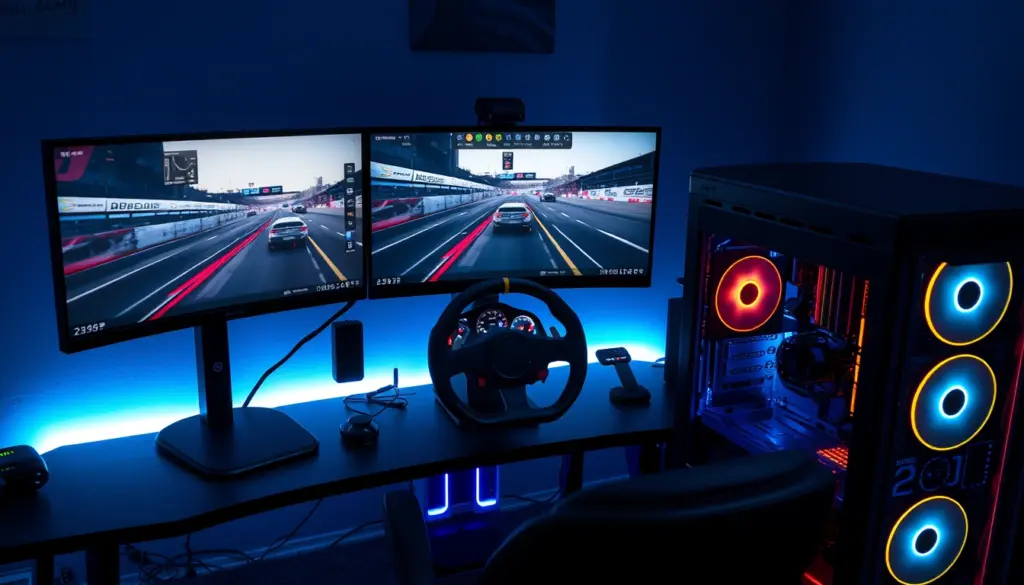
Graphics card prices have jumped sharply across the United States in the second half of 2026, and sim racers are feeling it more than most PC buyers. Triple-monitor and VR rigs demand serious GPU horsepower, which means the segment is unusually exposed to a pricing spiral that outlet BoxThisLap flagged in its September report, “Sim Racing GPU Prices Are Rising: What Should You Buy?” The piece lays out, card by card, how much more a new GPU costs today than it did back in June, and the gap is large enough to change what a reasonable budget build looks like.
This is not a niche story confined to enthusiast forums. It sits at the intersection of two trends shattered.io has tracked all year: a global memory chip shortage squeezing GPU bills of materials, and AI data center demand pulling GDDR and HBM supply away from consumer graphics cards. Sim racing just happens to be one of the clearest windows into the damage, because its hardware requirements (high refresh rates, multiple displays, VR headsets) leave little room to downgrade quietly.
What BoxThisLap Actually Reported
According to BoxThisLap, graphic card prices have risen sharply in the United States during the second half of 2026, making a new GPU considerably more expensive for sim racers than it was only a few months ago. The outlet’s core finding is a split between vendors: several NVIDIA GeForce RTX 50 Series cards have suffered particularly large increases, while AMD’s Radeon RX 9000 range has generally remained more competitive.
That split matters because it reshapes buying advice that was stable for most of 2025 and early 2026. When NVIDIA held a clear price-to-performance edge, recommending an RTX card by default was the easy call. BoxThisLap’s numbers suggest that edge has narrowed, and in some tiers reversed, at least on sticker price.
The RTX 50 Series Price Jumps, Card by Card
The clearest evidence is the month-over-month movement on entry and mid-tier RTX 50 Series cards. The RTX 5060 moved from roughly $370 in June to about $470 in August, a jump of around 27% in two months on a card that is supposed to be the budget option. The RTX 5070 climbed from about $660 to roughly $900 in August, and the RTX 5060 Ti 16GB went from around $570 to more than $800 in the same window. None of these are luxury flagship parts. They are the cards a triple-monitor sim racing build leans on most.
For a sport built on hardware that costs as much as the wheel base and pedals combined, a 25-40% swing in two months is not a rounding error. It changes whether a build is feasible at all for buyers working from a fixed budget set months in advance.
| GPU | June 2026 Price | August 2026 Price | Approx. Increase |
|---|---|---|---|
| RTX 5060 | ~$370 | ~$470 | ~27% |
| RTX 5070 | ~$660 | ~$900 | ~36% |
| RTX 5060 Ti 16GB | ~$570 | $800+ | ~40%+ |
Source: BoxThisLap, “Sim Racing GPU Prices Are Rising: What Should You Buy?” All figures are approximate US retail prices as reported by the outlet. Exact street prices vary by retailer and region.
Why AMD’s Radeon RX 9000 Cards Are Holding Steadier
BoxThisLap’s reporting draws a clear line: AMD’s Radeon RX 9000 range has generally remained more competitive while NVIDIA’s RTX 50 Series absorbed the bulk of the increases. The outlet does not publish exact RX 9000 dollar figures in the excerpt available, but the relative framing is unambiguous, and it lines up with the pattern shattered.io has covered elsewhere this year around AMD’s budget CPU pricing holding firmer than rivals even as DDR5 costs spiked.
That relative stability is the reason AMD cards dominate BoxThisLap’s recommendation table below. When two vendors’ street prices diverge this much in a two-month window, the “best” card for a given budget tier can flip entirely, and that is exactly what appears to have happened here.
BoxThisLap’s Recommendations by Sim Racing Setup
The outlet’s use-case table ties specific GPUs to specific sim racing configurations, from a single 1080p monitor up through high-end iRacing triple-screen rigs. The pattern is consistent: AMD’s RX 9070 and RX 9070 XT cover most of the mid-range and high-end use cases, while NVIDIA is reserved for the very top tier where its RTX 5070 Ti and RTX 5080 remain the recommendation despite the price jump.
| Use Case | Recommended GPU |
|---|---|
| Budget 1080p | RTX 5050 or Arc B580, around $300 |
| 1440p single monitor | RX 9070 16GB |
| 3440×1440 ultrawide | RX 9070 16GB |
| 4K single monitor | RX 9070 XT 16GB |
| 5120×1440 / monitor-based triples | RX 9070 XT 16GB |
| Triple 1440p | RX 9070 XT, RTX 5070 Ti, or RTX 5080 |
| High-end iRacing triples | RTX 5070 Ti or RTX 5080 |
Source: BoxThisLap. Note the pattern: AMD covers everything from 1440p single-monitor up through 4K and ultrawide, and only the most demanding triple-monitor setups pull NVIDIA back into the recommendation.
The Budget Call: Don’t Buy If You Don’t Have To
BoxThisLap’s most direct guidance is aimed at anyone on the fence: keep your existing GPU if it remains adequate. If you must buy now, the outlet’s advice is to compare the RTX 5050 and Arc B580 around the $300 level rather than stretching to an overpriced RTX 5060. That is a meaningful shift in tone from most of 2025, when upgrade cycles were pitched around “buy now while it’s affordable.” Now the message is closer to “wait it out unless your current card has actually failed you.”
For sim racers specifically, the calculus is a little different than for a general gamer, because triple-monitor and VR setups have a performance floor below which the experience genuinely breaks (dropped frames on a 120Hz triple-screen array are far more jarring than on a single display). That is part of why BoxThisLap still routes high-end iRacing builders toward the RTX 5070 Ti or RTX 5080 despite the price increases, rather than telling everyone to simply downgrade.
How This Fits the Broader 2026 GPU Market
Sim racing GPU prices are not rising in isolation. Shattered.io has tracked the same underlying pressure across the consumer GPU market all year. RTX 5090 pricing effectively doubled toward the $5,000 mark as AI compute buyers competed for the same silicon and memory that gaming cards depend on, and that surge has been documented in detail elsewhere on this site. Around the same time, NVIDIA pushed AI server hardware prices up more than 15% citing a memory crunch, a move also covered here, and industry-wide DRAM and NAND stockpiles fell below 10 days of supply according to reporting tracked on this site.
Put simply, GDDR6 and GDDR7 memory chips share fabrication capacity and supply chains with the DRAM going into AI servers. When data center demand spikes, consumer GPU memory gets squeezed, and board partners pass the cost along. Sim racing GPUs sit squarely in the RTX 5060-to-5080 band, which is exactly the range BoxThisLap found moving the most.
Historical Context: This Isn’t the First GPU Price Spike
Long-time PC builders will recognize the shape of this story, even if the cause is different this time. The 2020-2021 GPU shortage was driven by cryptocurrency mining demand colliding with pandemic-era supply chain chaos, pushing RTX 30 Series cards to double and triple their MSRPs on resale markets. That crisis eased once mining profitability collapsed and Ethereum moved to proof-of-stake in 2022, removing the single biggest source of speculative GPU demand almost overnight.
The 2026 spike is structurally different because AI data center demand is not going away the way mining demand did. There is no equivalent “off switch” on the horizon, which is part of why BoxThisLap and other outlets are framing this as a “wait unless necessary” market rather than a temporary blip. Enterprise AI buildout is a multi-year capital commitment, not a speculative trade that can unwind in a quarter.
Competitive Landscape: NVIDIA vs AMD vs Intel in Sim Racing
Three vendors are competing for sim racing budgets right now, and each occupies a different slice of BoxThisLap’s recommendation table. NVIDIA’s RTX 50 Series still anchors the top end through the RTX 5070 Ti and RTX 5080, but its mid-range cards (the RTX 5060 and RTX 5060 Ti 16GB) are the ones that absorbed the steepest August price hikes. AMD’s Radeon RX 9000 range, led by the RX 9070 and RX 9070 XT, has become the default recommendation across four of the seven use-case tiers in BoxThisLap’s table specifically because it held its price better. Intel’s Arc B580 shows up only once, paired with the RTX 5050 as a sub-$300 entry option for buyers who cannot stretch further.
That distribution is itself a signal. A year ago, a “best GPU for sim racing” table would have leaned NVIDIA-heavy across nearly every tier, on the strength of DLSS and NVIDIA’s broader driver optimization for racing titles. AMD closing that gap on price alone, without necessarily closing it on features, is the more interesting story for anyone tracking market share rather than just frame rates.
Market Impact: What This Means for Sim Racing Builders
The immediate effect is a compressed pool of “reasonable” builds. A triple-monitor rig that penciled out at roughly $2,000 in GPU cost back in June now needs closer to $2,700-$3,000 for the equivalent RTX tier, based on the RTX 5070 and RTX 5060 Ti movements BoxThisLap documented. That pushes more buyers toward AMD by default, not out of brand preference but out of arithmetic.
It also raises the stakes on used and refurbished GPU markets. When new-card prices rise this fast, secondhand RTX 40 Series and RX 7000 Series cards become relatively more attractive, since their performance-per-dollar ratio hasn’t moved even as new-card pricing has. Sim racing forums and Discord communities, which already lean heavily on used-hardware recommendations for budget builds, are likely to see that trend accelerate through the rest of 2026.
Why Sim Racing Specifically Gets Hit Hard
Sim racing is unusually GPU-bound compared to most PC gaming. A triple-monitor setup running iRacing, Assetto Corsa Competizione, or Le Mans Ultimate at high refresh rates is effectively rendering three separate viewports at once, and VR headsets used with the same titles multiply the pixel count further still. That means sim racers cannot “settle” for a lower GPU tier the way a single-1080p-monitor gamer can, without a visible and immediate drop in the experience: stutter across a triple-screen array is far more noticeable than the same frame drop on one display.
That inelastic demand is exactly why BoxThisLap’s recommendation table still routes high-end triple-monitor and VR builders toward the RTX 5070 Ti and RTX 5080 despite the price increases. There simply isn’t a comparably capable, meaningfully cheaper substitute at that performance tier yet.
The VR and Triple-Monitor Bandwidth Problem
It helps to understand why sim racing rigs need so much GPU headroom in the first place. A single 1440p monitor at 144Hz asks a GPU to push roughly 530 million pixels per second. Stack three of those monitors side by side, which is the standard sim racing configuration for peripheral vision in corners, and that number roughly triples before accounting for the wider field-of-view rendering each panel also has to calculate independently. VR headsets used with titles like Assetto Corsa Competizione add a second complication: they typically require a stable 90fps-or-higher frame rate per eye to avoid motion sickness, which leaves effectively no margin for the GPU to drop frames under load the way a casual single-monitor game might tolerate.
That combination is why the mid-range and high-end tiers of BoxThisLap’s recommendation table (the RX 9070 XT, RTX 5070 Ti, and RTX 5080) show up so consistently. Sim racing hardware requirements don’t scale down gracefully. A GPU that’s merely “good enough” on paper often isn’t good enough once dropped frames start appearing during high-speed cornering, which is precisely the moment a sim racer needs the most visual stability.
Regional Pricing Notes and Import Costs
BoxThisLap’s figures are specific to United States retail pricing, and the outlet is explicit that its data reflects the US market during the second half of 2026. Buyers outside the US should treat the dollar figures as directional rather than literal, since import duties, VAT, and regional distribution costs can shift the exact numbers meaningfully from one country to the next. What tends to travel across regions, though, is the relative pattern: when a component shortage hits global memory supply chains, it typically shows up in every market at roughly the same time, even if the magnitude in local currency varies.
That’s a useful sanity check for sim racers outside the US reading this coverage. If RTX 5060 and RTX 5070 pricing has jumped noticeably in your own region’s retailers over the same June-to-August window, it’s very likely the same underlying memory-chip pressure, not a local market quirk.
Predictions: Where GPU Prices Go From Here
- Expect the RTX 5060 and RTX 5060 Ti 16GB to remain the most volatile SKUs into Q4 2026, since they sit at the intersection of budget-buyer demand and the tightest memory-chip supply.
- AMD’s price advantage on the RX 9000 range is likely to persist through the rest of 2026 as long as AMD’s own AI accelerator lineup draws less directly on the same GDDR pool as NVIDIA’s data center GPUs.
- Watch for board partners to quietly trim RTX 5070 and 5070 Ti allocations to gaming retail channels in favor of AI-adjacent workstation SKUs, which would tighten gaming availability further even without an official price change.
- Used-market prices for RTX 40 Series and RX 7000 Series cards should firm up as new-card prices climb, narrowing the gap that currently makes secondhand hardware attractive.
- If AI data center memory demand cools in 2027 the way mining demand cooled in 2022, expect a similar relief cycle, but nothing in current reporting points to that happening before mid-2027 at the earliest.
What Sim Racers Should Actually Do Right Now
BoxThisLap’s bottom line is worth repeating because it cuts against the usual “upgrade now” instinct: keep the GPU you have if it’s still doing the job. For sim racers running a functioning triple-monitor or single-display setup, riding out the current price spike is the financially rational move unless a card has actually failed.
For those who genuinely need to buy, the outlet’s tiered guidance gives a workable framework: RTX 5050 or Arc B580 near $300 for budget 1080p, RX 9070 16GB for 1440p and ultrawide, RX 9070 XT 16GB for 4K and monitor-based triples, and RTX 5070 Ti or RTX 5080 only for the most demanding triple-monitor iRacing builds where nothing else currently matches the performance ceiling.
Where to Track Prices Going Forward
Given how quickly these numbers moved between June and August, static price guides go stale fast. Checking current listings directly against manufacturer product pages, such as NVIDIA’s RTX 50 Series lineup page and AMD’s Radeon RX 9000 series page, alongside retail tracking through outlets like Tom’s Hardware’s GPU coverage and PC Gamer’s graphics card section, is the most reliable way to catch a good window before it closes. Intel’s Arc lineup, covered on AMD’s broader Radeon product hub for comparison shopping, remains the budget wildcard worth checking before committing to the $300 tier.
Frequently Asked Questions
Why are sim racing GPU prices rising in 2026?
Graphics card prices have risen sharply in the United States during the second half of 2026, according to BoxThisLap, driven largely by memory chip supply pressure as AI data center demand competes for the same GDDR and DRAM capacity used in consumer GPUs.
Which GPU brand has risen the most in price?
NVIDIA’s RTX 50 Series has suffered the larger increases, with the RTX 5060, RTX 5070, and RTX 5060 Ti 16GB all jumping between roughly 27% and 40%+ from June to August 2026. AMD’s Radeon RX 9000 range has stayed comparatively more stable.
What’s the best budget GPU for sim racing right now?
BoxThisLap recommends the RTX 5050 or Arc B580 around the $300 level for budget 1080p setups, rather than stretching to an overpriced RTX 5060.
What GPU should I buy for a triple-monitor sim racing rig?
For triple 1440p setups, BoxThisLap points to the RX 9070 XT, RTX 5070 Ti, or RTX 5080 depending on budget. High-end iRacing triple-monitor builds are steered specifically toward the RTX 5070 Ti or RTX 5080.
Should I upgrade my GPU now or wait?
BoxThisLap’s guidance is to keep your existing GPU if it remains adequate, and only buy now if your current card genuinely can’t handle your setup.
Is this price spike similar to the 2020-2021 GPU shortage?
It shares some surface similarities, but the underlying cause is different. The 2020-2021 spike was driven largely by cryptocurrency mining demand, which eased once mining profitability collapsed. The 2026 spike is tied to AI data center memory demand, which does not have an obvious near-term “off switch.”
Are AMD GPUs better value than NVIDIA for sim racing in 2026?
On price, AMD’s RX 9000 range currently offers a stronger value position across most sim racing use cases according to BoxThisLap’s tiered recommendations, though NVIDIA’s RTX 5070 Ti and RTX 5080 remain the pick for the most demanding triple-monitor and VR builds.
Will GPU prices come back down?
Reporting has not indicated a near-term timeline for prices to ease. Given that the current pressure is tied to AI data center demand rather than a speculative trading cycle, any relief is more likely to be a gradual, multi-quarter shift than a sudden correction.