
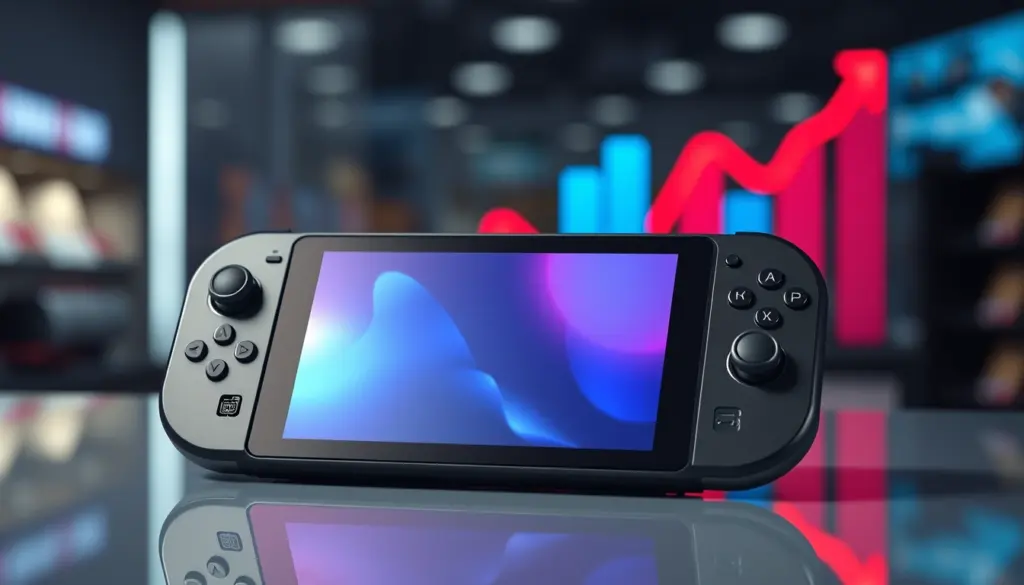
One year after it reached store shelves, the Nintendo Switch 2 has become the defining hardware story of this console generation. Nintendo’s official figures put Nintendo Switch 2 sales at 19.86 million units worldwide as of March 31, 2026, less than ten months after the system’s June 5, 2025 debut. That is enough to outpace the original Switch over the same window, outsell Sony’s PlayStation 5 in current quarterly and monthly sales, and drag the entire console market back toward growth. According to Nintendo’s investor relations data, the company also moved 48.71 million Switch 2 games in the same period – a software haul that explains why Nintendo just posted the most profitable year in its history.
This news analysis breaks down the Nintendo Switch 2 sales numbers in detail: how they compare with the PS5 and Xbox, what is driving demand, where the risks lie heading into year two, and what analysts expect next. Every figure below is drawn from official earnings reports and named industry trackers, and we flag the source for each claim.
Nintendo Switch 2 Sales Hit 19.86 Million: Inside a Record Year
The headline number is the one Nintendo confirmed in its fiscal-year results: 19.86 million Switch 2 consoles sold worldwide through March 31, 2026, the close of Nintendo’s fiscal year 2026. As Nintendo reported it, “Nintendo Switch 2 has sold 19.86 million hardware units and 48.71 million software units worldwide as of March 31, 2026.” That total beat the company’s own full-year forecast of 19 million units and pushed the system to within roughly 140,000 units of the symbolic 20 million milestone by spring.
The momentum did not stall after the launch rush. In the quarter ending March 31, 2026 alone, Nintendo sold 2.49 million Switch 2 units to retailers – a figure that, notably, came in about one million units ahead of the PlayStation 5 over the identical three-month span. For a console roughly nine months into its life cycle, that quarterly cadence is unusually strong; most hardware sees a steep drop-off once early adopters are served. Instead, the Switch 2 sales curve has stayed elevated well into 2026.
Context matters here. The original Switch went on to sell 155.92 million units across more than eight years, making it one of the best-selling consoles ever made. The sequel is being measured against that legacy from day one, and so far it is running ahead of the pace its predecessor set.
Switch 2 vs PS5 vs Xbox: The 2026 Console Scoreboard
The clearest way to read the Switch 2 sales story is against its rivals. On a lifetime basis, Sony’s PlayStation 5 remains far ahead – 93.7 million units shipped as of March 31, 2026, per Sony Interactive Entertainment. But lifetime totals describe the past. The forward-looking picture in the switch 2 vs ps5 race is the one that worries Sony: PS5 shipments fell to roughly 1.5 million units in the January–March 2026 quarter, down about 46% year over year, while Switch 2 was still accelerating.
Microsoft, meanwhile, has effectively conceded the hardware unit race. The company no longer discloses Xbox console shipments in its earnings, leaving third-party trackers to estimate. VGChartz pegs lifetime Xbox Series X/S sales at roughly 34.67 million as of April 2026 – less than half the PS5’s installed base and a fraction of the Switch family’s reach.
| Console | US sales, April 2026 | US sales YTD (Jan–Apr 2026) | Lifetime (global) |
|---|---|---|---|
| Nintendo Switch 2 | 877,493 | 4.03 million | 19.86 million (Mar 31, 2026) |
| Sony PlayStation 5 | 435,713 | 2.51 million | 93.7 million (Mar 31, 2026) |
| Nintendo Switch (original) | 199,420 | 0.84 million | 155.92 million (Mar 31, 2026) |
| Xbox Series X/S | 98,377 | 0.49 million | ~34.67 million (est., Apr 2026) |
US data sourced from Circana via VGChartz; lifetime figures from Nintendo, Sony, and VGChartz estimates. The pattern is consistent across every cut of the numbers: in 2026, the Switch 2 is the best-selling console in the United States by a wide margin, with the PS5 a distant second and Xbox a marginal player.
What Circana’s US Data Reveals About Switch 2 Demand
Market-research firm Circana (the rebranded NPD Group, the standard source for US game-industry tracking) provides the sharpest read on American demand. According to Circana, “In the US, Nintendo Switch 2 sales are 45% up over Nintendo Switch 1 and 29% up over PlayStation 5.” In other words, the Switch 2 is not just beating its stablemate’s launch trajectory; it is comfortably outselling Sony’s flagship in the world’s largest gaming market over a comparable window.
The software side is even more striking. Circana reports that “Nintendo sold 38 million Nintendo Switch 2 games during its first 7 months, compared to 27.5 million for the original Switch in the same period.” That is roughly a 38% jump in software sell-through over a console that itself became a software juggernaut. Strong game sales are the engine of console profitability, because Nintendo earns far more margin on a $70–$80 title than on the hardware itself.
Those US figures align with the monthly Circana data: in April 2026, the Switch 2 sold an estimated 877,493 units in the United States, more than the PS5 (435,713) and Xbox Series X/S (98,377) combined. Through the first four months of 2026, US Switch 2 sales reached about 4.03 million units against 2.51 million for the PS5.
The Software Engine: Mario Kart World and a 48.71 Million Attach Rate
If the hardware number grabs headlines, the software number explains the profits. Across all titles, Switch 2 owners bought 48.71 million games by March 31, 2026. Divide that by the installed base and you get an attach rate that any platform holder would envy.
Switch 2 software attach rate (as of March 31, 2026)
= software units / hardware units
= 48.71 million games / 19.86 million consoles
≈ 2.45 games sold per console
An attach rate near 2.5 games per console less than a year into a launch is exceptional – it signals that buyers are not just grabbing the hardware and waiting, but actively spending on the library. Leading the charge is Mario Kart World, the pack-in flagship, which sold 14.70 million copies. That single title attaches to roughly three out of every four consoles sold. Behind it, Donkey Kong Bananza reached 4.52 million units, while newer releases posted brisk numbers: Pokémon Pokopia moved 4 million copies in five weeks, and Tomodachi Life: Living the Dream shipped 3.8 million units within two weeks.
| Switch 2 title | Units sold | Note |
|---|---|---|
| Mario Kart World | 14.70 million | Launch flagship / bundle title |
| Donkey Kong Bananza | 4.52 million | Second best-selling Switch 2 game |
| Pokémon Pokopia | 4.00 million | In 5 weeks |
| Tomodachi Life: Living the Dream | 3.80 million | Shipped within 2 weeks |
| Total Switch 2 software | 48.71 million | All titles, as of Mar 31, 2026 |
Source: Nintendo fiscal-year 2026 sales data and Gematsu compilations. The takeaway is that the Switch 2 has a deep first-party catalog already pulling its weight, something neither the PS5 nor Xbox could claim at the equivalent point in their lives.
Switch 2 vs the Original Switch: A Steeper Sales Curve
The most useful internal benchmark for Switch 2 sales is the original Switch, which sold 155.92 million units and ranks among the best-selling game systems of all time. By VGChartz’s sell-through tracking, the Switch 2 was running about 8.32 million units ahead of where the original Switch stood at the same point – roughly 17.16 million versus 8.84 million over a comparable nine-month window. (Sell-through estimates from VGChartz differ slightly from Nintendo’s official sell-in figure of 19.86 million because they measure units reaching consumers rather than units shipped to retailers.)
Either way, the direction is unambiguous: the sequel is outselling a predecessor that itself rewrote Nintendo’s commercial record. That is rare. Successor consoles often launch into a smaller addressable market than the hit that preceded them; the Wii U infamously collapsed after the Wii. The Switch 2 has avoided that trap, and the data suggests why – it is converting the enormous existing Switch audience rather than starting from scratch.
Why Switch 2 Is Selling: 84% Upgraders and Pent-Up Demand
The single most important driver behind the Nintendo Switch 2 sales numbers is the installed base it inherited. Nintendo reports that “84% of Nintendo Switch 2 owners upgraded from the original Nintendo Switch console.” With more than 150 million original Switch units in the wild, even a modest upgrade rate translates into a vast pool of ready buyers – and 84% is not modest.
Three factors compound that advantage. First, full backward compatibility means upgraders keep their existing Switch libraries and Joy-Con controllers, lowering the cost of switching. Second, the pack-in strength of Mario Kart World gave early adopters an instant reason to buy. Third, Nintendo paced its first-party releases – Donkey Kong Bananza, Pokémon Pokopia, Tomodachi Life: Living the Dream – to keep momentum through the crucial first year rather than front-loading everything at launch.
The flip side of an upgrade-driven launch is a question mark over expansion. If 84% of early buyers are existing fans, growth eventually depends on reaching new and lapsed players. That is the variable analysts will watch most closely in year two.
Nintendo’s Record FY2026 Earnings: ¥2.3 Trillion, Up 98.6%
Hardware and software volume converted into a blockbuster year on Nintendo’s books. For fiscal year 2026, the company reported net sales of 2,313 billion yen, up 98.6% year over year, and operating profit of 360.1 billion yen, up 27.5%. The near-doubling of revenue reflects a full launch year of a high-priced new platform plus its attached software.
| Metric | FY2026 (ended Mar 31, 2026) | Change / note |
|---|---|---|
| Net sales | ¥2,313 billion | +98.6% YoY |
| Operating profit | ¥360.1 billion | +27.5% YoY |
| Switch 2 hardware sold | 19.86 million | Beat 19M forecast |
| Switch 2 software sold | 48.71 million | ~2.45 attach rate |
| FY2027 Switch 2 forecast | 16.5 million | Nintendo expects a decline |
The most revealing line in that table is the last one. Nintendo’s own forecast calls for Switch 2 hardware sales to slip to 16.5 million in fiscal year 2027 – a deliberate signal that management expects the post-launch surge to cool. Nintendo has a long history of guiding conservatively, but the projected decline is a reminder that no launch momentum lasts forever.
Switch 2 Specs and Pricing: What $449.99 Delivers
Part of the Switch 2 sales achievement is that it was accomplished at a higher price than any prior Nintendo handheld-hybrid. The console launched in the United States on June 5, 2025 at $449.99, with a $499.99 bundle that included Mario Kart World. That is a substantial step up from the original Switch’s $299.99 debut, and skeptics doubted the market would absorb it. The sales data settled that debate.
For the money, buyers get a meaningfully more capable machine, per Nintendo’s official specifications and confirmed teardowns documented on the Switch 2’s reference page.
| Specification | Detail |
|---|---|
| US launch price | $449.99 console / $499.99 with Mario Kart World |
| US launch date | June 5, 2025 |
| Display | 7.9-inch LCD, 1920×1080, VRR up to 120 Hz |
| Processor | Custom Nvidia (Ampere, T239); 3.072 TFLOPs docked / 1.71 TFLOPs handheld |
| Memory | 12 GB LPDDR5X (≈9 GB available to games) |
| Storage | 256 GB UFS |
| Backward compatibility | Yes – original Switch games and Joy-Con |
The custom Nvidia silicon delivers roughly an order-of-magnitude leap in raw GPU throughput over the 2017 hardware, and the larger 7.9-inch 1080p display with variable refresh up to 120 Hz finally moves Nintendo into a modern handheld bracket. Crucially, none of that broke the formula: the Switch 2 still plays the older library, preserving the value of a decade of game purchases.
Tariffs and the Japan Price Hike: Storm Clouds for Year Two
The biggest external risk to future Switch 2 sales is cost. In its filings, Nintendo explicitly flagged “the potential impact of tariffs and evolving market conditions” on the launch. US preorders opened in April 2025, and the company has so far held the American price at $449.99 – but it has not been immune elsewhere.
The clearest signal came at home: effective May 25, 2026, Nintendo raised the Switch 2’s price in Japan from ¥49,980 to ¥59,980, a roughly 20% increase. The company attributed the move to shifting market and currency conditions. A price hike in a console’s second year is unusual and points to real input-cost pressure – semiconductors, memory, and exchange-rate swings all bite into hardware margins. Whether that pressure eventually reaches US shelves is the open question hanging over the platform’s second year.
Sony’s PS5 Slowdown and Microsoft’s Hardware Retreat
To understand the market impact of the Switch 2, look at what is happening to its rivals. Sony’s PS5 reached 93.7 million lifetime units by March 31, 2026, but its growth is fading: quarterly shipments fell to about 1.5 million in early 2026, down roughly 46% year over year, and the console sits about 3.3 million units behind where the PS4 stood at the same point in its life. Sony is leaning on engagement and monetization instead – 125 million monthly active users on PlayStation Network, with digital downloads now accounting for about 85% of software sales.
Microsoft has gone further, stepping back from the hardware unit contest entirely. By no longer reporting Xbox console shipments, the company has effectively reframed Xbox as a software-and-services business spanning Game Pass, cloud streaming, and multiplatform releases on rival systems. With an estimated 34.67 million Series X/S units sold, the strategic logic is clear: compete on content, not boxes. The result is a console landscape where Nintendo dominates unit sales, Sony defends a large and lucrative installed base, and Microsoft optimizes for reach over hardware.
Historical Context: Switch 2 Among the Best-Selling Consoles
Where could the Switch 2 ultimately land? History offers guardrails. The original Switch (155.92 million) sits in the same elite tier as the PlayStation 2 (around 160 million) and the Nintendo DS (around 154 million). Reaching those heights takes the better part of a decade and sustained software support. The Switch 2 is only at the starting line of that journey with 19.86 million units, but its early pace is faster than the original’s was.
It is worth remembering how badly this could have gone. Nintendo’s track record with successors is volatile: the Wii sold over 100 million units, yet its successor, the Wii U, managed barely 13 million before being discontinued. The Switch 2’s strong start matters precisely because it breaks that boom-bust pattern. Analysts had also underestimated the launch – research firm Omdia, for instance, forecast that “14.7 million Nintendo Switch 2 systems will be sold globally in 2025,” a figure the console blew past once full-year and early-2026 sales were counted. Beating the analyst consensus this decisively is itself part of the story.
Staying Safe on an Always-Online Console
With nearly 20 million new always-online devices in homes – many belonging to children using the system’s GameChat voice and video features – account security becomes a mainstream concern, not a niche one. A Nintendo Account now ties together purchases, payment methods, save data, and communications, which makes it an attractive target. Gaming credentials are routinely harvested by infostealer malware and resold; our reporting on how infostealers harvested 1.8 billion credentials shows how quickly those logins circulate.
The practical defenses are the same ones we recommend for any high-value account. Enable two-factor authentication, use a unique passphrase backed by sound password security practices, and learn to spot the fake “your account is locked” emails covered in our guide to phishing attacks. Platform-level incidents are a reality across the industry, and understanding how data breaches unfold is the best way to limit your exposure when one inevitably hits a service you use.
5 Predictions for Nintendo Switch 2 Sales Through 2027
Based on the data above, here is where the Switch 2 sales trajectory most likely heads:
- Switch 2 passes 20 million sold by summer 2026. Sitting within 140,000 units of the mark at the end of March, the console almost certainly crossed 20 million within weeks of its first anniversary.
- It out-sells the PS5 on an annual basis in 2026. With Switch 2 already 29% ahead of the PS5 in US sales per Circana and PS5 shipments down about 46% year over year, Nintendo is positioned to win the calendar year on units.
- Nintendo beats its own 16.5 million FY2027 forecast. The company habitually guides low; a holiday lineup plus continued upgrader demand makes the conservative target a likely floor rather than a ceiling.
- A US price increase becomes a live risk. After the May 2026 hike in Japan from ¥49,980 to ¥59,980, sustained tariff and component pressure could force a similar move in North America during year two.
- The attach rate stays elevated. With a ~2.45 games-per-console rate already and a deep first-party pipeline, software will keep carrying Nintendo’s margins even as hardware growth normalizes.
Frequently Asked Questions About Nintendo Switch 2 Sales
How many Nintendo Switch 2 units have been sold?
Nintendo confirmed 19.86 million Switch 2 units sold worldwide as of March 31, 2026, alongside 48.71 million software units. That total beat the company’s full-year forecast of 19 million and left the console just shy of 20 million by its first anniversary.
Is the Switch 2 outselling the PS5?
In current sales, yes. The Switch 2 sold roughly one million more units than the PS5 in the quarter ending March 31, 2026, and Circana data shows US Switch 2 sales running 29% ahead of the PS5. On a lifetime basis, however, the PS5 is still far ahead at 93.7 million units versus the Switch 2’s 19.86 million.
How do Switch 2 sales compare with the original Switch?
The Switch 2 is running ahead of its predecessor’s pace. Circana reports US Switch 2 sales are 45% higher than the original Switch over a comparable period, and VGChartz sell-through data put the Switch 2 roughly 8.32 million units ahead of where the original stood at the same nine-month mark.
Why is the Nintendo Switch 2 selling so well?
The biggest driver is the existing Switch audience: Nintendo says 84% of Switch 2 buyers upgraded from the original. Backward compatibility, the pack-in success of Mario Kart World, and a steady first-party release cadence have sustained the strong sales curve well past launch.
How much does the Nintendo Switch 2 cost?
The Switch 2 launched in the US on June 5, 2025 at $449.99, with a $499.99 bundle including Mario Kart World. Nintendo has held the US price steady but raised the Japanese price from ¥49,980 to ¥59,980 effective May 25, 2026, citing market conditions.
Will Switch 2 sales decline in 2027?
Nintendo’s own forecast projects 16.5 million Switch 2 units in fiscal year 2027, down from 19.86 million in FY2026. That reflects an expected post-launch cooldown, though Nintendo typically guides conservatively and could exceed the target if demand and software momentum hold.
How many Switch 2 games have been sold?
Switch 2 owners bought 48.71 million games by March 31, 2026 – an attach rate of about 2.45 games per console. Mario Kart World leads at 14.70 million copies, followed by Donkey Kong Bananza at 4.52 million.
Related Coverage
- More gaming platform news and analysis
- Data Breaches: How They Happen and How to Protect Yourself
- Password Security: What Actually Keeps Accounts Safe
- Phishing Attacks: How to Recognize and Avoid Them
- Infostealers Stole 1.8B Credentials in 2025
- Two-Factor Authentication: How to Lock Down Your Accounts
Sales and financial data in this article is drawn from Nintendo’s fiscal-year 2026 investor materials, Sony Interactive Entertainment’s published business data, and market-research figures from Circana, Omdia, and VGChartz, each linked inline. Figures are current as of Nintendo’s reporting through March 31, 2026 and Circana US data through April 2026. Last updated June 26, 2026.