
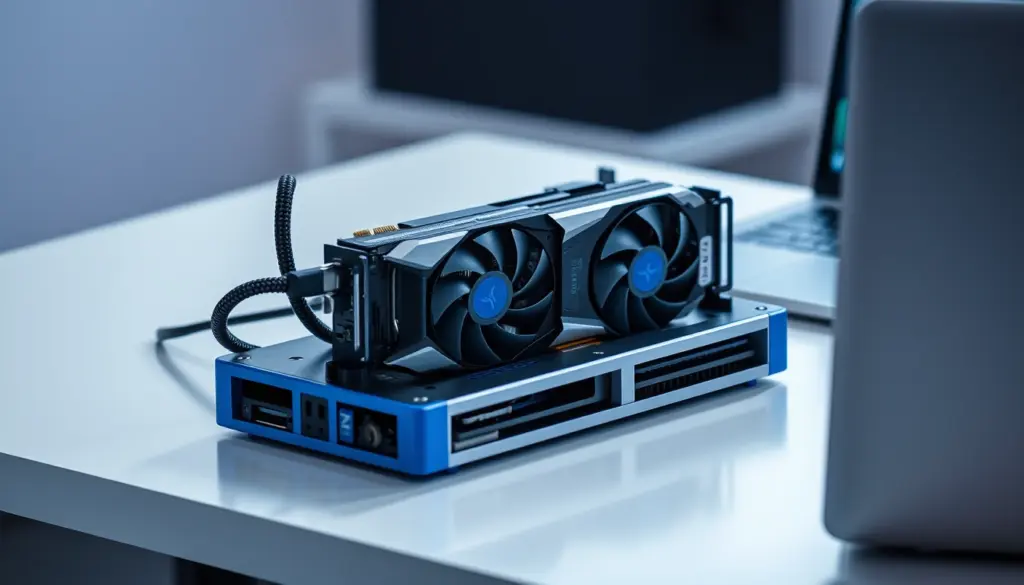
UGREEN has pushed out a new external GPU dock, and the spec sheet reads like a wish list assembled by PC builders tired of choosing between speed and power. The LinkStation Pro swaps the outgoing model’s USB4 link for Thunderbolt 5, bolts on an OCuLink port for a second high-bandwidth path to the GPU, and packs an 850W power supply rated 80 Plus Gold. Notebookcheck confirmed the launch on September 15, framing it as UGREEN’s most direct answer yet to the growing crowd of laptop owners who want desktop-class graphics without a desktop tower.
UGREEN Unveils the LinkStation Pro eGPU Dock
The LinkStation Pro is UGREEN’s upgraded external graphics card dock, built to sit between a laptop and a full-size desktop GPU. It replaces the company’s earlier USB4-based LinkStation as the flagship model in the lineup, according to the announcement covered by Notebookcheck. The core pitch has not changed: buyers supply their own graphics card, drop it into the enclosure, and get desktop-level rendering power routed back to a thin-and-light laptop over a single cable.
What has changed is everything underneath the hood. The dock moves its primary host connection from USB4 to Thunderbolt 5, adds a dedicated OCuLink port for GPUs that need a shorter, lower-latency hop, and doubles down on power delivery for gamers and creators running the newest RTX 40, RTX 50, and Radeon RX 7000 cards. VideoCardz separately reported a price point of $450 for the unit, though final retail pricing tends to shift once a product reaches distributors outside its home market.
Thunderbolt 5 Replaces USB4 as the Host Connection
The headline upgrade is the jump to Thunderbolt 5, which carries up to 80 Gbps of total bandwidth between the dock and the host laptop. That is double the 40 Gbps ceiling of Thunderbolt 4 and the USB4 standard the previous LinkStation relied on. For anyone pushing 4K frame buffers or high refresh-rate external monitors through the same cable as the GPU traffic, that extra headroom matters more than it might look on paper.
Thunderbolt 5 launched as a spec from Intel in September 2023, and hardware built around it only started reaching shelves in real volume through 2024 and 2025. A dock like the LinkStation Pro landing in September 2026 shows just how long it takes a new interconnect standard to work its way from spec sheet to a $450 accessory sitting next to someone’s laptop. UGREEN also built in backward compatibility, so the dock still works with USB4, Thunderbolt 4, and Thunderbolt 3 laptops, just without the full bandwidth ceiling.
OCuLink Gives GPU Data a Second Path
Alongside Thunderbolt 5, the LinkStation Pro adds a single OCuLink port. OCuLink is a PCIe 4.0 x4 connection capable of up to 64 Gbps, and unlike Thunderbolt, it skips the USB-C tunneling layer entirely. That means lower latency and less protocol overhead for machines that actually expose an OCuLink port, which today mostly means gaming handhelds, mini PCs, and a small but growing set of motherboards built with external GPU expansion in mind.
Putting both Thunderbolt 5 and OCuLink on the same dock is a hedge. Thunderbolt covers the vast majority of modern laptops. OCuLink covers a smaller, more enthusiast-driven crowd that already cares about squeezing out every drop of PCIe bandwidth. UGREEN betting on both at once suggests the company sees the OCuLink corner of the market as more than a niche experiment at this point.
Inside the 850W Power Supply
The built-in 850W power supply is the other pillar of this launch. It carries 80 Plus Gold certification and complies with the ATX 3.1 specification, the same standard Nvidia and its partners have pushed for RTX 40 and RTX 50 series cards with high transient power spikes. An integrated PSU means buyers only need to supply a graphics card, not a separate power brick to feed it, which simplifies the whole eGPU pitch considerably.
80 Plus Gold and ATX 3.1 Compliance
80 Plus Gold certification, tracked by the 80 PLUS program, requires a power supply to hit at least 87 to 90 percent efficiency across typical load levels. ATX 3.1 compliance matters specifically because newer GPUs draw power in short, sharp spikes rather than a flat line, and PSUs built to older ATX specs can trip protection circuits or brown out under that kind of load. Meeting both standards inside a compact dock enclosure is not trivial engineering.
GPU Power Connectors for RTX 40, RTX 50, and RX 7000
The PSU includes native 12V-2×6 and 12VHPWR connectors, the same connector types Nvidia has used across the RTX 40 and RTX 50 lines. UGREEN also lists support for AMD’s RX 7000 series cards. Anyone who has dealt with adapter cables and dongle chains to make an older PSU fit a newer GPU connector will understand why native support is worth calling out rather than treating it as a footnote.
Laptop Charging Jumps to 140W
Power delivery back to the host laptop rises to 140W, up from the 100W ceiling on the earlier USB4 LinkStation. That 40W jump is the difference between a dock that trickle-charges a thin ultrabook while under load and one that can actually keep pace with a power-hungry 16-inch creator or gaming laptop running flat out. It is a small number on a spec sheet, but it directly affects whether someone can leave their original charger at home once the dock is plugged in.
Power delivery over Thunderbolt and USB-C follows the USB-IF specifications, which cap out at 240W under the newest Extended Power Range profile. UGREEN’s 140W falls well short of that ceiling, but it clears the bar for the vast majority of high-performance laptops currently on the market, including most 14-inch and 16-inch gaming and workstation models.
Full Port Layout and Daisy-Chain Support
Beyond the headline connections, the LinkStation Pro carries three Thunderbolt 5 ports with daisy-chain support, meaning a single cable run from the laptop can feed the dock and then continue on to additional Thunderbolt peripherals like monitors or storage. It rounds out the layout with the one OCuLink port already mentioned and a single USB-A 3.2 port rated at 10 Gbps for older accessories that have not made the jump to USB-C.
Daisy-chaining matters more than it sounds like it should for anyone trying to keep a desk tidy. A single Thunderbolt 5 cable to the laptop, then a chain running from the dock out to a display and a fast external drive, cuts down on cable clutter that eGPU setups have struggled with since the format existed. It also lets the dock double as a de facto docking station rather than a single-purpose GPU box.
UGREEN LinkStation Pro Spec Sheet
Here is the confirmed spec rundown for the LinkStation Pro, pulled from the UGREEN announcement as reported by Notebookcheck.
| Spec | UGREEN LinkStation Pro |
|---|---|
| Host connection | Thunderbolt 5 (up to 80 Gbps) |
| Secondary connection | OCuLink, PCIe 4.0 x4, up to 64 Gbps |
| Backward compatibility | USB4, Thunderbolt 4, Thunderbolt 3 |
| Power supply | 850W, 80 Plus Gold, ATX 3.1 compliant |
| GPU power connectors | Native 12V-2×6 / 12VHPWR |
| Supported GPUs | Nvidia RTX 40, RTX 50 series; AMD RX 7000 series |
| Laptop power delivery | Up to 140W (up from 100W on prior model) |
| Thunderbolt ports | 3x Thunderbolt 5, daisy-chain capable |
| Additional ports | 1x USB-A 3.2, 10 Gbps |
| Reported price | $450 (per VideoCardz) |
How the LinkStation Pro Stacks Up Against Rival eGPU Docks
Most of the eGPU enclosures still shipping in volume today, including long-running favorites like the Razer Core X and the Sonnet Breakaway Box 750ex, were designed around Thunderbolt 3. That standard tops out at 40 Gbps, and both of those enclosures ship with 650W and 750W power supplies respectively rather than UGREEN’s 850W unit. Razer’s Core X launched at roughly $299 with up to 500W of power budget reserved for the GPU and 100W of laptop charging. Sonnet’s 750ex ships with a 750W PSU, reserves up to 375W continuous plus 100W peak for the GPU, and delivers 85W of laptop power.
| Dock | Host connection | Bandwidth | PSU | Laptop power delivery |
|---|---|---|---|---|
| UGREEN LinkStation Pro | Thunderbolt 5 + OCuLink | 80 Gbps (TB5) / 64 Gbps (OCuLink) | 850W, 80 Plus Gold | 140W |
| Razer Core X | Thunderbolt 3 | 40 Gbps | 650W ATX | 100W |
| Sonnet Breakaway Box 750ex | Thunderbolt 3 | 40 Gbps | 750W | 85W |
| UGREEN LinkStation (prior model) | USB4 | 40 Gbps | Not disclosed | 100W |
On paper, the LinkStation Pro doubles the raw bandwidth of every competitor in that table and adds an OCuLink path none of them offer. Whether that translates into meaningfully higher in-game frame rates depends heavily on which GPU is installed and which games are being tested, since Thunderbolt bandwidth has rarely been the limiting factor for eGPU performance at 40 Gbps in the first place. Where the extra bandwidth clearly helps is in reducing bottlenecks for high refresh-rate external displays chained off the same cable, and in supporting the higher transient power draw of newer GPU generations without the PSU buckling.
A Short History of External GPU Docks
External GPU enclosures have been a niche corner of the PC market for roughly a decade, gaining real traction once Thunderbolt 3 arrived with enough bandwidth to make the concept viable for gaming rather than just professional GPU compute work. Early boxes from Sonnet, Akitio, and Razer proved the format could work, but they were held back by 40 Gbps ceilings and PSUs that struggled to keep up as GPUs grew hungrier for power with each generation.
Thunderbolt 4 arrived in 2020 as a tightened version of the same 40 Gbps standard, mandating stricter minimum requirements for certification but not raising the bandwidth ceiling. It took until Intel’s Thunderbolt 5 brief in September 2023 for a genuine doubling of bandwidth to reach the roadmap, and it took roughly two more years for hardware built around it to become the kind of thing a mainstream accessory brand like UGREEN would ship at a consumer price point. That gap between spec announcement and shelf-ready product is fairly typical for interconnect standards, and it is exactly the gap the LinkStation Pro is now closing.
Why Thunderbolt 5 Adoption Is Finally Picking Up
Thunderbolt 5 adoption has been slow for a familiar reason: chicken-and-egg timing between laptops that support it and accessories built to take advantage of it. A dock is only as fast as the slowest link in the chain, so a Thunderbolt 5 eGPU box plugged into a Thunderbolt 4 laptop still runs at 40 Gbps. As more 2025 and 2026 laptop generations ship with native Thunderbolt 5 controllers, docks like the LinkStation Pro finally have an audience that can use the full bandwidth rather than paying for headroom they cannot access yet.
UGREEN shipping a Thunderbolt 5 product at a mainstream $450 price point, rather than holding it back as a premium enterprise accessory, is itself a signal. Accessory makers tend to move into a new interconnect standard once they expect enough of the install base to support it within the product’s realistic shelf life, typically 12 to 24 months. That UGREEN made the jump now suggests the company’s internal forecasts for Thunderbolt 5 laptop penetration have crossed whatever threshold justifies the engineering cost of an 850W, dual-standard enclosure.
What This Means for Handheld and Mini PC Owners
The OCuLink port is where this launch gets interesting for a different audience entirely. Handheld gaming PCs and compact mini PCs have increasingly shipped with OCuLink ports specifically so owners can plug into a desktop GPU when docked at home, then disconnect and go portable. UGREEN putting OCuLink alongside Thunderbolt 5, rather than picking one standard and forcing everyone else to adapt, means a single dock can now serve both a Thunderbolt laptop user and an OCuLink handheld owner without buying two separate boxes.
That flexibility is a meaningful departure from how most eGPU enclosures have been built until now. Manufacturers have generally picked a lane, either chasing the broader Thunderbolt laptop market or the smaller but vocal handheld and mini PC crowd. A dual-standard approach costs more in engineering and testing, but it widens the buyer pool considerably, and it hedges against either standard failing to gain the traction its backers expect.
Market Impact: eGPU Docks Meet a Tight GPU Supply
This launch also lands at an odd moment for the graphics card market itself. GPU prices across the RTX 50 series have climbed through 2026 as memory supply tightens and AI-driven demand for high-end silicon competes directly with gaming demand for the same production capacity. An eGPU dock is only as useful as the graphics card someone can actually install in it, and right now finding an RTX 5090 or even a mid-range RTX 5070 at anything close to list price has gotten harder, not easier.
That backdrop cuts two ways for UGREEN. On one hand, a tight GPU market could soften near-term demand for a dock that assumes buyers already have, or can easily obtain, a current-generation card worth $450 worth of dock infrastructure to support. On the other hand, eGPU docks let one graphics card serve multiple machines, moving between a desktop and a laptop as needed, which becomes more appealing precisely when GPUs themselves are expensive and hard to source. Whether the LinkStation Pro benefits from that dynamic or gets squeezed by it will likely depend on how quickly GPU supply eases into 2027.
The OCuLink Trade-Off Nobody Talks About
OCuLink’s PCIe 4.0 x4 connection at up to 64 Gbps sounds like a straightforward win over Thunderbolt’s protocol overhead, and in raw throughput terms it often is. The trade-off is compatibility. OCuLink requires a matching port on the host device, and outside of gaming handhelds, a handful of mini PCs, and enthusiast motherboards, that port simply does not exist on most laptops people already own. Thunderbolt’s advantage has always been ubiquity, not peak bandwidth, and that dynamic has not changed just because OCuLink posts better numbers in isolation.
UGREEN’s answer is to offer both rather than pick a side, which is a sensible hedge but not a free one. Supporting two host standards inside a single enclosure adds cost, adds firmware complexity, and adds another set of compatibility questions buyers have to work through before purchasing. For a first-time eGPU buyer, the practical advice remains simple: check what port your specific laptop, handheld, or mini PC actually has before assuming this dock’s dual connectivity solves every use case at once.
Predictions: Where eGPU Docks Go From Here
- Expect at least one more major accessory brand, likely one already selling Thunderbolt hubs or docking stations, to announce its own Thunderbolt 5 eGPU enclosure within the next two to three quarters.
- Native Thunderbolt 5 laptop adoption will likely accelerate through 2027 as more CPU platforms ship with integrated Thunderbolt 5 controllers, narrowing the gap between docks like this one and the laptops that can actually max out their bandwidth.
- OCuLink support on mainstream motherboards and mini PCs will probably keep expanding slowly rather than becoming a default feature, keeping it a secondary rather than primary connection standard for at least another product cycle.
- Pricing on 80 Plus Gold, ATX 3.1-compliant eGPU enclosures will likely stay in the $400 to $500 band near term, reflecting both the PSU cost and continued tightness in GPU-adjacent component supply chains.
- If GPU prices remain elevated into 2027, expect more marketing from eGPU vendors around the idea of sharing one graphics card across a desktop and a laptop, rather than framing these docks purely as a laptop-to-desktop performance upgrade.
What This Launch Signals for UGREEN’s Roadmap
UGREEN has spent the past few years building a reputation on docking stations, charging hardware, and network-attached storage rather than high-end PC accessories, so a dual-standard, 850W eGPU dock represents a step up in both ambition and engineering complexity for the brand. Retiring the USB4-only LinkStation in favor of the Pro model, rather than keeping both in the lineup side by side, suggests UGREEN wants to be taken seriously in a segment historically dominated by Razer, Sonnet, and a handful of smaller boutique makers.
Whether that bet pays off will come down to two things largely outside UGREEN’s control: how fast Thunderbolt 5 laptops actually reach store shelves in volume, and how long the current graphics card supply crunch drags on. Both trends are moving in UGREEN’s favor over a multi-year horizon, but neither is moving fast enough yet to guarantee the LinkStation Pro finds a mainstream audience within its first year on shelves.
Frequently Asked Questions
What is the UGREEN LinkStation Pro?
It is UGREEN’s upgraded external GPU dock, letting a laptop or compatible mini PC use a full-size desktop graphics card over Thunderbolt 5 or OCuLink instead of an internal slot.
How fast is Thunderbolt 5 compared to Thunderbolt 4?
Thunderbolt 5 supports up to 80 Gbps of bidirectional bandwidth, double the 40 Gbps ceiling of Thunderbolt 4 and the older USB4 standard.
Does the LinkStation Pro need its own power supply?
No. The dock has an integrated 850W power supply rated 80 Plus Gold and built to the ATX 3.1 specification, so buyers only need to supply the graphics card itself.
Which graphics cards work with the LinkStation Pro?
UGREEN lists support for Nvidia’s RTX 40 and RTX 50 series cards and AMD’s RX 7000 series, using native 12V-2×6 and 12VHPWR power connectors.
What is OCuLink and why does it matter here?
OCuLink is a PCIe 4.0 x4 connection standard offering up to 64 Gbps with lower protocol overhead than Thunderbolt. It mainly benefits gaming handhelds and mini PCs that ship with a matching OCuLink port.
How much does the UGREEN LinkStation Pro cost?
VideoCardz reported a price of $450, though street pricing can shift once the dock reaches retailers outside its initial launch market.
Can the LinkStation Pro charge my laptop while running a GPU?
Yes. It delivers up to 140W of power to a connected laptop over Thunderbolt, up from the 100W ceiling on the previous USB4 LinkStation model.
Is the LinkStation Pro backward compatible with older laptops?
Yes. UGREEN says the dock works with USB4, Thunderbolt 4, and Thunderbolt 3 devices, though bandwidth drops to whatever ceiling the host laptop’s port supports.