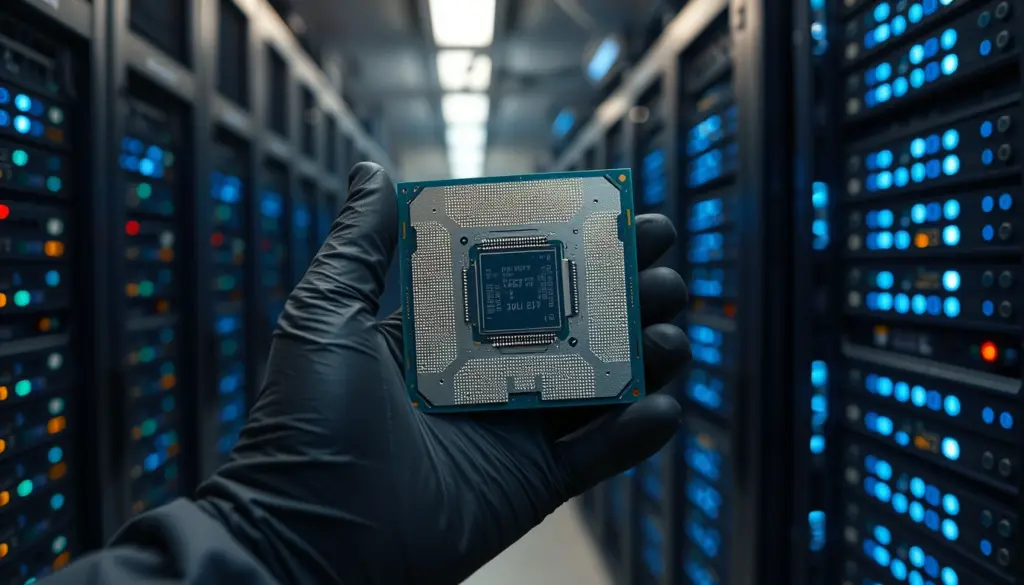
Arm Holdings is weeks away from shipping its first data center processor as a finished chip rather than a design license, and the numbers behind that shift are starting to add up. The AGI CPU, a 136-core server processor built on Arm’s Neoverse V3 cores, is set to reach customers in the fourth quarter of 2026, according to Arm’s own guidance reported by Tom’s Hardware. For a company that spent 35 years licensing chip blueprints instead of selling silicon, that’s a genuinely new business.
The technical picture sharpened considerably at Hot Chips 2026 in August, where Arm engineers walked through the interconnect fabric, memory subsystem, and packaging choices behind the chip for the first time in public. What emerged is a processor built to compete directly with Intel’s Xeon line, AMD’s Epyc chips, and, awkwardly, with Arm’s own long-time customers Nvidia and Amazon Web Services. This piece breaks down what the AGI CPU actually contains, why Meta signed on as lead partner, how it stacks up against the competition on paper, and what analysts think it means for the next few years of server chip economics.
Arm Ships Its First Data Center Chip as Production Ramps
Arm first unveiled the AGI CPU on March 24, 2026, describing it as the company’s first production-ready silicon product rather than an IP license. Shares of Arm Holdings jumped 16.38% to $157.07 the day of the announcement, a reaction that reflected a business model change as much as a product launch. The company’s full-year revenue for the period hit a record $4.92 billion, up 23% year over year, giving Arm a financial cushion to fund a much more capital-intensive silicon business.
Six months later, the story has moved from announcement to execution. Arm has told investors it expects to ship between $90 million and $100 million worth of AGI CPUs in the fourth quarter of 2026 alone, the first real revenue test for a company that built its entire history on royalties rather than hardware sales. An analyst cited by Tom’s Hardware cautioned that even that figure would leave Arm short of 5% penetration into the broader server CPU market, a reminder that Intel and AMD still ship the overwhelming majority of data center processors today.
Inside the 136-Core Design
The AGI CPU is a dual-chiplet processor manufactured on TSMC’s N3P process, with configurations offered at 64, 128, or 136 Neoverse V3 cores. Each core clocks between 2.80 GHz and 3.70 GHz and carries a 10-wide frontend and decode stage, a 10-wide dispatch pipeline, an 8-wide retire stage, and an out-of-order execution window of more than 384 entries, according to the technical breakdown published by ServeTheHome.
Each of the two chiplets packs 70 cores, four of which are redundant to improve manufacturing yield, for a usable maximum of 136 cores per package. Every chiplet contains roughly 50 billion transistors and connects to its counterpart through a UCIe fabric link running at 2 TB/s, tight enough bandwidth that the two dies behave close to a single monolithic processor for most workloads. The whole package carries a 300W TDP, putting it in the same power envelope as top-end Xeon and Epyc parts rather than the lower-power designs Arm has historically been known for in mobile and embedded chips.
Hot Chips 2026 Reveals the Memory and Interconnect Details
Memory bandwidth is where the AGI CPU makes its clearest pitch to AI infrastructure buyers. Arm placed both compute and I/O chiplets on the same die to cut DRAM latency below 100 nanoseconds, and the chip supports a 12-channel memory controller running DDR5-8800, which Arm says delivers up to 844.8 GB/s of bandwidth. That figure matters because agentic AI workloads, the kind that chain together many small model calls and tool invocations rather than running one large batch job, tend to be far more memory-bandwidth-bound than classic enterprise software.
The chip also ships with 96 lanes of PCIe 6.0 and CXL 3.0 support, plus Chipkill memory protection and quality-of-service controls aimed at multi-tenant cloud deployments. Mohamed Awad, Arm’s EVP of Cloud AI, framed the design choice bluntly at the Arm Everywhere event, arguing that chasing ever-higher clock speeds the way x86 vendors have carries a real cost. “When you increase the frequency, what else do you increase? Power. That’s a problem. These boost modes are not sustainable across long periods of time. They’re not sustainable across a chip,” Awad said, according to The Register.
Why Arm Broke 35 Years of Licensing-Only Business
For its entire existence, Arm made money by licensing processor architectures and core designs to companies like Apple, Qualcomm, Samsung, and Nvidia, who then built and sold their own chips. The AGI CPU flips that model: Arm designs, has TSMC manufacture, and sells the finished processor directly, competing in the same market as some of its own licensees. Arm CEO Rene Haas has argued the data center gives Arm a structural opening that mobile never quite offered. “In the data center, particularly with AI accelerated code, it is all native cloud, meaning that you’re starting from a base where there isn’t legacy enterprise x86 that you need to support,” Haas said in an interview published by Tae Kim’s Substack.
Haas has also pointed to results from existing Arm-based cloud silicon as evidence the architecture itself isn’t the only advantage at play. “In the data center, we have another fairly significant advantage in that if you look at customers like Microsoft, Google, or AWS, all who have custom chip efforts on ARM, all who have talked about getting 60% benefit in terms of performance on a like for like basis, that’s not just the ARM ISA,” he said on the Acquired podcast, a point that positions the AGI CPU as building on years of hyperscaler experience rather than starting from zero.
Meta’s Role as Lead Customer and Co-Design Partner
Meta is not a passive buyer here. The company co-developed the AGI CPU alongside Arm and plans to deploy it next to its own custom MTIA inference accelerators, according to reporting from Forbes. That combination, a general-purpose Arm CPU handling orchestration and data movement while MTIA chips handle the AI math, mirrors the CPU-plus-accelerator pairing Nvidia has built around its own Grace Hopper and Grace Blackwell superchips, except with Meta controlling both halves of the stack for its own data centers instead of buying from a single vendor.
For Meta, the appeal is straightforward: less dependence on Nvidia and Intel for the CPU side of its AI clusters, and a direct hand in shaping a chip built around its own agentic workload patterns. For Arm, having a hyperscaler as co-designer and first customer solves the classic chicken-and-egg problem new server chips face, where cloud operators are reluctant to commit to unproven silicon and chipmakers are reluctant to build without a committed anchor customer.
Who Else Is Buying: OpenAI, Cerebras, Cloudflare and More
Beyond Meta, Arm has confirmed commercial commitments from OpenAI, Cerebras, Cloudflare, F5, Positron, Rebellions, SAP, and SK Telecom. That list spans AI labs, AI chip startups, a CDN and edge-compute provider, and enterprise software vendors, suggesting Arm is pitching the AGI CPU less as a narrow AI accelerator companion and more as a general data center CPU that happens to be tuned for agentic workloads.
Cloudflare’s involvement is worth watching closely given the company already runs one of the largest Arm-based edge networks in the industry. If Cloudflare moves meaningful capacity onto the AGI CPU specifically, rather than sticking with existing Neoverse-based edge silicon, that would be a stronger signal of real-world performance gains than any vendor benchmark. OpenAI’s interest lines up with the same agentic-inference argument Arm has been making publicly: as AI systems shift from single large batch inference calls toward chains of smaller tool-using steps, the bottleneck moves from raw FLOPS toward memory bandwidth and CPU-side orchestration, exactly the areas the AGI CPU targets.
Arm AGI CPU vs AWS Graviton5, Nvidia Grace, and Intel Xeon
The AGI CPU doesn’t exist in a vacuum. AWS already runs its own Arm-based Graviton line, Nvidia sells Arm-based Grace CPUs alongside its GPUs, and Intel and AMD continue to ship high core count x86 chips built for the same data centers. The table below lines up publicly disclosed specs across the current generation of each.
| Processor | Core Count | Core Architecture | Process Node | Memory Bandwidth | Status (Sept 2026) |
|---|---|---|---|---|---|
| Arm AGI CPU | Up to 136 | Neoverse V3 | TSMC N3P (3nm-class) | 844.8 GB/s (DDR5-8800) | Shipping Q4 2026 |
| AWS Graviton5 (R9g) | 192 | Neoverse V3 | Not disclosed | Not disclosed | Generally available, 25% faster than Graviton4 |
| AWS Graviton4 | 96 | Neoverse V2 | Not disclosed | ~537 GB/s | Generally available |
| Nvidia Grace Superchip | 144 (per superchip) | Neoverse V2 | TSMC 4nm-class | Not disclosed here | Shipping |
| Intel Xeon 6+ | Up to 288 | x86 (Intel 18A) | Intel 18A | Not disclosed here | Shipping, claims 30% lead over Epyc per Intel |
Read the core counts carefully. AWS Graviton5 and Intel’s Xeon 6+ both post higher raw core counts than the AGI CPU’s 136-core ceiling, which cuts against any narrative that Arm’s new chip is simply the biggest core count in the market. Arm’s argument instead centers on performance-per-rack and performance-per-watt rather than per-chip core totals, since data center buyers increasingly plan capacity in gigawatts of power draw rather than raw chip counts. For deeper background on how Graviton5 compares with its predecessor, see our AWS Graviton5 coverage, and for the x86 side of this comparison, our Intel Xeon 6+ report covers Intel’s own claims against AMD Epyc.
The Rack Density Argument: Supermicro’s 336-Chip Design
Arm’s clearest differentiation claim isn’t about a single chip, it’s about what happens when you pack thousands of them into a data hall. For hyperscale deployments, Arm partnered with Supermicro on a liquid-cooled 200kW rack design housing 336 AGI CPU processors, adding up to more than 45,000 cores in a single rack. Arm’s official statement, published on its newsroom site, puts a specific number on the payoff: “The Arm AGI CPU delivers more than 2x performance per rack versus x86 CPUs, enabling up to $10B in CAPEX savings per GW of AI data center capacity,” according to the Arm newsroom announcement.
That $10 billion figure is Arm’s own marketing claim rather than an independently audited benchmark, and it comes with an asterisk in Arm’s own materials tying it to specific assumptions about gigawatt-scale buildouts. Still, the framing tells you where Arm expects to win the argument with hyperscalers: not on individual chip benchmarks, but on the multi-year capital expenditure math of building out gigawatt-class AI campuses, where even a 10-20% efficiency gain compounds into real money across tens of thousands of racks.
Market Reaction and the Road to $90 Million in Q4 Sales
Investors treated the March unveiling as a genuine strategic pivot rather than a routine product refresh, sending Arm shares up more than 16% in a single session. The table below tracks the key financial and shipment figures reported since.
| Metric | Figure | Timeframe |
|---|---|---|
| Arm stock move on announcement day | +16.38% to $157.07 | March 24, 2026 |
| Arm full-year revenue | $4.92 billion (+23% YoY) | FY2026 |
| Projected AGI CPU shipment value | $90M-$100M | Q4 2026 |
| Analyst-estimated server market penetration | Under 5% | By FY2027 |
| Claimed rack-level performance gain vs x86 | More than 2x per rack | Arm’s own figure |
| Cores per Supermicro liquid-cooled rack | 45,000+ (336 chips) | 200kW rack design |
The gap between the stock market’s enthusiasm and the actual near-term revenue is worth sitting with. A $90-100 million quarter is a rounding error next to Intel’s or AMD’s data center CPU revenue, both of which report billions per quarter from server chips. What moved Arm’s stock wasn’t Q4 2026 revenue, it was the signal that Arm now has a credible path to capturing silicon margin instead of only royalty and licensing fees, a much larger addressable revenue pool over a multi-year horizon.
The Channel Conflict: Competing With Your Own Licensees
The awkward part of Arm’s pivot is that Nvidia, AWS, and other Neoverse licensees are now, in a narrow sense, competitors as well as customers. AWS builds Graviton chips on Arm’s architecture and sells them exclusively inside its own cloud. Nvidia builds Grace CPUs on Arm’s architecture and pairs them with its own GPUs. Both companies have far deeper hyperscale distribution than Arm does on its own, and neither has an obvious incentive to switch its own internal chip programs to buying finished silicon from Arm instead of continuing to license the core IP and build in-house.
Arm’s bet is that the AGI CPU expands the total market rather than cannibalizing existing licensees, by reaching data center operators who don’t have the scale or engineering resources to design their own Arm-based server chips from scratch, the way Meta, OpenAI, Cerebras, and Cloudflare are doing through direct partnership instead of building silicon teams of their own.
Historical Context: From Mobile IP to Data Center Silicon
Arm’s architecture has dominated mobile phones for two decades precisely because Arm never built its own chips, letting Apple, Qualcomm, Samsung, and dozens of others compete on implementation while Arm collected licensing fees from nearly everyone. That model scaled cleanly because phone makers wanted differentiated hardware and were willing to pay for the flexibility of custom silicon.
Data centers work differently. Hyperscalers with the resources to design custom Arm chips, AWS, Google, Microsoft, and Nvidia among them, already have. Everyone else, from mid-sized cloud providers to AI labs like OpenAI, has neither the volume nor the engineering headcount to justify building a chip team from scratch. That gap between “large enough to design your own silicon” and “large enough to need a lot of capable servers” is exactly the space the AGI CPU is built to fill, and it’s a gap x86 vendors Intel and AMD have served almost by default for years simply because there was no finished Arm alternative to buy off the shelf.
Competitive Impact on Intel and AMD
Intel and AMD aren’t standing still. Intel’s Xeon 6+ line, built on the company’s 18A process, now scales up to 288 cores and Intel has claimed a roughly 30% performance lead over AMD’s competing Epyc chips in its own benchmarks. AMD, meanwhile, continues to push its Epyc roadmap and has separately guided toward a much larger addressable AI infrastructure market in recent investor commentary. Both companies have decades of enterprise software compatibility, established supply chains, and existing hyperscaler relationships that a brand-new chip line can’t replicate overnight.
Analysts covering the space have framed the stakes in blunt terms: unless Intel and AMD can match Arm’s claimed performance-per-watt gains in the specific niche of agentic AI infrastructure, some of the migration toward Arm-based servers in new AI data center buildouts could become permanent rather than a temporary experiment. That’s a meaningfully different threat than Arm’s mobile dominance ever posed to x86, because it targets new AI capacity being built right now rather than asking anyone to rip out existing enterprise infrastructure.
Why Arm Says Agentic AI Needs a Different CPU
Arm’s technical pitch rests on a specific claim about where AI workloads are heading. Mohamed Awad has argued the company built the AGI CPU around exactly what agentic data centers need, rather than trying to retrofit a general-purpose server chip. “We’re focused on exactly and only what the agentic datacenter needs, performance, scale, and efficiency,” Awad said, according to The Register’s coverage of the Arm Everywhere event.
The distinction matters because agentic AI systems, ones that chain together many tool calls, retrieval steps, and smaller model invocations rather than running a single large batch inference job, put far more pressure on memory bandwidth, interconnect latency, and CPU-side orchestration than on raw floating point throughput. That’s the same rationale behind the AGI CPU’s sub-100ns DRAM latency target and its 844.8 GB/s memory bandwidth spec, both of which matter more for chatty, latency-sensitive agent workloads than they do for traditional batch-processed enterprise software.
Five Predictions for Arm’s Data Center Push
- Q4 2026 shipments land close to guidance. Expect Arm to report AGI CPU revenue in the $90-100 million range for the quarter, a small but closely watched proof point rather than a market-moving number.
- Cloudflare becomes the bellwether to watch. If Cloudflare shifts meaningful edge or core capacity onto the AGI CPU specifically, that’s a stronger real-world signal than any Arm-published benchmark.
- Intel and AMD respond with performance-per-watt marketing, not price cuts. Both companies are more likely to lean on efficiency claims for their next Xeon and Epyc refreshes than to compete purely on sticker price.
- Server market penetration stays under 5% through FY2027. The analyst estimate cited by Tom’s Hardware looks conservative but realistic given how entrenched x86 remains in existing enterprise deployments.
- More AI labs sign direct silicon deals rather than building their own chips. OpenAI and Cerebras’ involvement suggests other AI labs without in-house chip teams could follow the same path instead of investing in custom silicon programs.
What This Means for Buyers and the Wider AI Chip Market
For enterprises and cloud buyers, the AGI CPU adds a genuine third option beyond “build your own Arm chip” and “buy x86 from Intel or AMD,” specifically for AI-heavy workloads where memory bandwidth and rack density matter more than raw single-thread performance. That’s a narrower use case than Arm’s mobile business ever addressed, but it’s also a much higher dollar-value one, given how much capital hyperscalers are currently pouring into AI data center buildouts.
The risk for Arm is execution at a scale it has never operated at before. Licensing IP to Apple or Qualcomm carries none of the manufacturing, supply chain, or customer support obligations that come with selling finished chips directly to hyperscalers. Arm now owns all of that, on top of continuing to run its traditional licensing business for every other customer that isn’t buying AGI CPU silicon outright. How well Arm manages that dual role, silicon vendor to some customers and IP licensor to others, may end up mattering as much as the chip’s raw specs.
Frequently Asked Questions
What is the Arm AGI CPU?
It’s Arm’s first finished, production-ready server processor, built around up to 136 Neoverse V3 cores on TSMC’s N3P process, designed specifically for AI data center workloads rather than general enterprise computing.
When does the Arm AGI CPU ship?
Arm has guided to initial customer shipments in the fourth quarter of 2026, with projected shipment value of $90 million to $100 million for that quarter.
Who is Arm’s lead customer for the AGI CPU?
Meta co-developed the chip and is the lead customer, planning to deploy it alongside its own custom MTIA AI accelerators. Other confirmed commercial partners include OpenAI, Cerebras, Cloudflare, F5, Positron, Rebellions, SAP, and SK Telecom.
How does the Arm AGI CPU compare to AWS Graviton5?
Graviton5 actually has more cores, 192 versus the AGI CPU’s maximum of 136, and both use Neoverse V3 cores. The key difference is that Graviton5 is exclusive to AWS’s own cloud, while the AGI CPU is sold as finished silicon to any customer Arm partners with.
Is Arm competing with its own customers?
In a narrow sense, yes. AWS and Nvidia both license Arm’s architecture to build their own custom server chips (Graviton and Grace respectively), and now Arm is also selling a finished competing product. Arm’s argument is that it’s expanding the overall Arm-based server market rather than cannibalizing existing licensees.
Why did Arm’s stock jump on the announcement?
Arm shares rose 16.38% to $157.07 on March 24, 2026, the day of the unveiling. Investors reacted to the strategic shift toward capturing silicon margin on top of Arm’s existing licensing revenue, a much larger long-term revenue opportunity than royalties alone.
What is the AGI CPU’s power consumption?
The chip carries a 300W TDP, comparable to high-end Intel Xeon and AMD Epyc data center processors, rather than the low-power designs typically associated with Arm chips in mobile devices.
Will the Arm AGI CPU threaten Intel and AMD’s data center dominance?
Not in the near term. Analysts estimate the AGI CPU will capture under 5% of the server CPU market by FY2027, and Intel’s Xeon 6+ already scales to 288 cores. The bigger long-term risk to Intel and AMD is losing share specifically in new AI data center buildouts, where Arm’s rack-density and performance-per-watt claims are most relevant.