
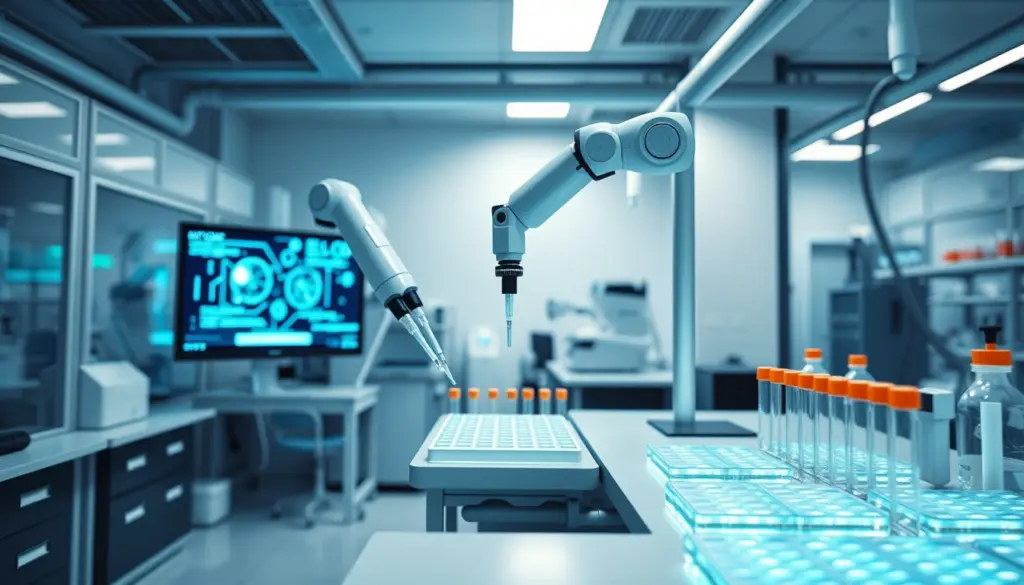
Anthropic has quietly built a physical biology laboratory in the San Francisco Bay Area, and it is testing whether Claude can direct robotic lab equipment through real scientific experiments with only limited human involvement. The project, confirmed to Reuters by Eric Kauderer-Abrams, Anthropic’s head of life sciences, marks the company’s first confirmed move from software-only AI into hands-on wet-lab science. It also reopens a debate the industry has been circling for two years: what happens when a language model stops writing about experiments and starts running them.
Anthropic, which publishes most of its official updates through its newsroom page, has not said where exactly the lab sits, how big it is, what it cost to build, or which instruments fill it. The company has also declined to confirm that the facility is specifically built for drug discovery, even though the effort sits inside Anthropic’s broader push into AI-assisted life sciences. What is confirmed, on the record, is narrower and more interesting than the breathless headlines suggest: a real lab, real robots, and a model still learning to hold the pipette.
What Anthropic Has Actually Confirmed About the Lab
Strip away the speculation and the confirmed facts are these. Anthropic operates a wet lab in the Bay Area dedicated to physical biology experiments, according to reporting that traces back to a Reuters interview. The company is exploring whether Claude models can direct robotic laboratory equipment through multi-step experiments, with humans still required in the loop for safety. Anthropic has not disclosed the lab’s opening date, staffing levels, or the specific experiments running inside it right now.
Crucially, Anthropic told reporters the lab is not specifically a drug-discovery facility, even though the automation work clearly feeds into the company’s wider ambitions around AI and pharmaceutical science. The company also confirmed it is not running any clinical trials there. That distinction matters. A robotics-assisted research bench that helps scientists run more assays per week is a very different animal from a facility developing candidate drugs for human testing, and conflating the two overstates where Anthropic actually is today.
Kauderer-Abrams put the company’s own progress in blunt terms, telling Reuters, “We’re in the very early innings of using AI to automate the execution of lab work, an area that has the potential to bring about meaningful acceleration in so many different processes,” according to itnews.com.au’s account of the interview. That is a company executive managing expectations, not overselling a breakthrough, and it is worth taking at face value.
Who Is Eric Kauderer-Abrams, and Why His Confirmation Carries Weight
Eric Kauderer-Abrams leads Anthropic’s life-sciences function, the internal group tasked with figuring out where Claude’s reasoning abilities can plug into biology and chemistry research. His willingness to confirm the lab’s existence to Reuters, rather than let it leak through a job posting or a contractor’s LinkedIn update, suggests Anthropic wanted to control the framing of this story rather than have it broken by someone else first.
That framing choice tells its own story. Kauderer-Abrams did not claim Claude runs the lab unsupervised, and he did not claim the facility produces drug candidates. He said the opposite on both counts. Reuters quoted him saying, “We believe that to do biology, the final test is still and will be for a while in real lab work,” a line that reads less like a moonshot pitch and more like an argument for why Anthropic needs physical infrastructure at all, given that computational predictions about proteins or compounds still have to be checked against a bench experiment before anyone trusts them.
He also confirmed the automation work is already underway in some form, telling reporters, “We absolutely are doing that today,” per a Reuters account syndicated on Yahoo Finance. Taken together, his comments describe a company running early pilots, not a finished platform.
Inside the “Very Early Innings” of AI-Directed Lab Robotics
Lab automation itself is not new. Pharmaceutical companies and academic labs have used robotic liquid handlers, plate readers, and automated microscopes for well over a decade. What Anthropic is testing is different in kind: whether a general-purpose language model, the same family of Claude models that write code and answer emails, can plan and direct that hardware through a scientific protocol instead of a scientist typing commands into proprietary lab-automation software.
That idea extends a capability Anthropic has already been building for desktop and cloud environments. Anthropic’s Claude Cowork and Claude Code products picked up background computer-use features in a Mac beta rollout on September 3, 2026, letting Claude operate applications on a user’s desktop while the person keeps working on something else. Applying that same “operate the interface, take the actions, report back” pattern to a wet lab means teaching Claude to interpret sensor readings, sequence pipetting steps, and flag anomalies, rather than just clicking through a spreadsheet or a browser tab.
Anthropic has also been testing narrower scientific tasks that hint at where this is headed. The company posted on its official account that it wanted to test whether Claude could design novel protein binders from scratch, a benchmark for the kind of molecular-design reasoning that would eventually need to be validated in a real lab, not just scored against a computational metric. You can read Anthropic’s own post about the protein-binder experiment here. That is precisely the gap the Bay Area lab appears built to close: turning a model’s molecular guess into a bench result.
Anthropic’s 2026 Life-Sciences Moves So Far
The biology lab did not appear in isolation. It is the latest entry in a string of 2026 moves that show Anthropic steadily pushing Claude’s agentic abilities from chat windows into real-world execution. The table below lines up the confirmed dates.
| Date (2026) | Development | Source |
|---|---|---|
| August 2026 | Reports indicated Claude was involved in roughly 26% of Anthropic’s own internal AI research and development work, with the bulk of remaining work reaching at least an AI-assisted stage | Industry reporting on Anthropic’s internal usage |
| September 3, 2026 | Claude Cowork and Claude Code gained background computer-use features in a Mac beta for Pro and Max plans, letting Claude operate desktop applications with less direct supervision | Reported rollout coverage |
| September 2026 | Anthropic publicly described testing whether Claude could design novel protein binders from scratch | Anthropic’s official account |
| September 18, 2026 | Reuters reported Anthropic operates a physical wet lab in the San Francisco Bay Area and confirmed the company is testing Claude-directed lab robotics | Reuters, via itnews.com.au |
Read as a sequence, the pattern is consistent rather than sudden. Anthropic has spent 2026 widening the scope of tasks Claude can carry out with reduced supervision, first inside its own R&D pipeline, then across a user’s desktop, and now, tentatively, on a physical lab bench. Anthropic covered its own internal AI usage figures in detail in a separate report on Claude’s role in Anthropic’s AI R&D, and the desktop-automation thread connects directly to Claude’s growing agentic coding demonstrations.
What Anthropic Is Not Saying: Separating Fact From Speculation
Several claims circulating since the Reuters story broke go beyond what Anthropic has confirmed, and a news analysis owes readers a clear line between the two. Anthropic has not confirmed that the lab is specifically a drug-discovery facility. It has not disclosed the lab’s location beyond “San Francisco Bay Area,” nor its size, cost, equipment list, headcount, or opening date. It has not confirmed that Claude currently operates any part of the lab autonomously or without a human present. And it has explicitly said it is not running clinical trials at the site.
That last point deserves emphasis because it is the one most likely to get flattened in aggregation. A wet lab testing whether an AI model can sequence pipetting steps is not the same thing as a company developing a drug candidate for human trials, and Anthropic drew that line itself when asked. Readers should treat any claim that Anthropic is “developing new drugs with AI robots” as an inference the company has not made, not a confirmed fact.
The Competitive Field: Who Else Is Building AI Into Lab Science
Anthropic is a late entrant to a field that already has established players approaching the same problem from different angles. Isomorphic Labs, the Alphabet-backed company spun out of Google DeepMind, built its reputation on AlphaFold’s protein-structure predictions and has spent years turning those predictions into drug-design partnerships with pharmaceutical companies. Recursion Pharmaceuticals has run large-scale automated wet labs for years, using robotics and machine learning to screen cellular responses to compounds at a scale no human technician team could match manually.
OpenAI and Google DeepMind, by contrast, have leaned harder into general reasoning and scientific claims made through their frontier models rather than confirmed dedicated wet-lab infrastructure of their own. Anthropic’s move puts it in a different lane: rather than partnering out its physical execution entirely, the company appears to want direct, in-house experience running Claude against real hardware, presumably so its models learn from lab feedback the way they have learned from code execution feedback in software.
| Organization | Known Approach | Confirmed Physical Lab |
|---|---|---|
| Anthropic | Testing Claude-directed robotic lab equipment for biology experiments, human oversight required | Yes, confirmed September 2026 (Bay Area) |
| Isomorphic Labs | Protein-structure prediction (built on AlphaFold heritage) paired with pharma drug-design partnerships | Relies on partner labs and internal research infrastructure |
| Recursion Pharmaceuticals | Long-running automated wet-lab screening combined with machine learning models | Yes, established automated labs (Salt Lake City) |
| OpenAI | General-purpose reasoning models applied to scientific problem-solving | No confirmed dedicated wet lab as of these reports |
| Google DeepMind | Foundational science models (AlphaFold lineage) and research partnerships | No newly confirmed standalone facility tied to this story |
The comparison matters for a simple reason: Anthropic is the company most associated with cautious, safety-forward messaging in the AI industry, and yet it is now the one confirming direct physical experimentation with AI-directed robotics. That is a notable reversal of expectations, and it will likely put pressure on rivals to clarify their own physical-science ambitions, whether they want to or not.
Why This Matters for the Market
Anthropic’s biology lab lands at a moment when the company is under close financial scrutiny ahead of a widely anticipated public listing. Investors and analysts have already been debating how much of Anthropic’s valuation rests on Claude’s software business versus speculative expansion into new domains, a tension covered in detail in coverage of Wall Street’s reaction to Anthropic’s IPO risk profile. A confirmed move into physical science infrastructure adds a new variable to that debate: does a wet lab represent a genuine new revenue avenue in pharma partnerships and life-sciences tooling, or is it a costly, early-stage research bet that will not pay off for years, if at all.
There is also a talent and positioning angle. Life-sciences automation sits at the intersection of two of the most expensive hiring markets in tech right now: frontier AI research and wet-lab biology expertise. Anthropic building this capability in-house, rather than solely through partnerships, signals it intends to compete for that hybrid talent pool directly, which could put pressure on hiring budgets across the sector, from Isomorphic Labs to smaller biotech startups trying to attract the same scientists.
For pharmaceutical and biotech companies watching from the sidelines, the practical question is whether Anthropic eventually offers this capability as a service, the way cloud providers turned internal infrastructure into rentable products. Nothing Anthropic has said confirms that plan, but the company’s history of turning internal Claude capabilities into external products, most recently visible in its steady cadence of new model releases aimed at competing with rivals like GPT-6 Astra, makes it a reasonable question to ask rather than dismiss.
Historical Context: From AlphaFold to Autonomous Lab Robots
To understand why this story matters beyond a single company, it helps to trace the arc that got the industry here. DeepMind’s AlphaFold, first released in 2020 and refined through subsequent versions, proved that a machine-learning model could predict protein structures with enough accuracy to reshape structural biology research. That was a purely computational breakthrough, run on servers, checked against experimental data collected by human-run labs.
The next logical step, one the industry has discussed for years without much public evidence of execution, was closing the loop: letting an AI system not just predict what a scientist should test, but actually direct the equipment that runs the test, read the result, and decide what to try next. Robotic “self-driving labs” have existed as an academic research topic for years, with university groups building small-scale automated chemistry platforms. What Anthropic’s confirmation adds is a frontier AI lab, with Claude’s general reasoning capabilities, attempting the same closed loop at commercial scale rather than as a university pilot project.
That context also explains why Kauderer-Abrams’ “very early innings” framing is credible rather than falsely modest. Every prior attempt at this kind of closed-loop automation has taken years to move from a controlled demo to something a working scientist trusts enough to leave unattended. There is no reason to expect Claude’s version to skip that curve entirely, even with a substantially more capable underlying model than earlier academic systems used.
The Safety Question: Human Oversight and Biosecurity Risk
Anthropic has staked much of its public identity on AI safety, and a physical biology lab raises a different category of risk than a chatbot giving bad advice. Automating lab work touches biosecurity concerns directly: could a sufficiently capable, poorly supervised system be steered toward synthesizing something dangerous, even inadvertently? Anthropic’s own answer, at least in what it has told reporters, is that human involvement remains required for safety at every stage of the current work.
That answer lines up with steps Anthropic has taken elsewhere in its model lineup. The company’s Claude Fable 5.1 release earlier in 2026 specifically targeted biosecurity-adjacent risks, cutting flagged biological-risk outputs sharply as part of its anti-distillation and safety-lock features. A lab-automation program that ran without equivalent guardrails would sit awkwardly next to that safety record, which gives Anthropic a strong internal incentive to keep humans in the loop for now, whatever the long-term roadmap looks like.
It also raises a governance question the company has not yet answered publicly: who audits an AI-directed lab protocol before it runs, and what happens when Claude’s plan for an experiment diverges from what a human researcher expected? Anthropic has not disclosed any external audit or oversight structure specific to the biology lab, which leaves that question open for now.
What Anthropic’s Own Team Is Saying
The clearest window into Anthropic’s thinking so far comes directly from Kauderer-Abrams’ comments to Reuters. Beyond the “very early innings” line, he was direct about why physical validation still matters even in an AI-heavy research pipeline: “We believe that to do biology, the final test is still and will be for a while in real lab work,” as reported by itnews.com.au. That is a striking statement from a company built entirely on software, effectively conceding that no amount of model capability replaces a bench result.
He confirmed the automation work is live in some capacity today, not just planned, telling reporters, “We absolutely are doing that today,” in the same Reuters interview picked up by Yahoo Finance. And Anthropic’s own account described the underlying ambition in a public post, stating the company “wanted to test if Claude could successfully design novel protein binders from scratch,” language that frames the lab work as an extension of model evaluation rather than a commercial drug-discovery operation, at least for now.
Predictions: Where This Goes Next
A few developments look likely over the next 12 to 18 months, based on how Anthropic has handled past capability rollouts and how the broader field of self-driving labs has historically matured.
- Anthropic will likely publish more detail on the lab, including specific experiment types, once results are strong enough to be a positive story rather than a liability, following the same pattern it used before disclosing internal Claude usage statistics.
- Expect competitive pressure on OpenAI and Google DeepMind to clarify or expand their own physical-science infrastructure plans, given that Anthropic just became the frontier lab most publicly associated with hands-on wet-lab automation.
- Biosecurity researchers and policy groups will likely ask Anthropic pointed questions about oversight structures for the lab, echoing scrutiny the company has already faced over model safety commitments.
- Recursion Pharmaceuticals and Isomorphic Labs will likely emphasize their multi-year head start in automated wet-lab execution as a competitive differentiator against a newer entrant still in “early innings.”
- Pharmaceutical companies will likely explore partnership conversations with Anthropic well before any commercial lab-automation product exists, given how aggressively the industry has chased AI partnerships in 2025 and 2026.
What to Watch For in the Coming Weeks
The most useful signal for readers tracking this story will not be another vague confirmation, it will be specifics: a named partner institution, a described experiment type, or a hiring push for wet-lab scientists on Anthropic’s careers page. Any of those would indicate the program has moved past pilot testing. Silence on those fronts, by contrast, would support Kauderer-Abrams’ own framing that this remains exploratory work rather than a near-term product.
Anthropic’s pattern this year has been to let capabilities mature quietly before discussing them publicly, visible in how it handled disclosures around its Mythos safety research program and in how cautiously it addressed internal concerns raised by departing safety researchers earlier this year. There is little reason to expect the biology lab to break that pattern, which means detailed updates may come in the form of a research paper or a controlled announcement rather than another leak.
Related
- Anthropic Says Claude Leads 26% of Its Own AI R&D [2026]
- Anthropic Weighs New Model as GPT-6 Astra Hits 13% [2026]
- Anthropic Gives EU Access to Mythos, 10,000+ Bugs [2026]
- Claude Vibe-Codes Windows 3.1 Shell in 1 Hour [2026]
- Anthropic Researcher Quits: “Gambling With Our Lives” [2026]
Frequently Asked Questions
Does Anthropic really have a biology lab?
Yes. Anthropic confirmed to Reuters that it operates a physical wet lab in the San Francisco Bay Area for biology experiments, with the confirmation coming directly from Eric Kauderer-Abrams, the company’s head of life sciences.
Is Claude running the lab without human supervision?
No. Anthropic says human involvement remains required for safety, and the company describes the effort as being in the very early stages of testing whether Claude can direct robotic lab equipment with limited, not zero, human intervention.
Is Anthropic developing new drugs with this lab?
Anthropic has specifically said the facility is not built exclusively for drug discovery and that it is not running any clinical trials there, even though the work connects to the company’s broader interest in AI-assisted life sciences.
Where exactly is the lab located?
Anthropic has only confirmed the lab sits somewhere in the San Francisco Bay Area. The company has not disclosed a specific city, address, size, or opening date.
How does this compare to Isomorphic Labs or Recursion Pharmaceuticals?
Both companies have run automated wet-lab or drug-design programs for years, giving them a head start on physical execution. Anthropic’s confirmed effort is newer and, by its own description, still in early testing rather than production use.
Why would an AI company build a physical lab at all?
Kauderer-Abrams told Reuters that biology still requires real lab work as the final test of any computational prediction, meaning Anthropic needs physical infrastructure to validate what its models predict rather than relying on simulations alone.
Does this connect to Claude’s other agentic features?
It appears to draw on the same underlying approach behind Claude’s background computer-use features rolled out for Claude Cowork and Claude Code in September 2026, extending the idea of an AI system operating equipment or interfaces toward physical lab hardware.
What should readers watch for next?
Concrete signals to watch include named research partners, described experiment types, wet-lab hiring on Anthropic’s careers page, or a published research paper. Any of these would indicate the program has moved beyond early pilot testing.