
A Chinese hardware vendor is selling a GeForce RTX 5090 with three times the memory Nvidia ever shipped on the card, and it costs less than half of what a stock RTX 5090 fetches at US retail right now. The listing, from a Shenzhen-based OEM called Suqiao Intelligent Technology, showed up on Alibaba this month with a price tag of $3,888 for a board carrying 96GB of GDDR7 memory instead of the 32GB Nvidia designed the card to hold. Tom’s Hardware first flagged the listing and pegged it at roughly 35% below the going US price for an unmodified RTX 5090 in September 2026.
The timing matters. Official RTX 5090 pricing has been climbing for months as GDDR7 supply tightens, and street prices in the United States now range from around $4,600 to more than $9,000 depending on the board partner and retailer. Against that backdrop, a 96GB card selling for under $4,000, even one built from aftermarket rework rather than a factory Nvidia design, has become a story about memory economics as much as about graphics cards.
Who Is Shenzhen Suqiao Intelligent Technology?
Suqiao is described in trade listings as a Chinese OEM and ODM operation that builds graphics cards, motherboards, and servers, largely for buyers who want customized or non-standard configurations that mainstream board partners like Asus, Gigabyte, and MSI won’t touch. The company’s Alibaba storefront lists the modified RTX 5090 at $3,888 with a minimum order of one unit, a detail that signals this is a retail-style listing rather than a bulk-only enterprise deal.
Other Alibaba sellers, tracked in a separate roundup of the listings, price similar 96GB RTX 5090 rebuilds at roughly $5,858 to $5,900, suggesting Suqiao’s price sits at the aggressive end of a small but active gray-market niche rather than as an outlier. None of these listings carry Nvidia’s name, warranty, or endorsement. They are third-party rework jobs performed on cards that started life as ordinary RTX 5090s.
RTX 5090 Price Breakdown: MSRP, Street Price, and the Modded Alternative
Nvidia launched the RTX 5090 at a $1,999 manufacturer suggested retail price with 32GB of GDDR7 memory built from sixteen 2GB memory devices, according to widely cited teardown estimates. That MSRP has become largely theoretical. Reports place September 2026 US street prices for a genuine, unmodified RTX 5090 anywhere from roughly $4,600 up to $9,500 depending on the model and retailer, with one report noting cards were selling for at least $5,000 by September 1. Even the modified 96GB card at $3,888 lands above the official 1,999 dollar launch price, so nobody involved is getting an RTX 5090 for MSRP in the fall of 2026.
| Product | Memory | Reported Price (USD) | Source Status |
|---|---|---|---|
| Official RTX 5090 (MSRP) | 32GB GDDR7 | $1,999 | Nvidia launch price |
| RTX 5090 US street price, Sept 2026 | 32GB GDDR7 | ~$4,600 – $9,500 | Retail/marketplace reports |
| Suqiao modified RTX 5090 | 96GB GDDR7 (advertised) | $3,888 | Alibaba listing |
| Other 96GB modded RTX 5090 listings | 96GB GDDR7 (advertised) | ~$5,858 – $5,900 | Alibaba listings |
| Nvidia RTX Pro 6000 Blackwell | 96GB GDDR7 | ~$16,000 – $17,999 | Professional product, cited pricing |
That last row is the one that puts the whole story in perspective. Nvidia already sells a genuine 96GB Blackwell card, the RTX Pro 6000, aimed at workstation and AI workloads. It costs somewhere between $16,000 and $17,999 in the pricing cited by outlets tracking the professional GPU market. A Suqiao mod at roughly a quarter of that cost is exactly why buyers priced out of the professional tier are looking at gray-market rework in the first place. For more on how RTX 5090 pricing already blew past $5,000 in the US market this year, the trend line has been building since spring.
Inside the Mod: How Suqiao Triples RTX 5090 Memory
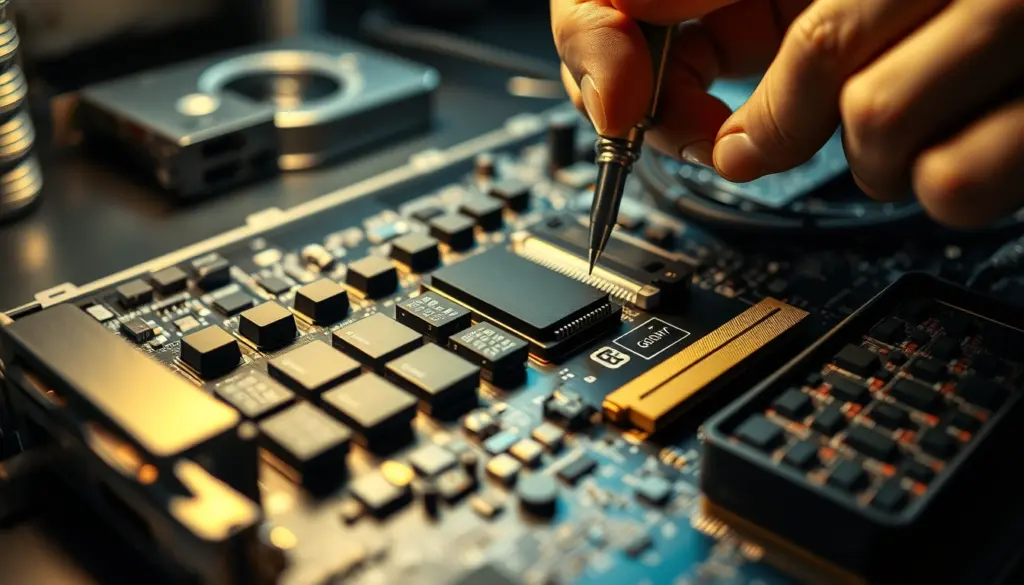
The process reported around the Suqiao card is board-level rework: technicians desolder the factory GDDR7 memory devices and replace them with higher-density chips, then re-flash firmware so the GPU recognizes the new capacity. The GPU die itself stays untouched. A modified RTX 5090 is still running the same Blackwell compute silicon as a stock card, it just has access to far more memory to work with.
What isn’t confirmed is the exact chip density and count Suqiao uses to hit 96GB. Some coverage has pointed to a 32-chip, 3GB-per-chip arrangement, but that layout actually describes Nvidia’s own RTX Pro 6000 Blackwell, a separate factory product, not a verified teardown of the Suqiao board. Reporting also hasn’t nailed down whether the reworked card runs at full official memory clocks and power limits or whether Suqiao dials things back to keep the modified memory stable. Signal integrity, memory training, and driver compatibility are all open questions on a board that was never validated by Nvidia at this capacity.
Nvidia has not issued any public statement addressing the Suqiao card specifically, and none of the available reporting includes independent benchmark results confirming the modified board performs as advertised under sustained load.
Why US RTX 5090 Prices Blew Past $9,000 This Fall
The spread in September 2026 US pricing is wide enough to tell its own story. Per-model listings put an Aorus Master around $4,930, a Zotac Solid OC near $4,999, an Asus TUF Gaming OC at $5,090, and an ROG Astral around $6,000, while some retailers reported top-end cards running past $9,000. A narrower estimate from another source put the realistic buying window closer to $4,900 to $5,199, which still sits well above the original launch price.
| Board Partner Model | Reported September 2026 Price |
|---|---|
| Gigabyte Aorus Master RTX 5090 | ~$4,930 |
| Zotac Solid OC RTX 5090 | ~$4,999 |
| Asus TUF Gaming OC RTX 5090 | ~$5,090 |
| Asus ROG Astral RTX 5090 | ~$6,000 |
| High-end retailer listings (various) | up to ~$9,500 |
None of these are official Nvidia prices, they reflect what retailers and marketplaces were actually charging as of mid-to-late September. The gap between a $1,999 launch price and a nearly $10,000 top-end listing is what makes a $3,888 modified card with triple the memory look competitive on paper, even with all the uncertainty around its build quality.
The GDDR7 Shortage Driving the Price Spike
RTX 5090 pricing hasn’t moved in a vacuum. Memory has been the binding constraint across the entire PC and AI hardware supply chain through 2026, a trend TrendForce has tracked closely across both GDDR and HBM markets. China’s AI chip prices jumped roughly 50% this year as HBM supply tightened, and that pressure has bled into consumer GDDR7 allocation as memory makers prioritize high-margin AI accelerator contracts over graphics card supply. Separate reporting on industry-wide memory stockpiles falling below 10 days of supply underscores how thin the buffer has gotten across the board, not just for Nvidia’s flagship consumer card.
One secondary estimate puts GDDR7 module costs at roughly $20 per 2GB device, which would put the raw memory bill on a stock 32GB RTX 5090 at around $320. Scaling that same rate to 96GB would require something like 48 equivalent modules, though nobody has confirmed the exact chip arrangement Suqiao actually uses, and that estimate isn’t a verified spot-market quote. Intel CEO Lip-Bu Tan has separately warned that memory costs are up roughly sevenfold with no relief expected until 2028, a timeline that suggests the pressure pushing RTX 5090 prices toward $9,000 isn’t going away anytime soon.
Why 96GB of VRAM Matters for AI Inference
The appeal of the modified card isn’t gaming frame rates, it’s memory capacity for running large language models locally. VRAM determines whether a model, its KV cache, and its context window fit on a single GPU without offloading to system RAM, which tanks throughput. A 32GB card caps out fairly quickly against modern open-weight models in the 30B-to-70B parameter range once quantization and context length are factored in. A 96GB card, even a rebuilt one, opens the door to running much larger models or serving more concurrent requests without a second GPU.
That’s the same demand curve pushing buyers toward Nvidia’s own high-memory professional cards, just at a price point most individual developers and small AI shops can’t justify. A $3,888 card that claims to close most of that capacity gap, even with unverified reliability, explains why the listing generated enough attention to trend on social platforms within days of surfacing.
RTX 5090 96GB vs Nvidia’s RTX Pro 6000 Blackwell
Nvidia’s actual answer to the 96GB question is the RTX Pro 6000 Blackwell, a workstation-class card built and validated at that memory capacity from the factory. It carries full Nvidia warranty coverage, professional driver certification, and enterprise support, none of which come with a Suqiao rework. The professional card’s $16,000-to-$17,999 pricing reflects that validation and support structure, not just the raw cost of memory chips.
A modified RTX 5090 doesn’t inherit any of the RTX Pro 6000’s professional features just because it shares a memory total. It remains a consumer Blackwell GPU with consumer drivers, running memory Nvidia never validated at that density on that board. For workloads where stability and support matter more than sticker price, the gap between the two products is about far more than the roughly $12,000 price difference.
Export Control Questions Nobody Has Answered
A modified GPU sold out of China with a large jump in AI-relevant memory capacity naturally raises questions about US export control rules, particularly given how much scrutiny Nvidia’s China-market chips have already drawn from the Commerce Department’s Bureau of Industry and Security. But the available reporting doesn’t establish that the Suqiao card itself violates any export rule. Compliance in these cases hinges on the GPU’s technical classification, its destination, the end user, the end use, and the exporter, not simply on whether a board with more memory shows up on a marketplace listing.
There’s also no confirmation the Suqiao cards are being shipped outside China at meaningful volume, or that they come with any functioning Nvidia warranty support wherever they land. The listing itself doesn’t answer whether this is a domestic Chinese product aimed at local AI developers working around GPU export restrictions on higher-tier Nvidia hardware, or a card intended for international resale.
A Short History of Chinese GPU Memory Mods
Suqiao’s 96GB RTX 5090 isn’t the first time Chinese vendors have reworked Nvidia cards to add memory. Modified RTX 4090 boards carrying 48GB of memory, roughly double the card’s stock 24GB, circulated in similar gray-market channels in 2024 and 2025, aimed at the same local-AI-inference crowd. Detailed pricing, seller identity, and independent teardown data on those earlier 48GB cards are thin in retrospective reporting, but the pattern is consistent: whenever Nvidia’s consumer flagship falls well short of the VRAM needed for serious local AI work, someone in China’s hardware supply chain tries to close that gap with aftermarket rework.
| Card | Stock Memory | Reported Modded Memory | Approximate Era |
|---|---|---|---|
| RTX 4090 | 24GB GDDR6X | 48GB (reported) | 2024–2025 |
| RTX 5090 | 32GB GDDR7 | 96GB (Suqiao listing) | September 2026 |
The jump from doubling capacity on the RTX 4090 to tripling it on the RTX 5090 tracks with how much larger and more memory-hungry open-weight AI models have gotten in the two years between those cards.
The Risks Buyers Don’t See: Warranty, Stability, and Drivers
Buying a reworked GPU from an Alibaba listing carries risks that never show up in a spec sheet. There’s no Nvidia warranty on a board with desoldered and replaced memory, so any failure, whether from the mod itself or an unrelated component, is the buyer’s problem alone. Memory training and BIOS compatibility on non-standard configurations can produce instability that only shows up under specific workloads, not in a quick benchmark run. Driver support is built around Nvidia’s validated configurations, so a 96GB RTX 5090 sits entirely outside what Nvidia’s driver team tests or optimizes for.
None of the current reporting includes confirmed production volume, return rates, or failure rates for the Suqiao card, which means early buyers are effectively the test group for a product Nvidia never built or endorsed.
What This Means for Nvidia, AMD, and Everyday Buyers
For Nvidia, the existence of a $3,888 alternative to a $16,000 professional card is an awkward pricing signal, even if the company never sanctioned it. It suggests real demand for high-memory consumer-adjacent hardware that Nvidia’s own product stack, with its steep jump from the RTX 5090 to the RTX Pro 6000, isn’t fully serving. No comparable 96GB modded AMD card has surfaced in current reporting, which for now leaves this specific gray-market niche entirely built around Nvidia’s Blackwell architecture.
For ordinary gamers and buyers, the bigger story remains the baseline price of a real RTX 5090, not the modded fringe case. Street prices pushing toward $9,000 sit alongside a broader memory cost crunch that’s also driving up costs on budget phones and laptops, where memory now accounts for a much larger share of the bill of materials than it did a year ago. A gray-market 96GB card for AI developers doesn’t change the math for someone just trying to buy a gaming GPU at a reasonable price.
Historical Context: The GPU Memory Arms Race
Nvidia has spent the past several GPU generations drawing a hard line between consumer and professional memory capacity, in part to protect the pricing and margin structure of its workstation and data center lines. The RTX 3090 topped out at 24GB, the RTX 4090 held at 24GB again, and the RTX 5090 moved to 32GB, a modest step given how much larger AI models have grown across that same span. Each generation, that gap between what enthusiasts want for local AI work and what Nvidia is willing to ship on a consumer card has widened, and each generation, aftermarket modders in China have stepped in to close it, whether through the RTX 4090 48GB mods or now the RTX 5090 96GB rework.
That pattern predates the current AI boom. Modified memory boards on older Nvidia cards for mining and rendering workloads circulated in gray-market channels for years before large language models made VRAM capacity a mainstream consumer talking point. What’s changed is the price gap the mods are now closing: a $12,000-plus difference between a modified consumer card and Nvidia’s genuine 96GB professional part is a far bigger incentive than anything the mining era produced.
5 Predictions for RTX 5090 Pricing and VRAM Mods
- US RTX 5090 street prices stay elevated through early 2027. With memory supply tight and Intel’s CEO pointing to no relief before 2028, a return to anything near the $1,999 MSRP looks unlikely in the near term.
- More Chinese vendors enter the modded-VRAM niche. Suqiao’s listing and the competing $5,858–$5,900 offers suggest multiple shops are already chasing this business, and low barriers to entry mean more sellers are likely to follow.
- Nvidia stays publicly silent but may act on the gray market privately. Nvidia hasn’t commented on the Suqiao card, and a formal statement is unlikely unless the mods start showing up at meaningful scale outside China or drawing regulatory attention.
- The launch of Nvidia’s next-generation cards won’t fix the memory gap. Reports have already pushed the RTX 60 series toward a 2028 timeline, meaning current RTX 5090 pricing pressure, and the incentive to mod it, persists for a long stretch.
- Scrutiny of modded exports will grow alongside AI chip export debates. As US-China AI hardware tensions continue, a high-VRAM modified consumer GPU is a plausible flashpoint for future export control clarification, even without confirmed violations today.
That RTX 60 timeline connects to a broader pattern this fall: leakers and analysts have been split on when Nvidia’s next architecture actually ships, and the same uncertainty is playing out around conflicting claims about a 2027 RTX 6090 launch, with some sources pushing the timeline out further still. Until Nvidia’s roadmap firms up, RTX 5090 pricing, and the gray-market activity around it, has little reason to cool off.
Frequently Asked Questions
Is the 96GB RTX 5090 a real Nvidia product?
No. It’s a third-party rework performed by a Chinese vendor, Shenzhen Suqiao Intelligent Technology, on a standard RTX 5090 board. Nvidia builds the RTX 5090 with 32GB of GDDR7 and has not endorsed, validated, or commented on the 96GB modification.
How much does the modded RTX 5090 cost?
Suqiao’s Alibaba listing prices the 96GB card at $3,888. Competing sellers on the same platform list similar 96GB rebuilds for roughly $5,858 to $5,900.
What is the current official RTX 5090 price?
Nvidia’s launch MSRP was $1,999, but September 2026 US street prices for genuine, unmodified RTX 5090 cards range from roughly $4,600 to $9,500 depending on the board partner and retailer, driven largely by the ongoing GDDR7 memory shortage.
Why does a 96GB RTX 5090 matter for AI work?
VRAM capacity determines how large a model, and how much context, can run on a single GPU without slower workarounds like offloading to system memory. More memory lets developers run bigger open-weight models locally or handle more simultaneous requests without buying a second card.
Is buying a modded RTX 5090 safe?
There’s meaningful risk. The card carries no Nvidia warranty, and reworked memory can introduce stability issues around signal integrity, BIOS compatibility, and driver support that Nvidia never tested for. No independent teardown or sustained-load benchmark has been published to confirm the modified card performs reliably.
Does the modded card violate US export controls?
That hasn’t been established. Export compliance depends on factors like technical classification, destination, end user, end use, and exporter, set by the Commerce Department’s Bureau of Industry and Security, not simply on whether a board with more memory appears on a marketplace listing.
How does the modded card compare to Nvidia’s own 96GB card?
Nvidia’s RTX Pro 6000 Blackwell is a genuine 96GB professional card with full warranty and driver support, priced around $16,000 to $17,999. The modified RTX 5090 claims similar memory capacity at roughly a quarter of that price, but without any of the validation or support behind the professional part.
Has this happened before with other Nvidia cards?
Yes. Modified RTX 4090 boards with 48GB of memory, double the card’s stock 24GB, circulated through similar Chinese gray-market channels in 2024 and 2025 for the same reason: closing the gap between consumer GPU memory and what local AI workloads demand.