
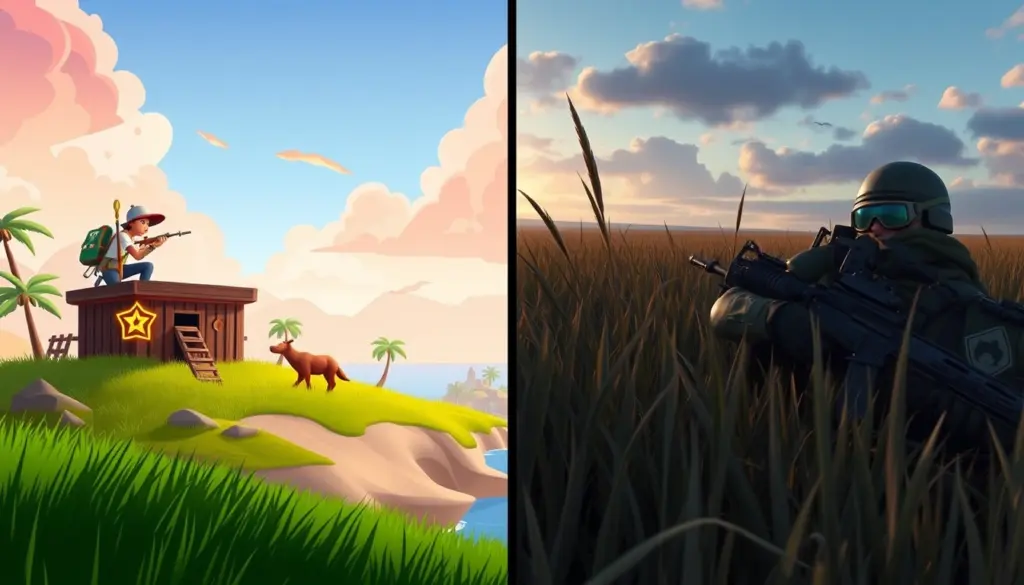
Two of the biggest battle royale esports titles on the planet run competitive ladders that work almost nothing alike. Fortnite’s Ranked mode leans on a 22-step tier system split across eight named bands, while PUBG: BATTLEGROUNDS keeps things tighter with eight tiers and a Rank Points formula that Krafton just rewired in Update 42.1. If you’ve climbed one ladder and are wondering how the other stacks up, or you’re deciding which game rewards your playstyle more, the differences show up in matchmaking, season length, reset behavior, and even how much a bad game actually costs you. This comparison breaks down both systems as they stand on September 24, 2026, using Epic’s and Krafton’s own patch notes plus third-party tracking data where official numbers are not published.
Both games sit at the center of the battle royale genre, but they got there through different design philosophies. Fortnite built its identity around construction mechanics layered on top of a shrinking-map shooter, which means its ranked ladder has to account for building skill alongside gunplay. PUBG stuck closer to the genre’s original template: no building, bigger maps, and a slower, more tactical pace that rewards patience over mechanical flash. Those design choices ripple all the way down into how each game measures and rewards skill, which is the core of what this comparison unpacks.
Fortnite Ranks vs PUBG Ranks: Quick Comparison Table
Before getting into mechanics, here’s the side-by-side breakdown. Both games are free-to-play battle royales, but the ranked structures underneath diverge on almost every axis that matters to a competitive player.
| Feature | Fortnite Ranked | PUBG Ranked |
|---|---|---|
| Named tiers | 8 (Bronze, Silver, Gold, Platinum, Diamond, Elite, Champion, Unreal) | 8 (Bronze, Silver, Gold, Platinum, Diamond, Master, Grandmaster, Conqueror) |
| Total rank steps | 22 (7 tiers x 3 divisions, plus Unreal) | Not published as a single figure since Update 42.1’s RP overhaul |
| Progress currency | Ranked progress driven by placement and eliminations | Rank Points (RP), driven by placement, survival time, and kills |
| Published formula | Not disclosed by Epic | Not fully disclosed by Krafton, but weighting direction confirmed in patch notes |
| Hidden rating | Skill Rating persists across visible rank resets | MMR-style matchmaking separate from visible RP |
| Separate ranked modes | 5 ladders: Battle Royale, Zero Build, Reload, OG, Ballistic | Effectively 3: Solo, Duo, Squad, with Gold+ requirements raised in Update 43.1 |
| Current season (Sept 24, 2026) | Chapter 7 Season 4, “Override,” started Aug. 20, 2026 | Season 42/43 transition window, tied to Updates 42.1-43.1 |
| Top-tier structure | Unreal is a single, leaderboard-style rank with no sub-divisions | Conqueror is a leaderboard-based rank above Grandmaster |
| Free to play | Yes, on PC, PlayStation, Xbox, Switch, and mobile | Yes, on PC (Steam, Epic Games Store), PlayStation, and Xbox |
| 2026 flagship esports event | FNCS Global Championship, $2,000,000 purse, Sept. 26-27, 2026 | PGC 2026, $1,500,000+ base purse, Istanbul, Dec. 1-13, 2026 |
| Steam-tracked concurrent peak | Not a Steam title (Epic Games Store, standalone launcher) | 794,644 (30-day peak, Sept. 13, 2026, per Steam trackers) |
| Battle Pass / season pass cost | 1,000 V-Bucks (roughly $8.99 cash equivalent) | No single verified 2026 USD price for the Survivor/Ranked Pass |
How Fortnite’s Ranked Ladder Works
Fortnite’s ranked system runs on eight named tiers, but seven of them, Bronze through Champion, are split into three divisions each. Add the single-step Unreal rank at the top and you land on 22 total steps players can occupy. That’s a relatively recent change. Epic expanded Elite and Champion from single, undivided ranks into three-division tiers each during a 2026 update tracked by guide sites as v40.20, which pushed the ladder from an older 18-step layout to the current 22-step version. Any guide still describing Elite and Champion as flat, undivided tiers is working from outdated information.
Climbing depends mainly on two inputs Epic has confirmed matter: match placement and eliminations. What the company has not published is a formula. There’s no official table saying an elimination is worth a fixed number of points or that ninth place always nets a specific value. Guides that publish exact numbers are estimating from observed play, not quoting Epic. What is documented is that a hidden Skill Rating sits underneath the visible badge, and that rating carries over through season resets even when your public rank drops. That’s why some players rocket back up within a handful of games after a reset while others grind for weeks, according to breakdowns from independent rank trackers covering similar hidden-MMR systems.
Fortnite also runs five separate ranked ladders rather than one: standard Battle Royale, Zero Build, Reload, OG, and the 5v5 Ballistic mode. Each uses the same eight-tier, 22-step structure, but the player pools, pacing, and difficulty curve differ mode to mode. A Platinum badge in Zero Build and a Platinum badge in standard Battle Royale do not represent identical skill levels, since the modes reward different priorities around rotation, building mechanics, and endgame positioning. Reload Ranked in particular compresses match length and lobby size compared to full Battle Royale, so players climb faster in raw match count but face a tighter margin for error since fewer players means each elimination and placement swing carries more relative weight.
How PUBG’s Ranked Ladder Works
PUBG: BATTLEGROUNDS keeps its PC and console ranked ladder to eight named tiers: Bronze, Silver, Gold, Platinum, Diamond, Master, Grandmaster, and Conqueror. Conqueror sits apart from the rest as a leaderboard-based rank rather than a fixed RP threshold, similar in spirit to how Unreal works in Fortnite. Krafton has not published a complete table of exact RP cutoffs for every tier in the current cycle, so treat any guide claiming precise thresholds with some skepticism unless it cites an official patch note.
The bigger story in 2026 is Update 42.1, which rebuilt how Rank Points get calculated. According to Krafton’s own patch notes, final placement now carries more weight than before, and surviving longer produces more RP on its own, independent of kills. The update also softened RP losses at higher tiers, so a rough match at Diamond or Master no longer tanks your rank the way it once did. Krafton layered in streak bonuses too: two consecutive top-four finishes earn a 5 RP bonus, and two consecutive wins earn 10 RP, with only the higher bonus applying if you qualify for both. Those streak counters reset at the start of a new season or after a leaver penalty.
Kills still factor into RP, but Krafton has not published the exact weighting between placement, survival time, and eliminations, so PUBG’s formula remains just as opaque as Fortnite’s when it comes to hard numbers. What’s different is the direction of travel: PUBG has been explicit in patch notes about rewarding survival and punishing high-tier players less harshly for one bad game, while Fortnite has stayed quiet on the mechanics behind its own placement-and-elimination model.
Points, RP, and What Actually Moves the Needle
Neither game hands players a spreadsheet, but the philosophy behind each system is visible in how developers talk about their own changes.
Fortnite’s Approach: Placement Plus Eliminations
Fortnite has consistently framed ranked progress around placement plus eliminations as the two pillars, without publishing weights. That leaves the exact tradeoff between surviving longer and racking up kills as something players learn through trial and error rather than a documented rule, and it’s a big reason why community-run guides on ranked strategy tend to disagree on the margins even when they agree on the broad strokes.
PUBG’s Approach: Survival-Weighted RP
PUBG went further in 2026, explicitly stating in Update 42.1 notes that final placement now matters more than it used to, and that survival time on its own contributes RP separate from kills.
| Mechanic | Fortnite Ranked | PUBG Ranked |
|---|---|---|
| Primary scoring inputs | Placement + eliminations | Placement + survival time + kills |
| Consecutive-match bonuses | Not documented | +5 RP for 2 consecutive top-4s, +10 RP for 2 consecutive wins |
| High-tier loss protection | Not documented | Reduced RP loss at higher tiers, confirmed in Update 42.1 |
| Exact published formula | No | No |
The practical upshot: PUBG has been more transparent about the mechanics behind its recent changes, even without releasing a full formula, while Fortnite’s placement-and-eliminations model has stayed essentially the same story for several seasons running. If you want a ranked system where the developer regularly explains what changed and why in patch notes, PUBG’s 2026 cadence gives you more to work with.
Season Length and Rank Resets Compared
Fortnite’s ranked periods track the game’s chapter and season calendar rather than running on a fixed, independent schedule. The current window is Chapter 7 Season 4, “Override,” which launched August 20, 2026. One ranked-period tracker lists the associated competitive window running through roughly December 7, 2026, though individual ranked modes can carry their own reset dates that don’t line up perfectly with the Battle Pass timer. Visible rank drops at these season boundaries, but the underlying Skill Rating is retained, which speeds up the climb back for players who were already performing above their displayed badge.
PUBG runs on a more explicitly numbered season structure, tracked through Krafton’s official news page. Season 42 spans roughly three months across Updates 42.1 through 42.3, and Krafton’s own September 2026 announcements also reference a Season 43 transition, with ranked season end windows listed as September 10, 2026 for PC and September 17, 2026 for console. That’s a tighter, more frequent reset cadence than Fortnite’s chapter-tied approach, and it means PUBG players go through placement-style recalibration more often over the course of a year.
Neither game uses simple day-based inactivity decay, the kind where your rank quietly bleeds points if you stop playing. Both instead tie meaningful rank movement to scheduled season transitions, patch updates, and match performance rather than the calendar clock ticking while you’re logged off.
Hidden Skill Rating and Matchmaking
Both games separate what you see from what actually drives your matchmaking. In Fortnite, the visible ranked badge is not a complete picture of matchmaking skill. Epic uses hidden skill information alongside the public rank, and that hidden number is part of why players occasionally feel like their lobby is tougher than their badge suggests, or why they climb unusually fast after a reset.
PUBG runs a comparable setup. Matchmaking leans on MMR that sits apart from the visible RP number, and that separation is part of why two players at the same displayed rank can have very different match experiences. Krafton has not published the exact MMR calculation, mirroring Epic’s silence on Fortnite’s own weighting, but the structural approach, hidden rating plus visible progress currency, is functionally similar across both games even though the surface-level tier names and division counts differ sharply.
The practical difference shows up at the extremes. Fortnite’s Unreal rank and PUBG’s Conqueror rank both function as leaderboard positions rather than simple RP thresholds, meaning the very top of each ladder is determined by relative standing against other elite players in that period, not just crossing a fixed point total.
Solo, Duos, Squads: Mode-by-Mode Differences
Fortnite spreads its ranked system across five distinct ladders covering different formats and rule sets, from standard Battle Royale to the no-building Zero Build mode to the smaller-scale Reload and OG variants, plus the 5v5 Ballistic mode. Each uses the same tier and division framework, but a rank earned in one mode doesn’t transfer to another, and the player pools behind each ladder aren’t identical in size or skill distribution.
PUBG keeps things closer to three core formats: Solo, Duo, and Squad ranked queues. Update 43.1 specifically raised the minimum performance requirements for Gold tier and above in Solo and Duo modes, according to Krafton’s official patch notes, which means the bar for holding a Gold+ badge got harder in those formats without necessarily changing Squad requirements the same way. That’s a smaller, more contained set of ranked formats compared to Fortnite’s five-ladder spread, but it also means PUBG’s design team can tune each format’s requirements independently, as the Update 43.1 change shows.
Squad-based play dominates both games’ competitive scenes. FNCS and PGC both run team formats at their highest levels, even though casual ranked queues in both titles support solo and duo play for players who don’t want to coordinate with a full squad.
Player Population and Server Health
Comparing player counts across these two games is messier than it looks, mostly because they’re tracked completely differently. PUBG sells through Steam, so its numbers show up on public trackers in real time. SteamDB recorded a 24-hour peak of 782,467 players and a specific recorded peak of 791,618 on September 12, 2026, while a separate Steam-tracking source put PUBG’s 30-day peak at 794,644 players on September 13, 2026. PUBG’s all-time Steam peak sits far higher, at 3,257,248, though that figure reflects the game’s 2017-2018 launch boom rather than current 2026 activity.
Fortnite doesn’t publish through Steam, so there’s no equivalent public ledger. Epic itself does not regularly release official monthly or daily active user figures. Third-party estimates from industry trackers put Fortnite at roughly 110 million monthly active players in early 2026, with concurrent player estimates ranging from roughly 1.5 million to 3.5 million depending on time of day and whether a live event is running. One tracker, Fortnite.gg, reported Battle Royale average player counts down 37% in September compared to August, though that figure reflects a single mode’s average rather than the game’s full cross-platform population.
The honest conclusion is that neither figure translates cleanly against the other. PUBG’s numbers are Steam-only and miss console and Epic Games Store players entirely. Fortnite’s numbers are third-party estimates rather than confirmed Epic data. Both games maintain large, healthy populations heading into Q4 2026, but a precise head-to-head ranking isn’t something the public data supports.
What does translate reasonably well is queue health at the ranked-tier level rather than the game level. Both games see the heaviest population concentration in the middle tiers, Silver through Diamond in Fortnite and Silver through Platinum in PUBG, which means matchmaking times stay short for the average ranked player in either title. The thinnest lobbies sit at the extremes: Bronze and Unreal in Fortnite, Bronze and Conqueror in PUBG, where queue times can stretch longer simply because fewer players occupy those bands at any given moment during off-peak hours.
Esports Stakes: FNCS vs PGC 2026
Fortnite’s competitive scene centers on FNCS, the Fortnite Champion Series. The 2026 FNCS Global Championship carries a confirmed $2,000,000 prize purse and runs September 26-27, 2026. Some secondary reports put the full 2026 FNCS season total, including earlier Majors, at $10,000,000, but that figure traces back to secondary outlets rather than a directly verifiable Epic announcement, so it’s worth treating as a reported estimate rather than a confirmed total.
PUBG’s marquee event, the PUBG Global Championship, lands later in the year. PGC 2026 runs December 1-13, 2026 in Istanbul, Turkiye, with 32 teams competing across nine match days. Krafton’s officially published base prize pool is $1,500,000, split into a $1,310,000 ranking prize and a $190,000 special prize, plus additional crowdfunded contributions that typically push the final total higher by the event’s close.
Structurally, the two scenes reward different skills. FNCS outcomes hinge heavily on rotations, storm positioning, and building or editing mechanics, since Fortnite’s core combat loop is built around construction. PGC outcomes come down to tactical positioning, loot management, and gunfights in a game with no building at all, which makes crossover between the two competitive scenes rare even among players who are strong in both titles’ casual ranked queues.
Both events also differ in format cadence. FNCS runs multiple Majors across a competitive season before culminating in the Global Championship, giving players several qualification windows throughout the year. PGC operates as PUBG’s single annual capstone event, with regional leagues and qualifiers feeding into the December tournament rather than multiple standalone Majors carrying their own separate prize pools. That makes PGC qualification a longer, single-track grind across the year, while FNCS gives competitive Fortnite players more discrete opportunities to qualify or re-qualify across separate Major windows.
Pricing and Free-to-Play Breakdown
Both games are free to play with no cost gate on ranked mode itself. Where they differ is in the optional subscription and pass economy layered on top.
| Item | Fortnite | PUBG: BATTLEGROUNDS |
|---|---|---|
| Base game | Free | Free |
| Ranked mode access | Free, no purchase required | Free, no purchase required |
| Season pass | Battle Pass, 1,000 V-Bucks (~$8.99 cash equivalent) | Survivor/Ranked Pass, no single verified 2026 USD price found |
| Subscription tier | Fortnite Crew, $11.99/month | No directly comparable monthly subscription verified |
| Optional upgrade | Not applicable | BATTLEGROUNDS Plus, optional and not required for ranked play |
Fortnite’s pricing is the more transparent of the two. Epic publishes a clear V-Bucks cost for its Battle Pass and a flat $11.99 monthly rate for Fortnite Crew, which bundles the current Battle Pass with a rotating cosmetic and a monthly V-Bucks allowance. PUBG’s store runs on a mix of G-Coin, BP, and direct cash purchases depending on the item, and Krafton’s public 2026 store updates don’t establish one universal current dollar figure for the Survivor or Ranked Pass, so treat any specific number you see elsewhere with caution unless it links back to an official Krafton storefront page.
Platform Availability and Crossplay
Fortnite has the wider platform footprint. It’s available on PC, PlayStation, Xbox, Nintendo Switch, and mobile, with iOS and Android availability subject to regional storefront rules that have shifted a few times since the Epic-Apple legal disputes. That breadth is part of why Fortnite’s ranked player pool spans such a wide range of input devices and hardware tiers in a single matchmaking ecosystem.
PUBG: BATTLEGROUNDS runs on PC through Steam and the Epic Games Store, plus PlayStation 4, PlayStation 5, Xbox One, and Xbox Series X|S. There’s no verified native PUBG: BATTLEGROUNDS release on Nintendo Switch as of this writing. PUBG Mobile exists as a genuinely separate game with its own client, its own progression, and its own rank terminology (including an “Ace” tier not used in the PC/console version), so it shouldn’t be treated as the same ranked ladder just because it shares a name and setting with the PC/console title.
Fortnite Ranked: Pros and Cons
- Pro: Five separate ranked ladders let you specialize in the format that fits your playstyle, from building-heavy Battle Royale to no-build Zero Build.
- Pro: Wider platform support means bigger, more consistently populated lobbies across most regions and time zones.
- Pro: The 22-step tier structure gives a granular sense of progress within each named tier.
- Con: Epic has never published the exact ranked-points formula, leaving players to reverse-engineer how placement and eliminations are weighted.
- Con: Ranked resets are tied to chapter and season boundaries that can shift without a fixed, predictable calendar.
- Con: A rank in one ranked mode (say, Zero Build) tells you nothing about your standing in another (say, standard Battle Royale).
PUBG Ranked: Pros and Cons
- Pro: Update 42.1 made the ranking philosophy more transparent, with Krafton explicitly detailing what changed and why in patch notes.
- Pro: Reduced RP losses at higher tiers mean one bad game is less punishing for Diamond-and-above players than it used to be.
- Pro: A simpler eight-tier structure with only three core modes (Solo, Duo, Squad) is easier to track than a five-ladder system.
- Con: Conqueror and Grandmaster thresholds aren’t published as exact RP numbers, so climbing at the top end still feels opaque.
- Con: No native Nintendo Switch release limits the platform pool compared to Fortnite.
- Con: Season transitions (42 into 43) happening close together in 2026 mean more frequent placement-style recalibration.
5 Use Cases: Which Ranked Ladder Fits You
1. You want granular rank feedback after every session. Fortnite’s 22-step system, with three divisions inside most tiers, gives you a finer-grained read on whether you’re trending up or down than PUBG’s flatter eight-tier ladder.
2. You’re building skills toward console competitive play. Both games support PlayStation and Xbox ranked queues, similar to how Call of Duty’s ranked play handles console-specific matchmaking, but PUBG’s Update 43.1 raised Solo and Duo requirements for Gold and above, so it currently demands more consistent solo performance to hold mid-tier rank on console.
3. You want to compete without mastering building mechanics. PUBG has no building system at all, similar in spirit to Apex Legends’ no-build ranked ladder, and Fortnite’s Zero Build ranked ladder exists specifically for players who want battle royale ranked progression without the construction skill gap.
4. You care about esports prize money as a long-term goal. FNCS’s confirmed $2,000,000 Global Championship purse lands in September, while PGC 2026’s $1,500,000+ base purse plays out in December in Istanbul. Both scenes are viable, but they reward very different mechanical skill sets.
5. You’re on Nintendo Switch and want ranked battle royale. Fortnite is your only option between these two. PUBG: BATTLEGROUNDS has no verified native Switch release, so Switch players default to Fortnite’s ranked ladder by platform limitation alone.
Common Mistakes That Stall Your Climb
Players stuck at the same badge for weeks in either game tend to make similar mistakes, even though the games themselves play nothing alike. In Fortnite, the most common trap is chasing eliminations at the expense of placement. Since Epic has confirmed both inputs matter but never published the exact weighting, players who third-party fight for kills late in a match often torch a placement that would have banked more net progress by rotating away instead. Building skill compounds this problem: players below Diamond frequently lose fights they could have won simply because their edit speed can’t keep pace with their game sense, which means practicing mechanics in Creative mode often moves the rank needle faster than more ranked games alone.
PUBG climbers run into a different wall. Since Update 42.1 rewards survival time independent of kills, players who play too aggressively in the early and mid-game often forfeit RP they didn’t need to risk. The system now explicitly favors surviving into the final circles even without a kill to show for it, so treating every engagement as optional, not mandatory, tends to produce steadier climbs than an aggressive, fight-everything approach. The other common error is ignoring the Update 43.1 change to Solo and Duo Gold+ requirements: players who coasted through Gold on placement alone in earlier seasons now find that bar higher, and adjusting expectations around what counts as a strong game matters more than it used to.
A mistake that applies to both games equally: panicking after a season reset. Since both Fortnite’s Skill Rating and PUBG’s MMR persist behind the visible number, a rank drop at season start is not a skill drop. Players who grind excessively in the first few days of a new season, trying to force their way back to their old badge, often perform worse than if they simply played their normal game and let the hidden rating pull their visible rank back up over the following week or two.
Regional Servers and Latency Considerations
Why Connection Quality Matters More in Ranked
Ranked performance in a battle royale is inseparable from connection quality, and the two games handle regional server distribution differently. Fortnite’s wider platform footprint, spanning PC, PlayStation, Xbox, Switch, and mobile, means Epic maintains a broad regional server network to support crossplay lobbies across all of those devices at once. That generally produces more region options and shorter queue times outside of peak hours, though it also means ranked lobbies can mix input types (controller, mouse and keyboard, and touch) within the same match unless a player manually restricts input-based matchmaking where the option exists.
PUBG’s server footprint is narrower by comparison, tied to its PC (Steam and Epic Games Store) and console-only presence without a mobile or Switch version sharing the same ranked pool. That can mean smaller regional lobbies in less-populated PUBG regions, particularly outside peak hours, though the tradeoff is a ranked population that skews toward players already comfortable with a no-building, longer-range shooting style, since Fortnite’s much larger casual base isn’t diluting the PUBG ranked queue the way it can with mixed-skill lobbies in some other free-to-play titles. Players chasing the most stable, lowest-latency ranked experience in either game should prioritize wired connections and off-peak queue times regardless of which ladder they’re climbing, since neither developer has published server-specific latency guarantees for ranked queues.
Migration Guide: Moving Between Fortnite and PUBG Ranked
Neither game transfers rank, cosmetics, or progress to the other, so switching means starting placement essentially from zero on the new ladder. Here’s how to make that transition faster.
- Step 1: Pick the matching ranked format first. If you’re strong in Fortnite Zero Build, start in PUBG’s Solo or Duo queue rather than Squad, since both minimize team-coordination dependency.
- Step 2: Rebuild your sensitivity settings from scratch. Fortnite’s building-driven camera movement and PUBG’s more traditional shooter aim don’t map onto the same sensitivity curve, and reusing old settings usually hurts your first few sessions.
- Step 3: Expect a placement-style grind either way. Even without formal placement matches in Fortnite, your Skill Rating still needs games to calibrate, and PUBG’s MMR works the same way behind the visible RP number.
- Step 4: Adjust your engagement range. PUBG rewards longer-range positioning and patience given its larger maps and lack of building for cover, while Fortnite ranked, especially in Battle Royale and Reload, rewards closer, faster fights tied to building and editing speed.
- Step 5: Learn the loss-protection differences. PUBG’s Update 42.1 softened RP losses at higher tiers, so aggressive high-risk plays cost you less once you’re established at Diamond or above. Fortnite hasn’t published an equivalent safety net, so treat every match as carrying full risk to your visible badge.
- Step 6: Track your two ranks separately. Since neither system shares data with the other, keep separate notes or use each game’s native rank tracker rather than assuming performance in one predicts performance in the other.
The Verdict: Which Ranked System Wins in 2026
There’s no single correct answer here, because the two systems optimize for different things. Fortnite’s 22-step ladder and five separate ranked modes give more granular feedback and more format choice, backed by a platform footprint that includes Switch and mobile, territory PUBG doesn’t touch. If you want frequent, fine-grained rank movement and the option to specialize in no-build play without leaving the ranked ecosystem, Fortnite’s system does more for you.
PUBG’s eight-tier system is simpler on paper, but Update 42.1 makes a real case for transparency. Krafton told players exactly what changed, softened the punishment for one rough match at high tiers, and added streak bonuses that reward consistency over single-game heroics. If you value knowing why your rank moved the way it did, and you don’t need a building mechanic to enjoy competitive battle royale, PUBG’s 2026 ranked system is the more honest, more communicative of the two right now.
On raw numbers, Fortnite still wins on scale: an estimated 110 million monthly players against PUBG’s Steam-tracked peak in the 790,000-range (which excludes console and Epic Games Store users entirely, so the real total runs higher). On transparency and recent design attention, PUBG’s 2026 patch notes edge ahead. Pick based on what you’re optimizing for, not just which game has the bigger number.
If forced to a single recommendation: new competitive players who want the most active scene, the widest platform choice, and the most granular rank feedback should start with Fortnite. Players who already know they dislike building mechanics, or who want a ranked system that’s been more transparently reworked in the last few months, get more value from PUBG’s 2026 iteration of Rank Points. Either way, both ladders reward the same underlying habits, consistent placement, controlled risk-taking, and patience through season resets, even if the tier names and division counts look nothing alike on the surface.
Frequently Asked Questions
Does Fortnite have more ranked tiers than PUBG?
Yes. Fortnite’s ladder has 22 total steps across eight named tiers, since Bronze through Champion each split into three divisions. PUBG’s PC/console ladder has eight named tiers, Bronze through Conqueror, without a published total step count under the current Update 42.1 system.
Can I use my Fortnite rank to predict my PUBG rank, or vice versa?
No. The two games track entirely separate hidden skill ratings and visible progress systems. A high Fortnite rank says nothing about where you’d place in PUBG’s ranked queues, since the games reward different mechanical skills.
Which game has a bigger ranked prize pool in 2026?
FNCS’s confirmed 2026 Global Championship purse is $2,000,000. PGC 2026’s officially published base purse is $1,500,000, plus crowdfunded additions that typically raise the final total. Reported figures for FNCS’s full-season total run as high as $10,000,000, but that number isn’t independently verified through a direct Epic announcement.
Is PUBG Mobile’s ranked system the same as PUBG: BATTLEGROUNDS on PC and console?
No. PUBG Mobile is a separate title with its own client, matchmaking pool, and rank terminology, including an “Ace” tier that doesn’t exist in the PC/console version. Don’t assume rank or skill carries over between them.
Does Fortnite ranked reset every season?
Visible rank drops at season and ranked-period boundaries, but your underlying Skill Rating is retained, which typically lets stronger players climb back to their previous level faster than a true placement reset would allow.
Why did PUBG change its RP system in 2026?
Update 42.1 rebuilt Rank Points to weight final placement more heavily, reward longer survival independent of kills, reduce RP losses at higher tiers, and add streak bonuses for consecutive top-four finishes and wins. Krafton’s patch notes frame the change as rewarding consistent, survival-focused play over pure kill-farming.
Which game is better for players who don’t like building mechanics?
PUBG has no building system at all, making it a more direct fit for players who dislike construction-based combat. Fortnite’s Zero Build Ranked ladder offers a middle ground, keeping the battle royale format and ranked progression while removing the building skill requirement entirely.
How many players does PUBG have compared to Fortnite in 2026?
PUBG’s Steam-tracked 30-day concurrent peak hit 794,644 on September 13, 2026, though that excludes console and Epic Games Store players. Fortnite doesn’t report through Steam, so third-party estimates of roughly 110 million monthly active players are the closest available figure, and the two numbers aren’t directly comparable due to different measurement methods.