
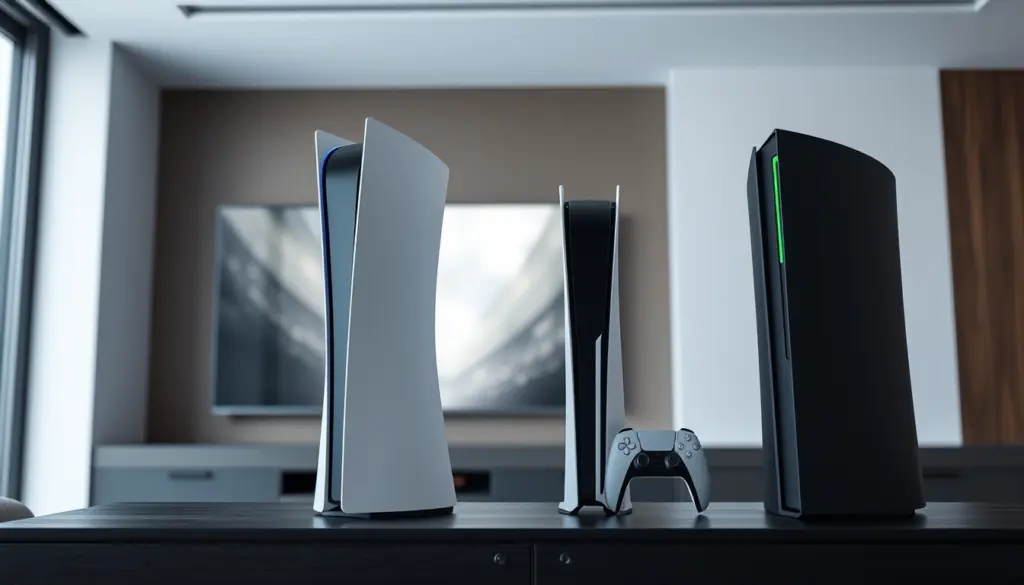
Sony’s most powerful console yet now costs more than ever, and Microsoft’s flagship is about to close some of the price gap from the wrong direction. A PS5 Pro vs Xbox Series X purchase decision in 2026 comes down to a widening price spread, two fundamentally different upscaling philosophies, and a console generation that keeps getting more expensive instead of cheaper as it ages. The PS5 Pro’s $899.99 price tag – the result of a second U.S. price increase in under a year – currently sits $250 above the Xbox Series X’s $649.99, and that gap is set to shrink on August 1, 2026, when Microsoft raises the Series X to $799.99. This comparison, part of our broader gaming hardware coverage, breaks down the verified specs, current 2026 pricing across every SKU, Digital Foundry benchmark results from four major 2026 releases, subscription costs, and backward-compatibility tradeoffs, so the decision rests on numbers rather than marketing copy. The short version: the PS5 Pro’s 60 compute units and 16.7 teraflops of GPU compute put it roughly 37% ahead of the Xbox Series X’s 12.15 teraflops on paper – but raw compute is not the whole story, and Digital Foundry’s own game-by-game testing shows the Xbox Series X still wins some head-to-head matchups outright.
PS5 Pro vs Xbox Series X: Full Specs Comparison
Both consoles share the same CPU family, which makes the specs comparison unusually clean: this is a story about GPU architecture and memory design, not processing generations. The PS5 Pro uses an eight-core, sixteen-thread AMD Zen 2 chip clocked up to 3.5GHz, officially unchanged from the base PS5 that launched in 2020. The Xbox Series X runs the same core count and architecture at a slightly higher 3.8GHz (3.66GHz with simultaneous multithreading enabled). Neither console has moved to a newer CPU architecture since the generation began, which is why neither manufacturer markets this generation as a CPU upgrade – the entire pitch on both sides is graphics.
Where the two diverge sharply is the graphics processor. Sony describes the PS5 Pro’s GPU as a hybrid architecture, combining RDNA 2 and RDNA 3 elements with custom machine-learning enhancements, rather than a straightforward jump to a newer AMD architecture generation – some lower-quality aggregators mislabel it as a flat “RDNA 3” or “RDNA 3.5” part, but Sony’s own technical breakdown, presented by lead architect Mark Cerny and detailed by TechRadar, describes the hybrid design specifically. That GPU delivers 60 compute units against the Xbox Series X’s 52, and 16.7 teraflops of compute versus 12.15 teraflops – a roughly 37% raw compute advantage for the PS5 Pro. Memory tells a similar story: the PS5 Pro pairs 16GB of GDDR6 with 2GB of DDR5 for system tasks (18GB total, with 576GB/s of bandwidth), while the Xbox Series X uses a 16GB GDDR6 pool split unevenly across two speed tiers – 10GB running at 560GB/s and 6GB at a slower 336GB/s, a quirk of its memory design developers have worked around since 2020.
Storage and I/O round out the differences. The PS5 Pro ships with a 2TB SSD against the Series X’s 1TB, and its expansion path uses a standard M.2 NVMe slot rather than Xbox’s proprietary expansion cards. The PS5 Pro also carries newer connectivity – Wi-Fi 7 and a USB-C front port – while the Xbox Series X is limited to Wi-Fi 5 (802.11ac) and offers no USB-C port at all, according to specs confirmed by GamingBolt. The full breakdown:
| Specification | PS5 Pro | Xbox Series X |
|---|---|---|
| Release date | November 7, 2024 | November 10, 2020 |
| Current U.S. price | $899.99 | $649.99 (rising to $799.99 Aug 1, 2026) |
| CPU | AMD Zen 2, 8-core/16-thread, up to 3.5GHz | AMD Zen 2, 8-core/16-thread, 3.8GHz (3.66GHz w/ SMT) |
| GPU architecture | Hybrid RDNA 2/RDNA 3 with custom ML enhancements | RDNA 2 |
| Compute units | 60 CU | 52 CU |
| GPU compute | 16.7 TFLOPS | 12.15 TFLOPS |
| System memory | 16GB GDDR6 + 2GB DDR5 (18GB total) | 16GB GDDR6 (10GB at 560GB/s + 6GB at 336GB/s) |
| Memory bandwidth | 576GB/s | 560GB/s (fast pool) |
| Internal storage | 2TB NVMe SSD | 1TB NVMe SSD |
| Expansion storage | Standard M.2 NVMe slot | Proprietary expansion card, 0.5–4TB |
| Optical drive | Detachable 4K UHD Blu-ray, sold separately (~$119.99) | Built-in 4K UHD Blu-ray |
| Upscaling | PSSR (dedicated ML silicon) | FSR (software only) |
| Ray tracing | Hardware-accelerated, 2–3x base PS5 | Hardware-accelerated, 2020-generation |
| Wi-Fi | Wi-Fi 7 | Wi-Fi 5 (802.11ac) |
| USB | USB-C front port | USB-A only, no USB-C |
| Dimensions | 388 × 89 × 216mm | 301 × 151 × 151mm |
| Weight | 3.1kg | 4.46kg |
| Power draw (gaming) | ~215–225W | ~150–220W |
One notable asymmetry: the Xbox Series X includes its 4K Ultra HD Blu-ray drive in the box, while the PS5 Pro’s optical drive is a detachable accessory sold separately for roughly $119.99. Buyers who want physical media on PS5 Pro are paying an effective premium on top of the console’s already-higher price – a detail that matters more with Sony ending physical disc production entirely by January 2028.
GPU Power and Ray Tracing: Where the PS5 Pro Pulls Ahead
The 37% compute gap between the PS5 Pro’s 16.7 teraflops and the Xbox Series X’s 12.15 teraflops is the single number Sony leans on hardest in its PS5 Pro marketing, and it is real – but teraflops measure theoretical peak throughput, not how a game actually renders. The more consequential difference is what each console does with ray tracing. Mark Cerny has described the PS5 Pro’s ray-tracing hardware as processing intersection tests two to three times faster than the base PS5, according to TechRadar’s technical breakdown of the console. The Xbox Series X, by contrast, still runs 2020-generation ray-tracing hardware that has not changed since launch, which increasingly shows in titles that lean on reflections, global illumination, or dense shadow work.
That gap explains why most PS5 Pro-enhanced games choose to spend their extra compute budget on ray tracing rather than raw resolution. Sony’s Pro-enhanced patches typically hold a target frame rate – usually 60fps – while enabling ray-traced reflections or lighting that the base PS5 and Xbox Series X either disable entirely or run at a lower internal resolution to sustain. Digital Foundry’s testing of Capcom’s Pragmata is the clearest example so far: the PS5 Pro version locks a ray-traced 60fps with what Digital Foundry called “vastly superior image quality” compared to both the base PS5 and Xbox Series X versions of the same game.
None of this means the Xbox Series X is falling behind across the board. Its higher CPU clock speed (3.8GHz versus the PS5 Pro’s 3.5GHz) occasionally shows up as steadier frame pacing in CPU-bound scenes, and its single, unified approach to memory bandwidth can behave more predictably in engines that were not specifically optimized around Sony’s split memory architecture. The compute advantage is real and measurable, but it is a ceiling the PS5 Pro can reach in well-optimized, Pro-patched titles – not a guarantee that every game runs proportionally faster.
PSSR vs FSR: The Upscaling Battle
The most consequential architectural difference between these two consoles has nothing to do with teraflops. The PS5 Pro includes dedicated machine-learning silicon that runs Sony’s PlayStation Spectral Super Resolution, or PSSR – an AI-driven upscaling system built specifically to reconstruct a lower internal render resolution up to a sharper 4K output, similar in concept to Nvidia’s DLSS on PC. The Xbox Series X has no equivalent dedicated ML hardware. It relies on AMD’s FidelityFX Super Resolution (FSR), a software-based upscaler that runs on the same general-purpose compute units doing the rest of the rendering work, rather than on separate silicon built for the job.
In practice, that hardware difference is why the PS5 Pro can push ray tracing and higher internal resolutions simultaneously in ways the Xbox Series X struggles to match – the reconstruction step is nearly free on PS5 Pro because it happens on dedicated silicon, while FSR competes for the same compute budget as everything else Series X is rendering that frame. Sony has now patched or shipped more than 100 titles with dedicated “PS5 Pro Enhanced” support, according to TechRadar, including 007: First Light, Alan Wake 2, and Assassin’s Creed Shadows, with newer additions like Saros and the upcoming Marvel’s Wolverine expected to lean on PSSR from launch rather than receiving it as a later patch.
The catch for PS5 Pro buyers is that this advantage is opt-in per game. A title without a PS5 Pro patch runs identically to how it runs on a base PS5 – the extra GPU hardware and PSSR silicon sit unused unless a developer specifically targets them. Xbox Series X owners do not face this problem in the same way, because FSR, where a developer chooses to implement it at all, behaves consistently across the whole Xbox Series X|S family rather than requiring console-specific enhancement work. It is a tradeoff between a higher ceiling that requires developer buy-in (PS5 Pro) and a more consistent, lower ceiling that does not (Xbox Series X).
2026 Pricing: What Each Console Costs After the Latest Hikes
Pricing is where the PS5 Pro vs Xbox Series X comparison gets genuinely messy, because both companies have raised prices multiple times since 2025 and are doing so again within weeks of each other. Sony has now increased PS5 hardware prices twice in under a year: a first round in August 2025, followed by a second increase on April 2, 2026, that pushed the PS5 Pro from $749.99 to $899.99 – a $150 jump – while the standard PS5 disc console rose from $549.99 to $649.99 and the Digital Edition rose from $499.99 to $599.99. The PlayStation Portal remote player also rose $50, to $249.99. Sony’s official announcement, posted to the PlayStation Blog, attributed the increase to “continued pressures in the global economic landscape” – language that mirrors the memory-chip shortage driving a broader 2026 console sales slowdown across the industry.
Microsoft’s turn comes next. The Xbox Series X currently sells for $649.99 (disc) or $599.99 (all-digital), prices that already reflect an October 2025 increase from the console’s original 2020 launch prices. On June 25, 2026, Microsoft announced a second round of increases effective August 1, 2026: the Series X disc model rises to $799.99 and the all-digital model to $749.99, both $150 increases. Xbox Series S climbs too – the 512GB model goes from $399.99 to $499.99, and the 1TB model from $449.99 to $599.99. The Xbox Series X 2TB “Galaxy Black” special edition, currently $799.99, is being discontinued entirely rather than repriced. Microsoft’s official reasoning cites storage and memory component costs that have risen more than 2.5x, warning of another possible doubling by fall 2027.
| Console / SKU | Price Before Latest Hike | Current or Upcoming Price | Effective Date |
|---|---|---|---|
| PS5 Digital Edition | $499.99 | $599.99 | April 2, 2026 |
| PS5 (disc) | $549.99 | $649.99 | April 2, 2026 |
| PS5 Pro | $749.99 | $899.99 | April 2, 2026 |
| PlayStation Portal | $199.99 | $249.99 | April 2, 2026 |
| Xbox Series S 512GB | $399.99 | $499.99 | August 1, 2026 |
| Xbox Series S 1TB | $449.99 | $599.99 | August 1, 2026 |
| Xbox Series X All-Digital | $599.99 | $749.99 | August 1, 2026 |
| Xbox Series X (disc) | $649.99 | $799.99 | August 1, 2026 |
| Xbox Series X 2TB Galaxy Black | $799.99 | Discontinued | August 1, 2026 |
The net effect: by August 2026, every current-generation console from both companies will cost more than it did at the start of 2025, and the PS5 Pro vs Xbox Series X price gap narrows from $250 today to $100 once the Series X disc model hits $799.99. Both companies have introduced buy-now-pay-later financing and certified-refurbished discount programs to soften the impact – a tacit admission that these are not small increases for most buyers.
Storage and Expansion: NVMe vs Proprietary Cards
Both consoles ship with fast, generation-appropriate SSDs, but how you add more space diverges completely. The PS5 Pro’s internal 2TB drive already doubles the Xbox Series X’s 1TB, and when it fills up – which happens quickly with modern install sizes regularly exceeding 100GB per game – PS5 Pro owners can add capacity using any compatible M.2 NVMe SSD that meets Sony’s minimum sequential-read requirement. These drives are commodity PC components, widely available from Western Digital, Samsung, Crucial, and other manufacturers, and prices have historically undercut first-party accessories once a drive clears Sony’s speed bar.
Xbox Series X owners do not have that option. Microsoft’s expansion path requires a proprietary card that plugs directly into a rear port sized specifically for it – no generic NVMe drive will work. These cards have consistently carried a price premium over equivalent-capacity standard SSDs precisely because they are a single-supplier product with no commodity alternative. That premium is compounded by the memory-chip shortage driving 2026’s broader console price increases: expansion storage, like the consoles themselves, has gotten more expensive across the board, and Xbox owners have no way to shop around the way PS5 Pro owners can.
Storage pressure also compounds differently depending on which Xbox Series X SKU a buyer picks. The all-digital 1TB model has no disc drive to fall back on, so every game purchase – often 80 to 150GB for modern AAA titles – eats directly into that single terabyte with no physical-media offset. PS5 Pro owners face the same digital bloat for digital purchases, but starting from double the base capacity and with a cheaper path to expand it, the storage math consistently favors Sony’s console for buyers who install more than a handful of large games at once.
Backward Compatibility: Xbox’s Quiet Advantage
This is the category where the Xbox Series X wins outright, and it rarely comes up in PS5 Pro vs Xbox Series X comparisons that focus purely on teraflops. Microsoft has spent years building a backward-compatibility program that lets the Series X natively run thousands of original Xbox, Xbox 360, and Xbox One titles, many enhanced with FPS Boost (which raises older games’ frame rates, sometimes doubling or quadrupling them) and Auto HDR (which adds high-dynamic-range lighting to games that never shipped with it). A Series X owner with an old disc collection, or games already purchased digitally on a previous Xbox generation, can generally expect them to simply work – often looking and running better than they did on original hardware.
Sony’s approach is narrower. The PS5 Pro plays PS4 titles natively, which covers the most recent generation, but reaching further back into PS1, PS2, or PS3 libraries requires a PlayStation Plus Premium subscription, which streams or emulates a curated catalog rather than running purchased discs or downloads directly. It is a smaller library, gated behind an ongoing subscription cost, rather than a standing feature of owning the hardware.
For a buyer with no console history – someone picking a first “real” console in 2026 – this difference matters less. But for anyone weighing a PS5 Pro vs Xbox Series X decision who already owns a stack of Xbox 360 or Xbox One discs, or a digital library tied to an existing Microsoft account, the Series X’s backward compatibility is effectively free value a PS5 Pro cannot replicate without an additional monthly subscription.
Digital Foundry Benchmarks: Four Games Tested Head-to-Head
Specs sheets only go so far – the more useful evidence comes from side-by-side testing of actual shipping games. Digital Foundry, the technical-analysis outlet best known for its console and PC benchmark breakdowns, has tested a run of 2026 releases across PS5, PS5 Pro, and Xbox Series X, and the results do not point in one consistent direction.
Capcom’s Pragmata is the PS5 Pro’s strongest showing to date: Digital Foundry found the PS5 Pro version locks a ray-traced 60fps with what the outlet described as “vastly superior image quality” next to both the base PS5 and Xbox Series X versions, which compromise on either resolution or ray-tracing fidelity to hit comparable frame rates. That is the PSSR-and-extra-compute advantage working as intended.
The Assassin’s Creed Unity remaster tells a more mixed story. Digital Foundry measured the Xbox Series X running at a native 2880×1620, a higher resolution than the PS5 Pro’s 2304×1296 – a genuine win for Microsoft’s console on raw pixel count. The PS5 Pro countered with a more consistent 60fps, meaning neither console cleanly “wins” the comparison; it depends whether a player prioritizes resolution or frame-rate stability.
Obsidian’s The Outer Worlds 2 is the clearest Xbox Series X win of 2026 so far, and worth highlighting precisely because it cuts against the narrative that the PS5 Pro automatically wins every cross-platform comparison. Digital Foundry found the Xbox Series X port outperformed both the base PS5 and the PS5 Pro, with the PlayStation versions suffering image breakup, lower resolution, and frame-rate drops specifically in performance mode – a reminder that a stronger GPU on paper does not guarantee a better-optimized port for every studio’s engine.
Obsidian’s earlier release Avowed rounds out the set, though with a caveat: Digital Foundry’s comparison there centered on the base PS5 rather than a PS5 Pro-specific patch, showing the standard PS5 with a slight edge in higher-frame-rate mode thanks to a more refined VRR implementation, while the Xbox Series X delivered what Digital Foundry called “a little sharper” visuals in general play. Independent verdicts from other outlets line up with the overall pattern: TechRadar’s side-by-side testing and Trusted Reviews’ comparison both describe the PS5 Pro as the more powerful machine on balance, while stopping short of calling it a clean sweep. The table below summarizes all the results.
| Game / Comparison | Result | Source |
|---|---|---|
| Pragmata | PS5 Pro locks ray-traced 60fps w/ PSSR; “vastly superior image quality” vs base PS5 & Series X | Digital Foundry |
| Assassin’s Creed Unity remaster | Series X native 2880×1620 beats PS5 Pro’s 2304×1296; PS5 Pro’s 60fps more consistent | Digital Foundry |
| The Outer Worlds 2 | Xbox Series X port outperforms PS5 AND PS5 Pro; PlayStation versions show image breakup, lower res, frame drops in performance mode | Digital Foundry |
| Avowed | Base PS5 slight edge in high-fps mode (VRR); Series X “a little sharper” overall | Digital Foundry |
| PS5 Pro Enhanced titles | 100+ titles patched w/ PSSR/RT upgrades (007: First Light, Alan Wake 2, AC Shadows) | TechRadar |
| Overall verdict | PS5 Pro described as “unambiguously the more powerful machine” on balance, not a clean sweep per-title | Trusted Reviews |
Subscriptions Compared: Game Pass Ultimate vs PlayStation Plus Premium
Neither console is a one-time purchase in practice. Both platform holders have built their post-launch strategy around subscription services, and both raised subscription prices in the same April-to-May 2026 window as their hardware price increases – making the total cost of ownership question more complicated than just comparing console MSRPs.
Xbox Game Pass Ultimate is the console’s headline subscription tier: full access to the Game Pass library across console, PC, and cloud, plus day-one access to most first-party Xbox releases. It briefly rose roughly 50% in late 2025 before backlash prompted the newly installed Xbox gaming CEO, Asha Sharma, to cut the price back to $22.99 a month on April 21, 2026, alongside a PC-only tier cut to $13.99. One meaningful change survived the rollback: new Call of Duty releases no longer join Game Pass Ultimate on day one, instead arriving roughly a year after launch – a real reduction in value even at the lower price.
Sony’s PlayStation Plus Premium raised prices on May 20, 2026, alongside its Essential and Extra tiers – the second such increase in three years, according to TweakTown’s coverage of the change. Essential rose to $10.99 a month, Extra to $16.99, and Premium to $19.99, with Sony citing the same DRAM and SSD cost pressures behind the hardware price increases. Critically, the increases apply only to monthly and three-month plans; annual subscriptions were left untouched, meaning a PS Plus Premium subscriber who commits to a full year still pays $159.99, a meaningfully better per-month rate than paying monthly.
| Subscription Tier | Monthly Price | Annual Price | Key Detail |
|---|---|---|---|
| Xbox Game Pass Essential | $9.99 | – | Cloud + online multiplayer, limited library |
| Xbox Game Pass Premium | $14.99 | – | Expanded library (formerly “Standard”) |
| Xbox Game Pass for PC | $13.99 | – | PC only, no console/cloud access |
| Xbox Game Pass Ultimate | $22.99 | – | Full console+PC+cloud; new CoD delayed ~1yr |
| PS Plus Essential | $10.99 | $79.99 | Online multiplayer, monthly games |
| PS Plus Extra | $16.99 | $134.99 | Adds game catalog (400+ titles) |
| PS Plus Premium | $19.99 | $159.99 | Adds PS1-3 classics catalog, game trials |
Comparing the two flagship tiers directly, Game Pass Ultimate’s $22.99 monthly rate costs more than PS Plus Premium’s $19.99, but the value proposition differs: Game Pass Ultimate includes day-one access to new first-party releases (minus Call of Duty, now delayed a year), while PS Plus Premium’s day-one first-party catalog is thinner – Sony has generally kept its biggest exclusives, including its expected 2026 releases, out of the subscription entirely at launch.
Estimating Total Cost of Ownership
Console MSRP is only part of the real cost of either platform. Factoring in a subscription over a typical two-year ownership window changes the comparison meaningfully, especially once the Xbox Series X’s August 2026 price increase is included. The illustrative calculation below uses the verified 2026 U.S. prices covered throughout this comparison – it is a simple estimate, not an official calculator from either company, and it excludes game purchases, which vary enormously by player.
# Illustrative 24-month cost estimate (console + top subscription tier)
# All figures are verified current 2026 U.S. MSRP, not an official calculator.

ps5_pro_console = 899.99
ps_plus_premium_month = 19.99

xbox_series_x_now = 649.99          # current price, before Aug 1, 2026 hike
xbox_series_x_post_hike = 799.99    # effective August 1, 2026
game_pass_ultimate_month = 22.99

months = 24

ps5_total = ps5_pro_console + (ps_plus_premium_month * months)
xbox_total_now = xbox_series_x_now + (game_pass_ultimate_month * months)
xbox_total_post_hike = xbox_series_x_post_hike + (game_pass_ultimate_month * months)

print(f"PS5 Pro + PS Plus Premium, 24 months:  ${ps5_total:,.2f}")
print(f"Xbox Series X (current) + Game Pass Ultimate, 24 months:  ${xbox_total_now:,.2f}")
print(f"Xbox Series X (post-hike) + Game Pass Ultimate, 24 months:  ${xbox_total_post_hike:,.2f}")

# Output:
# PS5 Pro + PS Plus Premium, 24 months:  $1,379.75
# Xbox Series X (current) + Game Pass Ultimate, 24 months:  $1,201.75
# Xbox Series X (post-hike) + Game Pass Ultimate, 24 months:  $1,351.75
Even after Microsoft’s August 2026 increase, buying an Xbox Series X and subscribing to Game Pass Ultimate for two years comes out slightly cheaper than a PS5 Pro with PlayStation Plus Premium – though the gap shrinks to under $30 over two years once the post-hike Xbox price is used, down from roughly $180 at today’s pre-hike price. Buyers who skip the top-tier subscription entirely, or who commit to PS Plus Premium’s cheaper annual plan rather than paying monthly, will see meaningfully different numbers than this illustrative comparison.
Exclusive Games and the 2026 Library
The console-exclusivity landscape that used to make this an easy decision has been eroding for years, and 2026 is accelerating that trend rather than reversing it. The clearest example is Halo: Campaign Evolved, which launches on PS5 for the first time in the franchise’s history on July 28, 2026, ending roughly 25 years of Xbox exclusivity for Microsoft’s flagship franchise. It is not an isolated decision – it follows Forza titles, Indiana Jones and the Great Circle, and other former Xbox-first releases making their way to PlayStation, part of a broader multiplatform strategy under Xbox’s restructured leadership following significant 2026 studio layoffs and divestitures.
That does not mean exclusivity has disappeared. The PS5 Pro’s enhanced-title roster leans on games that remain PlayStation-first even if not permanently exclusive, and Sony continues to fund a larger slate of platform-exclusive first-party productions than Microsoft does in 2026 – a strategic difference dating back to Microsoft’s post-2020 decision to prioritize Game Pass subscriber growth over exclusivity as its primary competitive lever. Xbox’s counter-strategy is volume and access rather than exclusivity: Game Pass Ultimate’s several-hundred-title library, available day one on both console and PC, is designed to make the question “which exclusives does this console have” less relevant to the purchase decision than it was in previous console generations.
Grand Theft Auto VI is the biggest 2026 test of this dynamic, and notably a rare case of true day-one parity: Rockstar has confirmed simultaneous launch on both PS5/PS5 Pro and Xbox Series X|S on November 19, 2026, with no PC version at launch and no platform-exclusive content announced on either side. Rockstar has not published any PS5-Pro-versus-Series-X technical comparison for the game, and any specific frame-rate or resolution prediction circulating online ahead of launch should be treated as speculation rather than fact – a distinction worth making given how much unverified “which console runs GTA 6 better” content is already spreading ahead of the actual release.
Real-World Performance Examples
Beyond the Digital Foundry benchmark set, a handful of real-world patterns are worth calling out for anyone comparing these consoles ahead of an actual purchase, rather than just reading a spec sheet.
- PS5 Pro Enhanced patches consistently target 60fps with ray tracing enabled rather than pushing native 4K – Pragmata is the current best example, and Sony’s pattern across more than 100 enhanced titles suggests this will remain the template through 2026.
- Cross-platform engines do not automatically favor the more powerful console – The Outer Worlds 2 running better on Xbox Series X despite the PS5 Pro’s compute advantage shows engine optimization and a studio’s familiarity with a platform can outweigh raw hardware specs.
- Resolution and frame-rate priorities can split even within one game – Assassin’s Creed Unity’s remaster gives Xbox Series X the resolution win and PS5 Pro the frame-rate-consistency win simultaneously, with no single “better” answer.
- Franchise-defining exclusives are moving cross-platform – Halo: Campaign Evolved’s PS5 debut on July 28, 2026, means the “which console has the better exclusives” calculus is measurably different in 2026 than it was even a year earlier.
- The biggest 2026 release treats both consoles identically – GTA VI’s simultaneous November 19, 2026, launch on PS5 Pro and Xbox Series X|S, with no platform-exclusive content, is the strongest signal yet that publishers are optimizing for reach over platform-specific showcases.
Taken together, these examples argue against treating the PS5 Pro’s teraflops advantage as a reliable predictor of how any specific game will perform. It is a real and repeatedly demonstrated ceiling – Pragmata proves that – but Digital Foundry’s own testing shows that ceiling is not always reached, and is sometimes beaten outright by a well-optimized Xbox Series X port. Buyers chasing the best possible experience for a specific upcoming title are better served checking whether Digital Foundry, or a similarly rigorous outlet, has already tested that game on both consoles, rather than assuming the PS5 Pro’s on-paper compute lead automatically translates into a better experience in every release.
Who Should Buy the PS5 Pro
The PS5 Pro’s $899.99 price only makes sense for specific buyers, not as a general-purpose recommendation over the cheaper Xbox Series X. It earns its price for a narrower set of use cases:
- Buyers already invested in PlayStation’s exclusive lineup – anyone with an existing PSN library, trophies, and save data tied to Sony’s first-party franchises gets the most direct value from staying in that ecosystem at the higher hardware tier.
- Enthusiasts chasing the best possible image quality in supported titles – the PSSR-and-ray-tracing combination in Pro-enhanced games like Pragmata is a genuine, measurable step up that the Xbox Series X’s software-only FSR cannot match in those specific titles.
- Anyone planning to expand storage repeatedly over the console’s lifespan – the ability to buy any qualifying commodity NVMe SSD rather than a proprietary Xbox expansion card adds up over a five-to-seven-year console generation.
- 4K-television owners who want the newest connectivity standards – Wi-Fi 7 and USB-C are meaningfully more future-proof than the Xbox Series X’s Wi-Fi 5 and USB-A-only setup, particularly for anyone streaming 4K content over wireless.
- Buyers who already own the separate 4K Blu-ray drive or do not care about physical media – the drive’s ~$119.99 separate cost is a real deduction from the PS5 Pro’s value proposition for anyone who still buys discs.
What the PS5 Pro is not well suited for is budget-conscious buyers, or anyone without a strong existing preference for PlayStation’s exclusive catalog. At $899.99, it costs more than most gaming PCs capable of similar or better performance, and the gap to the Xbox Series X – even after Microsoft’s August price increase – remains at least $100.
Who Should Buy the Xbox Series X
The Xbox Series X’s case is built on value and software ecosystem rather than raw hardware superiority, and it holds up well for a different set of buyers:
- Game Pass subscribers who prioritize library size over peak visual fidelity – several hundred titles available day one, across console, PC, and cloud, for $22.99 a month is a fundamentally different value calculation than paying full price per game.
- Buyers with an existing Xbox 360 or Xbox One library – native backward compatibility with FPS Boost and Auto HDR enhancements means old purchases keep working and often look better than they did originally, at no extra cost.
- Households that want one box for games and 4K movies without buying accessories – the built-in Ultra HD Blu-ray drive avoids the PS5 Pro’s separate ~$119.99 optical-drive purchase.
- PC and Xbox cross-platform players – Xbox Play Anywhere titles and shared Game Pass entitlements between console and PC give Series X owners more flexibility about where they actually play a given title.
- Anyone prioritizing price over peak specs – even after the August 1, 2026, increase to $799.99, the Series X remains $100 cheaper than the PS5 Pro, and today’s pre-hike $649.99 price is $250 cheaper.
- Competitive and multiplayer-focused players – Xbox’s large installed base and cross-play infrastructure, combined with Game Pass’s inclusion of major live-service and multiplayer titles, suit players whose priority is who they can play with rather than single-player visual fidelity.
The clearest case against the Xbox Series X is for buyers chasing best-in-class visuals in supported titles, or anyone who has already decided PlayStation’s exclusive lineup matters more to them than price – no amount of Game Pass value changes the PS5 Pro’s hardware and PSSR advantage in the specific games built to use it.
Switching Consoles: A Migration Guide for Players
Moving from one ecosystem to the other is not as simple as plugging in a new box – PlayStation and Xbox do not share save data, purchased-game libraries, or account systems, and there is no first-party tool that migrates a library between them. Anyone weighing a switch as part of a PS5 Pro vs Xbox Series X decision should plan around a handful of concrete gaps.
What does not transfer
- Digital game purchases. Titles bought on the PlayStation Store do not carry over to the Xbox Store, and vice versa – even for the same game, a new copy has to be purchased on the new platform.
- Save data and trophies/achievements. PlayStation Trophies and Xbox Achievements are platform-locked, and most single-player save files have no cross-platform sync unless a specific publisher built one in.
- Controllers. A DualSense controller does not work as a full-featured Xbox controller and an Xbox controller is not natively supported on PS5 hardware – both platforms use proprietary wireless protocols alongside Bluetooth.
- Storage expansion hardware. A PS5 Pro’s M.2 NVMe expansion drive cannot be reused in an Xbox Series X, and Xbox’s proprietary expansion cards are equally useless on PlayStation hardware – though a PS5’s standard NVMe drive can at least be repurposed in a PC afterward.
What actually does carry over
The real migration path runs through individual publishers rather than the platform holders. Games with their own account systems – Fortnite, Rocket League, Call of Duty, Genshin Impact, and similar live-service titles – typically support cross-progression through the publisher’s own login (an Epic Games account, an Activision account, and so on), independent of whether the underlying hardware is PlayStation or Xbox. Anyone planning a switch should check, title by title, whether the games they care about most support this kind of publisher-level account linking before assuming progress will be lost.
Subscriptions do not transfer either – a PlayStation Plus Premium subscription has no Xbox equivalent credit, and Game Pass Ultimate does not partially refund into a PS Plus purchase. Anyone switching should treat the two as fully separate ongoing costs and budget accordingly, factoring in whichever subscription price applies after the 2026 increases covered above.
Pros and Cons: PS5 Pro vs Xbox Series X
PS5 Pro
Pros:
- 37% more GPU compute (16.7 vs 12.15 teraflops) and 60 vs 52 compute units
- PSSR hardware upscaling with no Xbox Series X equivalent
- Ray-tracing hardware two to three times faster than base PS5
- 2TB internal storage, double the Xbox Series X
- Standard, commodity-priced M.2 NVMe expansion storage
- Wi-Fi 7 and USB-C, both newer than Xbox Series X’s connectivity
- Stronger 2026 first-party exclusive slate
Cons:
- $899.99 price is the highest of any current-generation console
- Second U.S. price increase in under a year, with no signal hikes are over
- 4K Blu-ray drive sold separately for roughly $119.99
- PS1-3 backward compatibility requires an ongoing PlayStation Plus Premium subscription
- PSSR and Pro-specific enhancements only benefit patched titles, not the full library
Xbox Series X
Pros:
- $649.99 current price, $250 cheaper than PS5 Pro (narrowing to $100 after August 1, 2026)
- Built-in 4K Ultra HD Blu-ray drive, no separate purchase required
- Deep native backward compatibility across Xbox, 360, and One libraries with FPS Boost and Auto HDR
- Game Pass Ultimate’s day-one library of several hundred titles
- Higher CPU clock speed (3.8GHz vs 3.5GHz)
Cons:
- 2020-generation ray-tracing hardware with no PS5 Pro-equivalent refresh
- No dedicated ML upscaling hardware – FSR runs on shared compute
- Proprietary, historically pricier expansion storage cards
- Wi-Fi 5 only, no USB-C port
- Also rising in price, to $799.99, on August 1, 2026
- New Call of Duty releases no longer included in Game Pass Ultimate at launch
The Verdict: Which Console Wins in 2026?
There is no single winner in a PS5 Pro vs Xbox Series X comparison – the data points in two different directions depending on what a buyer actually optimizes for, and treating this as a simple “which is better” question misrepresents how close the real-world results are.
On raw specifications, the PS5 Pro wins clearly: 60 compute units against 52, 16.7 teraflops against 12.15 (a 37% gap), dedicated PSSR upscaling hardware the Xbox Series X simply does not have, and ray-tracing hardware Sony claims is two to three times faster than the base PS5’s. Digital Foundry’s Pragmata testing backs that up directly – a locked ray-traced 60fps with image quality the outlet called “vastly superior” to both competing versions. If the goal is the single most powerful console available today at any price, the PS5 Pro is that console.
On value, the Xbox Series X wins just as clearly. It costs $649.99 today against the PS5 Pro’s $899.99 – a $250 gap – and even after Microsoft’s own August 1, 2026, price increase to $799.99, a $100 gap remains. Factor in the included 4K Blu-ray drive (versus the PS5 Pro’s separate ~$120 purchase), native backward compatibility with two prior console generations, and a Game Pass Ultimate library that undercuts buying games individually, and the Series X’s total cost of ownership advantage extends well past the console purchase itself.
On real-world performance specifically, neither console dominates. Digital Foundry’s own testing across four major 2026 releases split roughly evenly: PS5 Pro won decisively in Pragmata, Xbox Series X won decisively in The Outer Worlds 2, and Assassin’s Creed Unity’s remaster split the difference between resolution (Xbox) and frame-rate consistency (PS5 Pro). That inconsistency is the most important data point in this entire comparison – it means the PS5 Pro’s spec-sheet advantage does not reliably predict which console will run a given game better.
The practical recommendation: buy the PS5 Pro if raw power, PSSR-enhanced visuals, and PlayStation’s exclusive catalog matter more to you than $250 (or an eventual $100). Buy the Xbox Series X if value, library size through Game Pass, and backward compatibility matter more than peak graphical fidelity in a subset of enhanced titles. Both are consoles getting more expensive as 2026 goes on – the choice between them comes down to which tradeoff a specific buyer is actually willing to pay for.
Frequently Asked Questions
Is the PS5 Pro really more powerful than the Xbox Series X?
Yes, on paper. The PS5 Pro’s 60 compute units and 16.7 teraflops of GPU compute outpace the Xbox Series X’s 52 compute units and 12.15 teraflops by roughly 37%, and its dedicated PSSR upscaling hardware has no Xbox Series X equivalent. In practice, Digital Foundry’s game-by-game testing shows that advantage does not always translate to better real-world performance – the Xbox Series X has outperformed the PS5 Pro in at least one major 2026 release, The Outer Worlds 2.
How much does the PS5 Pro cost compared to the Xbox Series X in 2026?
The PS5 Pro costs $899.99 following an April 2, 2026, price increase. The Xbox Series X currently costs $649.99 (disc model), a $250 gap, but that narrows to $100 once Microsoft’s own August 1, 2026, price increase takes the Series X to $799.99.
Will the Xbox Series X get more expensive again in 2026?
Microsoft has already confirmed the next increase: the Series X disc model rises to $799.99 and the all-digital model to $749.99 on August 1, 2026, alongside price increases across the Xbox Series S lineup and the discontinuation of the 2TB Galaxy Black model. Microsoft has cited ongoing storage and memory component cost increases as the reason and has not ruled out further increases beyond this one.
Does the PS5 Pro come with a disc drive?
No. The PS5 Pro’s Ultra HD Blu-ray drive is a detachable accessory sold separately for roughly $119.99. The Xbox Series X includes its 4K Blu-ray drive in the box at no extra cost, which narrows the effective price gap for anyone who wants physical-media support.
Can I use my PS5 Pro save data or games on an Xbox Series X?
No. PlayStation and Xbox do not share accounts, save files, trophies, achievements, or purchased digital libraries, and neither company offers a first-party migration tool between platforms. Cross-progression only works on a per-game basis, through a publisher’s own account system, for titles that specifically support it – live-service games like Fortnite or Rocket League are the most common examples.
Which console has better backward compatibility?
The Xbox Series X, clearly. It natively runs thousands of original Xbox, Xbox 360, and Xbox One titles, many enhanced with FPS Boost and Auto HDR. The PS5 Pro plays PS4 games natively but requires an active PlayStation Plus Premium subscription to access a curated selection of PS1, PS2, and PS3 titles.
Is Xbox Game Pass Ultimate or PlayStation Plus Premium the better deal?
It depends on priorities. Game Pass Ultimate costs more per month ($22.99 versus $19.99) but includes a larger day-one library and most first-party Xbox releases at launch, except new Call of Duty titles, which now arrive roughly a year later. PS Plus Premium is cheaper monthly and offers a better annual rate ($159.99 a year, unchanged by the May 2026 increase), but Sony’s biggest first-party exclusives generally launch outside the subscription rather than inside it.
Will GTA 6 run better on PS5 Pro or Xbox Series X?
Nobody outside Rockstar knows yet, and any specific claim circulating online should be treated as speculation. Rockstar has confirmed GTA VI launches simultaneously on PS5/PS5 Pro and Xbox Series X|S on November 19, 2026, with no PC version at launch, but has not published any platform-specific technical comparison. Given how evenly Digital Foundry’s other 2026 benchmarks have split between the two consoles, assuming either one will clearly outperform the other before independent testing exists is not supported by the available evidence.
Related Coverage
- PS5 vs Xbox Series X: $649 Each, 91M vs 34M
- PS5 Pro vs PS5: $899 vs $649, 45% Faster
- Xbox Series X vs Series S: $649 vs $399, 4K vs 1440p
- PS5 Sales Crash 58% as Console Prices Surge
- GTA 6 Pre-Orders Live: $79.99, Console-Only
- Halo: Campaign Evolved Hits PS5 July 28, $49.99
- Xbox Layoffs: 3,200 Jobs Cut, 4 Studios Divested