

Top Data Center Virtualization Software for IT Teams in 2026
VMware’s Broadcom acquisition reshuffled IT budgets across the industry, and plenty of teams are still figuring out their next move. Licensing costs jumped sharply for a huge number of organizations, and that pressure pushed the search for alternatives into overdrive. This list covers the top data center virtualization software for IT teams in 2026 – from enterprise-grade hypervisors to open-source platforms – so teams can weigh real options against their actual workloads.
Why Virtualization Software Matters for Data Centers Right Now
Server sprawl used to be the main reason teams turned to virtualization. That’s still true. But the conversation has shifted, cost restructuring, hybrid cloud pressure, and tighter security requirements have turned the hypervisor layer into a strategic decision rather than a purely technical one.
Broadcom’s pricing changes after the VMware acquisition are a big part of why this matters right now. Some organizations reported licensing cost increases of up to tenfold compared to pre-acquisition rates, according to Sangfor’s own public analysis of the market. That’s not a marginal adjustment; it’s a forcing function that’s hard to ignore.
And it’s not just cost. IT teams are also looking for platforms that bundle security controls, storage management, and networking into one layer, rather than buying and managing each as a separate product. The platforms on this list reflect that shift.
What This List Looked at
Each platform was evaluated on four criteria: deployment model and hardware compatibility, built-in security and networking features, operational tooling for existing admin teams, and total cost of ownership relative to what organizations are replacing.
Vendor-reported figures, G2 ratings, Gartner Peer Insights data, and publicly available reviewer commentary on PeerSpot informed the comparisons. No pricing was invented, where list prices aren’t public, that’s noted directly.
1. Sangfor aSV Hypervisor
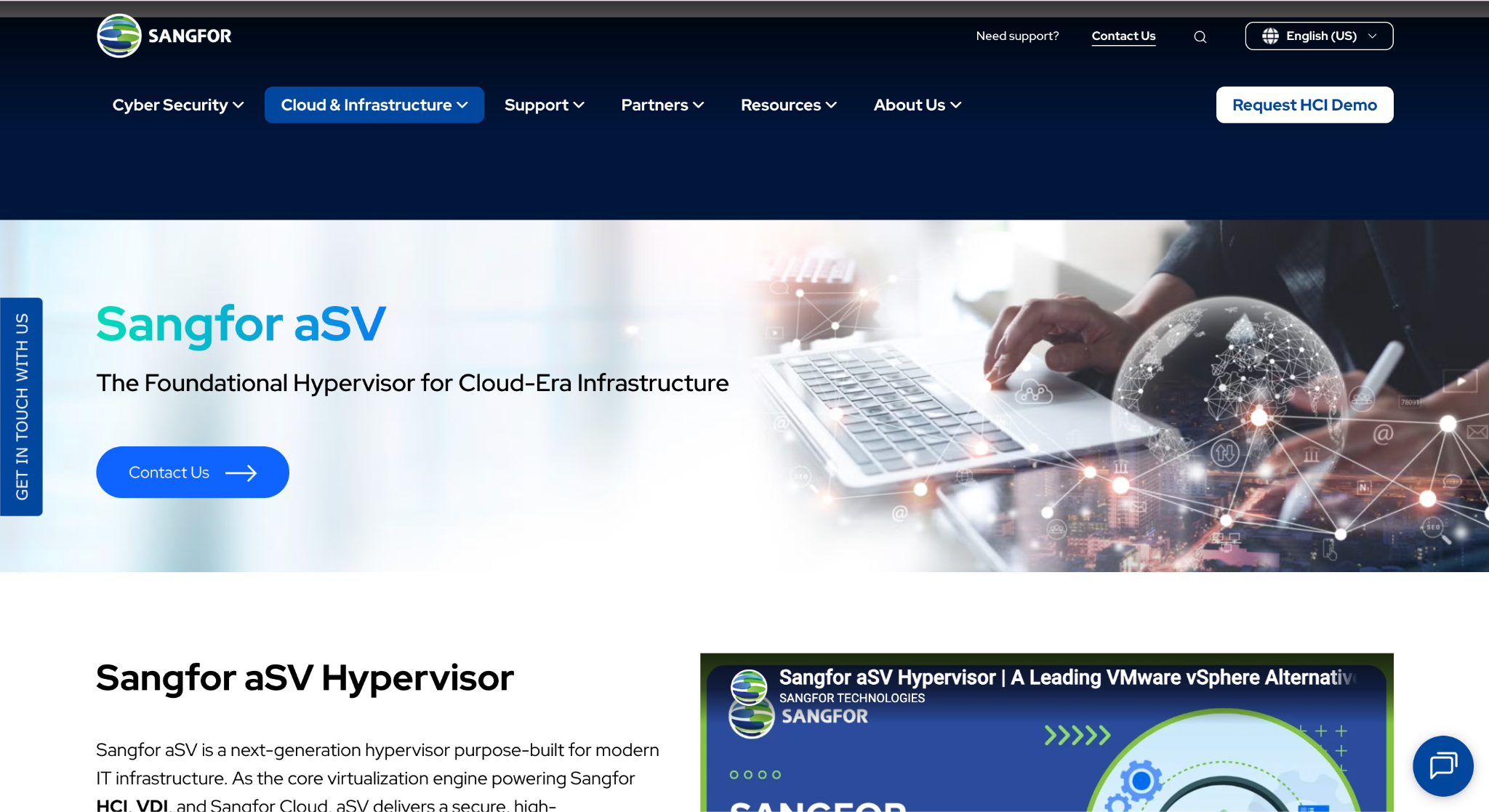
Sangfor aSV is a type-1, KVM-based bare-metal hypervisor from Sangfor Technologies, built as a VMware vSphere alternative for mid-market and large enterprises. It sits at the compute layer inside Sangfor’s Hyper-Converged Infrastructure stack and bundles networking (aNET), storage (aSAN), and security (aSEC) into a single license, so teams don’t need to separately purchase equivalents to VMware’s NSX or vSAN. The platform ships with over 230 PowerCLI-equivalent CLI commands, which means VMware admins can carry over existing automation scripts without rewriting them from scratch. Live migration completes with under 3 seconds of measured performance impact, and Proactive HA 2.0 flags likely node or VM failures before they cause actual outages.
On G2, Sangfor Cloud Platform holds a 4.7 out of 5 rating across 94 reviews, with Leader badges in both Server Virtualization and Hyperconverged Infrastructure for Summer 2026. Gartner Peer Insights gives the platform a 4.8 overall rating with 100% Willingness to Recommend across 23 verified enterprise reviews. Reviewer-reported cost savings versus VMware run between 30% and 40% on PeerSpot; Sangfor cites over 12,000 completed VMware migrations and 28,000+ cloud customers worldwide.
Features:
- Bundled networking, storage, and security in one hypervisor license
- 230+ PowerCLI-equivalent CLI commands for VMware admin continuity
- Proactive HA 2.0 with sub-3-second live migration
- Intelligent micro-segmentation and integrated WAF/IPS via aSEC
- Named a Representative Vendor in the 2025 Gartner Market Guide for Server Virtualization Platforms
2. Broadcom
Broadcom is one of the largest technology companies in the world, spanning semiconductors, enterprise software, and cybersecurity. In the virtualization space, its main offering is VMware Cloud Infrastructure, the platform most large enterprises have run for the past decade. After acquiring VMware, Broadcom restructured licensing toward bundled subscription tiers rather than the à la carte model that administrators were used to. That change works well for organizations with large, stable VMware deployments, but it’s a primary reason many IT teams are now evaluating alternatives. Broadcom’s software client base includes banks, insurance companies, government agencies, and global IT service providers. The company is headquartered in Palo Alto, California, and employs around 33,000 people.
Features:
- VMware Cloud Infrastructure (vSphere, vSAN, NSX) as a bundled platform
- Symantec cybersecurity tools integrated across the product portfolio
- Broad enterprise support network for large global deployments
- Fiber Channel and storage area network management tools
3. Nutanix
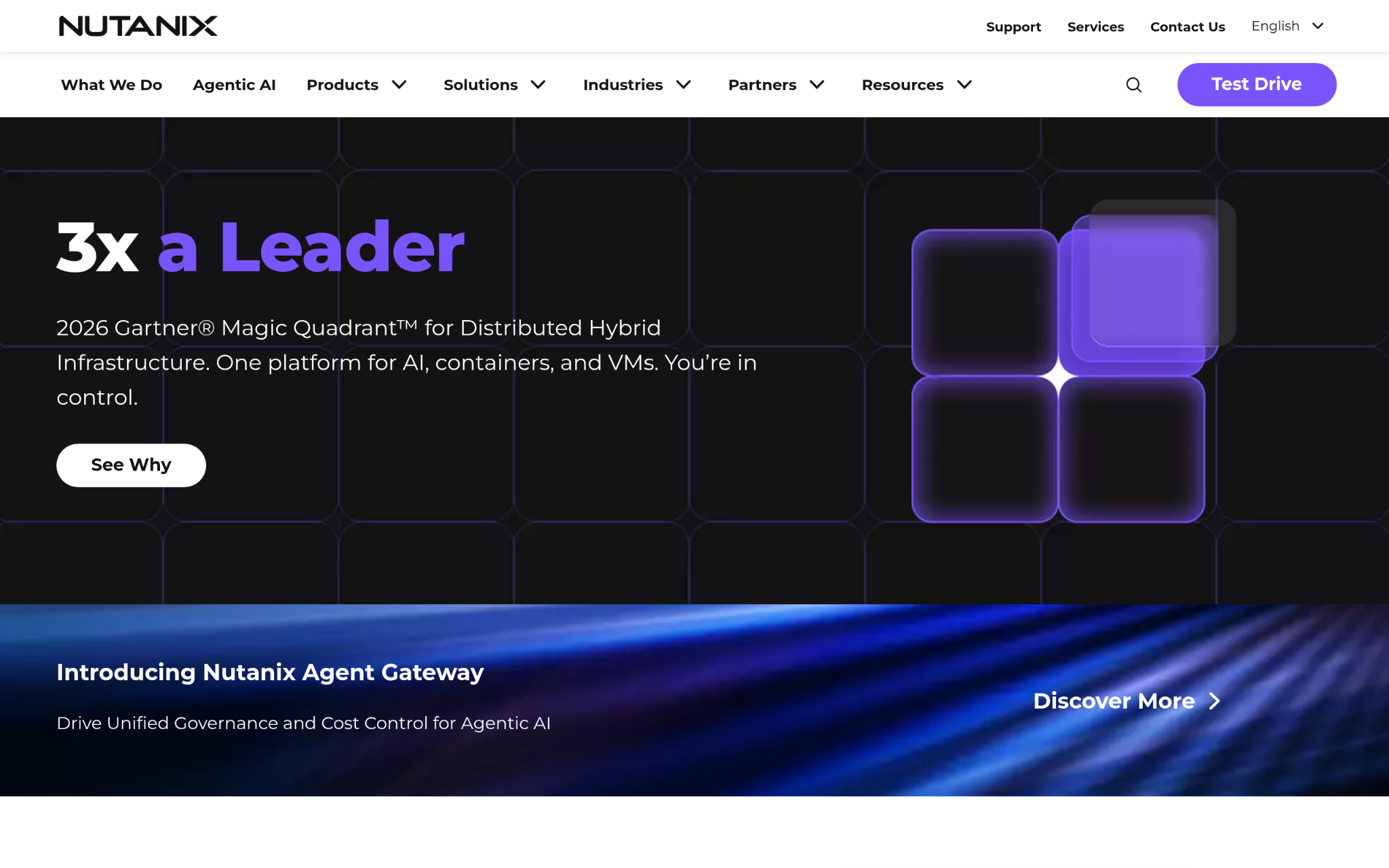
Nutanix is a San Jose-based cloud computing company, founded in 2009 and publicly traded on NASDAQ under NTNX, with roughly 7,800 employees. Its Cloud Platform pairs AOS storage with AHV virtualization, and the platform covers hybrid and multicloud deployments alongside Kubernetes, database-as-a-service, and software-defined networking. Nutanix was named a Leader in the 2026 Gartner Magic Quadrant for Server Virtualization Platforms, ranking highest in Execution, a meaningful data point for enterprise procurement teams. The platform suits organizations already building around a hybrid cloud architecture, though it requires a minimum node count for certain configurations and works from a more restricted certified hardware list than some competitors. So if you’re evaluating it, check that hardware list early. Nutanix also holds a Leader position in the 2026 Gartner Magic Quadrant for Distributed Hybrid Infrastructure.
Features:
- AHV hypervisor integrated with AOS distributed storage
- Nutanix Flow for software-defined networking and microsegmentation
- Nutanix Kubernetes Platform for containerized workloads
- Leader in the 2026 Gartner Magic Quadrant for Server Virtualization Platforms
4. Proxmox
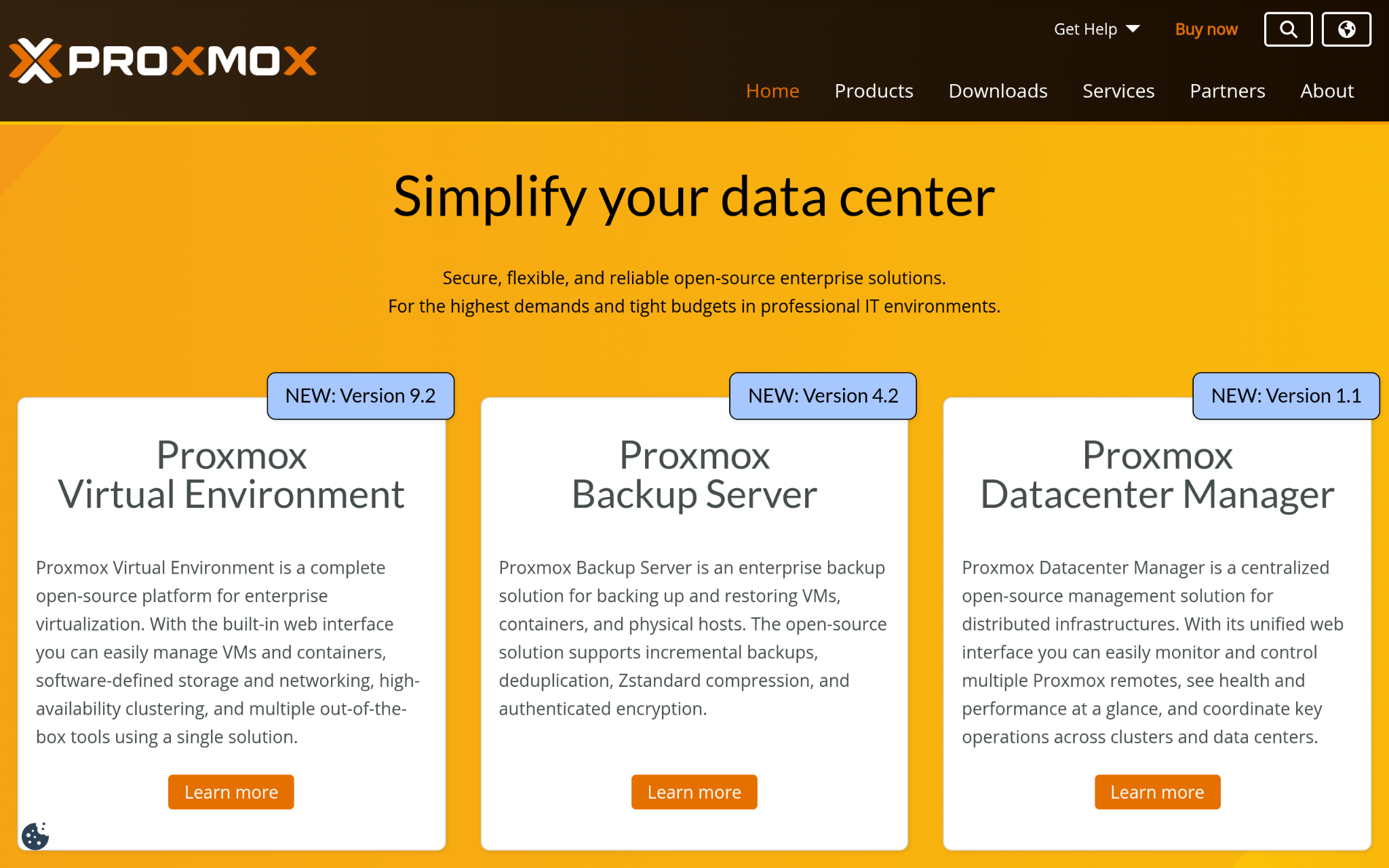
Proxmox Server Solutions GmbH was founded in February 2005 and is headquartered in Vienna, Austria, with 68 employees as of August 2026. Proxmox Virtual Environment (VE) was the first platform to combine KVM-based virtualization and LXC container-based virtualization in a single interface, and that architecture remains its clearest technical differentiator. The platform manages more than 1.5 million hosts globally, with documented customers including the European Space Agency, YouTube, and Northrop Grumman. Proxmox has partnerships with over 1,000 resellers across 142 countries, including hardware and software partners like NVIDIA and Veeam.
Here’s the thing, the full feature set is available without a paid commercial subscription, which matters a lot for teams that need to evaluate and test before committing budget. Proxmox is genuinely free and open source in a way most enterprise hypervisors aren’t; that makes it a strong pick for cost-constrained teams willing to handle more configuration themselves.
Features:
- Combines KVM virtualization and LXC containers in one interface
- Full feature access without a paid subscription
- Proxmox Backup Server for enterprise-grade backup
- Proxmox Datacenter Manager for centralized multi-site management
- 1.5+ million hosts managed globally
5. Red Hat
Red Hat, founded in 1993 and headquartered in Raleigh, North Carolina, is a subsidiary of IBM and employs approximately 19,000 people. Its virtualization offering sits inside a broader platform that includes Red Hat Enterprise Linux (RHEL), OpenShift Container Platform, and Ansible Automation Platform. Red Hat supports more than 90% of Fortune 500 companies, with customers across financial services, automotive, and the public sector. The focus in virtualization is on organizations that want to run workloads inside an open-source, container-first infrastructure, particularly teams already deep into Kubernetes and OpenShift. Red Hat was named a Leader in the 2026 Gartner Magic Quadrant for Cloud-Native Application Platforms for the third consecutive year, which reflects its positioning as an infrastructure modernization platform rather than a pure hypervisor replacement.
Features:
- Red Hat Enterprise Linux as a stable foundation for virtualized workloads
- OpenShift Container Platform for hybrid and multicloud Kubernetes deployments
- Ansible Automation Platform for infrastructure automation at scale
- Leader in the 2026 Gartner Magic Quadrant for Cloud-Native Application Platforms (3rd consecutive year)
Bottom Line
The right platform depends heavily on what a team is replacing and where they’re heading next. Teams migrating off VMware will find the most migration-specific tooling in platforms built explicitly for that transition. Open-source-friendly teams with strong internal Linux skills can get real mileage from Proxmox’s no-cost full feature set. Organizations running hybrid cloud and Kubernetes workloads at scale will lean toward Nutanix or Red Hat. Broadcom stays the default path for enterprises with large, stable VMware estates where the new licensing structure pencils out.
But honestly, there’s no single answer here. The top data center virtualization software for IT teams in 2026 all solve a genuine problem, the gap is in which problem each team is actually trying to solve.