
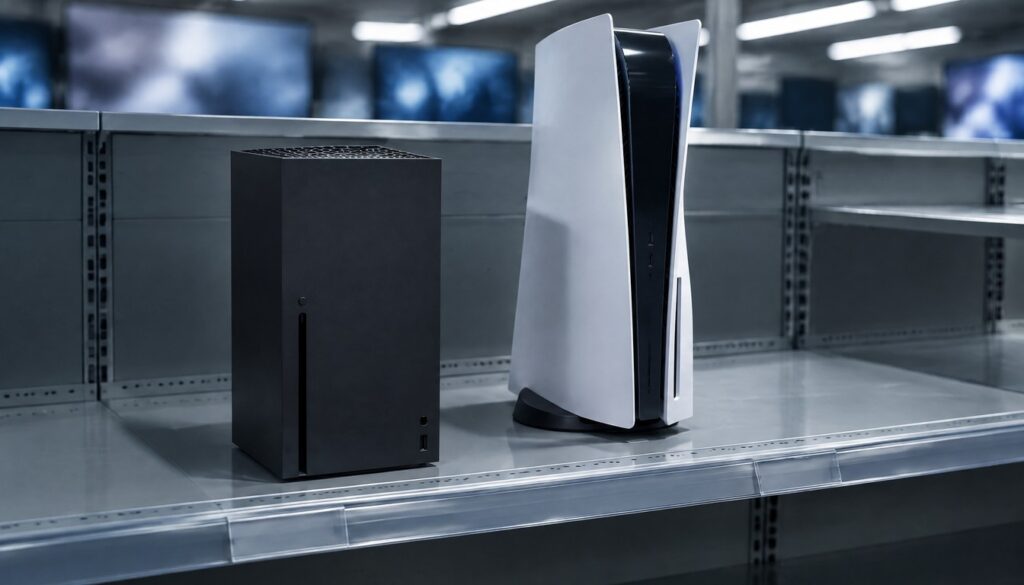
The US console market just posted its roughest year-to-date stretch in over a decade. Xbox hardware unit sales fell 33% year over year through August 2026, a record low for the platform in the United States, according to Tom’s Hardware, citing fresh figures from Circana’s US Retail Tracking Service. PlayStation hardware fared only somewhat better, down 25% over the same period and sitting at its weakest point since 2013. Both numbers landed alongside console prices that have climbed to all-time US highs, and the timing is no coincidence.
Mat Piscatella, the Circana analyst who tracks US game spending, shared the figures on Bluesky and summarized the mood in blunt terms through Video Games Chronicle: “For 2026 YTD ending August, Xbox hardware unit sales are down 33% versus a year ago in the US, while PlayStation hardware units are 25% lower.” Behind that one-line summary sits a market where two of the three console makers have pushed through multiple price hikes in a single calendar year, and buyers are visibly pulling back.
Xbox’s 33% Collapse Is an All-Time US Low
Xbox hardware has never posted a weaker year-to-date result in the US than what Circana logged through August 2026. A 33% drop against the same eight-month window in 2025 isn’t a seasonal blip, it’s the steepest sustained decline the brand has recorded since its 2001 launch, per the reporting bundled into Tom’s Hardware’s coverage of the Circana data. Microsoft has raised Xbox prices three times in roughly two years, and the latest round landed hard: the Series X disc model now lists at $799.99, a price hike that Microsoft pushed through effective August 1, 2026, according to TechPowerUp.
The Series S line took an even sharper hit on price. The 512GB model now sells for $499.99, roughly $100 more than its earlier price point, while the 1TB model sits at $599.99, about $150 higher than before. Microsoft also discontinued its 2TB Series S configuration entirely, narrowing the storage lineup right as prices climbed. The Series X Digital Edition rounds out the range at $749.99. None of these are small, one-time adjustments. Stacked together, they represent the most aggressive repricing of the Xbox lineup since the console launched.
What makes the 33% figure sting is that it isn’t a single bad month dragging down an otherwise stable average. Circana’s monthly breakdown for August 2026 alone shows Xbox unit sales down 31% year over year, meaning the brand’s decline has been consistent across most of the year rather than concentrated in one disastrous stretch. A console that’s merely expensive can still move units if shoppers are willing to pay up. A console that’s expensive and showing a sustained double-digit year-to-date decline is signaling something closer to buyer resistance.
PlayStation’s Weakest Stretch Since the PS4 Launch Wait
PlayStation’s 25% year-to-date decline doesn’t match Xbox’s freefall, but it’s still the platform’s softest US performance since 2013, the year shoppers were holding off purchases ahead of the PlayStation 4 launch. That’s a meaningful historical marker. 2013 was a deliberate pause: consumers knew a new generation was coming and waited for it. 2026 is different. The PS5 and PS5 Pro aren’t about to be replaced, yet buyers are stepping back anyway, and the price tag looks like the obvious reason.
Sony raised the PlayStation 5 Pro’s price back in April 2026, pushing it to $899.99, per TechPowerUp’s reporting on the Circana figures. The PlayStation Portal remote player climbed too, now listed at $249.99, up from its $199.99 launch price. Sony hasn’t discontinued any PS5 configurations the way Microsoft axed the 2TB Series S, but the direction of travel on price is identical: up, and by a wide margin, across nearly every SKU in the lineup.
Circana’s August-only snapshot shows PlayStation hardware down a comparatively milder 11% year over year that month, well below the 25% year-to-date figure. That gap suggests PlayStation’s decline has been uneven across 2026, with some months hitting harder than others, while Xbox’s drop has been more evenly spread across the year. Either way, both platforms are heading in the same direction, and neither is finding a floor.
Average Console Prices Hit Records in 2026
The headline unit-sales percentages only tell half the story. Circana also tracks the average price shoppers actually paid at checkout, and those figures are just as stark. Piscatella reported through VGChartz that “the average price a consumer has paid for a new Xbox console in 2026 YTD ending August is $529, 26% higher than a year ago, while the average PlayStation console has sold for $597, 20% higher than last year.” Both figures, he noted, sit at all-time US highs, adding: “Price sensitivity is becoming a real problem.”
Those averages blend across every SKU each brand sells, from entry-level digital editions to premium Pro models, so they capture more than a single list-price change. A $529 average Xbox transaction and a $597 average PlayStation transaction both represent meaningful jumps from where the market sat a year earlier, and they land during a period when real wages and discretionary spending haven’t moved anywhere near 20-26% higher for most US households.
| Console / SKU | Current US Price | Price Change | Effective Date |
|---|---|---|---|
| Xbox Series S (512GB) | $499.99 | +$100 (approx.) | 2026 |
| Xbox Series S (1TB) | $599.99 | +$150 (approx.) | 2026 |
| Xbox Series X Digital Edition | $749.99 | Raised in 2026 | 2026 |
| Xbox Series X (disc) | $799.99 | Price hike confirmed | August 1, 2026 |
| PlayStation 5 Pro | $899.99 | Price hike confirmed | April 2026 |
| PlayStation Portal | $249.99 | +$50 from launch price | 2026 |
| Nintendo Switch 2 | $499.99 | Price hike confirmed | September 2026 |
Average selling price data tends to lag list-price changes because retailers work through older inventory at older prices before new stock arrives. That means the $529 and $597 averages Circana reported may still be catching up to the full effect of 2026’s price hikes, which raises an uncomfortable question for both companies heading into the holiday quarter: if the averages are still climbing, how much further could unit sales fall before the market finds a bottom?
The Memory Shortage Behind the Price Hikes
None of this is happening in a vacuum. Reporting tied to the Circana figures points to a global memory and storage shortage as the mechanical driver behind the price increases, with demand from AI data center buildouts pulling DRAM and NAND flash supply away from consumer electronics. Data centers can pay far more per gigabyte of memory than a console maker ever could, and when supply tightens, console manufacturers either eat the cost or pass it to buyers. In 2026, Microsoft, Sony, and Nintendo have all chosen to pass at least some of it along.
Micron’s chief executive has reportedly warned that memory constraints could persist until at least 2028, a timeline that stretches well beyond this holiday season. If that holds, console pricing may not have found its ceiling yet. A multi-year memory crunch doesn’t resolve itself in a single product cycle, and console makers locked into annual or semi-annual component contracts may face more pressure to adjust prices again before supply loosens.
It’s worth being precise about what the available reporting does and doesn’t establish here. The data show a strong correlation between rising average prices and falling unit sales, and the memory-shortage explanation is the one most consistently cited across outlets covering the story. But correlation isn’t the same as a complete causal account. Platform age, the current point in each console’s life cycle, software release schedules, and competition from PC and mobile gaming could all be contributing to the unit declines alongside the price increases.
Nintendo Isn’t Escaping the Downturn Either
Xbox and PlayStation are the two platforms carrying the steepest year-to-date declines, but Nintendo hardware isn’t immune to the broader pressure. Circana’s August 2026 monthly breakdown showed Nintendo hardware units down 15% year over year that month, landing between PlayStation’s 11% monthly drop and Xbox’s steeper 31% monthly decline. Nintendo also raised the price of the Switch 2 to $499.99 in September 2026, squarely citing the same memory and storage cost pressures affecting its two rivals.
That puts all three console makers in an unusual position at the same moment: every major hardware brand in the US market has now raised prices within the same calendar year, and every major hardware brand is seeing unit sales soften as a result. It’s rare for Microsoft, Sony, and Nintendo to move in such obvious lockstep on pricing, and rarer still for all three to post weakening demand in the same stretch.
Circana’s “Most Precarious Position Since the Early 80s” Warning
Piscatella’s commentary didn’t stop at the unit and price figures. He has described the current US hardware market as its most precarious position since the early 1980s, a reference point that predates the modern console industry’s biggest crash: the 1983 video game market collapse, when a flood of low-quality titles and oversaturated hardware briefly gutted consumer confidence in home gaming altogether. Invoking that comparison, even loosely, signals that Circana views 2026’s slowdown as more than a routine late-cycle dip.
The analyst’s framing matters because Circana is the industry’s most frequently cited source for US retail game spending, and its monthly commentary routinely moves coverage across outlets from Polygon to specialty hardware press. When that same source describes the market in historically loaded terms, retailers, publishers, and investors tend to pay closer attention than they would to an ordinary month of soft numbers.
How 2026 Stacks Up Against Past Console Slumps
Console sales have dipped before, but the shape of past slumps looked different. The Xbox One generation trailed the PlayStation 4 badly throughout its lifetime, with industry estimates generally placing lifetime Xbox One sales somewhere around 58 to 60 million units worldwide, against roughly 117 million PS4 units that Sony has reported shipping. Microsoft stopped regularly publishing Xbox hardware shipment numbers partway through that generation, which is part of why precise lifetime figures for Xbox One remain estimates rather than confirmed totals.
That earlier slump was fundamentally a competitive problem: one platform was simply outselling the other. The 2026 slowdown looks different in kind. Both platforms are declining together, at the same time, against their own prior-year performance, not against each other. That’s a demand problem spanning the entire category rather than a share shift from one console maker to its rival, and it lines up with a market where both brands raised prices in the same window.
The 2013 comparison for PlayStation is worth unpacking too. That dip was driven by anticipation: shoppers knew the PS4 was imminent and simply waited. There’s no equivalent “wait for the next thing” dynamic driving 2026’s decline. The PS5 Pro, Series X, and Switch 2 are all current-generation hardware, not aging platforms on the verge of replacement. That makes a demand-driven explanation, rather than a generational-transition explanation, the more plausible read of this year’s numbers.
The August 2026 Snapshot: A 13-Year Low for Total Hardware
Zooming out from individual platforms, August 2026 alone tells its own story. Total US hardware unit sales fell 15% year over year that month to roughly 559,000 units, the lowest August total in the 13 years since 2013, when the market logged about 423,000 units during the PS4 launch-anticipation lull. The fact that a month with hardware this mature can approach a total last seen during a deliberate pre-launch pause says something about how far demand has cooled.
The monthly figures also show just how unevenly the pain is distributed across brands. Xbox absorbed the steepest single-month decline at 31%, Nintendo came in at 15%, and PlayStation posted the mildest monthly drop at 11%, even though PlayStation’s year-to-date figure (25%) sits well above its August-only number. That mismatch between monthly and year-to-date trends across all three brands suggests the slowdown has been arriving in waves rather than a single steady slide, likely tracking each company’s individual price-hike timing.
Xbox vs PlayStation vs Nintendo: The Numbers Side by Side
Putting every figure Circana has released in one place makes the scale of the slowdown easier to read. The table below lines up year-to-date and single-month results for all three platforms, alongside what each brand did on pricing in 2026.
| Platform | YTD Units (through Aug. 2026, YoY) | August 2026 Units (YoY) | Historical Marker | 2026 Price Action |
|---|---|---|---|---|
| Xbox | -33% | -31% | All-time US low | Raised 3 times in 2 years; Series X disc to $799.99 (Aug. 1) |
| PlayStation | -25% | -11% | Lowest since 2013 | PS5 Pro raised to $899.99 (April); Portal to $249.99 |
| Nintendo | Not disclosed | -15% | Part of broader slowdown | Switch 2 raised to $499.99 (September) |
| Total US hardware | -11% (spending) | -15% (units, ~559,000) | Lowest August since 2013 (~423,000) | All three brands raised prices in 2026 |
Average transaction prices tell the other half of the comparison: Xbox buyers paid an average of $529 in 2026 year-to-date, up 26% from a year earlier, while PlayStation buyers paid an average of $597, up 20%. Both platforms are selling fewer units at meaningfully higher prices, which is the exact combination that tends to worry retailers heading into a holiday quarter that depends heavily on hardware bundles and gift purchases.
What Microsoft and Sony Have (and Haven’t) Said
Neither Microsoft nor Sony has issued a fresh corporate statement laying out a revised hardware strategy in response to Circana’s figures, based on the reporting currently available. What’s confirmed is the pricing action itself: Microsoft’s three price increases over two years and its discontinuation of the 2TB Series S, and Sony’s April 2026 PS5 Pro increase alongside the PlayStation Portal’s climb to $249.99. Both moves speak louder than a press statement would, but neither company has publicly framed the strategy as a retreat from hardware or a pivot toward something else.
That absence of commentary is itself notable. When unit sales hit a generational low, companies often get ahead of the story with context about services revenue, software attach rates, or long-term strategy. The quiet from both Microsoft and Sony on this specific set of numbers leaves outside analysts like Piscatella as the primary voice shaping how the market is interpreting the slowdown.
Competitive Pressure From PC and Cloud Gaming
Consoles aren’t just competing against each other anymore. Every dollar added to a Series X or PS5 Pro price tag narrows the gap with a mid-range gaming PC, a category that doesn’t carry the same platform-exclusive restrictions and increasingly offers comparable performance at adjacent price points. Handheld PCs and cloud-streaming services add further pressure, giving budget-conscious buyers more ways to play current titles without committing to a $799.99 or $899.99 box.
That dynamic doesn’t show up directly in Circana’s console-specific figures, but it’s part of the broader context analysts use to explain why price increases translate so cleanly into unit declines this generation. A console buyer with a shrinking price gap to a PC, and a library of existing games already working fine on last-generation hardware, has less urgency to upgrade or buy in for the first time.
Market Impact: Software, Services, and the Holiday Quarter
Fewer new consoles in homes eventually means a smaller addressable base for software sales, subscription services, and digital storefronts, even if existing owners keep spending. That matters most heading into the October-December quarter, which historically carries the bulk of annual hardware volume thanks to gift-giving. If 2026’s price-driven slowdown persists into the holidays, both Microsoft and Sony face a tougher setup for converting gift-season traffic into actual unit sales, right when retailers are counting on console bundles to anchor doorbuster promotions.
There’s also a knock-on effect for third-party publishers and accessory makers, who plan release schedules and inventory around expected installed-base growth. A materially slower rate of new console adoption can push publishers toward prioritizing PC and mobile ports, or toward leaning harder on existing-owner engagement through live-service content rather than banking on a wave of new hardware buyers discovering their catalog for the first time.
Predictions: Where This Goes From Here
A few trends seem likely to play out over the next several quarters, based on the trajectory Circana’s data has established and the memory-market timeline analysts have flagged.
- Expect continued pressure on average selling prices through at least early 2027, since retailers are still working through pre-hike inventory and the full average-price effect of 2026’s increases hasn’t fully landed yet.
- If Micron’s multi-year memory-shortage timeline through 2028 holds, additional price adjustments from one or more console makers before the 2027 holiday season are plausible, rather than a one-time correction.
- Holiday 2026 bundle promotions will likely become the primary lever all three companies pull to stabilize unit sales, since none has signaled a base price rollback.
- Watch for Microsoft and Sony to lean more heavily on subscription and services messaging in future earnings calls, shifting investor attention away from raw hardware unit figures.
- Nintendo’s position looks comparatively more resilient on the monthly figures, and the Switch 2’s hybrid handheld-console format may continue to cushion it against the sharper swings hitting dedicated home consoles.
Why This Story Matters Beyond Gaming
The console slowdown is one of the clearest consumer-facing signals yet of how AI infrastructure spending is reshaping prices for ordinary electronics. Game consoles aren’t a niche memory buyer, they sell in the tens of millions of units annually, and when their makers start openly restructuring SKUs and discontinuing configurations to manage component costs, it’s a visible marker of just how far the memory squeeze has spread beyond server farms and into living rooms.
It also offers an early read on consumer price tolerance more broadly. If shoppers are pulling back meaningfully at a 20-26% average price increase on a product many consider a want rather than a need, that’s a data point worth watching for anyone pricing other memory-dependent consumer electronics heading into 2027.
Frequently Asked Questions
How much did Xbox hardware sales fall in 2026?
Xbox hardware unit sales in the US were down 33% year over year for 2026 year-to-date through August, according to Circana’s US Retail Tracking Service, an all-time low for the platform.
How much did PlayStation hardware sales fall in 2026?
PlayStation hardware unit sales fell 25% year over year over the same period, the platform’s weakest US result since 2013.
What does the Xbox Series X cost now?
The Xbox Series X disc model lists at $799.99 after a price increase that took effect August 1, 2026. The Digital Edition is priced at $749.99.
What does the PlayStation 5 Pro cost now?
The PS5 Pro lists at $899.99 following a price increase Sony implemented in April 2026.
Why are console prices rising in 2026?
Reporting tied to the Circana figures links the increases to a global shortage of memory and storage chips, with AI data center demand pulling DRAM and NAND supply away from consumer electronics manufacturers.
Is Nintendo Switch 2 also affected by the price hikes?
Yes. Nintendo raised the Switch 2’s price to $499.99 in September 2026, citing the same memory and storage cost pressures affecting Xbox and PlayStation. Nintendo hardware units were down 15% year over year in August 2026 alone.
How long could the memory shortage driving these price hikes last?
Micron’s chief executive has reportedly warned that memory constraints could persist until at least 2028, suggesting console pricing pressure may not ease in the near term.
How does 2026’s decline compare to past console slumps?
Unlike the Xbox One era, when one platform simply trailed the other in lifetime sales, the 2026 slowdown affects both Xbox and PlayStation at the same time against their own prior-year performance, pointing to a broader demand and pricing problem rather than a competitive share shift.