
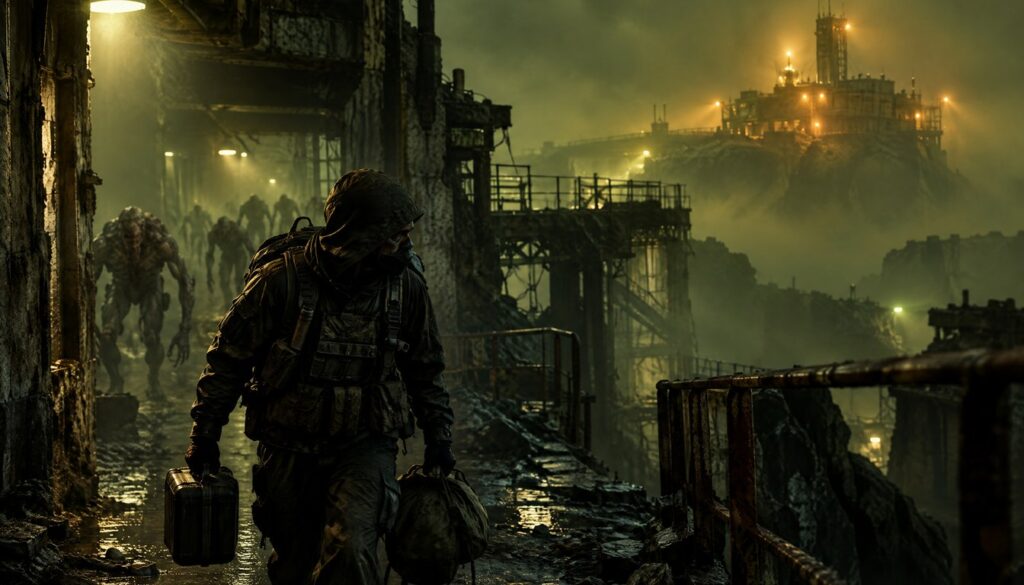
A new survival-horror game called ANOMALITH is set to launch on PC, PlayStation 5, and Nintendo Switch 2 on October 29, 2026, and the project’s producer is openly naming his biggest inspiration: Resident Evil. Producer Gai Kidokoro told Automaton Media during the 2026 Tokyo Game Show that the team built the game’s core systems around what Resident Evil already does best, while layering in a supply-run structure borrowed from a very different genre. The announcement lands in one of the busiest horror-adjacent stretches Nintendo Switch 2 has seen since launch, and that timing is doing almost as much work as the pitch itself.
What Is ANOMALITH?
ANOMALITH is a third-person survival-horror title built around exploration, limited resources, and combat against mutated enemies inside a dangerous region called the Anomaly Zone. Coverage from CBR describes the game as combining a Resident Evil-style survival loop with a base-and-expedition structure. The game is confirmed for PC, PlayStation 5, and Nintendo Switch 2, with a release date of October 29, 2026, just two days before Halloween. Several outlets, including GamesRadar, have credited FuRyu Corporation in connection with the title’s artwork, though a formal publisher announcement has not been independently confirmed at the time of writing.
The title sits in a genre ANOMALITH’s own producer says is underserved relative to demand. Kidokoro has pitched the game less as a clone of any single franchise and more as a deliberate remix: Resident Evil’s tension and resource scarcity, paired with a repeated cycle of heading out, gathering supplies, and returning to safety. That second half of the loop is where things get more unusual, and where the game starts to pull away from a straightforward Resident Evil comparison.
Release Date and Platforms Confirmed for October 29
ANOMALITH’s release window is now locked to a single date across all three confirmed platforms: PC, PlayStation 5, and Nintendo Switch 2 on October 29, 2026. That puts it in direct competition for attention with a wave of other titles landing on Switch 2 the same week, and inside a month that Nintendo’s own release calendar lists as unusually dense. Price, file size, and Nintendo Switch 2 performance targets have not been disclosed in any sourcing reviewed for this story, so readers should treat those specifics as still open rather than assume parity with other recent Switch 2 releases.
The Switch 2 release in particular matters for a horror title with heavier atmospheric ambitions, since the console’s hybrid design means ANOMALITH needs to hold up both docked and in handheld mode. Nintendo has not published Switch 2-specific resolution or frame rate targets for the game, and no technical breakdown has surfaced from a verified outlet as of this writing. That is a notable gap given how closely Switch 2 owners have tracked performance specs for other October releases, something covered in detail around titles like It Takes Two’s free Switch 2 upgrade.
Producer Gai Kidokoro’s Resident Evil Comparison
The Resident Evil comparison isn’t a reach from outside commentators. It’s coming directly from the person running the project. In the Automaton Media interview reported by CBR, Kidokoro said the team “referenced the Resident Evil series, as its core systems are the closest to ANOMALITH’s.” That’s a specific, deliberate framing choice. Rather than describe ANOMALITH as a horror game inspired broadly by the genre, Kidokoro pointed at one franchise’s mechanical backbone, specifically, its mix of limited inventory space, deliberate combat pacing, and environmental tension, as the direct template.
That kind of direct citation is relatively rare in game marketing, where studios often prefer vaguer language about “inspiration” to avoid inviting one-to-one comparisons that can backfire if the final product falls short. Kidokoro’s willingness to name Resident Evil specifically sets a clear bar for what reviewers and players will measure ANOMALITH against once it ships on October 29. It also arrives at a moment when Resident Evil itself is unusually visible on Switch 2, which cuts both ways for ANOMALITH’s positioning.
Inside the Anomaly Zone: Setting and Enemies
ANOMALITH’s world centers on the Anomaly Zone, a region described in reporting as home to living beings of unknown origin that trigger bizarre phenomena the deeper players travel into it. Enemies encountered inside the zone are described as humans who have undergone strange mutations, rather than conventional undead or monster designs drawn wholesale from other franchises. That setup gives the game a body-horror angle that leans closer to Resident Evil’s viral-outbreak logic than to supernatural horror, reinforcing Kidokoro’s stated reference point. It’s a different flavor of dark fantasy than the open-world action found in Dragon’s Dogma 2: Dark Arisen’s own Switch 2 debut earlier in October, even though both games share a release month.
Combat is framed around third-person shooting, a perspective Kidokoro says he personally favors as a fan of the format. Players navigate distinctive, labyrinth-like areas within the zone while fighting these mutated enemies, with the same resource-scarcity pressure that defines classic survival-horror design: ammunition, healing items, and safe routes are all treated as limited commodities rather than abundant tools. No specific enemy count, boss roster, or difficulty settings have been confirmed in sourcing available at publication time.
The Anomaly Zone Countermeasures Office, Explained
One detail that separates ANOMALITH from a pure Resident Evil retread is the presence of an in-fiction organization called the Anomaly Zone Countermeasures Office. Reporting describes this body as responsible for monitoring and managing activity tied to the zone, giving the game’s narrative a bureaucratic, institutional layer that echoes how Resident Evil titles have historically used organizations like Umbrella Corporation or the BSAA as narrative scaffolding. Whether the Countermeasures Office functions as an ally, an obstacle, or something more complicated to the player character has not been detailed in available coverage.
What is clear is that ANOMALITH is positioning itself with more worldbuilding infrastructure than a bare-bones horror shooter would need, suggesting the developers are planning for a story with some depth rather than a pure arcade loop. That ambition is consistent with Kidokoro’s comments about wanting the retro Japanese setting to carry real weight rather than act as window dressing.
Survival Loop: Resident Evil Meets a Supply-Run Structure
The part of ANOMALITH that moves furthest from a direct Resident Evil copy is its gameplay cycle. Kidokoro told Automaton Media that for the loop in which players gather supplies and then return to their base, the team referenced Escape from Tarkov. That’s a meaningfully different design lineage: Tarkov’s raid-and-extract structure is built around risk-reward decisions tied to carrying loot out of a hostile zone, rather than Resident Evil’s more linear progression through fixed save points and set-piece encounters.
Combining those two systems is an ambitious bet. Resident Evil’s tension depends on carefully rationed resources inside a mostly fixed map, while extraction-style loops depend on player-driven risk calculation across repeated runs. ANOMALITH is effectively trying to graft a roguelike-adjacent expedition cycle onto a more traditional, narrative-forward horror structure. If it lands, the hybrid could give the game replay value that a straight Resident Evil clone wouldn’t have. If the two systems fight each other, that friction could also become the game’s defining criticism once reviews start appearing after the October 29 launch.
Where the Evangelion Comparisons Come From
Some early coverage, including CBR’s own headline framing, has drawn a line between ANOMALITH and Neon Genesis Evangelion. It’s worth being precise about what that comparison actually rests on. Kidokoro has not cited Evangelion by name as a design influence in the interview material reviewed for this story. The Evangelion connection described in reporting is presented as a visual and thematic observation made by the reporter, tied to the game’s imagery around anomalous zones, mysterious biological threats, and an institutional response organization, rather than a confirmed creative citation from the developer.
That distinction matters for anyone trying to predict ANOMALITH’s tone. Resident Evil is a confirmed, producer-stated mechanical reference. Evangelion is an observed aesthetic parallel from outside commentary. Readers should treat the first as fact and the second as critical interpretation until Kidokoro or FuRyu address it directly.
ANOMALITH vs. Resident Evil: A System-by-System Comparison
Given that Kidokoro has made the Resident Evil comparison explicit, it’s useful to lay out where ANOMALITH tracks closely with the franchise and where it diverges. The table below draws only on confirmed reporting; anything not independently verified is marked accordingly rather than guessed at.
| System | Resident Evil (franchise norms) | ANOMALITH |
|---|---|---|
| Core design reference | Original source material | Explicitly cited by producer Gai Kidokoro as the closest match to ANOMALITH’s systems |
| Camera / combat perspective | Varies by entry; third-person common in recent titles | Third-person shooting, per Kidokoro’s stated preference |
| Resource structure | Limited inventory, scarce ammo and healing items | Described as similarly resource-constrained survival design |
| Progression loop | Mostly linear advancement through fixed areas and saves | Expedition-and-return structure referencing Escape from Tarkov |
| Antagonist design | Viral outbreaks, mutated creatures, bioweapons | Humans undergoing strange mutations inside the Anomaly Zone |
| Institutional framing | Umbrella Corporation, BSAA, and similar organizations | Anomaly Zone Countermeasures Office |
| Confirmed platforms | Varies by title; broad multiplatform history | PC, PlayStation 5, Nintendo Switch 2 |
| Price / technical specs | Set per title at launch | Not confirmed in available reporting |
Switch 2’s Crowded October: Where ANOMALITH Fits
ANOMALITH is not launching into a quiet month. Nintendo’s own October 2026 release schedule lists a dense run of Switch 2 titles in the weeks leading up to ANOMALITH’s debut, and the collision with Resident Evil itself is hard to ignore. Resident Evil 2 Deluxe Edition, Resident Evil 3, and Resident Evil 4 Gold Edition are all set to land on Switch 2 on October 16, just thirteen days before ANOMALITH’s own launch. For a game whose producer is openly citing Resident Evil as a direct design reference, that proximity is either a gift or a trap, depending on how the finished product compares.
| Date | Game | Note |
|---|---|---|
| October 8 | Kingdom Hearts Collection [I-III] | Switch 2 release |
| October 8 | Order of the Sinking Star | Switch 2 release |
| October 9 | Dragon’s Dogma 2: Dark Arisen | Switch 2 release |
| October 14 | Ratatan | Switch 2 release |
| October 15 | Castlevania: Belmont’s Curse | Switch 2 release |
| October 16 | Resident Evil 2 Deluxe, RE3, RE4 Gold | Direct genre overlap with ANOMALITH |
| October 22 | Nintendo Switch Sports Resort, Final Fantasy Resonance | Switch 2 releases |
| October 23 | Call of Duty: Modern Warfare 4 | Switch 2 release |
| October 27 | Minecraft | Switch 2 release |
| October 29 | ANOMALITH | PC, PS5, Switch 2 launch |
That calendar, compiled from Nintendo’s own announcements and cross-checked against outlets like Nintendo Life, shows just how little breathing room ANOMALITH has. Switch 2 owners interested in survival horror could plausibly buy three Resident Evil remasters and ANOMALITH within the same three-week stretch, which raises the practical question of budget fatigue as much as genre comparison.
Historical Context: Survival Horror’s Long Console Cycle
Survival horror as a genre has a well-documented habit of resurging whenever a new console generation needs a flagship atmosphere piece. The original Resident Evil helped define the PlayStation era in 1996. Resident Evil 4 reshaped third-person action-horror in 2005 and is still being resold and remastered two decades later, including on Switch 2 this same October. Each hardware cycle tends to produce at least one title that tries to fuse established survival-horror grammar with whatever new mechanical trend is dominating the broader industry at the time.
ANOMALITH’s attempt to fuse Resident Evil’s scarcity-driven tension with an extraction-style supply loop fits that pattern closely. Extraction mechanics, popularized well outside the horror genre by titles like Escape from Tarkov, have spent the last several years migrating into adjacent genres as developers look for ways to add replayability to otherwise linear experiences. Applying that structure to survival horror specifically is still a relatively untested combination at this scale, which is part of why Kidokoro’s framing has drawn attention from outlets covering the Switch 2 release calendar.
Market Impact: What a Crowded Horror Month Means
For FuRyu and the ANOMALITH team, launching the same month as three remastered Resident Evil entries carries real commercial risk alongside the marketing upside of an easy comparison point. Remasters of beloved, already-proven titles tend to convert reliably among players who already trust the franchise, and Resident Evil 4 in particular has a long track record of strong critical reception across multiple re-releases. A new, unproven IP competing for the same wallet share in the same three-week window needs either a lower price point, a distinct enough hook, or strong early reviews to avoid being squeezed out, and none of those variables have been confirmed publicly yet for ANOMALITH.
On the other hand, a packed horror-adjacent month on Switch 2 could also work in ANOMALITH’s favor by keeping the genre visible in storefronts and on social media at the exact moment the game needs discovery. Players who finish a Resident Evil remaster in mid-October and want something new before Halloween are a built-in audience, provided ANOMALITH’s marketing successfully rides that wave rather than getting lost beneath it. That dynamic is similar to what shaped reception for other recent Switch 2 catalog additions, including the pattern seen around Octopath Traveler’s Switch 2 arrival earlier this month, and the broader rush of first-party content covered in the Switch 2 Zelda launch blitz.
What Kidokoro Has Said About ANOMALITH’s Design
Kidokoro’s public comments, given during the 2026 Tokyo Game Show and reported by CBR, are the most concrete source of information on ANOMALITH’s design intent currently available. On the core comparison that’s driving most of the coverage, Kidokoro said: “We referenced the Resident Evil series, as its core systems are the closest to ANOMALITH’s.”
On the supply-run mechanic that separates the game from a straight homage, Kidokoro added: “Additionally, for the gameplay cycle, in which you gather supplies and return to your base, we referenced Escape from Tarkov.” And on how the game’s retro Japanese, Showa-era setting has landed with audiences outside Japan, Kidokoro said the reception was unexpected, noting: “The fact that the Showa-era retro vibe resonated not only with Japanese players but also with overseas players was a new discovery for us.”
Taken together, those three comments sketch a producer who is confident about naming his references directly rather than hiding behind vague marketing language, and who seems genuinely surprised by how well a very specific, culturally rooted aesthetic has traveled internationally ahead of launch.
What’s Still Unconfirmed Ahead of Launch
Despite the clarity around ANOMALITH’s design philosophy, several basic launch details remain unannounced as of this writing. Price has not been confirmed on any platform. File size and Nintendo Switch 2 storage requirements have not been published. Performance targets, including resolution and frame rate in both docked and handheld modes, have not been disclosed. A formal publisher credit beyond the FuRyu association noted by GamesRadar has not been independently verified, and no multiplayer or co-op modes have been confirmed, suggesting the game is single-player unless stated otherwise closer to launch.
With just under three weeks between this reporting and the October 29 release date, that’s a fairly short runway for FuRyu to fill in pricing and technical details that typically arrive well ahead of launch for titles aiming at broad console audiences. How quickly those gaps get filled will say a lot about how confident the team is heading into a crowded release month.
Predictions: What to Watch Before October 29
- Expect FuRyu to confirm pricing and a Switch 2 storage footprint within the next one to two weeks, given how close the launch date already is.
- The Resident Evil comparison will likely become the dominant review angle once critics get hands-on time, for better or worse, since Kidokoro invited that framing himself.
- Marketing is likely to lean into the Showa-era retro aesthetic internationally, given Kidokoro’s stated surprise at its overseas reception.
- Expect at least one outlet to directly ask FuRyu about the Evangelion comparisons raised in early coverage, since the studio has not addressed them on record.
- Sales performance against the October 16 Resident Evil remaster wave will be the clearest early signal of whether ANOMALITH’s hybrid pitch resonates with a mainstream Switch 2 audience or stays a niche pickup, a dynamic similar to what’s driving anticipation for later 2026 survival entries like Monster Hunter Wilds on Switch 2.
Frequently Asked Questions
When does ANOMALITH release?
ANOMALITH is scheduled to release on October 29, 2026, on PC, PlayStation 5, and Nintendo Switch 2.
Who is making ANOMALITH?
Gai Kidokoro is the game’s producer. Multiple outlets, including GamesRadar, have credited FuRyu Corporation in connection with the title, though an official publisher statement has not been independently confirmed.
Is ANOMALITH similar to Resident Evil?
Yes, according to producer Gai Kidokoro, who told Automaton Media that the team referenced Resident Evil’s core systems directly when designing ANOMALITH’s survival mechanics.
Is ANOMALITH connected to Evangelion?
Not officially. Visual and thematic comparisons to Evangelion have come from reporters covering the game, not from Kidokoro, who has not cited it as a design influence in available interviews.
What platforms will ANOMALITH be available on?
ANOMALITH is confirmed for PC, PlayStation 5, and Nintendo Switch 2, all releasing simultaneously on October 29, 2026.
How much will ANOMALITH cost?
Pricing has not been announced as of this writing. No official price has been confirmed for any of the three platforms.
What is the Anomaly Zone Countermeasures Office?
It’s an in-game organization described in reporting as responsible for monitoring and managing activity tied to the Anomaly Zone, the dangerous region at the center of ANOMALITH’s story.
What other games are launching on Nintendo Switch 2 around the same time?
ANOMALITH shares its October 29 launch window with a packed Switch 2 schedule that includes Resident Evil 2 Deluxe Edition, Resident Evil 3, and Resident Evil 4 Gold Edition on October 16, plus Call of Duty: Modern Warfare 4 and Minecraft later in the month, according to Nintendo’s official October 2026 release schedule.
Related
- It Takes Two Hits Switch 2 Free Oct. 15, 60 FPS [2026]
- Octopath Traveler I, II Hit Switch 2 at $59.99 Each [2026]
- Dragon’s Dogma 2: Dark Arisen Switch 2 Review: 30 FPS Target Holds
- Kingdom Hearts III + Re Mind Hits Switch 2 Oct. 8, 45GB [2026]
- Nintendo’s Switch 2 Zelda Blitz: 4 Launches, 14 Days [2026]