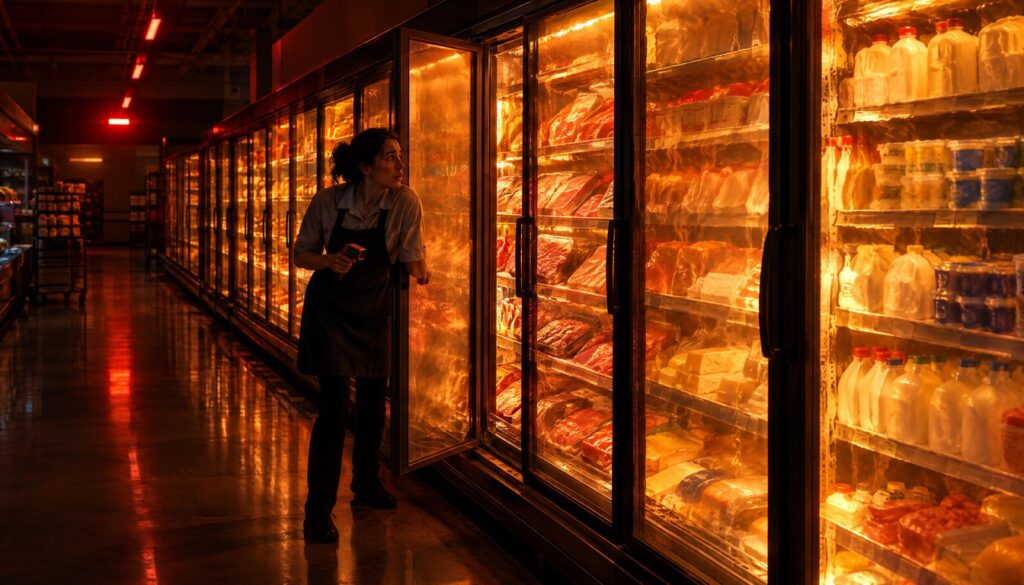
Shoppers at several of France’s largest supermarket chains got an unpleasant surprise this week: refrigerators that had been quietly keeping meat, dairy and frozen goods cold overnight instead climbed toward oven-like temperatures. The Paris prosecutor’s office confirmed on October 12, 2026, that it had opened an investigation into what it called a “large-scale cyberattack” that hit connected refrigeration systems at food retailers across the country, according to CBS News. The incident, which unfolded overnight between Sunday, October 11, and Monday, October 12, spoiled large volumes of fresh and frozen food and was linked to fires at some locations.
This isn’t a theoretical warning about internet-connected appliances anymore. It’s a live, multi-chain incident that forced some of the country’s biggest grocery brands to throw out inventory, shut down refrigeration units and call in investigators, all before most of their customers had finished breakfast. Retail groups Les Mousquetaires (which owns Intermarché and Netto), Coopérative U, Carrefour and Monoprix each separately confirmed damage, with store counts ranging from dozens to around 150 locations per chain. What makes this a cybersecurity story rather than a simple equipment failure is the scale and the coordination: multiple competing retailers were hit in the same overnight window, pointing toward a shared vulnerability somewhere in the connected refrigeration supply chain rather than isolated hardware glitches.
Timeline: What Happened Between October 11 and 12
Based on retailer statements gathered by French and international outlets, the attack played out overnight while stores were closed. Les Mousquetaires said refrigerators at roughly 150 of its stores were pushed to 50°C (122°F) and stayed there for about six hours before staff discovered the problem the following morning. That is a swing of more than 50 degrees above a typical refrigerated setpoint, enough to spoil dairy, meat and produce well before anyone opened the doors for the day.
Other chains reported damage on a similar overnight schedule, though not every retailer disclosed exact temperatures or durations. The Irish Times reported that the pattern across chains, hundreds of affected stores discovered nearly simultaneously on a Monday morning, led investigators to treat it as one coordinated event rather than several unrelated technical failures. French authorities have not yet said whether the attackers used a single point of entry or exploited the same flaw independently across different retailers’ systems.
Retailer by Retailer: Who Reported What Damage
Each affected group gave its own account of the damage, and the numbers vary quite a bit depending on how big the chain is and how its refrigeration network is managed. Intermarché, part of the Les Mousquetaires group, said it had to “throw away all of the products” that were fresh or frozen in the affected locations, a blunt admission that there was no salvaging the inventory once the cold chain broke. Coopérative U told AFP that almost 100 of its outlets were hit. Carrefour, which operates roughly 6,000 stores across France according to Ynet, said 80 of its supermarkets were affected, a small fraction of its total footprint but still a meaningful number of stores losing stock in a single night. Monoprix put its own exposure at about 5% of its store network, which runs to more than 400 locations nationwide.
Put side by side, the numbers suggest the attack’s reach wasn’t uniform. Les Mousquetaires and Coopérative U reported the highest raw store counts, while Carrefour and Monoprix, despite running far larger total networks, reported a smaller share of locations affected. That unevenness matters for the investigation: it could mean different retailers run different refrigeration platforms with different exposure, or it could simply reflect how each chain is still counting the damage days after the fact. Early figures in a fast-moving breach like this one tend to shift as retailers complete their internal audits.
| Retailer | Stores Affected | Share of Network | Reported Outcome |
|---|---|---|---|
| Les Mousquetaires (Intermarché/Netto) | ~150 stores | Not disclosed | Fridges hit 50°C for ~6 hours; all affected food discarded |
| Coopérative U | ~100 stores | Not disclosed | Outlets targeted overnight, per AFP |
| Carrefour | 80 stores | Small fraction of ~6,000 FR stores | Supermarkets affected; temperature not disclosed |
| Monoprix | Not disclosed exactly | ~5% of 400+ stores | Affected locations confirmed; temperature not disclosed |
None of the retailers have published a full, itemized list of which specific stores were hit, and the figures above come directly from each company’s own public statements rather than a single authoritative tally. That gap is itself notable. In a cyber incident spanning multiple corporate groups, a shared public accounting would help investigators and the public understand how widespread the exposure really was.
Inside the Paris Prosecutor’s Investigation
The Paris prosecutor’s office opened a formal investigation into what it described as “the large-scale cyberattack affecting the refrigerators of several major food retail chains across France.” Officials said the probe would work to establish the link between the intrusion and the reported “foodstuff losses and the outbreak of fires,” language that leaves open, deliberately, whether the fires were a direct result of the tampering or a secondary consequence of overheated or malfunctioning equipment, according to MKFM.
That distinction isn’t just legal hairsplitting. If attackers forced refrigeration compressors or electrical components into a stressed state that caused fires directly, this becomes one of the more serious cyber-physical incidents to hit retail infrastructure in Europe. If the fires were unrelated or only loosely connected, the core incident is still severe, but the forensic picture, and the legal charges that could eventually follow, look different. As of this reporting, investigators have not disclosed the identity of the attackers, their motive, or exactly which software or hardware they exploited to reach the refrigeration systems.
How Hackers Could Remotely Control a Refrigerator
Modern commercial refrigeration isn’t just a compressor and a thermostat anymore. Large retail chains typically run centralized refrigeration-management platforms that monitor and adjust temperature setpoints, defrost cycles and alarm thresholds across hundreds of stores from a single dashboard. That’s useful for maintenance efficiency, a technician can spot a failing unit in a store three states away without driving there, but it also means one compromised platform, one stolen credential, or one exposed management interface can potentially reach every connected store at once.
Investigators haven’t confirmed the exact method used in this case. What’s publicly known is the effect: refrigeration units that should sit near 4°C instead climbed to 50°C, which is consistent with a defrost cycle being triggered and never properly reversed, or with setpoints being overwritten entirely. Either scenario points toward command-level access to the refrigeration network rather than a conventional data breach aimed at stealing customer records.
A Generic Example of How Remote Refrigeration Commands Work
To be clear, the snippet below is a generic illustration of how building-automation and refrigeration-monitoring protocols structure a remote command. It is not drawn from this specific investigation and no technical details of the French attack have been confirmed publicly.
// Illustrative only -- generic BMS/refrigeration telemetry pattern
// Not specific to the France incident; no exploit details are confirmed
SET device=refrigeration_unit_214
  setpoint_temp=50.0C
  mode=defrost_override
  duration=21600s   // ~6 hours
  auth_token=<management_platform_credential>
The point of the example isn’t the syntax, it’s the concept: a single authenticated session against a centralized platform can, in principle, issue a setpoint change to many devices at once. That’s exactly the kind of blast radius that would explain why multiple stores within the same chain, and reportedly across several competing chains, showed the same symptom on the same night.
The Danfoss Question: What’s Confirmed and What Isn’t
Some reporting has named Danish engineering firm Danfoss, a major supplier of refrigeration controllers and compressor electronics, as part of the technology environment involved in the affected stores. It’s important to be precise about what that does and doesn’t mean. No official statement from the Paris prosecutor’s office, the retailers, or Danfoss itself has confirmed that Danfoss equipment was the entry point, that a specific vulnerability in Danfoss systems was exploited, or that Danfoss’s own corporate network was breached. The company’s name surfacing in coverage reflects its prominence in the refrigeration-equipment market, not a confirmed role in the attack chain.
Similarly, unverified claims circulating in some outlets put the combined Intermarché and Netto store count above 300, well beyond the roughly 150 figure Les Mousquetaires itself disclosed. Until the retailer or prosecutors confirm a higher number, the 150-store figure from the company’s own statement is the only one worth treating as reliable. The same caution applies to a reported fire at the Marché des Enfants Rouges in Paris. No official source has established a confirmed link between that fire and the refrigeration attack, and the cause of that specific blaze has not been determined in public reporting.
Why Food Retail Became an OT Security Blind Spot
Retail chains have spent the better part of two decades hardening the systems that touch payment data, largely because PCI compliance and card-network pressure forced the issue after breaches like Target’s in 2013. Refrigeration, lighting, HVAC and other building-operations technology got far less of that attention. These operational technology (OT) systems were historically isolated, air-gapped compressors with analog thermostats, but the push toward remote monitoring, predictive maintenance and energy-efficiency reporting has connected almost all of it to the internet over the past decade.
That shift created a security gap that the security industry has been warning about for years without it generating much urgency, because until this week, OT incidents at retailers mostly meant downtime or data exposure, not literal spoiled groceries and reported fires. Food retail isn’t the only sector learning this lesson in real time either. Pizza chain Dodo Pizza confirmed its own cyberattack just weeks earlier, with hackers claiming access to data tied to 68 million users, a reminder that the food and hospitality sector broadly has become a live target rather than an afterthought for attackers.
Common OT Weak Points in Store Networks
Security researchers have flagged a consistent set of weaknesses across retail OT environments for years: internet-exposed management interfaces, shared or reused passwords across hundreds of stores, unrestricted vendor VPN access for maintenance contractors, and flat networks where point-of-sale, corporate IT and refrigeration controls all sit on the same segment. None of these have been confirmed as the specific cause of the French incident, but they describe the broader category of risk that OT security teams have been racing to close.
Part of the difficulty is prioritization. Security teams juggling thousands of known vulnerabilities across IT and OT systems often have to triage by severity score rather than business impact, and the gap between a vulnerability’s CVSS score and whether it’s actually being exploited in the wild can run for days before a patch lands, a mismatch recently documented in detail when comparing CVSS scoring against CISA’s Known Exploited Vulnerabilities list. Network appliances sitting at the edge of these environments are a frequent entry point too; a SonicWall flaw rated a maximum CVSS 10.0 was found under active attack earlier this year, underscoring how a single unpatched edge device can become the door into an otherwise well-defended internal network.
A Decade of Warnings: From Target’s HVAC Vendor to Cold-Chain Ransomware
This isn’t the first time a facilities-management system has turned into a liability for a major retailer. The most frequently cited precedent is Target’s 2013 breach, in which attackers first obtained network credentials belonging to Fazio Mechanical Services, an HVAC and refrigeration contractor with remote access into Target’s systems, then used that foothold to reach payment infrastructure. That incident is widely remembered as the moment retail security teams realized a vendor’s remote-maintenance access could become the path into a much bigger breach, even though the HVAC systems themselves weren’t the end target.
Cold-chain logistics has faced its own string of cyber incidents since then, though usually through a different mechanism. Ransomware attacks against warehouse and distribution operators have repeatedly knocked out the IT systems that track temperature logs, schedule dispatch and manage inventory, putting food safety at indirect risk by disabling monitoring and documentation rather than directly commanding refrigeration hardware to overheat. The French incident, if the reporting holds up, represents a more direct version of that risk: not disabling the thermostat, but reportedly overriding it.
| Incident | Year | Entry Point | Primary Impact |
|---|---|---|---|
| Target / Fazio Mechanical | 2013 | Compromised HVAC contractor credentials | Pivot into payment systems; large-scale card and customer data exposure |
| Cold-chain ransomware incidents | Recurring, 2020s | Ransomware against logistics/warehouse IT | Disrupted temperature monitoring and dispatch; indirect food-safety risk |
| French supermarket refrigeration attack | 2026 | Unconfirmed; suspected refrigeration-management platform access | Direct temperature manipulation; spoiled food, reported fires |
The progression across these three categories, vendor-credential pivot, IT-layer ransomware, and now direct OT manipulation, traces a path toward attackers getting closer to the physical equipment itself rather than just the data surrounding it. That’s a harder problem to defend against, because it requires securing control systems that were designed decades ago for reliability and uptime, not for resisting a remote adversary.
Market Impact: Food Safety Costs, Insurance and Investor Attention
The immediate financial hit is straightforward to describe even without an official damage estimate: every one of the roughly 400-plus confirmed affected stores across the four retailer groups lost some combination of fresh meat, dairy, produce and frozen inventory in a single night, inventory that French retailers now have to write off, replace and, in the case of Intermarché, discard entirely to eliminate any health risk. Multiply that across hundreds of stores and the direct food-waste cost alone will likely run into the millions of euros before accounting for cleanup, equipment repair, or any fire damage.
Who Pays When the Freezer Fails
Beyond the immediate write-off, there’s a longer tail of cost that tends to follow incidents like this: cyber-insurance claims, regulatory scrutiny from French food-safety authorities, and pressure from investors asking whether refrigeration vendors and retailers adequately assessed OT risk before this happened. Credit-rating agencies have already shown they’re willing to flag cyber exposure as a factor in financial-health assessments for other sectors, as seen when ratings agencies recently flagged cyber risk at banks following unrelated incidents. It wouldn’t be surprising if similar scrutiny eventually extends to food retailers with large, centrally managed OT footprints.
The Ransomware Economics Fueling OT Targeting
It’s worth noting that nothing in official reporting so far confirms this was a ransomware attack, no retailer has disclosed a ransom demand, and the motive remains unconfirmed. But the broader trend in cybercrime economics helps explain why OT systems, including refrigeration, have become more attractive targets generally. Attackers have increasingly shifted toward data theft and operational disruption as leverage rather than relying purely on encryption, with one recent industry analysis finding ransomware-linked data theft surged 275% even as actual ransom payments declined. Separately, research from Zscaler found generative AI tools are helping fuel ransomware payouts that now average $432,000 per incident, a figure that illustrates just how much financial pressure a single successful OT or IT compromise can put on a mid-size retail operation.
Whether or not money changes hands in this specific case, the economic logic is the same: physical disruption, spoiled food, closed stores, fire damage, carries real business cost even without a single record being stolen. That changes the incentive calculus for both attackers and defenders. A refrigeration platform that can reach 150 stores at once is, from a purely economic standpoint, a higher-value target than a single store’s point-of-sale terminal.
Competitive Response: How Retailers Will Likely Harden Refrigeration Networks
Expect the four affected groups, and likely competitors who weren’t hit this time, to move on a few fronts quickly. Network segmentation separating refrigeration-management platforms from corporate IT and point-of-sale systems is the most obvious fix, and the kind of change that’s cheap relative to the cost of another incident. Credential rotation across remote-maintenance accounts, including those held by third-party refrigeration integrators and vendors, is another near-term step, echoing the exact lesson from Target’s HVAC-contractor breach over a decade ago.
Longer term, chains with centralized refrigeration dashboards will likely add anomaly detection tuned specifically for implausible setpoint commands, a freezer suddenly being told to target 50°C should trigger an automatic alert and rollback long before six hours pass. None of the affected retailers have publicly detailed their remediation plans as of this reporting, which is normal this early in an active investigation, but the pattern from comparable incidents suggests these are the moves that follow.
Five Predictions for the Months Ahead
- French and EU regulators will likely use this incident to push retail and food-logistics operators toward faster compliance with NIS2-style OT security requirements, given the direct food-safety and fire-risk angle.
- Expect at least one affected retailer to disclose a more specific root cause, vendor access, exposed interface, or stolen credential, within the coming weeks as the Paris investigation progresses.
- Other major European grocery chains that weren’t named this week will likely conduct internal audits of their own refrigeration-management platforms, whether or not they publicize the results.
- Cyber-insurance underwriters covering food retail will probably start asking more detailed questions about OT network segmentation during renewal season.
- If the Danfoss connection is eventually confirmed rather than speculative, expect broader scrutiny of refrigeration-equipment vendors’ remote-access architecture across the industry, not just at the retailers directly affected.
These are editorial projections based on how comparable OT incidents have played out historically, not confirmed plans from any named company or official.
Frequently Asked Questions
What happened to French supermarket refrigerators in October 2026?
A cyberattack overnight between October 11 and 12, 2026, altered refrigeration settings at multiple French food retailers, pushing some units to 50°C and spoiling large amounts of fresh and frozen food. The Paris prosecutor’s office opened an investigation the same day.
Which supermarket chains were affected?
Les Mousquetaires (Intermarché and Netto), Coopérative U, Carrefour and Monoprix each confirmed stores were affected, with reported counts ranging from about 80 (Carrefour) to roughly 150 (Les Mousquetaires).
How hot did the refrigerators get, and for how long?
Les Mousquetaires reported refrigeration units reaching 50°C (122°F) and staying there for approximately six hours overnight before the issue was discovered.
Did the cyberattack cause fires?
Fires were reported at some affected locations, but the Paris prosecutor’s office said the investigation would work to establish the link between the attack and the reported food losses and fires. That connection has not been confirmed as of this reporting.
Who is behind the attack?
No attacker has been publicly identified, and no motive has been confirmed. Claims naming specific equipment vendors or a precise exploited vulnerability remain unconfirmed.
Is food from an affected store safe to eat?
Retailers including Intermarché said affected fresh and frozen products were discarded specifically to eliminate health risk. Shoppers with concerns about a specific purchase should check with the store directly.
How could hackers remotely control a refrigerator?
Large retail chains typically run centralized refrigeration-management platforms that can adjust temperature setpoints and defrost cycles across many stores at once. Gaining access to that kind of platform, rather than physically tampering with each individual unit, would explain how many stores could be affected on the same night. The exact method used in this case has not been confirmed.
What should other retailers do now?
Security practice generally points toward segmenting refrigeration and other OT networks away from corporate IT and payment systems, rotating credentials used by maintenance vendors, and adding alerts for implausible temperature commands. These are general best practices, not confirmed remediation steps from any specific retailer named in this incident.
Related Coverage
- Luminis Health MyChart Back After 4-Week Cyberattack [2026]
- Rafræn Skilríki and Online Casinos: How Icelandic Players Prove Who They Are
- Anthropic Bars Claude From Arrest Calls in 31 Days [2026]
- FBI Arrest Ties Ransomware Negotiator to Its Own Hack [2026]
- FBI Arrests Ransomware Negotiator, 54, on 2 Counts [2026]