
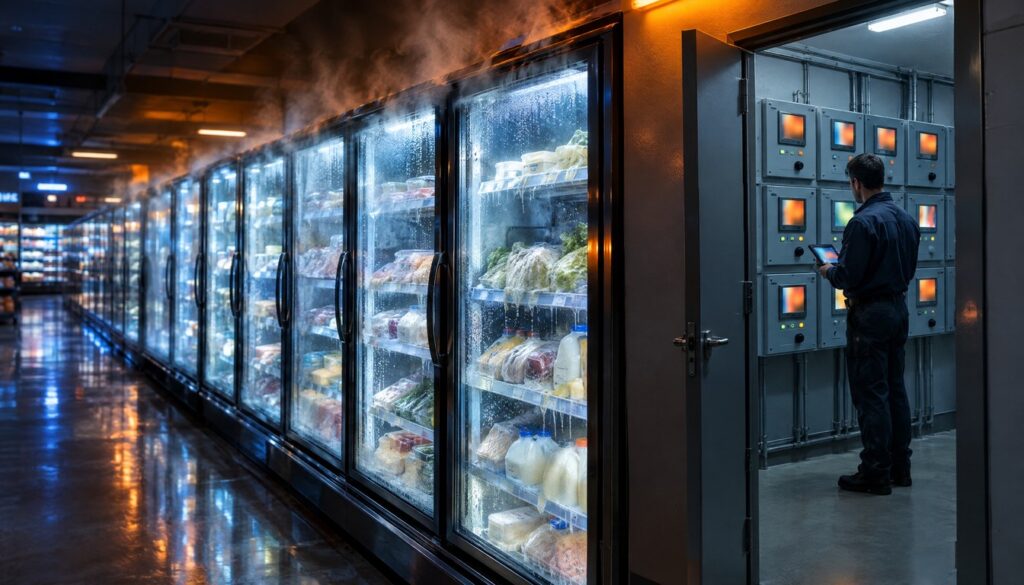
A week after hackers sent refrigerators at hundreds of French supermarkets soaring toward 50°C (122°F), the story is shifting from cleanup to a harder question: how many other retailers, in how many other countries, are running the same exposed equipment right now. New reporting on the incident points squarely at remote-access architecture, not just outdated software, as the root problem, and security researchers say the exposure extends well beyond France’s borders.
The attack hit refrigeration-management systems overnight between October 11 and 12, 2026, according to French authorities. Within days, the Associated Press and other outlets confirmed that hundreds of stores across several major French retail chains had lost control of their cold-storage systems. The Paris prosecutor’s office opened a formal investigation, and no individual or group has claimed responsibility. What makes this story bigger than a single bad week for French grocers is the pattern underneath it: industrial refrigeration gear, built to run quietly in a back room for a decade or more, got connected to the internet for remote monitoring, and in many cases nobody closed the door behind it.
What happened to French supermarket refrigeration systems
The disruption hit refrigeration and freezer units at stores operated by Intermarché, Netto, Coopérative U, and Monoprix. Reported figures put roughly 300 Intermarché and Netto locations, 80 Coopérative U stores, and 30 Monoprix stores among those affected. Temperatures in some units reportedly climbed as high as 50°C, a level that would spoil most refrigerated and frozen stock within hours rather than days.
France’s finance minister, Roland Lescure, told Parliament that around 700 of the country’s roughly 10,000 supermarkets were affected, a scale that turns this from an isolated IT glitch into one of the broader disruptions to hit French retail infrastructure this year. The BBC reported that stores scrambled to move stock, toss spoiled inventory, and in some cases shut down cold cases entirely while technicians worked through the weekend.
CERT-FR, the French government’s computer emergency response team, issued a bulletin naming the specific equipment involved: Danfoss AK-SM and AK-SC series controllers, along with Copeland XWEB and Dixell XWEB monitoring systems. Danfoss, the Danish manufacturer behind much of the affected gear, separately identified its AK-SM800 and AK-SC355 fridge-regulator systems as notably affected. For readers tracking this story since the weekend, that’s an important update: the earlier reporting on the initial fridge cyberattack didn’t yet have the full list of named systems that CERT-FR later confirmed.
The remote access problem behind the headline
Refrigeration controllers exist so that a technician, or increasingly a cloud dashboard, can check compressor temperatures and energy draw without walking the aisle. That remote-management capability is exactly what let retailers run leaner maintenance schedules over the past decade. It is also, according to multiple outlets covering this story, the feature that turned a back-room appliance into an internet-facing target.
Industrial cybersecurity firm Claroty reported that numerous Danfoss controllers were directly accessible from the public internet, meaning anyone scanning IP ranges could find and probe them without needing to breach a corporate network first. That detail matters more than the temperature numbers, because it describes a design and deployment choice rather than a single software flaw. A controller sitting behind a firewall and a VPN is a very different risk than the same controller answering requests straight from the open internet.
A researcher at Claroty, identified in reporting by SecurityInfoWatch only by the surname Utzke, described what an attacker could do after reaching an exposed Danfoss AK-SM 800A platform: “execute arbitrary operating system commands.” That is a significantly worse outcome than simply flipping a thermostat setting. Arbitrary command execution on an industrial controller can mean full control of the device, and potentially a foothold to move laterally into whatever network segment the controller sits on.
Antoine Hautin of the security firm Almond made a related point: refrigeration equipment that was historically isolated from any network is now routinely wired into sensors and remote-monitoring platforms, often added after the original equipment was installed. The connectivity gets bolted on; the security review of that connectivity often doesn’t happen at the same pace.
Legacy equipment that stopped getting updates
Danfoss has acknowledged the incidents directly. The company told Time it is “aware of incidents in France affecting a limited number of refrigeration management systems,” and confirmed that the affected units “were running outdated firmware.” That phrasing lines up with what Danfoss told multiple outlets about the broader category of equipment involved: most of it consists of legacy products that “no longer receive software or security updates.”
Danfoss’s public guidance has been consistent and, in hindsight, prescient: the company said it has “long advised customers to keep supported systems updated with the latest firmware and to migrate legacy systems to current-generation solutions,” and separately told reporters it recommends operating these systems “behind a firewall.” The gap between advice and practice is where this incident lives. Firmware updates require planned downtime, budget approval, and often a vendor service contract that retailers may have let lapse once the original hardware was paid off and running fine.
This is a familiar shape in industrial control system security: equipment is specified for a 10- to 20-year service life, software support runs out well before the hardware does, and nobody budgets for a mid-life security refresh because the thing still works. Retail chains face this tension across point-of-sale terminals, HVAC controls, and warehouse automation, not just refrigeration. The French incident is a concrete, costly illustration of what happens when that tension goes unresolved at scale.
Why this is not just a French problem
Danfoss, Copeland, and Dixell all sell globally, and refrigeration-monitoring deployments that mirror the French setup exist across North America, the UK, and the rest of Europe. SecurityInfoWatch framed its coverage around exactly that point, reporting that the French cyberattack “exposes potential risks for US grocers” who run comparable remote-access refrigeration infrastructure. The vulnerability class here, internet-exposed industrial controllers running old firmware, does not respect national borders or retail brand names.
That is also the throughline connecting this event to the cold-chain insurance exposure flagged by Australian insurers in the days after the attack. Insurers underwriting cold-chain and food-retail risk are now asking clients a question that rarely came up before this month: can you confirm your refrigeration controllers are not reachable from the open internet? For an industry that treats refrigeration as plumbing rather than IT, that is not a question most operations teams have a ready answer to.
Historical context: industrial control systems have been a soft target for years
The French fridge incident fits a pattern security researchers have warned about since well before 2026. The 2010 Stuxnet worm demonstrated that industrial controllers could be targeted directly rather than through the IT networks around them. The 2013 breach of a major US retailer, traced back to credentials stolen from an HVAC contractor with remote access to store systems, showed that building-management equipment could become a path into a much bigger network. The 2021 Colonial Pipeline ransomware attack, and the same year’s attempted tampering with a water-treatment facility in Oldsmar, Florida, both involved remote-access tools meant to simplify maintenance that instead widened the attack surface.
What is different about the French case is the target: not a pipeline or a water plant, but the everyday cold chain that keeps groceries safe to eat. Food safety regulators in most countries require refrigerated goods to stay below set temperature thresholds, and a sustained excursion to 50°C does not just risk spoiled profit margins, it risks a public health incident if improperly cooled stock reaches a shelf. That framing is part of why this story moved so fast through outlets like the New York Times and Al Jazeera, both of which framed it as a food-security story as much as a cybersecurity one.
Market impact: industrial cybersecurity gets a retail wake-up call
Industrial control system security has historically been sold to energy utilities, manufacturing plants, and water systems, sectors with regulators who mandate OT security programs. Retail and grocery have largely sat outside that conversation, treating refrigeration, lighting, and building controls as facilities management rather than attack surface. This incident is likely to change that calculus for risk officers at major retail chains, not because the dollar losses from spoiled inventory at a few hundred French stores are enormous in isolation, but because the exposure pattern (internet-facing legacy controllers with known remote-command vulnerabilities) is almost certainly replicated across thousands of other retail sites worldwide.
ICS-focused security vendors such as Claroty, Dragos, and Nozomi Networks built their businesses on exactly this kind of asset-visibility and exposure-detection work for energy and manufacturing clients. Retail chains that have never run an OT security audit are a large, largely untapped market for that same service, and this incident gives procurement teams a concrete, headline-friendly reason to ask for one. Expect refrigeration and building-automation vendors to face new pressure from retail customers to document patch cadence, firmware support windows, and whether a given controller model ships with any direct internet exposure by default.
| Retailer | Reported affected stores | Reported impact |
|---|---|---|
| Intermarché and Netto | 300 | Refrigeration/freezer disruption |
| Coopérative U | 80 | Refrigeration/freezer disruption |
| Monoprix | 30 | Refrigeration/freezer disruption |
| All affected chains combined | ~700 (per Finance Minister Roland Lescure) | Up to 50°C in affected units |
The named systems and what makes them a target
CERT-FR’s bulletin and Danfoss’s own statement together name four distinct product families tied to this incident. Each serves a similar function: monitoring and regulating refrigeration units, usually across an entire store or a chain of stores from a central dashboard.
| System | Manufacturer | Role | Status per Danfoss/CERT-FR |
|---|---|---|---|
| AK-SM800 / AK-SM series | Danfoss | Centralized refrigeration monitoring and control | Legacy, outdated firmware flagged |
| AK-SC355 / AK-SC series | Danfoss | Refrigeration regulator/controller | Legacy, outdated firmware flagged |
| XWEB | Copeland | Remote monitoring system | Named in CERT-FR bulletin |
| XWEB | Dixell | Remote monitoring system | Named in CERT-FR bulletin |
None of the public reporting to date confirms the precise technical mechanism attackers used to reach these systems or alter their settings. The CERT-FR bulletin and Claroty’s research point to internet exposure and outdated firmware as contributing conditions, but no outlet has confirmed that a specific firmware vulnerability was exploited in this exact incident, and no group has claimed credit. That distinction matters for anyone drawing conclusions this week: the exposure is confirmed, the exact exploit path is not.
Competitive and vendor landscape: who’s exposed to this story
Danfoss sits at the center of the story by name, but it is one of several large players in industrial refrigeration controls, alongside Copeland (formerly Emerson’s commercial refrigeration unit) and smaller specialists like Dixell. All three now have customers asking the same question at once: is our deployment one of the exposed ones. That is a different kind of pressure than a single CVE disclosure, because it touches installed base going back years, not just the newest product line.
For the retailers themselves, Intermarché, Netto, Coopérative U, and Monoprix are independent, competing chains, which makes the shared exposure notable. It suggests the vulnerability sits with the refrigeration-equipment supply chain rather than with any one retailer’s IT practices, a detail that shifts liability conversations toward vendors and integrators rather than purely onto store-level IT teams. Expect retail trade groups and insurers to push for clearer contractual language on who is responsible for firmware maintenance on equipment that is physically owned by the retailer but managed remotely by, or on behalf of, the manufacturer.
What security teams should check this week
For any organization running Danfoss, Copeland, or Dixell refrigeration-monitoring equipment, or similar remote-access building-control systems from other vendors, the practical response does not require waiting for a full forensic report on the French incident. Danfoss’s own longstanding advice (patch, firewall, segment) remains the right starting checklist, and it is advice that applies regardless of which specific exploit technique turns out to be confirmed.
- Inventory every refrigeration, HVAC, and building-control system with any remote-management capability, including systems installed by a contractor rather than internal IT.
- Confirm none of those systems answer requests directly from the public internet; route all remote access through a VPN or a dedicated, authenticated gateway.
- Check firmware versions against vendor-supported releases, and flag any device that has aged out of the vendor’s update cycle.
- Segment building-control networks away from point-of-sale and corporate IT networks so a compromised controller cannot become a path to customer or payment data.
- Ask refrigeration and building-automation vendors directly whether their remote-monitoring platforms have been assessed against this incident’s reported exposure pattern.
This is a continuation of the same hardening advice that applies to the broader category of operational-technology firmware gaps flagged after the attack’s first 24 hours, but this incident puts weight behind that advice in a way that is hard to ignore: a legacy firmware issue didn’t just sit as a theoretical risk assessment finding, it put refrigerated food at 50°C in hundreds of real stores within a single night.
Regulatory response taking shape
The Paris prosecutor’s office investigation is the first formal step, but it is unlikely to be the last. France operates under the EU’s NIS2 directive, which expanded cybersecurity obligations to a broader set of “important” and “essential” entities than its predecessor, and large retail and food-supply operators increasingly fall within that scope. An incident large enough to draw a finance minister’s comments in Parliament, as this one did from Roland Lescure, tends to accelerate regulatory attention rather than wait for the normal multi-year review cycle.
Expect French and EU regulators to use this incident as a case study in upcoming guidance on critical retail infrastructure, in the same way earlier ICS incidents shaped sector-specific rules for energy and water utilities. Food retail has not historically been treated as critical infrastructure in the same tier as those sectors, and this event is a strong argument for revisiting that classification, at least for the cold-chain systems that keep food safe to sell.
How this compares to other 2026 OT and ICS incidents
Framed against the broader run of infrastructure and vulnerability stories shattered.io has tracked this year, this incident stands out for targeting a sector, food retail, that security budgets rarely prioritize at the same level as energy or finance. It shares a root cause (internet-exposed legacy controllers) with disclosures covered in our CVSS versus CISA KEV vulnerability prioritization analysis, where the gap between a vulnerability’s severity score and its real-world exploitation risk is exactly the gap that let outdated refrigeration firmware sit unpatched for years without triggering an urgent response.
It also follows the broader 2026 trend of attackers and researchers alike turning attention toward operational technology that was never designed with internet exposure in mind. The investigation into the 700-store toll and the Paris prosecutor’s probe will likely take weeks or months to produce a clear account of the exploit chain, consistent with how most ICS incident investigations unfold once the original news cycle moves on.
Predictions: what happens next
Based on the pattern of similar ICS and OT incidents over the past decade, several outcomes look likely in the weeks and months ahead.
- Danfoss, Copeland, and Dixell will face a wave of customer audit requests asking for firmware status and internet-exposure checks across their installed base, not just in France.
- Industrial cybersecurity vendors will pitch retail chains on OT-specific exposure assessments, using this incident as the reference case, the same way utilities began buying ICS security tools after earlier high-profile incidents.
- Cyber-insurance underwriters covering food retail and cold-chain logistics will add refrigeration-system remote-access questions to renewal questionnaires, following the pattern already reported among Australian insurers.
- EU and French regulators will cite this incident in future guidance on critical infrastructure scope, likely pushing large food retailers closer to the compliance tier currently reserved for energy and water utilities.
- Additional affected retailers or countries may surface as researchers and journalists scan for similarly exposed Danfoss, Copeland, and Dixell deployments outside France, given Claroty’s finding that exposed controllers were discoverable on the open internet well beyond this one incident.
The bigger lesson for connected building systems
Refrigeration controllers are a small, unglamorous corner of enterprise technology, which is exactly why they slipped through security reviews for years. The same can be said for elevator controls, lighting systems, HVAC units, and loading-dock automation across thousands of commercial buildings. None of these categories get the security scrutiny that servers, laptops, and cloud accounts receive, yet all of them increasingly ship with remote-management features that, left unsecured, offer the same kind of foothold Claroty described in the Danfoss case.
The French incident did not need a sophisticated zero-day to cause real damage. It needed legacy equipment, a remote-access feature nobody locked down, and enough scale (hundreds of stores) to turn a technical gap into a national news story and a formal criminal investigation. That combination is not unique to French supermarkets, and it is not unique to refrigeration. It is a preview of what happens any time connected building infrastructure outpaces the security review meant to govern it.
Frequently asked questions
What caused the French supermarket refrigeration cyberattack?
The exact attack mechanism has not been confirmed publicly. CERT-FR and Claroty have pointed to internet-exposed Danfoss, Copeland, and Dixell refrigeration-control systems running outdated firmware as contributing factors, but no specific exploited vulnerability has been confirmed in this incident, and no attacker has claimed responsibility.
Which French retailers were affected?
Reported affected chains include Intermarché, Netto, Coopérative U, and Monoprix, with roughly 300 Intermarché and Netto stores, 80 Coopérative U stores, and 30 Monoprix stores named in reporting. France’s finance minister told Parliament that around 700 of the country’s 10,000 supermarkets were affected overall.
How hot did the affected refrigerators and freezers get?
Reports indicate temperatures in some affected units reached as high as 50°C (122°F), far above safe storage thresholds for refrigerated and frozen food.
Which refrigeration systems were named in the investigation?
CERT-FR’s bulletin named Danfoss AK-SM and AK-SC series controllers, along with Copeland XWEB and Dixell XWEB monitoring systems. Danfoss separately identified its AK-SM800 and AK-SC355 systems as notably affected.
Could a similar attack happen to grocers outside France?
Security researchers say yes. Danfoss, Copeland, and Dixell sell their refrigeration-control systems globally, and reporting has specifically flagged potential risk for US grocers running comparable remote-access refrigeration infrastructure.
Is anyone being prosecuted for the attack?
The Paris prosecutor’s office has opened an investigation. As of this reporting, no individual or group has been identified as responsible, and no charges have been filed.
What should retailers do to protect similar systems?
Danfoss has long recommended keeping firmware updated, migrating off legacy systems, and operating refrigeration controllers behind a firewall rather than exposing them directly to the internet. Security researchers also recommend network segmentation between building-control systems and core IT or payment networks.
Does this count as a food safety incident, not just a cybersecurity one?
Both. Sustained temperature excursions above safe storage thresholds can spoil food and create public health risk if improperly cooled stock reaches shelves, which is why food safety regulators and cybersecurity agencies are both paying attention to this story.