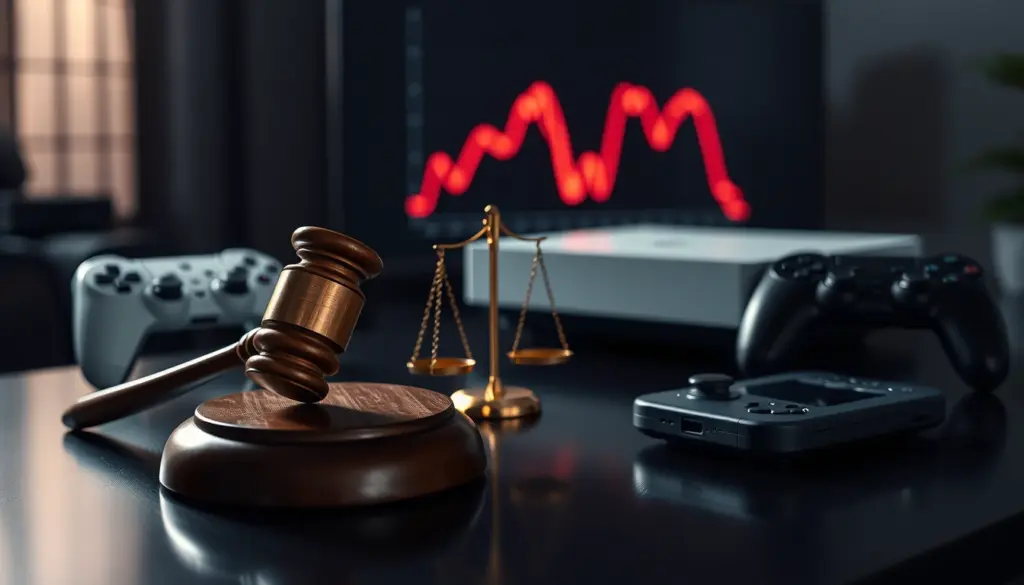
Nintendo told a federal judge this week that its customers have no legal claim to a share of the tariff refunds it may soon collect from the US government – a defense filed one day before Nintendo’s Tokyo-listed shares dropped 4%. The July 21, 2026 motion to dismiss is Nintendo’s answer to Hoffert et al. v. Nintendo, a proposed class action accusing the company of “double-dipping”: raising Switch and Switch 2 accessory prices in 2025 to cover tariffs a court later ruled illegal, then separately suing the federal government to get those same tariff payments back.
Sony faces a nearly identical accusation. Walker et al. v. Sony Interactive Entertainment, filed in the Northern District of California, claims Sony pocketed a “substantial windfall” by raising PlayStation 5 prices by as much as $200 per unit with no plan to pass along whatever refund the government eventually pays. Together, the two suits turn a routine 2025 pricing story into one of gaming’s biggest unresolved legal fights of 2026: who actually owns the money from an illegal tariff, once the price increase it justified is already sitting on a customer’s receipt.
The Accusation: Nintendo and Sony Accused of ‘Double-Dipping’ on Tariffs
Both lawsuits rest on the same legal theory: unjust enrichment through “double recovery.” In 2025, the Trump administration imposed sweeping tariffs on imported goods under the International Emergency Economic Powers Act (IEEPA), and both Nintendo and Sony responded by raising prices on tariff-exposed hardware, citing “changes in market conditions” and a “challenging economic environment,” respectively. Neither company named tariffs directly in its pricing announcements, but plaintiffs in both the Nintendo tariff lawsuit and the Sony case argue the timing makes the connection obvious.
The twist arrived in February 2026, when the US Supreme Court ruled the Trump administration had exceeded its authority in imposing the IEEPA tariffs, invalidating them. The federal government subsequently stood up a $166 billion refund program covering roughly 300,000 importers across every sector of the economy, not just gaming. Nintendo moved quickly to claim its share, suing the government in March 2026 for its own refund, with interest.
That is where “double recovery” comes in. If Nintendo and Sony already collected the tariff cost once, from consumers, at checkout, and now collect it a second time, from the Treasury, plaintiffs argue neither company has any remaining justification for keeping the original price increase in place, let alone for refusing to refund it. Nintendo’s own filing does not deny that it may receive a refund; it argues that receiving one “does not give Plaintiffs any legal entitlement to those funds” – a distinction Nintendo’s lawyers drew explicitly in court papers.
Timeline: From Trump’s Tariffs to the Supreme Court’s Reversal
The path from a 2025 pricing decision to a 2026 tariff lawsuit runs through more than a dozen distinct events across two companies, one Supreme Court ruling, and two separate federal cases:
- April 2025: The Trump administration imposes broad IEEPA tariffs. Nintendo holds the Switch 2 console price steady but raises accessory prices: the Joy-Con 2 pair goes from $89.99 to $95, other Switch 2 accessories rise $5 to $10, and original Switch models climb $30 to $50.
- August 2025: Sony raises PS5, PS5 Digital Edition, and PS5 Pro prices by $50 each, citing a “challenging economic environment.”
- February 20, 2026: The US Supreme Court rules the IEEPA tariffs unlawful. The administration later announces a $166 billion refund program for roughly 300,000 importers nationwide.
- March 6, 2026: Nintendo sues the US government for its own tariff refund, with interest.
- April 2, 2026: Sony implements a second hike, adding $100 to the disc and Digital Edition PS5 and $150 to the PS5 Pro – cumulative increases since August 2025 of $150, $150, and $200 respectively.
- Late April 2026: Gregory Hoffert and Prashant Sharan file the proposed class action Hoffert et al. v. Nintendo in Washington state court.
- May 6, 2026: Amorey Walker and Bryce Foster-Quarles file Walker et al. v. Sony Interactive Entertainment in the Northern District of California.
- July 21, 2026: Nintendo files its motion to dismiss, or alternatively to compel private arbitration.
- July 22, 2026: Nintendo’s Tokyo-listed shares fall 4%.
As of this writing, the court has not yet ruled on Nintendo’s motion, and Sony’s case management conference is scheduled for August 3, 2026 before Magistrate Judge Sallie Kim.
How Much Nintendo and Sony Actually Raised Prices
The dollar figures at the center of the tariff lawsuit are modest per unit but scale quickly across tens of millions of consoles sold. Sony’s increases are the largest in absolute terms, since the entire PS5 lineup – not just accessories – was repriced twice within eight months:
| Product | Price Before Aug 2025 | Price After Apr 2026 | Increase |
|---|---|---|---|
| Nintendo Switch 2 Joy-Con 2 (pair) | $89.99 | $95.00 | +$5.01 (~6%) |
| Nintendo Switch (original, various models) | varies | varies | +$30 to +$50 |
| Sony PS5 (disc) | $499.99 | $649.99 | +$150 (~30%) |
| Sony PS5 Digital Edition | $449.99 | $599.99 | +$150 (~33%) |
| Sony PS5 Pro | $699.99 | $899.99 | +$200 (~29%) |
Nintendo’s public position, repeated in its motion to dismiss, is that its accessory increases were “modest and selective” and driven by a mix of memory chip costs, labor, and shipping – not tariffs alone. Sony has not offered a comparably detailed public breakdown of its own cost drivers beyond citing broad economic pressure. Both companies left their flagship console-only bundles largely untouched relative to accessories and premium SKUs, a distinction plaintiffs in both cases argue was a deliberate way to limit visible sticker shock while still recovering tariff costs across the wider product line.
Inside Hoffert v. Nintendo
The Nintendo tariff lawsuit was filed in Washington state court by two named plaintiffs, Gregory Hoffert and Prashant Sharan, on behalf of a proposed nationwide class of everyone who purchased a price-hiked Switch or Switch 2 accessory between February 2025 and February 2026 – the window bracketing the tariff-driven increases and the Supreme Court’s reversal. The complaint alleges Nintendo will “recover the same customs duty payments twice: once from consumers via higher prices, and a second time from the federal government via tariff reimbursements, including government interest.”
That framing is what makes this a “double recovery” case rather than an ordinary price-gouging complaint: the plaintiffs are not arguing the original price increase was illegal on its own, only that keeping it in place after a government refund arrives amounts to unjust enrichment. Nintendo disputes that characterization entirely, and its motion argues the entire theory collapses once a transaction is treated as final at the moment of sale, regardless of what happens to the underlying tariff months or years later.
Inside Walker v. Sony Interactive Entertainment
Sony’s version of the tariff lawsuit, filed by plaintiffs Amorey Walker and Bryce Foster-Quarles, uses nearly identical language: a nationwide class covering PS5 purchases from August 1, 2025 to the present, and an accusation that Sony is set to receive a “double recovery windfall” it has no intention of sharing with the customers who funded the original price increase. Law360 reported the case has been assigned to Magistrate Judge Sallie Kim, with an initial case management conference scheduled for August 3, 2026.
Unlike Nintendo, Sony has not publicly disclosed whether it has filed its own refund claim against the US government – a gap that plaintiffs’ attorneys are likely to probe during discovery, since the existence (or absence) of a Sony refund filing bears directly on whether a “windfall” exists at all. Sony has not issued a detailed public response beyond standard litigation boilerplate declining to comment on pending cases.
Nintendo’s Motion to Dismiss: ‘Not How Commercial Transactions Work’
Nintendo’s July 21 filing makes three core arguments. First, that consumers who bought Nintendo hardware “received exactly what they bargained and paid for: a console, game and/or accessory at a price to which both parties agreed” – and that retroactively unwinding a completed transaction because of a later legal development “is not how commercial transactions work.” Forbes reported Nintendo’s filing states plainly that “Nintendo or one of its retailers set a price for each product, and consumers decided whether that price was worth paying.”
Second, Nintendo argues consumers had alternatives: they could have “abstain[ed] from purchasing the product or [sought] out competing products” if the price was unacceptable. Third, and most consequential for the case’s survival, Nintendo argues that its own Terms of Service require disputes to go to private arbitration rather than a class action lawsuit at all.
The Arbitration Clause Argument
Compelling arbitration is often the more powerful of Nintendo’s two arguments, because it does not require a judge to rule on the merits of “double recovery” at all – it only requires finding that customers agreed to Nintendo’s terms of service, which nearly all Switch and Switch 2 owners must accept to use online features. US courts have historically enforced these clauses under the Federal Arbitration Act far more consistently than they rule on novel unjust-enrichment theories, which is why GameDeveloper’s coverage of the filing treated the arbitration request as the more immediate threat to the Nintendo tariff lawsuit’s survival as a class action, even if Nintendo loses on the underlying legal theory.
Why Nintendo’s Stock Fell 4% in Tokyo
Nintendo’s Tokyo shares dropped 4% on July 22, 2026, the trading day immediately following coverage of the dismissal motion. A single class-action motion rarely moves a stock this large on its own; the more likely explanation is that the filing crystallized investor attention on Nintendo’s broader tariff exposure at a moment when the company is already forecasting a unit sales decline for its fiscal year ending March 2027, citing tariffs and price adjustments as headwinds in its own guidance.
The timing compounds an already difficult stretch for Nintendo’s hardware business. Switch 2 pricing rose again in September 2026 in the US, Canada, and Europe, and Nintendo has separately disclosed a roughly $638 million cost hit this fiscal year tied to memory-chip shortages, tariffs, and currency swings. A pending class action does not change any of those fundamentals on its own, but it adds legal-cost uncertainty and headline risk on top of a hardware margin story investors were already watching closely.
The $166 Billion Refund Program Behind the Fight
Both lawsuits only exist because of the scale of the underlying refund program. After the Supreme Court’s February 2026 ruling, the federal government did not simply stop collecting the invalidated IEEPA tariffs going forward – it set up a retroactive refund program covering an estimated $166 billion already collected from roughly 300,000 importers across every category of imported goods, from electronics to apparel to industrial equipment. Gaming hardware is a small fraction of that total, but Nintendo and Sony are among the highest-profile consumer brands caught in the resulting fight over where the money should end up.
Nintendo’s own suit against the government, filed in March 2026, argues the tariffs “resulted in the collection of more than $200 billion in tariffs on imports for nearly all countries” – language reported by WRAL from Nintendo’s Court of International Trade filing. That case is entirely separate from the consumer class action, but it is the reason plaintiffs argue Nintendo will end up holding money twice: once from the price increase, and again from the government’s refund.
Corporate America’s Tariff Windfall Playbook
Nintendo and Sony are not alone in facing this exact fact pattern, and the wider corporate response splits cleanly into two camps: companies passing tariff refunds back to customers, and companies keeping them while raising prices in the first place. Ford faces a similar Michigan class action over an estimated $1.3 billion in expected tariff refunds it has so far declined to pass along. Only a small number of major companies have publicly committed to sharing refunds at all.
| Company | Raised Prices Citing Tariffs | Passing Refunds to Consumers | Facing a “Double Recovery” Suit |
|---|---|---|---|
| Nintendo | Yes | No | Yes – Hoffert et al. v. Nintendo (WA) |
| Sony | Yes | No | Yes – Walker et al. v. Sony (N.D. Cal.) |
| Ford | Yes | No | Yes – Michigan class action |
| Costco | – | Yes, via future price reductions | No |
| FedEx | – | Yes, direct reimbursement | No |
| UPS | – | Yes, direct reimbursement | No |
The contrast matters for how a judge might eventually view Nintendo and Sony’s conduct. Costco, FedEx, and UPS did not need a class action to decide that money collected from customers to cover a now-invalid tariff should flow back to them in some form. That three companies made that call voluntarily undercuts, at least rhetorically, Nintendo’s argument that unwinding a completed sale over a later legal development is simply “not how commercial transactions work.”
Historical Context: Console Pricing in the Tariff Era
Tariff-driven price hikes arrived on top of an already unusual pricing cycle for this console generation. Historically, hardware got cheaper as it aged: the PS4 fell from $399.99 at launch to roughly $299 within three years, and the Xbox 360 saw a similar decline. The PS5, Switch 2, and Xbox Series X/S generation broke that pattern, rising in price as 2026 wore on – Sony’s increases are detailed above, Nintendo raised Switch 2 pricing again in September 2026, and Microsoft raised Xbox Series X/S prices in the same window, each citing overlapping cost pressures from memory-chip shortages and tariffs.
That pricing environment has already reshaped the sales leaderboard once this year – Sony’s own hardware sales fell sharply after its price increases took hold, even as Nintendo’s Switch 2 continued outselling the PS5. The tariff lawsuit adds a legal dimension to a story that was already primarily about affordability, and it arrives alongside separate legal pressure on Sony’s storefront pricing practices, which face their own class actions in multiple countries.
Legal Analysis: Will the Arbitration Clause Sink These Cases?
Unjust enrichment claims built on a “double recovery” theory are not new to American courts, but they are not common in the consumer class action context either – most reported unjust enrichment cases involve a single defendant collecting money it was never entitled to, not a defendant collecting money legally at the time of sale and only becoming potentially over-compensated because of a later, unrelated government action. That novelty cuts both ways: it gives Nintendo’s lawyers room to argue the theory has no clear precedent, while giving plaintiffs’ lawyers room to argue no court has ever rejected it either.
Why the Sony Case May Be More Exposed
Sony’s case may be harder to dismiss on the arbitration ground alone if its own terms of service are less airtight on this specific point than Nintendo’s, though that has not yet been tested in filings. Sony also faces a structural disadvantage Nintendo does not: without a disclosed refund claim against the government, Sony cannot point to “the same money Nintendo is suing to get back” as cleanly as Nintendo can frame its own case. If Sony has not filed for a refund at all, plaintiffs may struggle to prove a “windfall” exists yet – but that same silence could also look worse to a judge if Sony is simply waiting to file quietly later.
Market and Investor Impact
Beyond the single-day 4% share drop, the more durable market impact is what the tariff lawsuit signals about hardware-margin risk heading into 2027. Nintendo and Sony both built their 2025–2026 pricing strategy around the assumption that tariff costs were a permanent, not temporary, feature of the business – Nintendo’s own leadership has described the pressure as “medium to long term.” A class action that specifically targets the logic of that pricing strategy adds a new variable: legal cost, reputational risk, and the possibility that a future court order could force either company to actually reverse price increases it has treated as durable.
For investors, the more important number may not be the eventual settlement or judgment, which is likely to represent a small fraction of either company’s revenue, but the disclosure and litigation cost of fighting a nationwide class action through discovery. Sony’s case management conference on August 3, 2026 will be the next concrete signal of how quickly, or slowly, that process moves.
What Happens Next: Key Dates to Watch
Three dates matter most for anyone tracking how the tariff lawsuit resolves. First, a ruling on Nintendo’s July 21 motion to dismiss, which has no fixed deadline but typically takes weeks to months in similar consumer class actions. Second, Sony’s case management conference on August 3, 2026, which will set the discovery schedule and give the first real signal of the court’s posture toward the “double recovery windfall” theory. Third, any move by Nintendo to disclose the status of its own March 2026 refund suit against the government, since a ruling in Nintendo’s favor there would directly strengthen plaintiffs’ argument that real refund money exists and is simply being withheld.
A fourth factor worth watching is contagion: Ford’s Michigan class action already shows the same legal theory extending well beyond gaming, and any company that raised consumer prices in 2025 while separately pursuing its own government tariff refund is now a plausible target for the same style of complaint.
Predictions: Where the Tariff Lawsuits Go From Here
1. Nintendo’s arbitration argument, not its “bargained for” argument, decides the class-action question. Judges tend to rule on enforceable arbitration clauses before wading into novel unjust-enrichment theories, and Nintendo’s motion is structured to invite exactly that shortcut.
2. Sony settles before Nintendo does, if either settles at all. Without a disclosed government refund claim to defend, Sony has less incentive to fight the underlying theory all the way to a ruling that could also complicate any future refund filing of its own.
3. At least one more major electronics or appliance brand faces a similar suit within a year. Ford’s parallel case already shows the pattern extending past gaming, and any company that both raised prices in 2025 and is separately seeking a tariff refund is exposed to the same theory.
4. Neither Nintendo nor Sony voluntarily reverses its price increases in 2026, regardless of the lawsuits’ outcome. Both companies have already framed the pricing pressure as structural rather than temporary, making a voluntary rollback commercially unlikely even if litigation risk rises.
5. The stock impact remains contained to single-digit percentage moves tied to news events, not a sustained selloff. The lawsuits’ financial exposure is small relative to either company’s overall revenue; the bigger driver of Nintendo and Sony share prices through the rest of 2026 remains hardware unit sales and console pricing broadly, not this litigation specifically.
Frequently Asked Questions
What is the Nintendo tariff lawsuit about?
Hoffert et al. v. Nintendo accuses Nintendo of raising Switch and Switch 2 accessory prices in 2025 to cover tariffs later ruled illegal by the Supreme Court, then separately suing the US government for a refund of those same tariffs without passing any benefit back to consumers.
Why is Sony also being sued over tariffs?
Walker et al. v. Sony Interactive Entertainment makes a nearly identical “double recovery windfall” claim, based on Sony raising PS5, PS5 Digital, and PS5 Pro prices by a cumulative $150 to $200 between August 2025 and April 2026.
Did Nintendo actually win money from tariff refunds?
Nintendo sued the US government for a tariff refund in March 2026, but as of this writing there is no public confirmation that money has been paid out, only that Nintendo is pursuing it.
What did Nintendo argue in its motion to dismiss?
Nintendo argues consumers “received exactly what they bargained and paid for,” that a later tariff refund creates no legal entitlement for past customers, and that its terms of service require arbitration rather than a class action.
When will the Sony tariff lawsuit go to trial?
No trial date has been set. The case’s first case management conference is scheduled for August 3, 2026 before Magistrate Judge Sallie Kim in the Northern District of California.
Are consumers likely to win these lawsuits?
It is too early to say. Nintendo’s arbitration clause argument is considered a significant procedural hurdle for the class action to survive, independent of whether the “double recovery” theory itself has merit.
Will Nintendo or Sony refund the price increases?
Neither company has committed to doing so. Nintendo’s court filings explicitly argue it has no legal obligation to, and Sony has not made a public statement on the question.
What other companies face similar tariff-refund lawsuits?
Ford faces a comparable class action in Michigan over an estimated $1.3 billion in expected tariff refunds it has declined to pass along to customers, using the same underlying legal theory as the Nintendo and Sony cases.
Related Coverage
- PS5 Sales Crash 58% as Console Prices Surge
- PlayStation Store Sued in 4 Nations, $2.7B at Stake
- Switch 2 Hits 19.86M, Outsells PS5 in Year One
- Valve Steam Antitrust Trial: 32,000 Devs, $3.1B
- Switch 2’s EU Fix Adds 10g, Retires Switch 1 in 2027
- Xbox Shipments Sink 22%, Head Toward Zero by 2027
For more coverage of the business side of the games industry, visit the gaming section.