
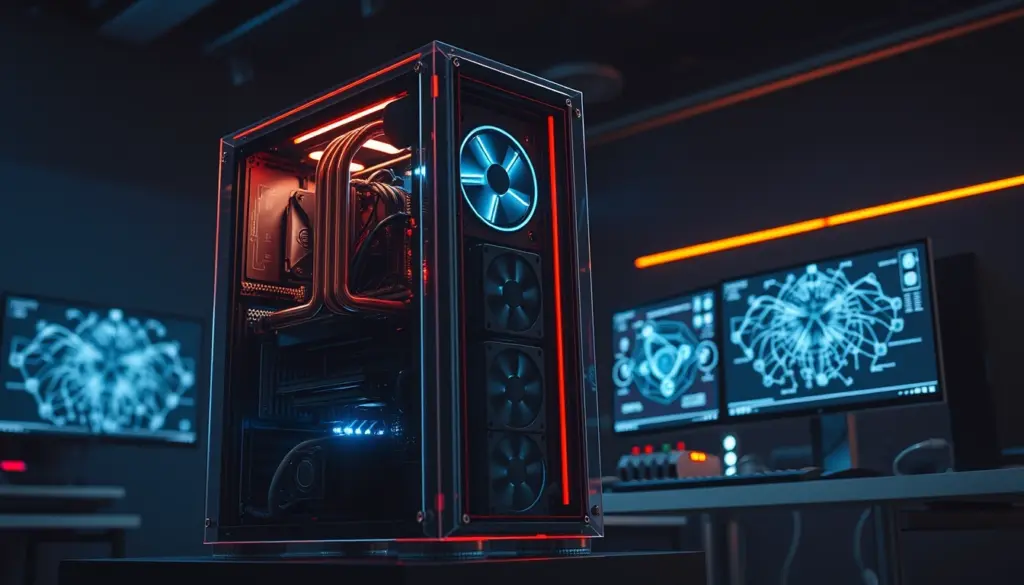
AMD used its IFA 2026 keynote in Berlin to show off a machine most buyers will never touch: the Threadripper Halo Station, a liquid-cooled deskside workstation built to run AI models with more than a trillion parameters without ever touching the cloud. The company calls it a prototype. The specs read like a shrunken datacenter rack.
AMD General Manager Jack Huynh introduced the machine on stage September 4, framing it as a new category rather than a faster PC. “Today here at IFA, we are witnessing the birth of something entirely new. This is the most powerful workstation in the world, designed and engineered for completely new era computing, capable of running AI models with more than 1 trillion parameters and we call it the Threadripper Halo Station,” Huynh said, according to Investing.com’s coverage of the keynote.
No price. No ship date. No retail partner named on stage. What AMD did confirm is a spec sheet that puts the Halo Station closer to a small AI cluster than anything sold under the Threadripper badge before. Here is what is actually locked down, what analysts are guessing, and why AMD picked this moment to plant a flag in the local-AI-workstation market.
What AMD Announced at IFA 2026
The Threadripper Halo Station debuted at IFA 2026 in Berlin on September 4, 2026, described by AMD as a prototype deskside workstation that brings datacenter-class AI compute into a single system, according to AMD’s own product page. The company’s pitch is narrow and specific: engineer a box that can train, fine-tune, and run large models locally, including agentic workflows, for researchers and developers who are currently stuck waiting on shared cloud GPU capacity.
AMD’s official language on the announcement reads: “AMD Threadripper™ Halo Station is a prototype system AMD is showing for the first time at IFA 2026 that brings datacenter-class AI compute into a single deskside workstation,” per the AMD Threadripper Halo Station product page. A companion line from AMD’s event materials adds that the system “is engineered to break through today’s bottlenecks to train and run massive models locally.”
That bottleneck framing matters. Cloud GPU rental prices for high-end accelerators have been volatile through 2026, and AI teams that need dedicated, always-on capacity for months at a time increasingly run the numbers on owning hardware outright instead of renting it by the hour. AMD is betting there is a real, if small, buyer base willing to pay datacenter money for a machine that sits under a desk.
Inside the Box: A 96-Core Threadripper PRO 9995WX
The CPU at the center of the Halo Station is the Ryzen Threadripper PRO 9995WX, AMD’s flagship workstation chip built on the Zen 5 architecture. It packs 96 cores and 192 threads, with boost clocks reported up to 5.4 GHz, an 8-channel DDR5 memory controller, and 128 lanes of PCIe 5.0 connectivity, according to hardware outlet coverage of the launch. That lane count matters more than it sounds: it is what lets AMD hang multiple full-bandwidth accelerator cards off a single CPU without starving any of them.
System memory tops out at 2TB of DDR5, a figure multiple outlets, including Tom’s Hardware, confirmed independently from AMD’s own materials. Everything in the chassis, CPU and accelerators alike, runs on liquid cooling, a departure from the air-cooled workstation norm that signals just how much heat AMD expects this configuration to throw off under sustained AI workloads.
The Real Story: 576GB of HBM3E for Local Models
The CPU is almost a supporting actor. The headline number is memory attached to AMD’s Instinct MI350P accelerators, the same datacenter GPU line AMD sells into hyperscale AI clusters. The demo unit shown at IFA carried two MI350P cards, each with 144GB of HBM3E memory and 4TB/s of bandwidth, for a base configuration of 288GB of accelerator memory. AMD has confirmed a hardware path to four cards, which would push total accelerator memory to 576GB, according to ServeTheHome’s breakdown of the system.
Stack that 576GB of HBM3E on top of 2TB of system DDR5 and the Halo Station can, in theory, hold a model with more than a trillion parameters entirely on one machine without swapping to disk or splitting inference across a network. That is the entire pitch. AMD is not selling raw FLOPS as the differentiator here, it is selling capacity: the ability to keep an enormous model resident in memory on a single deskside box.
AMD’s second confirmed quote from the launch doubles down on that framing: the Halo Station is “designed and engineered for a complete new era of computing, capable of running AI models that are a trillion parameters,” Huynh said, as reported by PCMag’s writeup of the keynote.
Threadripper Halo Station: Full Spec Sheet
| Component | Confirmed Spec |
|---|---|
| CPU | AMD Ryzen Threadripper PRO 9995WX (Zen 5) |
| Cores / Threads | 96 cores / 192 threads |
| Boost Clock | Up to 5.4 GHz |
| Memory Channels | 8-channel DDR5 |
| PCIe Lanes | 128 x PCIe 5.0 |
| System Memory | Up to 2TB DDR5 |
| Accelerators | AMD Instinct MI350P, 2 in base config, path to 4 |
| Accelerator Memory (per card) | 144GB HBM3E, 4TB/s bandwidth |
| Total Accelerator Memory (max) | 576GB HBM3E (4 cards) |
| Cooling | Full liquid cooling, CPU and accelerators |
| Target Workload | Local training, fine-tuning, and inference on 1T+ parameter models |
| Status as of Sept. 6, 2026 | Prototype, no confirmed price or ship date |
What It Will Cost: Analyst Estimates, Not AMD Numbers
AMD has not published a price for the Threadripper Halo Station, and the company has not committed to a shipping date. That has not stopped hardware press from running the math on parts alone. Tom’s Hardware estimated that the processor, 2TB of DDR5, and the two accelerators would have cost more than $100,000 at street prices on the day of the announcement, with storage, power delivery, and cooling potentially pushing a finished configuration past $150,000.
Treat that figure as an estimate built from component pricing, not a number AMD has confirmed. AMD’s own materials describe the unit on stage as a prototype, language that typically precedes a longer runway before retail availability, OEM partnerships, and final pricing get locked in. Buyers hoping for a Halo Station configurator this quarter are going to be disappointed either way.
Why AMD Is Chasing Local AI Instead of Just Bigger Clusters
AMD’s Instinct line already competes for hyperscale AI cluster deals against Nvidia’s datacenter GPUs, a fight AMD has been fighting from behind for most of the current AI buildout. The Halo Station is a different bet: instead of trying to out-scale Nvidia in the cloud, AMD is packaging its accelerator silicon into a form factor a single researcher can own outright.
That plays to a real, growing complaint among AI developers: shared cloud GPU queues, per-hour billing that adds up fast on long fine-tuning runs, and data governance rules that make some organizations reluctant to push proprietary model weights or sensitive training data off-premises at all. A workstation that keeps everything local sidesteps both problems, provided the buyer can afford the hardware and doesn’t mind the discontinued elasticity of cloud scaling.
It also gives AMD a marketing platform independent of the CUDA ecosystem fight it has struggled to win. Instead of asking developers to migrate existing CUDA pipelines to ROCm, AMD is pitching a brand-new use case, on-device trillion-parameter models, where no incumbent has an entrenched software advantage yet.
Halo Station vs. Nvidia DGX Spark vs. Apple Mac Studio
AMD is not the only company selling a desk-sized box for local AI. Nvidia’s DGX Spark and Apple’s Mac Studio both chase overlapping but distinct slices of the same market, and none of the three plays the exact same game.
Nvidia DGX Spark: Smaller, Cheaper, CUDA-Native
Nvidia’s DGX Spark runs on the GB10 Grace Blackwell Superchip with 128GB of coherent unified LPDDR5x memory, according to Nvidia’s own product page. Nvidia positions it for fine-tuning models up to roughly 70 billion parameters and running inference on models up to about 200 billion parameters, a fraction of the trillion-parameter ceiling AMD is marketing for the Halo Station. What DGX Spark has that AMD does not is a mature CUDA, cuDNN, and TensorRT software stack that most AI research pipelines are already built on.
Apple Mac Studio: Consumer Price, Consumer Ceiling
Apple’s current Mac Studio lineup, built around the M5 Max and M5 Ultra chips, tops out at 512GB of unified memory, with that top configuration listed as arriving in late October, according to Apple’s Mac Studio page. That is a serious amount of memory for a machine that starts at a fraction of workstation-class AI pricing, and it has made Mac Studio a popular choice for developers running mid-size open models locally. It is not, however, aimed at trillion-parameter frontier models, and Apple has never marketed it that way.
| Machine | Core Silicon | Max Local Memory | Primary Software Stack | Target Buyer |
|---|---|---|---|---|
| AMD Threadripper Halo Station | Threadripper PRO 9995WX + up to 4x Instinct MI350P | 2TB DDR5 + up to 576GB HBM3E | ROCm | AI researchers, model developers, deep-pocketed labs |
| Nvidia DGX Spark | GB10 Grace Blackwell Superchip | 128GB unified LPDDR5x | CUDA / cuDNN / TensorRT | Individual developers, small AI teams |
| Apple Mac Studio (M5 Max/Ultra) | M5 Max or M5 Ultra SoC | Up to 512GB unified memory | Metal / MLX | Creative pros, developers, prosumer AI users |
The honest read on this comparison: AMD is not really competing with DGX Spark or Mac Studio on price or accessibility. It is competing with them on ceiling. Nobody else is publicly marketing a deskside machine that can hold a trillion-parameter model in memory without splitting it across a network of servers.
The ROCm Problem AMD Still Has to Solve
Hardware capacity is only half the story for any AI workstation. AMD’s Instinct accelerators run on the company’s ROCm software stack, which has closed ground on Nvidia’s CUDA ecosystem over the past two years but still trails it in library support, framework maturity, and the sheer volume of existing research code written against CUDA primitives.
A researcher deciding between a Halo Station and a DGX Spark isn’t just comparing memory ceilings. They are weighing whether the extra capacity is worth porting workflows to ROCm, or whether staying inside Nvidia’s ecosystem, even at a lower memory ceiling, is the safer bet for getting existing code running fastest. AMD’s wager is that for teams specifically blocked by memory limits, that tradeoff will tilt in its favor. For everyone else, it likely will not.
From Threadripper to Halo: How AMD Got Here
Threadripper has spent most of its history as a high-core-count chip for video editors, 3D renderers, and simulation workloads, a workstation product distinct from AMD’s server-focused EPYC line. The Halo Station marks the first time AMD has paired that CPU lineage directly with its Instinct datacenter accelerators inside a single consumer-facing chassis, rather than keeping the two product lines in separate markets.
It also follows AMD’s Ryzen AI Halo branding, which launched mini PCs built around integrated NPUs for on-device AI earlier in 2026. The Threadripper Halo Station borrows the Halo name but operates at a completely different scale, swapping integrated NPU silicon for full discrete datacenter accelerators. The naming overlap signals AMD wants “Halo” to mean on-device AI capability across its entire product stack, from small form factor mini PCs up to six-figure workstations.
Market Impact: What This Means for AMD, Nvidia, and Buyers
For AMD, the Halo Station is as much a statement as it is a product. It gives the company a headline-grabbing answer to Nvidia’s dominance in AI infrastructure without requiring AMD to win a cloud contract to prove the point. Every outlet covering the IFA keynote led with the “most powerful workstation in the world” framing, which is exactly the kind of positioning AMD needs heading into a year where Nvidia’s Blackwell and upcoming Rubin architectures continue to set the pace in datacenter AI.
For Nvidia, the competitive pressure is indirect for now. DGX Spark serves a different, lower price tier, and Nvidia’s real battleground remains hyperscale cluster deals rather than six-figure prosumer workstations. But if AMD can get the Halo Station into the hands of even a small number of visible AI researchers and get workloads running well on ROCm, it chips away at the CUDA-is-the-only-serious-option narrative that has underpinned Nvidia’s pricing power.
For enterprise AI buyers, the calculus is narrower still. A machine priced somewhere north of $100,000, per Tom’s Hardware’s component-based estimate, is not a mainstream purchase. It is a tool for organizations that already know they need dedicated, always-on capacity for trillion-parameter workloads and have decided that cloud rental costs over a multi-year horizon outweigh the up-front hardware spend. That is a small buyer pool, but it is a buyer pool AMD did not have a product for until this week.
Where Coverage Diverges: Hype vs. Practicality
Press reaction since the keynote has split along a predictable line. Coverage focused on the technical specs treats the Halo Station as a genuine engineering milestone, the first deskside machine with a credible claim to trillion-parameter local inference. Coverage focused on practicality keeps circling back to the same point: this is prototype hardware with no price, no ship date, and no named OEM partner, aimed at a buyer who represents a rounding error of AMD’s total addressable market.
Both readings are correct, and they are not actually in tension. AMD built a halo product in the literal sense: something designed to generate attention and signal technical capability, more than something designed to move volume. Whether it ever ships as a purchasable SKU is a separate question from whether it succeeded at that first job.
What Still Isn’t Confirmed
Plenty remains unresolved a couple of days after the keynote. AMD has not confirmed final pricing, a retail or enterprise ship date, which OEMs (if any) will build and sell the system, or benchmark numbers against real training and inference workloads. Every dollar figure currently circulating, including the six-figure estimates from Tom’s Hardware, is a third-party calculation based on component costs, not an AMD-issued price.
It’s also unclear whether “path to four” accelerators means AMD will sell a four-card configuration at launch, or whether that capacity exists mainly as a future upgrade path for early two-card buyers. AMD’s language so far leaves both readings open.
Predictions: What Happens Next
- A 2027 launch window is likely. Prototype-to-retail timelines for workstation-class hardware at this scale typically run 6-12 months, putting a realistic ship date sometime in 2027 rather than late 2026.
- Pricing will land in six figures, tiered by accelerator count. Expect AMD to offer a lower-cost two-MI350P configuration alongside a premium four-card version once official pricing appears, rather than a single fixed SKU.
- ROCm tooling announcements will follow closely. AMD cannot sell trillion-parameter local AI on hardware alone. Expect software partnerships and ROCm compatibility updates timed to any firm ship date.
- Nvidia will not respond with a direct DGX Spark successor immediately. DGX Spark and Halo Station serve different price tiers, so Nvidia’s more likely counter is emphasizing DGX Station or cluster-scale products rather than matching AMD’s memory ceiling at the same form factor.
- Enterprise interest will outpace individual-buyer interest. The price ceiling all but guarantees early adoption comes from research labs and enterprise AI teams with dedicated hardware budgets, not individual developers.
Frequently Asked Questions
What is the AMD Threadripper Halo Station?
It is a prototype liquid-cooled deskside workstation AMD showed at IFA 2026, built around a 96-core Threadripper PRO 9995WX CPU and up to four Instinct MI350P accelerators, designed to run AI models with more than a trillion parameters locally.
How much will the Threadripper Halo Station cost?
AMD has not announced official pricing. Tom’s Hardware estimated the core components alone, CPU, 2TB of DDR5, and two accelerators, would cost more than $100,000 at street prices, with a fully finished configuration potentially exceeding $150,000.
When will the Threadripper Halo Station be available to buy?
AMD has not confirmed a release date. The company describes it as a prototype system shown for the first time at IFA 2026, with no retail timeline announced as of September 6, 2026.
How much memory does the Threadripper Halo Station have?
Up to 2TB of system DDR5 memory, plus up to 576GB of HBM3E memory across four Instinct MI350P accelerator cards. The base configuration shown at IFA used two accelerators for 288GB of accelerator memory.
How does the Threadripper Halo Station compare to Nvidia’s DGX Spark?
DGX Spark uses Nvidia’s GB10 Grace Blackwell Superchip with 128GB of unified memory and targets fine-tuning up to roughly 70-billion-parameter models. The Halo Station targets a much higher ceiling, more than a trillion parameters, but runs on AMD’s ROCm software stack rather than Nvidia’s more established CUDA ecosystem.
Is the Threadripper Halo Station meant for regular consumers?
No. AMD is targeting AI researchers, model developers, and engineering teams working with large generative models who are constrained by cloud or shared infrastructure, not general consumers or gamers.
What accelerators does the Threadripper Halo Station use?
AMD Instinct MI350P accelerators, the same accelerator family AMD sells into datacenter and hyperscale AI clusters, each carrying 144GB of HBM3E memory and 4TB/s of memory bandwidth.
Why did AMD announce a prototype instead of a shipping product?
Showing a working prototype at a major trade show like IFA lets AMD generate press attention and signal technical direction well before pricing, manufacturing partners, and supply chains are finalized, a common strategy for halo-tier hardware announcements.