
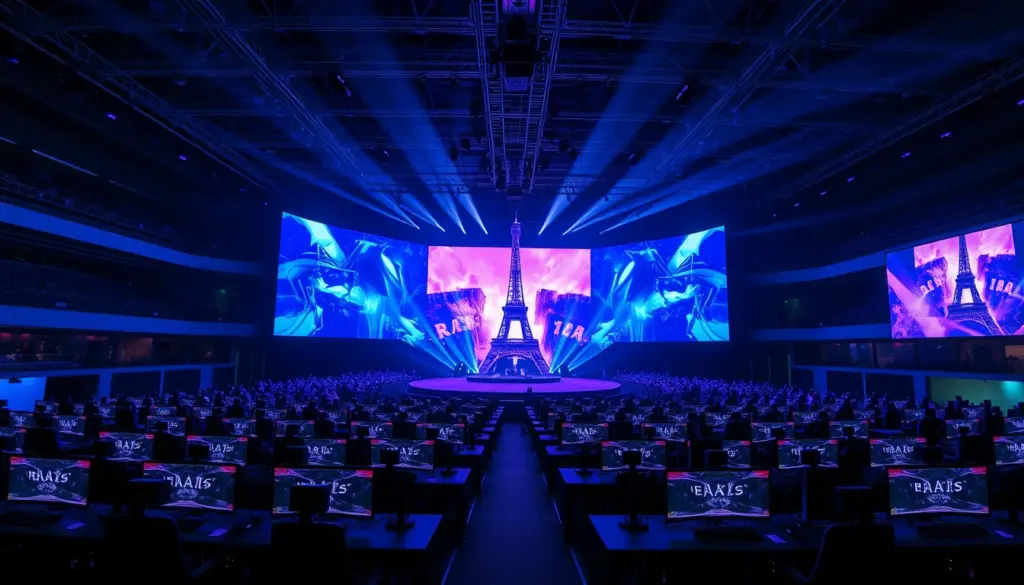
The Esports World Cup opened its third edition on July 8, 2026, in a city its organizers never planned to use. For two years the tournament was synonymous with Riyadh, the Saudi capital that built it into the richest prize pool in competitive gaming. This year it is happening at Paris Expo Porte de Versailles instead, after a security-driven relocation announced just eight weeks before the opening ceremony. The esports world cup now carries a record $75 million prize pool, more than 2,000 players from over 200 clubs, and a mainstream French television deal that puts competitive gaming on channels that have never carried it before.
The move is more than a change of venue. It exposes how much of modern esports economics runs through a single sovereign wealth fund, how fragile a Middle East-anchored events calendar can be, and how a festival built to project Saudi soft power ended up handing France a €600 million marketing opportunity instead. Here is what actually happened, what the numbers show, and what it means for the business of competitive gaming heading into 2027.
Why the Relocation: Security Concerns Tied to the 2026 Iran War
Reports of the relocation surfaced on May 14, 2026, with official confirmation from the Esports World Cup Foundation on May 20. The stated reason was regional instability connected to the 2026 Iran war, which had produced strikes near Saudi infrastructure and disrupted regional air travel in the months leading up to the tournament. Moving an event with over 2,000 traveling players, staff, and equipment out of a conflict-adjacent region in roughly eight weeks was, by any organizational standard, an emergency operation rather than a planned expansion.
Organizers were careful with the framing. The official line held that Riyadh remains the permanent home of the esports world cup, and that Paris represents a one-year rotation rather than a strategic pivot away from Saudi Arabia. As proof of that intent, the separate Esports Nations Cup – a related country-vs-country competition – is still scheduled to run in Riyadh later in 2026. Whether that framing survives contact with a successful Paris edition is one of the open questions this article returns to in its predictions.
Regardless of the motivation, the practical result is unprecedented: this is the first time the tournament has been held outside Saudi Arabia since its 2024 launch, according to Wikipedia’s tournament record.
Inside the $75 Million Prize Pool
The headline number is $75 million, up from $71.5 million in 2025 and $62.5 million at the 2024 launch. That makes 2026 the third consecutive year the esports world cup has set a new record for total prize money in competitive gaming, but the pace of growth is decelerating sharply – a detail most coverage of the event has skipped over.
| Edition | Host city | Total prize pool | Club Championship pool | Club partners | Participants |
|---|---|---|---|---|---|
| 2024 (1st) | Riyadh, Saudi Arabia | $62.5 million | $20 million | 30 organizations | ~2,000, 100+ countries |
| 2025 (2nd) | Riyadh, Saudi Arabia | $71.5 million | $27 million | 40 organizations | 2,500+, 100 countries |
| 2026 (3rd) | Paris, France | $75 million | $30 million | 40 organizations | 2,000+, 100+ countries |
Beyond the Club Championship allocation, the 2026 pool breaks down into roughly $39 million spread across the 25 individual game championships, about $6 million reserved for qualifier events, and just under $1 million in MVP and creator awards. Note that the Club Championship’s top prize is frozen at $7 million even as the total pool grows – the increase is being spent on breadth (more clubs earning something) rather than a bigger jackpot for the single winner.
The growth-rate story is the more interesting one for anyone tracking whether this is a sustainable business model or a subsidized marketing spend that eventually plateaus:
pools = {"2024": 62_500_000, "2025": 71_500_000, "2026": 75_000_000}
years = list(pools.keys())
for a, b in zip(years, years[1:]):
    growth = (pools[b] - pools[a]) / pools[a] * 100
    print(f"{a} -> {b}: +{growth:.1f}%")

# 2024 -> 2025: +14.4%
# 2025 -> 2026: +4.9%
Year-over-year growth roughly dropped by two-thirds. That is consistent with a fund normalizing spend after a splashy launch, not one that is retreating – the pool is still record-setting – but it undercuts the “unstoppable growth” narrative that tends to accompany each year’s press cycle. If the trend continues, 2027’s pool likely lands closer to $78–79 million than another double-digit jump.
25 Tournaments, 24 Games: The Paris Lineup
The 2026 program spans 25 tournaments across 24 titles, running the full seven-week window from July 6 through August 23. The roster mixes shooters, MOBAs, fighting games, sports titles, and racing games, and organizers used the relocation as an opportunity to refresh the lineup rather than simply port over 2025’s schedule.
| Title | Genre | 2026 status |
|---|---|---|
| Counter-Strike 2 | Tactical shooter | Returning |
| VALORANT | Tactical shooter | Returning |
| Dota 2 | MOBA | Returning, $2 million title pool |
| League of Legends | MOBA | Returning |
| Rainbow Six Siege | Tactical shooter | Returning |
| Street Fighter 6 / Tekken 8 | Fighting | Returning |
| Fortnite (Reload mode) | Battle royale | Returning |
| Trackmania | Racing | New for 2026 |
| StarCraft II | RTS | Dropped |
| Rennsport | Racing sim | Dropped |
Dropping StarCraft II drew immediate pushback from real-time-strategy fans and creators, who argued the genre that effectively built modern Korean esports was being sidelined in favor of higher-viewership shooter and battle-royale titles. Trackmania’s addition is a smaller but telling signal: it is a PC-native, community-mod-friendly racer with a passionate but modest following, suggesting organizers are still willing to gamble on niche titles rather than chase only the biggest streaming numbers.
Opening Ceremony: DJ Snake, Aya Nakamura, and 24.4 Million Viewers
The opening ceremony took place July 8 at La Seine Musicale, a concert venue on the Île Seguin outside central Paris, with performances from DJ Snake, Aya Nakamura, Theodora, and Mosimann, according to Tech Times’ coverage of the launch. It was a deliberate break from the more corporate, arena-bound openings of the Riyadh years, staged instead as a French pop-culture event first and an esports show second.
The bet paid off in raw attention: tracking firm Esports Charts recorded 24.4 million viewers across the ceremony’s broadcast and streaming footprint, a figure Forbes flagged as a standout even by the tournament’s own recent history. For an opening ceremony – traditionally the least competitive, most skippable part of any esports calendar – that is a legitimately large number, and it suggests the celebrity-headliner strategy is doing real audience-development work beyond the existing esports fanbase.
100,000 Tickets – and the Skepticism Behind the Number
Organizers announced on July 8 that more than 100,000 tickets had been sold for the Paris edition, a figure reported by The National as record pace for a first-year event in a new market. Given that Riyadh’s venues in 2024 and 2025 were built specifically around Saudi Arabia’s sports-entertainment push, out-drawing that pace with a cold-start audience in France is a meaningful data point for the “Europe wants this” thesis organizers are selling.
It is also a number that deserves scrutiny rather than repetition. The tournament runs for seven weeks across dozens of individual sessions, and “100,000 tickets” almost certainly counts session passes rather than unique attendees – a single enthusiastic fan attending ten sessions counts ten times toward that total. Esports industry press has raised exactly this concern, noting that the figure has not been broken down into unique visitors versus total ticketed sessions. None of that makes the number meaningless, but it means “100,000 tickets” and “100,000 people came to Paris Expo” are two different claims, and organizers have so far only supported the first one.
Who Owns the Esports World Cup: PIF, Savvy Games Group, and ESL FACEIT
Understanding who actually runs the esports world cup requires tracing three layers of ownership. The event itself is administered by the Esports World Cup Foundation, a nonprofit funded by Saudi Arabia’s Public Investment Fund (PIF) – the same sovereign wealth fund behind LIV Golf and stakes across Premier League football. Day-to-day tournament operations are supervised by ESL FACEIT Group, the merged tournament organizer that PIF’s gaming vehicle, Savvy Games Group, acquired for roughly $1.5 billion in 2022.
Savvy Games Group is the operative entity to watch. It has pledged approximately $38 billion toward gaming and esports industry development, funding everything from the Club Partner Program’s direct payments to esports organizations – about $20 million distributed to 40 partner clubs in both 2025 and 2026 – to outright acquisitions and equity stakes across the games business. The nonprofit-foundation structure at the top gives the tournament a charitable, sport-governing-body veneer, but the money and operational control both trace back to a single state-owned investment fund.
The EA Buyout Connection: Saudi Arabia’s Broader Gaming Playbook
The esports world cup is not PIF’s only major gaming bet running in parallel this year. The same fund is a lead backer of the $55 billion take-private acquisition of Electronic Arts, a deal that has been stuck at a CFIUS national-security review for months. Earlier in 2026, PIF reorganized its gaming holdings internally, transferring roughly $12 billion in equity positions – including stakes tied to Nintendo, Take-Two Interactive, and Bandai Namco – into Savvy Games Group, while keeping its EA position under direct PIF ownership rather than folding it into the Savvy portfolio.
Seen together, the pattern is a coordinated, multi-front bet on gaming as a strategic industry: publisher ownership through the EA deal, tournament and league infrastructure through Savvy Games Group and ESL FACEIT, and now a flagship live event relocated to the world’s most esports-hungry market outside Asia and North America. A tournament that looked, in 2024, like a one-off soft-power showcase now reads as one piece of a much larger portfolio strategy – which is exactly why the EA deal’s regulatory outcome and the esports world cup‘s European reception are worth tracking as a single story rather than two unrelated ones.
Economic Impact: Paris Bets on Becoming Europe’s Esports Capital
French officials have projected the tournament will generate approximately €600 million (roughly $700 million) in broader economic impact across tourism, hospitality, local spending, and event-related employment. A more conservative estimate, cited in local press, puts the direct spillover from the event itself at €300–400 million. Neither figure comes from an independent post-event audit – both are pre-event or early-event projections from officials and organizers with an obvious interest in the number looking large – so they should be read as the ceiling of the case, not a confirmed outcome.
Context helps calibrate that figure. The BLAST.tv Paris Major, a single-game Counter-Strike tournament held in the city in 2023, generated an estimated $32.4 million in economic benefit for Paris. Even the conservative €300 million estimate for the esports world cup is roughly ten times that – a jump that reflects the seven-week duration and 24-title breadth of the event, but is still large enough that it deserves independent verification once organizers publish (or decline to publish) post-event numbers. The explicit goal, per regional officials, is to establish Paris as Europe’s leading esports host within five years; this tournament is the opening argument for that case, not the proof of it.
France Télévisions and Esports’ Mainstream Broadcast Test
The most structurally interesting business story of this edition may not be the prize pool at all. France Télévisions, the national public broadcaster, is airing daily esports world cup coverage across France 2, France 3, and its france.tv streaming platform starting July 7, according to reporting on the broadcast deal. Those three outlets combined reach roughly 96 percent of the French population aged four and older – a distribution footprint no Twitch or YouTube esports broadcast has ever approached domestically.
French esports viewership has historically stayed overwhelmingly digital, with more than 80 percent of consumption happening online rather than on traditional television. A national broadcaster committing daily linear airtime to competitive gaming is a genuine first for the French market, and it is explicitly aimed at reaching older viewers and families that advertisers have struggled to access through streaming-only distribution. If viewership holds up through the seven-week run, expect other national broadcasters elsewhere in Europe to test similar deals for 2027 – this is the kind of experiment sponsors watch closely because it determines whether esports sponsorship budgets can ever compete with traditional sports for non-endemic advertisers.
The Sportswashing Debate: Criticism, Withdrawals, and Unpaid Prize Money
None of the numbers above happen in a vacuum. The esports world cup has faced sustained sportswashing criticism since its 2024 launch, with human-rights organizations including Amnesty International and Human Rights Watch flagging Saudi Arabia’s record on LGBTQ+ rights, women’s rights, treatment of dissidents, and the war in Yemen as context for PIF-funded sports and entertainment properties – the same framework applied to LIV Golf and Saudi-backed football investment. CNN described the tournament’s 2024 debut as causing a big splash and division across the industry, a framing that has held up across three editions.
The Withdrawal Pattern
A small but recurring number of teams and creators have declined to participate on human-rights grounds, and the pattern has continued into the Paris era rather than fading with the venue change.
| Year | Team / creator | Stated reason |
|---|---|---|
| 2022 (Gamers8) | Moist Esports | Objected to competing under a government criticized on LGBTQ+ rights |
| 2024 | Ex Oblivione | Cited inadequate accessibility support for community members |
| 2025 | ChrisCCH (Street Fighter 6) | Objected to how the event is funded and managed |
| 2025 | GeoGuessr community | Competitive maps disabled after organized fan protest |
The picture is not uniformly one-sided. At the 2024 event, Team Liquid received organizer approval to wear Pride-themed jerseys during competition – a small but real counterpoint to the boycott narrative, and evidence that participating organizations and the Foundation have found at least some room for negotiation rather than blanket restriction.
The 2024 Payment Dispute
Separately from the human-rights criticism, the 2024 Riyadh edition generated a genuine financial-integrity problem: multiple Apex Legends players, production staff, and on-screen talent reported unpaid prize money and invoices for months after the event concluded, despite a $60 million headline prize pool. The Esports World Cup Foundation has since stated that more than 99 percent of payments – including the full 2024 prize pool – have been completed, attributing the remaining delays to banking, verification, and cross-border processing requirements across dozens of countries and financial systems.
That explanation is plausible on its face – international esports payouts genuinely do involve slow banking rails – but it does not fully answer why a Foundation with a $75 million 2026 budget and PIF-scale backing could not resolve a 2024 payment gap faster. With far more media spotlight this year thanks to the France Télévisions deal and the Paris relocation, payment transparency is a much higher-stakes reputational issue than it was in Riyadh.
Security Stakes: Anti-Cheat, DDoS Risk, and Payment Integrity
A $75 million prize pool is, among other things, a very large bounty sitting on top of consumer software – and that has real security implications worth examining beyond the human-rights and financial-transparency angles above. Every major shooter on the 2026 roster runs kernel-level or deep anti-cheat: VALORANT’s Riot Vanguard, the tactical shooter we covered in depth in our recent report on Vanguard’s device-bricking incidents, Counter-Strike 2’s Valve Anti-Cheat, Apex Legends’ Easy Anti-Cheat, and Rainbow Six Siege’s BattlEye all run at Paris this summer, each with a very different risk-and-friction tradeoff between catching cheaters and exposing players to invasive system access.
The tournament’s format actually mitigates one common risk: LAN finals, played on organizer-controlled hardware and networks at Paris Expo, are inherently more resistant to the DDoS attacks and connection manipulation that plague high-stakes online qualifiers, where a targeted attack against a single player’s home connection can decide a match worth tens of thousands of dollars. The exposure shifts earlier in the pipeline – to the regional online qualifiers feeding into Paris, and to the account security of 2,000+ competitors who are now public targets for social-engineering and account-takeover attempts simply by virtue of having qualified.
The 2024 payment dispute described above is itself a security-adjacent story: any system moving tens of millions of dollars to individuals across 100+ countries is a target for interception, invoice fraud, and identity-verification abuse, independent of whether the underlying delays were innocent. As the esports world cup‘s financial footprint grows, expect payment-processing transparency – not just anti-cheat – to become a standard question tournament organizers are asked to answer publicly.
From Gamers8 to a $75 Million Spectacle: How We Got Here
The tournament did not appear from nothing. It is the direct successor to Gamers8, a Riyadh gaming festival that ran in 2022 and 2023 under the same Saudi funding structure and served as the proof of concept for a permanent, branded, multi-title championship. The esports world cup proper launched in 2024 with a $62.5 million pool and roughly 2,000 participants from 100 countries, then expanded in 2025 to $71.5 million, 28 club teams, and more than 2,500 participants – still entirely in Riyadh.
That three-year arc – from a regional festival, to a self-branded global tournament, to a forced-but-successful international relocation – compresses a growth trajectory that took traditional sports leagues decades into three summers. It also means 2026 is the first real stress test of whether the format travels, or whether it was quietly dependent on Riyadh’s purpose-built venues and unlimited state marketing budget all along. Early signals – the ticket sales, the broadcast deal, the 24.4 million ceremony viewers – suggest it travels reasonably well, though a single edition in one European city is a thin sample size for a permanent conclusion.
Competitive Landscape: EWC vs. Gamescom, Majors, and Franchise Leagues
The esports world cup occupies an unusual middle ground in the gaming-events calendar, and it is worth being precise about what it is not. It is not a trade show like Gamescom, the Cologne convention that draws hundreds of thousands of attendees to see game announcements and hands-on demos rather than watch competitive play – the two events are scheduled just days apart on the 2026 European calendar (Paris runs through August 23, Gamescom opens August 26), effectively giving European gaming fans a six-week, two-city gauntlet of back-to-back industry spectacle.
It is also structurally different from single-game Valve Majors like the BLAST.tv Paris Major, which crown a champion in one title over one weekend, and from franchised regional leagues that run a season format inside a single game’s ecosystem. The esports world cup‘s defining bet is breadth: one prize pool, one brand, and one seven-week window spanning 24 unrelated titles and their entirely separate fan communities, unified only by the Club Championship point system that rewards organizations for fielding competitive rosters across as many of those games as possible. No other event in competitive gaming currently attempts that scale of cross-title aggregation, which is precisely what makes its economics – and its portability outside Saudi Arabia – worth watching closely.
Five Predictions for the Esports World Cup’s Future
- A Riyadh return remains likely for 2027, but is not guaranteed. Organizers have been explicit that Saudi Arabia is the tournament’s permanent home, and the Esports Nations Cup is already booked there for later 2026 – but that commitment depends on the regional security situation stabilizing, which is outside PIF’s control.
- Prize-pool growth keeps decelerating rather than reversing. Based on the 14.4%-to-4.9% growth slowdown from 2025 to 2026, expect the 2027 pool to land closer to $78–79 million rather than another double-digit jump – still record-setting, but no longer accelerating.
- Payment-transparency scrutiny intensifies. With mainstream French broadcast attention now attached to the brand, another multi-month payment dispute like 2024’s would carry far more reputational risk than it did in Riyadh, pushing the Foundation toward faster public disclosure of payout status.
- More organized boycotts are likely in a European host city. Paris offers activists and press far easier access than Riyadh does; expect the withdrawal and protest pattern seen with GeoGuessr and ChrisCCH to continue, and possibly intensify, in any future European edition.
- Other national broadcasters test similar deals. If France Télévisions’ viewership holds through August, expect at least one other major European broadcaster to pursue a comparable esports carriage deal ahead of the 2027 edition, wherever it is held.
Frequently Asked Questions
When and where is the Esports World Cup 2026?
The tournament runs from July 6 to August 23, 2026, at Paris Expo Porte de Versailles in Paris, France – its first edition ever held outside Saudi Arabia.
Why did the Esports World Cup move from Riyadh to Paris?
Organizers cited regional security concerns tied to the 2026 Iran war, which had disrupted air travel and raised safety concerns near Saudi infrastructure. The relocation was reported on May 14, 2026, and confirmed on May 20.
How big is the Esports World Cup 2026 prize pool?
$75 million total, a new record, up from $71.5 million in 2025 and $62.5 million in 2024. It breaks down into a $30 million Club Championship pool, roughly $39 million across 25 individual game championships, about $6 million for qualifiers, and just under $1 million in MVP and creator awards.
Who funds the Esports World Cup?
The nonprofit Esports World Cup Foundation runs the event, funded by Saudi Arabia’s Public Investment Fund. Tournament operations are supervised by ESL FACEIT Group, owned by PIF’s gaming investment vehicle, Savvy Games Group.
Will the Esports World Cup return to Saudi Arabia?
Organizers say Riyadh remains the tournament’s permanent home and describe Paris as a one-year rotation. The related Esports Nations Cup is still scheduled for Riyadh later in 2026, but a confirmed 2027 host has not been announced.
What games are played at the Esports World Cup 2026?
Twenty-four titles across 25 tournaments, including Counter-Strike 2, VALORANT, League of Legends, Dota 2, Rainbow Six Siege, Street Fighter 6, Tekken 8, Fortnite (Reload mode), and new addition Trackmania. StarCraft II and Rennsport were dropped from the 2025 lineup.
Is the Esports World Cup connected to the EA buyout?
Indirectly, yes. Both are backed by Saudi Arabia’s Public Investment Fund. PIF is a lead investor in the pending $55 billion Electronic Arts take-private deal and separately funds the Esports World Cup Foundation, making both part of the same sovereign gaming-investment strategy.
How can I watch the Esports World Cup 2026?
Most tournaments stream on each game’s official channels and the event’s own platforms. In France, France Télévisions is carrying daily coverage on France 2, France 3, and france.tv starting July 7 – the first major traditional broadcast deal for esports in the French market.