Roblox spent the first half of 2026 doing something almost no consumer platform ever does willingly: it built a wall in front of its own front door. Since January 2026, every one of the platform’s users has had to pass a mandatory Roblox age verification check – usually a facial-age scan – before they can send or receive a single chat message. The company framed it as the responsible move. Wall Street framed it as a catastrophe. When Roblox reported first-quarter results, it beat almost every growth metric analysts had modeled and then slashed its full-year outlook in the same breath, blaming the age-check rollout. The stock fell more than 18% in a day, roughly $6.7 billion in market value evaporated, and by early July 2026 at least half a dozen law firms had filed securities class actions.
For a security-and-privacy audience, the Roblox story is far more than an earnings miss. It is the largest live experiment yet in what happens when a platform used by tens of millions of children starts scanning faces to decide who is allowed to talk to whom – and it exposes every tension baked into the global push for online age assurance: child safety versus surveillance, regulatory pressure versus growth, and a “privacy-preserving” biometric pipeline whose fine print does not always match the marketing. This analysis breaks down what Roblox actually built, the numbers behind the market shock, the litigation stacking up on two separate fronts, and what the whole episode signals for the future of the platforms your kids already live on.
What Roblox’s Mandatory Age Verification Actually Requires
The core change is narrower than the headlines suggest, and understanding that nuance matters. Roblox did not age-gate its games. You can still sign up and play the vast majority of experiences without proving anything. What Roblox age verification gates is communication – the ability to use chat and messaging features. According to Roblox’s own newsroom announcement, any user who wants access to chat must complete an age check, and users who decline are simply left unable to talk to other players.
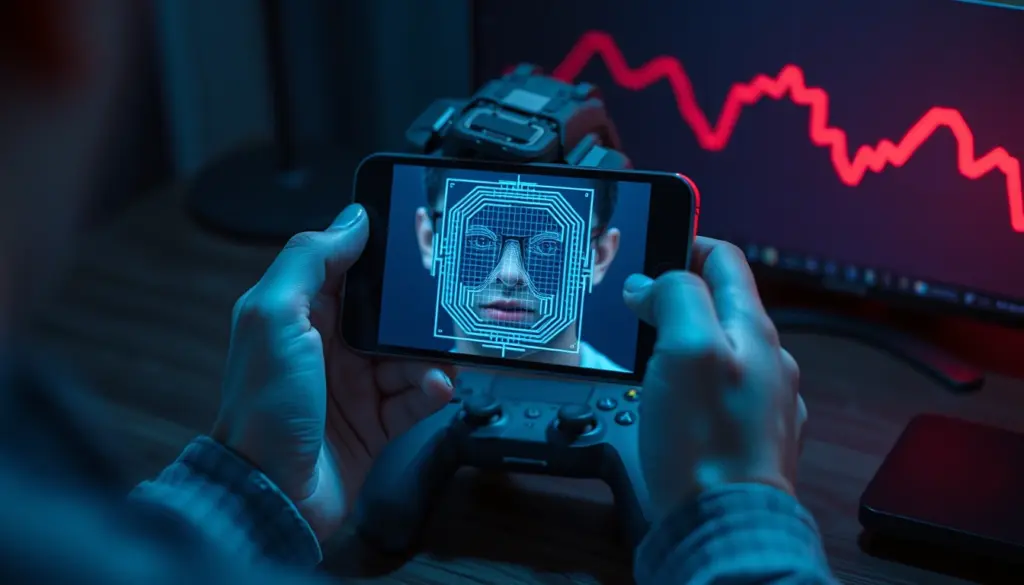
There are two ways to clear the check. The default is facial age estimation: the user records a short selfie video, turning their head in a few directions, which an algorithm analyzes to estimate an age band – not a precise birthday, and not a confirmed legal identity. The alternative is uploading a government ID. The facial-estimation pipeline is operated by a third-party vendor, Persona, which Roblox says analyzes and then deletes the selfie once an age band is assigned. The mechanics are documented on Roblox’s age-estimation page and were broken down in detail by TechCrunch.
The Six Age Bands and Who Can Talk to Whom
Once you are checked, Roblox sorts you into one of six age bands and restricts chat to your own band and immediately adjacent bands. As PC Gamer reported, the company describes these as “common-sense limits” designed to keep adults from freely messaging young children. In practice, it is an access-control matrix. Here is the model in plain code:
// Roblox age-band chat model (simplified)
const bands = ["Under 9", "9-12", "13-15", "16-17", "18-20", "21+"];

// Chat is allowed only within the same band or an immediately adjacent one
function canChat(userA, userB) {
  return Math.abs(bands.indexOf(userA) - bands.indexOf(userB)) <= 1;
}

canChat("9-12", "13-15");    // true  (adjacent bands)
canChat("Under 9", "16-17"); // false (2+ bands apart)

// Exception: "Trusted Connections" (verified real-world contacts)
// can bypass the band rule after a mutual opt-in.
The one escape hatch is Trusted Connections, a feature that lets users link up with people they actually know in real life and chat across band boundaries. For everyone else, the adjacency rule is enforced platform-wide. A 25-year-old and a 10-year-old can no longer exchange messages, full stop – which is precisely the interaction pattern the child-safety lawsuits accused Roblox of enabling for years.
The Rollout Timeline: From Announcement to Global Enforcement
Roblox moved unusually fast for a change this sweeping. CEO David Baszucki previewed the plan publicly in November 2025 – including a widely covered CNN appearance that came shortly after a wave of lawsuits alleging the platform failed to protect minors. Enforcement then rolled out region by region over roughly two months, reaching global coverage by January 2026. The rollout was tracked closely by the biometrics trade press because it is one of the largest deployments of facial age estimation ever attempted on a consumer platform.
| Date | Milestone | Scope |
|---|---|---|
| November 2025 | Baszucki previews mandatory age checks for communication | Global announcement |
| Early December 2025 | First markets begin enforcement | Australia, New Zealand, Netherlands |
| December 2025 – January 2026 | Facial age estimation or ID becomes mandatory to chat | Worldwide phase-in |
| January 2026 | Age check required to chat now live everywhere chat is offered | United States + all regions |
| Late January 2026 | ~45% of daily active users have completed a check | Global adoption |
| End of Q1 (March 31, 2026) | 51% of global DAU / 65% of US DAU age-checked | Global adoption |
The phased approach was deliberate. By starting in Australia, New Zealand, and the Netherlands – smaller, high-regulation markets – Roblox could stress-test the Persona pipeline before switching it on for its enormous US base. That sequencing looked prudent operationally. Financially, it delayed the moment anyone could measure the damage until the whole system was live.
Adoption by the Numbers: 51% Globally, 65% in the US
The single most important operational number is completion rate, and it is telling on two levels. By the end of the first quarter of 2026, only 51% of Roblox’s global daily active users had completed an age check, rising to roughly 65% in the United States. Put differently: nearly half the platform’s global user base still had not verified – and until they do, they cannot chat, which throttles the exact engagement loops that drive Roblox’s economy.
The composition of who did verify underscores why this platform draws so much regulatory heat. Of users who completed checks in the early weeks, TechCrunch reported that roughly 35% were under 13, 38% were ages 13–17, and only 27% were over 18. Nearly three-quarters of verified users are minors. When a platform where most of the audience is children builds a face-scanning gate, the privacy and safety stakes are not abstract – they are the core of the business. This is the same tension we have tracked in gaming’s broader fight over ownership and consumer rights in our coverage of the Stop Killing Games EU campaign.
The $6.7 Billion Shock: How Age Checks Cut Roblox’s Outlook
On the surface, Roblox’s Q1 2026 was a blowout. Per the company’s Q1 2026 shareholder letter, revenue hit $1.442 billion, up 39% year over year; bookings reached a record $1.731 billion, up 43%; daily active users climbed 35% to 132 million; engagement hit 31 billion hours; and free cash flow came in at $596 million. Almost every line beat expectations.
Then management cut full-year guidance hard. It reduced 2026 bookings-growth guidance from the 22%–26% it had promised only three months earlier to just 8%–12%, taking projected full-year bookings down to roughly $7.33–$7.60 billion from a prior range around $8.28–$8.55 billion – close to a $900 million haircut. The stated cause was the age-check rollout: verification friction had dented app-store ratings, and lower ratings meant fewer of the organic sign-ups that app stores normally funnel to Roblox. Growth engineered out of the system, on purpose.
| Metric | Q1 2026 result | Year-over-year |
|---|---|---|
| Revenue | $1.442 billion | +39% |
| Bookings | $1.731 billion (record) | +43% |
| Daily active users | 132 million | +35% |
| Engagement hours | 31 billion | Growth continued |
| Free cash flow | $596 million | Positive |
| Full-year 2026 outlook | Prior guidance | Revised guidance |
|---|---|---|
| Bookings growth | 22% – 26% | 8% – 12% |
| Bookings ($) | ~$8.28B – $8.55B | ~$7.33B – $7.60B |
| Implied cut at midpoint | – | ~$900 million lower |
| Stated driver | – | Age-check friction → lower app-store ratings → fewer organic sign-ups |
Why Beating Estimates Still Crashed the Stock
Markets price the future, not the quarter. A 43% bookings beat tells investors where Roblox was; a guidance cut from 26% to 12% tells them where it is going. Roblox shares closed at $55.26 on April 30, 2026, and opened the trapdoor the next day, falling to $45.13 on May 1 – an 18.33% single-session drop that erased more than $6.7 billion in market capitalization. It was, by any measure, one of the strangest earnings reactions of the year: a company punished not for failing, but for admitting that its own safety initiative would slow it down.
Securities Class Actions Pile Up Over the Rollout
By early July 2026, the earnings shock had metastasized into litigation. Multiple securities firms filed class actions on behalf of investors who bought Roblox stock during a class period running from October 30, 2025 through April 30, 2026 – the window between the age-check announcement cycle and the guidance-cut reveal. As one of the filings summarizes it, the complaints allege that Roblox executives made materially misleading statements by promoting the age-verification rollout – which the company characterized as a “gold standard” intended to arrive with “no friction” – while allegedly concealing that it would slow growth, reduce on-platform communication, cut app-store ratings, and impair organic sign-ups.
The lead-plaintiff deadline across these actions is August 7, 2026. Whether or not the claims ultimately succeed, the litigation crystallizes the central irony of Roblox age verification: the same disclosure that reassured regulators and parents is now the evidentiary spine of a shareholder-fraud case. For a platform, “we made it harder to use our product in order to protect kids” is an admirable sentence – and, apparently, an actionable one.
The Child-Safety Lawsuits That Forced Roblox’s Hand
Roblox did not adopt facial age estimation in a vacuum. It moved under a rapidly escalating legal siege. Texas Attorney General Ken Paxton sued the company in November 2025, and Louisiana Attorney General Liz Murrill followed in early 2026, both alleging Roblox failed to protect children from exploitation and misrepresented the strength of its safety controls. In total, attorneys general in at least seven states – Louisiana, Texas, Tennessee, Kentucky, Florida, Iowa, and South Carolina – have filed suits or opened investigations.
On the private-litigation side, the Judicial Panel on Multidistrict Litigation consolidated the growing pile of individual cases in December 2025, transferring them to the U.S. District Court for the Northern District of California. By June 2026, that federal MDL contained roughly 162 lawsuits. The common thread: allegations that Roblox’s moderation and safety tools were weaker than advertised and that adults could too easily reach minors. Seen against that backdrop, mandatory age checks are not just a safety feature – they are a legal defense being built in real time. The pattern of platforms being reshaped by policy echoes what we documented in analyses like PlayStation ending physical discs, where regulation and market forces quietly rewrite how a platform works.
The Biometric Privacy Problem Nobody Wants to Own
Here is where the security lens sharpens. Age assurance is sold as a shield for children, but every age-verification system is, structurally, an identity-collection system – and identity-collection systems are honeypots. When a platform gathers millions of selfies and ID documents, it manufactures one of the most attractive breach targets imaginable. Digital-rights groups have argued for years that age-verification mandates erode online anonymity by design; the Electronic Frontier Foundation has repeatedly warned that these systems trend toward surveillance infrastructure. The threat model here is the same one behind every mega-breach we cover; see our running analysis of how data breaches actually happen.
The Persona Data-Retention Discrepancy
The most concrete privacy flashpoint is a mismatch between marketing and legal fine print. Roblox says the selfie used for facial age estimation is deleted as soon as an age band is assigned. But as MediaNama documented, Persona’s own privacy policy reportedly permits retention of biometric data for up to three years. Roblox’s position is that it instructed Persona to delete immediately – but “we told our vendor to delete it” is a very different guarantee than “our vendor’s contract requires deletion.” For biometric data, which cannot be reset like a password, that gap between promise and enforceable terms is exactly where privacy risk lives. It is the same class of problem that makes credential and identity systems so fragile – a theme in our guide to passkeys versus passwords.
When the Age Estimate Is Simply Wrong
Facial age estimation is probabilistic, not exact, and the errors are visible in the wild. MediaNama collected reports of adults being flagged as minors and, more alarmingly, of young children being sorted into the 18-plus band – the exact failure mode the whole system is meant to prevent. Roblox lets users appeal a wrong estimate via ID verification or parental controls, but every appeal path is another point where sensitive documents change hands. Accuracy failures are not just an inconvenience; in an age-gated safety system, a misclassification can place a child in an adult chat pool, or lock a legitimate adult out of the platform they pay for.
How Age Verification Compares Across Gaming Platforms
Roblox is the most aggressive, but it is not alone. Age assurance is becoming a platform-layer feature across gaming and social apps, each vendor picking a different point on the privacy-versus-certainty curve. The competitive picture matters because whatever becomes “normal” here will set expectations for every service a young person touches – including the storefronts and chat apps we compare in pieces like Signal vs. WhatsApp vs. Telegram.
| Platform | Primary age-assurance approach (2026) | Scope of enforcement |
|---|---|---|
| Roblox | Mandatory facial age estimation (Persona) or ID, six age bands | Required for all chat/communication, global |
| Discord | Facial or ID age verification in select regions | Triggered by regional law (UK, Australia) |
| Epic / Fortnite | Age-based “cabined accounts,” parental-consent flows | Under-13 restrictions, feature gating |
| Steam (Valve) | Self-declared age gate; storefront maturity checks | Minimal biometric assurance |
| Meta (VR/social) | Facial age estimation piloted for teen accounts | Feature and account-type gating |
The contrast is stark. Steam still leans largely on a self-declared birthday, while Roblox now demands a biometric scan to type “gg” in a chat box. That spread tells you the industry has no consensus yet on how much certainty is worth how much intrusion – which is exactly why regulators are stepping in to force the question.
The Regulatory Wave Behind the Rollout
The timing was not coincidental. Roblox switched on global age checks in the same window that governments worldwide were codifying age-assurance expectations. Australia’s world-first under-16 social media ban took effect on December 10, 2025, forcing platforms like Facebook, Instagram, TikTok, Snapchat, and YouTube to keep minors off entirely or face fines up to roughly A$50 million. Crucially – and this is a detail most coverage gets wrong – Roblox was explicitly exempted from Australia’s list of age-restricted platforms, alongside Steam, Discord, and others. In other words, Roblox’s own age-check push was largely preemptive, not compelled by that specific ban.
The broader regulatory pressure is real, though. The University of Sydney’s explainer notes how quickly the Australian model is being studied elsewhere. The UK’s Online Safety Act now obliges platforms to implement “highly effective” age assurance, enforced by Ofcom. The EU’s Digital Services Act pushes in the same direction, and a growing patchwork of US state laws – from Texas to Utah – is mandating age checks and app-store accountability. Roblox reads that map correctly: build the machinery now, on your own terms, before a regulator dictates them for you. As NBC News detailed, the company’s policy teams frame this as ongoing engagement with regulators across the US, UK, and EU.
Historical Context: Roblox’s Long Road on Child Safety
To understand why the market reaction was so severe, remember that Roblox has been fighting the child-safety narrative for years. The platform has layered on parental controls, content-maturity labels, restrictions on experiences for younger users, and moderation systems that scan text – and even keystroke and emoji patterns – for abuse. Critics, including short-sellers who questioned the durability of Roblox’s growth and metrics, argued those measures were insufficient given how central the platform is to under-13 audiences. According to the platform’s documented history, Roblox has grown from a niche creation sandbox into one of the most-used entertainment products on Earth for children, which magnified both the safety obligation and the regulatory target on its back.
Mandatory facial age estimation is the most drastic step in that arc – an admission that softer, self-declared controls were no longer defensible, legally or reputationally. It is also a bet: that becoming the “safe” platform is worth a temporary growth wound. Whether that bet pays off depends on how the next few quarters resolve the tension between trust and friction.
Market Impact: Investors, Parents, and Creators
The fallout lands on three groups. Investors now have to price a company whose safety posture is a permanent growth variable; the guidance cut reset the entire 2026 model and handed short-sellers and class-action firms a narrative. Parents get a genuinely stronger barrier between their children and strangers – but also a new requirement to hand a face scan or ID to a third-party vendor whose retention terms are contested. And creators, the developers who build Roblox experiences, face a quieter squeeze: if half the audience cannot chat, social and multiplayer experiences lose stickiness, and reaching the under-13 cohort now runs through age-band walls.
There is a broader market signal, too. Roblox just demonstrated, in public and in dollars, that aggressive age assurance carries a measurable near-term cost. Every rival platform watched $6.7 billion evaporate. That will shape how cautiously – or reluctantly – competitors approach their own rollouts, and how loudly they lobby for regulations that spread the cost across the whole industry rather than the first mover. The economics of who pays for online safety is now a boardroom question, sitting alongside the fraud and identity risks flagged in the WEF Global Cybersecurity Outlook 2026.
What Happens Next: Five Predictions
- Adoption climbs, growth stabilizes. As age-check completion pushes past 70–80%, the drag on organic sign-ups should ease and Roblox’s growth rate will find a new, lower-but-steadier baseline through late 2026.
- Rivals follow, quietly. Expect Discord, Epic, Meta, and others to expand facial or ID-based age assurance under regulatory pressure – but to phase it in far more cautiously now that Roblox has shown the market penalty for moving first and fast.
- The Persona retention gap draws scrutiny. The mismatch between “deleted immediately” and a vendor policy allowing multi-year retention is tailor-made for biometric-privacy enforcement under laws like Illinois’ BIPA and Texas’ CUBI. Watch for an attorney general or regulator to probe it.
- Age assurance becomes table stakes. Between the UK Online Safety Act, the EU DSA, and expanding US state laws, “highly effective age assurance” moves from competitive differentiator to baseline legal requirement for any platform touching minors.
- A biometric incident becomes the next headline. With millions of scans and IDs now concentrated in age-verification pipelines, a breach, leak, or misuse somewhere in the vendor ecosystem is a matter of when, not if – and it will reopen this entire debate.
The Bottom Line on Roblox Age Verification
Roblox age verification is the clearest case study yet of a platform choosing safety and paying for it in market cap. The company built a facial-scanning gate in front of chat, watched adoption stall at 51% globally, cut nearly a billion dollars from its outlook, lost $6.7 billion in value in a day, and drew securities class actions on top of the child-safety lawsuits that started the whole chain. For readers who care about privacy and security, the lesson is uncomfortable and important: the tools we build to protect children online are also the largest identity-collection systems ever deployed at consumer scale – and the fine print, the accuracy, and the breach exposure of those systems deserve exactly as much scrutiny as the safety problem they aim to solve. The industry is watching Roblox to learn what age assurance costs. It should watch just as closely to learn what it risks. For more on how platform policy keeps reshaping gaming, browse our full gaming coverage.
Frequently Asked Questions
Is Roblox age verification mandatory for everyone?
It is mandatory to use chat and communication features. You can still create an account and play most experiences without verifying, but as of January 2026 you cannot send or receive messages until you complete an age check via facial age estimation or ID. As of the end of Q1 2026, 51% of global daily active users and about 65% of US users had completed it.
Does Roblox store my face scan?
Roblox says the selfie video used for facial age estimation is processed by its vendor, Persona, and deleted once an age band is assigned. However, reporting has noted that Persona’s own privacy policy reportedly allows biometric-data retention for up to three years, and Roblox states it has instructed Persona to delete immediately – a distinction worth understanding before you submit a scan.
Why did Roblox stock drop after good earnings?
Roblox beat Q1 2026 growth expectations (revenue +39%, bookings +43%, DAU +35% to 132 million) but simultaneously cut full-year bookings-growth guidance from 22–26% to 8–12%, blaming age-check friction. Markets price the future, so the guidance cut mattered more than the beat: shares fell 18.33% on May 1, 2026, wiping out over $6.7 billion in market value.
What are the six Roblox age bands?
The bands are Under 9, 9–12, 13–15, 16–17, 18–20, and 21+. Chat is permitted only within your own band or an immediately adjacent one, with a “Trusted Connections” exception for verified real-world contacts. The rule is designed to prevent adults from freely messaging young children.
Can facial age estimation be fooled?
It can be imperfect in both directions. Reports have surfaced of adults misclassified as minors and children sorted into the 18-plus band. Determined users can also attempt to use an older person’s face or an ID that is not theirs. Age estimation raises the barrier significantly but is not a perfect identity check – which is one reason critics question how much privacy risk it is worth.
Is Roblox banned in Australia for under-16s?
No. Australia’s under-16 social media ban that took effect December 10, 2025 applies to platforms like Facebook, Instagram, TikTok, Snapchat, and YouTube. Roblox was explicitly exempted from that list, along with Steam and Discord. Roblox’s own age-check system is a separate, self-imposed measure that it rolled out globally on its own timeline.
Which states are suing Roblox over child safety?
Attorneys general in at least seven states – Louisiana, Texas, Tennessee, Kentucky, Florida, Iowa, and South Carolina – have filed lawsuits or launched investigations alleging failures to protect children. Separately, a federal multidistrict litigation in the Northern District of California held roughly 162 individual lawsuits as of June 2026.
Do other gaming platforms require age verification too?
Increasingly, yes, but approaches vary widely. Discord uses facial or ID checks in regions where law requires it; Epic uses age-based “cabined accounts” for younger Fortnite players; Meta has piloted facial age estimation for teen accounts; and Steam still relies largely on a self-declared birthday. Roblox is currently the most aggressive, applying mandatory biometric or ID checks to all chat access globally.
Related Coverage
- Stop Killing Games: 1.29M Signatures, No EU Law
- PlayStation Ends Discs in 2028: 85% Now Digital
- Data Breaches: How They Happen and How to Protect Yourself
- Signal vs. WhatsApp vs. Telegram: 3B vs 1B
- Passkeys vs. Passwords: 8.5s vs 31s Sign-In
- GTA 6 Pre-Orders Live: $79.99, Console-Only
- WEF Cybersecurity Outlook 2026: Fraud Tops CEO Fears