

Last updated: 28 August 2026
Dragon Tiger is one of the simplest casino card games: the dealer deals a single card to the Dragon spot and one to the Tiger spot, and you bet on which will be higher – Dragon and Tiger bets pay 1:1 with a house edge of about 3.73%, while the tempting Tie bet pays 8:1 but carries a punishing house edge of 32.77%. Aces are low, suits don’t matter for the main bet, and the entire round is decided by a single card comparison. This guide explains the rules, the three bet types, and exactly why the Tie bet is far worse value than it looks.
Key points
- Single-card comparison: one card to Dragon, one to Tiger, higher card wins.
- Dragon/Tiger bets pay 1:1 with a house edge of about 3.73% (RTP around 96.27%).
- The Tie bet pays 8:1 but carries a house edge of 32.77% (RTP just 67.23%).
- Aces are low and suits are irrelevant for the main Dragon/Tiger bet.
- On a tie, Dragon/Tiger bets typically lose half the stake, with half returned.
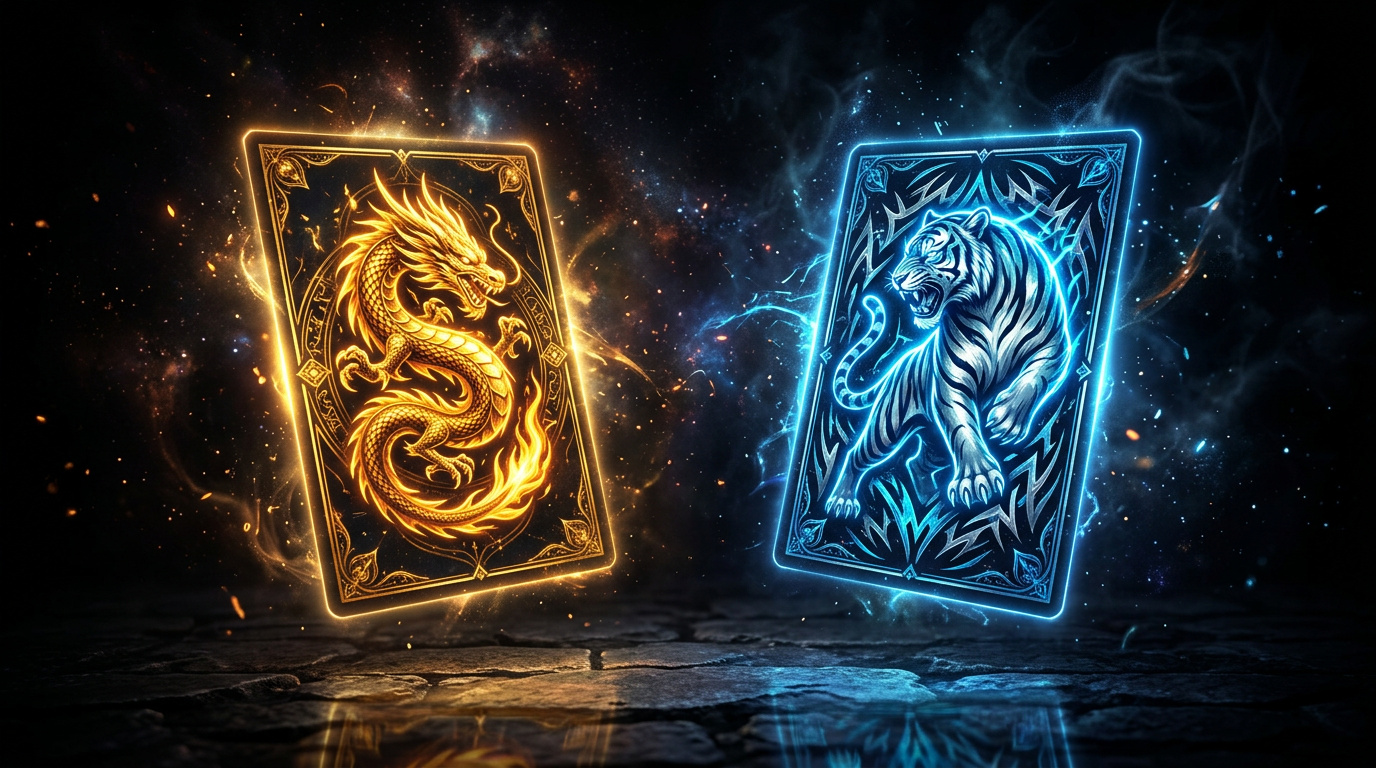
How Dragon Tiger works
The basic round
Dragon Tiger is a two-card comparison game with about the simplest structure in the casino: the dealer deals exactly one card to the Dragon position and one card to the Tiger position, and the higher-ranked card wins. There’s no drawing, no strategy about when to hit or stand, and no complex hand-building – the entire outcome is decided by comparing two single cards.
This extreme simplicity is precisely what makes Dragon Tiger popular: a complete round takes seconds, the rules can be understood in under a minute, and there are no decisions to make once your bet is placed beyond which side you backed.
Card ranking and the Ace rule
Cards rank in their standard order, with one important exception that catches newcomers: Aces are usually low in Dragon Tiger, ranking below the 2 rather than above the King. Suits do not matter at all for the main Dragon or Tiger bet – only the numerical rank of each card determines the winner.
This means the lowest possible card is an Ace and the highest is a King, and knowing this Ace-low rule is essential to reading the outcome correctly, since it’s the opposite of many other card games where the Ace is high.

The three bet types
Dragon and Tiger bets
The two main bets – Dragon and Tiger – are straightforward: you’re betting on which of the two positions will receive the higher card. Both pay 1:1 (even money), meaning a winning bet returns your stake plus an equal amount in winnings.
Under standard rules, these bets carry a house edge of about 3.73%, corresponding to an RTP of roughly 96.27%. This is a competitive house edge that sits reasonably close to the market average for casino games, making the Dragon and Tiger bets genuinely the sensible core of the game from a value perspective.
The Tie bet and why it’s a trap
The Tie bet wins only if both the Dragon and Tiger cards match in rank, and it’s where the game’s real mathematical danger lies. While the Tie bet typically pays a tempting 8:1 (some casinos offer 10:1 or 11:1), at the standard 8:1 payout it carries a house edge of a punishing 32.77%, corresponding to an RTP of just 67.23%.
This enormous gap between the Tie bet’s edge and the Dragon/Tiger bets’ edge is the single most important thing to understand about Dragon Tiger: the Tie bet’s large headline payout masks odds that are dramatically worse than the even-money bets, making it one of the poorer-value bets available in any casino game.
What happens on a tie
The half-stake rule
When the Dragon and Tiger cards match in rank, producing a tie, the standard rule is that Dragon and Tiger bets usually lose half the stake, with the other half returned to the player. This is a specific rule worth understanding before playing, since it’s a partial loss rather than a full push or a full loss.
This half-stake-on-tie rule is precisely what generates the house edge on the otherwise even-money Dragon and Tiger bets – without it, betting Dragon or Tiger would be much closer to a fair coin flip, but the partial loss on ties tilts the mathematics in the house’s favour.

Comparing the bets mathematically
Why the edge gap matters so much
The contrast between the two bet categories is stark: a Dragon or Tiger bet gives back roughly 96.27 units for every 100 wagered over the long run, while an 8:1 Tie bet gives back only about 67.23 units for every 100 wagered. That’s a difference of nearly 30 percentage points in expected return.
In practical terms, this means a player who sticks exclusively to Dragon and Tiger bets is playing one of the more reasonable-value simple casino games, while a player drawn repeatedly to the Tie bet by its large payout is playing one of the worst-value bets in the building – the same game, but a radically different mathematical proposition depending on which bet you choose.
The strategy is simply which bet you pick
Because Dragon Tiger involves no decisions once cards are dealt, the entire “strategy” of the game reduces to a single choice: which bet type you place. Avoiding the Tie bet and sticking to Dragon or Tiger is the only meaningful way to influence your expected return, since no system or pattern-tracking changes the underlying random outcome of the card comparison.

Bankroll and pacing
Fast rounds require deliberate limits
Because each Dragon Tiger round resolves in seconds, the game can move through your bankroll far faster than slower games where each decision takes time. This rapid pace makes setting a firm loss limit and a session time limit before you start especially important, since the natural pauses that slow games provide simply don’t exist here.
No betting pattern changes the game’s underlying odds, whichever bet you choose. What you can control is your bet selection (favouring Dragon or Tiger over Tie), your stake size, and when you decide to stop.
Responsible gambling
Speed and simplicity as risk factors
The very simplicity and speed that make Dragon Tiger appealing are also what make it worth approaching carefully – fast, simple games can encourage a rapid succession of bets with little reflection between them. This guide is for informational purposes only and does not constitute gambling advice; always check the specific payouts and rules at your chosen platform, since Tie payouts in particular can vary. For adults 18 and over only, where legally permitted.
Getting help
If gambling has stopped being controlled entertainment, seeking support from a qualified counsellor or support service is a reasonable step, independent of which game is involved.
Conclusion
Dragon Tiger’s appeal is its speed and simplicity, but that simplicity hides a crucial mathematical fork: the Dragon and Tiger bets are reasonable value at roughly 96.27% RTP, while the Tie bet is one of the worst bets in the casino at 67.23%. Understanding that single distinction is genuinely the most useful thing to know before playing.
Frequently asked questions
How do you play Dragon Tiger?
The dealer deals one card each to the Dragon and Tiger positions, and you bet on which will be higher. The higher-ranked card wins, with Aces low and suits irrelevant.
What is the house edge on Dragon and Tiger bets?
About 3.73%, corresponding to an RTP of roughly 96.27%. Both bets pay 1:1 (even money).
Why is the Tie bet considered a bad bet?
At the standard 8:1 payout, the Tie bet carries a house edge of 32.77% (RTP just 67.23%), dramatically worse than the even-money Dragon and Tiger bets despite its larger payout.
What happens if there’s a tie in Dragon Tiger?
Dragon and Tiger bets usually lose half the stake, with the other half returned. This half-stake rule is what generates the house edge on those bets.
Are Aces high or low in Dragon Tiger?
Aces are usually low, ranking below the 2, making the Ace the lowest card and the King the highest.
Is there any strategy to Dragon Tiger?
The only meaningful choice is which bet you place. Sticking to Dragon or Tiger over the Tie bet is the sole way to improve your expected return, since no system changes the random card outcome.
Written by Priya Anand, contributor at Shattered covering casino game mechanics and mathematics across South Asian markets. Our coverage draws on game documentation and independent verification. Shattered’s coverage is independent; we do not accept payment for favourable coverage of any operator.
Related Coverage
- Lightning Roulette Rules: Multipliers, the 29:1 Payout and RTP
- How Does the Aviator Game Algorithm Work? Provably Fair Explained
- Online Casino Winnings Taxes USA: The Complete Rules (2026)
- Net Banking Casino Deposit India: How It Works and the Risks
- Is Real-Money Teen Patti Legal in India? The Skill vs Chance Question