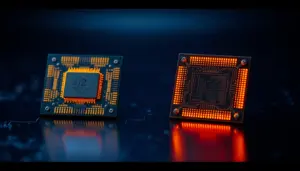

Yotta Data Services just placed one of the largest single GPU orders anyone in India has ever made public. On September 11, 2026, at the GPU Future Forum in Mumbai, the Hiranandani Group-backed cloud operator confirmed plans to deploy 80,000 Nvidia Vera Rubin GPUs across two new campuses, backed by more than $12 billion in capital spending. It is a bet that India’s AI compute market is about to shift from small, rented GPU clusters to nation-scale infrastructure, and it lands the country squarely in the middle of Nvidia’s next chip cycle.
The announcement matters beyond India. Vera Rubin is Nvidia’s first HBM4 platform, and Yotta’s order is one of the earliest large-volume commitments disclosed anywhere in the world. CEO Sunil Gupta says the company already controls a majority share of India’s installed GPU capacity, and this expansion is designed to lock that lead in before rivals catch up. Below, the numbers, the hardware, and what the deal signals for the next 18 months of the AI infrastructure race.
What Yotta Just Announced
Yotta’s plan splits 80,000 GPUs across two sites. The first, a new D4 data center under construction in Greater Noida, will house 40,000 Vera Rubin GPUs inside a 120-megawatt facility. The second, an NM2 campus expansion in Navi Mumbai, will run 40,000 Nvidia GB300 Blackwell Ultra GPUs across 80 megawatts. Combined, the two sites add 200 megawatts of GPU-dense capacity, a scale that puts Yotta in the same conversation as major hyperscale operators building out AI factories in the US and Gulf states.
Gupta told Moneycontrol that the Noida site is dedicated to Nvidia’s newest Vera Rubin GPUs while Navi Mumbai keeps building on the existing Blackwell Ultra generation, giving Yotta a mixed fleet rather than a single-generation bet. The $12 billion figure covers land, power infrastructure, liquid cooling, networking, and the GPUs themselves, though Yotta has not broken out how much goes to Nvidia hardware specifically.
This isn’t Yotta’s first large order. Reports from August 2026 already had the company committing to smaller Vera Rubin batches, and a separate Gorilla Technology partnership signed earlier in the year covers more than 5,000 GPUs at Yotta’s existing NM1 facility in a deal valued near $500 million, later expanded toward $2.8 billion. The 80,000-GPU figure represents a major step up from those earlier commitments, not a first move into Nvidia silicon.
Inside the Vera Rubin GPU: HBM4 and the Bandwidth Leap
Vera Rubin is Nvidia’s successor to Blackwell, and the headline change is memory, not raw compute. Each Rubin GPU packs 288GB of HBM4 memory across eight stacks, delivering roughly 22 terabytes per second of bandwidth per chip. That is about 2.75 times the roughly 8 TB/s bandwidth of Blackwell Ultra’s HBM3e memory, at the same 288GB capacity. For AI workloads that spend as much time moving data as computing on it, that bandwidth jump often matters more than the raw FLOPS number on a spec sheet.
The GPU itself is built on TSMC’s 3-nanometer process as a dual-die package with roughly 336 billion transistors, rated at approximately 50 petaflops of NVFP4 inference performance per chip. It pairs with a new Vera CPU, an 88-core Arm-based Olympus design with simultaneous multithreading that gives 176 threads per socket, connected to the GPU over NVLink-C2C at roughly 1.8 TB/s. Nvidia entered full production on Vera Rubin around June 1, 2026, with partner shipments scheduled to begin in the second half of the year, which lines up with Yotta’s own rollout timeline.
The NVL72 Rack: Scaling to Exaflops
Nvidia sells Rubin primarily as a rack-scale system called Vera Rubin NVL72, pairing 72 Rubin GPUs with 36 Vera CPUs in a single liquid-cooled cabinet. That rack pools 20.7 terabytes of HBM4 memory, moves data internally at roughly 260 TB/s over NVLink 6, and reaches close to 3.6 exaflops of NVFP4 inference throughput. Scale-out networking between racks runs at roughly 28.8 TB/s. Power draw for a full rack lands between 190 and 230 kilowatts, well above the roughly 140 kilowatts a GB300 NVL72 rack draws, and it requires full liquid cooling with no air-cooled configuration on offer.
Vera Rubin NVL72 rack (Nvidia, full production June 2026)
------------------------------------------------------------
GPUs per rack:        72 x Rubin (VR200)
CPUs per rack:         36 x Vera (88-core Arm, SMT)
Memory per GPU:        288 GB HBM4
Bandwidth per GPU:      ~22 TB/s
Pooled rack memory:     20.7 TB HBM4
NVLink 6 (scale-up):    ~260 TB/s
Scale-out networking:   ~28.8 TB/s
NVFP4 inference:        ~3.6 exaFLOPS (rack)
Rack power draw:        190-230 kW
Cooling:                Liquid only, no air option
Production status:      Full production since ~June 1, 2026
Vera Rubin vs Blackwell Ultra GB300: The Spec Gap
Yotta’s decision to run Vera Rubin at one site and stick with GB300 Blackwell Ultra at the other gives a useful side-by-side. Rack-level memory capacity stays flat between generations at 20.7 TB pooled HBM, but bandwidth, compute, and power all jump with Rubin. The table below lines up the per-GPU and per-rack numbers as reported around Nvidia’s production ramp this year.
| Spec | Vera Rubin (VR200) | Blackwell Ultra (GB300) |
|---|---|---|
| Process node | TSMC 3nm (N3) | TSMC 4nm-class |
| Memory type | HBM4 | HBM3e |
| Memory per GPU | 288 GB | ~288 GB |
| Bandwidth per GPU | ~22 TB/s | ~8 TB/s |
| NVFP4 inference per GPU | ~50 PFLOPS | ~15 PFLOPS |
| NVL72 pooled memory | 20.7 TB | 20.7 TB |
| NVL72 NVLink bandwidth | ~260 TB/s | ~130 TB/s |
| NVL72 rack power | 190-230 kW | ~140 kW |
| Production status (Sept 2026) | Full production since June 2026 | Shipping since 2025 |
The practical read: Rubin roughly triples FP4 compute per GPU and nearly triples memory bandwidth, but it also draws considerably more power per rack. That trade-off is exactly why Yotta is running both generations in parallel rather than betting the entire buildout on the newest chip. GB300 racks are proven, available now, and cheaper to power. Vera Rubin racks are faster but demand data-center power density India’s grid has not had to deliver at this scale before.
Two Campuses, 200 Megawatts, One Bet
Splitting the order between Greater Noida and Navi Mumbai is not just a geographic hedge. It also spreads the power and cooling burden across two grid regions, which matters given how much electricity 80,000 GPUs actually consume once racked and running.
| Facility | Location | GPU allocation | Power capacity | Chip generation |
|---|---|---|---|---|
| D4 (new build) | Greater Noida | 40,000 GPUs | 120 MW | Vera Rubin |
| NM2 (campus expansion) | Navi Mumbai | 40,000 GPUs | 80 MW | GB300 Blackwell Ultra |
| Combined total | Two states | 80,000 GPUs | 200 MW | Mixed fleet |
A 200-megawatt combined GPU footprint puts Yotta in a similar range to mid-sized hyperscale campuses being built in the US and Middle East, though still well short of the multi-gigawatt sites Nvidia’s largest US customers are planning. For India, where dedicated AI data-center capacity barely existed three years ago, it is a genuinely large jump.
Why HBM4 Bandwidth Matters More Than FLOPS
Chip marketing tends to lead with FLOPS, but the people actually running large language models on this hardware watch bandwidth first. Modern transformer inference is frequently bottlenecked by how fast weights and key-value cache can move between memory and compute, not by how many multiply-adds the silicon can theoretically perform. That is why Nvidia has pushed HBM generation upgrades on roughly a two-year cadence even when raw compute gains slow down.
Rubin’s 22 TB/s per-GPU figure, at 2.75 times Blackwell Ultra’s HBM3e bandwidth, directly targets the trillion-parameter model class that OpenAI, Anthropic, and Google have been training and serving. Faster memory access shortens the time spent waiting on data during both training checkpoints and live inference, which translates into lower cost per token served, assuming the rest of the software stack, cooling, and networking can keep up.
India’s Sovereign AI Push and Yotta’s Market Position
Yotta’s expansion sits inside a broader Indian government push toward domestic AI compute, often described locally as a sovereign AI effort. The logic is straightforward: relying entirely on US or Gulf-based cloud regions for AI workloads creates data residency and latency problems for Indian enterprises, banks, and government agencies. Building GPU capacity inside the country addresses both.
Gupta has said Yotta already holds an estimated 60 to 70 percent share of India’s installed GPU capacity, a dominant position that this expansion is meant to defend rather than establish. Competitors including AM Intelligence, an Indian AI infrastructure firm that separately ordered 9,000 Vera Rubin systems, are moving in the same direction, though at meaningfully smaller scale. Reliance, Tata, and several state-backed data center operators have also floated AI compute plans this year, meaning Yotta’s first-mover advantage is real but not guaranteed to last.
The Money: $12 Billion, IPO Plans, and Financing Questions
Funding an 80,000-GPU buildout is not trivial for a company Yotta’s size. Reports place the company’s IPO target at up to $1.5 billion in proceeds and a valuation goal near $6 billion, numbers that look thin against a $12 billion capital commitment. That gap is likely to be filled through a mix of debt financing, vendor financing arrangements with Nvidia and its partners, and possibly additional equity rounds before any public listing.
Nvidia itself has leaned into vendor financing arrangements elsewhere this year to accelerate customer buildouts, most visibly in its OpenAI partnership. Nvidia CEO Jensen Huang described the scale of that commitment in a CNBC interview: “The 10 gigawatts is equal to between 4 million and 5 million graphics processing units (GPUs), which is what the company will ship in total this year and twice as much as last year,” Huang said, per CNBC’s reporting on the OpenAI data-center deal. Whether Nvidia extends similar financing support to Yotta has not been disclosed, but the pattern of chipmaker-backed buildouts is becoming the norm rather than the exception across 2026’s AI infrastructure race.
Nvidia’s Global Vera Rubin Rollout Beyond India
India is one stop on a much wider rollout. Nvidia has been expanding AI factory capacity commitments across multiple regions through 2026, tying Vera Rubin and Blackwell Ultra shipments to sovereign and hyperscale deals alike. In Australia, Nvidia has partnered with local operators to grow AI factory capacity, with the company noting that expanding capacity there will enable local innovators to develop models, applications, and agents while supporting additional power generation projects to meet regional and global demand for AI compute, according to Reuters’ coverage of the Australian expansion.
Huang has repeatedly framed these buildouts in physical, almost industrial terms rather than purely as chip sales. Discussing the trajectory of future GPU-dense data centers, he said: “Over the next several years, we’re going to be building giant AI factories. Not normal AI factories, ones you see from space,” a quote reported by Yahoo Finance. Yotta’s 200-megawatt combined campus is not yet in that visible-from-space category, but it points in the same direction: fewer small rented GPU pods, more purpose-built, power-hungry campuses tied directly to a single chip generation.
Historical Context: From Hopper to Blackwell to Rubin
Nvidia’s data-center GPU cadence has compressed sharply since the Hopper generation launched in 2022. Blackwell followed in 2024, Blackwell Ultra extended it through 2025, and Vera Rubin arrived in full production barely 18 months after the original Blackwell chips started shipping. Each generation has paired a compute jump with a memory upgrade, but Rubin marks the first time Nvidia has shipped a completely new HBM standard, HBM4, alongside a new CPU architecture in the same platform refresh.
That compressed cadence puts real pressure on buyers like Yotta. Committing $12 billion to a chip generation that could be functionally superseded within two years is a real risk, and it explains why the company is hedging with a mixed Blackwell Ultra and Vera Rubin fleet rather than going all-in on the newest silicon at both sites.
Power and Cooling: Can India’s Grid Support 200 Megawatts?
Vera Rubin’s NVL72 racks require full liquid cooling and draw up to 230 kilowatts each, meaning Yotta’s Greater Noida site alone needs roughly the electricity draw of a small town concentrated inside one data center. India’s grid has historically struggled with industrial-scale, always-on power demand in fast-growing regions, and both Uttar Pradesh (home to Greater Noida) and Maharashtra (home to Navi Mumbai) will need dedicated substation and transmission upgrades to support the buildout on Yotta’s stated timeline.
Yotta has described both sites as Tier IV facilities, the highest resiliency classification for data centers, which typically means redundant power feeds and cooling loops. Meeting that standard at 200 megawatts combined is achievable but expensive, and it is one of the less-discussed line items likely buried inside that $12 billion figure alongside the GPUs themselves.
Competitive Landscape: AMD, Google TPU, and the Rest
Yotta’s decision to standardize on Nvidia across both new campuses is notable given how aggressively AMD and Google have been pitching alternatives this year. AMD’s Instinct accelerators and Google’s TPU pods have both picked up hyperscale customers elsewhere, largely on price and supply availability rather than raw performance. Yotta going all-Nvidia across 80,000 GPUs signals continued confidence in Nvidia’s software ecosystem, specifically CUDA and the surrounding tooling that most Indian AI startups and enterprises are already building on, rather than a pure cost calculation.
Why Yotta Didn’t Split Its Order Across Vendors
Multi-vendor hedging sounds safer on paper, but it carries its own cost. Running mixed CUDA, ROCm, and TPU software stacks across one data center adds engineering overhead that a leaner operator like Yotta may not want to carry this early in its buildout. Standardizing on Nvidia across both sites, even while mixing GPU generations, keeps the software and operations side simpler even as the hardware side stays split between Vera Rubin and GB300.
That said, the concentration risk cuts both ways. If Nvidia’s Vera Rubin supply chain hits delays, which has happened with prior generations, Yotta has no fallback hardware ordered at meaningful scale. Competitors hedging across multiple chip vendors may end up more resilient even if their peak performance numbers look weaker on paper today.
Market Impact: Reading Nvidia’s Order Book
Individual orders of this size do not move Nvidia’s stock on their own, but they matter cumulatively. Coverage of the announcement noted Nvidia shares were already trading near record levels heading into the news, with analysts framing large sovereign and regional AI infrastructure deals as evidence that demand for Blackwell and Rubin-generation silicon extends well past the handful of US hyperscalers that dominate headlines, according to Watcher.Guru’s market coverage of the deal.
For Nvidia, an 80,000-GPU order from a single Indian operator, layered on top of the 9,000-system order from AM Intelligence and similar regional deals elsewhere, adds up to meaningful geographic diversification of its customer base at a moment when a handful of US AI labs still account for a disproportionate share of total GPU demand. That diversification matters for investors trying to gauge how durable Nvidia’s growth is beyond the next one or two quarters.
Risks and Skepticism: Can Yotta Actually Execute?
Announcing 80,000 GPUs and actually racking them are different things. Yotta still needs to finish construction at D4, secure grid connections at both sites, and take delivery of GPUs that Nvidia is simultaneously allocating to customers worldwide amid continued supply tightness. The company’s IPO timeline, its financing gap between $12 billion in commitments and a roughly $6 billion targeted valuation, and India’s own track record on large infrastructure project delays all add execution risk that headline GPU counts tend to obscure.
There is also a demand-side question. India’s domestic AI startup and enterprise market, while growing quickly, is still smaller than the US or China in terms of paying customers for GPU compute at scale. Yotta is partly betting that demand will catch up to the supply it is building, and partly betting on export or multinational customers using Indian capacity for cost or regulatory reasons rather than pure domestic uptake.
Predictions: What Happens Next
- Yotta will likely disclose a financing structure, debt, vendor credit, or a new equity round, within the next two quarters to close the gap between its $12 billion commitment and current balance sheet capacity.
- Expect at least one additional Indian operator to announce a five-figure GPU order before the end of 2026 as competitors respond to Yotta’s move and try to defend market share.
- GB300 Blackwell Ultra deployment at Navi Mumbai will likely go live before Vera Rubin racks at Greater Noida, given GB300’s mature supply chain versus Rubin’s newer, more power-hungry design.
- Grid capacity, not chip supply, becomes the binding constraint on Yotta’s timeline, with at least one public report of substation or transmission delays likely surfacing in Uttar Pradesh or Maharashtra within the next year.
- Nvidia will cite India as a growth market on at least one 2026 or early-2027 earnings call, using Yotta and AM Intelligence orders as evidence of demand diversification beyond US hyperscalers.
What This Means for Developers and Enterprise Buyers
For Indian software teams and enterprises, the practical upside of Yotta’s buildout is more local access to high-end inference and training capacity without routing workloads through US or Singapore-based cloud regions. That should eventually mean lower latency for India-facing AI products and simpler data residency compliance for regulated industries like banking and healthcare.
The catch is timing. None of the 80,000 GPUs are running production workloads yet, and Greater Noida’s D4 site is still under construction. Teams planning around this capacity should treat 2026 as a build-out year and expect meaningful availability sometime in 2027, contingent on the execution risks discussed above.
Frequently Asked Questions
How many Nvidia Vera Rubin GPUs did Yotta order?
Yotta plans to deploy 80,000 Nvidia GPUs total across two sites: 40,000 Vera Rubin GPUs at a new D4 data center in Greater Noida, and 40,000 GB300 Blackwell Ultra GPUs at its NM2 campus in Navi Mumbai.
How much is Yotta spending on this expansion?
Yotta has committed more than $12 billion to the combined buildout, covering land, power infrastructure, liquid cooling, and GPU hardware across both campuses.
What makes Vera Rubin different from Blackwell Ultra?
Vera Rubin is Nvidia’s first HBM4 GPU platform, delivering roughly 22 TB/s of memory bandwidth per chip, about 2.75 times Blackwell Ultra’s HBM3e bandwidth, alongside a new Vera CPU built on an 88-core Arm design.
When does Yotta’s new capacity go live?
Construction is ongoing at both sites as of September 2026. Nvidia entered full Vera Rubin production around June 2026, and Yotta’s own deployment timeline points toward capacity coming online through 2027 rather than immediately.
How much of India’s GPU capacity does Yotta already control?
CEO Sunil Gupta has stated Yotta holds an estimated 60 to 70 percent share of India’s installed GPU capacity ahead of this expansion.
Is Yotta the only Indian company buying Vera Rubin GPUs?
No. AM Intelligence, a separate Indian AI infrastructure company, has ordered 9,000 Vera Rubin systems, and other operators are reportedly evaluating similar deals as India’s sovereign AI push accelerates.
How does this compare to Nvidia’s other large 2026 deals?
It is smaller than Nvidia’s OpenAI partnership, which covers at least 10 gigawatts of planned capacity and millions of GPUs, but it ranks among the largest single-operator GPU orders disclosed in Asia this year.
What could delay or derail the buildout?
Grid capacity and substation upgrades in Uttar Pradesh and Maharashtra, financing gaps between Yotta’s $12 billion commitment and its balance sheet, and continued global tightness in Nvidia’s GPU supply chain are the three most likely sources of delay.