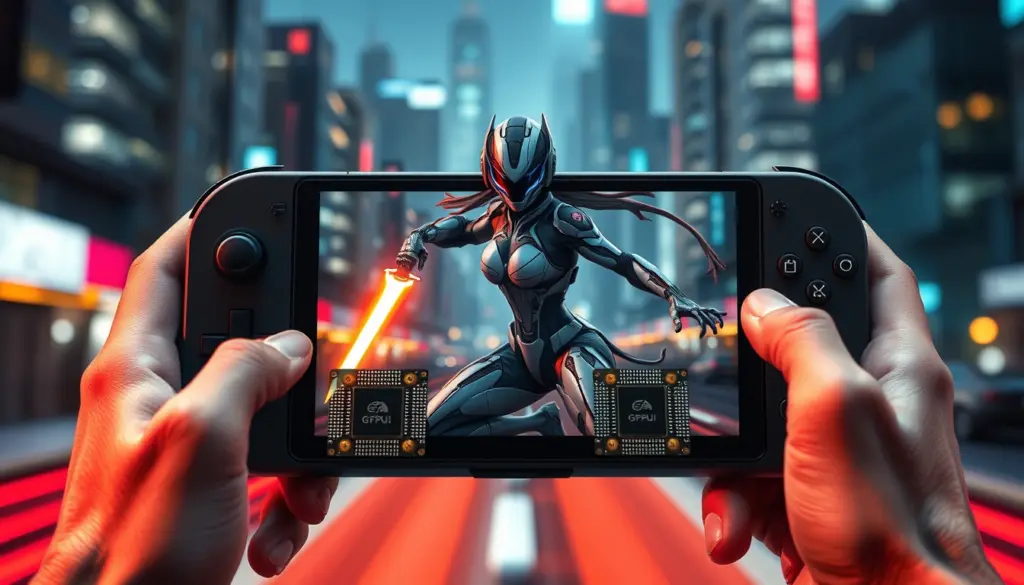
Stellar Blade is coming to Nintendo Switch 2, and the way it gets there says a lot about where handheld gaming stands in 2026. Developer Shift Up confirmed the port will run at 60 frames per second in both docked and handheld modes, but that number comes with an asterisk. The game renders its base frames at 30 fps, then leans on AMD’s FSR 3.1 frame interpolation to double the output to 60. Nvidia’s DLSS, also present on the chip inside Switch 2, is doing something different: it upscales the image, not the frame rate. The result is a hybrid pipeline that nobody has run on Nintendo hardware before, and it has reopened a debate that PC and PlayStation players have been having for three years: does a frame-generated 60 actually feel like 60?
What Shift Up Confirmed About Stellar Blade on Switch 2
The confirmation came from a developer interview covered by Nintendo Everything, in which a Shift Up representative walked through the technical choices behind the Switch 2 version of Stellar Blade: Complete Edition. Outlets have identified the speaker as DongKi Lee, CTO at Shift Up, discussing the specific engineering trade-offs made to hit a 60 fps target on Nintendo’s newest console.
The headline commitment is straightforward: Stellar Blade targets 60 fps whether you’re playing in handheld mode or docked to a TV. Handheld resolution is described as upscaled 720p, while docked mode pushes to upscaled 1080p. Neither number is a native render resolution. Both are the output of an upscaling pass, and the frame rate itself is the product of an interpolation pass layered on top. That’s two separate pieces of image-reconstruction technology stacked on a single frame, which is unusual even by 2026 standards for a handheld hybrid console.
Shift Up isn’t hiding the trade-off. Lee explained that the studio deliberately locked the base render to 30 fps so the interpolation layer would have a consistent input to work from. “It was important to have even latency for players,” Lee said, according to Nintendo Everything’s interview coverage. That single sentence is the crux of the whole story: Shift Up is treating latency as something to manage and stabilize, not something to eliminate.
How AMD FSR 3.1 Frame Interpolation Actually Works
FSR 3.1 is AMD’s third major revision of FidelityFX Super Resolution, and its frame interpolation feature (commonly shortened to frame generation) works by analyzing two consecutively rendered frames and generating a synthetic frame that sits between them. The GPU never actually renders the geometry, lighting, or physics for that in-between frame. It’s built from motion vectors and pixel data borrowed from the real frames around it. Displayed frame rate goes up. Simulation rate, the actual pace at which the game engine is processing input and updating game state, does not.
That distinction is the entire reason this story matters. A game rendering natively at 60 fps updates its simulation, reads controller input, and displays a new frame roughly every 16.7 milliseconds. A game rendering at 30 fps with a generated frame inserted between each real one still only updates its simulation and reads input every 33.3 milliseconds, even though the screen is refreshing at 60 fps. Lee’s own explanation lines up with this: Shift Up took “AMD’s FSR 3.1 for PC and used the feature called frame interpolation to achieve the target for 60 frames per second,” according to the Nintendo Everything interview. The studio ported a PC-class technology stack onto console hardware specifically because Switch 2’s silicon didn’t give them another route to 60.
AMD’s own documentation for the FidelityFX suite (see AMD’s FSR product page) pairs frame generation with a companion feature called Anti-Lag 2, designed specifically to claw back some of the latency that interpolation adds by shortening the render queue elsewhere in the pipeline. It isn’t clear from Shift Up’s public comments whether Anti-Lag 2 is active in the Switch 2 build, and that’s a detail worth watching once the game is in reviewers’ hands.
Why DLSS Handles Upscaling but Not Frame Generation Here
Switch 2’s custom chip includes Nvidia hardware capable of running DLSS, which is why Nintendo has marketed the console’s upscaling as a headline feature since launch. But the version of DLSS available on Switch 2 handles image reconstruction only. It takes a lower-resolution rendered frame and reconstructs it up to a higher output resolution using Nvidia’s neural upscaling model. It does not include Nvidia’s frame generation technology, the feature that on RTX-series PC graphics cards can synthesize entire extra frames the same way FSR does.
Shift Up’s workaround was to use DLSS for the job it can do on this hardware (upscaling from a lower internal resolution to 720p handheld or 1080p docked) and then bolt on FSR 3.1’s frame interpolation, which is hardware-agnostic and runs on Nvidia silicon just as it does on AMD or Intel GPUs, to handle the frame-rate side separately. Nvidia’s own DLSS technology overview describes the full suite, including frame generation, but that fuller feature set has not shipped on Switch 2 to date. Lee’s comments to Nintendo Everything make the constraint explicit: DLSS “doesn’t have any features for frame generation” on this hardware, so the studio reached for AMD’s toolkit to fill the gap.
It’s a pragmatic solution, and also a slightly strange one: a game running Nvidia upscaling and AMD frame generation side by side on a console nobody would have called an AMD platform a year ago. AMD documents the underlying interpolation technique on its GPUOpen FSR 3 resource page, which lays out the same frame-pairing approach Shift Up is now applying inside a Nintendo exclusive port.
The 30 FPS Base Render: What It Means for Input Lag
This is where the “fake 60” criticism comes from, and it’s worth separating the marketing number from the mechanical one. When Stellar Blade displays 60 frames per second on a Switch 2 screen, only half of those frames represent a new simulation tick. The other half are interpolated. Your dodge, your parry, your combo input, all of it is still being read and processed at a 30 fps cadence, because that’s the rate the underlying engine is actually running at.
Community technical discussion following the Nintendo Everything interview has raised a related concern: some analysis suggests the DLSS upscaling pipeline may be reconstructing from an internal render resolution well below the advertised 720p and 1080p outputs, potentially in the 360p-to-540p range, before both the upscaler and the frame interpolator do their work. Shift Up has not published exact internal resolution figures, so that range should be treated as informed speculation rather than a confirmed spec until Digital Foundry or a similar outlet runs a frame-by-frame teardown after launch.
What Shift Up has been transparent about is the design intent. Lee framed the 30 fps base as a stability choice, not a shortcut: an even, predictable simulation rate that FSR then doubles for display, rather than a variable frame rate that would make interpolation artifacts and latency swings worse. Whether that reads as “even latency” or “consistently laggy” depends heavily on the genre. Stellar Blade is an action game built around parries and dodge windows, the exact kind of combat system where input timing is most noticeable to players.
Handheld vs Docked: Where the Trade-offs Show Up
Both handheld and docked modes share the same 60 fps target and the same 30 fps-to-60 fps interpolation pipeline, but they differ in output resolution, which changes how visible any interpolation artifacts (ghosting around fast-moving edges, halo effects near character outlines) are likely to be. A smaller handheld screen tends to mask upscaling and interpolation softness better than a large TV, which is one reason console makers have leaned on upscaling tricks in handheld modes for years. Docked play at 1080p on a bigger screen is where FSR interpolation’s visual seams, and the latency behind them, are hardest to hide.
| Spec | Handheld Mode | Docked Mode |
|---|---|---|
| Target frame rate | 60 fps (interpolated) | 60 fps (interpolated) |
| Base render frame rate | 30 fps | 30 fps |
| Output resolution | Upscaled 720p | Upscaled 1080p |
| Upscaling technology | Nvidia DLSS | Nvidia DLSS |
| Frame generation technology | AMD FSR 3.1 interpolation | AMD FSR 3.1 interpolation |
| Native frame generation via DLSS | Not available on this hardware | Not available on this hardware |
The Input Lag Debate: Native 60 FPS vs Frame-Generated 60 FPS
Frame generation has been controversial since Nvidia first shipped DLSS 3 on RTX 40-series graphics cards, and AMD’s FSR 3 rollout on PC drew the same criticism when it launched: reviewers and players routinely flagged that a game showing “120 fps” with frame generation enabled did not feel like a genuine 120 fps game in terms of responsiveness, because the input sampling rate lagged behind the display rate. Console gaming has largely avoided that debate until now, because most first-party 60 fps modes on PS5 and Xbox Series X are native, real render rates rather than interpolated ones.
Stellar Blade’s Switch 2 version imports that PC-era debate directly onto a Nintendo console. It’s worth noting that input lag isn’t new to this specific game, either. Stellar Blade’s original director, Hyung-Tae Kim, has previously spoken publicly about the game’s animation-driven timing on other platforms, telling Video Games Chronicle in earlier coverage that a roughly half-second window between a button press and a visible on-screen skill response was a deliberate animation choice tied to how parries and dodges read to the player, separate from any hardware or frame-generation latency. That’s a reminder that Stellar Blade’s combat has always had its own timing philosophy; the Switch 2 port adds a second, hardware-driven layer of latency on top of it through the interpolation pipeline.
The practical question for players is whether the added latency from a 30 fps base sits inside a tolerable window or becomes noticeable during precision inputs like parry timing. AMD frames its Anti-Lag 2 feature as exactly the kind of tool meant to narrow that window, per AMD’s FidelityFX documentation, but whether Shift Up has implemented it for Stellar Blade’s Switch 2 build hasn’t been detailed publicly.
Developer and Industry Perspective
Shift Up’s own framing of the decision, as relayed in the Nintendo Everything interview, treats the DLSS-plus-FSR pipeline as the only realistic path to a 60 fps marketing number on this hardware. “We use DLSS for upscaling, and then took the result we got and used frame interpolation from FSR 3.1 to be able to target 60 frames per second,” the Shift Up developer representative said, according to Nintendo Everything’s interview. That quote is the clearest public description yet of how a Nvidia-based console is running an AMD-developed frame generation feature.
The same interview is where Lee’s comment about “even latency” comes from, and it’s a phrase worth sitting with: Shift Up isn’t claiming the pipeline is latency-free. The studio is claiming the latency is consistent, frame to frame, rather than the value the studio is optimizing for. That’s a materially different promise than “responsive,” and it’s the kind of distinction that tends to get lost when a marketing bullet point simply says “60 fps.”
AMD, for its part, continues to position Anti-Lag 2 as the standard mitigation for exactly this scenario, describing it in product documentation as designed to reduce input latency for a more responsive experience when frame generation is active. Whether that mitigation is present, absent, or tuned differently in a console port versus a PC implementation is the kind of detail that usually only surfaces once outlets with frame-time capture equipment get hands-on time with a shipping build.
Historical Context: Frame Generation’s Rocky Reputation
Frame generation entered the mainstream PC conversation with Nvidia’s DLSS 3 on the RTX 40-series lineup, and it was controversial from day one. Reviewers benchmarking those cards routinely noted that the headline frame-rate gains looked great on a chart but didn’t translate one-to-one into a smoother feel, because the technology only smooths what’s on screen, not what the game is doing with your inputs. AMD answered with FSR 3’s own frame generation feature, open enough to run on non-AMD hardware, which is precisely the flexibility Shift Up is now exploiting to bring it to Switch 2’s Nvidia-based chip.
Consoles had mostly sidestepped this fight. PS5 and Xbox Series X’s “performance modes” have typically meant a genuine, natively rendered 60 fps, sometimes at a reduced resolution, but not an interpolated one. Handheld hardware changes that calculus, because the power budget is so much smaller. Switch 2 has to do more with less, and frame generation is one of the few remaining tools left on the table once resolution has already been cut and upscaling has already been applied. Stellar Blade appears to be the first widely reported case of a Switch 2 game reaching for that tool specifically to hit 60.
Competitive Comparison: How Other Switch 2 Ports Handle Performance
Not every Switch 2 game facing the same power constraints has reached for frame generation. Street Fighter 6’s Switch 2 port, for example, has been reported running at native sub-1080p internal resolutions, reconstructed with DLSS up to 720p handheld and 1080p docked, while keeping frame generation off entirely and prioritizing a genuinely native 60 fps. That’s a deliberate choice for a competitive fighting game, where input read consistency matters more than raw output resolution or visual smoothness. It’s also a useful comparison point: two Switch 2 games, two very different philosophies for hitting the same 60 fps marketing line, and only one of them is really running at 60 on the simulation side.
| Title (Switch 2) | Upscaling Tech | Frame Generation | Simulation Rate at “60 fps” |
|---|---|---|---|
| Stellar Blade: Complete Edition | Nvidia DLSS | AMD FSR 3.1 interpolation | 30 fps (interpolated to 60 for display) |
| Street Fighter 6 (per Digital Foundry-style reporting) | Nvidia DLSS | None reported | 60 fps (native) |
| Stellar Blade on PC | DLSS (including DLSS 4) or FSR | Optional, including multi-frame generation | Variable, user-selectable |
The PC version of Stellar Blade is instructive here too. On PC, players can choose between DLSS (including the newer DLSS 4 feature set) and FSR 3.1, both offering optional frame generation, and both leaving the choice of whether to trade latency for smoothness in the player’s hands via a settings menu. Switch 2 removes that choice. Shift Up has picked the configuration for you, and the 60 fps mode is the only mode on offer.
Market Impact: What This Means for Switch 2’s Third-Party Pipeline
Switch 2 has spent its first year in the market courting exactly this kind of third-party port: a modern, PS5-era action game brought over with real technical effort rather than a stripped-down mobile-style conversion. Stellar Blade landing on the console, alongside titles like games historically compared against PS5’s own performance ceiling, is a signal that publishers see the platform as worth the engineering investment, not just a curiosity.
But the FSR 3.1 solution also reveals a real limitation in Switch 2’s chip. If Nvidia’s own frame generation feature isn’t available on this silicon, other developers chasing a 60 fps checkbox on demanding titles are likely to face the same fork Shift Up did: cut resolution further and stay native, or reach for AMD’s cross-platform frame interpolation the way Shift Up just did. Expect more developer interviews over the next few months confirming similar hybrid pipelines as more ambitious ports target the console. That has implications for how outlets and players evaluate Switch 2 marketing claims going forward: “60 fps” on this hardware may need a follow-up question about what’s actually being rendered underneath it.
What Reviewers and Players Should Watch For at Launch
A handful of specific things will settle this debate once Stellar Blade actually ships on Switch 2 and outlets can run frame-time and input-lag capture equipment against a retail build. First, the actual controller-to-screen latency figure in milliseconds, measured directly rather than inferred from the 30 fps base rate. Second, whether visual artifacts from stacking DLSS upscaling under FSR interpolation are visible during fast combat, particularly around Eve’s weapon trails and enemy attack telegraphs, since Stellar Blade’s combat depends on players reading those cues quickly. Third, whether Shift Up patches in any latency-reduction features, such as an Anti-Lag-style option, after launch feedback comes in.
Players who already own the game on PS5 or another platform and are deciding whether to double-dip on Switch 2 specifically for portability should treat the 60 fps claim as a display number rather than a responsiveness guarantee until independent latency testing confirms how it actually plays.
Predictions: Where Console Frame Generation Goes From Here
- More Switch 2 third-party ports will adopt the same DLSS-upscale-plus-FSR-interpolate hybrid pipeline as studios hit the same silicon constraints Shift Up described.
- Independent outlets with frame-time capture rigs will publish latency comparisons of Stellar Blade’s Switch 2 build within weeks of release, likely becoming the reference case for how “interpolated 60” is judged on the console going forward.
- Expect louder calls from reviewers and player communities for Nintendo or publishers to disclose base render rate alongside advertised frame rate on box art and store pages, similar to how PC games now often disclose upscaling reliance.
- AMD’s FSR toolkit is likely to see continued adoption on non-AMD hardware, including other Nvidia-chip-based devices, as a stopgap wherever a platform’s native frame generation feature set is incomplete.
- If backlash over input responsiveness is significant, don’t rule out a post-launch patch adding a native 30 fps mode without interpolation as an alternative for players who prefer consistent, non-interpolated input timing over the higher displayed frame rate.
Why This Story Is Bigger Than One Game
Stellar Blade’s Switch 2 port is a small case study with a large implication. Nintendo built a console with real Nvidia hardware inside it, then watched a major third-party partner reach past that hardware’s native feature set and grab a competitor’s technology to hit a marketing number. That’s not a knock on Shift Up, whose engineers were transparent about the trade-off once asked. It’s a data point about how much headroom Switch 2’s silicon actually has left once you strip away every upscaling and interpolation trick available. Frame generation isn’t cheating, and it isn’t free either. It’s a tool with a cost, and for the first time, a first-party Nintendo platform is asking players to pay that cost without much say in the matter.
Frequently Asked Questions
Is Stellar Blade on Switch 2 really running at 60 fps?
The display outputs 60 frames per second, but the underlying game engine renders and simulates at 30 fps. AMD’s FSR 3.1 frame interpolation generates the additional frames shown on screen, so the visual frame rate and the actual simulation rate are not the same number.
Does Switch 2 support Nvidia DLSS frame generation?
According to Shift Up’s developer comments to Nintendo Everything, the DLSS implementation available on Switch 2 only handles resolution upscaling. It does not include Nvidia’s frame generation feature, which is why the studio used AMD’s FSR 3.1 for that part of the pipeline instead.
Will frame interpolation make Stellar Blade feel laggy on Switch 2?
That depends on your sensitivity to input timing. Because the base simulation runs at 30 fps, controller input is read at that same rate regardless of the 60 fps display output. Shift Up has described the approach as prioritizing consistent, even latency rather than eliminating latency, but independent frame-time and input-lag testing after launch will be the clearest way to judge how it actually plays.
What resolution does Stellar Blade run at on Switch 2?
Reports point to an upscaled 720p output in handheld mode and an upscaled 1080p output in docked mode, both reconstructed using Nvidia DLSS from a lower internal render resolution.
Is this the first Switch 2 game to use AMD FSR frame generation?
Stellar Blade is among the first widely reported Switch 2 titles confirmed to combine Nvidia DLSS upscaling with AMD FSR 3.1 frame interpolation in the same rendering pipeline, a notable pairing given that Switch 2’s chip is built around Nvidia hardware.
How does this compare to Stellar Blade on PC?
On PC, Stellar Blade offers both DLSS (including DLSS 4) and FSR 3.1 as selectable options, with frame generation available as an optional toggle for players who want it. Switch 2 does not offer that choice. The 60 fps mode using DLSS upscaling and FSR interpolation is the configuration Shift Up has built into the console version.
Who developed Stellar Blade?
Stellar Blade is developed by Shift Up, the South Korean studio that originally released the game on PlayStation 5 before bringing it to PC and now to Switch 2 as Stellar Blade: Complete Edition.