
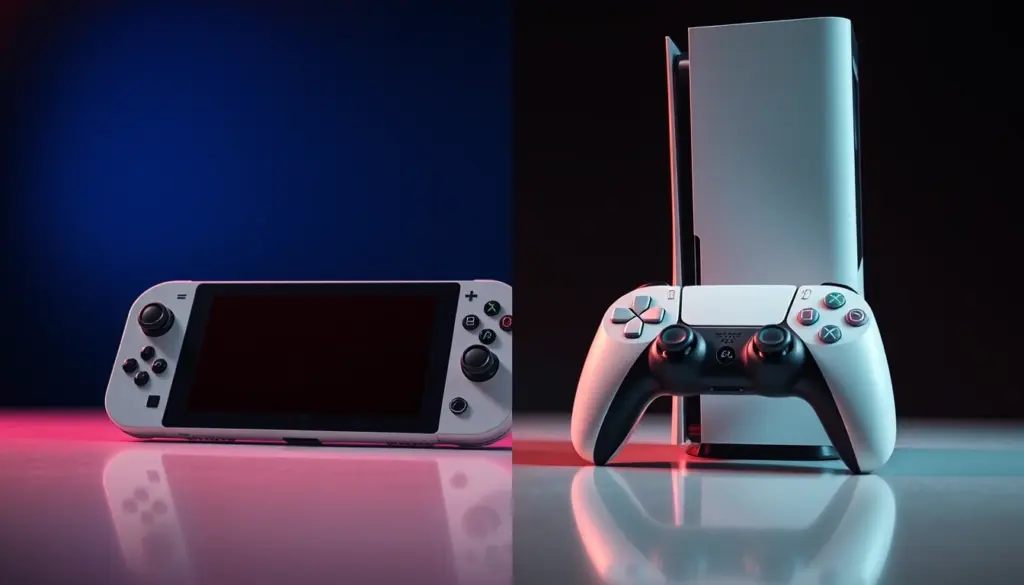
The Switch 2 vs PS5 question has become the defining console dilemma of 2026. On one side sits Nintendo’s hybrid, the fastest-selling console the company has ever shipped. On the other is Sony’s raw-power flagship, still the best-selling home console of its generation. Both machines got noticeably more expensive this spring as a global memory-chip shortage pushed hardware prices up across the industry, so choosing correctly matters more than it did a year ago. This comparison breaks down every angle that counts — price, specs, real-world performance, graphics, game libraries, subscriptions, and sales — using only verified 2025–2026 data, so you can decide which console deserves your money as of September 2026.
Here is the short version before we dig in: the Nintendo Switch 2 is the cheaper, more flexible machine that plays anywhere and leans on Nvidia’s DLSS to look far better than its raw power suggests. The PlayStation 5 is the muscle car — roughly three times the graphics throughput, native 4K output, and a deep catalog of cinematic single-player blockbusters. Neither is objectively “better”; they solve different problems. The rest of this Switch 2 vs PS5 breakdown explains exactly which problem each one solves, and for whom.
Switch 2 vs PS5: The 2026 Matchup at a Glance
Before the deep dive, here is the head-to-head summary. The Nintendo Switch 2 launched on June 5, 2025 at $449.99 and rose to $499.99 on September 1, 2026 following a scheduled increase. The PlayStation 5 family sits above it after Sony’s April 2, 2026 price revision, with the Digital Edition at $599.99, the Disc Edition at $649.99, and the range-topping PS5 Pro at $899.99. That pricing gap — $150 between the cheapest Switch 2 and the cheapest disc-based PS5 — frames the entire decision.
| Category | Nintendo Switch 2 | Sony PlayStation 5 |
|---|---|---|
| Starting price (US, Sept 2026) | $499.99 | $599.99 (Digital) / $649.99 (Disc) |
| Form factor | Hybrid handheld / home console | Home console |
| Raw GPU throughput | ~3.07 TFLOPS (docked) | 10.28 TFLOPS |
| Signature upscaling | Nvidia DLSS | FSR / PSSR (Pro) |
| Max output resolution | 4K/60 (docked) | 4K/120, 8K-ready |
| Portable play | Yes (7.9″ screen) | No (streaming only) |
| Units shipped (Mar 31, 2026) | 19.86 million | 93.7 million |
| Best for | Portability, Nintendo exclusives, families | 4K power, cinematic AAA, VR |
If your priority is a machine you can throw in a bag and play on a plane, the Switch 2 wins before the conversation even starts. If you want the biggest, sharpest picture on a living-room TV and the widest selection of third-party blockbusters, the PS5 answers that. Most of what follows is about the shades of gray between those two poles.
Switch 2 vs PS5 Specs: Full Hardware Comparison
Any honest Switch 2 vs PS5 specs comparison has to acknowledge that these are fundamentally different classes of hardware. The Switch 2 is a battery-powered hybrid built around a custom Nvidia processor, engineered to sip power when undocked and stretch performance with AI upscaling. The PS5 is a mains-powered home console built around AMD silicon, engineered to brute-force high resolutions and high frame rates. The table below lays out the officially published specifications for each, plus the PS5 Pro as a reference point for buyers weighing the top of Sony’s range.
| Specification | Nintendo Switch 2 | PS5 (Slim) | PS5 Pro |
|---|---|---|---|
| CPU | 8× ARM Cortex-A78C (custom Nvidia SoC) | 8-core AMD Zen 2, up to 3.5 GHz | 8-core AMD Zen 2, high CPU mode |
| GPU architecture | Nvidia Ampere-class, Tensor Cores | AMD RDNA 2, 36 CUs | AMD RDNA-based, ~60 CUs |
| GPU throughput | ~3.07 TFLOPS docked (~1.7 handheld) | 10.28 TFLOPS | ~16.7 TFLOPS |
| System memory | 12 GB LPDDR5X | 16 GB GDDR6 | 16 GB GDDR6 + 2 GB DDR5 |
| Internal storage | 256 GB UFS | 1 TB SSD | 2 TB SSD |
| Storage expansion | microSD Express (up to 2 TB) | M.2 NVMe slot | M.2 NVMe slot |
| Display (built-in) | 7.9″ LCD, 1920×1080, 120 Hz VRR, HDR10 | None | None |
| Max output | 4K/60 docked, 1080p/120 handheld | 4K/120, 8K-ready (HDMI 2.1) | 4K/120, 8K-ready (HDMI 2.1) |
| Upscaling | Nvidia DLSS (CNN + Tiny DLSS) | AMD FSR | PSSR (AI upscaling) |
| Ray tracing | Yes (hardware RT cores) | Yes (RDNA 2 hardware RT) | Yes (enhanced RT) |
| Optical drive | None (cartridge + digital) | Ultra HD Blu-ray (Disc Edition) | Optional external disc drive |
| Battery | 5,220 mAh (2–6.5 hrs) | N/A (mains) | N/A (mains) |
| Launch date | June 5, 2025 | Nov 2020 (Slim: Nov 2023) | Nov 2024 |
Two numbers dominate the Switch 2 vs PS5 specs sheet. The first is memory: 12 GB of LPDDR5X in the Switch 2 versus 16 GB of faster GDDR6 in the PS5. The second is raw graphics throughput, where the PS5’s 10.28 TFLOPS towers over the Switch 2’s roughly 3.07 TFLOPS in docked mode. On paper, that is a decisive win for Sony. In practice, as the performance section explains, the gap on screen is narrower than the raw figures imply, because the two machines reach their pixels by completely different routes. It is also worth noting the storage disparity: the PS5’s 1 TB SSD dwarfs the Switch 2’s 256 GB, though Nintendo’s use of microSD Express keeps expansion cheap and simple.
Switch 2 vs PS5 Price: Why Both Consoles Cost More in 2026
Pricing is the most volatile part of this comparison, and it moved sharply in the first half of 2026. According to the official PlayStation Blog announcement, Sony raised US prices effective April 2, 2026: the standard Disc Edition and the Digital Edition each climbed by $100, while the PS5 Pro jumped $150. Nintendo followed on May 8–9, 2026 with notice of its own increase, which took the Switch 2 from $449.99 to $499.99 on September 1, 2026. Both companies cited the same underlying cause: a severe DRAM and NAND memory shortage, worsened by AI data-center demand consuming supply, layered on top of new US tariffs on advanced semiconductors.
| Model | Price (Sept 2026) | Change in 2026 | Effective date |
|---|---|---|---|
| Nintendo Switch 2 | $499.99 | +$50 (from $449.99) | Sept 1, 2026 |
| PS5 Digital Edition | $599.99 | +$100 | Apr 2, 2026 |
| PS5 Disc Edition | $649.99 | +$100 | Apr 2, 2026 |
| PS5 Pro | $899.99 | +$150 | Apr 2, 2026 |
The practical takeaway for a 2026 buyer is twofold. First, the Switch 2 is the last major console still sitting below $500, even after its September 1 rise to $499.99, a $50 increase that still leaves it the only sub-$500 option. Second, the true entry point to Sony’s ecosystem is now the $599.99 Digital Edition, not the disc model; you trade the Ultra HD Blu-ray drive and the ability to buy cheaper physical games for a $50 discount. Buyers eyeing the very top of the range should read our dedicated PS5 Pro vs PS5 breakdown, because at $899.99 the Pro costs almost exactly twice a Switch 2 and competes in a different budget bracket entirely.
Factor in software and the math shifts again. Nintendo first-party games routinely launch at $69.99–$79.99 and hold their price for years, while the PS5’s larger install base and frequent sales mean its catalog often trends cheaper over time. Neither ecosystem is clearly “cheaper to own” — it depends heavily on how many games you buy and whether you chase discounts.
To see the real gap, add up a representative first-year bundle. A Switch 2 at $499.99, one $79.99 game, a year of Nintendo Switch Online at $19.99, and a 256 GB microSD Express card (around $50) lands near $650. The equivalent PS5 Disc Edition at $649.99, one $69.99 game, and a year of PS Plus Essential at $79.99 already reaches roughly $800 before any storage upgrade. That ~$150 delta at the checkout is the single most important practical fact in the entire Switch 2 vs PS5 comparison for budget-minded buyers — and it only widens as the Switch 2 stays cheaper on subscriptions year after year.
Switch 2 vs PS5 Performance: 3.07 vs 10.28 TFLOPS
Raw Switch 2 vs PS5 performance is where the two consoles look least alike. The PS5’s AMD RDNA 2 GPU delivers 10.28 TFLOPS of compute; the Switch 2’s Nvidia chip produces roughly 3.07 TFLOPS when docked and less when running on battery. That is a gap of more than three to one in favor of Sony. Pair that with the PS5’s wider, faster 16 GB GDDR6 memory bus and its eight Zen 2 cores, and in any pure horsepower test — native resolution, frame rate under load, ray-tracing density — the PlayStation 5 wins comfortably.
| Performance metric | Nintendo Switch 2 | PlayStation 5 |
|---|---|---|
| Raw GPU compute | ~3.07 TFLOPS (docked) | 10.28 TFLOPS |
| Memory bandwidth | LPDDR5X (shared pool) | 448 GB/s GDDR6 |
| Typical AAA target (docked) | 1080p–1440p reconstructed | Up to native 4K |
| Frame-rate ceiling | 120 fps (supported titles) | 120 fps (supported titles) |
| Cyberpunk 2077 approach | DLSS from as low as 648p | 4K/60 Performance RT |
| Ray tracing budget | Hardware RT, limited | Hardware RT, larger |
Digital Foundry’s cross-platform testing, corroborated by the specifications published by Nintendo and Sony, confirms the raw hierarchy: the PS5 renders more pixels, more consistently, with a bigger ray-tracing budget. But raw throughput is only half the story. The Switch 2 was engineered around a technology the PS5 does not have — Nvidia’s DLSS — and that changes what the numbers mean once a game is actually on screen. This is why Switch 2 vs PS5 performance arguments that stop at the TFLOPS figure miss the point entirely.
How DLSS Lets the Switch 2 Punch Above Its Weight
DLSS (Deep Learning Super Sampling) uses the Switch 2’s dedicated Tensor Cores to reconstruct a high-resolution image from a much lower internal render. Digital Foundry identified two implementations on the console: a standard CNN model used in demanding ports like Cyberpunk 2077, and a lighter “Tiny DLSS” variant — roughly 50% cheaper in frame time — used in games such as Fast Fusion. In practice, the Tensor Cores can rebuild a near-4K frame from a render as low as 648p, cutting the GPU workload by around 44% while producing output that Digital Foundry’s analysts describe as approaching native quality in well-optimized titles.
The result is that a 3-TFLOP handheld can display games that its raw compute should not be able to run well. In Cyberpunk 2077, Digital Foundry found the Switch 2’s reconstructed image can actually surpass the Xbox Series S in dense street scenes, precisely because DLSS rebuilds a cleaner 1080p frame than the Series S’s native rendering manages. It still falls short of the PS5’s ray-traced lighting and steadier frame rates — but “worse than a PS5, better than a Series S” is an astonishing place for a portable to land.
A handful of real-world 2026 releases show this dynamic in action. Mario Kart World runs natively at up to 4K/60 on the Switch 2 hardware it was built for, looking pristine. Cyberpunk 2077: Ultimate Edition leans on the full DLSS pipeline to hold a stable image where raw silicon alone could not. Cross-platform tentpoles like Hogwarts Legacy and Elden Ring ship on both consoles, but the PS5 versions push higher native resolutions and steadier frame rates, while the Switch 2 versions trade fidelity for the freedom to play them on a train. Annualized giants such as EA Sports FC and NBA 2K appear on both platforms too, typically with richer crowd detail and lighting on PS5. The pattern is consistent: if a game exists on both, the PS5 renders it with more brute force, and the Switch 2 makes it portable.
Switch 2 vs PS5 Graphics: DLSS Reconstruction vs Native 4K
The Switch 2 vs PS5 graphics comparison comes down to a philosophical difference in how each console reaches your television. The PS5 aims to render close to native 4K and then, where needed, upscales with AMD’s FSR or — on the Pro — the AI-driven PSSR. The Switch 2 renders at a deliberately low internal resolution and leans on DLSS to reconstruct the rest. Both end up outputting a 4K-class signal to a docked TV, but the PS5’s is built from far more real pixels, which shows up in fine detail, transparency effects, and heavy ray-traced scenes.
To make the reconstruction concept concrete, consider the pixel math a DLSS pass performs when the Switch 2 targets a 4K docked output from a 648p internal render:
Internal render:   1152 x 648   =    746,496 pixels
Reconstructed to:  3840 x 2160   =  8,294,400 pixels
Upscale factor:    ~11.1x more pixels on screen
GPU workload cut:  ~44% vs native rendering (Digital Foundry)

# The Tensor Cores infer the missing ~7.5M pixels from
# motion vectors + a trained neural network, rather than
# the shader cores rendering them the traditional way.
That inference step is why the Switch 2 can display visually rich games at a fraction of the PS5’s power draw. But inference is not free of artifacts: fast motion, fine foliage, and transparent effects are where reconstructed images can wobble, and where the PS5’s larger pool of real pixels pulls clearly ahead. For a living-room setup on a large 4K TV, the PS5 delivers the more consistently pristine picture. On the Switch 2’s own 7.9-inch 1080p screen, however, the reconstruction is essentially invisible — the handheld looks superb in the mode most owners use most.
Ray Tracing and HDR: Where the Gap Widens
Both consoles have hardware ray-tracing units, but the PS5’s larger GPU affords a much bigger RT budget. In practice, PS5 games apply ray-traced reflections, shadows, and global illumination more aggressively and at higher frame rates, while Switch 2 titles tend to use RT sparingly to protect performance. Both support HDR — the Switch 2 via HDR10 on its built-in panel and over HDMI, the PS5 across HDR10 on any compatible display. If cutting-edge lighting is what defines “next-gen graphics” for you, the PS5 is the stronger Switch 2 vs PS5 graphics pick. If you value a great-looking picture that also fits in your hands, the Switch 2’s DLSS approach is remarkable.
Display, Battery, and Portability: The Hybrid Advantage
This is the category where comparison becomes almost unfair, because only one of these machines even competes. The Switch 2 carries a 7.9-inch 1080p LCD with a 120 Hz variable refresh rate and HDR10, powered by a 5,220 mAh battery that Nintendo rates at 2 to 6.5 hours depending on the game. It is a complete gaming experience you can use on a couch, a train, or a plane, then dock to a TV in seconds. The PlayStation 5 has no screen and no battery; it is a stationary box that outputs to a television, with remote streaming to phones and the PlayStation Portal as its only “portable” answer.
For a large segment of buyers, portability is not a nice-to-have — it is the entire reason to choose a console. Commuters, parents who game after the kids are asleep, students in dorms, and anyone who shares a household TV all benefit enormously from the Switch 2’s flexibility. The trade-off is screen size and absolute fidelity: a 65-inch OLED fed by a PS5 is a different spectacle than a 7.9-inch handheld panel, however sharp that panel is. If you already own a great TV and rarely leave the living room, the Switch 2’s hybrid trick may hold little value for you. If you do not, it can be transformative. Readers weighing portable-only options should also compare our Steam Deck vs Switch 2 analysis and the ROG Xbox Ally X vs Legion Go 2 handheld comparison.
The controller and accessory ecosystems differ too. The Switch 2 ships with detachable Joy-Con 2 controllers — now magnetically attached and usable as a mouse in supported games — and supports a dedicated Switch 2 Pro Controller for traditional play. The PS5’s DualSense is widely praised for its haptic feedback and adaptive triggers, with a premium DualSense Edge option for competitive players, and the console anchors a dedicated PlayStation VR2 headset ecosystem that the Switch 2 has no equivalent to. If immersive rumble and virtual reality matter to you, that tilts the decision toward Sony; if swappable, mouse-capable controllers and drop-in tabletop multiplayer appeal more, the Switch 2’s Joy-Con approach stands alone.
Game Libraries and Exclusives Compared
Hardware sells the console, but software keeps it. Here the two platforms diverge in character as much as in catalog. Nintendo’s strength is a stable of first-party franchises that exist nowhere else and that consistently top critical and sales charts. Sony’s strength is a deep bench of cinematic single-player exclusives plus near-universal third-party support — if a big multiplatform game ships in 2026, it ships on PS5, and often looks its best there outside of a high-end PC.
Nintendo Switch 2 Exclusives
The Switch 2 arrived with Mario Kart World as its signature launch title, an open-world evolution of the kart-racing series, and has since built out a strong exclusive lineup. Standouts include Donkey Kong Bananza, one of the console’s most acclaimed 3D platformers; Pokemon Pokopia, a warmly received cozy life-sim blending Pokemon with Animal Crossing sensibilities; Hyrule Warriors: Age of Imprisonment, a fast-paced Musou set in the Zelda universe; and Mario Tennis Fever. These are system-sellers in the literal sense — you cannot play them, legally, on any other hardware. For millions of buyers, a single Nintendo franchise is enough to settle the entire Switch 2 vs PS5 question on its own.
PlayStation 5 Exclusives and Third-Party Depth
Sony’s catalog leans into big-budget, story-driven experiences: Astro Bot, which won Game of the Year at The Game Awards 2024; Marvel’s Spider-Man 2; God of War Ragnarok; Final Fantasy VII Rebirth; Horizon Forbidden West; Gran Turismo 7; and 2025’s Ghost of Yotei. Beyond exclusives, the PS5 is the default home for third-party AAA releases — sports franchises, annualized shooters, and the biggest open-world games routinely arrive on PS5 first and run there at their highest console settings. If your taste runs to prestige single-player campaigns and cutting-edge multiplatform titles, the PS5’s library is deeper and broader.
Backward Compatibility: Bringing Your Library Forward
Backward compatibility is a quiet but decisive factor, especially for anyone upgrading within a family they already own hardware in. The Switch 2 is backward compatible with the vast majority of the original Nintendo Switch library — a catalog of more than 15,000 titles — whether from physical cartridges or previously purchased digital copies. Many older games even benefit from improved load times and steadier frame rates on the new hardware. Nintendo has published a compatibility list of the small number of exceptions, and throughout early 2026 issued patches that restored several previously incompatible titles, including Doom (2016), Final Fantasy XII: The Zodiac Age, and Kirby’s Return to Dream Land Deluxe.
The PS5 plays the overwhelming majority of the PlayStation 4’s roughly 4,000-game library, and many of those titles run at higher, steadier frame rates thanks to a “Game Boost” feature. What neither console offers, of course, is cross-brand compatibility: your Switch cartridges will never run on a PS5, and your PS4 discs will never run on a Switch 2. If you are deeply invested in one ecosystem’s back catalog, that investment is a powerful reason to stay within it — and a real cost to consider before switching sides.
Digital-library portability deserves a specific mention. Nintendo’s Virtual Game Card system lets Switch 2 owners load and lend their digital games across their own devices and family group, while Sony’s account-based licensing ties PS5 digital purchases to your PlayStation Network account with console-sharing features. In both cases your digital catalog follows your account rather than the specific box, which makes upgrading within a brand painless — and makes losing access to that library on a brand switch all the more costly.
Online Subscriptions: Nintendo Switch Online vs PS Plus
Ongoing subscription cost is a real part of console ownership, and here the two platforms differ sharply in both price and philosophy. Nintendo Switch Online is inexpensive and lightweight; PlayStation Plus is pricier but tiered, with higher tiers functioning as a Netflix-style game catalog. As of June 2026, the US Nintendo Switch Online pricing was unchanged even as Nintendo raised prices in Japan, while PS Plus monthly rates rose across all three tiers in May 2026.
| Service / tier | Monthly | Annual | Key benefit |
|---|---|---|---|
| Nintendo Switch Online (Individual) | $3.99 | $19.99 | Online play, NES/SNES library |
| NSO + Expansion Pack (Individual) | — | $49.99 | Adds N64/Genesis, DLC |
| NSO Family | — | $34.99 | Up to 8 accounts |
| PS Plus Essential | $10.99 | $79.99 | Online play, monthly games |
| PS Plus Extra | $16.99 | $134.99 | Catalog of hundreds of games |
| PS Plus Premium | $19.99 | $159.99 | Adds classics, cloud streaming |
The gap is stark: a year of basic online play costs $19.99 on Switch 2 versus $79.99 for PS Plus Essential — four times as much. Even NSO’s premium Expansion Pack tier, at $49.99 a year, undercuts the cheapest PS Plus annual plan. What you get for the higher PS Plus outlay, though, is substantial: the Extra and Premium tiers bundle hundreds of downloadable games, effectively a rotating library that can replace many individual purchases. For a household that plays a lot and values a deep on-demand catalog, PS Plus Extra can be excellent value; for someone who mainly wants to play Nintendo’s own games online with friends, NSO is dramatically cheaper.
Sales Showdown: 19.86M vs 93.7M Units
Sales figures do not tell you which console is right for you, but they reveal momentum — and momentum shapes how long a platform stays well-supported. Per Nintendo’s fiscal-year results, the Switch 2 shipped 19.86 million units worldwide as of March 31, 2026, and industry trackers put it above 20.7 million by May. That is an extraordinary result for a console less than a year old — enough to make the Switch 2 the second-fastest-selling console of all time in its debut year, according to TechTimes.
The PlayStation 5, by contrast, had shipped 93.7 million units by March 31, 2026 — a commanding lifetime lead built over more than five years on the market, and a figure that puts Sony within striking distance of the 100-million milestone. The nuance is in the trend: the PS5 is a mature console late in its cycle, and Q1 2026 was its weakest sales quarter ever at roughly 1.5 million units, while the Switch 2 outsold it by about a million units in the most recent quarter. In other words, the PS5 leads the race overall, but the Switch 2 is sprinting. Both platforms are commercially healthy enough that support is not a concern for either — for the deeper numbers, see our reports on Switch 2 sales hitting 19.86M and the broader PS5 vs Xbox Series X install-base breakdown.
Which Console Should You Buy? 6 Real-World Use Cases
The right answer to the Switch 2 vs PS5 question depends entirely on how you actually live and play. Here are six common buyer profiles and the console that fits each best.
- The family with young kids: Switch 2. Nintendo’s exclusives are age-appropriate and iconic, the Family NSO plan is cheap at $34.99/year, and portability keeps the peace on car trips. The lower $499.99 entry price seals it.
- The 4K home-theater enthusiast: PS5. If you have a large 4K TV and a soundbar, the PS5’s native-4K rendering, aggressive ray tracing, and Ultra HD Blu-ray drive make it the obvious centerpiece.
- The commuter or frequent traveler: Switch 2. A console you can play on a plane with a 2–6.5 hour battery is in a category the PS5 simply cannot enter.
- The cinematic single-player fan: PS5. Astro Bot, God of War Ragnarok, Spider-Man 2, and Final Fantasy VII Rebirth are a murderers’ row of prestige campaigns.
- The budget-conscious buyer: Switch 2. Even after its September 1 rise to $499.99, it is the only major console still under $500, with $19.99/year online play.
- The VR-curious or multiplatform gamer: PS5. It is the default home for third-party AAA releases and the only one of the two with a dedicated VR headset ecosystem.
Notice that almost none of these profiles are actually in conflict — which is why a meaningful number of households eventually own both. The Switch 2 handles Nintendo exclusives and on-the-go play; the PS5 handles 4K blockbusters and third-party tentpoles. If budget forces a single choice, let your dominant use case — portability versus power — make the call.
Switching Platforms: Migration and Setup Guide
If you are moving into one of these ecosystems — either upgrading from an older console or switching sides — a little planning saves a lot of frustration. The single most important thing to understand is that there is no bridge between the two: nothing you own on Nintendo transfers to PlayStation, or vice versa. Within each brand, however, the upgrade path is smooth.
Moving from an original Switch to a Switch 2 follows a straightforward system-transfer flow:
1. Update both consoles to the latest system software.
2. On Switch 2: Settings > System > System Transfer > "Transfer from a Switch."
3. On the old Switch: confirm the same menu as the source device.
4. Keep both units on the same Wi-Fi network, plugged in.
5. Transfer user accounts, save data, and digital games.
6. Re-download purchased titles; move microSD content as prompted.
7. Verify backward-compatible games launch, then wipe the old unit.
Upgrading from a PS4 to a PS5 is similarly painless: connect both consoles to the same network and use PS5’s Data Transfer wizard, or restore saves from PS Plus cloud storage. Most PS4 games run on PS5 automatically, and many receive free performance upgrades. If you are switching brands entirely — say, leaving PlayStation for Nintendo — budget for the fact that you are starting your library from scratch, and check whether the specific games you care about even exist on the destination platform. Cross-progression exists in some live-service titles such as Fortnite and Minecraft, so your account-linked progress in those can follow you, but standalone single-player games and their saves cannot.
One practical tip: before committing, price out the full first-year cost, not just the hardware. Add the console, one or two must-play games, a year of online service, and any storage expansion. On that basis the Switch 2 typically lands several hundred dollars below a comparably equipped PS5 — a gap worth weighing against the PS5’s greater power and library depth.
Switch 2 vs PS5 Pros and Cons
Distilling the full Switch 2 vs PS5 comparison into balance sheets makes the trade-offs easy to scan.
Nintendo Switch 2
- Pros: Lowest price of any major console ($499.99); true portability with a 7.9″ 1080p/120 Hz screen; exclusive Nintendo franchises; DLSS punches well above its raw specs; cheap online at $19.99/year; backward compatible with 15,000+ Switch games.
- Cons: One-third the raw GPU power of the PS5; only 12 GB RAM and 256 GB storage; weaker in ray tracing and native 4K; thinner third-party AAA support; price raised to $499.99 in September 2026.
PlayStation 5
- Pros: 10.28 TFLOPS of raw power; native 4K and strong ray tracing; deep bench of cinematic exclusives; near-universal third-party support; 1 TB SSD; PS Plus Extra/Premium game catalogs; VR ecosystem.
- Cons: No portability; higher entry price after April 2026 hikes ($599.99+); pricier online play ($79.99/year Essential); larger, stationary footprint; late in its lifecycle.
Final Verdict: Switch 2 vs PS5 in 2026
After weighing every metric, the honest verdict is that the Switch 2 vs PS5 decision is not a contest of better versus worse — it is a contest of priorities, and the data draws a clean line between them. Choose the Nintendo Switch 2 if portability, price, and Nintendo’s irreplaceable exclusives top your list. At $499.99 (raised from $449.99 on September 1), with a superb handheld screen, DLSS-boosted visuals that outclass its raw 3.07 TFLOPS, and $19.99-a-year online play, it is the most flexible and affordable way into current-generation gaming. Its year-one sales of 19.86 million units are the market’s verdict that this formula works.
Choose the PlayStation 5 if raw power, native 4K fidelity, cinematic single-player blockbusters, and the broadest third-party library matter most. Its 10.28 TFLOPS, aggressive ray tracing, 1 TB SSD, and deep catalog — anchored by a 93.7-million-unit install base — make it the definitive living-room powerhouse, even at its post-April prices of $599.99 and up. For most buyers the smartest read of the Switch 2 vs PS5 performance and value equation is this: if you can only own one and you leave the house with your games, buy the Switch 2; if you rarely leave the couch and want the sharpest possible picture, buy the PS5. And if your budget stretches to both, you will not be the first household to conclude they are complements, not rivals.
Frequently Asked Questions
Is the Switch 2 more powerful than the PS5?
No. In raw terms the PS5 is significantly more powerful, with about 10.28 TFLOPS of GPU compute versus roughly 3.07 TFLOPS for the docked Switch 2 — more than three times the throughput. The Switch 2 narrows the on-screen gap using Nvidia DLSS to reconstruct high-resolution images, but the PS5 remains the stronger machine for native 4K and heavy ray tracing.
How much do the Switch 2 and PS5 cost in 2026?
As of September 2026, the Switch 2 is $499.99 (raised from $449.99 on September 1, 2026). The PS5 Digital Edition is $599.99, the PS5 Disc Edition is $649.99, and the PS5 Pro is $899.99 following Sony’s April 2, 2026 price increase.
Can the Switch 2 output 4K like the PS5?
Yes, but differently. The Switch 2 outputs up to 4K/60 when docked, reconstructing the image with DLSS from a lower internal resolution. The PS5 targets native or near-native 4K and supports up to 4K/120 as well as 8K-ready HDMI 2.1 output. On a large TV the PS5’s picture is built from more real pixels and generally looks cleaner in demanding scenes.
Which has better exclusive games, Switch 2 or PS5?
It depends on taste. The Switch 2 has Nintendo’s irreplaceable franchises — Mario Kart World, Donkey Kong Bananza, Pokemon, and Zelda spin-offs. The PS5 has cinematic single-player exclusives like Astro Bot, God of War Ragnarok, and Marvel’s Spider-Man 2, plus the deepest third-party AAA support. Neither library is objectively “better”; they serve different audiences.
Is the Switch 2 backward compatible with Switch games?
Yes. The Switch 2 plays the vast majority of the original Switch’s 15,000-plus game library, from both cartridges and digital purchases, with a short published list of exceptions. Many older titles run with improved load times and steadier frame rates on the new hardware.
Is online play cheaper on Switch 2 or PS5?
Much cheaper on Switch 2. Nintendo Switch Online costs $19.99 per year for an individual, versus $79.99 per year for PS Plus Essential. PS Plus’s higher Extra and Premium tiers ($134.99 and $159.99 annually) add large on-demand game catalogs that NSO does not match, so the value comparison shifts if you want those libraries.
Should I buy a Switch 2 or PS5 in 2026?
Buy the Switch 2 if you value portability, a lower price, and Nintendo exclusives; buy the PS5 if you want maximum power, native 4K, cinematic blockbusters, and the widest third-party library. If budget allows, many players ultimately own both because the two consoles complement rather than replace each other.
Prices and specifications verified as of September 2026 from official Nintendo, Sony, and PlayStation sources, VGChartz shipment data, and Digital Foundry performance analysis. Console pricing is subject to change; the Switch 2 increase took effect September 1, 2026.