
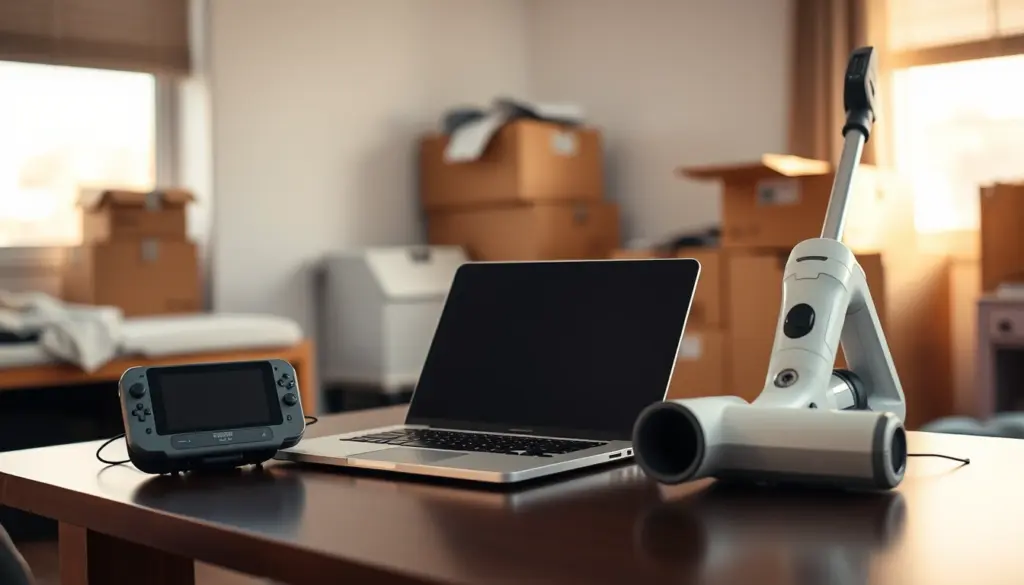
Dorm move-in week usually means shelling out full retail for a laptop, a game console, and something to clean the floor with. This year, Back Market is trying to change that math. Gizmodo flagged the refurbished electronics marketplace on September 2, 2026 for cutting prices on three unrelated but oddly complementary products: a Nintendo Switch, a Dell Latitude business laptop, and a Dyson V8 cordless vacuum. All three are listed well under their new-retail price, and the discounts land squarely in the week college students are moving into apartments and residence halls.
The story is small in scope but useful as a snapshot of where refurbished retail sits in 2026: big enough that a marketplace can time a multi-category sale around the academic calendar, and cheap enough that the pitch to students writes itself. Here’s what Gizmodo reported, what the numbers actually mean once you run the discount math, and how this fits into a refurbished electronics market that keeps getting bigger every year.
What Gizmodo’s Report Actually Says
Gizmodo’s piece, titled “Dell Laptop, Nintendo Switch, and Dyson Vacuum Get Last-Minute Price Drops to All-Time Lows for Dorm Move-In Week,” centers entirely on deals listed on Back Market, the Paris-founded refurbished electronics marketplace. The framing is straightforward: three products aimed at three different dorm-room needs, each priced below what a new equivalent would cost. A Nintendo Switch (32GB, Gray, 2017 model) covers “gaming and unwinding between classes.” A Dell Latitude 5420 14-inch laptop is pitched as “built for coursework and long library sessions.” A Dyson V8 Origin cordless vacuum handles “keeping a dorm room or apartment in order.”
Gizmodo makes the case for refurbished gear directly, writing that all three items “are available at considerably lower prices than their list equivalents, without the condition trade-offs that often give people pause before buying refurbished.” That’s the pitch of the entire piece in one line, and it lines up with how Back Market has marketed itself since it launched in 2014: refurbished doesn’t have to mean risky.
Nintendo Switch: $339 New vs. $229 Refurbished
The Nintendo Switch listed in the Gizmodo piece is the original 32GB Gray model from 2017, priced at $339 new. On Back Market, the same console is available at three condition tiers: $229 in Fair condition, $239 in Good condition, and $265 in Excellent condition. That’s a discount ranging from roughly 22% to 32% off the new price, depending on which condition grade a buyer picks.
It’s worth pointing out this is the 2017-era original Switch, not the newer Switch 2 hardware that Nintendo has been selling since 2025. For a student who wants a console purely to unwind between classes and doesn’t need current-generation specs, that gap between old and new hardware is exactly what makes the refurbished market work.
Dell Latitude 5420: A $400 Business Laptop for $250
The Dell Latitude 5420 14-inch, listed at $400 new, is priced at $250 in Fair condition on Back Market, a 37.5% discount. Dell’s Latitude line has historically been built for business, education, and enterprise buyers rather than casual consumers, which is part of why it shows up so often in the refurbished channel. Latitude units tend to come off corporate leases or institutional fleets in large batches, giving marketplaces like Back Market a steady supply of business-grade hardware to grade, refurbish, and resell.
For a student buying a laptop mainly for coursework, note-taking, and long stretches in the library, a business-class Latitude at $250 is a different value proposition than a consumer laptop at the same price. Business laptops are generally built with more emphasis on repairability and durability testing, which also happens to make them easier for a marketplace to refurbish and resell with confidence.
Dyson V8 Origin: $359 List Price Cut to $170
The steepest discount in the roundup belongs to the Dyson V8 Origin (2016), listed with a $359 price tag new. Back Market’s deal drops it to $170 in Excellent condition, a cut of more than 52%. Gizmodo’s own framing calls the refurbished V8 “a better answer to that need than anything sold new at a comparable price,” pointing at the gap between what a student can spend and what a comparable new cordless vacuum costs.
Cordless vacuums are an unglamorous but recurring dorm-week purchase, and the V8 Origin is old enough as a product line that Dyson has released several newer V-series models since it launched. That age is precisely why it’s cheap to refurbish and resell: parts and repair knowledge for a nearly decade-old vacuum are well understood, and demand from new-vacuum buyers has already shifted to newer models, freeing up secondhand and refurbished supply.
The Discount Math, Side by Side
Lined up together, the three deals show a consistent pattern: older or business-oriented hardware, refurbished and sold at a fixed discount tier based on cosmetic and functional condition. Here’s how the numbers break down.
| Product | New/List Price | Back Market Price | Condition Tier | Discount |
|---|---|---|---|---|
| Nintendo Switch (32GB, 2017) | $339 | $229 | Fair | ~32.4% |
| Nintendo Switch (32GB, 2017) | $339 | $239 | Good | ~29.5% |
| Nintendo Switch (32GB, 2017) | $339 | $265 | Excellent | ~21.8% |
| Dell Latitude 5420 14-Inch | $400 | $250 | Fair | ~37.5% |
| Dyson V8 Origin (2016) | $359 | $170 | Excellent | ~52.6% |
The Dyson deal stands out because it pairs the deepest discount with the highest condition grade, Excellent, while the Switch and Latitude deals sit at the Fair tier for their steepest cuts. That’s a meaningful detail for anyone comparing the three: a Fair-condition refurbished device generally means more visible cosmetic wear, while Excellent condition should look close to new.
Back-to-College Spending Just Crossed $100 Billion
The timing isn’t an accident. The National Retail Federation’s 2026 back-to-college survey found that US households expect to spend $103.5 billion on back-to-college shopping this year, the first time that category has topped $100 billion, with families spending an average of $1,437.79 per student. Electronics remain the single largest spending bucket, with shoppers planning to spend $341.95 on average, or $24.63 billion in total, and another $194.00 on average, $14.0 billion total, on dorm and apartment furnishings.
| Metric | 2025 | 2026 |
|---|---|---|
| Total back-to-college spending | $88.8 billion | $103.5 billion |
| Average spend per household/student | $1,325.85 | $1,437.79 |
| Electronics spending (total) | Not broken out | $24.63 billion |
| Dorm/apartment furnishings (total) | Not broken out | $14.0 billion |
Source: National Retail Federation. That jump from $88.8 billion to $103.5 billion year over year gives marketplaces like Back Market a clear incentive to run condition-graded sales precisely during move-in week, when electronics purchases are already concentrated and price sensitivity is high.
Inside Back Market’s Business
Back Market was founded in Paris in 2014 and has grown into one of the larger names in refurbished electronics. According to a company press release from September 2025, it had reached 17 million customers across 17 markets and said it had avoided more than 2 billion kilograms of carbon emissions through its circular-economy model. The company raised $510 million in a January 2022 Series E round that valued it at $5.7 billion, and research firm Sacra reported the company generated $495 million in 2025 revenue and reached global EBITDA break-even that year.
That combination, break-even economics plus nearly a decade of operating history, is part of why Back Market can run aggressive, condition-tiered pricing on products like the Switch, Latitude, and V8 Origin. It isn’t burning cash to subsidize a single promotional week; the pricing model is built into how the company buys, grades, and resells inventory year-round.
The Refurbished Electronics Market Keeps Growing
Back Market’s individual numbers sit inside a market that multiple research firms peg in the tens of billions of dollars and growing at a double-digit pace. Coherent Market Insights puts the global refurbished electronics market at $68.24 billion in 2026, projecting growth to $136.40 billion by 2033 at a 10.4% compound annual growth rate. Research and Markets, in a separate estimate, projects the market growing from roughly $103 billion in 2025 to more than $211 billion by 2031. The exact figures vary by methodology, but every major estimate agrees on the direction: this category is expanding faster than electronics retail overall.
That growth is what makes a single Gizmodo deals roundup worth paying attention to beyond the three specific products involved. Refurbished electronics stopped being a niche, slightly-suspect category years ago. It’s now a double-digit-growth business with real household names, competing directly with new-product retail for the same back-to-school dollars the NRF is tracking.
Nintendo Switch Pricing in the Switch 2 Era
The original Switch being sold in this deal is nearly a decade old at this point, and its position in the market has shifted since Nintendo’s Switch 2 launched in 2025. Shattered.io has tracked several data points on how that transition is playing out at retail, including Switch 2 sales figures that outsold PS5’s first-year numbers, a price increase on the Switch 2 itself, and a separate refurbished Switch 2 deal that beat a looming price hike.
Put next to those Switch 2 stories, the original Switch deal in the Gizmodo piece looks less like a headline console purchase and more like a budget add-on: a way for a student to have a game console in the dorm without committing current-generation prices to it. That’s a pattern that shows up across the hardware refurb market generally, where last-generation devices get cheaper and more available exactly as the next generation takes over new-unit sales.
Refurbished vs. New: What Dorm Shoppers Actually Trade Off
Condition grading matters more than the sticker price
Back Market’s condition tiers, Fair, Good, and Excellent, aren’t just marketing labels. Fair-condition devices generally carry visible wear like scratches or scuffs but should function fully. Good condition sits in the middle. Excellent condition should be close to indistinguishable from new aside from the price tag. Buyers comparing the Switch’s three price points ($229, $239, $265) are really deciding how much cosmetic wear they’re willing to accept for a $36 spread.
Warranty coverage is the real differentiator
The core pitch that Gizmodo makes, buying refurbished “without the condition trade-offs that often give people pause,” depends heavily on marketplaces backing their grading with a warranty and return policy. That backstop is what separates a marketplace like Back Market from buying a used device peer-to-peer with no recourse if something breaks two weeks into the semester.
How Back Market Compares to Other Refurbished Sellers
Back Market isn’t the only place to buy refurbished electronics, and students weighing this deal against alternatives should know how the landscape is structured. The table below lays out the basic model differences among the major refurbished channels.
| Retailer | Model | Typical Condition Grading |
|---|---|---|
| Back Market | Third-party marketplace, multiple sellers per listing | Fair / Good / Excellent / Premium tiers |
| Amazon Renewed | Amazon-vetted third-party sellers | Renewed Premium / Renewed |
| Best Buy Outlet | Retailer-run clearance and open-box channel | Open-box: Excellent / Satisfactory / Fair |
| eBay Certified Refurbished | Manufacturer or eBay-approved seller certification | Certified Refurbished (manufacturer-backed) |
The structural difference is that Back Market operates as a marketplace layered on top of many independent refurbishers, using its own condition-grading standard across all of them, while Amazon Renewed and eBay’s certified program lean on seller or manufacturer certification, and Best Buy Outlet is the retailer’s own open-box and clearance inventory rather than a dedicated refurbished program. None of these models is objectively better across the board, but the grading systems aren’t identical, which matters if a student is comparing prices across sites rather than sticking to one marketplace.
From Campus Classifieds to Certified Refurbished Marketplaces
Buying secondhand gear for a dorm room isn’t new. What’s changed is the infrastructure around it. A decade ago, a student looking for a cheap laptop or console was checking campus bulletin boards, Craigslist, or a classmate’s older sibling. Condition was whatever the seller claimed, and there was no real recourse if the item didn’t work.
Back Market’s 2014 founding, alongside similar moves by Amazon, eBay, and big-box retailers to formalize their own refurbished channels, replaced that informal peer-to-peer market with standardized condition grades, return windows, and warranties. The $5.7 billion valuation Back Market reached in its 2022 funding round, reported by Reuters at the time, reflected investor confidence that this formalization was a durable business, not a temporary pandemic-era trend. Four years later, with the company reporting break-even economics on nearly $500 million in revenue, that bet looks reasonably validated.
What These Deals Signal for Back-to-School Retail
Take the NRF’s $103.5 billion back-to-college figure and the fact that electronics alone account for $24.63 billion of it, and a single-marketplace deals roundup covering a console, a laptop, and a vacuum stops looking like a minor shopping blog post. It’s evidence that refurbished retail has become mainstream enough to compete directly for a meaningful slice of one of the largest annual consumer spending events in the US.
New-product retailers have generally responded to this shift by building out their own certified-refurbished and trade-in programs rather than ceding the category. Best Buy’s Outlet channel and Amazon Renewed both exist for exactly that reason. The pressure Back Market and similar marketplaces put on list prices during high-spend weeks like this one is part of what’s driving that response, even if no single deals story proves it on its own.
Predictions: Where Refurbished Tech Pricing Goes From Here
- More calendar-timed sales events. Expect refurbished marketplaces to keep aligning promotions with academic milestones, back-to-school in August/September, winter break turnover in December/January, and end-of-semester moves in May, rather than running generic year-round discounts.
- Deeper condition-tier granularity. As competition between Back Market, Amazon Renewed, and retailer-run outlet channels increases, expect more precise condition grading (beyond three or four tiers) to help buyers compare prices apples-to-apples.
- Faster turnover of Switch 2-era original Switch inventory. With Nintendo’s Switch 2 established in the market since 2025, expect original Switch units to keep flowing into refurbished channels at falling price points as more owners upgrade.
- Retailers expanding certified-refurbished sections. If the refurbished electronics market keeps growing at the roughly 10%-13% CAGR that Coherent Market Insights and Research and Markets both project, expect mainstream retailers to widen their own refurbished offerings rather than lose that share to independent marketplaces.
- Reinvestment from break-even marketplaces. Now that Back Market has reported reaching EBITDA break-even, expect it and similarly-scaled competitors to reinvest in warranty length, return windows, or inventory guarantees, the features that most directly address the “condition trade-offs” Gizmodo says put buyers off refurbished gear in the first place.
These are reasonable extrapolations from current spending and market-growth data, not confirmed roadmap items from any of the companies involved. Back Market, Nintendo, Dell, and Dyson haven’t announced specific plans matching any of the above.
Frequently Asked Questions
Is the Back Market Nintendo Switch deal for the original Switch or the Switch 2?
It’s the original Nintendo Switch, the 32GB Gray model released in 2017, not the newer Switch 2 hardware Nintendo has sold since 2025.
How much can you save buying the Nintendo Switch refurbished instead of new?
Based on the prices in Gizmodo’s report, the refurbished Switch ranges from $229 to $265 depending on condition, against a $339 new price, a discount of roughly 22% to 32%.
What condition is the Dell Latitude 5420 laptop in the deal?
The $250 price for the Dell Latitude 5420 14-inch applies to the Fair condition tier on Back Market, down from a $400 list price.
Is Back Market a legitimate company to buy refurbished electronics from?
Back Market is a Paris-founded marketplace operating since 2014. A company press release from September 2025 said it served 17 million customers across 17 markets, and research firm Sacra reported it generated $495 million in 2025 revenue while reaching EBITDA break-even.
Why is the Dyson V8 Origin discounted more than the Switch or the laptop?
The Dyson V8 Origin sees the deepest cut in the roundup, from $359 to $170, a discount of more than 52%. Gizmodo’s report doesn’t give a specific reason for the size of the discount, though older product lines with well-established parts and repair processes are generally cheaper to refurbish at scale.
How big is the refurbished electronics market in 2026?
Estimates vary by research firm. Coherent Market Insights puts the global market at $68.24 billion in 2026, growing to $136.40 billion by 2033. Research and Markets projects growth from roughly $103 billion in 2025 to more than $211 billion by 2031.
How much are US families spending on back-to-college shopping in 2026?
The National Retail Federation’s 2026 survey found US back-to-college spending is expected to reach $103.5 billion, the first time the category has topped $100 billion, with electronics as the single largest spending category at $24.63 billion.
Does buying refurbished electronics come with a warranty?
Warranty terms vary by marketplace and by individual seller listing. Buyers should check the specific warranty and return window attached to a listing before purchasing, since coverage isn’t identical across every refurbished retailer or every condition tier.