
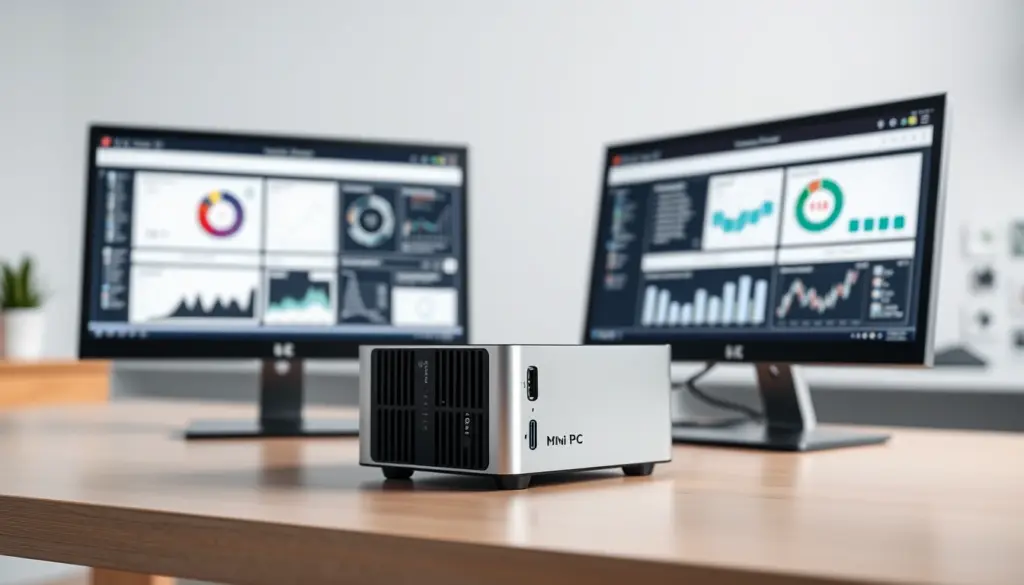
MINIX has launched the N304-AI, a mini PC built on Intel’s newly introduced Wildcat Lake platform, positioning the compact desktop as an entry-level option for on-device AI workloads. The launch was first reported by Wccftech and confirmed by Notebookcheck and MyEverydayTech, with additional coverage from Gadget Pilipinas and GIGAZINE.
The pitch is straightforward: pack Intel’s newest entry-tier silicon, a neural processing unit, and enough ports for a small office into a chassis roughly the size of a paperback book. MINIX says the N304-AI delivers up to 24 TOPS of combined AI performance, a figure the company frames as enough for edge inference, light AI tooling, and everyday desktop work without the price tag of a workstation-class NPU. What follows is a look at what’s actually inside the box, how it stacks up against the handful of rivals already shipping on the same Intel platform, and what its arrival signals about where budget AI hardware is headed in late 2026.
What Is the MINIX N304-AI Mini PC?
The N304-AI is a compact desktop system from MINIX, a company that has sold mini PCs and small-form-factor computing hardware for years. According to the company’s own announcement, the device is built to bring dedicated on-device AI acceleration to everyday computing tasks rather than to compete with high-end AI workstations. MyEverydayTech described the launch as bringing “dedicated on-device artificial intelligence acceleration to everyday computing workflows through Intel’s latest entry-tier architecture,” a framing that matches how MINIX itself talks about the machine.
MINIX is pitching the N304-AI at small and midsize businesses, digital signage installs, retail point-of-sale setups, home offices, education, and general business use, according to the launch coverage. That’s a deliberately unglamorous list. This isn’t a gaming box or a content-creation rig. It’s a machine meant to sit behind a monitor, under a counter, or bolted to the back of a signage display and just run, which is exactly the kind of hardware category Intel has been trying to grow with its entry-tier AI silicon.
Inside Intel’s Wildcat Lake Platform
The N304-AI runs on Intel’s Wildcat Lake platform, using the Intel Core 3 Processor 304 as its CPU. Notebookcheck’s coverage put it plainly: “It is powered by the Intel Wildcat Lake platform, a new processor series, and the company has chosen the Core 3 304 CPU from the lineup.” Wildcat Lake sits at the entry tier of Intel’s current processor stack, below the Core Ultra series that powers most premium thin-and-light laptops and higher-end mini PCs.
What makes Wildcat Lake notable isn’t raw clock speed or core count, it’s that Intel pushed AI acceleration hardware down into its cheapest processor tier. The platform pairs the Core 3 304 CPU with an integrated Intel AI Boost NPU and Intel Xe3 graphics, according to the specifications cited in the N304-AI’s launch materials. Historically, NPUs of any meaningful capability stayed exclusive to Intel’s Core Ultra and Meteor Lake-and-later chips aimed at premium devices. Wildcat Lake, and the N304-AI’s use of it, marks that capability moving into budget mini PC territory.
24 TOPS of AI Performance: What the Numbers Mean
MINIX’s own announcement is specific about the AI performance figure. The company states the N304-AI, “built on Intel’s latest Wildcat Lake platform and powered by the Intel Core 3 Processor 304 with integrated Intel AI Boost, delivers up to 24 TOPS of AI performance in a compact and efficient mini PC.” That combined figure breaks down into two components: the Intel AI Boost NPU contributes up to 15 TOPS on its own, with the remainder coming from the integrated Xe3 graphics processor working alongside it.
NPU-Only vs. Combined TOPS
The distinction between NPU-only and combined TOPS matters for buyers comparing spec sheets. A 15 TOPS NPU handles background AI tasks, like noise suppression in video calls or local image processing, without pulling the CPU or GPU into the work. The 24 TOPS combined figure only applies when software explicitly splits an AI workload across the NPU and the Xe3 iGPU together, which not all applications do yet. Buyers should treat 15 TOPS as the number that applies most consistently, and 24 TOPS as a ceiling reachable under specific software conditions.
Where That Leaves the N304-AI Against Copilot+ PC Requirements
Context matters here too. Microsoft’s own published Copilot+ PC hardware requirements, documented on Microsoft Learn, call for an NPU capable of at least 40 TOPS to qualify for that certification tier and its associated on-device AI features. Wildcat Lake’s 15 TOPS NPU, and even its 24 TOPS combined figure, falls well short of that bar. That’s not a knock on the N304-AI so much as a reminder of where it sits in the market: this is entry-level AI acceleration for lighter workloads, not a Copilot+ certified machine built for the heaviest on-device generative AI tasks.
Memory, Storage and Display: The Full Spec Sheet
The N304-AI ships with 16 GB of LPDDR5X-6400 memory, integrated directly onto the board rather than in swappable SO-DIMM slots, and a 512 GB PCIe 3.0 x4 NVMe SSD for storage. Neither figure is class-leading, but both are reasonable for the office and edge-computing tasks MINIX is targeting the device at. Graphics duties fall to the integrated Intel Xe3 GPU, which also supports up to three simultaneous displays through a mix of HDMI 2.1 (TMDS) and DisplayPort 1.4 outputs, letting a single unit drive a multi-monitor desk setup or a bank of digital signage screens.
| Component | MINIX N304-AI Specification |
|---|---|
| CPU | Intel Core 3 Processor 304 (Wildcat Lake platform) |
| NPU | Intel AI Boost, up to 15 TOPS |
| Combined AI performance | Up to 24 TOPS (NPU + Xe3 iGPU) |
| Graphics | Integrated Intel Xe3 |
| Memory | 16 GB LPDDR5X-6400 (onboard) |
| Storage | 512 GB PCIe 3.0 x4 NVMe SSD |
| Display outputs | HDMI 2.1 (TMDS) + DisplayPort 1.4, up to 3 displays |
| Ethernet | Dual Gigabit LAN (2x RJ-45) |
| Wireless | Wi-Fi 6, Bluetooth 5.3 |
| Operating system | Windows 11 Pro (pre-installed) |
| Chassis dimensions | 127 x 126.8 x 46 mm |
Networking: Dual Gigabit Ethernet Is the Headline Feature
Wccftech’s coverage led with the N304-AI’s networking setup rather than its AI specs, describing MINIX as launching “its newest mini host, which utilizes the Intel Wildcat Lake platform” with dual LAN ports as a defining feature. Two Gigabit Ethernet jacks on a mini PC this size is a deliberate choice aimed at small-office and edge-computing buyers who need failover connectivity, a second subnet, or a router-adjacent box without adding a separate network card. Wi-Fi 6 and Bluetooth 5.3 round out the wireless side, both standard for a 2026-era mini PC but neither cutting-edge (Wi-Fi 7 has already shipped in flagship laptops and some competing mini PCs).
For SMEs and digital-signage deployers, the dual-LAN setup is arguably more relevant day to day than the NPU. A box that can sit at a retail location, serve a signage display over one port, and report back to a management network over the second, without a USB dongle involved, solves a real deployment headache that shows up more often than any AI benchmark does.
Chassis and Design: Built for Tight Spaces
One detailed spec listing puts the N304-AI’s chassis at 127 x 126.8 x 46 mm, roughly the footprint of a large coaster and just under two inches tall. That size class is standard for the mini PC segment and small enough for VESA-mount installation behind a monitor or signage panel, though MINIX’s own materials don’t confirm a VESA bracket is included in the box. The compact chassis reinforces the device’s positioning: this is hardware meant to disappear into a desk setup or a wall-mounted display, not a machine designed to be shown off.
Windows 11 Pro and MINIX’s Target Buyers
The N304-AI ships with Windows 11 Pro pre-installed, the version of Windows aimed at business and IT-managed environments rather than the consumer-facing Home edition. That choice lines up with where MINIX says the device is headed: SMEs, digital signage, retail, home office, education, and general business use, according to the launch coverage and MINIX’s own messaging. Windows 11 Pro brings domain join, BitLocker, and remote management tooling that IT departments deploying dozens of these boxes across storefronts or classrooms will actually use, unlike the consumer AI features Microsoft has spent 2025 and 2026 pushing on higher-end Copilot+ hardware.
How the N304-AI Compares to Beelink and GMKtec
MINIX isn’t the only mini PC brand building on Wildcat Lake silicon. Notebookcheck’s review of the Beelink EQi 304, a rival mini PC also built around the Core 3 304 chip, priced that machine at $659 and configured it with 24 GB of DDR5 memory (upgradable to 64 GB) and 500 GB of UFS 3.1 storage, a different memory and storage approach than the N304-AI’s onboard LPDDR5X and NVMe setup. In the same review, Notebookcheck compared the Beelink EQi 304 against the GMKtec NucBox M6 Ultra, a $549 machine sold on Amazon US that Notebookcheck describes as a faster alternative for over $100 less, though that GMKtec model isn’t confirmed to use the same Wildcat Lake platform.
| Mini PC | Platform / CPU | Memory | Storage | Price (USD) |
|---|---|---|---|---|
| MINIX N304-AI | Intel Wildcat Lake / Core 3 Processor 304 | 16 GB LPDDR5X-6400 (onboard) | 512 GB PCIe 3.0 x4 NVMe | Not yet announced |
| Beelink EQi 304 | Intel Wildcat Lake / Core 3 304 | 24 GB DDR5-5600 (upgradable to 64 GB) | 500 GB UFS 3.1 | $659 (Notebookcheck) |
| GMKtec NucBox M6 Ultra | Not confirmed as Wildcat Lake | Not specified in review | Not specified in review | $549 (Notebookcheck, Amazon US) |
The comparison points to a segment forming around the $500 to $660 range for Wildcat Lake-class mini PCs, based on the confirmed price points from Notebookcheck’s reporting. Beelink’s own EQi 304 makes that spread concrete: its entry configuration, with 16 GB of memory and a 512 GB SSD, launched at $509, rising to the $659 figure for the 24 GB model cited above, so a single Wildcat Lake box can swing roughly $150 depending on how it’s specced. Where the MINIX N304-AI lands inside that band, or outside it, is one of the open questions around this launch.
Pricing: What’s Confirmed and What Isn’t
As of this writing, MINIX has not published a retail price or a firm availability date for the N304-AI in the launch coverage reviewed. That’s worth stating plainly rather than guessing: outlets covering the announcement describe specs, positioning, and target markets in detail, but none attach a confirmed dollar figure to the device. Given where Beelink and GMKtec have priced comparable entry-tier Wildcat Lake and Wildcat Lake-adjacent machines, a launch price somewhere in the $500 to $650 range would be consistent with the segment, but that’s an inference from competitor pricing, not a MINIX-confirmed number.
That pricing gap matters for anyone comparing the N304-AI against other current mini PC options, including Nvidia’s RTX Spark mini PCs, which target a different, higher-performance AI compute tier entirely and carry a correspondingly higher price, or the wave of RTX Spark-powered laptops that sold out earlier this year. The N304-AI is playing in a cheaper, more office-oriented lane, closer in spirit to the rest of the hardware market’s budget AI PC segment than to that higher-end compute tier.
Market Impact: A Mini PC Segment Still Growing
The N304-AI is landing in a mini PC market that multiple research firms peg as growing, even if their absolute size estimates diverge by billions of dollars depending on methodology. Mordor Intelligence estimates the global mini PC market at $22.1 billion in 2025, rising to roughly $23.14 billion in 2026 and reaching $29.11 billion by 2031, a 4.7% compound annual growth rate. Other firms, including Global Market Insights, put the market higher (around $24.7 billion in 2025) with a steeper growth curve, but the direction across every estimate points the same way: more units, more revenue, gradually.
Unit economics tell a more specific story. Research from IndexBox on the US portable mini PC market found average selling prices have actually declined, from roughly $550 to $600 in 2020 down to $450 to $500 by 2025, a trend the firm attributes in part to increased competition from budget-focused brands. That downward price pressure is exactly the environment the N304-AI is entering, and it helps explain why MINIX, Beelink, and GMKtec are all racing to put Wildcat Lake or Wildcat Lake-class silicon into sub-$700 boxes rather than reserving AI-capable NPUs for premium hardware. It’s a very different cost structure than the one shaping AI server memory pricing, where demand from data-center buildouts has been pushing costs up rather than down.
Historical Context: AI Silicon Moves Down-Market
For most of the current AI PC cycle, which picked up pace through 2024 and 2025, NPU-equipped processors were a premium feature reserved for higher-priced Core Ultra laptops and workstations. Entry-level and budget systems typically shipped with older silicon lacking any dedicated AI acceleration hardware at all. Wildcat Lake represents Intel pushing NPU capability, even at a modest 15 TOPS, down into its cheapest processor tier, and MINIX’s decision to build a sub-premium mini PC around it is an early signal of that trend reaching the mini PC category specifically.
That mirrors a broader pattern across the PC industry in 2026: AI-capable hardware is no longer confined to flagship devices. It shows up now in budget laptops, in mini PCs like the N304-AI, and increasingly in edge and signage hardware that never touches a consumer’s hands directly, a very different segment from the high-TOPS silicon going into AI server hardware at the data-center end of the market. Whether that hardware gets meaningfully used, given the 40 TOPS Copilot+ threshold sitting well above what Wildcat Lake offers, is a separate question from whether it ships.
Industry Voices on the Wildcat Lake Launch
MINIX’s own framing, published on its company blog, emphasizes the platform-and-performance pairing directly: the N304-AI is “built on Intel’s latest Wildcat Lake platform and powered by the Intel Core 3 Processor 304 with integrated Intel AI Boost,” delivering “up to 24 TOPS of AI performance in a compact and efficient mini PC,” according to the MINIX blog post announcing the launch.
Trade coverage has largely echoed that framing while adding its own context. Wccftech’s report describes the company as launching “its newest mini host, which utilizes the Intel Wildcat Lake platform,” per the outlet’s coverage of the N304-AI announcement. Notebookcheck’s writeup calls it a straightforwardly “affordable mini PC,” noting that “it is powered by the Intel Wildcat Lake platform, a new processor series, and the company has chosen the Core 3 304 CPU from the lineup,” in the outlet’s full review of the launch. MyEverydayTech framed the device’s purpose most explicitly, writing that MINIX “has officially announced the new N304-AI mini PC to bring dedicated on-device artificial intelligence acceleration to everyday computing workflows through Intel’s latest entry-tier architecture,” according to the site’s launch analysis.
Predictions: Where Wildcat Lake Mini PCs Go From Here
- Expect more mini PC brands to announce Wildcat Lake or Wildcat Lake-class machines through the rest of 2026, following the pattern already set by MINIX, Beelink, and GMKtec.
- Pricing across this new entry-tier AI mini PC segment will likely settle in the $500 to $700 band, based on where Beelink and GMKtec have already landed and where declining mini PC ASPs have been trending, per IndexBox.
- Dual Gigabit Ethernet and multi-display output, rather than raw TOPS figures, will keep driving purchase decisions for the SME and signage buyers this hardware category actually targets.
- Software support for splitting AI workloads across NPU and iGPU simultaneously, the mechanism behind the 24 TOPS combined figure, will remain uneven until more mainstream applications add explicit support for it.
- None of this entry tier will meet Microsoft’s 40 TOPS Copilot+ PC threshold in its current form, so expect continued market segmentation between “AI-capable” budget hardware and certified “Copilot+ PC” premium hardware through 2027.
Frequently Asked Questions
What is the MINIX N304-AI?
It’s a mini PC from MINIX built on Intel’s Wildcat Lake platform, using the Intel Core 3 Processor 304 CPU with an integrated AI Boost NPU, aimed at small businesses, digital signage, retail, education, and general office use.
How many TOPS does the MINIX N304-AI deliver?
Up to 15 TOPS from the Intel AI Boost NPU alone, and up to 24 TOPS when combined with the integrated Intel Xe3 graphics processor, according to MINIX’s own announcement.
How much does the MINIX N304-AI cost?
MINIX has not published a confirmed retail price as of this writing. Comparable Wildcat Lake-class mini PCs, including the Beelink EQi 304 and GMKtec NucBox M6 Ultra, are priced between $549 and $659, per Notebookcheck’s reporting.
What operating system does the N304-AI run?
Windows 11 Pro, pre-installed, according to the launch specifications.
How much memory and storage does it have?
16 GB of onboard LPDDR5X-6400 memory and a 512 GB PCIe 3.0 x4 NVMe SSD, per the confirmed specifications from the launch coverage.
Does the N304-AI qualify as a Copilot+ PC?
No. Microsoft’s published Copilot+ PC requirements call for an NPU rated at 40 TOPS or higher. The N304-AI’s Intel AI Boost NPU tops out at 15 TOPS on its own, well under that threshold.
How many displays can the N304-AI support?
Up to three simultaneous displays, through a combination of HDMI 2.1 (TMDS) and DisplayPort 1.4 outputs, according to the specification sheet cited in launch coverage.
How does the N304-AI compare to the Beelink EQi 304?
Both use Intel’s Wildcat Lake platform and the Core 3 Processor 304 CPU. The Beelink EQi 304 uses upgradable DDR5 memory (24 GB, expandable to 64 GB) and UFS 3.1 storage, while the N304-AI uses fixed 16 GB LPDDR5X-6400 memory and a 512 GB NVMe SSD. The Beelink model is priced at $659, per Notebookcheck; MINIX has not announced N304-AI pricing.