*A residential VPN that routes you through real home connections instead of datacenter racks. We look at the security model closely, because the thing that makes it useful is also the thing that reshapes who you trust.* For related coverage, see our piece on Aquifer Exploit Drains $2.5M as August Hacks Hit 50 [2026].
Most VPN reviews spend their word count on server counts and streaming unblocks. This one does not, because Mysterium VPN’s residential product is a different animal, and the interesting questions are about architecture and trust, not whether it plays a particular streaming catalog on a Tuesday.
The short version: Mysterium routes your traffic through IP addresses that belong to real residential internet connections rather than the datacenter IP ranges that most commercial VPNs use. That single design choice changes what the service is good at, what it is bad at, and, most importantly for a security-minded reader, who and what you are trusting when you press connect.
We have organized this review around that trade. First what the product is and the problem it solves, then how the node model actually works, then an honest look at performance and pricing, and finally a direct answer to the only question that matters: who should use this, and who should stay well away.
What it is, and the problem it solves
A residential VPN is a VPN whose exit addresses are residential IPs. When a website looks up the IP you are connecting from, it sees an address that belongs to a home broadband or mobile subscriber, not a block registered to Amazon, Google Cloud, or a hosting provider in Virginia.
That matters because a large slice of the modern web treats datacenter IPs as guilty until proven innocent. Anti-fraud systems, ad platforms, ticketing sites, sneaker drops, and countless login flows keep reputation lists of IP ranges. Datacenter ranges score badly on those lists because that is where most automated abuse originates. Residential ranges score well because that is where most ordinary humans sit.
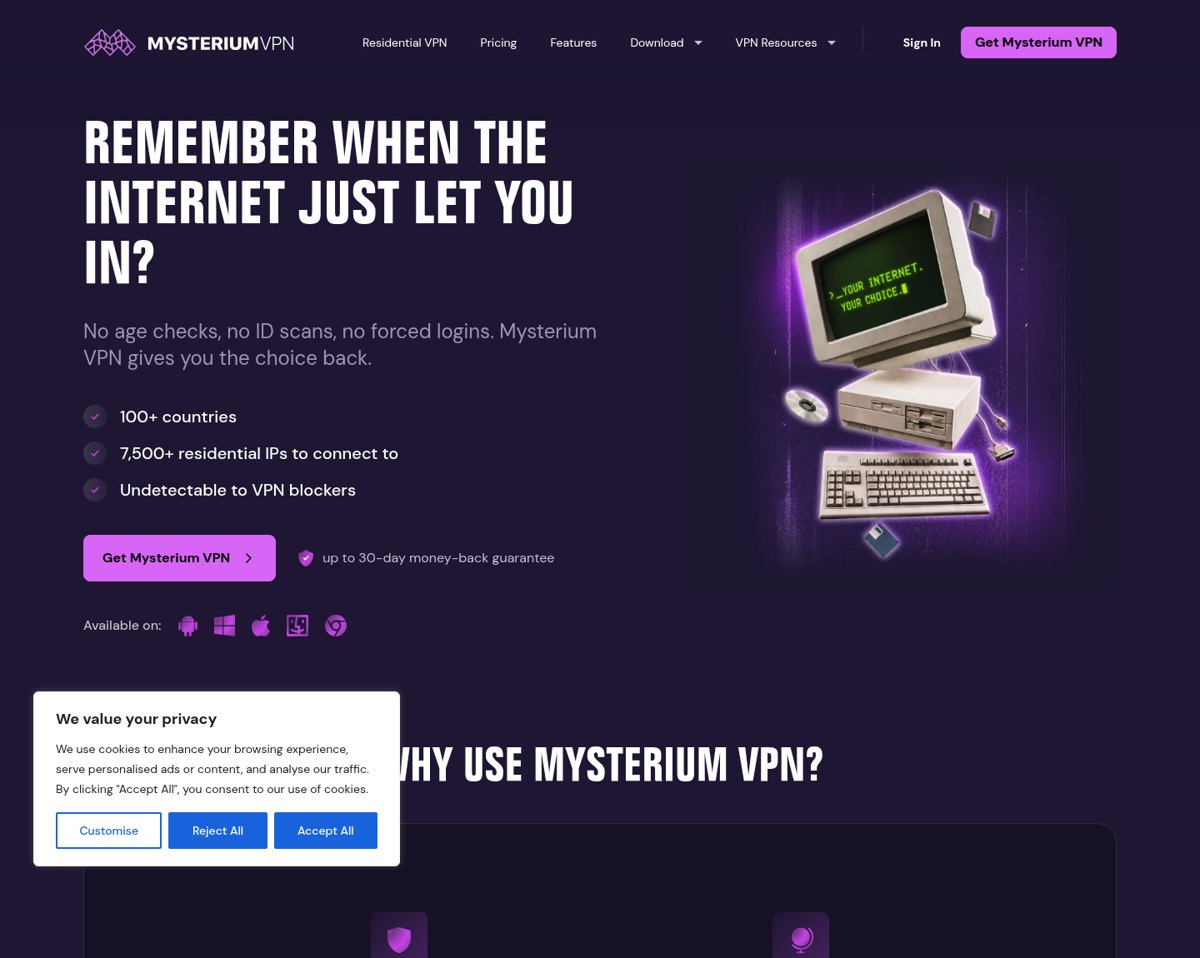
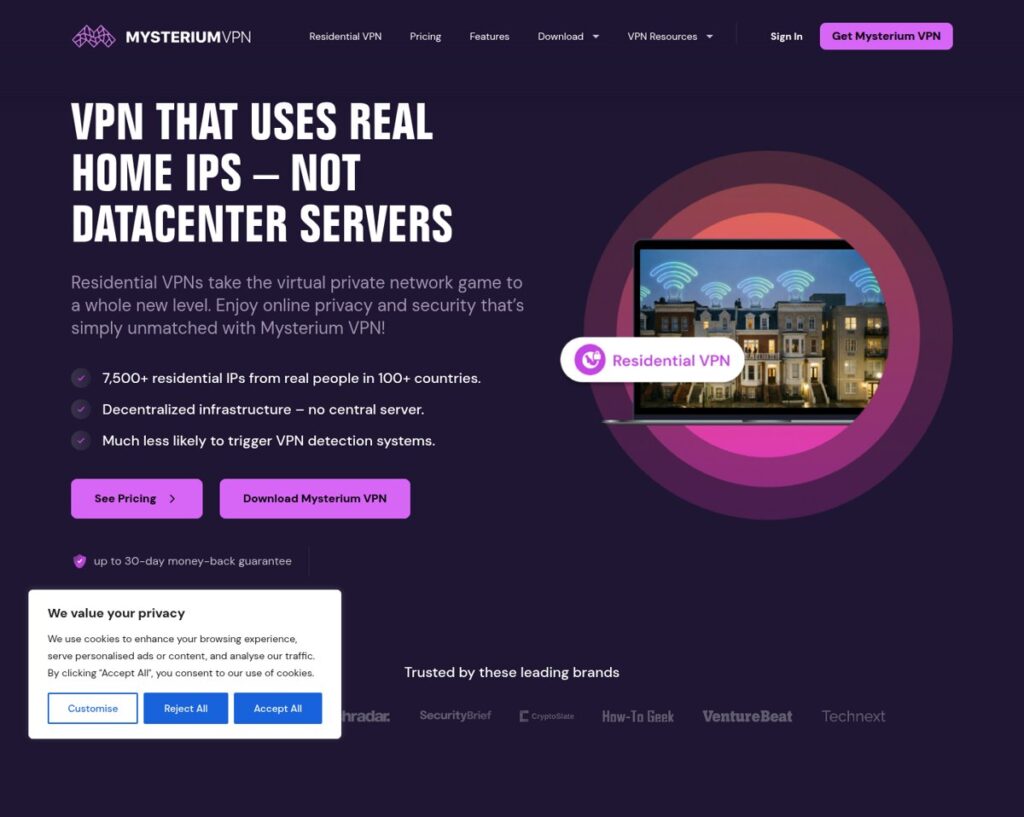
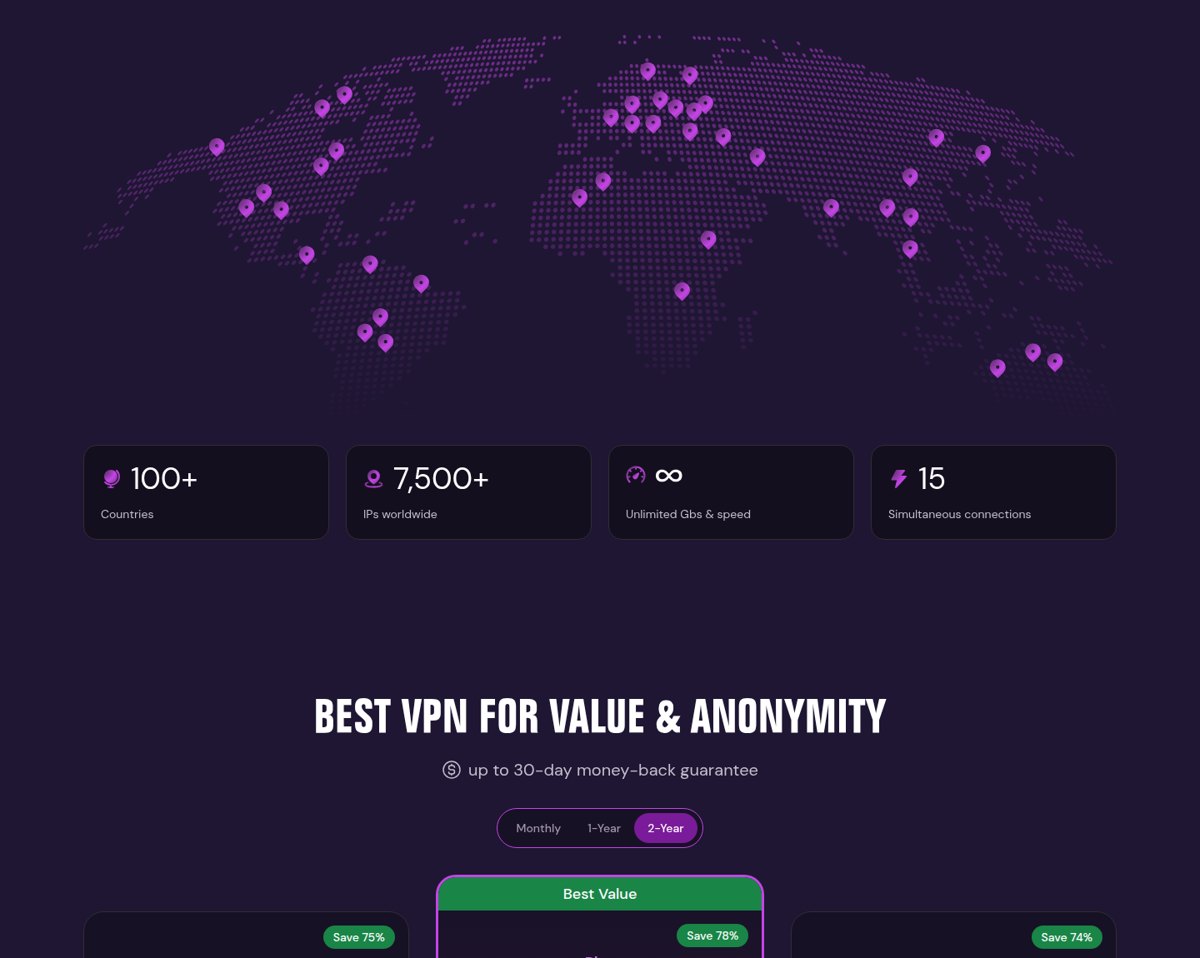
Mysterium leans into exactly this gap. Its residential page states the pitch plainly: a VPN that uses real home IPs, not datacenter servers, drawing on more than 7,500 residential IPs contributed by real people across 100 or more countries, on decentralized infrastructure that is, in the company’s words, less likely to trigger VPN detection. The offer carries up to a 30-day money-back guarantee.
So the problem it solves is narrow and specific. If your friction is that a datacenter VPN gets you blocked, throttled, captcha-walled, or flagged the moment you connect, a residential IP sidesteps most of that because you no longer look like a datacenter. If your friction is something else, a residential VPN may be the wrong tool, and we will be honest about that later.
There is a second, quieter problem Mysterium is trying to solve, and it is philosophical. A classic VPN asks you to trust one company with a full view of your traffic metadata. Mysterium’s decentralized design tries to spread that trust across many independent operators so that no single party sees the whole picture. Whether that actually improves your security depends on details, and those details are the heart of this review.
The security lens: what changes in the threat model
Before features, we need the frame. A VPN does not make you anonymous. It moves the point at which your traffic becomes visible from your internet provider to whoever runs the exit. The entire security question is: who is that new party, what can they see, and what stops them from misbehaving.
The classic centralized model
With a traditional datacenter VPN, the answer is simple to state. One company owns the servers, writes the software, holds the keys, and operates the exit nodes. You trust that company completely. Your protection rests on three things: their no-logs policy, the jurisdiction they operate under, and whatever independent audits back up their claims.
The strength of this model is accountability. There is a named legal entity with a reputation to lose, and, in the better cases, a published audit. The weakness is concentration. That one company is a single point of both failure and compromise. If it lies about logging, gets breached, or receives a legal order, every user is exposed through the same door.
The decentralized, node-based model
Mysterium changes the shape of that trust. Instead of one company owning every exit, the network is built from independent nodes, many of them run by ordinary people who share their connection and are compensated for it. Your traffic is routed through these nodes rather than through servers Mysterium itself operates.
This is where a security reader should slow down. The decentralized model genuinely helps with one thing: it removes the single all-seeing operator. There is no one company with a God’s-eye view of every session. That is a real structural benefit and it is the honest core of the decentralized pitch.
But it introduces a different concern, and you should hold both ideas at once. In a residential model, your exit node is, by design, a stranger’s home connection. The exit operator can see your traffic to the same degree any VPN exit can, which for anything not additionally encrypted end-to-end means they see where your traffic is going and, for plain HTTP, potentially what is in it.
The table below lays the trade out directly.
| Trust dimension | Classic datacenter VPN | Residential, node-based VPN |
|---|---|---|
| Who runs the exit | One named company | Many independent node operators |
| Single all-seeing party | Yes, the provider | No, view is fragmented across nodes |
| Exit operator identity | Vetted corporate infrastructure | Often an ordinary residential participant |
| Accountability if abused | One legal entity, one reputation | Distributed, harder to pin to one actor |
| IP reputation seen by sites | Datacenter, often flagged | Residential, usually trusted |
| Your defense against the exit | No-logs policy plus audits | Encryption in transit plus network design |
Read that table as a swap, not an upgrade. You are trading a concentrated risk you can name for a distributed risk that is harder to reason about. Neither is strictly safer. They are safer against different adversaries.
The practical takeaways are the same as for any VPN, only more so here. Keep everything on HTTPS, which nearly all of the modern web already is, so the exit node sees encrypted tunnels rather than readable content. Do not send credentials or sensitive data over plain HTTP through any residential exit. Treat the VPN as protection of your network path and IP identity, not as a license to be careless above the transport layer.
How it works, technically
Mysterium Network is an open-source, peer-to-peer project. The design has two roles. Node runners share bandwidth and act as exit points. Clients, meaning you, route traffic through those nodes. A discovery and payment layer connects the two sides and keeps the marketplace running.
The economic glue is the part that separates this from a normal VPN. Because node runners are independent people rather than salaried staff, they need a reason to keep serving traffic. Mysterium’s answer has been micropayments: node operators earn for the bandwidth they provide, historically settled with the project’s native MYST token. This is what lets a decentralized supply of residential IPs exist at all. Someone has to want to run the node.
For the client, the practical experience is meant to feel like a normal VPN app. You install it, you pick a location or IP type, you connect, and your traffic exits through a residential node in the region you chose. Under the hood the tunnel is built with standard modern VPN cryptography rather than anything exotic; the innovation is in where the tunnel ends, not in the ciphers themselves.
A few technical consequences follow directly from the node design, and they are worth stating plainly.
First, exits are not uniform. In a datacenter VPN, every server in a city is roughly identical hardware on a fat pipe. In a residential network, each exit is a different home connection with different upstream speed, different reliability, and a different local ISP. Your experience varies by which node you land on.
Second, addresses are not permanent in the way a corporate server IP is. Residential nodes come and go as their operators go online and offline. That churn is actually useful for privacy, because you are less pinned to a fixed identifier, but it is a change from the stable, always-on server you may expect.
Third, the network is only as large and as distributed as its participants. Coverage in a given country depends on how many people run nodes there. This is the flip side of decentralization: supply is organic, not provisioned on demand.
What the open-source posture buys you
Mysterium’s code being open matters for the security reader specifically. Open source does not automatically mean secure, and it is not a substitute for a formal audit. But it does mean the client and the protocol are inspectable rather than a sealed box, which is the right default for anything that sits in the middle of all your traffic. If you have the skills, you can read what the client does. If you do not, others can, and that public scrutiny is worth something.
Key features
Pulling the concrete capabilities together, here is what the residential product actually offers, based on Mysterium’s own stated specs plus the structural facts of how the network is built. Where a figure comes straight from the product page, it is a verified claim. Where something is a property of the architecture, we have marked it as such rather than dressing it up as a measured number.
| Feature | What Mysterium states or the design implies |
|---|---|
| IP type | Real residential IPs from actual home connections, not datacenter ranges |
| Pool size | More than 7,500 residential IPs (stated) |
| Country coverage | 100 or more countries (stated) |
| Infrastructure | Decentralized, peer-to-peer node network rather than company-owned servers |
| Detection profile | Positioned as less likely to trigger VPN and bot detection because exits look residential |
| Codebase | Open source and publicly inspectable |
| Payment model | Marketplace with node operators compensated for bandwidth, historically via the MYST token |
| Guarantee | Up to a 30-day money-back guarantee (stated) |
| Platform reach | Consumer apps across common desktop and mobile platforms |
Two features deserve a comment rather than a row.
The residential IP profile is the headline feature and it is real, but treat less likely to trigger detection as the honest hedge it is. Residential IPs carry better reputation than datacenter IPs, full stop. That is why they clear more checks. It is not a guarantee. Sophisticated anti-bot systems look at far more than IP reputation, including browser fingerprints, behavioral timing, and account history, and no IP type defeats those on its own.
The decentralized infrastructure is the second real feature, and its value is the fragmented-trust property we covered above, not raw speed or polish. Buy it for the architecture, not for a promise that a peer network will always be faster or steadier than a datacenter. It usually will not be, and that is the next section.
Performance and reliability, honestly
We did not run a lab benchmark for this review, and we are not going to invent one. Anyone quoting precise throughput figures for a residential peer network should be treated with suspicion, because the number depends entirely on which node you happened to connect through and what that person’s home upload speed is that day. Instead, here is what the architecture tells you to expect, framed from stated specs and category behavior.
Expect residential VPNs, Mysterium included, to be slower and more variable than a good datacenter VPN. This is not a criticism of the product; it is physics and topology. A datacenter server sits on a high-capacity backbone connection built for exactly this job. A residential node sits behind consumer broadband, where upload speed is usually a fraction of download, and where the operator is also using that same connection for their own life.
Latency is higher too, because your path often includes an extra hop and because home connections are not tuned for low-latency relay work. For the residential use cases that make sense, which we will get to, this is fine. For competitive gaming or large sustained downloads, it is a poor fit, and you should know that going in.
Reliability follows the same logic. Because nodes belong to real people, they go offline when those people turn off a router or leave home. A well-run residential network smooths this over by having enough supply that you can reconnect to another node, and Mysterium’s stated pool of 7,500-plus IPs across 100-plus countries is large enough that popular regions should have depth. Thinly covered countries will feel the churn more.
The reliability table below is qualitative on purpose. Precise uptime and speed numbers for a peer network are not something we can responsibly assert.
| Dimension | Realistic expectation for a residential node VPN |
|---|---|
| Peak speed | Lower and more variable than datacenter VPNs, capped by home upload |
| Latency | Higher, extra hop plus consumer-grade links |
| Consistency | Varies by node; reconnecting can change your experience |
| Coverage depth | Strong in popular regions, thinner where few people run nodes |
| Best-fit tasks | Privacy, geo-appropriate access, QA and testing, market and data checks |
| Poor-fit tasks | Competitive gaming, huge sustained transfers, latency-critical work |
If you take one thing from this section: judge a residential VPN by whether it gets you a trusted-looking IP that works, not by whether it wins a speed test. It will not win the speed test. Winning the speed test is not its job.
Pricing and plans
Here we have to be careful and honest, because pricing for this category shifts and we could not re-verify current live figures at the time of writing. Rather than quote a dollar amount we cannot stand behind, we will describe the structure, which is more stable than any specific promotion, and tell you exactly what to confirm on the page before you pay.
Two things are verifiable and worth anchoring on. Mysterium’s residential offer advertises up to a 30-day money-back guarantee, which meaningfully lowers the risk of trying it, and the underlying network runs on a paid marketplace where node operators earn for the bandwidth they supply. That second fact is why decentralized VPNs have historically leaned toward usage-based and crypto-settled billing rather than only flat monthly plans.
| Option | How it works | Best for | What to confirm before paying |
|---|---|---|---|
| Subscription | Flat recurring fee for ongoing access | Steady, everyday use | Current monthly and multi-month rates on the live page |
| Usage or pay-as-you-go | You pay for the bandwidth you consume | Occasional or bursty use | Whether it is offered and the per-unit rate |
| Crypto settlement | Payment via crypto, historically the MYST token | Privacy-focused buyers | Which coins and tokens are accepted now |
| Money-back window | Refund if it does not work for you | First-time triallists | The exact terms and length of the up-to-30-day guarantee |
The buying advice is simple. Because there is a money-back guarantee, the correct way to evaluate Mysterium is to try it against your actual blocked site or workflow inside the refund window, not to agonize over the plan choice up front. A residential VPN either clears the specific wall you care about or it does not, and that is a thing you can test in an afternoon.
One privacy note on payment, since this is a security review. If keeping the purchase itself private matters to you, the crypto option is the relevant feature, because it decouples the payment from a card in your legal name. If it does not matter to you, ignore it. Do not let a token be the reason you choose or avoid the product; judge the VPN on the VPN.
Pros and cons
No product is all upside, and a residential node VPN has a distinctly shaped set of trade-offs. Here is the balanced view.
| Pros | Cons |
|---|---|
| Residential IPs clear checks that block datacenter VPNs | Slower and more variable than datacenter VPNs by design |
| Decentralized design removes the single all-seeing operator | Your exit is a stranger’s home connection, a different trust model |
| Large stated pool, 7,500+ IPs across 100+ countries | Coverage and reliability depend on where node runners live |
| Open-source, publicly inspectable client and protocol | Open source is not the same as a completed formal audit |
| Up-to-30-day money-back guarantee lowers trial risk | Node churn means a less stable, less predictable connection |
| Crypto payment option supports private purchasing | Not suited to gaming, streaming-first buyers, or heavy transfers |
| Honest positioning: less likely to trigger detection, not immune | Detection can still catch you above the IP layer |
The pattern in that table is consistent. Nearly every strength has a matching cost that comes from the same root cause, which is that the exits are real homes run by real people. That is the whole product in one sentence. If that trade appeals to you, the cons are acceptable. If it does not, no feature list will fix the fit.
Who it is for, and who should skip it
This is the section that should decide your purchase, so we will be direct.
You are a good fit if your core problem is that datacenter VPN IPs get you blocked, flagged, or captcha-walled and you need to look like an ordinary home user. That covers a specific and legitimate set of jobs. Privacy-conscious browsing where you would rather not stand out as VPN traffic. Quality assurance and testing, where you need to see how your own site or app behaves for real users in a given country. Legitimate market and price research, ad verification, and localization checks, where a residential vantage point is the point.
For those use cases, a node-based residential VPN is a sensible tool, and Mysterium’s combination of a real residential pool, a decentralized trust model, and a money-back window makes it a reasonable one to trial first. The refund guarantee means testing it against your exact scenario costs you time rather than money, which is the right way to buy anything in this category.
You should skip it if your priority is raw speed for streaming, gaming, or big downloads. A well-run datacenter VPN will serve you better and cost you less stress, and you will not be paying the residential premium for a benefit you do not need. You should also skip it if you were hoping a residential IP would let you automate through security controls at scale. It will not reliably do that, and using any residential network to commit fraud, break into accounts, or evade protections that exist to stop abuse is both against the spirit of these services and, in many places, against the law. Keep your use on the legitimate side of that line.
And you should think twice, not skip but think, if you are not comfortable reasoning about the exit-operator trust model. A residential VPN is a fine tool for someone who understands that their traffic exits through someone’s home and who keeps everything on HTTPS accordingly. It is a worse tool for someone who assumes a VPN makes them invisible and behaves carelessly as a result. The technology rewards an informed user.
How it compares to the category
We are not going to name competitor products or link to them, but we can place Mysterium against the two broad alternatives you would actually weigh it against: a conventional datacenter VPN, and building or buying raw residential proxy access.
Against a classic datacenter VPN, the comparison is the one we have made throughout. Datacenter wins on speed, consistency, polish, and often price. Residential wins on IP reputation and on not looking like a VPN. If you have never been blocked, you probably do not need residential and should not pay for it. If you are constantly blocked, datacenter cannot solve that no matter how many servers it has, because the block is against the datacenter category itself.
Against raw residential proxy services, Mysterium’s pitch is packaging and trust model. Proxy providers sell residential IP access, often by the gigabyte, aimed at developers and data teams. They are powerful and unopinionated, and they put all the configuration and all the ethical responsibility on you. Mysterium wraps a residential exit in a consumer VPN app with a decentralized supply side and a refund guarantee, which is friendlier for an individual privacy user and less bare-metal than a proxy API.
The decision table below is the practical summary.
| If your situation is… | The category that fits |
|---|---|
| Never blocked, want max speed and streaming | Classic datacenter VPN |
| Blocked or flagged, want a home-user IP with an app | Residential node VPN like Mysterium |
| Building data pipelines needing granular proxy control | Raw residential proxy service |
| Want fragmented trust with no single all-seeing operator | Decentralized VPN specifically |
| Value private purchasing via crypto | Decentralized VPN with token payment |
The one place Mysterium is genuinely differentiated, rather than merely competitive, is the decentralized trust property. Plenty of services can hand you a residential IP. Far fewer are built so that no single company sits astride every session. If that architectural property is what you value, the field narrows quickly, and Mysterium is a natural name on the short list.
Verdict
Mysterium VPN’s residential product is a focused, honestly positioned tool that does one uncommon thing well. It gives you an IP that looks like a real home rather than a datacenter, and it does so through a decentralized network that removes the single all-knowing operator you accept with a normal VPN. Those are real, structural benefits, not marketing gloss.
It asks for real trade-offs in return. You give up the speed and consistency of datacenter infrastructure. You accept a different trust model in which your exit is a stranger’s connection, which is better against some adversaries and no better against others. And you accept that a residential IP improves your odds against detection without ever guaranteeing them, exactly as the product’s own careful wording says.
The company’s language is refreshingly non-inflated on that last point, and the up-to-30-day money-back guarantee means you can test the only claim that matters to you, which is whether it clears your particular wall, without committing real money to a guess. For a privacy-minded user, a QA or testing workflow, or legitimate market research that a datacenter IP keeps breaking, it earns a place on the shortlist. For a streaming-and-gaming buyer chasing speed, it does not, and it does not pretend to.
Judged as what it is, a residential, decentralized VPN with a clear-eyed pitch, it is a credible choice. Judge it against your specific blocked site inside the refund window and let that result, not any review including this one, make the final call.
FAQ
Is a residential VPN more anonymous than a normal VPN?
Not automatically. It changes what your exit IP looks like, from a flagged datacenter address to a trusted residential one, which helps you blend in with ordinary traffic. But anonymity still depends on the same fundamentals as any VPN: keeping traffic encrypted end to end, not leaking identity through logins or fingerprints, and understanding that your exit node can see your traffic path. Mysterium’s decentralized design helps by removing a single all-seeing operator, which is a genuine structural improvement, but it is not an invisibility cloak.
What does decentralized actually change for my security?
The main change is that there is no one company with a complete view of every session. In a classic VPN, you trust a single provider entirely. In Mysterium’s model, trust is spread across many independent node operators, so the view is fragmented. The cost is that your individual exit is often a stranger’s home connection rather than vetted corporate hardware. It is a different distribution of risk, safer against a central compromise, and it makes end-to-end encryption on your side more important, not less.
Will it be slower than my current VPN?
Most likely yes, and that is by design rather than a defect. Residential nodes run on consumer broadband, where upload speeds are limited and the connection is shared with the operator’s own use. Expect lower and more variable speeds and higher latency than a datacenter VPN. That is an acceptable trade for privacy, testing, and access use cases, and a poor trade for gaming or large sustained downloads. For a fuller explanation of why this happens, the general mechanics of tunneled connections are covered in standard references on how VPNs work.
Can I use it to get around security systems or scrape aggressively?
You should not, and that is not what this review recommends it for. Legitimate uses include privacy, quality assurance and testing your own properties, ad verification, and lawful market and price research. Using any residential network to commit fraud, break into accounts, or defeat protections that exist to stop abuse can be illegal and is against the purpose of these services. A residential IP also will not reliably beat modern anti-bot systems, which examine far more than your IP address.
How should I test whether it is worth paying for?
Use the money-back guarantee as your evaluation tool. Sign up, then connect and try your actual problem case, the specific site, region, or workflow that a datacenter VPN keeps breaking, inside the refund window. A residential VPN either clears that wall or it does not, and you can find out in an afternoon. If it works for your case, keep it. If it does not, request the refund. That is a more reliable test than any generic benchmark, including ours.
—
Further reading and references
- How VPNs work and what they do and do not protect: Virtual private network on Wikipedia
- Residential versus datacenter addresses and how proxies use them: Proxy server on Wikipedia
- The peer-to-peer model that underpins decentralized networks: Peer-to-peer on Wikipedia
- Modern VPN tunneling and cryptography, from the protocol authors: WireGuard
- Practical, non-commercial guidance on choosing and using a VPN: EFF Surveillance Self-Defense