
We put GoProxies’ new Scraping API under an infrastructure lens: what it takes to collect public web data at volume, where the reliability line really sits, and when renting an endpoint beats building your own. For related coverage, see our piece on Aquifer Exploit Drains $2.5M as August Hacks Hit 50 [2026].
Most reviews of a scraping tool start with the output: did it get the page, did it parse cleanly, how fast was the response. Those questions matter, but they miss the part that actually decides whether a data operation survives contact with the modern web. At any real volume, scraping is an infrastructure problem before it is a parsing problem. The hard costs are not in writing selectors. They are in maintaining a pool of exit IPs that do not get blocked, rotating them intelligently, rendering JavaScript-heavy pages, and absorbing the constant maintenance tax that anti-bot systems impose on anyone collecting data at scale.
That is the frame we used for GoProxies’ Scraping API. GoProxies is better known as a proxy network, and the Scraping API is a newer, higher-level product that sits on top of that network. It is in private beta as of this writing, which shapes both what we can say and how you should read the numbers below. We did not run a controlled benchmark against it, and we are not going to pretend we did. What we can do is assess the design, the stated specifications, the pricing, and how the whole thing fits into the build-versus-buy decision that any team collecting web data at volume eventually has to make.
What it is, and the problem it solves
A scraping API is an abstraction layer. Instead of you managing proxies, browsers, retries, and unblocking logic yourself, you send a target URL to a single endpoint and get back the page content. The provider handles the messy middle. GoProxies’ version bundles three things that teams usually have to assemble separately: a large rotating proxy pool, automated CAPTCHA handling, and headless-browser JavaScript rendering. All of it goes through one integration point.
To understand why that bundle is valuable, it helps to understand what breaks first when you scrape at scale. Web scraping itself is old and well understood. The difficulty is not fetching HTML. It is fetching HTML repeatedly, from many targets, without your requests being identified as automated and blocked. The web has spent the last decade building defenses against exactly that.
Three defenses dominate. The first is IP reputation. Sites track which addresses send suspicious traffic and throttle or ban them. Datacenter IP ranges are easy to fingerprint and are frequently blocked outright. The second is challenge-response gating, most visibly CAPTCHA and its invisible successors that score traffic on behavioral signals. The third is client-side rendering. A growing share of the web ships a nearly empty HTML shell and builds the real content in the browser with JavaScript, which means a naive HTTP request returns almost nothing useful.
A team building its own stack has to solve all three, then keep solving them as defenses evolve. That maintenance never ends. The pitch of a scraping API is that you rent someone else’s solution to all three and stop maintaining it yourself.
The GoProxies foundation
The Scraping API does not exist in isolation. It inherits GoProxies’ existing proxy infrastructure, and that inheritance is the most important thing about it.
GoProxies operates a pool the company describes as roughly 80 million ethically sourced IPs across about 200 locations. The bulk of that is residential: real consumer IP addresses assigned by internet service providers, which are far harder for a target site to distinguish from ordinary human traffic than datacenter addresses are. The company also runs dedicated ISP proxies, shared and dedicated datacenter proxies, and offers geo-targeting down to country, state, city, ISP, and ASN level.
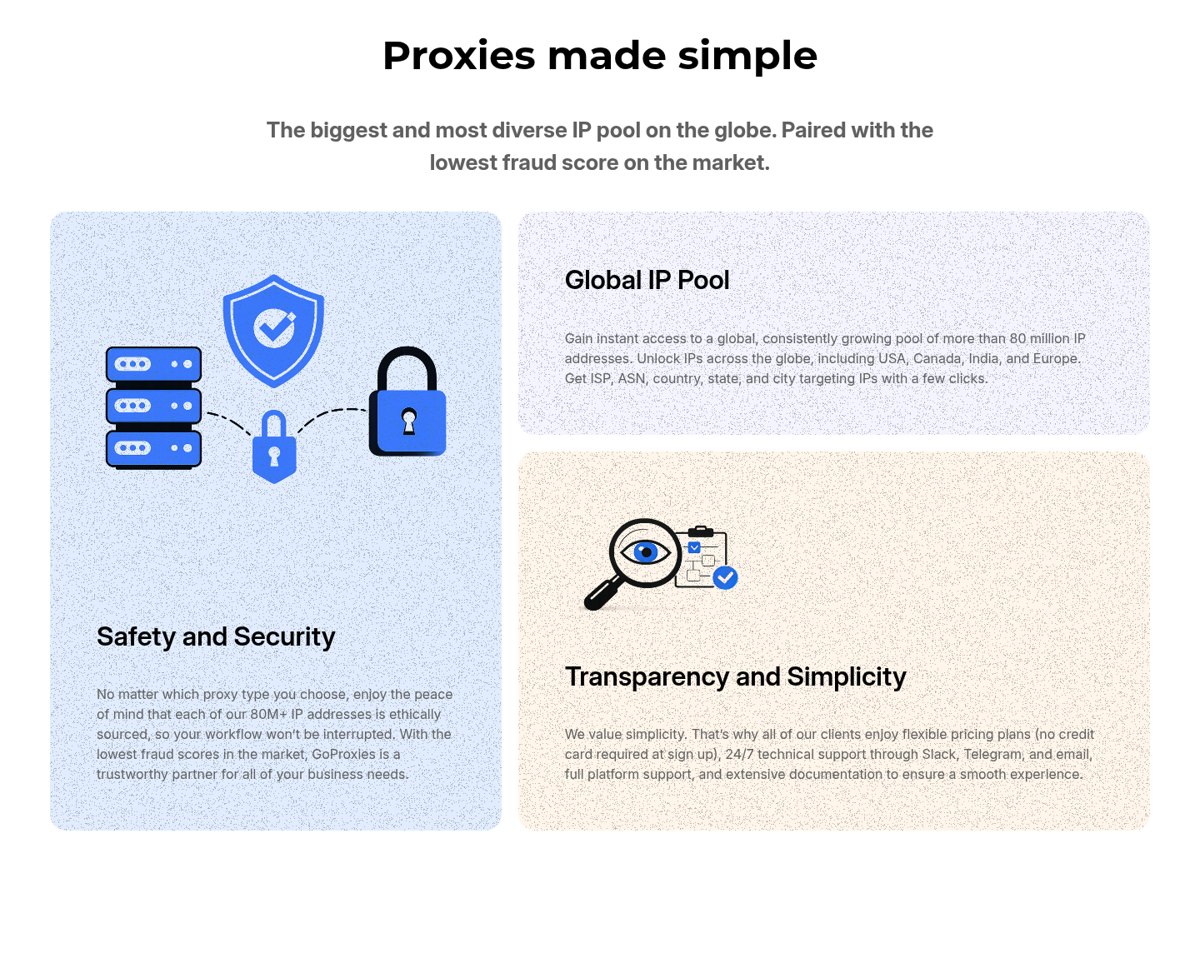
The distribution is what you would expect from a network aimed at Western commercial data collection. The United States accounts for more than 18 million addresses, with large pools in Germany, France, the United Kingdom, Canada, and India. If your targets are consumer-facing sites in North America and Western Europe, that geographic weighting works in your favor. If you need heavy coverage in specific emerging markets, you will want to confirm depth in your particular countries before committing, because a large global total does not guarantee density everywhere.
The word “ethically sourced” carries weight in this category and deserves scrutiny rather than a free pass. Residential proxy networks have a troubled history around consent, with some providers historically bundling proxy participation into free apps in ways users did not meaningfully understand. GoProxies makes sourcing consent a marketing point and claims a low fraud score on its addresses. We could not independently audit the sourcing chain, so treat the ethical claim as a stated position to verify against your own compliance requirements, not as a settled fact. For any regulated buyer, sourcing documentation should be part of procurement.
Key features
Here is the feature set as the product presents it, with our read on each.
| Feature | What it does | Infrastructure read |
|---|---|---|
| Single unified endpoint | One integration point handles proxy selection, retries, and unblocking | Removes the orchestration layer teams usually build and babysit themselves |
| 80M+ residential-led IP pool | Large rotating pool across ~200 locations | The core asset. Pool size and quality are what actually beat IP-reputation blocks |
| Automatic IP rotation | New exit IP per request by default | Standard for the category, but table stakes done well |
| Sticky sessions | Hold one IP across a multi-step flow | Needed for logins, carts, and any stateful sequence |
| CAPTCHA handling | Challenges solved without user intervention | Offloads one of the most brittle parts of a home-built stack |
| JavaScript rendering | Headless browser renders React, Vue, and Angular pages | Lets you scrape client-rendered sites that return empty HTML to plain requests |
| Geo-targeting | Country, state, city, ISP, ASN | Matters for localized pricing, SERP, and geo-gated content |
| Structured output | Raw HTML by default, JSON extraction available | Cuts parsing work when the built-in extraction fits your target |
The single most consequential item on that list is the pool itself. Everything else is orchestration around it. You can have flawless rotation logic and a perfect headless browser, but if your exit IPs are burned, none of it matters. A large, residential-led, reputationally clean pool is the hard part to build and the main reason to rent rather than build. The proxy server layer is where scraping succeeds or fails, and it is the layer that is most expensive to own.
The second most consequential item is JavaScript rendering, because it is where cost and complexity balloon. Rendering a page in a real browser is far heavier than fetching HTML. It consumes more compute, takes longer, and is where a lot of scraping infrastructure quietly falls over under load. A headless browser farm that stays healthy at volume is genuinely hard to operate, which makes bundling it into the endpoint a meaningful convenience if the execution holds up.
How it works, technically
The mechanics are deliberately simple from the caller’s side, which is the point. You send a request specifying the target URL and whatever options you need: a geo-target, whether to render JavaScript, whether to hold a sticky session. The API resolves an appropriate exit IP from the pool, routes the request, deals with any challenge that comes back, optionally renders the page in a headless browser, and returns the result. Output is raw HTML by default, with structured JSON extraction available where the built-in parsing covers your target.
That single-endpoint design is the whole value proposition compressed into one architectural decision. In a home-built stack, the equivalent flow touches a proxy manager, a rotation policy, a retry-and-backoff layer, a CAPTCHA-solving integration, and a browser pool, each of which is its own operational surface with its own failure modes. Collapsing that into one call is not a cosmetic simplification. It removes an entire category of glue code and the on-call burden that comes with it.
The tooling story is pragmatic. GoProxies lists compatibility with the usual automation and anti-detect stack, including Selenium, Puppeteer, and browser-profile tools like Multilogin, GoLogin, and AdsPower, plus proxy managers like Proxifier and FoxyProxy. That matters because most teams evaluating a scraping API already have code written against one of these. The less rewriting a migration requires, the lower the real switching cost.
On concurrency, the plans advertise unlimited concurrent sessions. Read that as an absence of a hard cap on parallel requests within your plan rather than a promise of infinite throughput, since real throughput is always bounded by the provider’s capacity and your target’s tolerance. Unlimited concurrency is useful for bursty workloads, but you should size expectations against your actual request volume, not the word “unlimited.”
Performance and reliability, honestly
This is where we have to be careful, because the product is in private beta and we did not run our own load tests. We are not going to invent latency figures or success-rate percentages we did not measure. Anyone who hands you precise benchmark numbers for a private-beta product should be met with suspicion.
What we can assess is the reliability posture as stated and reasoned from the architecture. GoProxies advertises a 99.99 percent uptime SLA on the Scraping API. On paper that is four-nines availability, which translates to a little under an hour of allowable downtime per year. That is a strong number for this category, where many providers publish softer targets or none at all.
Two caveats keep that number in perspective. First, an uptime SLA covers endpoint availability, not scraping success rate. Those are different things. An endpoint can be up while a specific target site is actively blocking the pool that hour. The metric that actually governs a data operation is the percentage of requests that return usable content, and no provider can guarantee that across all targets because it depends on defenses the provider does not control. Ask any vendor for target-specific success rates on the sites you actually care about, and treat a blanket uptime figure as necessary but not sufficient.
Second, an SLA is a commercial promise backed by service credits, not a law of physics. What matters in practice is the remedy when the number is missed and whether the provider’s status reporting is transparent enough to hold them to it. For a beta product, both the SLA enforcement and the historical track record are still being established, so weight the guarantee accordingly.
On the performance dimensions we can reason about rather than measure, the picture is coherent. A large residential pool should produce higher success rates against IP-reputation defenses than a datacenter-heavy competitor, because residential addresses are simply harder to distinguish from human traffic. JavaScript rendering will always be slower and more expensive per request than plain fetching, so if your targets are static you should be able to skip rendering and keep both cost and latency down. Sticky sessions are the right primitive for stateful flows. None of that is a benchmark. It is architecture that is consistent with the stated goals, which is the most an honest review can claim before independent testing at scale exists.
Our recommendation for any serious buyer is the same one we would give for any infrastructure dependency: run your own proof of concept against your own target list during the beta, measure success rate and latency on the sites you care about, and do not treat the marketing SLA as a substitute for that test.
Pricing and plans
Pricing is public and pay-as-you-go, structured as six request-based tiers with no contract requirement. This is a genuine plus. A lot of the scraping and proxy category hides pricing behind sales calls, and a published, self-serve price list lets you model costs before you talk to anyone. The company also states no credit card is required to start, which lowers the bar for a real evaluation.
| Plan | Monthly price | Requests included | Effective cost per 1,000 requests |
|---|---|---|---|
| Micro | $33 | 30,000 | $1.10 |
| Business | $63 | 70,000 | $0.90 |
| Advanced | $120 | 150,000 | $0.80 |
| Plus | $280 | 400,000 | $0.70 |
| Growth | $540 | 900,000 | $0.60 |
| Enterprise | $750 | 1,500,000 | $0.50 |
All tiers include worldwide access, unlimited concurrent sessions, dedicated account management, and up to five sub-users. The pricing curve does what good volume pricing should: the effective per-request cost falls steadily as you scale, from $1.10 per thousand at the entry tier to $0.50 per thousand at the top published tier. That is a clean, legible curve with no penalty for committing to volume.
A few things to weigh before you plug this into a budget. The unit is the request, not bandwidth, which is the right unit for a scraping API and easier to forecast than per-gigabyte proxy pricing. But you should confirm how the meter treats JavaScript-rendered requests, retries, and failed requests, because those details vary by provider and can move your real cost per usable page well above the headline per-request rate. A rendered request costs the provider far more to serve than a plain one, so it is reasonable to expect rendering to affect your effective rate somehow, whether through request weighting or a separate meter. Confirm this in writing during the beta.
The top published tier is 1.5 million requests a month. Any operation running above that is into custom enterprise territory, where you should expect negotiated pricing and, ideally, target-specific success guarantees rather than a generic SLA. If you are at that scale, the published table is a starting point for a conversation, not the final number.
Pros and cons
| Strengths | Limitations |
|---|---|
| Large, residential-led IP pool inherited from an established network | Scraping API is in private beta; track record is still forming |
| One endpoint bundles rotation, CAPTCHA, and JS rendering | No independent benchmarks yet; success rates unproven in public |
| Transparent, published pay-as-you-go pricing with no contract | “Ethically sourced” claim is stated, not independently audited here |
| Strong 99.99 percent uptime SLA on paper | Uptime SLA covers availability, not per-target scraping success |
| Broad tooling compatibility (Selenium, Puppeteer, anti-detect suites) | Geo depth outside North America and Western Europe needs checking |
| Per-request billing is easier to forecast than per-gigabyte | Metering of rendered, retried, and failed requests needs confirming |
| Sticky sessions and fine-grained geo-targeting | Beta means SLA enforcement and support maturity are still settling |
The honest summary is that the strengths are structural and the limitations are mostly about maturity and verification. The pool, the bundling, and the pricing transparency are real advantages rooted in the underlying network. The cautions are the normal cautions you would attach to any private-beta infrastructure product: unproven at public scale, claims not yet independently audited, and commercial guarantees not yet battle-tested.
Who it is for, and the build-versus-buy line
This is the decision that actually matters, so it deserves the most space.
Every team collecting web data at volume eventually hits the same fork. You can build your own scraping infrastructure, or you can rent it. The right answer depends almost entirely on scale and on whether data collection is your core competency or a supporting function.
Building your own makes sense in a narrow set of cases. If scraping is your core product, if you have unusual requirements that no off-the-shelf endpoint serves, or if you operate at a scale where the per-request economics of a managed service genuinely exceed the fully loaded cost of running your own pool and browser farm, then owning the stack can pay off. But be honest about that fully loaded cost. It is not just servers. It is the engineering time to acquire and maintain a clean IP pool, the on-call burden when anti-bot defenses change overnight, the browser farm that has to stay healthy under load, and the opportunity cost of the engineers doing all of that instead of your actual product. That maintenance tax is the number most build-it-yourself estimates leave out, and it is the number that most often makes the build look cheaper than it is.
Buying makes sense for the large majority of teams for whom data collection is a means, not an end. If you are a price-monitoring team, a market-research function, a brand-protection group, an SEO operation, or a data team feeding a downstream product, your comparative advantage is in what you do with the data, not in maintaining exit IPs. For those teams, a managed web scraping API like GoProxies’ is the more rational allocation of engineering effort, because it converts a large fixed maintenance burden into a predictable variable cost and lets your people work on the part that is actually yours.
The specific case GoProxies fits well is the mid-to-large operation that needs residential-grade success rates and JavaScript rendering, wants forecastable per-request costs, and does not want to run a proxy network as a side project. The transparent pricing and no-card start make it easy to test that fit before committing. Legitimate use cases the product is aimed at include public SERP data, e-commerce price and availability monitoring, competitor and market research, real estate listings, research datasets, and QA and testing of your own web properties across geographies.
One firm boundary worth stating plainly, because a responsible infrastructure review has to. A capable scraping stack is a neutral tool, and the legitimacy lives in how you use it. Collecting public data for research, monitoring, and testing is well-established practice, and the legal terrain around public data has shifted over the years, including in cases like hiQ Labs v. LinkedIn. But respecting site terms, honoring the Robots Exclusion Protocol where it applies, staying clear of personal and copyrighted data you have no right to, and not using scraping to defeat access controls or commit fraud are not optional niceties. They are the line between a legitimate data operation and a liability. Any tool this capable should be pointed only at data you have a lawful basis to collect.
How it compares to the category
We are not going to name competitor products or link to them, but the category shape is worth drawing so you can position GoProxies against the alternatives you already know.
The clearest comparison is not between products at all. It is between the two proxy types that sit under every scraping API, because that choice drives everything downstream.
| Dimension | Residential proxies | Datacenter proxies |
|---|---|---|
| What the IP looks like | A real consumer ISP address | A server-farm address in known ranges |
| Block resistance | High; hard to distinguish from human traffic | Lower; ranges are easy to fingerprint and ban |
| Typical cost | Higher per unit | Cheaper per unit |
| Best for | Well-defended consumer sites, geo-gated content | Lightly defended targets, high-volume static fetches |
| Failure mode | Cost creep at scale | Getting blocked when defenses tighten |
GoProxies leans residential, which is the right lean for the well-defended targets where scraping actually gets hard. That positions the Scraping API toward the higher-success, higher-capability end of the category rather than the cheap-and-cheerful datacenter end. The trade-off is that residential-led pricing will rarely be the absolute cheapest option per request, and it should not be. You are paying for success rate against defenses, which is the thing that is worth paying for.
Against the field of managed scraping APIs generally, GoProxies’ differentiators are the size and residential weighting of the inherited pool, the transparent published pricing in a category that often hides it, and the strong stated SLA. Its disadvantages relative to more established competitors are exactly what you would predict for a private-beta product: a shorter public track record, no independent large-scale benchmarks yet, and support and SLA-enforcement maturity that are still settling. A more established endpoint may give you more proven reliability today, at the cost of the pricing opacity that is common at the top of this market.
The build-versus-buy comparison sits above all of that. Below a certain scale, almost no one should build. Above a certain scale, with the right requirements, building can win. GoProxies is competing for the large middle where buying is clearly correct and the only real question is which endpoint to rent.
Verdict
GoProxies’ Scraping API is a well-designed managed endpoint built on a serious underlying network, and the infrastructure logic behind it is sound. The large residential-led pool is the hard asset that actually beats blocks, the single-endpoint bundling of rotation, CAPTCHA, and rendering removes a real and ongoing maintenance burden, and the transparent per-request pricing is a genuine advantage in a category that too often hides its numbers. The 99.99 percent stated SLA signals the right ambition.
The honest counterweight is maturity. This is a private-beta product with no independent large-scale benchmarks yet, an ethical-sourcing claim we could not audit, and a headline SLA that measures availability rather than the scraping success rate you actually care about. None of that is disqualifying. It is simply the reason to verify rather than trust, and the beta’s no-card start makes verification easy.
Our recommendation is straightforward. If you are a team for whom web data is a means and not an end, and you are somewhere in the mid-to-large volume range, GoProxies’ Scraping API belongs on your evaluation shortlist. Do not take the SLA or the marketing on faith. Run a proof of concept against your own target list, measure usable-response rate and latency on the sites that matter to you, confirm exactly how rendered and failed requests are metered, and ask for target-specific success expectations before you commit real volume. Do that, and you will know within a week whether renting this endpoint beats building your own. For most teams, on the evidence of the design and the network behind it, it very likely will.
FAQ
Is the GoProxies Scraping API generally available?
No. As of this writing it is in private beta. The underlying proxy network is an established product, but the Scraping API layer is newer, which is why its public track record and independent benchmarks are still forming. Treat the beta as an opportunity to test it against your own targets rather than a finished product to deploy blind.
What is the difference between a scraping API and just buying proxies?
Buying proxies gives you exit IPs and leaves the rest to you: rotation logic, retries, CAPTCHA handling, and browser rendering. A scraping API bundles all of that behind one endpoint, so you send a URL and get back content. You are paying to not maintain the orchestration layer yourself, which is the part that carries the ongoing maintenance tax.
Why does the residential-versus-datacenter distinction matter so much?
Because it drives success rate. Datacenter IP ranges are easy for sites to identify and block, while residential addresses look like ordinary consumer traffic and are far harder to filter out. For well-defended targets, a residential-led pool like the one GoProxies draws on is usually the difference between getting the data and getting blocked. Datacenter IPs are cheaper and fine for lightly defended, high-volume static targets.
Does the 99.99 percent SLA mean my scrapes will succeed 99.99 percent of the time?
No, and this is a common misread. An uptime SLA covers whether the endpoint is available, not whether a specific target site returns usable content on a given request. Scraping success rate depends on defenses the provider does not control and varies by target. Ask for target-specific success expectations separately, and treat the uptime figure as necessary but not sufficient.
When should I build my own scraping infrastructure instead of buying?
Build only when data collection is your core competency, when your requirements are genuinely unserved by any managed endpoint, or when your scale is large enough that the per-request economics beat the fully loaded cost of running your own pool and browser farm, including the engineering and on-call time that most estimates omit. For the large majority of teams, where data is a means rather than the product, buying a managed endpoint is the more rational use of engineering effort.