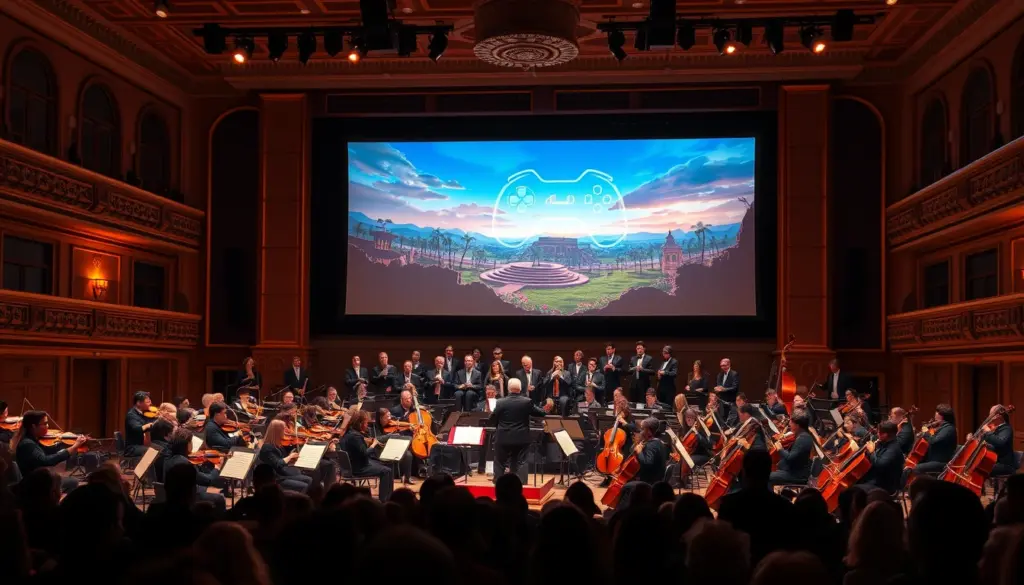
Video Games Live is coming back to Los Angeles for the first time in 12 years, with two shows set for September 11 and 12, 2026, at the San Gabriel Mission Playhouse. The touring orchestral series, which has spent two decades turning game soundtracks into full-scale symphonic concerts, will pair the San Gabriel Valley Symphony with a setlist spanning Halo, Final Fantasy, Warcraft, Skyrim and, notably, three world-premiere arrangements from Minecraft, Studio Ghibli films and Expedition 33. For a franchise built on live orchestras and licensed game music, the return to a market the size of Los Angeles after over a decade away is itself a data point worth unpacking.
The concerts, confirmed by the San Gabriel Valley Symphony and independently listed on ticketing platform Theatermania and event aggregator Soundtrackfest, land at a moment when game-music tourism has become a measurable line item for orchestras, venues and publishers alike. This piece breaks down what’s confirmed about the Los Angeles dates, why the 12-year gap matters, how Video Games Live stacks up against rival game-music tours, and what the economics of a mid-size orchestral gig actually look like in 2026.
What’s confirmed about the Los Angeles shows
Two performances are scheduled at the San Gabriel Mission Playhouse, located at 320 S. Mission Dr. in San Gabriel, part of the greater Los Angeles area. Both shows start at 8:00 PM, on Friday, September 11 and Saturday, September 12, 2026. The San Gabriel Valley Symphony, a community orchestra with its own multi-decade history in the San Gabriel Valley, is performing both nights at the venue’s home, the San Gabriel Mission Playhouse, backed by a full choir for select pieces. Guest conductor Esin Aydingoz is leading the September dates, according to the symphony’s own event listing.
A VIP add-on, branded VGL VIP – Los Angeles, CA, is attached to the Saturday show and starts at 6:00 PM ahead of the main 8:00 PM performance, per the event listing. Tickets for the general show are advertised starting at $25 on at least one promotional listing site, though that figure reflects one seller’s entry-level pricing tier and not a blanket price across every vendor. The event description circulating across the symphony’s own page and ticket resellers reads that after 12 years, Video Games Live finally returns to Los Angeles for a very special, electrifying, and immersive performance, a framing that multiple listings, including Theatermania’s, repeat nearly word for word.
Parking at the venue is limited: the adjacent lot holds 178 spaces and runs $15 during performances, while a free Park & Ride lot sits a half-block away at 257 S. Mission Dr., with additional free street parking nearby. The symphony’s own materials advise arriving at least 60 minutes before curtain, a detail that matters more than it sounds given the lot’s small footprint against what’s likely to be a sold-out or near-sold-out room for a franchise with this kind of built-in fan base.
The setlist: three world premieres headline the night
Video Games Live built its identity on mixing perennial crowd-pleasers with new arrangements, and the Los Angeles dates follow that formula. The San Gabriel Valley Symphony’s published program lists Halo, Final Fantasy, Tetris, Warcraft, Skyrim, Kingdom Hearts, The Last of Us and Undertale as returning staples, alongside three pieces billed as Video Games Live world premieres: Minecraft, a Studio Ghibli medley and music from Expedition 33, the Sandfall Interactive role-playing game that broke out commercially and critically in 2025.
A separate promotional listing for the same run names a slightly different mix, including Metal Gear Solid, Shadow of the Colossus and Okami alongside Halo, Warcraft, Skyrim, Kingdom Hearts, The Last of Us and Undertale. The discrepancy between the symphony’s program and the promotional listing isn’t unusual for a touring show. Video Games Live has historically rotated a handful of pieces city to city depending on orchestra size, choir availability and licensing windows, so the final program that plays on September 11 and 12 may draw from both lists rather than matching either one exactly.
The addition of Studio Ghibli material is the more interesting signal here. Video Games Live has spent 20 years positioned strictly around game scores. Folding in anime film music, even as a one-off world premiere, points to a broader trend across orchestral touring: game and anime soundtracks are increasingly booked together because they draw overlapping, younger audiences who buy tickets to hear music they already know from headphones and screens, not from a traditional concert hall upbringing.
Why the 12-year gap from Los Angeles matters
Video Games Live launched in 2005, according to its history on Wikipedia, and built its early reputation playing major US markets, including repeated Los Angeles-area engagements in its first decade. A 12-year absence from the country’s second-largest metro area, as described in the event’s own marketing copy, is a long stretch for a touring act that depends on filling rooms in cities with dense concentrations of gamers. It suggests the franchise shifted its US touring strategy toward secondary markets, university towns and one-off symphony partnerships rather than repeat visits to major coastal cities, likely a function of venue costs, orchestra availability and how touring economics changed for mid-size classical-adjacent acts over the 2010s and early 2020s.
Partnering with a community orchestra like the San Gabriel Valley Symphony, rather than a marquee ensemble like the LA Philharmonic, also tells its own story. Community and regional symphonies have become the default partner for touring game-music shows because they carry lower guarantee costs and more flexible scheduling than flagship orchestras booked a year or more out. That model has let smaller franchises like Video Games Live keep touring through years when concert-hall costs in major cities climbed sharply, even if it means playing a 1,200-seat Spanish Colonial Revival theater in San Gabriel instead of the Walt Disney Concert Hall downtown.
Video Games Live vs. rival orchestral game-music tours
Video Games Live isn’t the only orchestral franchise built on game soundtracks, and the field has gotten more crowded since the format proved it could sell tickets outside a niche audience. Distinct World, a similarly structured touring show built around a single franchise, and single-game symphonic tours tied to Final Fantasy, The Legend of Zelda and other franchises have all carved out slots on the same regional-orchestra circuit that Video Games Live relies on. The table below lays out how the format compares on structure, since publicly available financial figures for most of these tours aren’t disclosed.
| Tour / Franchise | Format | Typical Setlist Scope | Orchestra Partner Model | Notable 2026 US Activity |
|---|---|---|---|---|
| Video Games Live | Multi-franchise mixtape, host-led | 8-12 games per show, rotating by city | Regional/community orchestras booked per date | Los Angeles (San Gabriel), Sept. 11-12 |
| Distinct World (Final Fantasy) | Single-franchise deep dive | One franchise, multi-era medleys | Regional orchestras, occasional flagship halls | Selective US dates, franchise-anniversary driven |
| Zelda Symphony tours | Single-franchise, Nintendo-licensed | One franchise, era-spanning | Mix of regional and marquee orchestras | Tied to Zelda’s 2026 40th-anniversary promotion |
| Anime/game crossover shows | Emerging hybrid format | Game plus anime/film scores | Regional orchestras, festival bookings | Growing category; VGL’s Ghibli premiere fits this trend |
The distinction that matters for Los Angeles ticket buyers is format, not prestige. A multi-franchise show like Video Games Live sells breadth: fans of Halo and fans of Undertale can buy the same ticket. Single-franchise tours sell depth for a narrower, more devoted audience willing to pay more per person for a deeper catalog of one series. Neither model has published attendance or gross figures for the current US leg, and no box-office numbers for the Los Angeles dates have been released as of this writing, so any comparison has to stay structural rather than financial.
The venue: San Gabriel Mission Playhouse
The San Gabriel Mission Playhouse is a Spanish Colonial Revival theater that has operated as the city’s primary performing arts venue for decades and regularly hosts the San Gabriel Valley Symphony’s home season. Booking Video Games Live into that room rather than a larger downtown Los Angeles arena or concert hall is consistent with how the tour has approached other 2026 dates: smaller, acoustically strong rooms with an established local orchestra already resident on-site, rather than one-off arena bookings that require flying in a full backing ensemble.
That choice caps the show’s maximum audience well below what a Los Angeles arena date could draw, but it also caps the financial risk. A community-theater booking with a resident orchestra needs a smaller guarantee, smaller marketing budget and shorter run of ticket sales to break even than a full arena show would. For a touring act returning to a market after 12 years without box-office data to lean on, that’s a lower-risk way back in.
Ticket pricing and the VIP tier
Public pricing information for the Los Angeles dates is limited. One promotional listing advertises tickets starting at $25, which likely reflects the cheapest available seating tier rather than an average or top-tier price, and that figure has not been confirmed across every ticketing outlet carrying the show. The Saturday VIP add-on, VGL VIP – Los Angeles, CA, runs before the main performance starting at 6:00 PM, though exact VIP pricing and what’s included beyond early access hasn’t been published in the sources reviewed for this piece.
What is clear is that Video Games Live, like most touring orchestral shows, layers its revenue across general admission, premium seating and a VIP tier that typically bundles a meet-and-greet, merchandise or early access. That three-tier structure is close to industry standard for mid-size touring concerts in 2026, whether the show is built around a rock act, a symphony or, in this case, game soundtracks performed by a symphony.
Historical context: two decades of game music going orchestral
Video Games Live’s return to Los Angeles closes a loop that started 21 years ago. The franchise’s earliest US dates in the mid-2000s helped prove that game soundtracks, long dismissed outside gaming circles as background noise, could sell out concert halls when performed live by a full orchestra and choir. That template has since been copied by dozens of single-franchise tours, game publishers running their own in-house symphonic events, and orchestras programming game music directly into their regular subscription seasons rather than treating it as a novelty booking.
The Los Angeles gap specifically traces back to how touring economics shifted for mid-size acts through the 2010s. Venue costs in major coastal markets climbed, orchestra guarantees rose, and franchises like Video Games Live increasingly found it cheaper and more reliable to book secondary markets and partner with community orchestras that already had a home venue, rather than compete for dates in cities where concert-hall calendars are booked a year or more in advance by higher-grossing acts. Returning to a major metro through a satellite city like San Gabriel, rather than downtown Los Angeles proper, reflects that same logic even now.
Market impact: what a two-night regional run signals
No single two-night engagement moves an industry, but the pattern around it is worth tracking. Game-music licensing has become a steadier revenue stream for publishers than it was a decade ago, with franchises like Final Fantasy, Halo and Kingdom Hearts routinely clearing rights for touring symphonic shows well before a game’s anniversary or a new release. The addition of a brand-new title’s score, Expedition 33 in this case, to a franchise-spanning tour within roughly a year of the game’s original 2025 release shows how quickly a breakout soundtrack can move from a game credits screen to a concert-hall program.
The Studio Ghibli premiere is arguably the bigger structural signal. It’s the first time Video Games Live has folded film-anime music into its official program, according to the symphony’s own listing, which frames it as a deliberate expansion of the brand rather than a one-off guest slot. If that expansion sticks across future tour stops, it repositions Video Games Live less as a “game music” tour and more as a broader geek-culture orchestral brand, competing for the same audience as anime conventions and film-score tours rather than staying siloed to gaming.
Competitive comparison: touring formats in 2026
Beyond the franchise-versus-franchise comparison above, it’s worth looking at how orchestral game-music tours compare to the two other dominant live formats competing for the same entertainment dollar in Los Angeles this fall: large-scale esports events and traditional pop/rock touring. Each format asks a different amount of the audience’s time and money, and each has a different cost structure behind the scenes.
| Format | Typical Run Time | Venue Type | Core Cost Driver | Audience Draw |
|---|---|---|---|---|
| Orchestral game-music tour (VGL) | ~2 hours, single night | Regional theater/community hall | Orchestra guarantee, licensing per title | Multi-generational gamers, families |
| Large esports finals | Multi-day event | Arena | Production, broadcast rights, prize pool | Younger, competitive-gaming fans |
| Traditional touring concert | ~2-3 hours, single night | Arena/amphitheater | Artist guarantee, tour production | General music fans, brand-loyal |
| Single-franchise symphony tour | ~2 hours, single night | Regional to flagship halls | Licensing depth, orchestra tier | Franchise-devoted fans |
Video Games Live sits at the lower-risk, lower-ceiling end of that spectrum. It doesn’t compete on scale with an esports arena final or a stadium tour, but it also doesn’t carry the production and broadcast overhead those formats require. That’s part of why the franchise has been able to keep touring for two decades on a business model built around regional orchestras rather than chasing the biggest possible venue in every city.
What ticket buyers should know before September 11-12
For anyone planning to attend either date, the practical details matter more than the franchise history. Parking at the San Gabriel Mission Playhouse is limited to 178 spaces in the adjacent lot at $15 per vehicle during performances, with free alternatives at the Park & Ride lot on Mission Drive and on nearby streets. The symphony’s own materials recommend arriving at least an hour before the 8:00 PM start, which is a tighter window than it sounds once ticket-holders account for parking, will-call lines and the venue’s smaller footprint compared to a downtown arena.
Saturday’s VIP add-on starts two hours ahead of the main show, at 6:00 PM, for anyone who’s purchased that tier. Given that pricing details beyond the general $25 starting figure haven’t been published across every outlet selling tickets, prospective attendees should confirm exact seat pricing and VIP inclusions directly through the San Gabriel Valley Symphony or their chosen ticketing vendor rather than relying on a single promotional listing.
Predictions: where this goes next
- Expect Video Games Live to keep the Studio Ghibli-style crossover format in future 2026-2027 tour stops if the Los Angeles dates sell well, expanding beyond strictly game-licensed material.
- Expedition 33’s inclusion this early after its 2025 release will likely push other recent breakout game scores toward faster symphonic licensing deals, shortening the usual gap between a game’s release and its concert-hall debut.
- Regional and community orchestras will keep gaining touring bookings over flagship halls, as franchises prioritize lower guarantees and scheduling flexibility over marquee venue prestige.
- Look for at least one more Los Angeles-area date announcement from a rival franchise, such as a Final Fantasy or Zelda-focused symphonic tour, within the next 12 months, given the market’s evident appetite after this 12-year gap.
- Ticket pricing transparency will likely improve industry-wide as more of these tours move to direct-sale platforms rather than routing exclusively through third-party resellers that don’t display full pricing upfront.
How this compares to Video Games Live’s broader 2026 tour
The official Video Games Live tour-dates page lists ongoing stops across multiple cities in 2026, positioning Los Angeles as one leg in a broader US and international run rather than a standalone one-off. That matters for how much marketing and production budget the franchise can justify sinking into any single stop. A tour with multiple confirmed 2026 dates can amortize orchestral arrangements, licensing costs and marketing materials across every city on the route, which is part of why a two-night regional booking can still pencil out financially even without a downtown Los Angeles venue or major sponsorship attached.
The bottom line for Los Angeles-area gamers
Two shows, one weekend, a 12-year wait. Video Games Live’s return to the Los Angeles area on September 11 and 12 isn’t a blockbuster arena event, but it’s a useful snapshot of where orchestral game-music touring stands in 2026: smaller regional venues, community orchestra partnerships, franchise-spanning setlists that mix decades-old staples with a game that came out barely a year ago, and now, for the first time, film-anime music sharing the stage with Halo and Final Fantasy. Whether the Studio Ghibli premiere becomes a permanent fixture of the tour or stays a one-off experiment will say a lot about where this format goes over the next few years.
Frequently asked questions
When is Video Games Live playing Los Angeles in 2026?
Two shows are scheduled for September 11 and September 12, 2026, both starting at 8:00 PM, at the San Gabriel Mission Playhouse.
Where exactly is the venue?
The San Gabriel Mission Playhouse is located at 320 S. Mission Dr., San Gabriel, CA 91776, part of the greater Los Angeles area.
Who is performing with Video Games Live?
The San Gabriel Valley Symphony is the resident orchestra for both nights, with guest conductor Esin Aydingoz leading the performances, according to the symphony’s event listing.
What games are on the setlist?
Published listings include Halo, Final Fantasy, Tetris, Warcraft, Skyrim, Kingdom Hearts, The Last of Us and Undertale, plus world-premiere arrangements from Minecraft, Studio Ghibli and Expedition 33. A separate promotional listing also references Metal Gear Solid, Shadow of the Colossus and Okami, so the final program may draw from both lists.
How much are tickets?
One promotional listing advertises tickets starting at $25, though that reflects one seller’s entry-level pricing and hasn’t been confirmed across every ticketing outlet carrying the show.
Is there a VIP option?
Yes. A VIP add-on called VGL VIP – Los Angeles, CA is attached to the Saturday, September 12 show and begins at 6:00 PM, ahead of the 8:00 PM main performance.
Is parking available at the venue?
The adjacent lot has 178 spaces and costs $15 during performances. Free parking is available at a Park & Ride lot at 257 S. Mission Dr. and on nearby streets. Arriving at least 60 minutes early is recommended.
Why is this Video Games Live’s first Los Angeles show in over a decade?
Event materials describe it as a 12-year return to the market, though the specific business reasons behind the gap haven’t been detailed publicly by the tour’s organizers.