
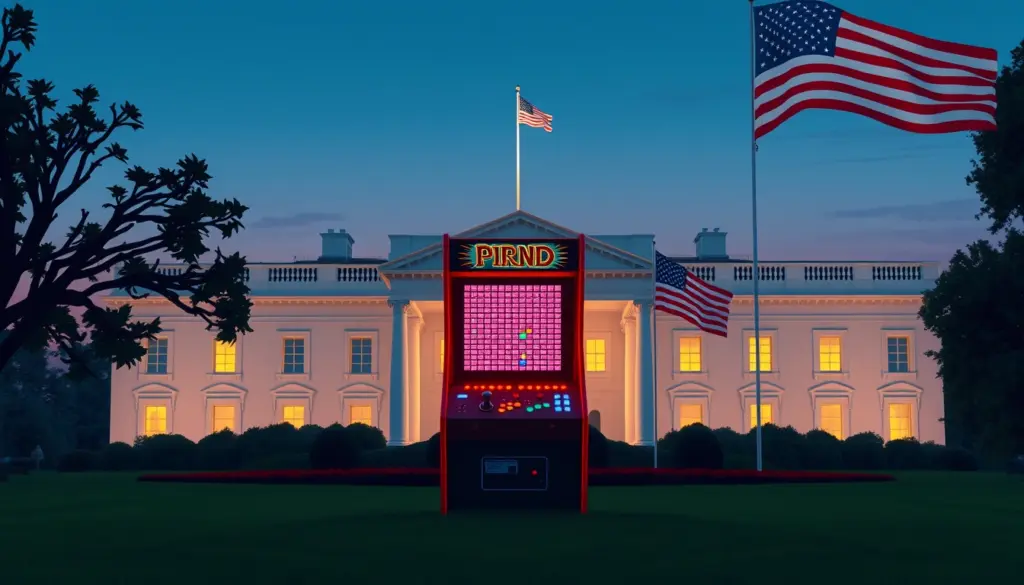
The White House added a video game arcade to its own website this week, and the video game industry did not take it quietly. On September 3, 2026, whitehouse.gov and a mirrored federal domain, arcade.gov, went live with five browser-playable, retro-styled games built around Trump administration policy priorities. Within 48 hours, the launch had triggered a rights-holder disavowal, revived questions about an existing Nintendo lawsuit, and split gaming press and political commentators along familiar lines.
This is not simply a story about pixel art. It is a story about what happens when a federal government borrows the visual language of copyrighted video games to sell policy, and about how quickly that borrowing collides with intellectual property law, international diplomacy, and a gaming industry that has spent decades building trademarks nobody asked it to lend to politics. The Tetris Company’s public warning over one of the five games was the first flashpoint. It will not be the last.
A Federal Website Turns Policy Into a Video Game
The Associated Press reported on September 3, 2026, that the White House website “unveiled Arcade, a collection of five low-resolution video games that promote different aspects of President Donald Trump’s agenda.” The games sit behind a dedicated section at whitehouse.gov/arcade, and the administration also stood up a parallel, easier-to-remember address at arcade.gov, according to multiple outlets tracking the launch. A sixth title is listed as “coming soon,” though no further detail has been published about it.
Each of the five live games recycles a recognizable arcade or mobile mechanic and repoints it at a specific policy theme: immigration enforcement, border security, school nutrition standards, and a child savings initiative. That combination, a federal agency shipping playable games styled after commercial hits, is what turned a minor web update into a week-long story spanning tech outlets, mainstream news, and international press.
Five Games, One Political Message
Each title maps directly onto a piece of the administration’s messaging calendar. Flappy Bill casts the player as a bald eagle carrying legislation over the National Mall, dodging obstacles in a clear nod to Flappy Bird’s flap-and-glide mechanic. Build the Wall asks players to stack falling wall sections, Tetris-style, to “protect the border from the coming horde,” per reporting from TechTimes and the AP. Rio Run is a Snake-style chase along the Rio Grande in which players gather and remove people attempting to cross the border. Supply Line borrows the conveyor-belt sorting mechanic associated with Tapper, tasking players with filtering school lunch items against “Make America Healthy Again” standards. Trump Savings Tycoon is a catching game built around the administration’s plan to seed newborn investment accounts with $1,000 for children born between 2025 and 2028.
None of the five games hides its source material. That is precisely the problem rights holders and legal commentators have raised: the closer a government product sits to an existing commercial game’s look and feel, the harder it becomes to argue the resemblance is coincidental.
Nintendo’s Lawsuit and Japan’s Two Formal Protests
The most consequential thread in this story is not new. TechTimes’ analysis, published September 4, 2026, frames the Arcade launch as one more entry in what it calls a broader pattern of unauthorized gaming IP use by this administration, and it is specific about the stakes: Japan’s Ministry of Foreign Affairs has lodged two separate formal diplomatic protests over earlier appropriations of Japanese-origin game characters and assets, and Nintendo is already suing over a separate, prior use of its intellectual property in administration-produced material. That litigation predates the Arcade and concerns different content, but it establishes that this administration has already been taken to court once over game IP, which changes how seriously Build the Wall and Rio Run’s visual borrowing is likely to be read by both journalists and lawyers.
That distinction matters. Nintendo has been an unusually active IP litigant this year, a pattern also visible in its separate tariff lawsuit against Sony and its continued push around anniversary properties like the Zelda 40th-anniversary showcase. As of this week, no outlet has reported that Nintendo, Bally Midway’s IP successors, or the rights holders behind Snake-style mechanics have taken new legal action specifically over the five Arcade games. What exists is a documented prior lawsuit, two prior diplomatic protests, and now a fresh batch of games built on the same playbook. Put together, that is less a one-off controversy and more a pattern regulators, rights holders, and reporters are now watching closely.
Tetris Draws a Line on “Build the Wall”
The clearest, named rights-holder response so far came from The Tetris Company. Newsweek reported on September 4, 2026, that the company “has distanced itself from a new Trump White House online arcade game that appears to draw inspiration from the iconic block-stacking video game,” stressing that it “was not involved” in the project. According to Newsweek’s report, the company’s official account posted: “The Tetris Company was not involved in the creation of ‘Build the Wall.’ We take copyright infringement very seriously.”
That statement stops short of a cease-and-desist letter or a lawsuit. It is a public disavowal paired with a warning, and as of this week no filing has followed it. A separate report from a Russian-language tech outlet, cited in wire coverage, described the same move as Tetris denying involvement in the initiative. The pattern across every outlet covering the story is consistent: strong public language, no confirmed legal filing yet, and the other games remaining live on the federal site. That last point shifted within days. By September 8 to 9, 2026, reporting from outlets including Ars Technica, Engadget, and TechCrunch, backed by archived-page comparisons and a 404 error where the game had sat, confirmed that Build the Wall had quietly been pulled from the Arcade. It was the one concrete change to follow Tetris’s warning, even though no lawsuit or cease-and-desist was ever filed.
Gaming Press Calls It Propaganda With Borrowed Code
Coverage from gaming and tech-focused outlets has leaned skeptical from the start. Reporting from that corner of the press repeatedly uses phrases like “Tetris knockoff” and describes Rio Run as resembling “the mobile favorite Snake” and Supply Line as “a condensed version of Tapper.” The framing across this coverage treats the Arcade less as civic outreach and more as a repackaging of nostalgia for political messaging, with the added complication that the underlying mechanics belong to other companies.
Fox News took a different editorial angle in its September 3, 2026 coverage, describing the launch as the White House giving “classic arcade games a MAGA makeover in new online launch” and highlighting the ability to fly a bald eagle through obstacles above the National Mall in Flappy Bill. That split, tech press treating the games as an IP problem, friendly outlets treating them as patriotic novelty, is itself a data point about how thoroughly this story has been absorbed into existing political media lines rather than treated as a neutral product launch.
Immigration Groups Call Rio Run Dehumanizing
The sharpest criticism has landed on Rio Run, the border-patrol game modeled on Snake. India Today’s September 4, 2026 coverage described the mechanic plainly: players “patrol the US-Mexico border along the Rio Grande and capture people attempting to cross.” Euronews Next’s report from the same window called the collection “pro-MAGA games with a deportation twist” and noted that rights groups criticized the game for turning enforcement policy into a scoring system.
The core objection from advocacy groups, as relayed across multiple outlets, is not aesthetic. It is that a federal government website is inviting the public to treat immigration enforcement, an area of real human consequence, as a points-based arcade challenge. That objection has traveled further and drawn more sustained coverage than the copyright dispute, even though the copyright dispute is the one with clearer legal teeth.
The White House Defense: “Policy You Can Interact With”
Administration officials have not gone quiet in the face of the criticism. USA Today reported on September 4, 2026, that an administration aide described the initiative as “policy you can interact with,” framing the retro aesthetic as a deliberate choice meant to pair nostalgia with a clear political message about border security, school nutrition, and family savings policy. Fox News’s coverage carried a similarly upbeat framing, presenting the Arcade as a patriotic, engagement-driven communications tool rather than a legal liability.
That messaging strategy is coherent on its own terms: nostalgia is sticky, arcade aesthetics are cheap to produce, and a game gets more social shares than a press release. The gap between that communications logic and the legal exposure it creates is exactly where this story now sits, and it is a gap the administration has not directly addressed in any of the coverage reviewed this week.
This Isn’t the First Political Video Game
Governments and campaigns turning to games for messaging is not new. US presidential campaigns have shipped browser and mobile games in past cycles as low-cost ways to reach younger voters, and federal agencies have occasionally used simple web games for public health and safety messaging. What is unusual here, and what separates the Arcade from that history according to the reporting reviewed this week, is the directness of the borrowing. Earlier political games generally built original mechanics or used generic genre conventions that predate any single company’s trademark. Build the Wall’s block-stacking gravity puzzle and Rio Run’s grid-based chase are close enough to Tetris and Snake that outlets across the political spectrum independently reached for the same comparisons without being prompted.
That is the detail worth sitting with: when reporters at outlets with opposing editorial lines, from Fox News to Euronews Next, all describe the same game as “a Tetris-style” title without coordinating, the resemblance is not a matter of interpretation. It is legible to a general audience, which is exactly the kind of resemblance copyright and trademark disputes are built on.
Legal Experts Weigh Government Speech Against Copyright
Detailed, named legal commentary is still thin in the first 48 hours of coverage, but the shape of the legal question is already visible in the reporting. TechTimes’ analysis raises the unauthorized-IP-use framing directly, pointing to the standing Nintendo suit and Japan’s two protests as evidence of an established pattern rather than an isolated incident. Newsweek’s coverage of Tetris’s statement implicitly raises the same question by quoting the company’s copyright-infringement language without a rebuttal from the administration on the legal merits.
Two legal doctrines are likely to matter most as this dispute develops, based on how the reporting has framed the dispute so far. First, the government speech doctrine gives federal communications wide latitude, but it does not override a private company’s copyright or trademark rights in original game mechanics, character design, or code. Second, a fair use or parody defense typically requires transformative commentary, and a straightforward reskin built to promote unrelated legislation is a harder fit for that defense than genuine satire would be. Neither doctrine has been tested against this specific dispute in court yet, since no lawsuit over the five Arcade games has been filed as of this week.
Market Impact: Reputational Risk Outweighs Web Traffic
No outlet covering the story in the September 3-5 window has published concrete visitor numbers, session data, or play counts for whitehouse.gov/arcade or arcade.gov. What every outlet agrees on is qualitative: the story spread fast. Inkl’s coverage described the deportation-themed game going viral, with backlash splitting “almost exactly along the same lines as the policies themselves.” That is a meaningful signal even without hard traffic numbers, because it means the Arcade achieved its stated communications goal, generating attention and conversation, while simultaneously generating the IP exposure that could turn into real legal cost.
For The Tetris Company, Nintendo, and any other rights holder whose game language shows up in a future federal product, the market calculation is straightforward: public disavowal costs nothing and protects a trademark’s reputation, while a lawsuit costs money and takes years. That is likely why Tetris chose the former this week. Whether that calculation changes if a seventh or eighth similarly-styled game appears is one of the open questions hanging over this story.
How the Arcade Compares to Other Government Digital Outreach
Federal agencies publish interactive content regularly, from IRS calculators to CDC risk-assessment tools, but almost none of it borrows the specific visual grammar of commercial video games this directly. The comparison that keeps surfacing in coverage is closer to branded advertising than to civic-tech: a fast-food chain running a Flappy Bird clone as a marketing stunt draws a cease-and-desist far more predictably than a public information campaign does, precisely because commercial use invites commercial-scale licensing disputes. A federal government occupies a stranger middle ground: it has the government speech doctrine on one side, but the games are demonstrably being used to build support for extremely specific and contested legislative and enforcement priorities, not to deliver neutral civic information.
That middle ground is untested. No comparable US administration has previously published a suite of games this visually close to protected commercial titles on an official federal domain, which is part of why legal commentators quoted across this week’s coverage are treating it as a genuinely new fact pattern rather than a rerun of an old dispute. It is a different kind of IP fight than the leak-prevention battles studios like Rockstar have waged this year, since here the government is the one accused of borrowing, not defending, someone else’s work.
The Five Games at a Glance
| Game | Style Precedent | Policy Theme | Core Mechanic |
|---|---|---|---|
| Flappy Bill | Flappy Bird | Legislation / national pride | Fly a bald eagle past obstacles over the National Mall |
| Build the Wall | Tetris | Border security | Stack falling wall sections against a “border siege” |
| Rio Run | Snake | Immigration enforcement | Patrol the Rio Grande and remove border crossers |
| Supply Line | Tapper | School nutrition standards | Sort lunch items on a conveyor belt |
| Trump Savings Tycoon | Catcher-style arcade games | Child savings accounts | Catch cash and gold bars to fill a $1,000 newborn account |
IP Exposure Scorecard
| Game | Nearest Rights Holder | Public Response So Far | Confirmed Legal Action |
|---|---|---|---|
| Build the Wall | The Tetris Company | Public disavowal, copyright warning (Sept. 4, 2026); game removed from the Arcade (Sept. 8-9, 2026) | None confirmed |
| Rio Run | No named rights holder statement reported | No public statement reported | None confirmed |
| Supply Line | No named rights holder statement reported | No public statement reported | None confirmed |
| Flappy Bill | No named rights holder statement reported | No public statement reported | None confirmed |
| Prior administration material (unrelated to the five Arcade games) | Nintendo | Ongoing dispute | Lawsuit filed, per TechTimes reporting |
The scorecard above makes the current state of the dispute easy to read: one confirmed rights-holder disavowal tied directly to an Arcade game, one confirmed and ongoing lawsuit tied to separate, earlier material, and two documented diplomatic protests from Japan’s Ministry of Foreign Affairs that predate this specific launch but establish the pattern TechTimes and other outlets are now pointing to.
What Happens Next
- Expect more rights holders whose game mechanics appear in the Arcade, whether or not they are named in current coverage, to issue public statements similar to Tetris’s disavowal, since it costs nothing and signals the company is protecting its trademark.
- The existing Nintendo lawsuit is likely to be watched closely as a bellwether: its outcome, even though it concerns separate material, will shape whether other rights holders decide litigation is worth pursuing over the Arcade games specifically.
- The sixth, “coming soon” game is likely to draw preemptive scrutiny from gaming press looking for its style precedent before it even launches, given the pattern established by the first five.
- Traffic and engagement data for whitehouse.gov/arcade and arcade.gov will likely surface in the coming weeks as third-party analytics trackers report on the domains, since no outlet has published numbers yet.
- Barring a wider change in strategy, expect the administration to keep the remaining games live rather than pull them, based on the tone of its public defense so far, which frames the criticism as evidence the messaging is working rather than as a reason to reconsider. The quiet removal of Build the Wall is the notable exception, and it suggests a direct rights-holder warning, rather than broad political criticism, is what actually moves a game off the site.
Why This Story Matters Beyond Gaming
Set aside the politics for a moment and the underlying issue is a familiar one to anyone who has watched IP disputes play out in marketing and advertising: recognizable game mechanics are protectable, and using them without a license carries real risk no matter who the user is. What makes this case different is the identity of the user. A federal government has more legal latitude to speak on policy than a private company does, but it does not have more latitude to reuse someone else’s copyrighted game design. That tension, between broad government speech protection and narrow, well-established IP law, is what every outlet covering this story keeps circling back to, and it is why gaming industry observers are treating this as more than a one-week news cycle.
The games industry has spent years fighting knockoffs, clones, and unlicensed reskins in ordinary commercial contexts. Having to make the same argument against the government that regulates and, in some cases, funds parts of that industry through trade and tax policy adds a layer of awkwardness no rights holder wanted. The games industry has already absorbed a rough 2026, and an unresolved fight with the federal government over IP is not the kind of headline studios were hoping to add to the year.
Frequently Asked Questions
What is the White House Arcade?
It is a section of the official White House website, also mirrored at arcade.gov, that launched on September 3, 2026 with five free, browser-playable, retro-styled video games tied to Trump administration policy themes, including immigration, border security, school nutrition, and child savings accounts.
Which games are currently available?
The five confirmed titles are Flappy Bill, Build the Wall, Rio Run, Supply Line, and Trump Savings Tycoon. A sixth game is listed as “coming soon” without further detail published yet.
Has Nintendo sued the White House over the Arcade games?
No. Nintendo’s confirmed lawsuit, reported by TechTimes, concerns separate, earlier administration material and predates the Arcade launch. As of this week, no new legal action tied specifically to the five Arcade games has been reported.
Did The Tetris Company take legal action over “Build the Wall”?
Not yet. According to Newsweek’s September 4, 2026 report, the company publicly stated it “was not involved” in creating the game and that it “takes copyright infringement very seriously,” but no cease-and-desist letter or lawsuit has been confirmed.
Why are immigration and rights groups criticizing Rio Run specifically?
Rio Run has players patrol the Rio Grande and remove people attempting to cross the border, and critics quoted across multiple outlets argue that turning enforcement actions into a scored arcade game trivializes a policy area with serious human consequences.
How has the White House defended the Arcade?
USA Today reported an administration aide described the initiative as “policy you can interact with,” and Fox News framed it as a patriotic, engagement-focused communications effort rather than a legal risk.
Are there any visitor or engagement numbers for the Arcade site?
No outlet has published concrete traffic figures for whitehouse.gov/arcade or arcade.gov as of this week. Coverage describes the launch, and particularly Rio Run, as having gone viral, but that is based on social sharing and media pickup rather than published analytics.
Is there legal precedent for a government using copyrighted game mechanics like this?
Not directly. Legal commentary referenced in current coverage notes that the government speech doctrine gives federal communications broad latitude on content, but it does not override a private company’s copyright or trademark protections, and no US administration has previously published a comparable suite of commercial-style games on an official federal domain.