
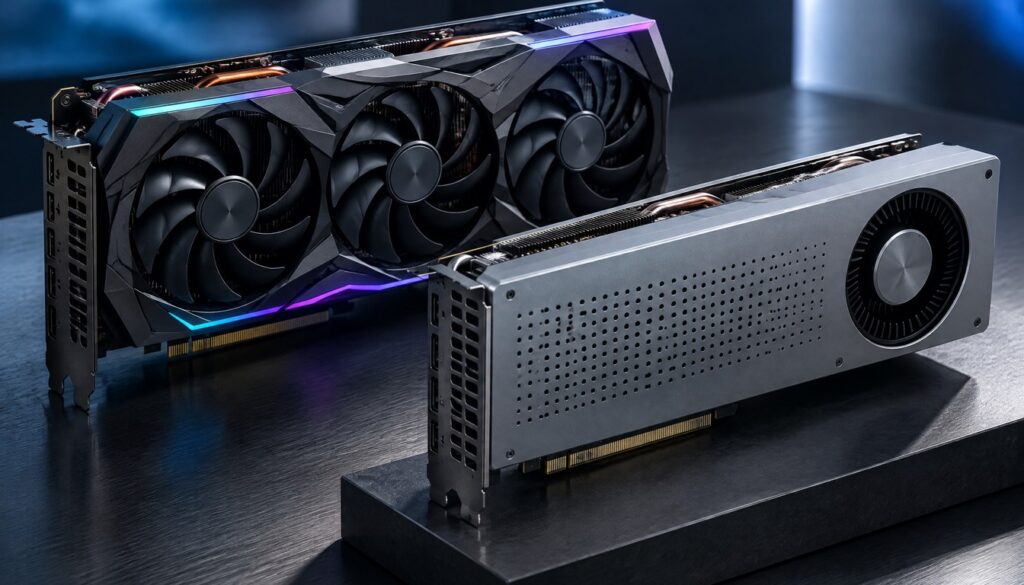
NVIDIA has reportedly stopped feeding fresh GB202 silicon to the GeForce RTX 5090, according to a wave of hardware outlets citing the same source on October 10, 2026. If the claim holds up, the card that has anchored NVIDIA’s consumer lineup since early 2025 is headed for a quiet exit, with the chip behind it redirected entirely toward the company’s far pricier RTX PRO Blackwell workstation cards.
The report traces back to hardware leaker MEGAsizeGPU, whose claims were picked up and reported by TechPowerUp, VideoCardz, and HotHardware, among others. NVIDIA itself has said nothing. No press release, no statement to any of the outlets covering the story, nothing on the company’s investor or product channels. That absence of confirmation matters, and this piece treats the production-ending claim exactly as what it is right now: a widely reported rumor, not a fact.
What’s actually being reported
The core claim is narrow but consequential. NVIDIA has allegedly stopped allocating new GB202 die output to the GeForce RTX 5090, and every future GB202 chip to come off the line will go to the RTX PRO Blackwell family instead. That would mean no more new RTX 5090 cards built from fresh silicon once existing channel inventory sells through. Reports also tie the RTX 5090 D v2, NVIDIA’s China-market variant built to comply with export rules, to the same fate, since it uses the same GB202 die.
Nothing in the reporting specifies an exact production cutoff date. Outlets covering the story are careful to flag that the source is a social media leaker, not an NVIDIA roadmap document or earnings call disclosure. Readers searching for a hard stop date won’t find one, because none exists in the public record as of this writing.
What makes the rumor plausible rather than dismissible is the chip itself. GB202 isn’t a GeForce-only part. NVIDIA’s own documentation already identifies GB202 as the flagship die in the RTX Blackwell architecture and confirms it powers the RTX PRO 6000 Blackwell, the company’s top-end professional card. The same silicon that ships in a $1,999 gaming card also ships in cards built for studios, data centers, and AI developers who pay many multiples of that price. When a single die serves two very different buyers, reallocating it toward the one who pays more is a basic supply decision, not a conspiracy theory.
The RTX 5090, by the numbers
Whatever happens to future production, the RTX 5090 that’s already on shelves and in builds remains NVIDIA’s current flagship GeForce card. Its specs, straight from NVIDIA’s own product listing, explain why losing it would actually sting for gamers and creators who need the memory headroom.
| Spec | GeForce RTX 5090 |
|---|---|
| Memory | 32 GB GDDR7 |
| CUDA Cores | 21,760 |
| Tensor Cores | 5th generation |
| Ray Tracing Cores | 4th generation |
| AI Performance | 3,352 AI TOPS |
| Shader (FP32) Throughput | 318 TFLOPS |
| Boost Clock | 2.41 GHz |
| Base Clock | 2.01 GHz |
| Listed Price (NVIDIA marketplace) | $1,999.00 |
That 32 GB memory pool is the card’s real differentiator. It’s a big reason the RTX 5090 became the default recommendation for anyone running large local AI models alongside gaming workloads, and it’s also exactly the kind of spec that makes a GPU attractive to buyers NVIDIA would rather route toward its professional lineup. shattered.io previously covered how that same demand pushed RTX 5090 buyers into signing a five-point export pledge just to purchase the card, a sign of how tightly NVIDIA already manages where this silicon ends up.
Where the chips would go instead
If GB202 really is being pulled from GeForce entirely, the destination is clear: NVIDIA’s RTX PRO Blackwell lineup. Company documentation lists three GB202-based RTX PRO products: the RTX PRO 6000 Blackwell Workstation Edition, the RTX PRO 6000 Blackwell Max-Q Edition, and the RTX PRO 5000 Blackwell. The RTX PRO 5000 Blackwell carries 48 GB of GDDR7, half again more than the RTX 5090’s 32 GB, and workstation cards in this tier routinely sell for several times the price of a consumer flagship.
That price gap is the entire story here. A GPU maker sitting on a limited supply of advanced dies, watching demand for professional and AI-adjacent hardware outstrip gaming demand, has an obvious incentive to ship every available die toward the higher-margin product line. NVIDIA doesn’t need a press conference to make that call. It just needs a wafer allocation meeting.
GB202 across the Blackwell lineup
Laying the GB202-based products side by side shows how one die now straddles two very different markets, and how little public information exists for the professional side of that split.
| Product | Market Segment | Memory | Status (Oct. 2026) |
|---|---|---|---|
| GeForce RTX 5090 | Consumer gaming / creator | 32 GB GDDR7 | Reportedly losing new GB202 allocation (unconfirmed by NVIDIA) |
| RTX PRO 6000 Blackwell Workstation Edition | Professional workstation | Not publicly disclosed | Shipping |
| RTX PRO 6000 Blackwell Max-Q Edition | Professional workstation, low-power | Not publicly disclosed | Shipping |
| RTX PRO 5000 Blackwell | Professional workstation | 48 GB GDDR7 | Shipping |
The gaps in that table aren’t an oversight. NVIDIA simply hasn’t published full core counts or memory configurations for every RTX PRO 6000 Blackwell variant, which is typical for a workstation line sold mostly through enterprise channels and system integrators rather than retail. That lack of transparency is part of why a leak like this one spreads so fast: there’s no public spec sheet to immediately confirm or kill it.
What the leaker actually said
It’s worth separating the leak itself from the coverage amplifying it. MEGAsizeGPU’s original posts, as captured by TechPowerUp, were blunt. The leaker wrote, “No more GB202 for 5090, confirmed.” In a follow-up, they added, “All future GB202 supplies are RTX Pro exclusive.” Those two lines, both reported by TechPowerUp, are the entire factual basis for this story. Everything else is interpretation and context layered on top by the outlets that picked it up.
A separate claim, relayed through VideoCardz’s reporting, attributes a more specific statement to the same source: “We have received a notification from the factory: NVIDIA will no longer sell any RTX 5090 models, including the D variants.” That’s a stronger claim than a supply reallocation. It implies an actual factory-level order, not just a leaker’s inference from watching die allocations shift. No independent outlet has verified that a factory notice of this kind exists, and NVIDIA has not addressed it directly.
None of this means the claim is false. Hardware leakers with supply-chain contacts have correctly called plenty of NVIDIA production shifts before they were official. It does mean readers should treat “NVIDIA ends RTX 5090” as a developing story rather than settled fact, at least until NVIDIA’s own channels, a retailer stock page, or a SKU update from an NVIDIA board partner lines up with it.
Why this would make business sense for NVIDIA
Set the leak aside for a moment and look at NVIDIA’s broader posture. The company has spent 2026 leaning hard into AI infrastructure and enterprise hardware, a shift visible in its record-setting buyback program and its continued push of workstation-class silicon into sovereign AI and enterprise deployments, including interest from Chinese firms evaluating cards like the RTX PRO 5500 Blackwell. Every GB202 die NVIDIA diverts from a $1,999 gaming card toward a workstation SKU selling for multiples of that price drops straight to the bottom line, assuming yields and demand both cooperate.
That logic doesn’t prove the rumor true. It explains why, if true, nobody at NVIDIA would be losing sleep over gamers’ reactions. The company has already shown it’s comfortable prioritizing AI and professional demand over consumer GPU supply, something reflected in GPU price surges across Europe this year that outside analysts have tied partly to constrained high-end supply. A GB202 reallocation would simply be the next chapter of a trend that’s already visible in pricing data.
Historical context: this isn’t the first time
This also isn’t the first time a GB202 production-ending rumor has circulated. French outlet Frandroid noted that NVIDIA had already denied a similar supply-shift claim back in November 2025, nearly a year before this round of reporting. That earlier denial didn’t stop the story from resurfacing, and it’s a useful data point for readers trying to calibrate how much weight to put on this specific report. Leakers watching the same supply chain sometimes pick up on real shifts months before they become visible at retail, and sometimes they’re reading early signals that NVIDIA later walks back or reshapes entirely.
NVIDIA’s broader history backs the pattern, even without specific numbers attached. Flagship gaming dies sliding toward professional and datacenter products as a generation matures is a recognizable shape in how the company has managed silicon before, driven by the same basic economics: professional buyers pay more per chip, and wafer supply is finite. What’s unusual this time is how early in the Blackwell generation the claim is landing, barely more than a year and a half after the RTX 5090 first shipped.
Market impact: what changes if it’s true
Assume for a moment the reporting holds up. The most immediate effect lands on anyone still shopping for a new RTX 5090. Existing retail and board-partner inventory wouldn’t vanish overnight, but once it sells through, there’s no restock coming. That typically pushes remaining units toward collector-style pricing, something shattered.io has already tracked with the thermal and connector issues that have shaped RTX 5090 ownership discussions all year. A card that’s hard to replace tends to hold or gain value even with known quirks.
Second, the RTX 5080 would become NVIDIA’s top available GeForce card for the rest of the Blackwell cycle, at least until a refresh or next-generation part lands. That’s a meaningful shift in the competitive picture, since the 5080 sits well behind the 5090 in both memory and raw compute. It also narrows the gap, intentionally or not, between NVIDIA’s top consumer offering and AMD’s high end, a comparison shattered.io broke down directly in its look at the RTX 5070 Ti against the RX 9070 XT.
Third, it reinforces a supply story that’s already playing out across the broader GPU market. NVIDIA’s desktop GPU shipment share has been sitting near 90 percent this year, according to prior shattered.io reporting on shipment data, and a company with that much market control can afford to deprioritize a single SKU without materially denting its overall position. For buyers, though, less choice at the very top of the stack generally means higher prices across the tiers just below it.
Competitive comparison: does AMD benefit?
On paper, an RTX 5090 exit should be good news for AMD. In practice, the benefit is limited, because AMD doesn’t currently field a card aimed at the RTX 5090’s price or performance tier. The RX 9070 XT, AMD’s current flagship consumer card, competes against the RTX 5070 Ti rather than the 5090, trading roughly comparable frame rates for a lower price point rather than chasing the 5090’s halo-tier positioning outright. If the RTX 5090 genuinely disappears and the RTX 5080 becomes NVIDIA’s ceiling, AMD’s RX 9070 XT ends up facing a narrower performance gap at the top of the market without AMD having to ship anything new to get there.
That’s a modest, almost accidental win for AMD rather than a result of its own roadmap. It also underscores how little direct competition exists at the true high end of the discrete GPU market right now. NVIDIA’s dominant shipment share means AMD’s gains tend to come from NVIDIA’s own supply decisions as much as from AMD’s product launches, a dynamic that’s shaped the GPU market for several generations running.
NVIDIA’s AI PC push adds another layer
This story also lands in the middle of NVIDIA’s broader push into AI-capable desktop and workstation hardware. The company has spent much of the back half of 2026 promoting products like RTX Spark, which it rolled out to PC makers while framing it against Intel and AMD’s own AI PC efforts, as covered in shattered.io’s report on the RTX Spark rollout to six PC makers. A GB202 pivot toward RTX PRO fits that same playbook: push high-value, high-memory silicon toward buyers running serious AI workloads, whether that’s a studio, an enterprise IT department, or a developer running large local models, rather than toward gamers who mostly care about frame rates.
Seen that way, the RTX 5090 rumor isn’t an isolated hardware story. It’s one more data point in NVIDIA’s yearlong tilt toward AI infrastructure revenue over pure gaming GPU volume, even when that tilt costs the company some goodwill among enthusiasts who’ve waited months for RTX 5090 stock to normalize in the first place.
What RTX 5090 owners and buyers should actually do
For current RTX 5090 owners, nothing changes immediately. No warranty terms shift because of a supply rumor, and NVIDIA hasn’t announced any end-of-life support timeline tied to this story. The practical question is for people still shopping.
- If you need an RTX 5090 specifically for its 32 GB memory pool, buying sooner rather than later reduces the risk of hunting through a thinning market later.
- If you’re flexible on budget and performance, watch how RTX 5080 pricing moves over the next few weeks. A sudden uptick in RTX 5080 demand or price would be a secondary signal that the rumor has legs.
- Don’t expect a discount. Supply tightening around a flagship card almost never pushes prices down, even amid an unconfirmed discontinuation report.
- Treat any listing claiming “last chance” or “final stock” language with skepticism until it’s backed by a retailer’s own inventory data, not just marketing copy riding the rumor cycle.
Predictions: what happens next
Treat these as informed, hedged forecasts rather than facts, since the underlying claim itself remains unconfirmed by NVIDIA.
- NVIDIA stays silent on an explicit confirmation or denial for weeks, following the same pattern it set with the November 2025 rumor Frandroid referenced, rather than issuing a quick statement either way.
- If true, the RTX 5080 becomes NVIDIA’s de facto gaming flagship for the remainder of the Blackwell generation, intensifying scrutiny of its 16 GB memory configuration relative to the 5090’s 32 GB.
- Remaining RTX 5090 retail inventory sees price firming rather than discounting, mirroring how limited-run flagship GPUs have historically behaved once restocks stop.
- RTX PRO Blackwell demand, including interest from AI-focused enterprise and sovereign buyers, keeps pulling GB202 output toward the professional line regardless of how this specific leak resolves.
- Expect the topic to resurface around NVIDIA’s next earnings call or GPU Technology Conference window, where analysts are likely to press for clarity on consumer Blackwell supply plans.
What stays genuinely uncertain
A few things are worth repeating plainly, because the breathless version of this story tends to drop the caveats. NVIDIA has not announced that the GeForce RTX 5090 is discontinued. NVIDIA has not confirmed that all future GB202 supply is reserved exclusively for RTX PRO products. There is no official end-of-production date on record. The claim that RTX 5090 D v2 is affected the same way comes from the same unverified leak, not a separate confirmed source.
What is confirmed: GB202 is real, it’s the flagship Blackwell die, it powers both the RTX 5090 and the RTX PRO 6000 Blackwell today, and NVIDIA has every financial incentive to prefer the professional side of that split as AI demand keeps climbing. Those facts make the rumor plausible. They don’t make it true.
Frequently Asked Questions
Is the RTX 5090 officially discontinued?
No. NVIDIA has not made an official announcement ending RTX 5090 production. The claim comes from hardware leaker MEGAsizeGPU and has been reported by outlets including TechPowerUp and VideoCardz, but it remains unconfirmed by NVIDIA as of October 10, 2026.
What is GB202?
GB202 is NVIDIA’s flagship GPU die in the RTX Blackwell architecture. It’s the chip inside the GeForce RTX 5090 and also powers the professional RTX PRO 6000 Blackwell card, according to NVIDIA’s own documentation.
Why would NVIDIA stop making the RTX 5090?
The reported motivation is economic. Professional and workstation GPUs built on the same GB202 die, such as the RTX PRO 6000 Blackwell and RTX PRO 5000 Blackwell, typically sell for significantly more than a $1,999 consumer card, making that allocation more profitable if supply is limited. This is an inference drawn from the reported shift, not a stated reason from NVIDIA.
What happens to people who already own an RTX 5090?
Nothing changes for existing owners. Warranty coverage and driver support aren’t affected by a production rumor, and NVIDIA hasn’t announced any related end-of-support plan.
Is the RTX 5090 D v2 affected too?
Reports claim the China-market RTX 5090 D v2 would be affected as well, since it uses the same GB202 die. NVIDIA has not confirmed this separately from the main RTX 5090 claim.
What would replace the RTX 5090 for gamers?
If the report is accurate, the RTX 5080 would become NVIDIA’s highest-performing available GeForce card until a refresh or next-generation product launches. The RTX 5080 currently trails the RTX 5090 substantially in both memory and core count.
Has this kind of rumor happened before?
Yes. According to French outlet Frandroid, NVIDIA denied a similar GB202 supply-shift rumor in November 2025, roughly a year before this latest report surfaced.
Where did this specific report originate?
The claim traces to posts from hardware leaker MEGAsizeGPU, which were then reported by TechPowerUp, VideoCardz, and other hardware outlets on and around October 10, 2026.