Nintendo is telling every original Switch owner running an older system version to update immediately after confirming a security flaw that lets a nearby attacker run unauthorized code on the console. The bug, tracked as CVE-2026-82079, is a stack-based buffer overflow in the Switch’s local wireless networking code, and Nintendo closed it with system update 23.0.0, released September 9, 2026. Coverage from CNET, TechRadar, IGN, Digitally Downloaded and Comics Gaming Magazine has pushed the advisory well beyond the usual patch-notes audience this week, and for good reason: any console still sitting below version 23.0.0 remains exposed.
The flaw sits in a narrow but real corner of the console’s feature set. It is not a remote, drive-by attack that works over the open internet. It requires an attacker within wireless range and, in the scenarios Nintendo has confirmed, a third party who can physically scan a QR code the console is displaying. That is a meaningfully smaller attack surface than a headline-grabbing remote exploit, but it is not a theoretical one either, and it lands on a platform install base built up over nearly nine years. Millions of original Switch units are still in circulation, many rarely updated, which is exactly the population Nintendo is now asking to act.
What Is CVE-2026-82079, Exactly
CVE-2026-82079 is classified as a stack-based buffer overflow in the local wireless networking functionality built into the original Nintendo Switch. In plain terms, the console’s wireless code doesn’t properly check the size of certain incoming network data before writing it into a fixed-size memory buffer. Send it data crafted to overrun that buffer, and an attacker within wireless range can potentially overwrite adjacent memory and hijack the console’s execution path. Advisories summarized in the current reporting describe the worst-case outcome as unauthorized code execution and data theft, meaning an attacker could, in principle, run their own code on the console or pull information stored on it.
The public CVE record assigns the identifier without a public technical writeup beyond the advisory summary, which is typical for a disclosure this fresh. That description places CVE-2026-82079 in a familiar bucket for console security researchers: a memory-corruption bug in a feature that talks to other devices over short-range wireless. What makes this one notable is not the bug class, which is decades old and well understood, but where Nintendo says it lives, tucked inside two specific consumer features that millions of households use without thinking twice about the network stack underneath them.
Two Ways an Attacker Could Trigger the Flaw
Nintendo’s advisory says the vulnerability has been confirmed in two limited scenarios, and both hinge on the same trigger: a third party scanning a QR code displayed on the console or the connected TV screen.
Send to Smartphone in the Album
The first confirmed path runs through the Switch’s Album app, specifically the Send to Smartphone feature that lets players transfer screenshots and clips off the console by scanning a QR code with their phone. That QR code briefly opens a local wireless connection between the console and whatever device scans it. If a third party scans that code instead of the intended phone, Nintendo’s advisory says they could exploit the buffer overflow during that handoff.
Mario Kart Live: Home Circuit
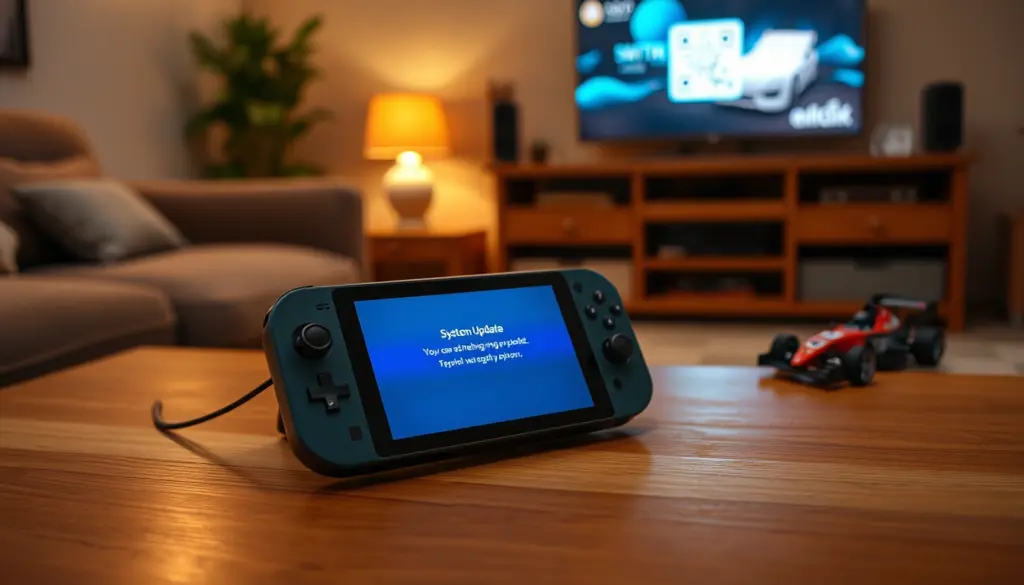
The second scenario involves Mario Kart Live: Home Circuit, the augmented-reality kart peripheral that pairs a physical remote-control kart with the Switch console to project a virtual race track through the TV. Setting up and playing with the kart also involves a QR-code pairing step between the kart and the console, and Nintendo confirms the same class of exploitation is possible there under the same condition: a third party able to scan the code.
Nintendo’s advisory frames the boundary plainly: this vulnerability cannot be exploited in an environment where a third party cannot scan the QR code displayed on the Nintendo Switch console screen (or the TV screen). Conversely, if a third party can directly scan the QR code, they could run unauthorized code on your Nintendo Switch console or obtain information stored on the console. That single sentence is doing most of the risk-assessment work here: no visual access to the code, no exploit.
Original Switch Affected, Switch 2 Escapes the Worst of It
Nintendo’s advisory states that the issue affects Nintendo Switch systems running a system version earlier than 23.0.0, and regional reporting narrows that further to the original Nintendo Switch, the console launched back in 2017, rather than the newer Nintendo Switch 2. Nintendo’s own language on the newer hardware is specific: this vulnerability cannot be exploited to obtain console information on Nintendo Switch 2. That doesn’t mean Switch 2 owners can ignore firmware updates altogether, it means this particular code-execution and data-theft path doesn’t extend to the newer machine.
There’s a small coincidence worth flagging for anyone tracking both platforms: Switch 2 also shipped a system update numbered 23.0.0 around the same period, though that release was about something unrelated, adding variable refresh rate support to a single launch title. Original Switch owners chasing “version 23.0.0” in their settings menu should double check which console they’re looking at, since the version number lining up across both platforms is coincidental, not a sign the same patch covers both. Switch 2’s own update history, including the drawn-out rollout covered in our VRR fix timeline, has followed a separate release cadence from the original hardware all year.
Inside Firmware 23.0.0: What Changed
Nintendo released system update 23.0.0 for the original Switch on September 9, 2026, and the fix for CVE-2026-82079 is bundled into that release. Consistent with the company’s long-standing practice, Nintendo’s public patch notes for system updates rarely spell out the technical detail behind a security fix, typically folding it into generic language about improved stability and system security. That pattern held here too: most players scrolling past the update prompt would have no idea a buffer overflow in the console’s wireless stack was the actual reason for the download.
That opacity is standard across the console industry, not unique to Nintendo, but it does mean the CVE identifier and the advisory language are the only real source of technical detail for anyone trying to understand what 23.0.0 actually locks down. Once a console installs the update, the buffer overflow path through both the Album’s Send to Smartphone feature and Mario Kart Live: Home Circuit’s pairing flow should no longer be exploitable, according to the advisory.
How to Update Your Nintendo Switch Right Now
Updating an original Switch to close this gap takes a few minutes and doesn’t require any technical background. From the HOME Menu, open System Settings, scroll down to System, and select System Update. If the console is already on 23.0.0 or later, it will say so immediately. If it isn’t, the download and install run automatically once confirmed.
HOME Menu > System Settings > System > System Update
  -> checks for and installs the latest version
  -> confirm console reads "23.0.0" or newer when complete
Consoles connected to Wi-Fi in sleep mode often pull system updates automatically in the background, which is why some players may find they’re already protected without having done anything manually. For anyone unsure, checking the version number directly in System Settings takes less time than reading this paragraph, and it’s the only way to confirm a given console is no longer exposed to CVE-2026-82079. Nintendo’s official support site maintains the current system update history for players who want to verify release dates and version numbers directly.
Why a QR Code Became an Attack Vector
QR codes feel low-tech compared to most modern security stories, which is part of why this advisory reads differently than a typical remote-exploit disclosure. Both confirmed scenarios depend on the console briefly opening a local wireless handshake tied to a code it is displaying on-screen, first to hand off screenshots to a phone, second to pair with the Home Circuit kart. In both cases, the QR code is functioning as a bootstrap for a short-lived wireless session, and the buffer overflow sits inside the code that parses whatever comes through that session.
That creates a risk profile most players haven’t had to think about before: exposure now depends partly on who can see the screen, not just who can reach the network. A living room with the blinds open, a shared dorm common area, or a Switch screen briefly caught on a livestream while Send to Smartphone is active are all plausible ways a QR code ends up visible to someone outside the intended handoff. None of that is a reported incident, it’s simply the logical extension of what Nintendo’s own advisory describes as the exploitation condition.
Historical Context: Switch Security Has Been Tested Before
The original Nintendo Switch has drawn serious hacker attention since well before this advisory. The console’s Tegra X1 chip carried a bootROM flaw widely known in the hacking community as Fusée Gelée, disclosed publicly back in 2018, which allowed arbitrary code execution at the hardware level and became the technical foundation for years of homebrew and piracy activity on the platform. That earlier flaw lived in silicon and couldn’t be patched away with a system update, forcing Nintendo to quietly revise later hardware revisions instead.
CVE-2026-82079 is a different kind of problem. It’s a software bug in a feature-level code path, not a silicon-level flaw, which is exactly why Nintendo could fix it with a downloadable firmware update rather than a hardware revision. Eight years separate the two disclosures, but both point to the same underlying reality: a console that stays on shelves and in living rooms for the better part of a decade accumulates a long tail of code paths, peripherals and legacy features that keep getting new scrutiny long after launch.
Market Impact: Should Players or Investors Worry
Judged purely on exploitation difficulty, CVE-2026-82079 is unlikely to move Nintendo’s business in any measurable way. Proximity and visual-access requirements rule out the kind of mass, remote exploitation that turns a bug into a financial or reputational crisis. Compare that to the kind of large-scale breach stories that dominate security headlines this year, where millions of records get pulled through a single exposed credential or misconfigured API, and this advisory looks almost quaint by comparison.
The bigger, quieter impact is on Nintendo’s patching discipline and on the regulatory backdrop it operates in. Governments have been pushing vendors toward faster, more predictable patch timelines generally, and initiatives like the federal directive tracked in our CISA known-exploited-vulnerabilities coverage reflect a broader expectation that hardware and software makers close known holes on a defined clock, not whenever convenient. Nintendo shipping a fix within its normal update cadence, rather than an emergency out-of-band patch, suggests the company assessed this as serious enough to fix but not urgent enough to break its usual release rhythm.
Nintendo vs Sony vs Microsoft: Who Patches Faster
Console makers differ in how aggressively they push security updates by default, and that gap matters more than most players realize. Sony and Microsoft both lean on background downloads while a console sits connected to power and Wi-Fi, aiming to get critical patches installed with minimal user action. Nintendo has offered similar background-download behavior on Switch for years, but the platform’s older install base, including units that spend long stretches offline in handheld mode away from home Wi-Fi, means a meaningful slice of consoles simply don’t check in often enough to self-heal quickly.
That’s the real lesson from CVE-2026-82079: the strength of a patch matters less than how many devices actually receive it. A console nearing its ninth year on the market, still selling steadily thanks to promotions like Nintendo’s recent storewide discount push, carries an install base far more fragmented in update status than a freshly launched machine. Whatever Nintendo’s internal patch velocity looks like, the outcome depends on millions of individual owners actually opening System Settings.
CVE-2026-82079 at a Glance
| Field | Detail |
|---|---|
| Vulnerability ID | CVE-2026-82079 |
| Vulnerability type | Stack-based buffer overflow |
| Affected component | Local wireless networking functionality |
| Affected devices | Original Nintendo Switch, system version earlier than 23.0.0 |
| Not affected (this issue) | Nintendo Switch 2 (cannot obtain console information via this flaw) |
| Attack vector | Crafted network traffic over local wireless, within range |
| Trigger requirement | Third party scans a QR code shown on console or TV screen |
| Potential outcome | Unauthorized code execution and data theft on the console |
| Fix version | System update 23.0.0 |
| Fix release date | September 9, 2026 |
Confirmed Exploitation Scenarios
| Scenario | Feature involved | Trigger condition | Third-party requirement |
|---|---|---|---|
| Screenshot/clip sharing | Send to Smartphone (Album app) | QR code displayed during transfer setup | Must directly scan the on-screen QR code |
| Kart pairing | Mario Kart Live: Home Circuit | QR code shown during kart-to-console pairing | Must directly scan the on-screen QR code |
Both rows in that table collapse to the same practical takeaway: if nobody outside the intended device can see the QR code when it’s on screen, Nintendo’s own advisory says the flaw isn’t exploitable. That is a genuinely narrow bar compared to most CVE disclosures, and it’s why this story reads as a “patch now, but don’t panic” situation rather than an active mass-exploitation event.
What Parents and Casual Players Should Know
Mario Kart Live: Home Circuit skews toward a younger, family audience by design, a physical toy paired with a console rather than a traditional cartridge game. That combination makes the pairing-QR scenario worth flagging specifically for parents managing a household Switch, since kids setting up the kart independently are exactly the users least likely to notice or question anything unusual during pairing. The fix requires nothing from a child beyond the console already being updated, which puts the responsibility squarely on whoever manages the household’s system updates.
The Send to Smartphone scenario carries a different, more adult risk profile: anyone who streams, screen-shares, or records their Switch gameplay for social media should be conscious that using the feature live exposes the QR code to whoever is watching, not just the intended phone. Updating to 23.0.0 removes that concern entirely, which makes this one of the rare security advisories where the fix costs nothing and the download takes minutes.
The Bigger Pattern: Smart Toys and Local Wireless Risk
CVE-2026-82079 fits a pattern that security researchers have flagged across the consumer electronics industry generally: features built for convenience, like QR-code pairing, NFC toy integration, or one-tap Bluetooth handoffs, tend to get less adversarial scrutiny during development than a device’s core networking stack. A toys-to-life peripheral like Home Circuit was designed to make pairing effortless for a child, and that same design goal is what opened a code path attackers could probe.
As consoles, smart toys, and household gadgets keep adding these convenience-first pairing flows, expect more disclosures shaped like this one: not catastrophic, not remote, but real enough that a manufacturer issues a formal advisory and a mandatory update. It is a reasonable bet that other companies shipping camera- or QR-paired peripherals are re-checking their own buffer handling this week, whether or not they say so publicly.
What Happens Next: Predictions
- Nintendo will likely push automatic background updates more aggressively as a default setting on future hardware, reducing the fragmented install-base problem this advisory exposes.
- Other manufacturers with QR- or camera-paired peripherals will quietly audit their own pairing code in the coming months, whether or not any of them confirm it publicly.
- Expect security researchers to spend more attention on toys-to-life and AR peripheral hardware generally, a category that has drawn far less scrutiny than mainline console firmware.
- A meaningful share of the original Switch’s install base will remain on pre-23.0.0 firmware for months, since offline handheld units don’t self-update without an active Wi-Fi connection.
- Nintendo Switch 2’s separate advisory language on this CVE will likely be cited by the company as evidence of a more hardened wireless stack on the newer platform, a point worth watching as Switch 2’s own security and enforcement track record continues to develop.
The Takeaway for Switch Owners
The practical instructions here are short: open System Settings, run a system update, confirm the console reads 23.0.0 or newer, and don’t worry that a driveway or a bus stop is somehow enough to put a Switch at risk. CVE-2026-82079 needs proximity and a clear line of sight to a QR code the console is actively displaying, conditions most people will never hit by accident. But “most people” isn’t the same as “everyone,” and a console with a near-decade-long tail of active hardware is exactly the kind of platform where a narrow, QR-triggered bug can still find enough exposed devices to matter. Updating costs a few minutes. Skipping it costs nothing until, for some small number of owners, it doesn’t. For more on where Switch and Switch 2 news lands next, our gaming coverage tracks Nintendo’s firmware and hardware moves as they happen.
Frequently Asked Questions
What is CVE-2026-82079?
It’s a stack-based buffer overflow vulnerability in the original Nintendo Switch’s local wireless networking code. Advisories describe it as potentially allowing unauthorized code execution and data theft when a third party can scan a QR code the console is displaying during specific feature use.
Which Nintendo Switch consoles are affected?
The original Nintendo Switch, running any system version earlier than 23.0.0. Nintendo’s advisory ties the affected scope specifically to that version threshold.
Is Nintendo Switch 2 vulnerable to this exploit?
Nintendo’s advisory states that this vulnerability cannot be exploited to obtain console information on Nintendo Switch 2, distinguishing the newer hardware from the original console for this specific issue.
How do I update my Nintendo Switch to fix CVE-2026-82079?
From the HOME Menu, go to System Settings, select System, then System Update. If the console isn’t already on version 23.0.0 or later, the update downloads and installs automatically once confirmed.
What is Nintendo Switch system update 23.0.0?
It’s the system firmware Nintendo released on September 9, 2026, for the original Switch, which closes the CVE-2026-82079 vulnerability along with the usual stability improvements typical of Nintendo’s update notes.
Can this vulnerability be exploited remotely over the internet?
No. Nintendo’s advisory ties exploitation to local wireless range and a third party being able to directly scan a QR code the console is displaying on-screen. There is no confirmed remote, internet-based path described in the advisory.
Does this affect Mario Kart Live: Home Circuit specifically?
Yes. Nintendo confirms the vulnerability can be triggered during the kart-to-console QR pairing step used to set up Mario Kart Live: Home Circuit, alongside the separate Send to Smartphone scenario in the Album app.
What should I do if I can’t update my Switch immediately?
Avoid displaying QR codes for Send to Smartphone or Home Circuit pairing anywhere someone outside your household could see the screen, including livestreams or shared spaces, until the console has installed system update 23.0.0 or later.