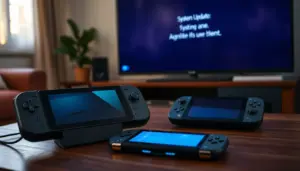

Nintendo pushed out a new Switch 2 system update on September 10, 2026, and buried inside the routine version bump was a feature players have asked for since the console launched last year: variable refresh rate support over HDMI. The catch, confirmed by Digital Foundry’s testing the same day, is that exactly one piece of software currently works with it.
System software version 23.0.0 adds VRR output in TV mode, letting a docked Switch 2 match its HDMI signal to a compatible television’s native refresh window instead of forcing a fixed 60Hz signal regardless of in-game frame rate. It is the kind of display-tech catch-up that PlayStation 5 and Xbox Series X/S owners have had for years. For Switch 2, whose docked mode has been criticized since launch for uneven frame pacing in demanding titles, it is a meaningful, if narrow, step.
What Firmware 23.0.0 Actually Changes
The headline addition in version 23.0.0 is VRR output for TV mode, according to Nintendo’s own update notes as reproduced by outlets covering the release on September 10. The system-level toggle lives in the console’s TV output settings, mirroring how Sony and Microsoft expose the same option on PS5 and Xbox Series X/S. Nintendo’s patch notes describe the feature as syncing the video output’s refresh rate to the game’s own processing speed on compatible displays, and they specify that an updated Nintendo Switch 2 Dock is required for the signal to pass through correctly.
That dock requirement matters. Switch 2 shipped with a redesigned dock at launch in June 2025 that already supports higher bandwidth HDMI output than the original Switch dock, and Nintendo appears to be leaning on that existing hardware rather than requiring a new peripheral purchase. Anyone running the console with an older, unmodified Switch dock left over from the first-generation hardware will not get VRR, regardless of software version.
Why Only One Game Works With Docked VRR
Digital Foundry’s write-up on the update, published September 10, flagged the most important limitation up front: VRR on Switch 2 runs on a whitelist. A game only activates the feature if its developer has specifically flagged it as VRR-compatible in a software patch. At the moment that list has exactly one entry: Nintendo Switch 2 Welcome Tour, the pack-in tech-demo title that ships with the console. Nintendo pushed a companion update, version 1.1.0, to Welcome Tour alongside the system firmware specifically to enable its “VRR Slider” demo mode in docked play, according to My Nintendo News’s coverage of Digital Foundry’s testing.
That means every third-party and first-party title already sitting on Switch 2 hardware, including system-sellers like Mario Kart World, will not gain VRR until their studios ship a dedicated patch. Nintendo has not published a roadmap or a list of titles slated for VRR updates, and Digital Foundry noted the company has made no promises about how quickly the library will grow beyond the single demo.
Inside the Testing: What the Numbers Show
40-60Hz vs 48-60Hz: A Narrower Gap Than Expected
Digital Foundry’s testing, relayed through My Nintendo News, found that Switch 2’s docked VRR window in 60Hz mode runs roughly between 40Hz and 60Hz, a range comparable to what Xbox Series X/S has offered since launch. That is a wider window than PS5’s VRR implementation, which Digital Foundry’s testing pegged closer to 48Hz through 60Hz. A wider VRR floor means more headroom for a game to dip in performance before frame pacing becomes visibly rough, since the display keeps adjusting its own refresh rate to match rather than judder against a fixed 60Hz signal.
Testing also found that Switch 2 supports low framerate compensation, or LFC, in 120Hz output mode, a technique that effectively doubles frame refreshes when a game’s rate drops below the VRR range floor so the display never has to fall back to a raw, uncompensated refresh. Digital Foundry noted the console’s internal handheld screen has actually supported VRR since launch, which is why the site expects most future first-party releases to pick up the feature relatively easily once developers prioritize the patch work.
VRR Explained: Why Frame Pacing Beats Raw Frame Rate
Variable refresh rate exists to solve a specific visual problem that raw frame rate numbers do not capture. A fixed-refresh display, like a TV locked to 60Hz, expects a new frame precisely every 16.7 milliseconds. When a game cannot hit that cadence exactly, frames arrive early or late relative to the display’s clock, producing stutter even if the average frame rate looks acceptable on a benchmark chart. VRR lets the display’s refresh timing bend to match whatever the console is actually rendering, frame by frame, which smooths out that stutter without requiring the game to run any faster.
This is precisely why Digital Foundry’s Welcome Tour testing described smoother perceived motion even when the demo’s frame rate dipped below a locked 60fps target. The console was not rendering more frames, it was simply not fighting its own display’s timing to show the frames it already had. For a console family that has drawn steady criticism for frame pacing issues in demanding docked titles, that is a real, measurable improvement, even if it currently only reaches a single piece of software.
How Switch 2 Compares to PS5 and Xbox on Display Tech
Nintendo is not introducing a new technology category to gaming, it is catching up to a standard the other two console makers settled years ago. The rollout timelines below show how long each platform took to bring VRR to market after its hardware first shipped.
| Console | Hardware Launch | VRR Added | Gap After Launch | Reported VRR Range (60Hz mode) |
|---|---|---|---|---|
| Xbox One X | November 2017 | November 2017 (launch) | 0 months | Adaptive Sync, industry first on console |
| Xbox Series X/S | November 2020 | November 2020 (launch) | 0 months | ~40-60Hz |
| PlayStation 5 | November 2020 | April 2022 | ~17 months | ~48-60Hz |
| Nintendo Switch (original) | March 2017 | Never added | N/A | Not supported |
| Nintendo Switch 2 | June 2025 | September 2026 | ~15 months | ~40-60Hz (docked, per Digital Foundry testing) |
Sony’s own experience is the closest precedent for what Switch 2 owners should expect next. Sony announced VRR support for PS5 in March 2022 and shipped it that April, roughly a year and a half after the console launched without it, according to Sony’s own PlayStation Blog announcement. Game-by-game VRR compatibility on PS5 also expanded gradually rather than arriving all at once, which is the same pattern Digital Foundry expects for Switch 2’s library now that the underlying system support exists.
Firmware 23.0.0: The Full Feature Breakdown
Beyond the headline VRR toggle, the September 10 update carries several smaller, related changes that outlets covering the patch notes have documented. The table below summarizes what changed and where it applies.
| Feature | What It Does | Applies To |
|---|---|---|
| Docked VRR output | Matches HDMI refresh rate to game frame rate on compatible TVs | TV mode only, whitelisted titles |
| Updated dock requirement | Requires the Switch 2-generation dock to pass the VRR signal | Docked play |
| Welcome Tour v1.1.0 patch | Enables the VRR Slider demo mode in TV mode | First supported title |
| Per-title whitelist | Developers must patch each game individually to enable VRR | All software, going forward |
| Low framerate compensation | Frame doubling when output drops below the VRR floor | Confirmed in 120Hz output mode |
| Handheld VRR (pre-existing) | Switch 2’s built-in screen already supported VRR at launch | Handheld mode |
Nintendo’s own wording for the change, as reproduced by outlets that captured the full patch notes on release day, focuses on the practical description rather than technical specs:
Switch 2 System Update 23.0.0 - Patch Notes Excerpt

- VRR output is now supported in TV mode.
- When both the software and the TV support it, the video
  will be output at a refresh rate that matches the game's
  processing speed.
- An update to the Nintendo Switch 2 Dock is required to
  enable this feature.
The Whitelist Problem: Developers, Not Nintendo, Decide What Gets VRR
The whitelist design is the most consequential technical decision in this update, and it is also the most likely source of ongoing frustration. Rather than exposing VRR as a system-wide setting that applies to any HDMI 2.1-capable display automatically, Nintendo requires each individual game to opt in through its own patch. That puts the pace of adoption in the hands of hundreds of separate development studios rather than under Nintendo’s direct control.
There is a practical argument for this approach. Not every Switch 2 title targets a fixed 60fps ceiling, and some games run internal frame-pacing logic that could behave unpredictably if VRR were forced on without developer testing. But the tradeoff is real: players who bought a Switch 2 specifically expecting modern display features at launch are, fifteen months later, still limited to a tech demo. TechRadar’s coverage of the rollout flagged the same gap, describing a long-requested display capability arriving with a catch that keeps most owners from actually using it yet.
Historical Context: Nintendo’s Slow Road to Modern Display Standards
Nintendo has never treated cutting-edge display technology as a priority the way Sony and Microsoft have. The original Switch, which launched in March 2017 and sold more than 155 million units over its lifetime according to Nintendo’s own financial disclosures, never gained VRR support in nearly a decade on the market. Its successor’s docked output was capped well below what rival consoles offered from their first day.
Microsoft, by contrast, has treated VRR as baseline console hardware since the Xbox One X in November 2017, and carried that support directly into Xbox Series X/S at launch in November 2020. Sony took a middle path, shipping PS5 without VRR in November 2020 and adding it through a system update roughly a year and a half later. Switch 2’s September 2026 rollout, arriving about fifteen months after its June 2025 launch, sits closer to Sony’s timeline than Microsoft’s, and its single-game software support at launch is narrower than either competitor managed at the equivalent point in their own VRR rollouts.
Market Impact: What This Means for Switch 2’s Living-Room Pitch
Docked Mode Is Where Nintendo Competes Directly With PS5 and Xbox
Switch 2’s hybrid design means Nintendo is fighting two different battles at once. In handheld mode, it competes against Steam Deck and other portable PC hardware, where display feature parity matters less than battery life and game compatibility. In docked mode, plugged into a living-room TV, it competes directly against PS5 and Xbox Series X/S on the exact terms those consoles have optimized for since 2020: frame pacing, refresh rate matching, and image smoothness on a big screen.
That is the context in which a single-game VRR rollout matters more than its scope suggests. Nintendo’s console business has leaned heavily on the argument that portability offsets any technical gap with rivals, but docked play is still how a large share of Switch 2 owners experience their most demanding games. Bringing VRR to TV mode, however narrowly, tells developers and reviewers that Nintendo intends to keep closing that technical gap rather than conceding it permanently. Whether that intent turns into a broad game library remains an open question that will only be answered by how many studios ship VRR patches over the coming months.
The Business Case: Sales Numbers Behind the Pressure to Modernize
Switch 2 has not struggled for demand. Nintendo’s fiscal year 2026 results, covering the console’s launch on June 5, 2025 through March 31, 2026, put global hardware sales at 19.86 million units, according to the company’s own investor relations disclosures as reported by Nintendo Everything. That figure beat Nintendo’s own revised full-year guidance of roughly 19 million units, and software attach was strong too, with 48.71 million software units sold in the same window, driven heavily by Mario Kart World’s launch-day bundle sales. Momentum has carried into the new fiscal year: Nintendo’s FY2027 first-quarter results, released August 6, 2026, put cumulative Switch 2 hardware sales at 23.68 million units as of June 30, 2026, with a further 3.82 million sold in the April to June quarter alone.
Strong hardware sales change the calculus around display features like VRR. A console selling in the tens of millions has a large enough installed base that even a single supported title reaches a meaningful audience, and it gives Nintendo leverage to ask third-party studios to prioritize patch work for a platform that is clearly not a niche add-on to their release plans. At the same time, a base this large also means unmet display expectations, such as the fifteen-month wait for basic VRR, are visible to a correspondingly large number of buyers who compare notes against PS5 and Xbox owners in the same household.
Competitive Landscape: Sony, Microsoft, and the VRR Standard
VRR itself is not a proprietary Nintendo, Sony, or Microsoft technology. It descends from the same Adaptive Sync foundation used by AMD’s FreeSync and, through HDMI 2.1’s standardized implementation, is compatible with most modern TVs regardless of which console is connected. That shared foundation is exactly why Switch 2’s belated support matters for competitive positioning rather than raw engineering difficulty: the hard part was never the standard itself, it was Nintendo choosing to prioritize implementing it.
Sony and Microsoft now treat VRR as a checkbox feature buyers expect by default, and both platforms’ broader software libraries reflect years of studios patching titles to take advantage of it. Nintendo’s whitelist-based, single-title starting point means the company is not yet competing on library breadth, only on the existence of the underlying capability. Closing that gap will depend far more on how quickly first-party teams like the ones behind Mario Kart World and future Switch 2 exclusives ship their own VRR patches than on any further firmware work from Nintendo itself.
What Comes Next: Predictions for Switch 2 Display Features
- First-party Nintendo titles, especially performance-mode-heavy releases, are the most likely candidates for the next wave of VRR patches, since Nintendo controls their development schedules directly.
- Third-party VRR adoption will likely lag first-party support by several months, mirroring how PS5’s VRR game library expanded gradually rather than all at once after Sony’s 2022 rollout.
- Because Switch 2’s handheld screen has supported VRR since launch, expect Nintendo to increasingly design future titles with VRR compatibility built in from the start rather than patched in later.
- Pressure from reviewers and Digital Foundry-style technical outlets will keep the whitelist’s slow growth in the spotlight, likely prompting Nintendo to publish a compatible-games list once the count moves beyond a single title.
- Expect Nintendo to bundle future VRR-enabled patches with other performance or resolution improvements, following the precedent set by Welcome Tour’s combined 1.1.0 update, rather than shipping VRR support as a standalone patch.
How to Update Your Switch 2 and Check VRR Compatibility
Updating to system software version 23.0.0 does not require any manual download for most users. Switch 2 consoles connected to the internet install system updates automatically in sleep mode, and the update can also be triggered manually from System Settings by selecting System, then System Update. Once on version 23.0.0, the VRR toggle appears under the console’s TV output settings, but it will only have a visible effect when three conditions are met at once: the console is docked using the Switch 2-generation dock, the connected TV supports VRR over HDMI, and the game being played has been specifically patched to support it.
For now, that last condition narrows the practical use case to Nintendo Switch 2 Welcome Tour, the free tech-demo title most owners already have installed. Players hoping to see VRR in their most-played titles will need to wait for individual publishers to confirm and ship compatible patches, and neither Nintendo nor major third-party studios have published release windows for that work as of this writing.
Frequently Asked Questions
What is Nintendo Switch 2 firmware 23.0.0?
It is a system software update Nintendo released on September 10, 2026, whose main addition is variable refresh rate (VRR) output support when the Switch 2 is docked to a compatible TV.
What is VRR and why does it matter on Switch 2?
VRR lets a display’s refresh rate adjust in real time to match a console’s actual frame output, reducing stutter compared to a fixed refresh rate. It matters for Switch 2 because docked play has drawn criticism for uneven frame pacing in demanding titles.
Which games currently support VRR on Switch 2?
As of this update, only Nintendo Switch 2 Welcome Tour supports docked VRR, following its own companion patch to version 1.1.0. Other titles will need individual developer patches to enable the feature.
Does VRR work in handheld mode?
Switch 2’s built-in handheld screen has supported VRR since the console’s original June 2025 launch. The September 2026 update specifically addresses docked, TV-mode output, which previously lacked VRR entirely.
Do I need a new dock to use VRR on Switch 2?
Nintendo’s update notes specify that an updated Nintendo Switch 2 Dock is required to enable the feature. The dock that ships with Switch 2 hardware supports this; older, first-generation Switch docks do not.
How does Switch 2’s VRR compare to PS5 and Xbox?
Testing reported through Digital Foundry found Switch 2’s docked VRR range in 60Hz mode runs roughly 40Hz to 60Hz, comparable to Xbox Series X/S and wider than PS5’s reported 48Hz to 60Hz range. Xbox has offered VRR since 2017, while PS5 added it in April 2022, about seventeen months after launch.
When will more games get Switch 2 VRR support?
Nintendo has not published a timeline or list of upcoming compatible titles. Based on how PS5’s VRR library expanded gradually after its 2022 rollout, broader Switch 2 game support is likely to arrive incrementally over the coming months rather than all at once.
How do I update my Switch 2 to version 23.0.0?
Most consoles connected to the internet update automatically. To check or trigger it manually, go to System Settings, then System, then System Update, and confirm the console shows version 23.0.0 or later.