
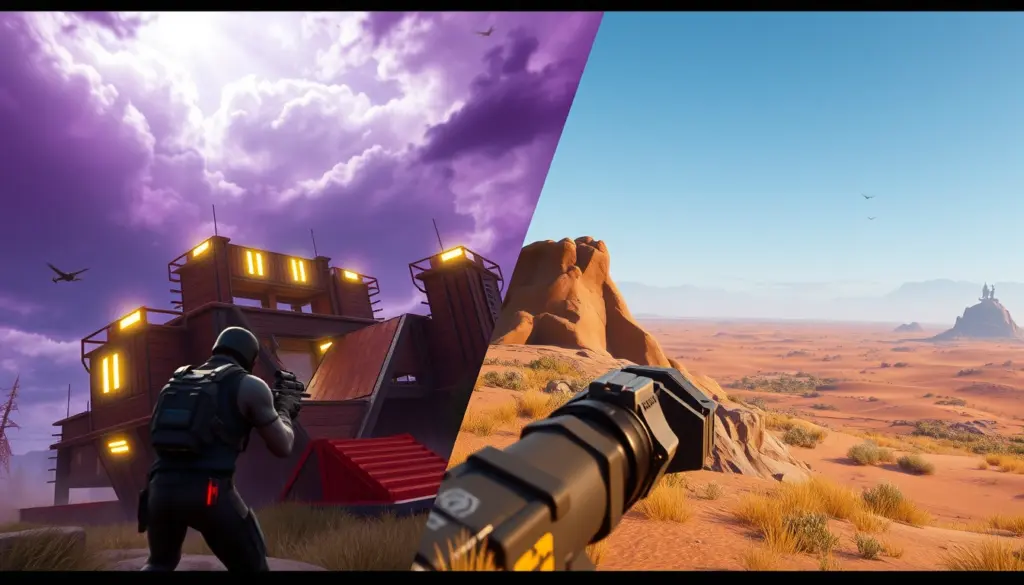
Fortnite’s ranked ladder runs on a single shared system, Bronze through Unreal, whether you queue into Battle Royale or Zero Build. But the two modes feel like different games once you’re actually climbing. One rewards edit speed and box control. The other strips all of that away and turns every fight into a pure aim-and-positioning contest. As of September 2026, Battle Royale still pulls the bigger lobby, but Zero Build carries a real competitive scene of its own, and picking the wrong ladder for your skill set is the fastest way to stall out in Gold.
This comparison breaks down the actual numbers behind both ranked ladders: population gaps, tier distribution, what climbing costs in time and gear, and which mode gives a controller player or a mechanical builder the better shot at Unreal this season. We’ll walk through the shared rank structure first, then split off into what actually separates the two modes in practice, from matchmaking depth to the competitive tournaments each one feeds into.
What Ranked Battle Royale and Ranked Zero Build Actually Are
Ranked Battle Royale is Fortnite’s original competitive ladder: full building, full editing, standard 100-player lobbies, and a rank tied to your combat and placement performance across a season. Ranked Zero Build runs the identical map, loot pool, and 100-player format, but removes construction entirely. No walls, no ramps, no 90-degree edit peeks. Every gunfight plays out in the open, behind natural cover, or inside pre-placed structures.
Epic folded both modes into the same eight-band rank structure years ago, and that hasn’t changed for the 2026 competitive calendar. What has changed is how the two communities have drifted apart. Builders treat Zero Build as a warm-up mode or an alternative when box-fighting burns them out. Zero Build specialists, meanwhile, increasingly treat it as their main queue, since aim and rotations, not construction speed, decide their games.
Fortnite also runs Ranked Reload and a Zero Build Reload variant on the same eight-band ladder, so the comparison in this piece focuses on the two flagship modes that carry the most ranked traffic, as detailed in our breakdown of all five ranked modes and their shared 22-step structure. For a look at how ranked stacks up against Fortnite’s older tournament format, see our comparison of Arena and Ranked.
A Brief History: How Zero Build Ranked Came to Exist
Zero Build didn’t start as a ranked mode at all. Epic added it as an unranked playlist in March 2022, largely in response to a growing chunk of the player base, particularly newer and controller-first players, who wanted competitive Fortnite without the mechanical wall that building had become. For its first several seasons, Zero Build had no rank ladder of its own. Players who wanted a ranked structure had to queue into Battle Royale, which meant the audience Zero Build was built for still had no competitive progression system tailored to them.
That changed when Epic folded Zero Build into the unified ranked system, applying the same Bronze-to-Unreal bands rather than inventing a separate scale. The move mattered for two reasons. First, it meant Epic’s rank data and matchmaking infrastructure could treat both modes as variations of one system rather than maintaining two parallel ladders. Second, it signaled that Epic viewed Zero Build as a permanent, first-class competitive mode rather than a casual side queue. Ranked Reload followed a similar path: rather than build new rank math, Epic mirrored the eight-band structure, according to Fortnite’s own ranked documentation, extending the same ladder logic to a faster, smaller-map format.
The result by the 2026 season is a Fortnite ranked ecosystem where every mode, whether it’s core Battle Royale, standard Zero Build, or the Reload variants, reports into the same rank identity. That consolidation is why a player’s Bronze, Gold, or Unreal badge means the same structural thing across the game, even though the skills required to earn it differ sharply by mode.
Fortnite’s Shared Rank Ladder: Bronze to Unreal Explained
Both modes use the same eight rank bands, and five of them split into three divisions each. That gives players 18 named ranks to climb, from Bronze III at the bottom to a single Unreal tier at the top. Once you touch Unreal in a season, you can’t be demoted back down, according to Foxyscore’s Fortnite ranked guide, which places Unreal among the top fraction of a percent of the ranked population.
| Rank Band | Divisions | Used in BR Ranked | Used in Zero Build Ranked | Approx. Skill Level |
|---|---|---|---|---|
| Bronze | I, II, III | Yes | Yes | New or casual players |
| Silver | I, II, III | Yes | Yes | Learning core mechanics |
| Gold | I, II, III | Yes | Yes | Consistent rotations, average aim |
| Platinum | I, II, III | Yes | Yes | Solid decision-making, above-average fights |
| Diamond | I, II, III | Yes | Yes | Strong mechanics, consistent placements |
| Elite | Single tier | Yes | Yes | Top-tier lobby awareness |
| Champion | Single tier | Yes | Yes | Near-competitive standard |
| Unreal | Single tier, no demotion | Yes | Yes | Top slice of the ranked population |
What’s not different is the naming and division count. What is different is how hard each division is to clear, since the same rank in Zero Build draws from a smaller, often more dedicated player pool than the same rank in Battle Royale.
How You Climb: Ranked Points, Eliminations, and Placement Scoring
Epic doesn’t publish a separate points currency for each mode. Both Ranked Battle Royale and Ranked Zero Build run on the same underlying rating system: you gain progression for eliminations and for how far you survive into a match, and you lose it for early deaths or repeated poor placements. There’s no published “Hype per rank” chart anymore, a change from Fortnite’s older Arena seasons where thresholds were public and fixed.
The practical effect is that grinding either ladder rewards the same basic loop: survive, get eliminations, place high, repeat. But the paths to those eliminations look completely different. In Battle Royale, a mediocre gunfight can be salvaged by out-building an opponent, retreating into a box, healing, and re-engaging. In Zero Build, once you’re in a bad fight, you’re in it until someone dies or disengages on foot. That single mechanical difference is why the two ladders develop such different playstyles even though they share one rating system.
Player Population: Which Mode Draws the Bigger Lobby
A September 2026 concurrent-player snapshot from Fortnite Tracker put Battle Royale at 368,420 concurrent players against 273,570 for Zero Build in the same sample window. That puts Zero Build’s population at roughly 74% of Battle Royale’s, or about 26% smaller. It’s a real gap, but it’s nowhere close to a dead mode: Zero Build is still pulling a quarter-million concurrent players at once.
| Metric | Ranked Battle Royale | Ranked Zero Build | Source |
|---|---|---|---|
| Concurrent players (Sept. 2026 sample) | 368,420 | 273,570 | Fortnite Tracker |
| Population relative to BR | 100% (baseline) | ~74% | Fortnite Tracker |
| Lobby size | 100 players | 100 players | Epic Games ranked docs |
| Rank bands shared | 8 bands, 18 named ranks | 8 bands, 18 named ranks | Foxyscore ranked guide |
| Elite+ share of ranked pool (Sept. 2026) | Elite 5.7%, Champion 2.7%, Unreal 1.7% | Included in same global sample | Esports Tales rank distribution |
Niche ranked variants tell a rougher story. A limited “ranked OG Zero Build” playlist launched in 2024 struggled to hold even 1,000 concurrent players in most windows and was pulled from rotation after failing to sustain interest, a reminder that Zero Build’s core ranked queue and its side-mode experiments perform very differently. The lesson for anyone deciding where to grind: stick to the two flagship ladders, Battle Royale and standard Zero Build, where matchmaking stays fast at every rank.
Rank Distribution Compared: Where Players Actually Sit
Because both modes share one ladder, Epic and third-party trackers mostly publish global distribution rather than splitting BR from Zero Build. The clearest recent snapshot, from Esports Tales’ September 2026 rank distribution tracker, shows Elite at 5.7% of the ranked population, Champion at 2.7%, and Unreal at 1.7%. That means roughly 90% of tracked ranked players sit at Diamond or below, and fewer than one in ten ever crack Elite.
A separate distribution pull cited in our Fortnite vs Valorant ranks comparison put Bronze at 38.1% and Silver at 28.8% of the ranked pool, meaning roughly two-thirds of active ranked players never climb past Silver in a given season. The two datasets don’t line up perfectly, since sample windows and regions differ, but they agree on the shape of the curve: a wide base, a thin middle, and a genuinely small elite tier at the top.
What neither Epic nor third-party trackers currently publish is a clean, mode-by-mode split of that curve. You can find Battle Royale’s overall shape and Zero Build’s overall shape, but a rank-by-rank comparison isolating just Zero Build players from just Battle Royale players isn’t publicly available in granular form as of this season. Treat any claim that “Zero Build ranks are easier” with some skepticism until Epic ships that breakdown. A third tracker, DCPro Sens’ 2026 ranks explainer, corroborates the same general pattern: Bronze and Silver combined make up well over half the ranked population, while Diamond and above stay in the single digits.
That consistency across three independent trackers, Esports Tales, DCPro Sens, and the dataset behind our Valorant comparison, matters more than any single number. When three separately maintained datasets all describe the same lopsided curve, it’s a reasonably safe bet that the underlying shape holds regardless of which specific snapshot date you’re looking at. What can shift meaningfully from month to month is the exact percentage in each band, since Epic’s matchmaking and rank-decay tuning changes with nearly every major update.
Build Mechanics vs Pure Gunskill: The Core Strategic Divide
This is where the two ladders genuinely diverge as games, not just as menus. In Ranked Battle Royale, mechanical building is the skill gate between the middle ranks and the top ones. Edit speed determines who wins a box fight. Piece control determines who holds high ground. A player with average aim but elite editing can still climb into Diamond and beyond by out-building weaker opponents, turning a losing gunfight into a winning one through pure mechanical speed.
Zero Build removes that entire axis. Positioning, cover usage, and rotation timing replace box fighting as the core skill. Getting caught in the open with no structure to retreat into is fatal, so the best Zero Build players win through map knowledge, pre-positioning near natural cover, and disciplined third-party avoidance rather than mechanical outplays. Fights resolve faster because there’s no way to stall a losing engagement by throwing up walls and re-healing behind them.
The practical takeaway for anyone stuck in a rank: if you’re losing fights in Battle Royale because you get out-edited in box fights, Zero Build removes that specific weakness from the equation. If you’re losing fights in Zero Build because you get caught in bad rotations, Battle Royale gives you a mechanical escape hatch that Zero Build simply doesn’t offer.
How to Practice for Each Ladder: Edit Courses vs Aim Trainers
Because the two modes reward different muscle memory, practicing for one doesn’t automatically improve your rank in the other. Battle Royale climbers get the most out of dedicated edit courses in Creative, where reps on 90s, double ramp rushes, and box resets translate directly into faster, cleaner outplays in ranked lobbies. Pairing that with a warm-up routine that mixes building drills and close-range aim keeps both halves of the BR skill set sharp before a ranked session.
Zero Build climbers get more value from pure aim trainers and close-quarters deathmatch modes, since tracking, flick accuracy, and recoil control carry far more weight when there’s no building to fall back on. Positioning drills matter just as much as mechanical ones. Reviewing your own deaths for how you approached cover, rather than just how you aimed, tends to move Zero Build rank faster than aim practice alone once you’re past the beginner tiers. Players coming from a Battle Royale background often over-rotate toward open ground out of habit, a tendency worth specifically training out before pushing into Platinum and above.
If you’re building a personal practice routine across ranked shooters more broadly, our guide to setting up a Fortnite rank tracker covers how to log match-by-match data so you can see which specific mechanic, editing or aim, is actually holding your rank back.
Controller Aim Assist and the Input Debate in Each Mode
Both ranked ladders are input-agnostic. Console and PC players queue into the same lobbies, controller and mouse-and-keyboard players share the same matchmaking pool, and there’s no separate MMR track based on input device. But the aim-assist conversation lands very differently depending on which mode you’re in.
In Zero Build, there’s no editing or building to offset a raw aim advantage, so fights hinge almost entirely on tracking and reaction time. That’s precisely why controller aim assist draws more scrutiny in Zero Build communities: without a mechanical counter-play option, the aim advantage from assist feels larger relative to everything else going on in a fight. In Battle Royale, high-level players can compensate for weaker aim with faster edits and better piece control, which is part of why mouse-and-keyboard players have historically gravitated toward the build-heavy ladder. Neither mode has announced input-based matchmaking splits for ranked play this season, so the debate remains a community and competitive-integrity discussion rather than a rule change.
Competitive Scene: FNCS, Ranked Reload, and Where Zero Build Fits
The Fortnite Championship Series remains built around construction. Tournament qualification pages list a Gold-or-higher requirement in Combined Ranked from the current or previous season, according to Royal Arena’s tournament tracking hub, and the flagship FNCS format itself is a build-mode competition, not a Zero Build one.
Zero Build isn’t absent from the competitive calendar, though. Epic’s official competitive schedule for the current chapter alternates Solo Battle Royale and Solo Zero Build cup days roughly every one to two weeks, with Zero Build Reload events layered in on a similar rotation. That gives dedicated Zero Build grinders a real path to cash cups and leaderboard recognition, just not the same marquee spotlight FNCS gives to the build-focused main circuit. If you’re aiming for the biggest prize pools specifically, Battle Royale is still the format that matters most. If you want more frequent, lower-stakes competitive reps instead, Zero Build’s rotating cup schedule delivers that without requiring you to learn building at a competitive level.
This split mirrors a broader pattern across the battle royale genre, where build-focused progression paths tend to anchor the biggest prize pools while build-free variants grow the overall competitive base. Our comparison of Fortnite and Apex Legends ranks covers how a fully build-free battle royale like Apex structures its own ladder and tournament access, which is a useful reference point if you’re weighing whether to invest your competitive reps in Fortnite’s Zero Build ladder or a different shooter entirely.
Cost to Compete: Gear, Battle Pass, and Prize Pools
Fortnite itself is free to play, and ranked access in both modes doesn’t require a purchase. But the real cost of competing seriously in each mode looks different once you factor in gear and time investment. Battle Royale’s build-heavy meta rewards low-latency, high-refresh setups and often pushes competitive players toward mouse-and-keyboard on PC to hit fast edit speeds, which raises the effective hardware floor. Zero Build’s aim-first meta is friendlier to controller players and to lower-spec setups, since there’s no edit-speed arms race to keep up with.
| Cost Category | Ranked Battle Royale | Ranked Zero Build |
|---|---|---|
| Game access | Free to play | Free to play |
| Battle Pass (optional, per season) | ~$9.99 | ~$9.99 (shared pass) |
| Recommended input for competitive play | Mouse and keyboard favored for edit speed | Controller viable at every rank |
| Effective hardware floor | Higher (low-latency monitor, high-end mouse) | Lower (controller-friendly) |
| Main competitive circuit | FNCS (build format, largest prize pools) | Rotating Zero Build cups, smaller pools |
| Tournament entry requirement | Gold+ in Combined Ranked | Gold+ in Combined Ranked |
Neither mode requires spending beyond the optional Battle Pass to rank up. The real “cost” difference is time spent developing a skill that doesn’t transfer cleanly between modes: editing reps for Battle Royale, aim-training reps for Zero Build. There’s also an indirect cost worth factoring in if you’re weighing a controller upgrade or a new mouse purely for ranked grinding. Battle Royale’s competitive scene has historically pushed harder on peripheral upgrades, since shaving milliseconds off an edit input can directly decide a box fight, while Zero Build’s aim-first meta rewards sensitivity tuning and screen time far more than raw input speed. If your budget for gear is limited, that’s a reasonable factor in deciding which ladder to prioritize this season.
Skill-Based Matchmaking: How Each Mode Handles Lobby Balance
Ranked matches in both modes use skill-based matchmaking layered on top of your current rank, pairing you against players near your rating rather than a pure random draw from the mode’s full population. That’s standard for any ranked ladder, but the practical effect differs between Battle Royale and Zero Build because of the population gap covered earlier. With roughly 368,420 concurrent Battle Royale players against 273,570 in Zero Build, Battle Royale’s larger pool generally gives its matchmaker more players to choose from at any given rank and region, which tends to produce tighter skill matching at peak hours.
Zero Build’s smaller population isn’t a serious problem at low-to-mid ranks, where there are still plenty of players to draw from. It becomes more noticeable at Elite, Champion, and Unreal, where the pool of qualifying players thins out fast at any single skill tier. Players climbing toward Unreal in Zero Build sometimes report wider skill variance within a single lobby at those top ranks compared to the same climb in Battle Royale, simply because there are fewer high-rated Zero Build players online at any given moment to fill out a tightly matched lobby.
Neither mode publishes its exact matchmaking algorithm or the specific rating window it uses to build a lobby, so treat lobby-difficulty complaints as anecdotal rather than confirmed mechanics. What is confirmed is the underlying population data driving the difference: a smaller player pool at the top of any ladder means fewer near-identical opponents to draw from, regardless of which battle royale or shooter you’re playing.
Match Pacing and Length: Why Zero Build Feels Faster
Epic doesn’t publish exact average match-length figures split by mode, but the pacing difference is consistent across competitive commentary and is easy to feel in practice. Battle Royale’s end-game tends to stretch out, since surviving players can box up, heal, and hold ground through zone rather than dying to the first shot that lands. That produces denser, longer final circles with more simultaneous survivors.
Zero Build resolves fights faster because there’s no way to stall a bad engagement. A player caught in the open during the final circle usually dies quickly rather than surviving through a rebuilt box, which trims the number of players still alive in the closing minutes. For players who want more games per session rather than fewer, longer ones, that faster resolution is a practical reason to favor the Zero Build ladder.
5 Real-World Examples From the 2026 Ranked Season
- The population snapshot. Fortnite Tracker’s September 2026 concurrent-player pull (368,420 BR vs. 273,570 Zero Build) is the clearest public evidence that both ladders remain healthy, with Zero Build holding roughly three-quarters of Battle Royale’s traffic.
- The failed niche variant. A limited “ranked OG Zero Build” playlist launched in 2024 struggled to clear 1,000 concurrent players for extended stretches and was eventually pulled, showing that not every Zero Build experiment sustains a healthy queue the way the standard ladder does.
- Ranked Reload’s shared structure. When Epic rolled out Ranked Reload, it mirrored the same eight-band, division-based ladder used in core Battle Royale and Zero Build rather than inventing a new system, reinforcing that Epic treats rank as one unified currency across modes.
- The Chapter 7 Season 4 competitive calendar. Epic’s official competitive schedule alternates Solo Battle Royale and Solo Zero Build cup days roughly weekly, with Zero Build Reload cups layered on a parallel rotation, giving both playstyles a recurring path to prize money.
- The distribution gap between trackers. Esports Tales’ September 2026 pull (Elite 5.7%, Champion 2.7%, Unreal 1.7%) and the Bronze-heavy distribution cited in our Fortnite vs Valorant comparison (Bronze 38.1%, Silver 28.8%) both point to the same conclusion from different samples: most ranked players, in either mode, never leave the bottom half of the ladder.
Which Mode Fits Your Playstyle: 5 Use-Case Recommendations
Controller players chasing quick rank gains should lean toward Zero Build. Removing the editing skill gate lets aim assist and positioning carry more weight, and there’s no edit-speed arms race putting console players at a structural disadvantage.
Mouse-and-keyboard players with strong mechanical reps tend to climb faster in Battle Royale, where editing speed and piece control let sharper mechanics offset an average aim day.
FNCS hopefuls need to grind Battle Royale specifically, since the flagship circuit and its largest prize pools remain a build-format competition, and Combined Ranked entry requirements draw from that ladder.
Players who want more matches per session should favor Zero Build’s faster fight resolution and shorter average end-games over Battle Royale’s longer, box-heavy final circles.
New or returning players easing back into ranked often find Zero Build the gentler on-ramp, since there’s one fewer mechanical system (building) to relearn before rank progress starts to reflect actual game sense.
Migration Guide: Switching Between BR Ranked and Zero Build Ranked
Moving from one ladder to the other isn’t a settings change, it’s closer to relearning a chunk of the game. Here’s how to make the switch without tanking your rank in the process.
- Play at least 10-15 unranked matches in the target mode before queuing ranked, since your instincts for cover and engagement distance need to reset.
- If you’re moving from Battle Royale to Zero Build, deliberately widen your engagement distance. Without walls to retreat behind, taking fights at closer range than you’re used to gets you killed faster.
- If you’re moving from Zero Build to Battle Royale, spend time in Creative edit courses before your first ranked session. Edit speed is the single biggest mechanical gap builders notice when they’ve been away.
- Expect a placement adjustment, not a hard reset. Fortnite carries a version of your prior rank standing into a new season or mode rather than starting everyone at Bronze.
- Track your death causes for your first 20 ranked matches in the new mode. If you’re dying mostly to being caught out of position, that’s a Zero Build-specific habit to fix. If you’re dying in box fights, that’s a Battle Royale-specific one.
- Adjust sensitivity separately for each mode if you’re on controller. Zero Build’s aim-first pace often rewards slightly higher sensitivity than a build-heavy Battle Royale setup where you’re constantly switching between building and aiming.
- Review replays of your losses, not just your wins. The fastest way to identify which mechanical gap is costing you rank is watching exactly where a fight turned.
- Don’t switch mid-grind toward Unreal. Since Unreal locks in for the rest of the season once reached, pick one mode to push hardest toward that milestone rather than splitting reps across both.
Pros and Cons: Ranked Battle Royale vs Ranked Zero Build
Ranked Battle Royale
- Pro: Larger player base means faster matchmaking at almost every rank.
- Pro: Mechanical building gives skilled players a way to escape bad fights rather than just losing them.
- Pro: Direct path to FNCS and the largest competitive prize pools.
- Con: High mechanical skill ceiling means slower rank progress for players who don’t practice editing.
- Con: Longer, denser end-games can make late losses feel more costly in time invested.
Ranked Zero Build
- Pro: Lower mechanical barrier to entry, since there’s no building system to learn.
- Pro: Faster match resolution means more games per hour of play.
- Pro: Friendlier to controller players without an edit-speed disadvantage against mouse-and-keyboard.
- Con: Smaller population (roughly 74% of Battle Royale’s) means slightly longer queues in off-peak windows.
- Con: Secondary status in the competitive scene next to the build-focused FNCS main circuit.
Common Mistakes That Stall Your Climb in Each Mode
Most players who plateau in Battle Royale ranked make the same handful of errors. They fight in the open instead of forcing engagements near natural or player-built cover, giving up the mechanical advantage the mode is built around. They over-commit to a losing box fight instead of resetting and repositioning, bleeding materials and health for a fight they could have disengaged from. And they neglect editing practice outside of matches, then wonder why their in-game edits feel slow under pressure. Editing is a reflex, not a decision, and reflexes only sharpen through repetition outside of high-stakes ranked lobbies.
Zero Build climbers tend to stall for different reasons. The most common is holding an exposed angle for too long, a habit that’s far more punishing without the option to quickly wall off. Another is under-using utility items like mobility gadgets and smoke grenades, since without building, those tools are your only way to create space or break an unfavorable engagement. A third is treating every fight as winnable: in a mode with no mechanical escape hatch, disengaging from a bad fight early is often the higher-rank-rating decision, even though it feels less satisfying than trying to force a kill.
Both communities also share one mistake: chasing a season’s final rank too aggressively in the last few days. Since Unreal locks in for the rest of the season once reached but nothing lower does, players who push late and lose their placement stability in Diamond or Elite can end up demoting shortly before a season resets, when a more conservative approach in those final sessions would have preserved a higher rank for the season’s official standing. Queuing when you’re tilted after a string of losses compounds this in both modes, since a rating system built on consistent performance punishes tilt-fueled sessions more harshly than a single bad game played with a clear head.
The Verdict: Which Ranked Ladder Is Right for You
Neither ladder is objectively better, and the data backs that up. Battle Royale still wins on raw population (368,420 vs. 273,570 concurrent players in the September 2026 sample) and remains the only path to FNCS and its top prize pools. Zero Build wins on accessibility and pacing, with no editing skill gate, faster fight resolution, and a controller-friendly meta that doesn’t punish console players for lacking PC-level edit speed. Neither wins on raw rank distribution, since the same bottom-heavy curve, roughly two-thirds of players sitting at Silver or below, shows up across trackers regardless of which mode fed the sample.
If your goal is competitive prestige and you’re willing to put in the mechanical reps, Battle Royale is the correct grind. If your goal is a faster, more consistent climb that rewards aim and game sense over muscle memory for building, Zero Build is the better-fit ladder, and its roughly quarter-million-strong concurrent population is plenty large enough to keep queues fast at every rank. Most serious ranked grinders end up playing both across a season anyway, using Zero Build to sharpen positioning and Battle Royale to keep mechanical skills from getting rusty. For more ranked systems and competitive breakdowns across other titles, see our full esports coverage.
Frequently Asked Questions
Do Battle Royale and Zero Build ranks carry over to each other?
No. Each mode tracks its own rank progression on the shared eight-band ladder, so reaching Diamond in Battle Royale doesn’t automatically place you at Diamond in Zero Build.
Which mode is easier to rank up in, Battle Royale or Zero Build?
There’s no official mode-by-mode distribution data confirming one is statistically easier. Zero Build removes the building skill gate, which helps players weak at editing, but Battle Royale gives skilled builders a mechanical way to win fights they’d otherwise lose. Which is “easier” depends entirely on your existing strengths. A controller player with strong aim and weak editing will likely climb Zero Build faster. A mouse-and-keyboard player who grew up box fighting will likely find Battle Royale the quicker path to Diamond and beyond.
Can I use a controller competitively in both modes?
Yes, both ranked ladders are input-agnostic with no separate matchmaking pool for controller versus mouse-and-keyboard. Controller players generally find Zero Build’s aim-first meta more comfortable since it removes the edit-speed disadvantage that shows up in Battle Royale’s box fights.
Does Zero Build have its own FNCS tournament?
Not as the main circuit. FNCS remains a build-format competition. Zero Build gets its own rotating cup days on Epic’s competitive calendar, alongside Zero Build Reload events, but the largest prize pools stay tied to the build-focused main event.
What rank do I need to enter official Fortnite tournaments?
Most official cups require Gold rank or higher in Combined Ranked from the current or previous season, based on tournament requirements tracked by Royal Arena’s competitive hub.
How many total ranks are there in Fortnite’s ladder?
Eight bands split into 18 named ranks: Bronze, Silver, Gold, Platinum, and Diamond each have three divisions (I, II, III), while Elite, Champion, and Unreal stand alone as single tiers with no demotion once Unreal is reached.
Is Zero Build’s population big enough for fast matchmaking at high ranks?
Yes for the standard Zero Build ranked queue, which held roughly 273,570 concurrent players in a September 2026 sample. Niche Zero Build side-modes have struggled to sustain population in the past, so stick to the core ranked queue rather than limited variants if matchmaking speed matters to you.
Does switching modes reset my rank each season?
Each new ranked season applies a soft reset that adjusts your starting rank based on prior performance rather than dropping everyone back to Bronze. Unreal status specifically resets every season and has to be re-earned, since it’s only guaranteed for the season in which you reached it. This applies identically in Battle Royale and Zero Build, since both draw from the same underlying rank system and reset on the same seasonal schedule.