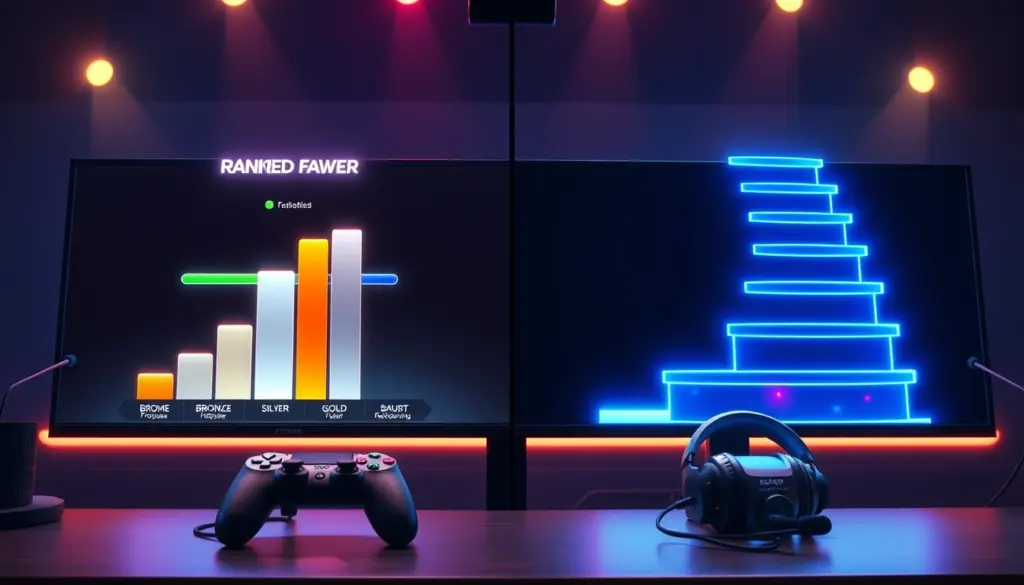
Fortnite has run two entirely different competitive ranking systems in its lifetime, and most players who quit during the Chapter 2 or Chapter 3 era have no idea the ladder they remember is gone. Arena, Epic Games’ original Hype Points system, ran from Fortnite’s early competitive years until Chapter 4 Season 2 in 2023, when it was replaced by Ranked, the Bronze-to-Unreal system players climb today. Nearly three years later, in Chapter 7, Ranked has grown into a 22-division structure that looks nothing like the 10-division Arena ladder it replaced. This comparison breaks down exactly what changed, what stayed the same, and what a player coming back to Fortnite in September 2026 needs to relearn before queuing into a ranked match.
Two Ranking Systems, One Battle Royale
Arena and Ranked solved the same problem in different ways: how to sort millions of Fortnite players into fair matches and identify the best of them for competitive play. Arena did it with a single running number called Hype, earned through eliminations and placement, that pushed players up through named leagues. Ranked replaced that number with a tiered system borrowed from games like League of Legends and Valorant, where players climb named ranks instead of watching a point total tick upward.
The switch mattered because Arena’s Hype totals reset every competitive season and varied wildly in scale depending on which season’s scoring rules were active. A player who hit 15,000 Hype in one season and 6,000 Hype in another had climbed to the same functional tier, Champion League, but the raw numbers gave newcomers almost no intuitive sense of where they stood. Ranked’s named tiers, by contrast, translate instantly: everyone understands what “Diamond” or “Platinum” means, even without knowing Fortnite’s internal point math.
That single design choice, trading a raw score for named tiers, is the throughline for this entire comparison. Every difference between the two systems, from matchmaking to rewards to how FNCS qualification worked, traces back to Epic choosing legibility over precision.
It is also worth being precise about timing, since players who left mid-Chapter 3 and are only now returning tend to conflate the two systems. Arena existed continuously from Fortnite’s earliest competitive seasons through Chapter 4 Season 2, when Ranked took over as the default ladder in 2023. That means Ranked has now been Fortnite’s primary competitive system for roughly three years, longer than many players realize, and it has already gone through at least one major internal expansion of its own, the 2026 update that split Elite and Champion into three divisions apiece. In other words, a player is not just comparing Arena to “current Ranked,” they are potentially comparing Arena to an early version of Ranked and a meaningfully different, more granular 2026 version at the same time.
Arena Explained: Hype Points, Bus Fare, and the Old Ladder
Arena organized players into three leagues, Open, Contender, and Champion, each split into multiple numbered divisions. Under Epic’s official Fortnite Champion Series Chapter 3 Season 1 rules, Open League ran Division I through IV across 0 to 1,999 Hype, Contender League covered Divisions I through III from 2,000 to 7,499 Hype, and Champion League started at Division I (7,500 to 9,999 Hype) and topped out at Division III, which began at 15,000 Hype with no upper ceiling, according to a rewards breakdown from GGRecon. Other seasons used slightly different brackets (some guides list Champion League starting near 6,000 Hype), which reflects how often Epic retuned the thresholds season to season rather than a single fixed scale.
Hype was earned through a scoring formula that combined placement points and elimination points, published each season in Epic’s “Competitive Update” posts. Higher divisions came with a mechanic called bus fare: a fixed amount of Hype deducted every time a player queued into a match, which scaled up the further they climbed. The effect was punishing by design. A Champion League player who queued into ten matches and placed poorly in most of them could watch their Hype total shrink even without ever losing to another player directly, simply from bus fare draining their score match after match.
Arena also had no separate ladder for Zero Build or Reload, because neither mode existed yet in its original form. It was built exclusively around traditional Battle Royale with building mechanics, split across Solo, Duo, and Squad queues, each tracking its own Hype total independently.
Ranked Explained: Bronze to Unreal in Chapter 7
Ranked launched in Chapter 4 Season 2 with eight named tiers: Bronze, Silver, Gold, Platinum, Diamond, Elite, Champion, and Unreal, according to reporting from the Mirror at launch, which counted 18 total ranks once Bronze through Diamond’s three divisions each were factored in. By Chapter 7 in 2026, Epic extended that same three-division structure to Elite and Champion as well, pushing the ladder to 22 total divisions once Unreal’s uncapped leaderboard tier is included, a structure documented by ranking guide Tesoro.gg using July 2026 season data.
Instead of a visible point total, Ranked shows players a progress bar within their current division. There is no equivalent to checking a raw Hype number; players only see how full their current tier’s bar is and whether they moved up, down, or stayed flat after a match. Progress is driven by placement and eliminations similarly to Arena’s old formula, but Epic never publishes the exact weighting, and community trackers have not reverse-engineered a definitive formula as of this season.
Ranked also fragmented across more modes than Arena ever did. Epic’s official Fortnite pages list separate Ranked ladders for standard Battle Royale, Zero Build, Reload, and Reload Zero Build, though Battle Royale and Zero Build progress has been unified into a single shared ladder since patch v40.00, according to competitive tracker Fortnite Tracker’s 2026 guide. Unreal remains the cap, described consistently across sources as a leaderboard-based rank rather than a fixed-threshold tier, meaning a player’s exact position among other Unreal-ranked players is what matters, not a point total.
Specs Comparison: Arena vs Ranked at a Glance
The table below lines up the two systems feature by feature, using the most recent documented version of each (Arena as it stood in its final competitive seasons, Ranked as it runs in Chapter 7 Season 4, September 2026).
| Feature | Arena (retired 2023) | Ranked (current, 2026) |
|---|---|---|
| Progression currency | Hype Points (raw number) | Rank tier + hidden progress score |
| Named leagues/tiers | 3 leagues (Open, Contender, Champion) | 8 named tiers (Bronze to Unreal) |
| Total divisions | 10 divisions across 3 leagues | 22 divisions across 8 tiers |
| Top tier structure | Champion League Div III, 15,000+ Hype, uncapped | Unreal, leaderboard-based, uncapped |
| Visible score | Exact Hype number shown | Progress bar only, no exact number |
| Entry cost per match | Bus fare deducted at higher divisions | No per-match entry cost |
| Modes covered | Solo, Duo, Squad Battle Royale only | Battle Royale, Zero Build, Reload, Reload Zero Build |
| BR/Zero Build ladders | Zero Build did not exist at Arena’s peak | Unified into one shared ladder since v40.00 |
| Input-based matchmaking | Not implemented | Introduced for console keyboard-and-mouse in Season 6 |
| FNCS qualification link | Champion League Hype thresholds gated entry | Ranked standing feeds into current qualifier structures |
| Season reset | Reset each competitive season | Reset each ranked season, partial soft reset |
| Status in 2026 | Retired, referenced only in legacy competitive test cups | Active, primary competitive ladder |
The most striking gap in that table is division count. Ranked more than doubles Arena’s granularity, splitting players into over twice as many rungs. That is not automatically better: more divisions means more frequent promotion and demotion, which can feel more rewarding in the short term but also more volatile, since it takes fewer bad games to knock a player down a division under Ranked than it did under Arena’s broader Hype bands.
Division and Tier Structure Compared
Arena’s Champion League divisions were wide by design. Division I to II alone spanned 7,500 to 14,999 Hype in the FNCS Chapter 3 Season 1 ruleset, a gap of nearly 7,500 points that could take dozens of matches to close. Ranked’s equivalent top tiers, Elite and Champion, are narrower bands with three divisions apiece, meaning a player near the top of the ladder moves through more discrete checkpoints on the way to Unreal than an Arena Champion League grinder ever did.
Both systems agree on one structural principle: the very top rank has no ceiling and functions as a leaderboard rather than a fixed point target. Arena’s Champion League Division III started at 15,000 Hype and simply kept counting upward, the same way Unreal today has no maximum score and instead ranks players against each other. Epic never abandoned that idea; it just renamed it and wrapped it in a friendlier tier label.
Where the two systems diverge most is at the entry level. Arena’s Open League started every player at zero Hype with four divisions to climb before reaching Contender League. Ranked starts every player in Bronze I with three divisions before Silver, a shallower on-ramp that gets new and returning players into competitive-feeling matches faster, at the cost of the top tiers being deeper and slower to climb than Arena’s comparatively flatter Champion League ever was.
Matchmaking and Skill Pairing: Then vs Now
Arena matched players strictly by league and division. A Contender League Division II player queued against other players in a similar Hype band, full stop. There was no separate accommodation for input device, platform, or anything else; the Hype number was the only variable that mattered for lobby composition.
Ranked inherited that rank-based matchmaking logic but layered new variables on top of it. Epic introduced input-based matchmaking during Season 6, which moved PS4 players using keyboard and mouse into the PC matchmaking pool instead of leaving them in the standard console queue, according to reporting from Fortnite News on the patch. PC players on controller stayed in the PC queue as before. It was a narrow, console-specific fix rather than a full separation of controller and mouse-and-keyboard players across the entire Ranked ladder, and no source in Epic’s current patch notes confirms a broader controller-versus-mouse split inside Ranked as of Chapter 7.
The practical difference for players: Arena’s matchmaking was simpler and more predictable, but it also meant a Champion League player who happened to be exceptional purely because of aim assist tuning or an under-the-radar strategy could sit in a lobby with far weaker opponents for a long stretch before their Hype caught up to their true skill. Ranked’s tighter, more granular divisions correct for that faster, since a hot streak or a slump shows up as a tier change within a handful of matches rather than a slow crawl along a single Hype scale.
Controller settings themselves have also become a bigger visible factor in Ranked-era discourse than they ever were during Arena’s run. Chapter 7 controller guides published throughout 2025 and 2026, including breakdowns from Vortex Gaming and BotLobbies, consistently recommend setting both Precision and Tracking Aim Assist Strength to 100% and running a Linear look input curve as the competitive baseline. Those exact settings existed in some form during Arena, but they were rarely discussed as prominently, since Arena’s Hype-based matchmaking gave players less immediate visibility into how a single settings change might shift their promotion or demotion odds within a tighter division band.
FNCS Qualification: Hype Thresholds vs Ranked Standards
Under Arena, FNCS eligibility was explicit and published in Epic’s official rules documents. Reaching Champion League, 7,500 Hype or higher in the Chapter 3 Season 1 rules, was the gate that separated players who could enter Fortnite Champion Series qualifiers from those who could not. The Hype threshold effectively was the tournament entry requirement, printed as a number anyone could check against their own account.
Ranked’s connection to competitive qualification is less numerically explicit. Epic’s competitive communications in 2026, including posts from the official Fortnite Competitive account referencing “Arenas Test Cups” scheduled in August 2026, show that the word Arena still surfaces in Epic’s competitive event naming even though the Hype-based ladder it once described no longer exists as the primary ranking system. That naming overlap is a useful reminder for returning players: seeing “Arena” mentioned in a 2026 patch note does not mean the old Hype system is back, it is Epic reusing a familiar label for test tournament formats layered on top of the Ranked ladder.
The net effect is that competitive-minded players in 2026 have to track Ranked division standing the way Arena veterans tracked a Hype number, but without a single public figure to point to. Reaching Champion or Unreal in Ranked is the modern equivalent of hitting Champion League in Arena, but the tournament-facing paperwork around it looks and reads differently than it did three years ago.
Population Benchmarks: Where Players Actually Land
Because Arena is retired, there is no way to benchmark its live population today, but three current trackers, Esports Tales, Tesoro.gg, and FNBoosting, all publish snapshots of where Chapter 7 Ranked players sit, and their numbers do not fully agree, which is itself a useful data point about how noisy self-reported ranked distribution tracking still is.
| Rank | Esports Tales (Jul 2026) | Tesoro.gg (Jul 2026, Ch.7 S3) | FNBoosting (2026 estimate) |
|---|---|---|---|
| Bronze | 38.1% | 38.1% (top 99.9%) | 25-30% |
| Silver | 28.8% | 28.8% (top 61.8%) | 25-30% |
| Gold | 8.4% | 8.4% (top 33%) | 20-25% |
| Diamond | ~8-11% | ~8-11% (top 8-11%) | Not separately listed |
| Champion | 2.6-4.1% | 2.6-4.1% (top 2.6-4.1%) | Not separately listed |
| Unreal | 1.8% | 1.8% | Under 0.5% |
| Sample size | Not disclosed | 4M+ players, all regions/platforms | Not disclosed |
Esports Tales and Tesoro.gg appear to draw from closely related or shared tracker data, since their Bronze through Unreal figures match almost exactly. FNBoosting’s independent estimate paints a flatter distribution, with a much larger Gold population and no separated Diamond or Champion figures, which suggests different trackers bucket mid-ladder players differently or sample from different regional pools. For a player trying to gauge their own standing, the safest read is that Bronze and Silver together still hold roughly two-thirds of the active Ranked population across every source, and Unreal consistently sits under 2% no matter which tracker is used.
It helps to separate two different numbers trackers publish: share of players (what percentage of the whole population sits in a given rank) and percentile threshold (what percentage of players you are ranked above once you enter a given division). Esports Tales’ July 2026 data reports both. On the percentile measure, Diamond I starts at the top 11% of players, Diamond II at the top 9.1%, and Diamond III at the top 8%. Champion is narrower still: Champion I marks the top 4.1%, Champion II the top 3.2%, and Champion III the top 2.6%, just above Unreal’s top 1.8%. Arena never published a directly comparable percentile breakdown for its divisions, since Hype totals were reported as raw scores rather than population percentiles, which makes today’s Ranked data genuinely more useful for a player who wants to know exactly how rare their rank actually is.
That distinction matters for anyone setting a climbing goal. A player aiming for Diamond III in 2026 is chasing a spot in the top 8% of the entire tracked population, a bar that did not exist in a directly comparable form under Arena’s three-league structure, where Contender League alone could span a much wider swath of the player base depending on the season’s Hype scaling.
Cost to Compete: Battle Pass, Crew, and Gear Pricing
Neither Arena nor Ranked ever charged players directly to queue into competitive matches, but climbing either ladder seriously has always come with surrounding costs, from battle passes to the hardware players use to compete. Those figures have shifted since Arena’s era, and it is worth pricing out what a competitively focused player spends in 2026.
| Item | Price (September 2026) | Notes |
|---|---|---|
| Standard Battle Pass | ~950 V-Bucks (~$8) | Per season, per Ponly’s 2026 pricing breakdown |
| Fortnite Crew subscription | $11.99/month | Includes Battle Pass, OG Pass, LEGO Pass, Music Pass, per CoinGate |
| Xbox Elite Wireless Controller Series 2 | $199 MSRP, ~$144.99 street | Common competitive controller, per TechRadar’s September 2026 deal roundup |
| Xbox Elite Wireless Controller Series 2 Core | $111.74-$149.99 | Budget version of the same controller line |
| Mouse and keyboard setup | No fixed competitive price point | Most PC Ranked players already own a mouse and keyboard, unlike a dedicated controller purchase |
Arena’s era carried the same Battle Pass and cosmetic costs, since those systems are tied to Fortnite’s overall economy rather than to the ranking system itself. What has changed is Fortnite Crew, which now bundles four separate passes (Battle Pass, OG Pass, LEGO Pass, and Music Pass) into one $11.99 monthly charge, a bundling strategy that did not exist when Arena was Fortnite’s primary competitive ladder. For a player budgeting toward serious Ranked or FNCS play, Crew has effectively become the default subscription rather than an optional extra.
Hardware costs are the other half of the equation, and they matter more under Ranked than they did under Arena simply because Ranked’s tighter divisions punish inconsistent input response more quickly. A player still using a worn analog stick or an unreliable mouse sensor will see that inconsistency reflected in faster demotions across Ranked’s 22 divisions than they would have under Arena’s wider Hype bands, where a single bad stretch had more room to average out before it cost an entire division. That is not a reason to panic-buy new gear, but it is a reason competitive-focused Ranked players tend to budget for a controller refresh, like the Elite Series 2 or its Core variant, more deliberately than casual Arena players once did.
Real-World Scenarios: Five Player Journeys
To make the comparison concrete, here are five composite scenarios built from how each system’s mechanics actually behaved, based on the documented rules above rather than any single named player’s account.
- The Contender League grinder (Arena era): A Duo player sitting at 4,500 Hype in Contender League Division II has to survive bus fare deductions on every queue while chasing the 5,000-point threshold into Division III, meaning a string of poor placements can actually push their Hype total backward even without a head-to-head loss.
- The Bronze-to-Silver climber (Ranked era): A returning player who last touched Fortnite during Arena starts fresh in Bronze I under Ranked, with no bus fare to worry about, and only needs a handful of solid placements to clear Bronze’s three divisions and reach Silver.
- The console keyboard-and-mouse player: Under Ranked’s Season 6 input-matchmaking change, a PS4 player who switches to keyboard and mouse gets moved into the PC matchmaking pool instead of facing console controller players, a distinction that did not exist anywhere in Arena’s matchmaking logic.
- The FNCS hopeful, then and now: In the Arena era, a player checked their Hype total against a published 7,500-point Champion League threshold to know if they qualified for FNCS. In 2026, that same player instead has to track Ranked division standing and current competitive announcements, since no single public point figure serves the same gatekeeping role.
- The Zero Build specialist: Arena had no separate ladder for Zero Build because the mode did not exist during Arena’s competitive run. A Zero Build-focused player in 2026 climbs the same shared Ranked ladder as Battle Royale players, following the unification made in patch v40.00, rather than grinding an isolated Zero Build-only Hype total.
- The percentile chaser: A player fixated on reaching the top 8% of the player base under today’s system can check their exact standing against Diamond III’s published percentile threshold. An Arena Contender League player chasing a similarly rare position had no equivalent percentile figure to check, only a raw Hype number with no stated context for how many other players shared that score.
Pros and Cons of Each System
Arena’s biggest strength was transparency. A visible Hype number left no ambiguity about where a player stood or how far they had to climb to the next division, and the same number doubled as an explicit, checkable FNCS qualification threshold. Its biggest weakness was the bus fare mechanic, which punished players for simply queueing into matches at higher divisions, creating a system where a run of bad luck could erase hours of progress.
- Arena pros: Exact score visibility, simple single-number progression, explicit published FNCS thresholds, well-documented seasonal scoring updates from Epic.
- Arena cons: Bus fare penalized queueing at higher divisions, no Zero Build or Reload ladder ever existed, thresholds shifted inconsistently between seasons, no input-based matchmaking accommodation.
- Ranked pros: Familiar named-tier structure borrowed from other competitive games, no per-match entry penalty, covers Battle Royale, Zero Build, and Reload, includes input-based matchmaking protections introduced in Season 6.
- Ranked cons: No visible exact score, making it harder to predict exactly how close a promotion or demotion is, more divisions overall means more frequent rank volatility, and FNCS qualification is less transparently tied to a single public number than it was under Arena.
Neither system is a clean upgrade over the other. Ranked solved Arena’s biggest complaint, the punishing bus fare mechanic, but introduced a new one: players can no longer point to an exact number and know precisely how many good games stand between them and their next tier. Community frustration with hidden progress bars is a common thread across other rank-based competitive games too, which suggests Epic made a deliberate trade-off rather than an oversight: it accepted less transparency in exchange for a system that feels more approachable to the millions of casual players who never touched Arena in the first place.
Migration Guide: What Returning Arena Veterans Need to Know
Players coming back to Fortnite after years away should expect a genuinely different mental model, not just a fresh coat of paint on the old Hype ladder. Someone who last logged in during Chapter 3 will find the client itself unrecognizable in places, and the ranking system underneath it has been rebuilt from the ground up rather than simply renamed. The steps below cover the practical adjustments, roughly in the order a returning player will actually run into them.
- Forget the Hype number entirely. There is no equivalent stat to check. Progress now shows as a fill bar within your current division, with no exact point total displayed anywhere in the client.
- Expect no bus fare penalty. Queueing into a match at a high Ranked tier does not cost anything up front the way climbing Champion League in Arena did. Losses and poor placements affect your rank, but simply playing a match does not.
- Pick your mode ladder deliberately. Battle Royale and Zero Build now share one Ranked progression since patch v40.00, but Reload and Reload Zero Build track separately. Decide which ladder actually matters to your goals before grinding.
- Re-learn the tier names. Elite and Champion now each carry three divisions as of the 2026 ladder expansion, unlike the launch-era 18-rank version that treated them as single undivided tiers.
- Check your input device settings. If you play on console with keyboard and mouse, understand that Season 6’s input-based matchmaking change routes you into the PC player pool rather than the standard console queue.
- Don’t expect a public FNCS Hype threshold. Track Epic’s competitive announcements and your Ranked division directly, since there is no single published point number that guarantees qualification the way 7,500 Hype once did.
Use-Case Recommendations: Which System Mindset Fits You
Since Arena no longer exists as a playable mode, this section is really about which mental habits from either era serve different types of players best inside today’s Ranked system.
- Casual returning players: Lean into Ranked’s shallow Bronze on-ramp. Three quick divisions before Silver make it easy to feel progress fast without the deep grind Arena’s Open League four-division climb required.
- Competitive FNCS hopefuls: Treat your Ranked division the way Arena veterans treated their Hype total, as a number to check obsessively, but pair it with active monitoring of Epic’s competitive announcement channels since there is no fixed public threshold anymore.
- Zero Build mains: Take advantage of the shared Battle Royale and Zero Build ladder introduced in v40.00 rather than treating the two modes as separate grinds, since progress in one now counts toward the other.
- Console players using keyboard and mouse: Understand the Season 6 input-matchmaking rule before queueing, so you are not surprised to see PC-caliber opponents in your lobbies.
- Players chasing Unreal specifically: Recognize that Unreal, like old Champion League Division III, is a leaderboard position rather than a fixed score. Climbing further within Unreal still matters even after you technically reach the rank.
- Budget-conscious players: A Fortnite Crew subscription at $11.99 a month now covers four passes at once, which is a better value proposition than buying the standalone Battle Pass every season the way most Arena-era players did.
The Verdict: Which Ladder Actually Served Players Better
Judged purely on transparency, Arena wins. A published Hype number and an explicit 7,500-point FNCS threshold gave players a level of certainty that Ranked’s hidden progress bar simply does not offer in 2026. Judged on accessibility and fairness across match types, Ranked wins clearly: 22 divisions across Battle Royale, Zero Build, and Reload cover far more of how people actually play Fortnite today than Arena’s Battle Royale-only, bus-fare-punished ladder ever did.
The population data reinforces that Ranked is functioning as intended at scale: across three separate trackers, roughly two-thirds of players sit in Bronze and Silver, with Unreal consistently below 2%, a distribution shape that looks healthy for a mass-market ranking system rather than one skewed toward extremes. Arena never had comparable public benchmarking data at this volume, in part because Hype’s variable seasonal scaling made cross-season comparison difficult even for Epic’s own competitive team.
For most players in 2026, Ranked is objectively the better system to spend time in, not because Hype Points were poorly designed for their era, but because Ranked covers more modes, removes the punishing bus fare mechanic, and gives newcomers a faster, friendlier on-ramp. Arena’s legacy is that it proved Fortnite players wanted a real competitive ladder in the first place. Ranked is what Epic built once it had years of data to fix Arena’s rough edges.
The one place Arena still beats Ranked on pure data is precision at the very top of competitive play. A 7,500 Hype threshold left zero room for interpretation about FNCS eligibility. Ranked’s reliance on division standing plus ongoing competitive announcements, including Epic’s own “Arenas Test Cups” naming choice in August 2026, adds a layer of tracking that Arena veterans never had to deal with. Epic solved the mass-market problem and, in doing so, made the competitive gatekeeping slightly less self-explanatory than it used to be. Whether that trade was worth it depends entirely on which side of the ladder a given player spends most of their time on.
Frequently Asked Questions
Is Fortnite Arena mode still playable in 2026?
No. Arena was retired when Ranked launched in Chapter 4 Season 2 in 2023. The word “Arena” still appears in some 2026 competitive event names, such as the “Arenas Test Cups” scheduled in August 2026, but that refers to test tournament formats layered on the current Ranked system, not the original Hype Points ladder.
How many ranks does Fortnite Ranked have in 2026?
Ranked has 8 named tiers, Bronze, Silver, Gold, Platinum, Diamond, Elite, Champion, and Unreal, split into 22 total divisions once Elite and Champion’s three-division expansion is counted alongside Bronze through Diamond, per Tesoro.gg’s July 2026 breakdown.
What was bus fare in Fortnite Arena?
Bus fare was a fixed Hype Point deduction charged every time a player queued into a match at higher Arena divisions, meant to make sustained climbing harder the higher a player’s division rose. Ranked has no equivalent mechanic.
Do Battle Royale and Zero Build share the same Ranked progress?
Yes, as of patch v40.00, Battle Royale and Zero Build Ranked progress was unified into a single shared ladder, according to Fortnite Tracker’s 2026 competitive guide. Reload and Reload Zero Build remain separate ladders.
What percentage of players reach Unreal rank?
Roughly 1.8% of the tracked Ranked population sat at Unreal as of July 2026 data from both Esports Tales and Tesoro.gg, drawn from a sample of more than 4 million players across all regions and platforms.
How does input-based matchmaking work in Fortnite Ranked?
Since Season 6, PS4 players using a keyboard and mouse are placed into the PC matchmaking pool instead of the standard console queue, based on which input device they use when they start matchmaking. PC controller players remain in the PC queue as before.
Is Fortnite Crew worth it for competitive Ranked players?
At $11.99 a month, Fortnite Crew bundles the Battle Pass, OG Pass, LEGO Pass, and Music Pass together, which is generally better value than buying a standalone Battle Pass for roughly $8 every season if a player intends to stay subscribed for multiple months in a row.
Did FNCS qualification work the same way under Arena and Ranked?
No. Arena tied FNCS eligibility to an explicit published Hype threshold, 7,500 points for Champion League in the Chapter 3 Season 1 rules. Ranked’s connection to competitive qualification is communicated through Epic’s ongoing competitive announcements rather than a single fixed public point number.
What percentile do you need to reach for Diamond or Champion in Ranked?
Per Esports Tales’ July 2026 data, Diamond III starts at the top 8% of tracked players, while Champion III starts at the top 2.6%, just above Unreal’s top 1.8%. These are percentile thresholds, not shares of the total player base, so they describe how many players you outrank rather than what fraction of the population sits in that exact tier.
Can I still see my old Fortnite Arena Hype total anywhere?
No. Since Ranked replaced Arena as the primary competitive ladder in Chapter 4 Season 2, Epic has not maintained a public record of individual players’ historical Hype totals inside the current client. Legacy Arena division and Hype threshold data survives only in archived rules documents and third-party guides like GGRecon and the Fortnite Wiki.