
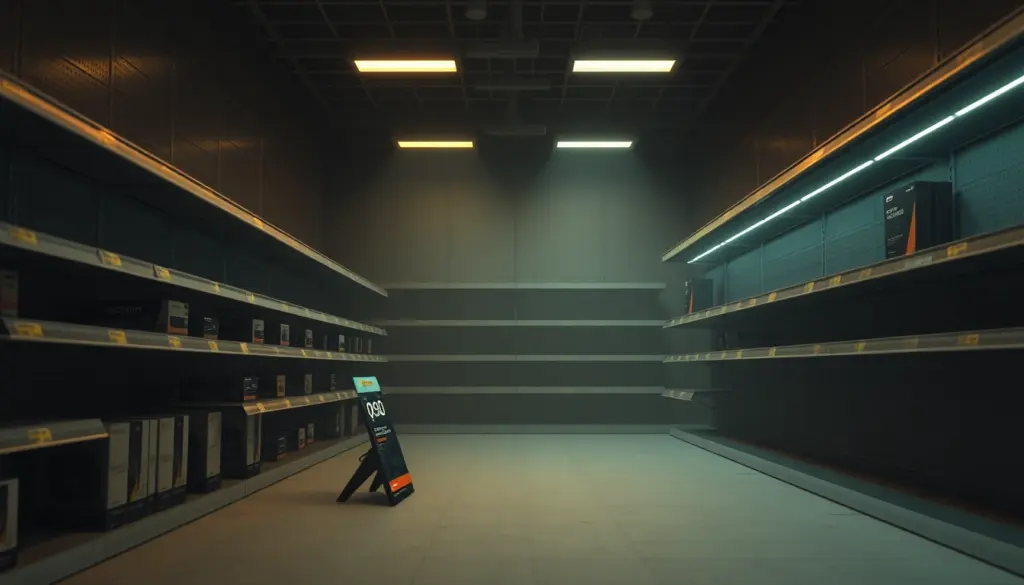
The GeForce RTX 5090 has effectively disappeared from first-party US retail shelves, and the cards that remain are commanding prices that would have sounded absurd a year ago. Tom’s Hardware reported on September 14, 2026, that first-party inventory of Nvidia’s flagship gaming GPU had “almost completely evaporated” from online retailers, leaving shoppers to hunt through third-party marketplace listings priced between $6,395 and $9,500, as much as 4.75 times the card’s $1,999 launch MSRP. PC Gamer corroborated the shortage on September 16, describing stock as disappearing from most major US retailers. The disappearance lines up with a separate Tom’s Hardware report the same week detailing how Nvidia is steering similar silicon toward the professional RTX Pro 5500, a workstation and AI-focused card said to pack roughly 2.6 times the RTX 5090’s VRAM. Together, the two stories describe a GPU maker quietly deprioritizing gaming in favor of markets where the same wafer allocation earns far more per card.
RTX 5090 Stock Disappears From US Online Retail
Tom’s Hardware’s September 14 check of Amazon and Newegg found essentially no first-party RTX 5090 listings left in stock. What remained came almost entirely from third-party marketplace sellers, and their prices reflected the scarcity. The cheapest listing the outlet found was $6,395 on Amazon’s marketplace. Newegg search results climbed as high as $8,699, and other marketplace offers reached the full $9,500. A single Micro Center location still had a card on shelves at roughly $4,299, showing that pockets of cheaper physical inventory persisted even as online listings spiraled upward.
This isn’t the first sign of trouble for RTX 5090 buyers this year. Shattered.io reported earlier in an RTX 5090 price surge tied to AI demand that prices had already doubled toward the $5,000 mark months before this latest retail vanishing act. What changed by mid-September wasn’t just price, it was availability. A card you could previously find in stock at an inflated price is now, per Tom’s Hardware and PC Gamer’s independent checks, largely not there to buy at any price through normal retail channels.
How Prices Climbed From $1,999 to $9,500
The RTX 5090 launched with a $1,999 MSRP. The $9,500 figure Tom’s Hardware documented represents roughly a 375% markup over that price, and even the cheaper $6,395 marketplace listing runs more than triple MSRP. For a card built on an architecture that’s been shipping for well over a year, that kind of price action doesn’t track with normal demand curves for aging hardware. Flagship GPUs are supposed to get cheaper as newer generations approach, not more expensive.
The gap between marketplace listings and remaining physical retail stock, like the $4,299 Micro Center unit, points to a market where online sellers are pricing to what desperate buyers will pay rather than to any restocking cost. That’s consistent with prior GPU droughts, though the driver this time is different. It’s institutional AI and workstation demand competing directly with gamers for the same limited silicon, not resellers exploiting a one-time launch shortage.
RTX 5090 US Retail Pricing Snapshot
| Price point | Amount | vs. $1,999 MSRP | Source / date |
|---|---|---|---|
| Official launch MSRP | $1,999 | Baseline | Nvidia |
| Micro Center in-store unit | ~$4,299 | +115% | Tom’s Hardware, Sept. 14, 2026 |
| Amazon marketplace (lowest found) | $6,395 | +220% | Tom’s Hardware, Sept. 14, 2026 |
| Newegg marketplace (high end) | $8,699 | +335% | Tom’s Hardware, Sept. 14, 2026 |
| Highest reported marketplace listing | $9,500 | +375% | Tom’s Hardware, Sept. 14, 2026 |
Nvidia’s RTX Pro 5500: Where the Silicon Is Going
A companion Tom’s Hardware report published the same week framed the shortage in blunt terms: Nvidia is treating gaming as a lower priority than AI-margin products built on related silicon. The outlet’s own headline put it directly, describing gaming taking “a backseat” as Nvidia overhauls the RTX 5090’s underlying hardware for “maximum AI margins,” with the professional RTX Pro 5500 delivering roughly 2.6 times the VRAM of the RTX 5090 at otherwise matching specs. The RTX 5090 itself carries 32GB of GDDR7 memory, though the exact confirmed VRAM capacity of the RTX Pro 5500 wasn’t disclosed in the reporting, so that figure shouldn’t be treated as a locked specification yet.
Nvidia’s existing RTX Pro 5000 48GB card offers a useful reference point. Tom’s Hardware reported it uses the same underlying GPU as the RTX 5090 but with roughly a third fewer enabled shader units and lower memory bandwidth, and it was selling for approximately $7,000 to $9,000, a price the market apparently tolerates because professional buyers value the memory capacity and certification more than raw gaming throughput. That pricing logic helps explain why a chipmaker with finite wafer allocation would rather route dies toward the Pro line than toward a $1,999 gaming flagship.
What’s Confirmed vs. What’s Still Reported
It’s worth being precise about what’s actually verified here. The available reporting does not include a direct statement from Nvidia confirming a deliberate reallocation of RTX 5090 dies to the RTX Pro 5500, nor statements from add-in board partners like ASUS, MSI, Gigabyte, or PNY explaining the shortage. The strongest sourced evidence remains Tom’s Hardware’s own retail-availability checks combined with its framing of the RTX Pro line as the more profitable outlet for the same class of silicon. Readers should treat the “why” as informed industry analysis rather than an on-record confirmation from Nvidia itself.
Why AI and Workstation Cards Are Winning the Silicon Race
The core economics are straightforward. A professional card selling for $7,000 to $9,000 generates dramatically more revenue per wafer than a gaming flagship capped, at least on paper, at $1,999. When memory supply is the binding constraint, and multiple reports from September 2026 say it is, a chipmaker has every incentive to steer that memory toward the highest-margin product line it can build. Nvidia doesn’t need to announce a formal reallocation policy for this pattern to emerge; it just needs to prioritize shipments and allocate GDDR7 and other constrained components to whichever SKU sells fastest at whichever price the market will bear.
There’s also a demand-side factor pulling RTX 5090 units specifically out of gaming’s reach. At least one report indicates organizations, including buyers in China, have been purchasing standard international RTX 5090 cards in bulk to build AI workstations, in some cases as a way around export restrictions tied to the region-specific RTX 5090D variant. That claim comes from a secondary outlet rather than Nvidia or a named AIB partner, so it should be read cautiously, but it’s consistent with the broader pattern: a consumer gaming card increasingly being bought for enterprise AI compute rather than gaming rigs.
The GDDR7 and HBM Memory Squeeze Behind the Shortage
None of this happens without a memory crisis sitting underneath it. Speaking at Splunk’s .conf26 Global Broadcast in mid-September, Intel CEO Lip-Bu Tan said memory prices had already risen five- to sevenfold, and that available supply was covering only about 50% of demand, remarks reported by TrendForce on September 16. Intel’s exposure is on the CPU and system side, but the underlying constraint, memory fabrication capacity, hits GPU makers just as hard. Shattered.io covered the CPU-side fallout of that same shortage in a report on memory chip stockpiles falling below ten days of supply, and the GPU market is now visibly running into the same wall.
TrendForce’s broader September research adds more detail: DRAM supply is expected to remain tight through 2027, and uncertainty around production and validation of next-generation HBM4E memory is already complicating planned AI accelerator configurations. That’s not a China-specific or Nvidia-specific problem, it’s a global bottleneck in advanced memory fabrication that’s rippling through every product category that depends on GDDR7 or HBM, from gaming GPUs to data-center accelerators.
The Chinese AI-chip market shows the same pressure from a different angle. Reuters reported on September 10 that Huawei had raised the indicated price of its Ascend 950DT accelerator to more than 250,000 yuan (about $37,255), 20% to 50% above quotes issued roughly two months earlier. Huawei’s Ascend 950PR climbed from about 60,000 yuan at the start of 2026 to more than 80,000 yuan, and its older Ascend 910C board rose from around 90,000 yuan to above 110,000 yuan. Beijing-based Cambricon reportedly repriced its next-generation chip, provisionally called the Cambricon 690, by 20% to 30% over prior quotes, and smaller suppliers including MetaX and Iluvatar CoreX raised prices similarly. Shattered.io detailed that pricing wave in full in its report on China’s AI chip price hikes tied to the HBM shortage. It’s the same memory scarcity showing up on both sides of the Pacific, just expressed through different product lines.
RTX 5090 vs. Nvidia’s Professional Cards
| Spec / detail | GeForce RTX 5090 | RTX Pro 5000 48GB | RTX Pro 5500 (reported) |
|---|---|---|---|
| Target market | Gaming / consumer flagship | Professional workstation | AI / workstation, per Tom’s Hardware |
| VRAM | 32GB GDDR7 | 48GB | ~2.6x RTX 5090’s VRAM (exact capacity unconfirmed) |
| Shader units vs. RTX 5090 | Baseline | ~1/3 fewer enabled | Not disclosed |
| Reported market price, Sept. 2026 | $6,395–$9,500 (scarcity-driven) | $7,000–$9,000 | Not yet priced publicly |
| Launch MSRP | $1,999 | Not covered in retrieved reporting | Not yet disclosed |
Historical Context: GPU Shortages Aren’t New, But This One’s Different
PC builders have lived through GPU droughts before. The 2021 cryptocurrency mining boom pushed Nvidia’s RTX 30-series cards well above MSRP for well over a year, and pandemic-era logistics constraints in 2020 and 2021 compounded the problem before supply eventually normalized. Both of those shortages eased once the external driver faded: mining profitability collapsed, and supply chains recovered after the pandemic.
This shortage looks structurally different. It isn’t driven by a speculative bubble that can pop overnight, it’s driven by a fundamental memory-fabrication bottleneck that TrendForce expects to persist through 2027, plus a durable, revenue-driven incentive for Nvidia to prioritize AI and workstation SKUs over gaming cards. Crypto miners eventually walked away from GPUs when the math stopped working. AI buyers, data centers, and enterprises building out inference and training capacity have no comparable off-ramp in sight, and neither does the underlying memory shortage constraining supply for everyone.
Market Impact: What This Means for the Broader GPU Landscape
Nvidia’s late-2026 GPU strategy increasingly looks like it’s being written for data centers first and gaming desks second. The company confirmed in early September that Lenovo and Acer will launch the first Windows PCs built around its RTX Spark chip in October 2026, part of a push detailed in shattered.io’s report on the RTX Spark PC rollout across eight OEM partners, another sign that Nvidia’s silicon roadmap is being shaped around AI-capable systems rather than pure gaming performance. Meanwhile, Nvidia’s newsroom said its Vera Rubin NVL72 platform delivered a debut result in the MLPerf Inference v6.1 benchmark suite on September 22, underscoring how much of the company’s engineering and manufacturing attention is now pointed at rack-scale AI infrastructure rather than desktop graphics cards.
For enthusiasts tracking the next generation, the timing compounds the frustration. Shattered.io reported separately that the RTX 60-series has already slipped to a 2028 launch window as RTX 5090 prices topped $5,000 earlier this year, and that delay now looks even more consequential given how much worse RTX 5090 availability has gotten since. Gamers waiting for the next flagship don’t have a near-term successor to jump to, and the card they’d normally fall back on has effectively left the building.
At least one outlet has framed the shortage as an opening for AMD to gain visibility in the high-end gaming segment while Nvidia’s flagship is scarce, though that framing comes from a single secondary source and hasn’t been independently corroborated with sales-share data in the reporting reviewed here. What is corroborated, across Tom’s Hardware, PC Gamer, and TrendForce, is that the RTX 5090’s disappearance is real, dated, and tied to structural memory constraints rather than a temporary blip.
Competitive Comparison: Nvidia, AMD, and Intel in the Memory-Constrained Era
All three major chipmakers are contending with the same underlying memory scarcity, just from different competitive positions. Nvidia has the flexibility to redirect scarce dies toward its highest-margin professional and AI lines because it dominates both the gaming and AI-accelerator markets simultaneously, a position AMD and Intel don’t share to the same degree. Intel’s CEO has been the most publicly blunt about the pain, telling the .conf26 audience that memory price increases of five to sevenfold are limiting the company’s ability to meet CPU demand, since Intel competes for the same constrained DRAM and packaging capacity without Nvidia’s AI-market pricing power to offset the cost.
AMD sits in a middle position: it lacks Nvidia’s dominant AI accelerator business but also isn’t as exposed as Intel to consumer CPU margins being squeezed by memory costs. If Nvidia keeps deprioritizing RTX 5090 gaming inventory in favor of Pro-line silicon, AMD’s high-end Radeon cards become a more plausible fallback for buyers who refuse to pay marketplace markups, assuming AMD isn’t fighting the same GDDR7 supply constraints, which the current reporting doesn’t rule out.
Impact on Gamers and PC Builders
For anyone trying to build or upgrade a high-end gaming PC in September 2026, the practical guidance is blunt: paying anywhere close to $1,999 MSRP for an RTX 5090 right now isn’t realistic through most online retail channels. Buyers are largely limited to waiting for restocks, checking regional brick-and-mortar inventory the way Tom’s Hardware found at Micro Center, or accepting third-party marketplace pricing that runs several thousand dollars over MSRP for scarcity, not performance.
There’s also a purchasing-risk dimension worth flagging. Tom’s Hardware noted that remaining listings increasingly come from third-party marketplace sellers rather than first-party retail inventory, which raises the usual concerns around warranty coverage, counterfeit risk, and price manipulation that tend to accompany any scarcity-driven secondary market. Builders determined to get a card this quarter should weigh those risks against simply stepping down to a lower Blackwell-generation SKU or waiting out the shortage.
What Comes Next: Five Predictions
- Elevated pricing persists through the 2026 holiday quarter. With TrendForce projecting tight DRAM supply through 2027 and HBM4E validation still unsettled, there’s no near-term catalyst that would push GDDR7 supply back to comfortable levels before year-end.
- More RTX 5090 silicon migrates toward Pro-class SKUs. As long as the RTX Pro 5000 and RTX Pro 5500 command $7,000-plus prices against a $1,999 gaming MSRP, expect Nvidia’s allocation decisions to keep favoring the higher-margin line, whether or not the company frames it that way publicly.
- Regional workarounds around export-restricted SKUs continue. Reports of bulk international RTX 5090 purchases for AI workstations suggest demand will keep finding paths around restrictions tied to region-specific variants like the RTX 5090D until enforcement tightens or pricing makes the workaround uneconomical.
- AMD’s high-end Radeon lineup gets a relative visibility boost. Even without confirmed sales-share shifts, a scarce and expensive RTX 5090 gives PC builders more reason to seriously evaluate AMD’s flagship cards, particularly if AMD’s own memory supply proves less constrained.
- The RTX 60-series delay compounds the pain into 2027 and beyond. With the next Nvidia gaming flagship already pushed to a 2028 window, gamers priced out of the RTX 5090 have no near-term successor to wait for, which likely keeps secondary-market demand for existing RTX 5090 units elevated well into next year.
Frequently Asked Questions
Why did the RTX 5090 disappear from US retail?
Tom’s Hardware’s September 14, 2026 check found first-party inventory had almost completely evaporated from major online retailers, with only third-party marketplace listings remaining. The shortage lines up with reports that Nvidia is prioritizing memory allocation toward higher-margin professional and AI-focused cards over gaming SKUs.
How much does an RTX 5090 cost right now?
Third-party marketplace listings documented by Tom’s Hardware on September 14 ranged from $6,395 to $9,500, against a $1,999 launch MSRP. Some regional physical retail, like a Micro Center location the outlet checked, still had stock closer to $4,299.
Is Nvidia still manufacturing the RTX 5090?
Nvidia hasn’t announced a discontinuation, and the available reporting doesn’t confirm the company has stopped production. The evidence points instead to allocation: the same class of silicon is reportedly being directed toward professional RTX Pro cards, which reduces how many units reach gaming retail channels.
What is the RTX Pro 5500 and how does it compare to the RTX 5090?
The RTX Pro 5500 is a professional-tier card that Tom’s Hardware reported delivers roughly 2.6 times the VRAM of the RTX 5090 at otherwise matching specs, targeting AI and workstation buyers rather than gamers. Its exact VRAM capacity, full specs, and pricing have not been officially confirmed in the reporting available.
Will RTX 5090 prices come back down?
Not in the immediate term, based on current reporting. TrendForce expects DRAM supply to stay tight through 2027, and Nvidia’s incentive to prioritize higher-margin Pro-line cards doesn’t appear likely to change while that pricing gap persists.
Is this shortage caused by GDDR7 or HBM memory?
Reporting attributes the RTX 5090’s specific shortage primarily to GDDR7 constraints, while separately, AI accelerators across the industry are competing for limited HBM capacity. Both memory types are affected by the same broader fabrication bottleneck.
Should I buy an RTX 5090 right now?
At current marketplace prices of $6,395 and up, most gaming use cases don’t justify the premium, since the premium reflects scarcity rather than added performance. Builders who don’t need a card immediately may be better served waiting for supply to stabilize or checking regional in-store inventory.
When is the RTX 60-series launching to replace the RTX 5090?
Shattered.io reported earlier in 2026 that the RTX 60-series had already slipped to a 2028 launch window, meaning gamers priced out of the RTX 5090 don’t have a near-term successor to fall back on.