Meta used its Connect 2026 keynote on September 23 to introduce Meta VR Glasses, a headset that trades the bulk of the Quest line for a pair of glasses that reportedly weighs about 100 grams. The company paired the reveal with a price of $1,299.99 and a spring 2027 ship date, positioning the device as a direct answer to Apple’s Vision Pro and Ray-Ban Display smart glasses in one move.
The number that is driving search traffic and social chatter this week is the weight comparison: at roughly 100 grams, Meta VR Glasses come in at less than half the mass of Apple’s iPhone 18 Pro, which Apple’s own spec sheet lists at 211 grams. That comparison, first surfaced by Notebookcheck, has become the shorthand headline for the launch even though Meta itself did not frame the announcement that way on stage.
What Meta Actually Announced at Connect 2026
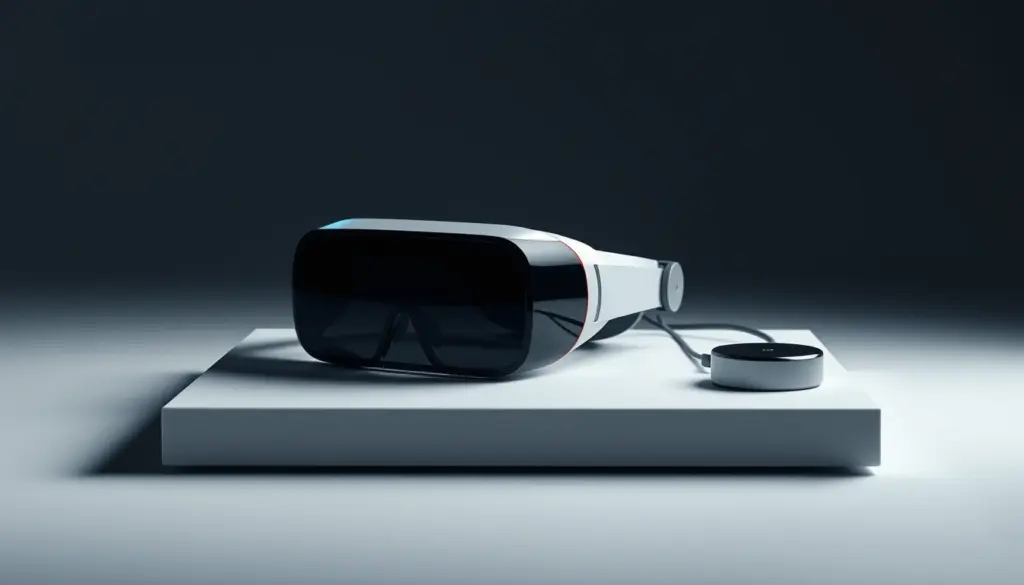
Meta VR Glasses mark the company’s third major hardware push in three years, following the Quest 3 headset line and the Ray-Ban Display smart glasses that shipped in 2025. Unlike those two products, this device splits its hardware across two physical pieces: the glasses themselves, which house the optics and displays, and a separate tethered “puck” that carries the processor, battery, and storage. Meta’s own announcement describes the combined system as “a cinema, courtside seat, workspace, and console, all in a pair of glasses.”
That two-piece design is the real engineering story behind the low weight figure. By moving the battery, Qualcomm Snapdragon Reality Elite chip (built on the XR2 Gen 3 platform), and storage into a puck that clips to a belt or sits in a pocket, Meta was able to keep the glasses themselves down to roughly 100 grams. The puck itself weighs approximately 300 grams, according to reporting from UploadVR, which means the full system is closer to 400 grams once both components are counted. Meta has not published a combined weight figure for the glasses-plus-puck system, so treat the 100-gram number as describing the headset piece a wearer’s face actually carries, not the entire product.
This tethered architecture is not new to the XR category. It echoes older PC VR headsets that relied on a wired breakout box, and it mirrors how some AR glasses from smaller startups have handled thermal and battery constraints. What is new is Meta applying that pattern to a consumer device carrying a $1,299.99 price tag and marketing built around outdoor and living-room use, rather than a tethered PC rig confined to a desk.
The 100-Gram Number, and Why It Is Spreading So Fast
Weight has become the single most-repeated spec in coverage of this launch, and for good reason. Every prior standalone VR headset from Meta, including the Quest 3 and Quest Pro, weighed well over 500 grams, and users routinely cited neck strain and face pressure as reasons for abandoning long sessions. A headset that reportedly weighs a fifth of that, even with an external puck attached, changes the physical experience of wearing the device for two hours during a movie or a work session.
The iPhone 18 Pro comparison specifically took off because it gives readers something tangible to hold in their mental picture. Most people have handled a modern flagship phone and have a rough sense of what 211 grams feels like. Telling them a VR headset now weighs less than half that number does more communicative work than a raw gram count on its own. It is worth being precise here: the 211-gram figure comes directly from Apple’s published technical specifications for the iPhone 18 Pro, and the 100-gram figure for Meta VR Glasses comes from Meta’s own announcement. The “half the weight” framing is arithmetic that follows from those two published numbers, not a phrase Meta used in its own materials.
Readers searching for terms like “meta vr glasses weight,” “meta vr glasses price,” and “meta vr glasses vs vision pro” are converging on this launch from three angles at once: curiosity about the hardware, price shock relative to Quest devices, and direct comparison shopping against Apple and other mixed reality players. That’s a wider funnel than a typical incremental headset refresh usually draws.
Full Specifications: Display, Chip, Memory, and Storage
Beyond weight, the spec sheet reported around the announcement points to a genuine display upgrade over the Quest line. Meta VR Glasses use what is being called a 5K Infinite Display built on micro-OLED panels, with a reported resolution of 2,412 by 2,288 pixels per eye and a pixel density of 37 pixels per degree. That density figure matters more than raw resolution for judging real-world sharpness, since it accounts for how tightly packed the pixels appear across the wearer’s actual field of view.
| Spec | Meta VR Glasses |
|---|---|
| Announcement date | September 23, 2026, at Meta Connect 2026 |
| Glasses weight | Approximately 100 grams |
| Puck weight | Approximately 300 grams |
| Price | $1,299.99 |
| Availability | Spring 2027 |
| Display | 5K Infinite Display, micro-OLED, 2,412 x 2,288 per eye |
| Pixel density | 37 pixels per degree |
| Processor | Qualcomm Snapdragon Reality Elite (XR2 Gen 3 platform) |
| Memory | 12GB RAM |
| Storage | 128GB internal, expandable to 1TB via microSD |
| Sizes offered | Standard and Large |
On the compute side, Meta VR Glasses run on a Qualcomm Snapdragon Reality Elite processor built on the XR2 Gen 3 platform, paired with 12GB of RAM. That memory figure lands in the same territory as the current Quest 3, but the Reality Elite branding suggests Qualcomm has tuned this silicon specifically for lighter, glasses-form headsets rather than repurposing a general XR2 chip. Storage starts at 128GB and can reportedly expand to 1TB through a microSD card, which is a notable concession to users who expect to carry local video libraries and downloaded games on a device meant for casual, mobile use rather than a desk-bound rig.
Meta is also offering the glasses in Standard and Large sizes, a fit consideration that has dogged smart glasses products across the industry since face shape and head width vary enough to make a single universal size impractical for a mass-market device.
Pricing and the Spring 2027 Wait
At $1,299.99, Meta VR Glasses sit well above every current Quest headset and roughly in line with premium smart-glasses-plus-compute bundles rather than mass-market VR gear. That price point puts Meta in a different competitive lane than its own $300 to $500 Quest lineup, and it signals the company is chasing the same higher-margin, early-adopter buyer that Apple targeted with the original Vision Pro at $3,499.
The spring 2027 ship date is the other detail worth sitting with. Announcing hardware roughly six to eight months ahead of shipment is a familiar Meta pattern, used previously with Quest hardware reveals timed to build pre-order interest well before manufacturing ramps. It also gives Meta a long runway to iterate on software, refine the puck’s thermal management, and line up developer support before the device reaches actual customers. Whether that gap helps or hurts momentum depends heavily on how competitors move in the interim.
How Meta VR Glasses Compare to Apple Vision Pro and Ray-Ban Display
The comparison table below lines up publicly known specs across the three most relevant headsets on the market or announced for near-term release. Figures for Apple Vision Pro and Ray-Ban Display reflect each company’s own published specifications; Meta VR Glasses figures come from the September 23 Connect 2026 announcement.
| Device | Weight | Price | Form factor |
|---|---|---|---|
| Meta VR Glasses | ~100g (glasses) + ~300g (puck) | $1,299.99 | Glasses tethered to compute puck |
| Apple Vision Pro | Approximately 600-650g (headset unit) | $3,499 (launch price) | Standalone strapped headset |
| Meta Ray-Ban Display | Under 70g (glasses only, no VR display) | $799 | Standalone smart glasses, no immersive VR |
What jumps out immediately is that Meta VR Glasses occupy a middle ground the market hasn’t had before. Apple’s Vision Pro remains the heaviest and most expensive of the three, built around full spatial computing rather than portability. Meta’s own Ray-Ban Display glasses are lighter still, but they trade away full VR immersion for a simpler heads-up display experience. Meta VR Glasses attempt to close that gap: closer to Ray-Ban Display in wearability, closer to Vision Pro in the type of immersive content it can render, once you count the puck as part of the system rather than pretending it does not exist.
The IMAX Enhanced certification reported around the launch, noted by Gizmochina, also puts a clear stake in the ground on content strategy. Meta appears to be leaning hard into movie and live sports viewing as the headline use case, rather than positioning the device primarily as a gaming platform the way earlier Quest marketing did.
Historical Context: Meta’s Long Road From Oculus to Glasses
Meta’s hardware division traces back to the 2014 acquisition of Oculus, and the company has spent roughly a decade cycling through headset designs that got progressively lighter and more self-contained. The original Oculus Rift needed a tethered PC and external sensors. Quest 2 went fully standalone but still weighed around 500 grams. Quest 3 refined the optics and added color passthrough while keeping weight in a similar range. Ray-Ban Display, released in 2025, was the company’s first real bet that glasses-form hardware with no immersive VR display could still sell at scale.
Meta VR Glasses represent an attempt to merge those two product lines rather than choose between them. Instead of picking either “lightweight glasses with limited display” or “heavy headset with full immersion,” the puck-based split architecture lets Meta claim both at once, at the cost of asking users to carry and manage a second physical object. Whether that tradeoff reads as clever engineering or an awkward compromise will likely depend on how seamlessly the puck connects and how long its battery lasts in real-world use, details that were not fully specified at the Connect 2026 keynote.
Market Impact: What This Means for the XR Hardware Race
The announcement lands at a moment when the broader XR and smart glasses category has been searching for a mainstream hook beyond gaming and enterprise pilots. Ray-Ban Display sales gave Meta real evidence that consumers will wear camera-and-display glasses in public, something earlier attempts like Google Glass never achieved at scale. A sub-$1,300 device that adds real VR immersion on top of that established comfort level is a logical next step for the company to test.
For component suppliers, the announcement reinforces demand for micro-OLED display panels and compact XR-tuned processors, a category Qualcomm has been building out through its XR2 chip family for several years now. It also puts pressure on Apple to clarify its own roadmap. Apple has not announced a lighter, cheaper Vision Pro successor, and a $1,299.99 competitor that undercuts Vision Pro’s price by well over half while claiming a fraction of the weight gives Meta a clean marketing wedge heading into 2027.
Retailers and accessory makers are also likely beneficiaries. A puck-based system opens room for third-party belt clips, cases, and battery packs in a way that a single all-in-one headset does not, echoing the accessory ecosystem that built up around earlier tethered devices and even around smartphone battery cases.
The Puck Tradeoff: Convenience Versus a Second Gadget to Carry
The decision to split compute away from the glasses is the part of this launch that will divide reviewers once hands-on units start circulating. On one hand, offloading the battery and processor is exactly what let Meta hit a 100-gram figure for the part that actually sits on a user’s face and nose, solving the comfort problem that has dogged every prior standalone VR headset the company has shipped. On the other hand, a puck is one more object to charge, carry, and avoid losing, and it reintroduces a tethered-device workflow that the entire smart glasses category has spent years trying to move past.
How Meta handles the physical connection between the puck and the glasses, whether it is a cable, a wireless link, or some hybrid, was not detailed in the initial wave of coverage. That detail will matter enormously for real-world usability. A cable running from a pocket to a pair of glasses is a very different experience from a wireless puck that can sit on a nearby table or clip unobtrusively to a belt. Reviewers who get early access ahead of the spring 2027 launch will almost certainly make this connection method a central part of their assessment, since it directly affects whether the “100 grams” headline number translates into a genuinely comfortable all-day wearable or a device still bound by a practical range limit.
What Is Still Unconfirmed
Several details that would normally accompany a hardware launch of this size have not been confirmed in the public record as of this writing. Meta has not published a combined weight figure covering both the glasses and the puck together, so any claim describing the full system as “100 grams” overstates what the company has actually stated. Battery life figures for the puck, field-of-view specifications, and refresh rate for the micro-OLED panels were also not detailed in the initial announcement coverage.
The phrase “half the weight of an iPhone 18 Pro,” while mathematically accurate based on the two published gram figures, is not language Meta used in its own announcement. It is a comparison that outlets, including Notebookcheck, constructed after the fact by placing Apple’s spec sheet next to Meta’s. Readers should treat it as an accurate derived comparison rather than an official company tagline.
Predictions: Where This Goes Next
- Expect Meta to publish a combined glasses-plus-puck weight figure and a battery life estimate before pre-orders open, since reviewers and comparison sites will demand it immediately.
- Apple will likely face renewed pressure to announce a lighter or cheaper Vision Pro variant before Meta VR Glasses ship in spring 2027, if only to avoid ceding the “affordable immersive headset” narrative for a full product cycle.
- Third-party accessory makers will move quickly on puck cases, clips, and extended-battery packs, mirroring how the accessory market responded to earlier tethered and battery-pack-dependent devices.
- IMAX Enhanced content partnerships will expand beyond the initial launch lineup, since positioning the device around movies and live sports requires a steady pipeline of certified content to justify the price against a traditional home theater setup.
- Competitors including Samsung and Google, both of which have XR platform ambitions tied to Android XR, will likely reference the 100-gram figure directly in their own marketing once their competing hardware reaches announcement stage.
Frequently Asked Questions
How much do Meta VR Glasses weigh?
The glasses themselves reportedly weigh about 100 grams. A separate tethered puck, which houses the processor, battery, and storage, adds approximately 300 grams. Meta has not published a combined weight for the full system.
How much do Meta VR Glasses cost?
Meta priced the device at $1,299.99, according to the company’s Connect 2026 announcement.
When can I buy Meta VR Glasses?
Meta has set availability for spring 2027, several months after the September 23, 2026 announcement.
Is it true Meta VR Glasses weigh half as much as an iPhone 18 Pro?
Based on published figures, yes: the glasses weigh roughly 100 grams and Apple lists the iPhone 18 Pro at 211 grams on its official specs page. That comparison is accurate math, but it is not phrasing Meta itself used in its announcement, and it does not account for the puck’s additional 300 grams.
What processor powers Meta VR Glasses?
A Qualcomm Snapdragon Reality Elite processor built on the XR2 Gen 3 platform, paired with 12GB of RAM.
How much storage do Meta VR Glasses have?
128GB of internal storage as standard, with expansion up to 1TB reportedly available via microSD card.
How does this compare to Apple Vision Pro?
Meta VR Glasses are dramatically lighter and cheaper than Apple Vision Pro, which weighs in the 600-650 gram range and launched at $3,499. Vision Pro remains a fully standalone headset, while Meta’s device splits its hardware between glasses and an external puck.
What sizes are available?
Meta is offering the glasses in Standard and Large sizes, according to reporting on the announcement.
Related
- Apple iPhone 18 Pro Battery Grows Just 1.7% [2026]
- iPhone 18 Pro Max Storage Falls to 25.6 MB/s [2026]
- Snapdragon 8 Elite Gen 6 Hits 5.11GHz on 2nm [2026]
- Qualcomm’s 30B AI Chip Challenges Apple A20 Pro [2026]
- RAM Now 60% of Phone Cost, Sparks Fake-Chip Checks [2026]