
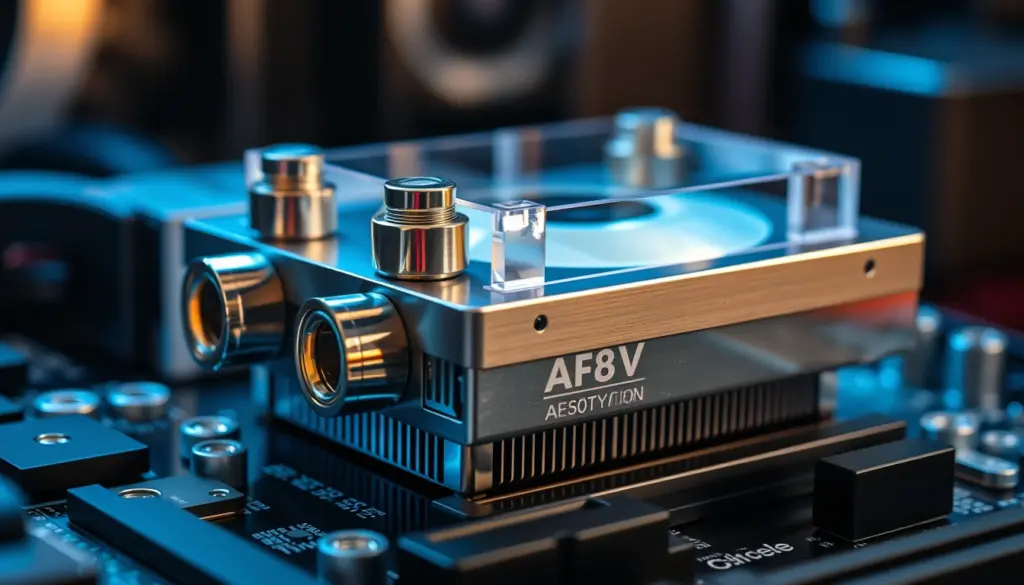
Thermal Grizzly has confirmed its first CPU water block built for Intel’s LGA 1954 socket, a move that puts a real product behind months of chatter about Intel’s next desktop platform. The block, called the Mycro Pro Stainless Steel, lists support for LGA 1700, LGA 1851, and LGA 1954 in a single Intel-focused SKU, according to reports first surfaced on September 24, 2026. A separate AMD version of the same cooler covers AM4 and AM5.
The story was picked up across several hardware outlets, including Wccftech, eTeknix, tech-insider.org, and TechPowerUp, all pointing to the same listing details: a model number, a price, and a socket lineup that quietly confirms LGA 1954 is no longer a rumor sitting in a leaked roadmap. It is a socket real enough that a German cooling manufacturer is already selling parts for it.
Thermal Grizzly Confirms Its First LGA 1954 Water Block
Water block makers usually wait until a socket ships before committing tooling to it. Building a cold plate and mounting mechanism for a socket that doesn’t exist yet is expensive, and getting the mounting pressure or hole spacing wrong means a recall. Thermal Grizzly’s decision to list LGA 1954 support now, ahead of any confirmed Intel launch event, is the clearest signal yet that the socket’s physical dimensions are locked.
The product itself isn’t new. The Mycro Pro Stainless Steel line has been part of Thermal Grizzly’s catalog for a while, sold as a compact water block aimed at small-form-factor builds and custom loops that need a slim cold plate rather than a tower cooler. What changed is the socket list printed on the box. Reports place the specific SKU as Mycro Pro Stainless Steel Intel 1700/1851/1954, model number TG-MY-P-ST-002, with LGA 1954 now sitting alongside the two sockets Intel already shipped this generation.
That combination matters. LGA 1700 covers Alder Lake through Raptor Lake Refresh. LGA 1851 covers Arrow Lake. LGA 1954, according to the reports, is tied to Nova Lake-S, the desktop platform Intel has been previewing in fragments for most of 2026. Cramming all three into one part tells buyers this cooler is meant to survive at least one more socket transition without a repurchase.
What Is the Mycro Pro Stainless Steel, and Why It Ships Now
Thermal Grizzly built its name on thermal paste before expanding into full water-cooling components, and the Mycro Pro Stainless Steel sits in its mid-tier cooling lineup. Enthusiasts building custom loops for compact cases have used earlier Mycro Pro revisions specifically because the block’s footprint and stainless steel top plate fit tight clearances that bulkier blocks can’t.
Releasing an LGA 1954-ready version now, months before Intel is expected to formally launch Nova Lake-S, is a bet that early adopters and system builders will want a cooling path ready on day one. It also protects Thermal Grizzly’s retail shelf space. If a rival cooling brand ships 1954 support first, it captures the pre-order crowd that reads specs sheets before a CPU is even benchmarked.
Reading the Model Number
The TG-MY-P-ST-002 designation follows Thermal Grizzly’s existing naming pattern for the Mycro Pro line, with “ST” pointing to the stainless steel top and “002” marking it as a revised version rather than a brand-new product family. That detail supports the idea that this is a running change to an existing water block rather than a ground-up redesign, which lines up with how most cooling vendors handle new-socket support: swap the mounting bracket and cold plate contact area, keep the rest of the design intact.
Inside the Specs: Sockets, Pricing, and What’s Confirmed
Here is what the gathered reporting actually confirms, without the extrapolation that tends to creep into leak coverage once a story starts circulating.
| Detail | Confirmed value |
| Manufacturer | Thermal Grizzly |
| Product name | Mycro Pro Stainless Steel |
| Intel SKU | Mycro Pro Stainless Steel Intel 1700/1851/1954 |
| Model number | TG-MY-P-ST-002 |
| Intel socket support | LGA 1700, LGA 1851, LGA 1954 |
| AMD socket support (separate SKU) | AM4, AM5 |
| Price (Intel version, VAT included) | $116.88 |
| Reported release date | September 23, 2026 (per one listing) |
| Headline report date | September 24, 2026 |
Everything in that table traces back to a retail or press listing. Details that circulated alongside the story, like a claimed 0.2mm fin pitch or a specific microfin count, come from social media posts rather than an on-record Thermal Grizzly statement, so treat those figures as unverified until the company publishes its own spec sheet.
Why LGA 1954 Signals Nova Lake-S Is Getting Real
Socket names tend to leak long before the chips that use them. Motherboard vendors need to finalize PCB layouts, case makers need mounting-hole specs, and cooler manufacturers need to know pin count and heat spreader dimensions before they can cut a single prototype. When a cooling company starts shipping retail product for a socket, it means those specs have been locked with enough confidence to commit to manufacturing.
That’s a different bar than a leaked slide or a supply-chain rumor. Thermal Grizzly is a company that sells physical parts with dimensional tolerances measured in fractions of a millimeter. Getting the mounting geometry wrong on LGA 1954 would mean returns, bent pins on customer builds, and a hit to a brand whose entire pitch rests on precision. That the company is willing to put its name on an 1954-compatible SKU suggests Intel’s socket dimensions for Nova Lake-S have already been shared with cooling partners under some form of early access. Coverage from outlets like Tom’s Hardware has tracked Intel’s current Core Ultra lineup on LGA 1851, with no official LGA 1954 platform page published yet, which is normal this far ahead of a launch.
It also follows a pattern shattered.io covered earlier this year, when Intel trimmed a 12Xe integrated graphics configuration from the Nova Lake-S stack and pushed it toward a later Razor Lake refresh instead. That reshuffling was itself a sign Intel was still actively tuning the platform’s lineup months before launch, which makes the appearance of finished cooling hardware now a useful marker of how close the socket spec actually is to final.
What’s Confirmed vs. What’s Still a Rumor
Some reports tie a Q1 2027 window to Nova Lake-S’s desktop launch, but that date has not been confirmed by Intel in any of the sources reviewed here. Treat it as an estimate circulating in the enthusiast press rather than an official date. The same caution applies to detailed die specs, core counts, or clock targets for Nova Lake-S. None of that is locked down in verifiable reporting yet, and a cooling block shipping early doesn’t tell us anything about the chip’s actual performance.
AMD Compatibility: Thermal Grizzly Isn’t Picking Sides
The same Mycro Pro Stainless Steel line also ships in an AMD-specific version covering AM4 and AM5, which is worth noting because it shows Thermal Grizzly treating both platforms as active markets rather than favoring one ecosystem. AM4 has stayed alive far longer than AMD originally planned, and AM5 remains the current platform for Ryzen desktop chips, so keeping both in the lineup protects sales across budget builders still on older AM4 boards and buyers upgrading within AM5.
That dual-socket strategy also reads as a hedge. If Nova Lake-S slips or launches to a lukewarm reception, Thermal Grizzly still has steady AM4 and AM5 demand to fall back on. Cooling vendors rarely bet an entire product line on one platform’s success, and this release is no exception.
Pricing Breakdown: $116.88 in a Cooling Market Under Pressure
At $116.88 including VAT, the Intel version of the Mycro Pro Stainless Steel sits in premium water-block territory, the kind of price that assumes a buyer is already committed to a custom loop rather than shopping for an all-in-one cooler. That price lands at a time when component costs across the PC hardware market are climbing for reasons that have nothing to do with cooling at all.
Memory prices have been the biggest driver. shattered.io reported that memory now accounts for a large share of the total bill of materials on budget phones and laptops, and that same pressure has pushed through to PC components broadly. Wafer costs are also expected to climb, with reports pointing to a possible 40% surge in silicon wafer prices heading into 2027 as AI chip demand eats into foundry capacity that used to go toward consumer parts. A $116.88 water block doesn’t use exotic silicon, but every manufacturer in the PC space is watching input costs rise across stainless steel, copper, and the acetal or aluminum used in mounting brackets.
GPU pricing tells a similar story. The RTX 5090 has effectively vanished from US retail shelves, with resale prices reported near $9,500, and AMD has separately signaled a possible 10% price increase across parts of its lineup, though it has reportedly kept Ryzen desktop chips out of that increase for now. A cooling accessory priced under $120 looks almost restrained next to those numbers, but it still moves in the same direction: up.
How This Compares Across Thermal Grizzly’s Socket Support
The clearest way to see what Thermal Grizzly actually shipped is to line up the two SKUs side by side. The Intel version spans three full socket generations in one part. The AMD version spans two.
| SKU | Sockets covered | Platform generations spanned |
| Mycro Pro Stainless Steel Intel 1700/1851/1954 | LGA 1700, LGA 1851, LGA 1954 | Alder Lake/Raptor Lake through Arrow Lake to Nova Lake-S |
| Mycro Pro Stainless Steel AMD (AM4/AM5) | AM4, AM5 | Ryzen 1000-series through current Ryzen AM5 chips |
Three-socket Intel compatibility in a single retail SKU is not a small engineering choice. It means the mounting bracket has to accommodate different hole spacing across generations, likely through a swappable backplate or adjustable standoffs rather than one fixed frame. That kind of multi-socket design has become close to standard practice among premium water-block makers precisely because socket transitions have accelerated. Buyers no longer expect to keep a cooler across a single CPU generation. They expect it to last two or three.
Historical Context: Cooling Makers Chasing Socket Changes
This isn’t the first time a cooling vendor has had to scramble ahead of a socket transition. When Intel moved from LGA 1200 to LGA 1700 with Alder Lake in late 2021, air and water cooler makers spent months shipping adapter kits and bracket updates because the new socket’s mounting holes didn’t match the previous standard. The same thing happened when AMD moved from AM4 to AM5 in 2022, a jump that also changed the socket from a pin-grid array to a land-grid array design, forcing an even bigger mechanical rework across the cooling industry, a shift covered extensively by outlets like AnandTech at the time.
What’s different with LGA 1954 is the timing. In past transitions, cooler compatibility tended to arrive after the CPU launched, sometimes with early adopters stuck waiting weeks for a proper bracket. Thermal Grizzly listing 1954 support ahead of any confirmed Nova Lake-S launch flips that sequence. It suggests cooling vendors have learned that being first to market with new-socket support is now a competitive differentiator worth chasing before the underlying chip even ships.
Motherboard and Case Compatibility Questions Buyers Are Asking
A cooler shipping ahead of the platform raises the obvious follow-up question: what motherboards will actually use LGA 1954? None of the sources reviewed here confirm specific board partners or chipset names tied to the socket. That’s normal at this stage. Motherboard vendors typically hold their own announcements until closer to a CPU’s retail launch, both for competitive reasons and because board layouts can still shift during validation.
Builders planning around a future LGA 1954 system should also factor in the socket and platform changes shattered.io has tracked across Intel’s recent generations. The shift from Intel’s Core Ultra X9 desktop parts, arriving as ARM-based chips grab a record share of the broader PC market, shows Intel isn’t just competing against AMD anymore. Every socket decision Intel makes now also has to account for a market where non-x86 options are gaining real traction with OEMs.
Market Impact: What This Means for DIY Builders and OEMs
For DIY builders running custom loops, the practical impact is straightforward: there is now at least one confirmed cooling option that won’t need replacing if they upgrade into Nova Lake-S down the line. That matters more than it sounds, because water blocks aren’t cheap to swap. A buyer investing $116.88 in a block wants assurance it survives past a single CPU generation, and Thermal Grizzly’s three-socket Intel SKU delivers exactly that assurance on paper.
For OEMs and system integrators, the signal is different. Component vendors watch what accessory makers are tooling for as an informal leading indicator of platform timing. A finished, retail-ready cooling SKU for LGA 1954 tells system builders that whatever Intel is planning, it’s far enough along that peripheral vendors are comfortable committing manufacturing runs to it. That tends to accelerate planning cycles across the rest of the supply chain, from case manufacturers checking clearance dimensions to power supply vendors confirming connector needs.
It’s also worth remembering that cooling demand doesn’t exist in isolation from the rest of the pricing environment. Cooler Master recently tripled the warranty on its GPU Shield adapter to three years, a move that reflects how much scrutiny cooling and mounting hardware is getting industry-wide right now, as buyers hold onto expensive GPUs and CPUs longer and expect the accessories protecting them to last just as long.
Competitive Landscape: Who Else Might Follow
Thermal Grizzly isn’t the only company that makes water blocks for enthusiast builds, and being first to list LGA 1954 support puts pressure on rivals to respond. Cooling brands that sell competing custom-loop parts typically move in lockstep once one vendor confirms new-socket support, both because the underlying mounting geometry becomes public knowledge and because no manufacturer wants to be the last one without a compatible SKU on shelves.
None of the reporting reviewed here names a second manufacturer with a confirmed LGA 1954 product yet, so this remains Thermal Grizzly’s advantage for now. But the pattern from past socket transitions suggests that window closes fast, usually within a few months of the first confirmed part hitting retail.
Predictions: Where LGA 1954 Cooling Support Goes From Here
- Expect at least one rival cooling brand to announce its own LGA 1954-compatible water block or mounting kit within the next two to three months, following the pattern set during the AM4-to-AM5 and LGA 1200-to-1700 transitions.
- Motherboard vendors will likely begin confirming board names and chipset branding for the Nova Lake-S platform before Intel gives a firm launch date, since board partners tend to leak ahead of CPU makers.
- Air cooler manufacturers will follow with bracket kits rather than full redesigns, since LGA 1954 support can often be added to existing tower coolers through a new backplate rather than a new heatsink.
- Pricing on early LGA 1954-compatible cooling gear will likely stay at a premium over equivalent LGA 1851 parts for the first several months, mirroring how new-socket compatible coolers have historically launched above the price of their previous-generation equivalents before competition brings prices down.
- If Nova Lake-S slips past whatever informal timeline circulates in enthusiast press coverage, expect Thermal Grizzly and other cooling vendors to keep selling the same water blocks under their existing LGA 1700/1851 branding, treating 1954 support as a bonus rather than the headline feature, until Intel actually confirms a launch window.
What Buyers Should Actually Do With This News
If you’re building a custom loop today and want a cooler that survives into whatever Intel ships next, the Mycro Pro Stainless Steel Intel 1700/1851/1954 is a reasonable buy on socket coverage alone. If you’re on AMD, the AM4/AM5 version offers the same long-term reasoning without any need to wait on Intel’s roadmap at all.
What buyers shouldn’t do is treat this cooler as confirmation of Nova Lake-S specs, pricing, or a launch date. A water block fitting a socket only confirms the socket’s physical dimensions, not the chip’s performance, core count, or release window. Those details remain, for now, outside what any verified report has confirmed.
Frequently Asked Questions
What is the Thermal Grizzly Mycro Pro Stainless Steel?
It’s a compact CPU water block from Thermal Grizzly, sold in separate Intel and AMD versions, aimed at custom-loop builders who want a slim cold plate for tight case clearances.
Which sockets does the Intel version support?
Reports confirm LGA 1700, LGA 1851, and LGA 1954 support in the SKU listed as Mycro Pro Stainless Steel Intel 1700/1851/1954, model number TG-MY-P-ST-002.
Does Thermal Grizzly make an AMD version?
Yes. A separate Mycro Pro Stainless Steel SKU covers AMD’s AM4 and AM5 sockets.
How much does the Intel version cost?
Reports put the price at $116.88, including VAT, for the Intel LGA 1700/1851/1954 version.
What is LGA 1954 for?
LGA 1954 is the socket associated in current reporting with Intel’s upcoming Nova Lake-S desktop platform, though Intel has not published an official socket confirmation as part of the sources reviewed here.
When is Nova Lake-S launching?
Some reports mention a possible Q1 2027 window, but that date is not confirmed by Intel and should be treated as an estimate rather than a fact.
When was the water block released?
One listing reported a September 23, 2026 release date, with the broader story reported across outlets on September 24, 2026.
Should I buy an LGA 1954-compatible cooler now if I don’t own a Nova Lake-S CPU yet?
If you’re already shopping for a premium water block and want socket longevity, it’s a reasonable purchase. If you’re waiting specifically for Nova Lake-S, it’s worth holding off until Intel confirms official platform details rather than buying cooling hardware as a proxy for CPU specs.