
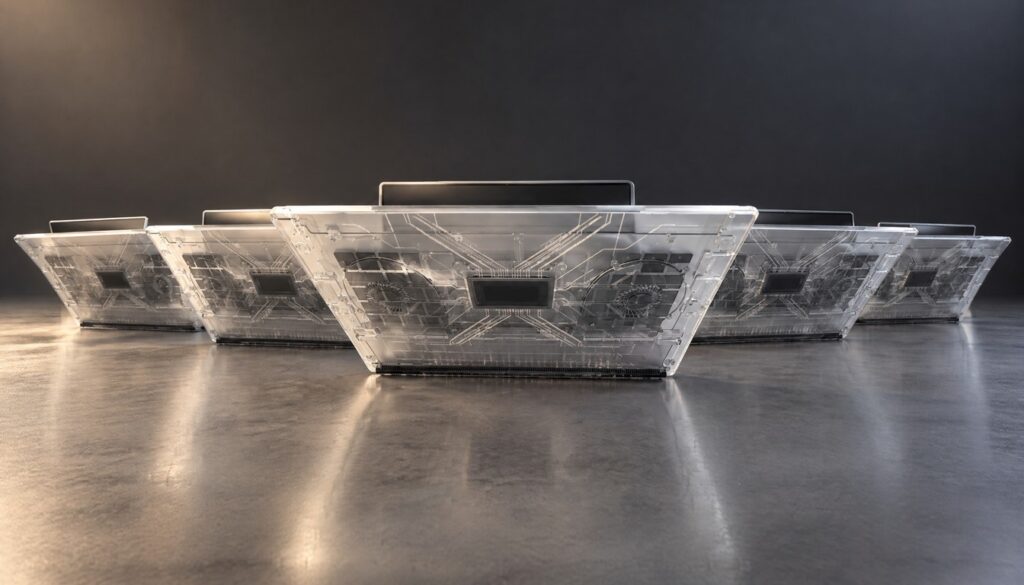
NVIDIA is taking its newest AI PC chip out of the keynote hall and onto a public sidewalk. The company confirmed it will host a free, open-to-the-public “RTX Spark Launch Celebration” in Berlin on October 16, 2026, the same day RTX Spark laptops begin shipping to retail. The venue is XPERION, the events space built into the Saturn electronics store at Alexanderplatz 3, and anyone 18 or older can walk in after registering through Luma.
The event matters beyond the free swag. It is the clearest sign yet that NVIDIA wants RTX Spark treated less like a workstation component and more like a flagship consumer product, with a launch party, a celebrity-adjacent raffle, and stage time for a major game studio. TechPowerUp first reported the Berlin plans, and German outlets including Hardwareluxx and GamesMarket confirmed the details separately.
This is a breaking story moving fast, and several of the specifics below (raffle mechanics, total capacity, any additional speakers) have not been finalized in NVIDIA’s public materials as of October 10, 2026. We will note clearly where a detail comes from NVIDIA directly versus where it comes from outlet reporting.
NVIDIA Turns a Chip Launch Into a Street Party
Chip launches rarely come with a guest list and a queue. NVIDIA’s decision to throw a public party for RTX Spark signals the company sees this product differently than past professional-grade silicon drops. The RTX Spark Superchip is being pitched to ordinary PC buyers, not just AI researchers, and the Berlin event is built to put that pitch in front of regular shoppers walking through one of the city’s busiest retail corners.
NVIDIA has framed the broader RTX Spark platform as, in the company’s words, “a new beginning for Windows PCs.” That positioning lines up with how the Berlin event is structured: fewer slides, more hands-on demo stations, and a stage show built for an audience that showed up after work rather than analysts filing into a conference room. The approach also tracks with how NVIDIA already sells RTX Spark laptops through mainstream partners rather than enterprise-only channels, a rollout we covered when the first six PC makers confirmed shipping dates.
Where and When: XPERION, Alexanderplatz, October 16
The location is specific and symbolic. XPERION sits inside the Saturn electronics store at Alexanderplatz 3, one of the highest-foot-traffic retail blocks in Berlin and a short walk from the city’s iconic TV Tower. Running the event inside an electronics retailer rather than a convention center lets NVIDIA put working hardware directly in front of walk-in shoppers, not just press and partners.
Capacity is limited, particularly for the stage program, so arrival time matters. The queue is scheduled to open at 18:00 local time, with doors and the main program beginning at 18:45. Attendees need to be 18 or older to enter, a restriction tied to the venue’s alcohol service rather than anything specific to the hardware on display.
How to Get In: Registration, Queue Times, Age Limit
Entry is free, but NVIDIA is requiring advance registration through Luma, the event-ticketing platform that has become a default tool for tech meetups and launch events. That requirement gives NVIDIA a headcount ahead of time and lets the company manage the limited stage-area capacity without turning away a crowd at the door.
The practical advice from outlets covering the event is straightforward: register early through Luma, and get in the queue well before the 18:00 opening if the stage show matters to you. NVIDIA has not published a hard attendee cap, but the “limited capacity” language applies specifically to the performance area inside XPERION, not the demo stations, which should stay open to walk-up visitors for longer.
Who’s on Stage: Creators, a Raffle, and CD Projekt Red
NVIDIA’s named program lineup includes creators AlexiBexi, FalcoPunch, and Alex Wätzel, alongside a stage appearance from CD Projekt Red, the Polish studio behind The Witcher 3 and Cyberpunk 2077. Pairing an AI-chip launch with a major game studio is not accidental. NVIDIA wants RTX Spark seen as capable of both local AI workloads and modern PC gaming, and a studio currently riding the wave of The Witcher 3 Remastered’s continued release push gives the pitch a recognizable face.
On-site activities center on hands-on demo stations covering AI creative tools, agent workflows, and games, letting attendees try RTX Spark hardware rather than just watch it on a screen. That hands-on emphasis matters for a chip NVIDIA is still introducing to a mainstream audience that mostly knows the brand for graphics cards, not unified-memory AI processors.
The Raffle: Five Jensen Huang-Signed ASUS ProArt Laptops
The single detail generating the most buzz around the Berlin event is the raffle. NVIDIA is giving away five ASUS ProArt P14 laptops personally signed by founder and CEO Jensen Huang. ASUS has already positioned its ProArt line as one of the earlier adopters of the RTX Spark platform, a push detailed in our report on the ProArt RTX Spark hitting 128GB of unified memory, and the signed units turn a standard giveaway into a collectible for NVIDIA’s fan base.
NVIDIA has not published exact raffle rules, entry mechanics, or the total attendance it expects, so attendees should confirm specifics on-site rather than assume standard sweepstakes terms. What is confirmed is the prize itself and that it is tied to the RTX Spark launch specifically rather than a general NVIDIA promotion.
What the RTX Spark Superchip Actually Is
RTX Spark is NVIDIA’s branding for a combined CPU-and-GPU platform built to run generative AI workloads locally on a Windows PC instead of routing them through the cloud. NVIDIA calls it the NVIDIA RTX Spark Superchip, and the company has pitched it jointly with Microsoft as a foundation for what both companies describe as the age of personal AI, detailed in NVIDIA’s official announcement with Microsoft.
The pitch is simple even if the engineering is not: let a laptop or small desktop run AI agents and large models directly on the device, using a large shared memory pool instead of bouncing data between separate system RAM and graphics memory. NVIDIA is betting that on-device AI, not another cloud subscription, is what convinces PC buyers to upgrade next.
Inside the Hardware: CUDA Cores, Grace CPU, Unified Memory
The top RTX Spark configuration pairs an NVIDIA Grace CPU with a Blackwell-based RTX GPU sharing one pool of unified memory, connected by NVIDIA’s NVLink-C2C interconnect. Tom’s Hardware’s coverage of the Computex unveiling put the headline numbers at up to 6,144 CUDA cores, a 20-core Grace CPU, and as much as 128GB of unified memory, with NVIDIA citing a ceiling of roughly one petaflop of FP4 AI performance.
That memory ceiling is the number NVIDIA keeps repeating because it determines how large a model a given machine can actually run. Reports on configurations tied to Microsoft’s own hardware push describe Surface Laptop Ultra models shipping with the full 128GB variant, aimed at buyers who want to run models in the 100-billion-parameter-plus range locally rather than through a hosted API.
RTX Spark Launch Celebration at a Glance
| Detail | Confirmed Information |
|---|---|
| Event name | RTX Spark Launch Celebration |
| Date | October 16, 2026 |
| Venue | XPERION, inside Saturn, Alexanderplatz 3, Berlin |
| Access | Public, free entry, 18+ only |
| Registration | Required in advance via Luma |
| Queue opens | 18:00 local time |
| Doors / program begins | 18:45 local time |
| Stage program | AlexiBexi, FalcoPunch, Alex Wätzel, CD Projekt Red |
| Raffle prize | Five Jensen Huang-signed ASUS ProArt P14 laptops |
| RTX Spark laptops on sale | October 16, 2026 |
| RTX Spark compact desktops | November 2026 |
From Computex Reveal to Retail Shelf: A Five-Month Sprint
RTX Spark’s path to the Berlin party started well before October. NVIDIA first unveiled the platform at Computex in Taipei, then gave it a second, more consumer-facing moment at IFA in Berlin in early September. Laptop preorders opened October 7, with retail availability landing October 16, the exact date of the XPERION event. That sequencing is not a coincidence. NVIDIA scheduled the public celebration to land the same week buyers can actually walk out of a store with the hardware, rather than hosting a party for a product still weeks away.
The compressed timeline also explains some of the market jitters around rival chipmakers. Intel’s stock took a hit as RTX Spark coverage intensified, a reaction we tracked when Intel shares dropped 2.6% on RTX Spark momentum. Whether that pressure holds past launch week depends heavily on how the retail rollout performs, not just how the Berlin crowd reacts.
NVIDIA has moved through this launch in distinct phases rather than one single announcement. The Computex reveal established the specs and the Grace-plus-Blackwell architecture. The IFA appearance in September gave European press and partners a second, more polished look. Preorders opening October 7 gave retailers a soft-launch window to gauge demand before the hard October 16 release date. The Berlin party caps that sequence with a consumer-facing event rather than another trade-show briefing, a pattern that lets NVIDIA keep RTX Spark in the news cycle for months instead of one announcement day.
Laptops First, Desktops in November
NVIDIA is staggering the rollout by form factor. Laptops ship first, timed to the October 16 date and the Berlin event. Compact desktops built around the same RTX Spark Superchip follow in November 2026, giving NVIDIA and its partners a second wave of coverage and retail attention roughly a month later.
That gap also buys NVIDIA time to read early laptop sales and adjust desktop messaging accordingly. If the Berlin-style public launch event draws strong turnout and press coverage, expect a similar consumer-facing push for the desktop wave rather than a quiet enterprise-channel release.
RTX Spark vs. the Competition
RTX Spark does not launch into an empty field. NVIDIA’s own DGX Spark, a separate workstation-class product, already sells at $4,999 for a 64GB configuration and $6,950 for 128GB, a split we broke down when NVIDIA confirmed the two-tier pricing. RTX Spark targets a cheaper, more mainstream laptop and compact-desktop buyer, leaving DGX Spark as the higher-priced option for developers who want a dedicated AI workstation rather than a daily-driver laptop.
AMD is not standing still either. The company’s Gorgon Halo platform has been benchmarked directly against RTX Spark hardware, with results we examined in our coverage of AMD’s answer to NVIDIA’s AI PC push. Intel, meanwhile, is defending its Xeon 6 lineup against the same RTX Spark narrative that has already dented its stock price. The net effect is a three-way fight over who defines what an “AI PC” even means heading into 2027.
RTX Spark vs. Key Alternatives
| Platform | Target Buyer | Notable Spec | Reported Price Point |
|---|---|---|---|
| NVIDIA RTX Spark (laptop) | Mainstream AI PC buyers | Up to 6,144 CUDA cores, 128GB unified memory | Varies by OEM; ships Oct. 16, 2026 |
| NVIDIA DGX Spark (64GB) | Developers, AI workstations | 64GB unified memory | $4,999 |
| NVIDIA DGX Spark (128GB) | Developers, larger local models | 128GB unified memory | $6,950 |
| AMD Gorgon Halo | AI-capable gaming and productivity laptops | Competing unified architecture, benchmarked against RTX Spark | Not directly comparable; OEM-dependent |
| Intel Xeon 6 | Enterprise and workstation CPUs | Traditional CPU-first architecture | Enterprise pricing, not consumer retail |
Why NVIDIA Is Selling an AI Chip Like a Console Launch
NVIDIA built its consumer brand on GeForce graphics cards, and GeForce launches have always leaned on hype events, influencer demos, and giveaways. Applying that same formula to RTX Spark is a deliberate choice to make an unfamiliar product category feel familiar. Most shoppers understand “faster graphics card.” Far fewer understand “unified-memory AI superchip,” so NVIDIA is borrowing a marketing playbook its audience already trusts.
The goodie-bag detail reinforces that strategy. Attendees are set to receive a six-month GeForce NOW Ultimate membership, a perk tying the AI-chip launch back to NVIDIA’s existing cloud-gaming subscription business rather than treating RTX Spark as an isolated enterprise product. NVIDIA is also reportedly lighting Berlin’s TV Tower in its signature green for the night, a stunt aimed squarely at social-media visibility rather than technical buyers.
Market Impact: AI PCs Get a Consumer Marketing Playbook
The Berlin event is small in scale but large in signal. If NVIDIA can turn a chip launch into a line outside an electronics store, it validates a template every PC-chip rival will feel pressure to copy. That changes the competitive fight from a spec sheet comparison into a battle over who can make their silicon feel exciting to a non-technical buyer standing in a retail aisle.
It also puts pressure on OEM partners. ASUS, Dell, HP, Lenovo, Microsoft Surface, and MSI are all shipping RTX Spark hardware at or near the October 16 date, with Acer and GIGABYTE expected to follow. Every one of those brands now has a stake in whether the Berlin-style launch energy translates into actual retail traffic once the laptops hit shelves across Europe and beyond.
For the broader hardware market, the stakes go past one product. If RTX Spark laptops sell well off the back of a public event rather than enterprise procurement cycles, it reshapes how every chipmaker budgets for consumer marketing versus trade-show spend going into 2027. A single Berlin night becomes a data point in a much larger argument about who actually drives AI PC adoption: IT departments, or walk-in shoppers at a Saturn store.
Historical Context: NVIDIA’s Long March Into Windows PCs
NVIDIA has sold graphics hardware into Windows PCs for decades, but RTX Spark marks a different kind of push: putting NVIDIA’s own branded CPU-GPU combination at the center of the machine rather than supplying just the graphics component. The Grace CPU lineage traces back to NVIDIA’s data-center ambitions, first built to pair with server-class GPUs rather than consumer laptops.
Bringing that architecture down to a 14-to-16-inch laptop chassis is a bet that the AI-PC category, which has mostly meant modest on-device chatbot features so far, is about to demand far more local compute. NVIDIA is betting that bet is worth a street party in Berlin.
What Comes Next: Five Predictions for RTX Spark
- Expect NVIDIA to replicate the Berlin format in at least one or two other major cities once November’s desktop wave approaches, given how cheap a retail-store activation is relative to a full press keynote.
- Watch for AMD and Intel to respond with their own public-facing AI PC demos rather than purely technical briefings, following the template NVIDIA is testing in Berlin.
- The signed ASUS ProArt P14 raffle units will likely surface on resale and collector markets within weeks of the event, given NVIDIA’s history of signed hardware becoming sought-after memorabilia.
- Retail sell-through data from the first two weeks after October 16 will shape how aggressively NVIDIA markets the November desktop launch.
- Expect continued stock-price sensitivity at Intel and AMD tied to RTX Spark retail headlines, continuing the pattern already visible in recent trading sessions.
FAQ
Is the RTX Spark Berlin launch event free to attend?
Yes. Entry is free and open to the public, though NVIDIA requires advance registration through Luma and limits attendance to guests 18 and older.
Where exactly is the event held?
The RTX Spark Launch Celebration takes place at XPERION, located inside the Saturn electronics store at Alexanderplatz 3 in Berlin.
What time should I arrive?
The queue opens at 18:00 local time, with doors and the main program beginning at 18:45. Arriving before the queue opens is advisable given the venue’s limited stage-area capacity.
Do I need a ticket?
You need a free registration confirmed through Luma rather than a paid ticket. NVIDIA has not detailed what happens if registration fills up before the event date.
What can I win at the event?
NVIDIA is raffling five ASUS ProArt P14 laptops personally signed by CEO Jensen Huang. Exact entry rules for the raffle have not been published.
When do RTX Spark laptops actually go on sale?
RTX Spark laptops are scheduled for retail availability on October 16, 2026, the same day as the Berlin event. Compact desktops follow in November 2026.
Which PC makers are shipping RTX Spark hardware?
ASUS, Dell, HP, Lenovo, Microsoft Surface, and MSI are among the confirmed partners shipping RTX Spark laptops around the October 16 date, with Acer and GIGABYTE expected to follow.
Is there a similar RTX Spark event planned outside Berlin?
NVIDIA has not announced additional public launch events beyond Berlin as of this writing, though the format could extend to other markets around the November desktop launch.